SVS Ultra Evolution Bookshelf Speaker Review: Do You Need a Subwoofer?
SVS Ultra Evolution Bookshelf Speakers
- Product Name: Ultra Evolution Bookshelf Speakers
- Manufacturer: SVS
- Performance Rating:

- Value Rating:
- Review Date: September 09, 2026 00:00
- MSRP: $ 1,200/pair
- Frequency Response: 40Hz - 40kHz (+/-3 dB)
- Sensitivity: 87dB (2.83V @ 1 meter full-space, 300Hz – 3kHz)
- Nominal impedance: 6 ohms
- Recommended amplifier power: 20 – 150 watts
- Dimensions: 14.88” (H) x 8.66” (W) x 11.25” (D)
- Weight: 18.8 lbs
Pros
- Big, powerful bass
- Pleasing tonal balance
- Excellent build and finish quality
Cons
- Glossy paint shows dust and fingerprints
SVS Ultra Evolution Speaker Introduction
My first encounter with the SVS Ultra Evolution Bookshelf speakers ($1,200/pair) was at T.H.E. Show SoCal 2025, where these flagship 2-way bookshelf speakers immediately challenged my expectations of what an SVS loudspeaker could sound like. Whenever I attend audio shows, there is a constant recalibration process that my brain and ear must undergo when going from room to room. If I just listened to a 7-foot-tall tower speaker driven by hulking monoblocks, walking into a room featuring a pair of 2-way mini-monitors and a desktop-friendly integrated amp obviously requires a different set of expectations. Audio shows also tend to feature lots of very expensive gear, and it should go without saying that a million-dollar system ought to be able to do things that a $10K system can’t. The less-expensive gear may still have a lot to offer, but it probably isn’t going to be an apples-to-apples comparison. So when I entered the SVS room, which was playing the Ultra Evolution Bookshelf speakers mated with the SB-5000 R|Evolution subwoofer ($2K), I was prepared to adjust my expectations accordingly. This was high-value audio, not cost-no-object exotica. But as it turned out, an altogether different recalibration was necessary. Even considering the fact that SVS was using the very capable and not-inexpensive Hegel H400 integrated amplifier ($7,700) in the demo system, the overall sound quality was so impressive that I had to completely reevaluate my understanding of SVS as a brand. While I expected high output and rousing dynamics, I was treated to a level of refinement and sonic sophistication that I had not experienced with earlier generations of SVS products. Later, when I needed a pair of price-appropriate standmount speakers to use for an amplifier review I was working on, the Ultra Evolution Bookshelf speakers immediately came to mind. I’ve now been using the speakers for several months. How do they sound in a more controlled setting, with more familiar gear, and without the assistance of the SB-5000 R|Evolution subwoofer? We’ll get to that, but first let’s examine the design.
SVS Ultra Evolution Bookshelf: Design
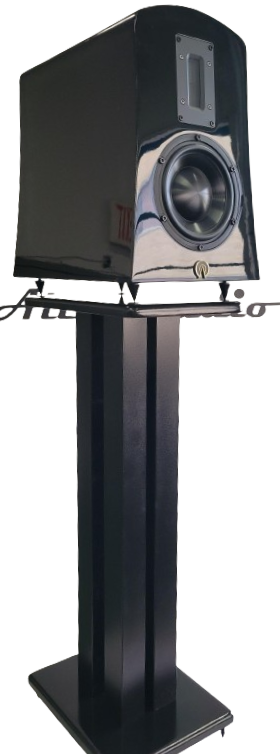
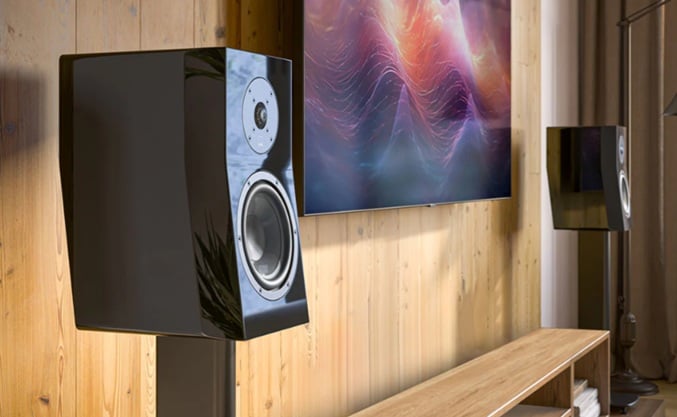
The Ultra Evolution Bookshelf is a ported standmount speaker measuring 14.88 inches tall, 8.66 inches wide, and 11.25 inches deep. At 18.8 pounds each, the speakers feel substantial enough to warrant some relatively beefy stands. Their overall build quality is excellent, and the glossy black painted finish is impeccable, even if it is a fingerprint magnet. Ben, my 13-year-old nephew, said of the Ultra Evolution Bookshelf, “This looks like a speaker Darth Vader would use.” (Then again, Ben has never seen the Alta Audio Alyssa.)
 The
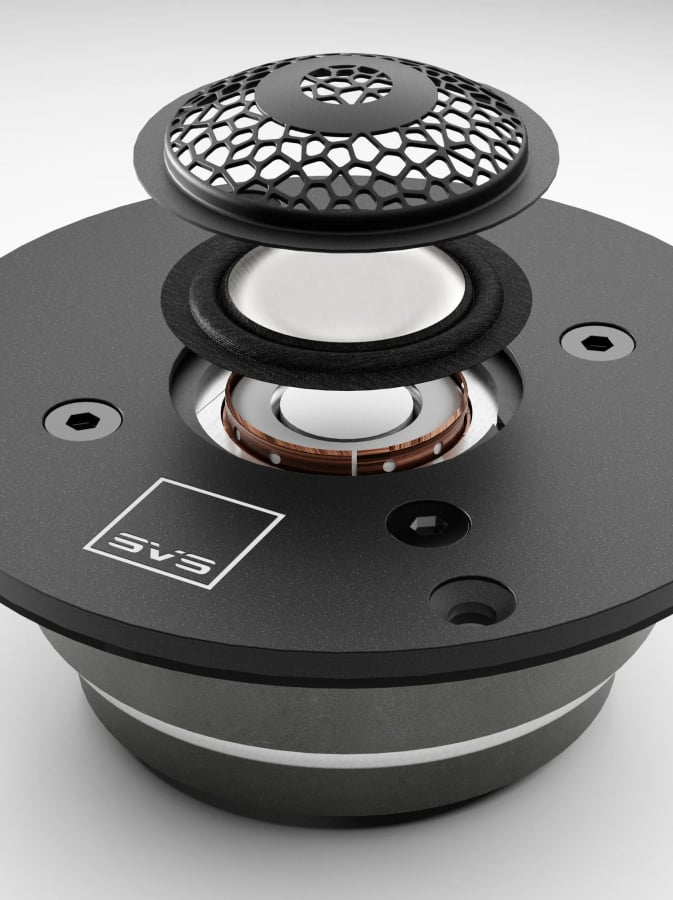
Ultra Evolution Bookshelf speaker features a 6.5-inch mid-woofer and a 1-inch
aluminum dome tweeter with a vapor-deposited diamond-like coating. This coating
vastly improves rigidity and acoustic properties, according to SVS, resulting
in “effortless, airy, and unveiled highs with no measurable distortion.” It
also reportedly extends the low frequency extension of the tweeter, allowing
for more seamless blending with the midrange. An FEA-optimized Organic Cell
Lattice Diffuser protects the dome and employs a semi-random pattern derived
from organic cell structures, which is said to improve off-axis response and
maximize the size of the listening sweet-spot. Silver tinsel leads contribute
optimal signal transfer and power handling, according to SVS.
The
Ultra Evolution Bookshelf speaker features a 6.5-inch mid-woofer and a 1-inch
aluminum dome tweeter with a vapor-deposited diamond-like coating. This coating
vastly improves rigidity and acoustic properties, according to SVS, resulting
in “effortless, airy, and unveiled highs with no measurable distortion.” It
also reportedly extends the low frequency extension of the tweeter, allowing
for more seamless blending with the midrange. An FEA-optimized Organic Cell
Lattice Diffuser protects the dome and employs a semi-random pattern derived
from organic cell structures, which is said to improve off-axis response and
maximize the size of the listening sweet-spot. Silver tinsel leads contribute
optimal signal transfer and power handling, according to SVS.
The mid-woofer’s 6.5-inch composite glass-fiber cone boasts an excellent stiffness-to-mass ratio, resulting in high sensitivity and pistonic behavior beyond the passband, according to SVS. (The crossover is centered at 1.8 kHz.) A long-stroke motor and specially-designed suspension guarantee high output, while cast aluminum alloy baskets ensure precise alignment of critical components and maximize thermal dissipation, according to the company. A vented aluminum voice coil former is said to maximize thermal control while minimizing air compression artifacts at high drive levels.
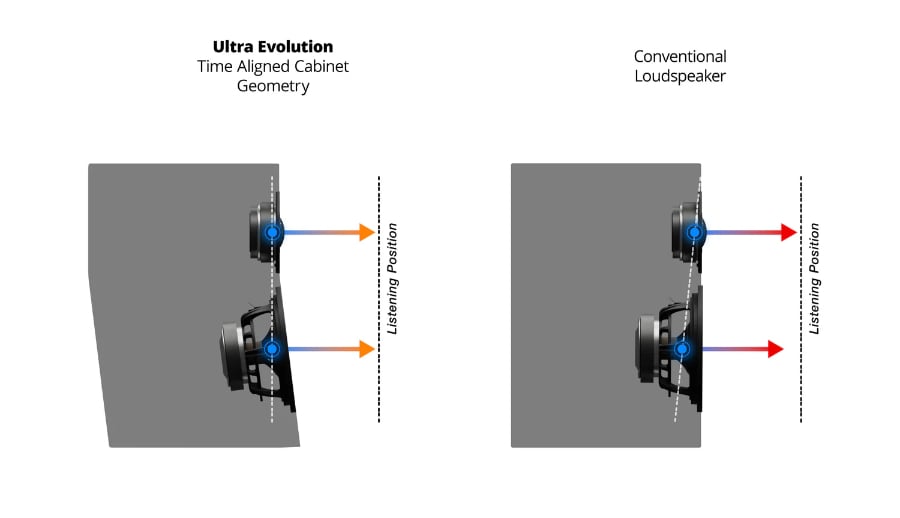
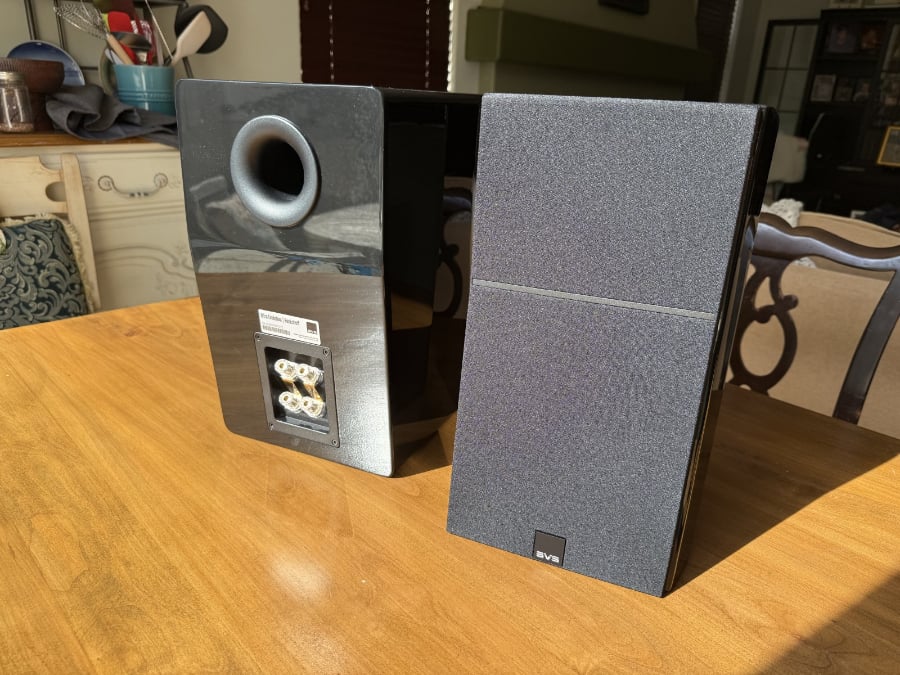
Like the other models in SVS’s flagship speaker range, the Ultra Evolution Bookshelf uses time-aligned cabinet geometry to introduce microsecond-level time delays between the drivers, ensuring that the effective acoustic center of each driver is equidistant from the listener. This results in improved linearity and directionality throughout the crossover frequencies, and a more accurate soundstage, according to the company. Meanwhile, chamfered front baffles and flush-mounted drivers reportedly reduce edge diffraction and improve on-axis and off-axis high-frequency response. The driver baffle is a full inch thick, ensuring a rigid and low-resonance mounting for the drivers. The rest of the FEA-optimized cabinet is ¾ inch thick, and features strategically-placed bracing and acoustic insulation to “eliminate acoustic and structural resonances, ensuring an inert enclosure and an uncolored response, even at the highest drive levels,” according to SVS. The front baffle has a hidden magnetic retention system for the included cloth grilles, but the speakers look better in the buff. Around back, there is a 2-inch-wide flared port.
SVS Ultra Evolution Bookshelf: Setup and System Details
I tested the Ultra Evolution Bookshelf with all three integrated amplifiers that are currently in residence: the NAD M10 V3 ($3,199), the QUAD 3 ($1,895), and the Rotel DX-5 ($1,699). The speakers proved to be relatively easy to drive, and worked well with all three amps. In fact, the 25-watt Rotel turned out to be my favorite partner for the SVS, but that had more to do with my personal preferences than with any objective compatibility issues. I streamed Qobuz using the Cambridge Audio MXN10 streamer, which fed a digital signal via optical Toslink to the Chord Hugo 2 DAC that I currently have on loan from The Sound Organisation. The Hugo was then connected via RCA cables to whichever amp was in use.
The speakers were placed on my Kanto SX26 speaker stands, which are filled with kitty litter for mass damping and additional stability. It is of vital importance that you use an audiophile-quality litter. I promise, your cat can hear the difference even if you can’t! All joking aside, one audiophile tweak that I can recommend is the IsoAcoustics GAIA Neo isolation feet, which have replaced the spikes that came with the Kanto stands. These height-adjustable feet have been critical in enabling me to achieve and maintain stable contact with my uneven floors. The SVS speakers are not especially picky about placement, but it is worth spending a little time dialing them in if you want to wrest the best performance from them. In my room, I ended up with the speakers two feet out from the front wall, 90 inches from my face, and 84.5 inches apart (measured from tweeter to tweeter). The right speaker was 4 feet from the right sidewall, and the left speaker was 3 feet from the partial left wall. Just past the plane of the speaker baffles, a deep rectangular window bay on the left wall adds another 49 inches of horizontal breathing room. After some experimentation, I ended up with the speakers toed in directly toward the listening position such that their side panels were not visible.
SVS Ultra Evolution Bookshelf: Sound Quality
The SVS Ultra Evolution Bookshelf presents music with a sense of acoustic mass and bass heft that I have not experienced from similar designs, giving the speakers an undeniable fun-factor. The low end is thick but quick, adding to the musical body, dynamic punch, and big-scale sound that are this speaker’s hallmarks. Thanks to a midrange that is on the warm side of neutral and a non-fatiguing high end, the overall character is easeful while still being authoritative. Many warm-leaning speakers pay a penalty in the form of a significant reduction in clarity, but that is not the case here. Detail retrieval is very good, if not quite class-leading, and the speaker’s general tonality sounds balanced and proportional, even if it’s not studio-monitor neutral. The smoothness of the treble might come as a surprise to those who think metal dome tweeters all sound the same; this new diamond-coated aluminum dome strikes a fine balance between resolution and fluidity.
Ever since I first heard Matilda Mann’s 2025 single “Inventing” (24-bit/44.1kHz) I have been greedily devouring this young British singer-songwriter’s infectious music at every opportunity. Like many of my favorite artists (The Beatles, Nickel Creek), she can’t be pinned down by a certain sound, and I hear hints of influence from various popular artists, from Fiona Apple to Sara Bareilles to Lizzie McAlpine. Mann’s 2025 album Roxwell (24-bit/48kHz) is a great place to start getting to know her music. The track “Say It Back” describes the singer’s all-consuming state of limerence. Using a driving beat and an almost desperate, Olivia-Rodrigo-esque frustration, the song conveys the incessant and merciless nature of unrequited love. All of this rides on the back of the steady kick-drum beat, which the Ultra Evolution Bookshelf speakers delivered with a gratifying sense of shove, if not the chest-pounding power of a huge tower speaker or good subwoofer, when driven by the QUAD 3 amp.
Curious about just how deep these speakers could go in the bass, I played some test tones. The 40Hz tone was powerful and sounded like a walk in the park for the SVS speakers. The 30Hz tone was quieter but still very present; the 20Hz tone was all but inaudible. Back on Roxwell, the larger-than-life, layered vocals on the track “Tell Me That I’m Wrong” floated completely free of the speaker cabinets when played back on the SVS Ultra Evolution Bookshelf, as if the unembodied 4-foot-wide mouth of a giant ghost were haunting my listening room. This was definitely a memorable moment with these speakers. What stood out most was the fact that the individual components of the song maintained their distinctive characters while combining to create a vast “wall of sound” presentation. The finger-picking of the guitar strings sounded intimate; the pad of synth strings laid a solid foundation; and the vocals were soaked with lush reverb, adding to the romance of the sonic atmosphere.


This ability to present the sensory gestalt of a piece of music while maintaining the textures of individual components turned out to be a strength of the SVS speakers across all genres of music. Olive Klug’s 2025 acoustic folk/Americana album Lost Dog (24-bit/44.1kHz) provided ample opportunities for the Ultra Evolution Bookshelf speakers to shine in this way. Klug’s voice is unusually bright and clear, with very little reverb or processing of any kind on the song “What To Make Of Me.” The speakers had no trouble delivering this “just the facts, ma’am” vocal presentation while simultaneously allowing the high-passed banjo to sound appropriately jangly and metallic, all while the bass sounded plump, rich, and round, like a ripe heirloom tomato. The hint of audible spit in the trumpet solo added some New Orleans flavor to an otherwise more Appalachian sound. Via the SVS speakers, all of these distinct sonic personalities were rendered concurrently, while still presenting the song as a cohesive performance, rather than a bunch of isolated audio tracks.
SVS Ultra Evolution Bookshelf vs. RBH Sound Inspire 5
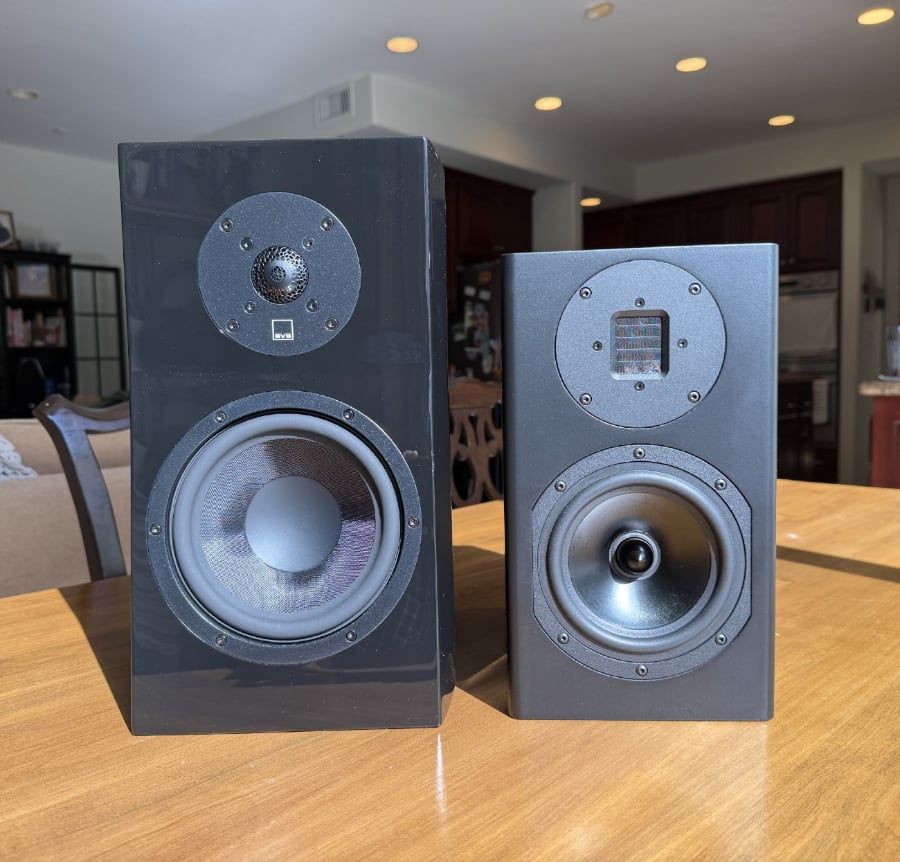
I compared the SVS to two other similarly-priced speakers, starting with the RBH Sound Inspire 5 ($1,200/pair, previously known as the RBH 5-ir). The Inspire 5 features a 5.25-inch aluminum cone mid-woofer and a 1.38-by-1-inch AMT tweeter. Although they cost the same as the SVS speakers, the Inspire 5 is not likely to be cross-shopped with the Ultra Evolution Bookshelf unless you know you’re going to be using a subwoofer (or unless you really don’t know what kind of speaker you’re looking for, which is more common than you might think). The Inspire 5 is much smaller than the SVS, and has very little in the way of bass, though this is by design since most Inspire 5 users likely have a subwoofer in tow. What the RBH lacks in low-end weight, it makes up for with a crisp and airy treble combined with a transparent midrange and a truly neutral-sounding tonality.
The 1975 Paul Simon album Still Crazy After All These Years (24-bit/96kHz) elucidated the relative strengths of the SVS and RBH speakers while highlighting their differences quite effectively, thanks in large part to the album’s fantastic percussion. The song “I Do It For Your Love” has always been a favorite for its moodiness, which is enhanced by Ralph Macdonald’s auxiliary percussion performance. There are woodblocks and a shaker off to the left of the soundstage, tambourine sharing the right of the stage with the electric guitar, and the ping of a triangle coming from the distance. On the RBH speakers driven by the QUAD amp, percussion instruments seemed to focus more on transient attack, whereas the SVS gave them more body, but with slightly less snap. On the whole, the RBH speakers offered more incisive detail in the top end, but this wasn’t always a good thing. The decay of cymbal crashes seemed to have a bit of added hiss from the AMT tweeter, and those same sounds decayed more naturally via the SVS’s diamond-coated dome. That said, the RBH had a more transparent-sounding midrange. Simon’s lead vocal came through with no noticeable coloration on the RBH, whereas the SVS added a slight, euphonic softness. The version of Paul Simon singing through the RBH speakers was drinking ice water and standing a foot away from the mic; the SVS Paul Simon was wearing mittens, drinking hot cocoa, and practically kissing the microphone.
The song “50 Ways To Leave Your Lover” features one of Steve Gadd’s most famous drum performances, which he somehow delivers with meticulous precision and an impossibly groovy rhythmic feel at the same time. The RBH speakers seemed to convey the microsecond timing of Gadd’s snare and hi-hat interplay with more unwavering exactness than the SVS speakers, but when the funky bass kicked in during the chorus, the RBH speakers simply weren’t able to evoke the physicality of the rhythm. The SVS speakers, on the other hand, made me want to crank up the volume and boogie.
There were also notable differences in the speakers’ spatial presentations. Both speakers imaged very well in the center of the soundstage, with a strong phantom center effect. But at the far left and right extremes of the stage, the RBH speakers rendered sounds that were freer of the speaker cabinets. In a direct comparison, the SVS speakers localized some hard-panned sounds to the speaker cabinets, if only slightly. The RBH also scored points for throwing a somewhat wider soundstage, though soundstage depth was a wash. All in all, the RBH speakers seem to offer greater resolution, with a studio-monitor-like tonal balance. The SVS speakers sound smoother, more refined, and substantially more powerful, though perhaps a bit colored. Spatially, the RBH speakers sound more ethereal — almost panel-like in their clarity and out-of-the-box presentation. But also like a panel speaker, the RBH Inspire 5 has limited bass extension and a gossamer-thin weightlessness that can make music sound more distant and therefore less intimate. The SVS speakers sound more corporeal, with fleshier tone and more impact. Given the fact that SVS is perhaps best known as a subwoofer manufacturer, it is amusing to me that the Ultra Evolution Bookshelf speakers do not in any way cry out for a subwoofer. The RBH speakers, in all fairness, are pretty clearly designed to be used with a sub.
SVS Ultra Evolution Bookshelf vs. Fyne Audio F500S
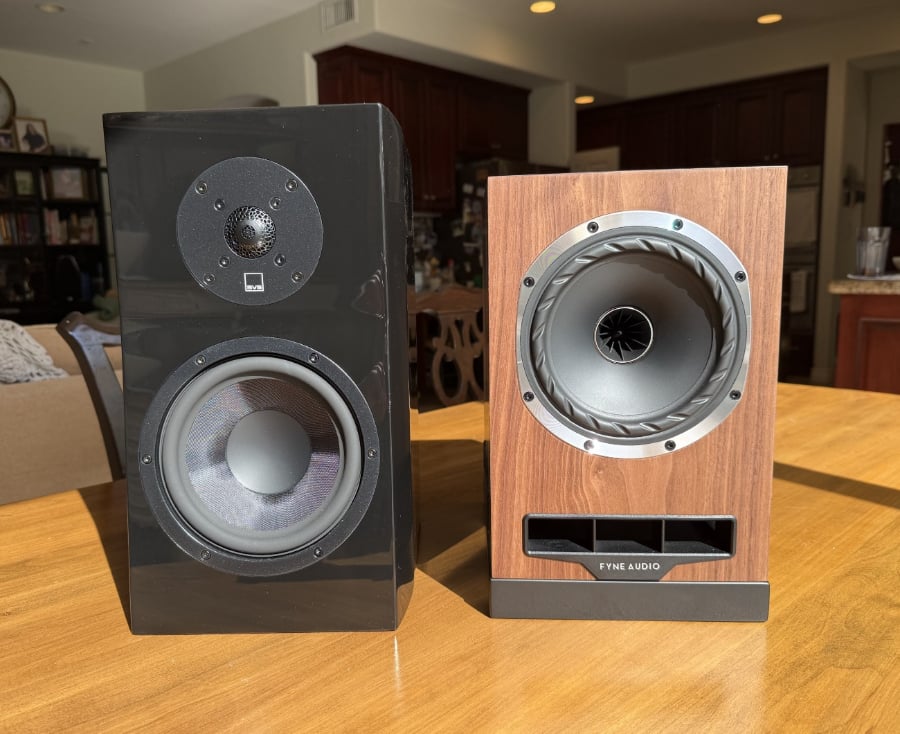
I can almost hear the tiny RBH speakers saying, “Hey man, pick on somebody your own size.” And I did want to see how the SVS Ultra Evolution Bookshelf speakers compared to something at least approaching a similar size. I reached out to the folks at Harmonia Distribution and ended up borrowing a pair of Fyne Audio F500S speakers ($1,299/pair). If you aren’t familiar with Fyne Audio, the UK-based company was founded by a group of former Tannoy employees in 2017, not long after Tannoy’s parent company was sold to an overseas holding company. The F500S is a two-way design featuring Fyne’s concentric IsoFlare point-source driver array, which has a 1-inch magnesium dome compression tweeter mounted in the center of a 6-inch multi-fiber mid-woofer cone.
The F500S is, first and foremost, a very open and revealing-sounding speaker, and it will appeal to those chasing precision and clarity. It throws a soundstage that is notably deeper than that of the SVS speakers (though not quite as wide), with impressive layer separation. The Fyne Audio speakers might be described as more “audiophile” in some ways — the leading edges of notes are more finely rendered than through the SVS, and the presentation is squeegee-clean, revealing inner detail with an immediacy that the SVS speakers don’t quite match. We aren’t talking about major differences, but audiophiles are fond of sweating the details. The Fyne Audio’s microscopic examination of fine detail can be a double-edged sword, however, when the speaker’s extra touch of upper treble bite sinks its incisors into recordings with any trace of harshness. These speakers do nothing to smooth over the rough edges of early Beatles recordings or ‘90s grunge rock. The SVS speakers are more forgiving of variations in recording quality, and are therefore more equal-opportunity when it comes to musical enjoyment across all genres. The result is a somewhat more laid-back (yet no less fun) listening experience with the SVS.
Tonally, the F500S has a definite midrange emphasis, which can be turned up another notch via the presence control on the back panel. This 3-position switch allows for +/- 3dB adjustments covering the upper midrange (2.5 – 5kHz). In my room, the + setting made good-quality acoustic recordings, like Nickel Creek’s 2014 album A Dotted Line, come to life to a startling degree. Via the Rotel DX-5 amp, plucked strings sounded more live than they did on the SVS speakers. Sara Watkins’s lead vocal on “Where Is Love Now” was also more forward in the soundstage and more engaging, thanks to the Fyne speakers’ nuanced way with micro-dynamics — the subtle shifts in energy and texture that make delicate recordings like this feel magical. But on some tracks from the same album, such as “Hayloft,” the Fyne speakers introduced some unwelcome sibilance, and the + position of the presence switch made the overall tonal balance feel too tilted upward, resulting in listening fatigue.

When it comes to macro-dynamic swings, the Fyne speakers sounded reserved and polite compared to the far more muscular SVS speakers, which have a significant advantage in terms of bass extension, weight, and power. The F500S presented the track “Hollywood (feat. Snoop Dogg & Jamie Principle)” from the 2018 Gorillaz album The Now Now (24-bit/44.1kHz) with superb vocal clarity and start/stop speed, delivering the synth bass and drum machine sounds with a pleasingly piquant flavor. But the all-important bass sounded anemic, leaving an impression of a scrawny sound. The SVS speakers offered a much more physical presentation, with a thicker midrange and a more confident and brawny bottom end. The sound didn’t have quite the crystalline clarity of the Fyne speakers, but it was so much larger in scale, it was like comparing a nightclub PA system to a Fisher-Price record player.
Despite a relative lack of bass, the Fyne speakers fought back with their superior stereo imaging across a wider listening area. I shared some listening sessions with my nephew Ben, and later with my dad, who was visiting from North Carolina. This gave me the opportunity to cede the sweet-spot and see how well the soundstage held up when I sat off to one side. The F500S speakers have a few tricks up their sleeves to deliver a wider listening area, namely the aforementioned IsoFlare point-source driver array and a patented BassTrax Tractrix Diffuser applied to the speakers’ down-firing ports. I can’t know exactly how much these features contributed to what I heard, but I can say that, compared to the SVS, the Fyne Audio speakers delivered more even sound dispersion and more stable stereo imaging when I was sitting outside of the traditional sweet-spot. These differences were relatively small, but noticeable. The Fyne speakers were also more engaging to listen to at lower volumes, especially with the presence switch in its + position. Between the SVS and the Fyne Audio speakers, which one you prefer will depend very much on your favorite music, your partnering gear, and your personal preferences. For me, in my room, the Fyne Audio F500S — like the smaller RBH Inspire 5 — would require a good subwoofer to deliver musical satisfaction comparable to what the SVS speakers can provide on their own. That said, the Fyne speakers portray voices and acoustic instruments with a level of sparkle and intimacy that can be addictive.
SVS Ultra Evolution Bookshelf Speakers: Conclusion
I would be remiss if I did not adequately stress the fact that these speakers sound weightier and more substantial than any two-way speaker with a 6.5-inch mid-woofer that I have yet heard anywhere near this price point. In fact, I went through the entire review period under the impression that the Ultra Evolution Bookshelf speakers had an 8-inch mid-woofer, and only realized my mistake when I looked up the specs to write this final draft of my review. I know it’s a cliché, but they really do sound more like a tower than a bookshelf speaker. Beyond their impressive scale and bass presence, the Ultra Evolution Bookshelf speakers have a balanced and endlessly listenable tonality that must be the result of a hundred very skillfully-made decisions and compromises. All loudspeaker engineering involves compromises, especially when cost is being carefully considered.
SVS Ultra Evolution Bookshelf Vs the Competition
I haven’t heard every speaker in this crowded price bracket, and if I were shopping around, I’d certainly want to hear the KEF Q Concerto Meta ($1,400/pair), the Wharfedale EVO 5.2 ($1,300/pair), and the new DALI SONIK 3 ($1,200/pair), just to name a few. I have directly compared the SVS to the Paradigm Premier 220B V2 ($1,100/pair), which offers greater transparency, bass definition, and pinpoint imaging, while the SVS counters with a warmer, fuller presentation and a more fun, forgiving character. I can confidently say, however, that the SVS Ultra Evolution Bookshelf speakers sound as good as anything I have heard in this class, and that their build and finish quality are beyond reproach. Also, I just have a blast listening to music whenever they are in the system. I don’t want to give in to the temptation of hyperbole that can accompany a positive review, and I won’t go so far as to say that these speakers are giant-killers. Although they deliver very good imaging, they don’t disappear from the soundstage quite as convincingly as super-expensive offerings from the likes of YG and Magico, for example. Although I don’t have a pair at home for direct comparison, my recollection is that the PS Audio Aspen FR5 can deliver just as much scale and bass power as the SVS speakers, plus a more open top end and laser-fast transients that are in another league. That speaker also costs three times as much as the SVS, and is much harder to drive. Perhaps you can see where I’m going with this. There’s no such thing as a perfect speaker, and it’s possible that you could find something you prefer over the SVS Ultra Evolution Bookshelf speakers for similar money. But I doubt you’ll find anything that is objectively better without spending significantly more. I currently have no fewer than 7 pairs of bookshelf speakers in residence, and I like all of them for different reasons. When I want to kick back and listen to music just for my own enjoyment, I reach for the SVS Ultra Evolution Bookshelf speakers.
Want to hear what the SVS Ultra Evolution Bookshelf speakers can do in your own system? Enter our FREE giveaway for your chance to WIN a $1,199.98 pair by September 30, 2026 at 11:59 p.m. EDT!
The Score Card
The scoring below is based on each piece of equipment doing the duty it is designed for. The numbers are weighed heavily with respect to the individual cost of each unit, thus giving a rating roughly equal to:
Performance × Price Factor/Value = Rating
Audioholics.com note: The ratings indicated below are based on subjective listening and objective testing of the product in question. The rating scale is based on performance/value ratio. If you notice better performing products in future reviews that have lower numbers in certain areas, be aware that the value factor is most likely the culprit. Other Audioholics reviewers may rate products solely based on performance, and each reviewer has his/her own system for ratings.
Audioholics Rating Scale
 — Excellent
- — Very Good
- — Good
- — Fair
- — Poor
| Metric | Rating |
|---|---|
| Build Quality | |
| Treble Extension | |
| Treble Smoothness | |
| Midrange Accuracy | |
| Bass Extension | |
| Bass Accuracy | |
| Imaging | |
| Dynamic Range | |
| Fit and Finish | |
| Performance | |
| Value | |
Jacob is a music-lover and audiophile who enjoys convincing his friends to buy audio gear that they can't afford. He's also a freelance writer and editor based in Los Angeles.
View full profile Subscribe to our newsletter