


Arendal Sound 1610 Bookshelf 8 Loudspeaker Review
Arendal Sound 1610 Bookshelf 8
- Product Name: 1610 Bookshelf 8
- Manufacturer: Arendal Sound
- Performance Rating:

- Value Rating:
- Review Date: February 11, 2026 00:00
- MSRP: $ 3,600/pair
- Design: Vented 3-Way
- Drivers:
8” Aluminum Woofer
1.1” Aluminum-Magnesium Tweeter
5” Carbon Midrange
- Frequency Linearity:
Frequency Response (anechoic): 47Hz – 20,000Hz +/-2.5dB
F3: 43Hz
F6: 34Hz
F10: 27Hz
- Sensitivity: 85dB / 2.83v / 1m
- Crossover Frequencies: 330Hz / 2300Hz
- Impedance: 4-ohms nominal
- Dimensions (W x D x H): 10.5" x 11.8" x 18.8"
- Weight: 35.8 lbs. (16.2kg)
Pros
- Accurate, balanced tonality
- Wide dynamic range
- Excellent low-frequency extension for a bookshelf speaker
- Outstanding build quality
- Backed by top-notch customer service & 60 day trial period
- 10 year warranty
Cons
- Demanding electrical load requires a stout amplifier
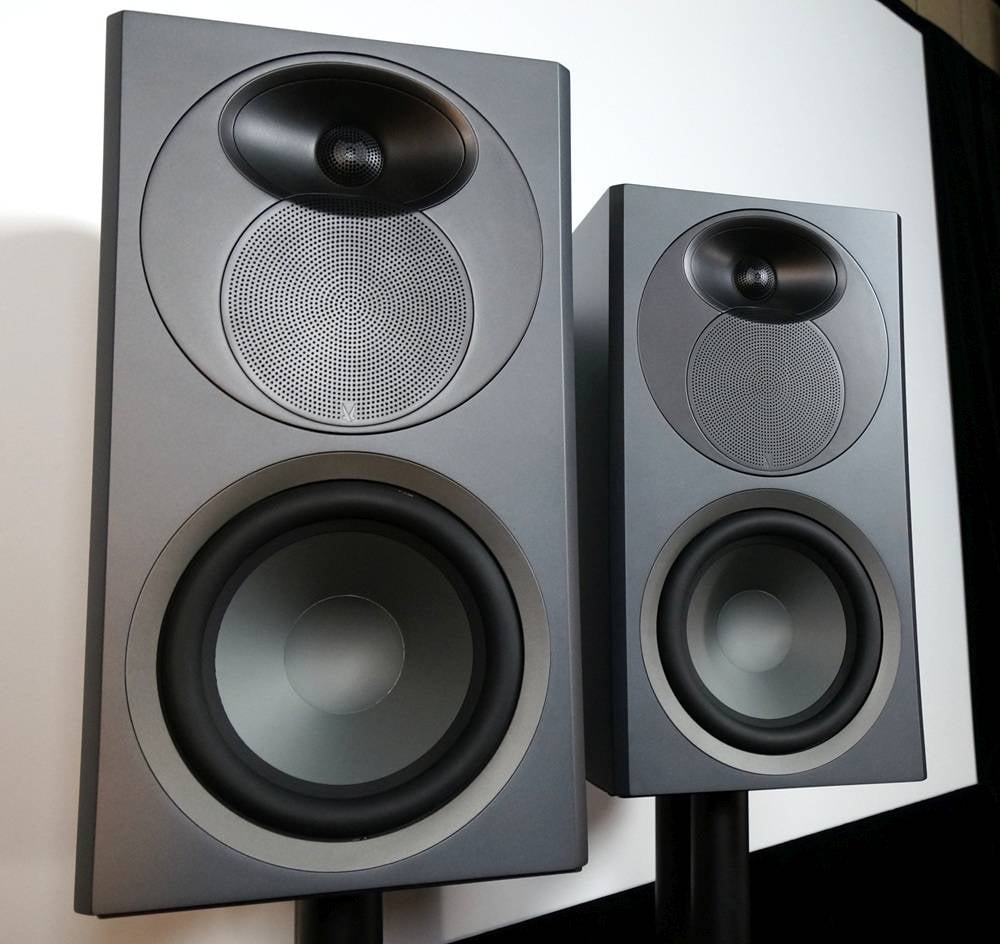
Arendal Sound 1610 Bookshelf 8 Built from 1528 DNA?
We were deeply impressed with Arendal’s physically massive 1528 series over a number of reviews. They showed what Arendal could do when much less constrained by pricing versus the 1723 and 1961 series, and that is really saying something since those series looked and felt a lot more expensive than they really were. They were loudspeaker bargains, and even though the 1528 speakers were considerably more expensive, they are still a whole lot of speaker for the money (both literally and figuratively). However, this leaves a big gap in Arendal’s lineup between the 1723 series and the 1528 series. Arendal’s new 1610 series attempts to fill in this gap. It is priced at a reasonable spacing between the two speaker lines, but it really resembles the 1528 in design and styling. It looks to me like a 1528 made much more affordable. That would be a very good thing indeed, providing that it can give much of what the 1528s are capable of without sacrificing a whole lot - but is that the case? That is the question we will try to answer in today’s review of the 1610 Bookshelf 8 standmount loudspeaker.
Arendal Sound 1610 Bookshelf 8 Packing and Appearance
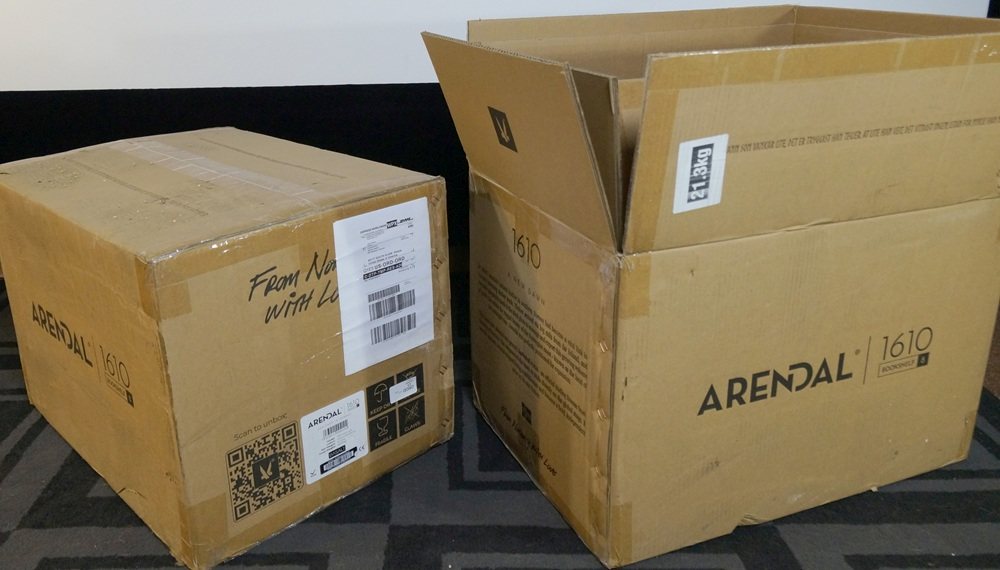
As with all the other Arendal products we have experienced, the 1610 Bookshelf 8 speakers had excellent packing, but they need to, since they are fairly heavy for their size and can only be had through parcel shipping services. The speakers arrived double-boxed. They weren’t just sandwiched by top and bottom foam pieces as with so many other speakers; the entire speaker was shielded by closed-cell foam. The speaker was wrapped in a soft polyester-cotton drawstring sack that was stamped with Arendal’s logo. Arendal also included a pair of cotton inspection gloves so the speakers can be unpacked without getting fingerprints all over them. Overall, the speakers are well-protected against the usual abuses of major parcel shipping companies.
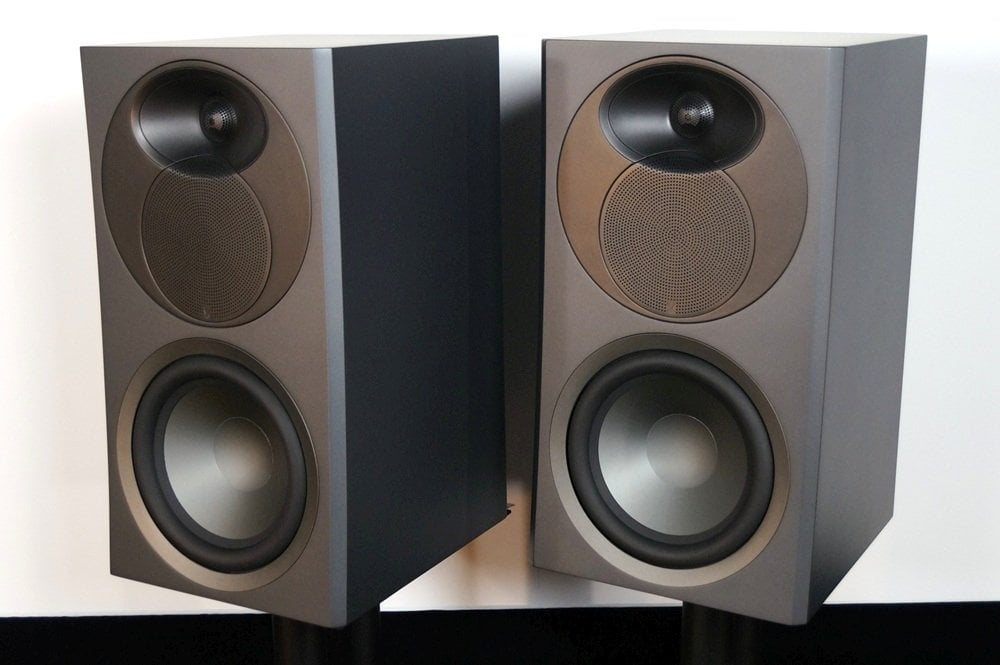
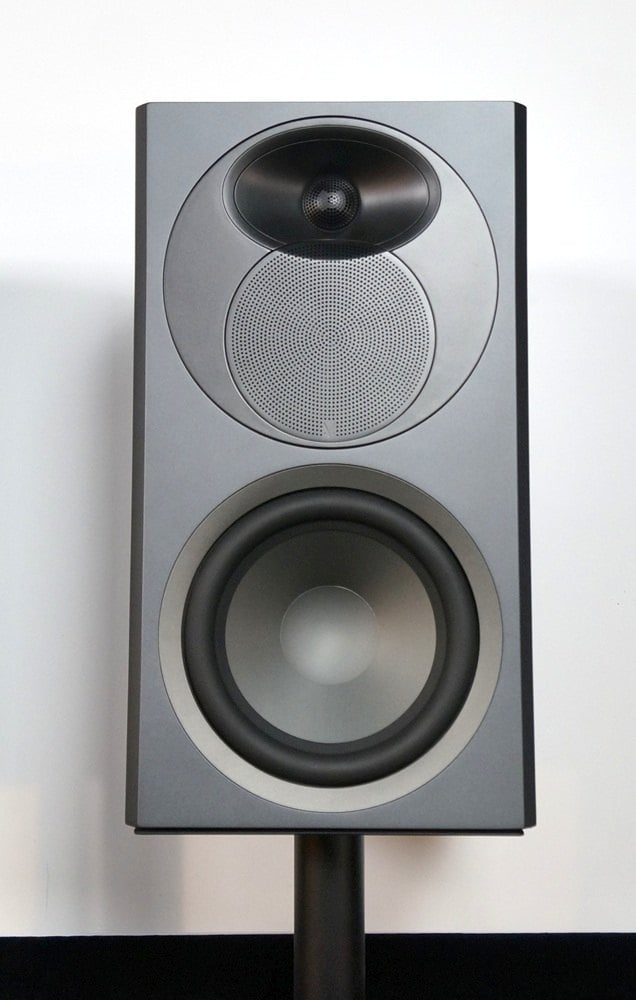
Once unpacked, the speakers are stylish yet reserved, like so much Scandinavian design. The cabinet front has a very gentle vertical curve, and the vertical edges are beveled. They look a lot like the 1528 series. The tweeter and midrange assembly are nearly identical to the 1528s. The bass cone is a bit different and looks like a more conventional bass driver as opposed to the 1528’s sleek aluminum cone and trim ring. The bass cone can be hidden by a grille that protrudes outward a bit. Since the tweeter and midrange are already covered with non-removable grilles, the included grille covers the bass driver only. The speakers that I received came in a ‘Basalt’ finish, which is a dark grey, but the 1610s can also be had in ‘Polar,’ which is a satin off-white. In the grey, these speakers aren’t visually eye-catching, nor are they at all ugly. I think they will do a good job of disappearing in most rooms, even though they are relatively large for standmount speakers. If you don’t want loudspeakers that are visually loud, they look to be a great choice, but they still have enough of a sense of style to not be completely boring either.
Arendal Sound 1610 Bookshelf 8 Design Analysis
Arendal’s 1610 Bookshelf 8 speaker is a 3-way bookshelf speaker designed for high output, low frequency extension, and smooth linearity. The cost of these design goals is sensitivity: wattage doesn’t go quite as far on this speaker as one without as deep bass, but we will get back to that later. The recipe to accomplish these goals is largely the same as that used in Arendal’s 1528 series, hence the visual similarity. It worked well in the 1528s, so it seems like a safe bet that it will work in the 1610 speakers. Let’s dig into the details of this design by starting at the top with the tweeter.
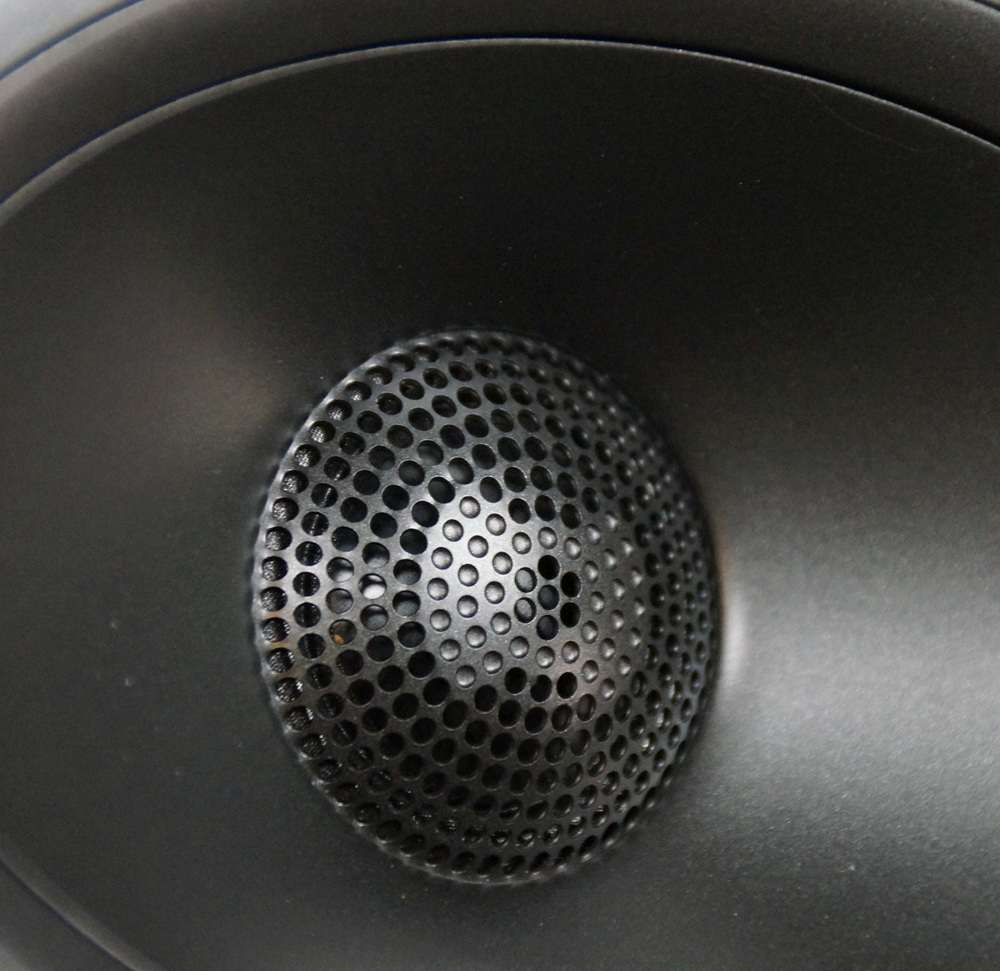
The 1610 Bookshelf 8 uses a 28mm (about 1.1”) aluminum-magnesium dome tweeter, (1528 uses more exotic lithium-magnesium), that is driven by a neodymium motor. The neodymium magnet must be a formidable one since Arendal says the tweeter sensitivity comes in at 95dB for 1W and 1m. The tweeter motor uses a copper shorting ring in order to lower inductance, thereby increasing bandwidth and lowering distortion. It is set in an elliptical waveguide that Arendal calls the “Røst™ Essence waveguide.” This waveguide looks to be going for a wide horizontal dispersion and narrow vertical dispersion. There is an acoustic lens covering the dome that looks like a grille. Not only does it protect the fragile dome, but it also helps to prevent acoustic energy radiating from different parts of the dome from interfering with each other, thereby reducing comb-filtering.
The midrange driver uses a 5” carbon cone that should offer a combination of high stiffness and light weight. Much like the 1528 midrange driver, it has a sealed basket and backplate. It also uses a copper shorting ring; this complicates the magnetization of the motor in the manufacturing phase and makes it costlier to produce, but, again, it allows for increased bandwidth and lower distortion. As with the tweeter, Arendal claims a 95dB sensitivity for 1W at 1m for the midrange driver, so the midrange motor must be pretty powerful. One thing Arendal has done that I really like is that they have mounted the midrange very close to the tweeter, and by doing so, they have greatly increased the width of the vertical listening angle before crossover nulls start to affect the response.
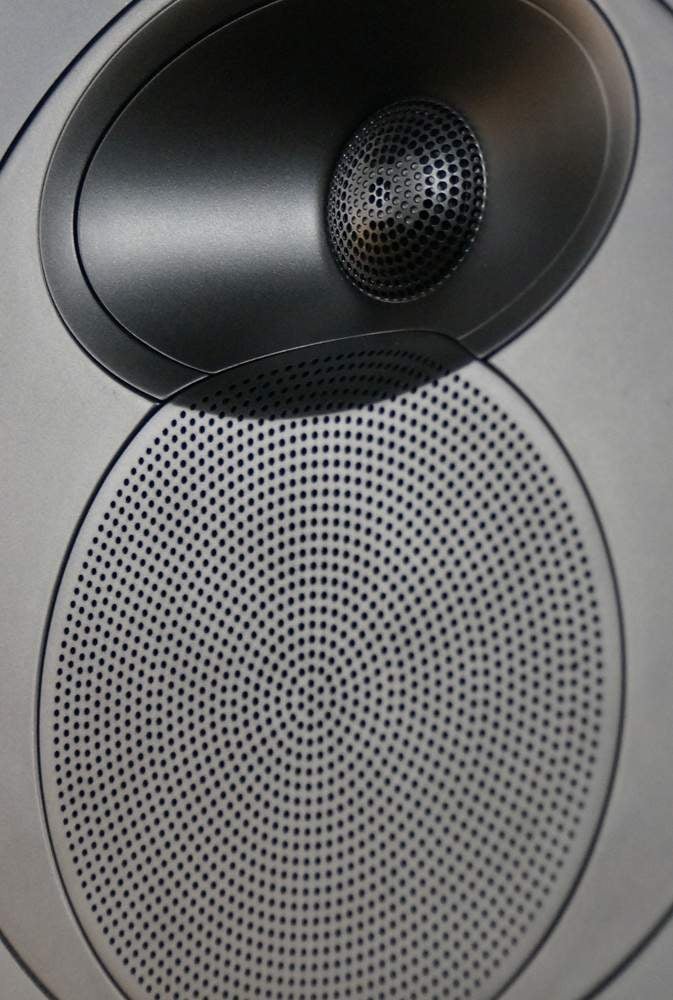
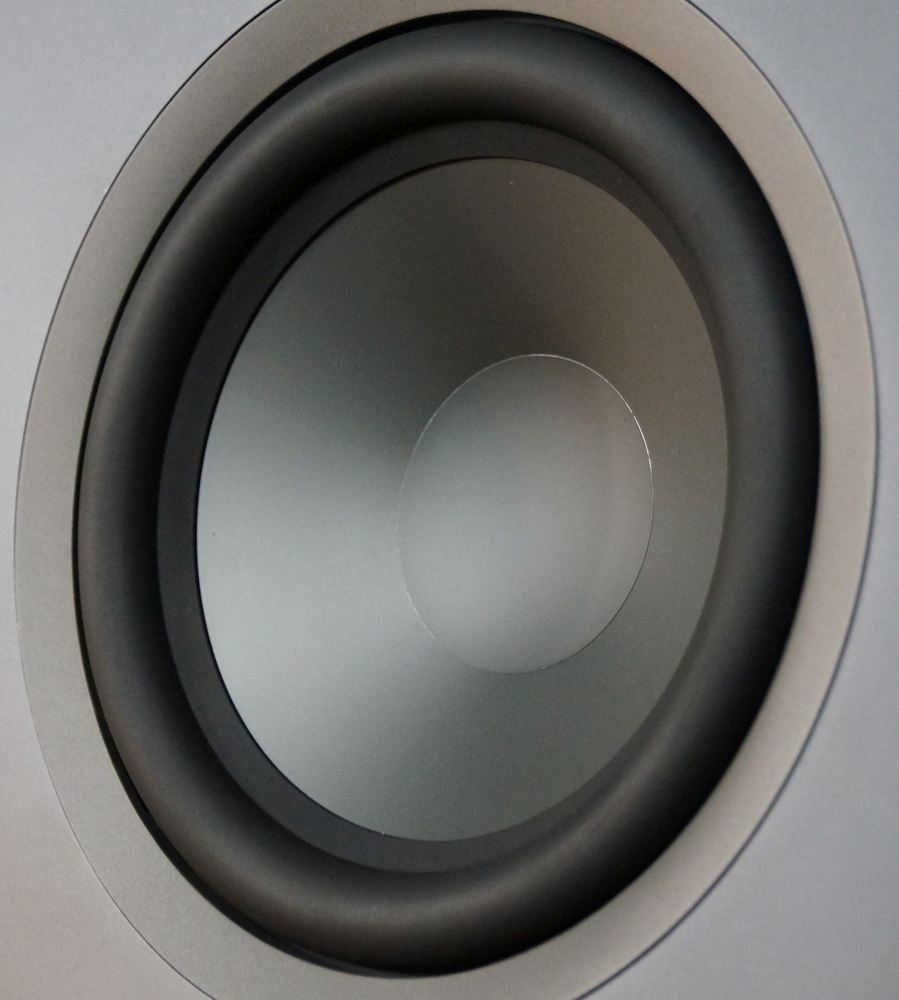
The bass driver uses an 8” aluminum cone. It has a beefy surround that looks to allow for a fairly high excursion. The surround has been reinforced with internal ribs, which should help lower distortion from deformation or flutter noise.
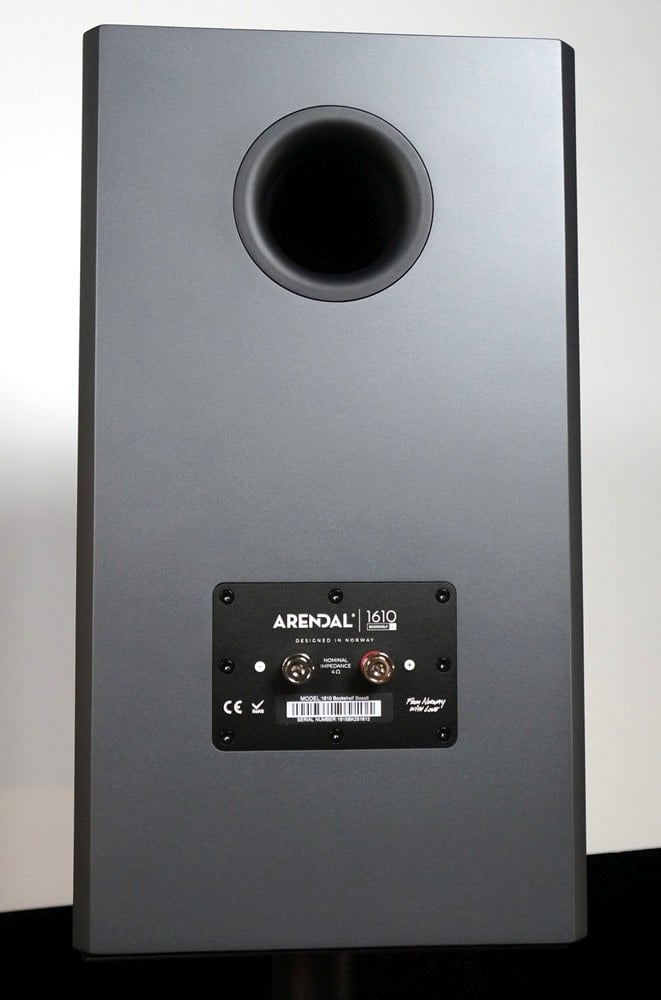 The drivers are crossed over at 330Hz and 2.3kHz with a fourth-order filter for the tweeter and second-order filters for the midrange and bass driver. The crossover components are high quality with aluminum heatsinked wire-wound resistors, air-core inductors, and polypropylene capacitors. Arendal claims only non-ferrous components are used in the signal path.
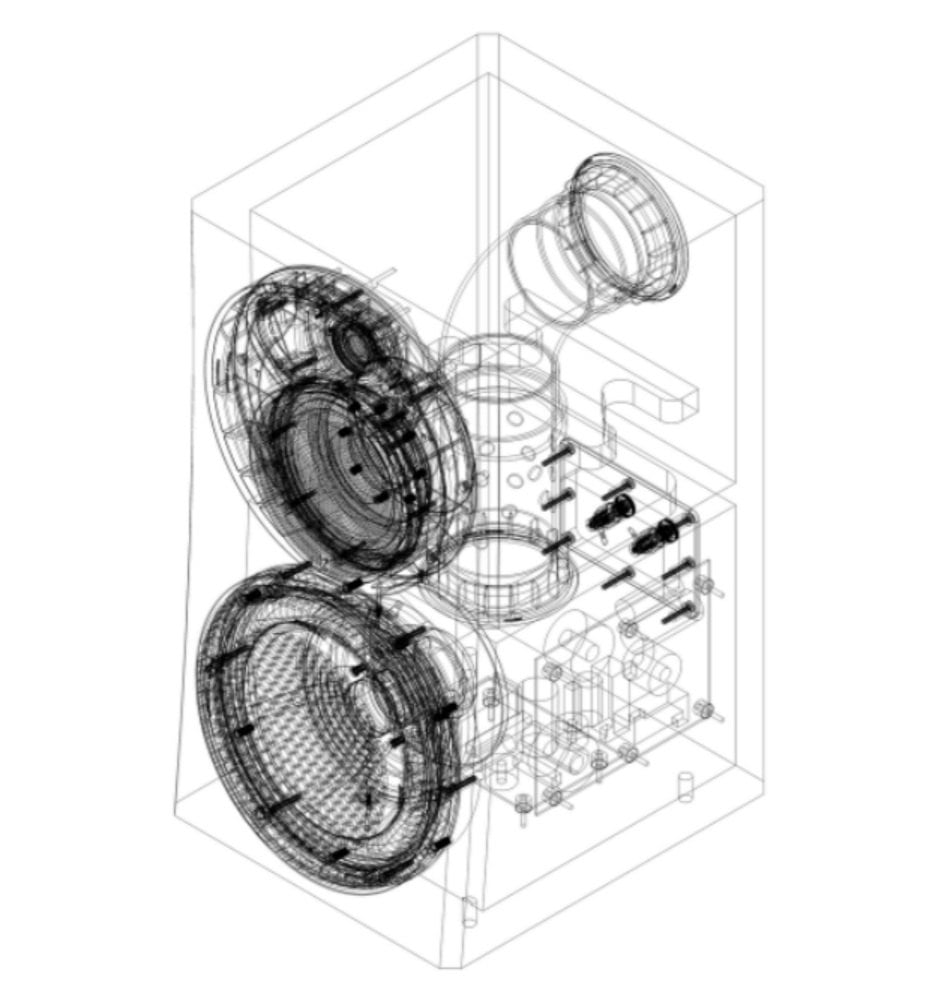
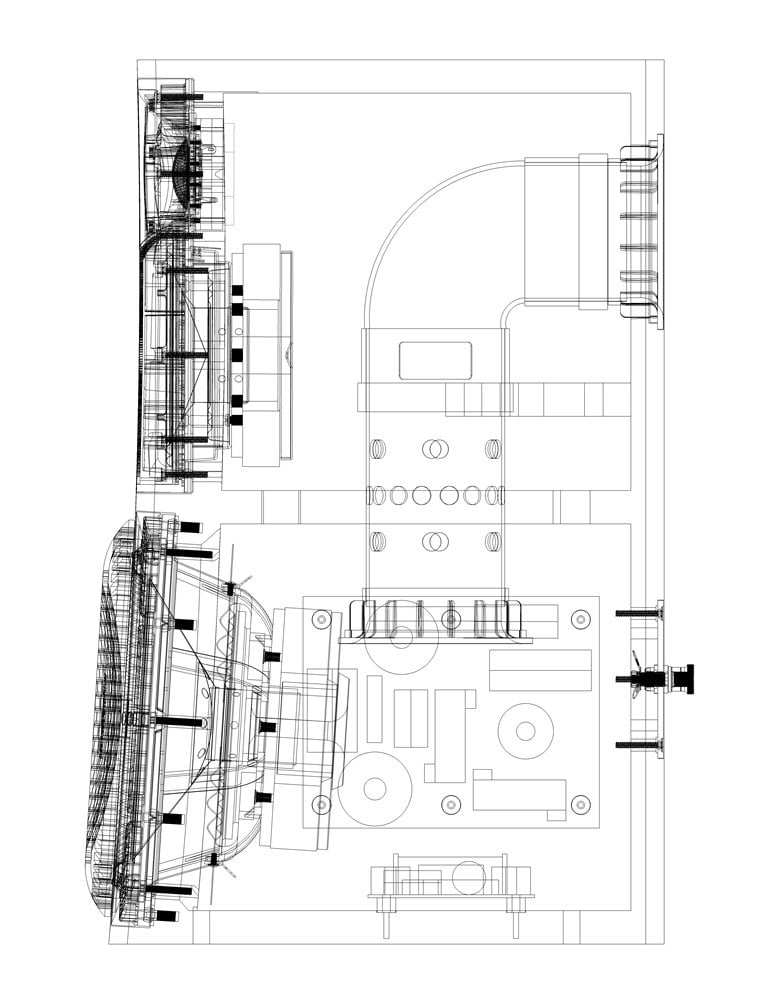
The enclosure for the 1610 Bookshelf 8 is a stout affair and clocks in at 35.8 lbs. While it’s not a small bookshelf speaker, it isn’t huge either, so there is a lot of internal mass to have that kind of weight. It is constructed using high-density fiberboard, and the front baffle has nearly 2” of thickness with ¾” thick side panels and braces. There is a window brace between the bass driver and midrange, and also a smaller brace that attaches the port to the back panel. The tweeter/midrange assembly is mounted to a thick steel plate, so the heavy-duty midrange driver is securely seated even during high amplitude levels. Arendal supplies a fairly robust plastic grille that is magnetically applied, and it definitely does a good job of protecting the woofer. The 1610 Bookshelf 8 does not come with installed feet, but it does come with some adhesive rubber pads that will keep it from making contact with hard surfaces for those who want to use them.
The terminal plate has two solid-copper five-way binding posts that are plated with rhodium for better conductivity and corrosion resistance. Thankfully, Arendal has opted not to have an option for bi-wiring or bi-amping, as those features would more likely cause harm than good on speakers such as these.
There is a fairly large port mounted on the rear of the 1610 bookshelf 8 that has a 2.8” diameter and has a bend going into the cabinet for additional depth. A port of this length and depth promises fairly deep extension, so this bookshelf speaker should deliver relatively deep bass. It is flared on both ends, and there are some holes in the tube that are intended to reduce port resonances by cancelling airflow inside the port. Arendal has included some port plugs, but I would advise against their use in most situations. They merely eliminate port output and thus diminish low-frequency extension. Sometimes sealing a port can help the loudspeaker integrate better with a subwoofer, so the port plugs may be helpful in those scenarios.
A good-sized bookshelf speaker with a high-sensitivity tweeter and midrange as well as a high-excursion bass driver and large port promises a wide dynamic range, but the low tuning frequency does suggest sacrificed sensitivity as well. This is a bookshelf speaker that wants to give you deep bass, but, in this form factor, that means it will need a good amount of wattage to get loud. This is not a big deal since wattage is pretty cheap these days, and you do not need to spend a fortune to get a few hundred watts per channel anymore. So then, let’s see what the 1610 Bookshelf 8 can do in some real-world listening with an adequate amount of power…
Arendal Sound 1610 Bookshelf 8 Listening Sessions
In my 24’ by 13’ (approximately) listening room, I set up the speakers a few feet off the back and side wallswith an equal distance between the speakers and the listening position. I angled the speakers to face the listening position. The listening distance from the speakers was about 9 feet. No room correction equalization was used. Processing was done by a Marantz 7705, and the amplification was a Monoprice Monolith 5x200 amplifier, which can deliver 300 watts at 4 ohms. No subwoofers were used.
Music Listening
A brand new release that is already gathering awards is “M’a dit Amour” by singer Julie Roset and pianist Susan Manoff. This album features rising star opera singer Roset performing a selection of French Melodies, a genre that was popular from the mid-19th century to the early 20th century and is essentially French poetry set to short pieces of music. This is instrumentally simple music with only Susan Manoff’s piano accompanying Roset’s singing, so much of the focus is on the vocalist, a good thing for a close examination of how the 1610 Bookshelf 8 speakers can express a sole human voice. The production and recording quality are top-notch in this 2026 release from Alpha Classics, so this should serve as a good example of the speaker’s capabilities. I streamed this release from Qobuz in a 96kHz/24-bit resolution.
 The first thing I noted was how clean this recording sounded. This is due in part to Roset’s pure soprano voice, which is so clear and uncluttered, as well as Manoff’s pristine piano accompaniment. Roset’s voice was central in the soundstage, but we do hear some reverb of her voice around her, so the recording venue isn’t an acoustically dead space. The piano is clearly recorded in the near-field, so we get less reverb from it. This is all made evident thanks to the 1610’s soundstaging capabilities. This album doesn’t get tremendously loud, and it does have some very soft passages, but I was never struggling to hear the music during these gentler moments, and the speakers provided a full sound throughout the running time. The grand piano sounded full with no weakness in the lower pitches. Roset’s voice sounded even and natural. A soprano like her would be wrecked by a sound system with sibilance problems, but I never heard any harshness or blare even in her most intense moments. By the end of this album, I could understand why it was sweeping so many awards; Roset is a sublime talent, Manoff provides a perfect springboard, and the production gets every possible distraction out of the way of their performance. The 1610 Bookshelf 8 speakers conveyed these qualities with aplomb. It is not a sonically complex album, but its elements are captured masterfully, both in the recording and the reproduction. I am not sure how many opera fans are going to be taking a hard look at the 1610 Bookshelf 8 speakers, but they would be doing themselves a disservice by not considering them if shopping in this price range.

To see what the 1610 Bookshelf 8 speakers could do with a full orchestra, I found a lovely recording of Beethoven’s Symphony No.6 by the Royal Concertgebouw Orchestra, which was led by the acclaimed conductor Daniel Harding. This 2022 album was recorded in the orchestra’s home concert hall, the famous Concertgebouw in Amsterdam, and was released by the Royal Concertgebouw Orchestra’s house label. One of Beethoven’s most famous works, Symphony No.6, ‘Pastoral,’ was meant to evoke a journey through nature, at first serene and then culminating in a storm and its aftermath. While there are many recordings of this iconic work, this lush performance by the Royal Concertgebouw Orchestra makes for a solid entry. I also streamed this release from Qobuz in a 96kHz/24-bit resolution.
 This recording nicely balances the symphonic hall acoustics that come with so much orchestral music. It allows the listener to hear the reverb from the performance space without obscuring the positions of the players or the definition of their instruments. The 1610 Bookshelf 8 speakers revealed this quality nicely by giving us the spaciousness of the recording venue as well as the soundstage of the players and the texture of their instruments. Imaging was good, and I had a sense of instrumental sections as well as more distinct locations of lead instrumentalists. The instruments all sounded natural and tonally balanced. The bass extension of the speakers was enough to pick up the lowest frequencies of this recording, and these bookshelf speakers managed to sound larger than they really were. The dynamic contrast between the crescendo of the fourth movement, “Gewitter, Sturm,” and its gentle wake in the final movement, “Hirtengesang,” had a striking realism in the 1610 Bookshelf 8 speakers. This recording really makes use of its 24-bit dynamic range, and the speakers were able to illustrate this clearly. These new speakers from Arendal turned out to be a terrific choice for orchestral music, and classical aficionados looking for standmount speakers that can do it all should be taking a close look at them.
I decided to take a turn from the purely acoustic to the purely electronic and loaded up an album titled “The City is My Friend” by an English artist called Remember. This comes from the dreampunk genre that I sometimes use for loudspeaker evaluation because of its dense atmospheres and inventive sonic pallets that can allow speakers to shine in a number of ways. “The City is My Friend” is at once futuristic and nostalgic, and sets emotive melodies against cyberpunk ambience. This album is good for demonstrating a sound system’s capabilities due to its striking synth sounds and dynamic soundstage.
The first track opens with sparse percussion underlined with a heavy sine wave bassline and layered with some synthy bells as the lead instrument that floated over everything. The bass was surprisingly potent, and the lead synths were reproduced with their spatial effects given depth and breadth. The third track, “Sleep,” bounces some reverberant chimes between the left and right sides of the soundstage on top of some phasey strings, and the 1610 Bookshelf 8 speakers projected an image that was much wider than their actual placement, a very nifty effect. In the fourth track, an arpeggiated synth dances between the width of the soundstage, and the superb imaging of the speakers allowed me to track its position with precision. Subsequent tracks told the same story, a synthetic soundscape given a tangible reality through pinpoint imaging and striking dynamics by the speakers. Most listeners of this music probably use headphones for it, but a pair of serious speakers like these Arendals is so much more transportative. Electronic music lovers who pick up a pair of the 1610 Bookshelf 8s are in for a real treat.

To check out how the 1610 Bookshelf 8 speakers handle being pushed hard, I threw on a newer release from the eloquently named Eatbrain label titled “Deadlights” by the artists Dropset and Esym. This EP is comprised of four tracks of hard-hitting drum’n’bass music that peg the dynamic range needle from start to stop. This music features massive bass, aggressive percussion, and sharp synths, so it begs to be played loud, and it will find the breaking point of any sound system at a high enough loudness level. I set out to see if I had enough amplification to push the 1610 Bookshelf 8 speakers past their limits.
I found out right away that these speakers had no trouble with loud listening levels. In many instances, I can find the limits of the woofers right away with bass-heavy music on standmount speakers since the low-end is the first to compress, but the 1610 Bookshelf 8s had a startling amount of dynamic range in the lower frequencies. The 8” woofers in these speakers were serious, and not only could the speakers dig deep, but they could play loud. These were bookshelf speakers with almost subwoofer-like bass. I was listening to loud drum’n’bass music, and I didn’t miss the subwoofer at all, a feat achieved by few bookshelf speakers. The title track, “Deadlights,” absolutely ripped with the 1610 speakers. Kick drums gave a tangible thump, and the snap of the snares made me wince. The metallic shredding of the lead synth blazed over the thundering bassline. The other tracks provided a similar experience, although “Deadlights” was the highlight (and also a kickass Steven King reference). Could these speakers rock? Yes, but users will need to give them adequate wattage since their 85dB sensitivity spec is somewhat low. They might struggle with a 25-watt amp, but a couple of hundred watts should make them sing.
Movie Watching
 One movie I had an interest in seeing that I thought would make for a good exhibition of loudspeaker capability was the recent version of “Frankenstein” by Guillermo del Toro. Mary Shelley’s “Frankenstein” has been adapted countless times throughout the years, but with some major talent like del Toro behind the camera and a nearly unlimited budget from Netflix, I knew I would be in for a treat on this one. The sound mix would surely be as good as anything out there, especially with del Toro’s wild imagination in play.
“Frankenstein” turned out to be a surprise and was not at all what I expected. While Frankenstein’s monster was always subject to misunderstandings that ended up in mayhem, this ‘monster’ was far more sympathetic than typical depictions. The sound mix was a wild ride with many highlights, the chief of which was the monster’s activation amidst a fiery thunderstorm in Dr. Frankenstein’s steampunk laboratory. Lightning cracked and charged some massive capacitors, which shot electrical arcs everywhere, and the 1610 speakers brought the carnage to life with vivacity. Later on, the monster’s inhuman voice bellowed across the arctic tundra with a guttural howl, which the speakers rendered with frightening force. The monster’s tremendous strength was partly denoted through the violent thuds and crunches as he threw men aside like dolls and snapped their bones like twigs, all brutally detailed by Arendal’s speakers. Alexandre Desplat’s emotive and grandiose score was reproduced with vibrance, and the sound system never muddled it up with the effect sounds or dialogue. Dialogue intelligibility was always very good, even with many of the lines lifted straight from Mary Shelley’s elaborate exchanges of the spoken word. I quite enjoyed Del Toro’s treatment of this classic story; it is beautifully produced and should be appreciated on a high-quality A/V system like the 1610 Bookshelf 8 speakers.

For typical action fare that would exhibit the 1610 Bookshelf 8’s dynamic range, I watched “Mission: Impossible - Dead Reckoning Part One.” I hadn’t seen it yet, but the Mission: Impossible series has always been a reliable vehicle for exciting action scenes. The sound mix should be top-notch in this insanely expensive 290-million-dollar movie. While I am no “Mission: Impossible” fanatic, I have always found them to be a fun way to kill two hours, and hopefully, this entry will continue that trend.
“Mission: Impossible - Dead Reckoning Part One” turned out to be a very fun entry in the series, possibly my new favorite after the first movie. The action set pieces were outstanding, and the 1610 Bookshelf 8 speakers did a great job in bringing them to life. The movie opens with a scene that involves a submarine disaster; it was very bass-heavy, but the low-frequency extension of the speakers was so deep that I didn’t miss subwoofers at all. While the scene likely had infrasonics that the speakers were not catching, the speakers managed to get a strong response down to 30Hz in-room, which is excellent for standmount speakers. I have had quite a few tower speakers that could not quite dig that low! Further on, an amusing car chase in Rome let the speakers go wild with revving engines, crashes, and tires skidding, all of which were vividly reproduced by the 1610 Bookshelf 8 speakers. The highlight was the finale, a prolonged action scene that took place on board a steam train that meets disaster in predictable action movie fashion. The roar of the steam engine and the shuddering of the derailed train cars were all given seemingly endless dynamic energy and detail that helped to make the scenes feel real. As with all Mission: Impossible action scenes, in hindsight, it is pretty preposterous, but in the moment, it is engaging, and that is because of how meticulously these scenes are choreographed. The sights and sounds have to be lifelike to pull off the suspension of disbelief for these scenes to work, so a good image and a good sound are critical for an immersive experience. On this count, the 1610 Bookshelf 8 speakers delivered the goods beautifully. They proved that you don’t need large tower speakers or subwoofers to have a big screen experience - if the bookshelf speakers are good enough.
Arendal Sound 1610 Bookshelf 8 Loudspeaker Measurements
The 1610 Bookshelf 8 speakers were measured in free air at a height of 4 feet at a 1-meter distance from the microphone, and the measurements were gated at a 4-millisecond delay. In this time window, some resolution is lost below 600 Hz, and accuracy is completely lost below 30 Hz. Measurements have been smoothed at a 1/24 octave resolution.
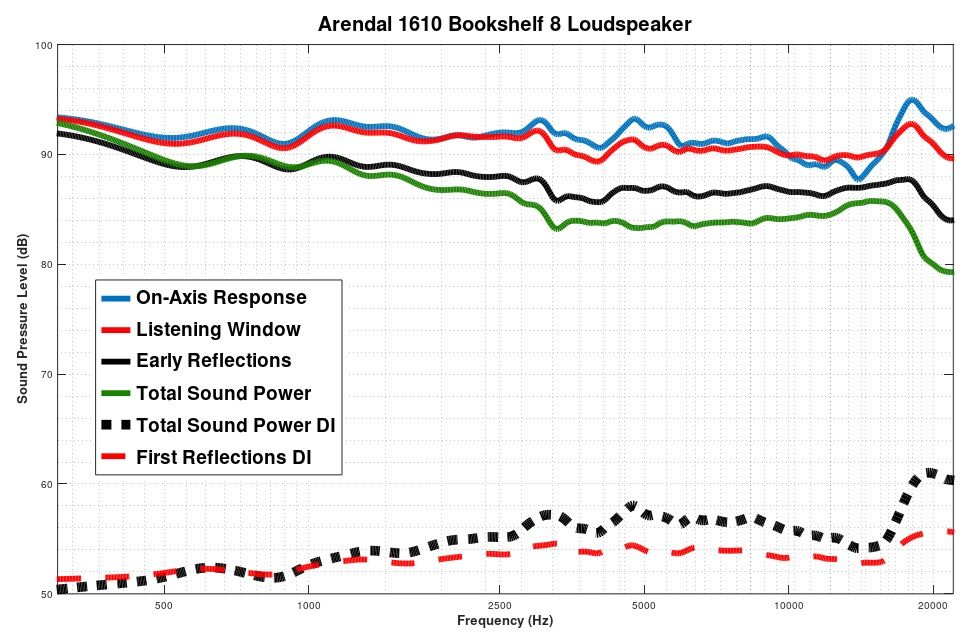
The above graph shows the direct-axis frequency response and other curves that describe the speaker’s amplitude response in a number of ways. For more information about the meaning of these curves, please refer to our article Understanding Loudspeaker Measurements Part 1.
The above responses of the 1610 Bookshelf 8 are fairly neutral. They are not quite as smooth as Arendal’s 1528 speaker that we measured, but they portray a loudspeaker that does very little to alter the incoming signal sound relative to human hearing. The on-axis response gets a little rocky at the top end, but that occurs in such a high-frequency range that few listeners would be able to discern anything there, and not much recorded content has anything important in that spectrum anyway. The most important curve in this group is the Listening Window response, and it shows a very smooth response with only very minor variances. The 1610 Bookshelf 8 is a well-controlled, linear loudspeaker. The Early Reflections and Sound Power curve shows a small blip around 3kHz which is the crossover point between the midrange and the tweeter, but it is barely a 1dB drop on the whole. The First Reflections directivity index, which is the most important of the two directivity indexes, suggests a speaker with well-matched dispersion between the drivers.
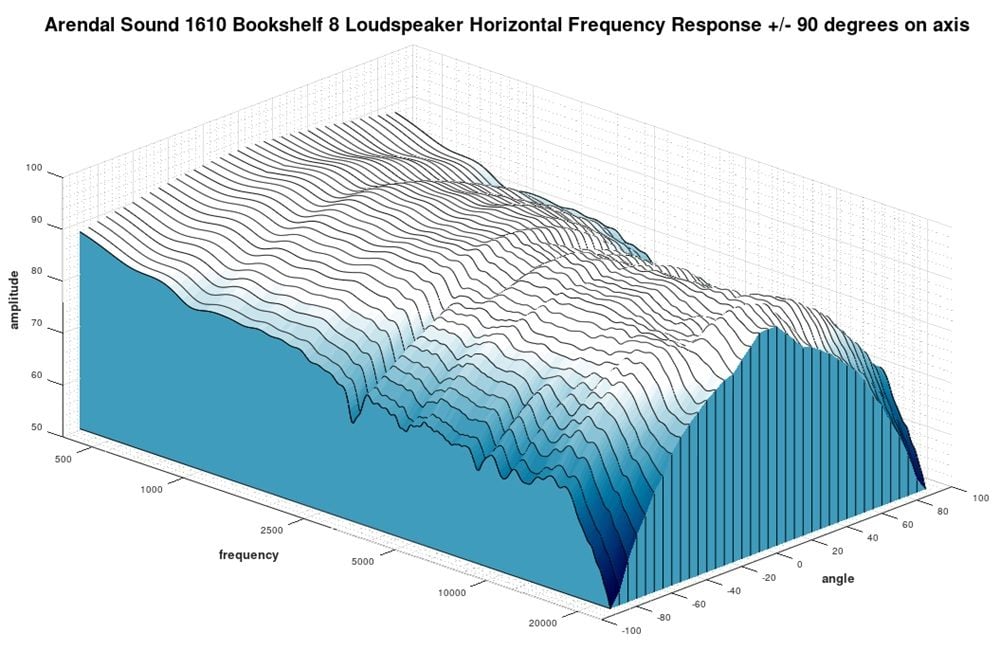
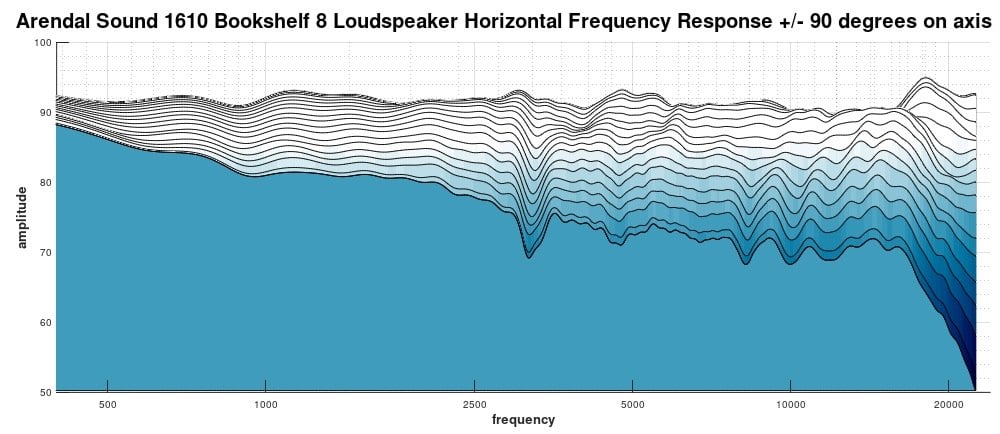
The above graphs depict the 1610 Bookshelf 8’s direct-axis and horizontal dispersion out to a 90-degree angle in five-degree increments. Information on how to interpret these graphs can be read in this article: Understanding Loudspeaker Review Measurements Part II.
The above graphs show pretty good, although not absolutely perfect, directivity control throughout the measured bandwidth. There are some slight bunching up of curves and some instances where the off-axis responses don’t quite match the responses near the on-axis, but these are minor and very unlikely to manifest anything audible. What we have here from the 1610 Bookshelf 8 is overwhelmingly good news. The responses generally have good correlation with each other, and that means that the speaker retains the same sound character across a wide angle of the frontal projection. The advantage of this is that this speaker will not be fussy about placement to get a good sound over a wide range of listening positions. It also has a major advantage in that the acoustic reflections will resemble the direct sound, and that is easy for equalization systems to achieve a specific target response. Systems like Audyssey and Dirac will take very well to this sort of dispersion pattern.
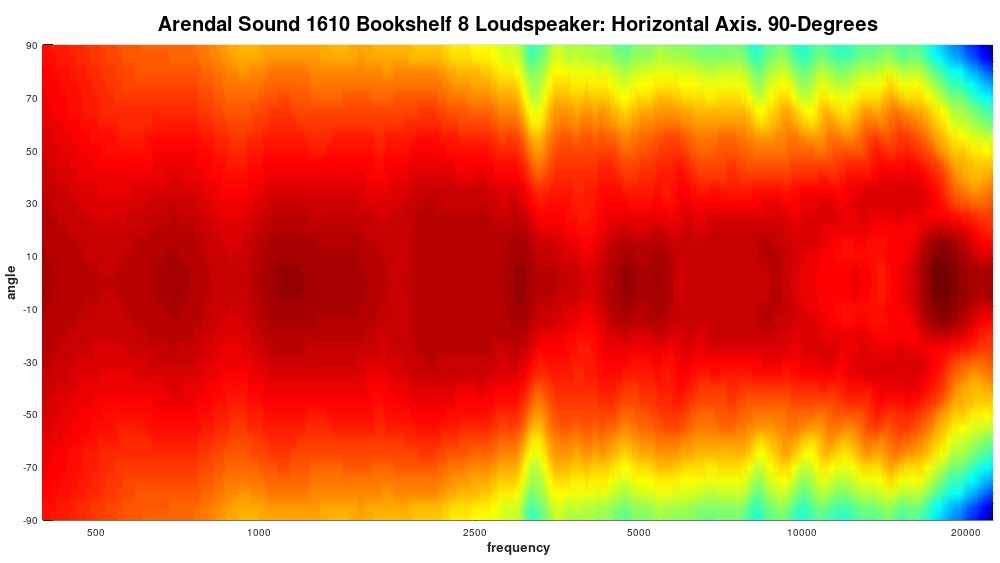
The above polar
map shows the same information as the preceding graphs but depicts it in
a way that can offer new insight regarding these speakers’ behavior.
Instead of using individual raised lines to illustrate amplitude, polar
maps use color to portray amplitude, and this allows the use of a purely
angle/frequency axis perspective. The advantage of these graphs is that
they can let us see broader trends of the speaker’s dispersion behavior
more easily. More information about interpreting this graph can be read
in this article: Understanding Loudspeaker Measurements Part II.
In the above graph, we get another look at the 1610 Bookshelf 8’s superlative directivity control. It is a relatively wide-dispersion loudspeaker and holds a fairly consistent level of energy out to 60 degrees off-axis. Again, we do see a tiny directivity mismatch going from midrange to tweeter, but it would be too small to translate into anything audible. The width of the dispersion pattern holds out to nearly 20kHz, a pretty astounding feat for a loudspeaker with a relatively shallow waveguide. I do think that the slight tip-up in energy in the response as it approaches these high frequencies helps to keep the response broad in the top end. Usually, the width in dispersion narrows as the frequencies rise, but this speaker doesn’t start doing that until nearly 20kHz. That means that even far off-axis listening positions will get hit with the full range of sound, going all the way up to the highest frequencies of human perception. The bottom line for this graph is that the consistency in energy at horizontal angles will make this a very easy speaker to work with in setup and placement for optimal sound.
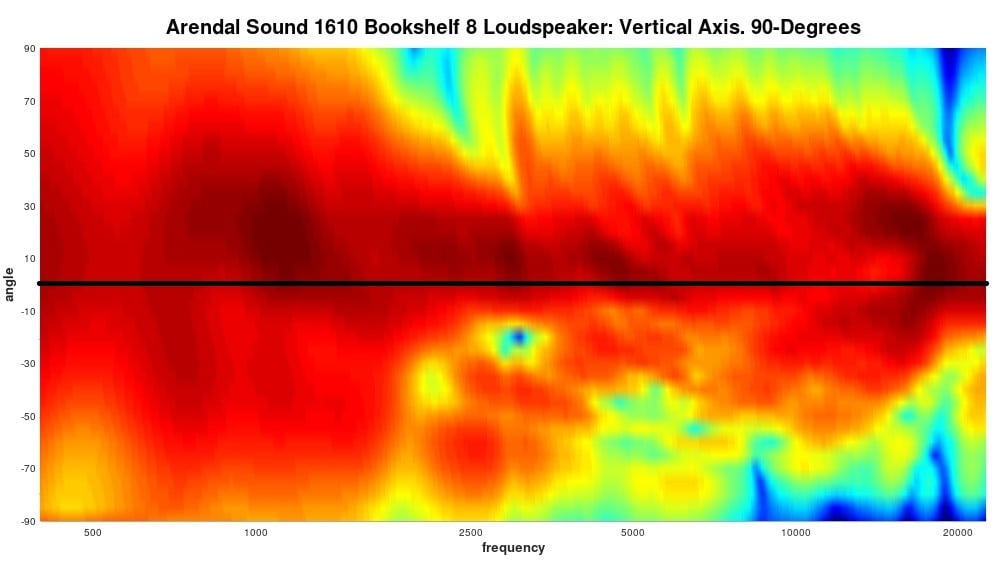
The above polar map
shows the 1610 Bookshelf 8’s response behavior along its vertical axis,
where zero degrees is directly in front of the tweeter (denoted by the
lateral black line), negative degree values are below the tweeter, and
positive degree values are above the tweeter.
Here, we can see some phase conflicts at lower angles but not much at higher angles. Phase cancellation is taking a chunk out of the responses once we go below 15 degrees, and it happens largely from 2kHz to about 5kHz. It is interesting to see that not much phase cancellation occurs at high angles. What this tells us is that the 1610 Bookshelf 8 is best listened to on-axis or at somewhat higher angles. Make sure the tweeter is at ear-level height or perhaps a bit below ear-level height when positioning the speaker. It may pay to get a somewhat low speaker stand to pair with these speakers.
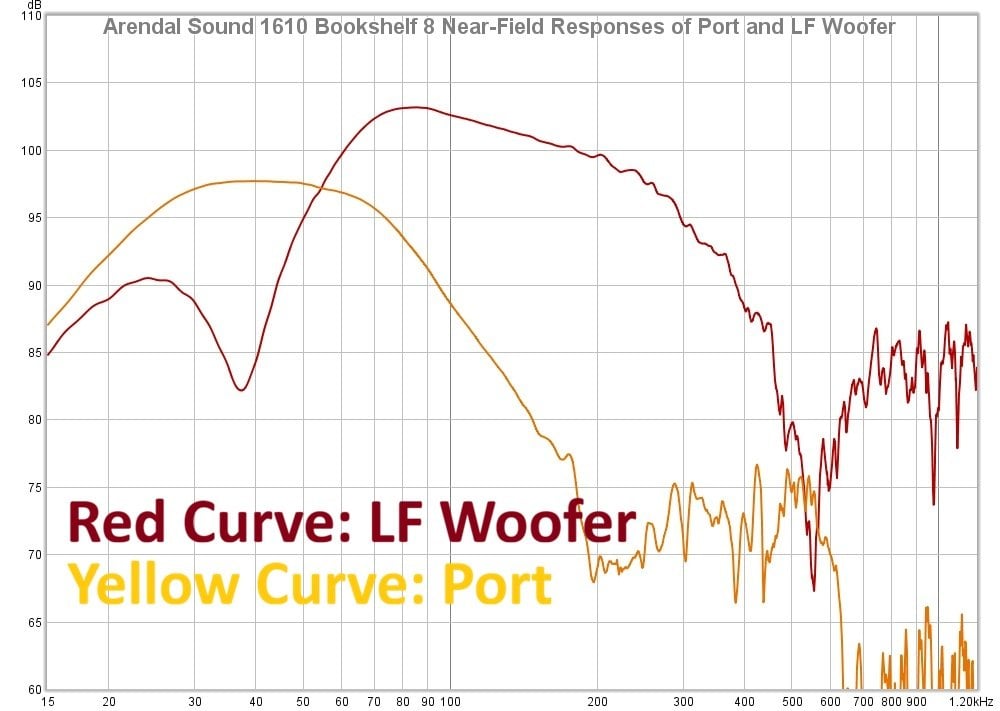
The above graph exhibits near-field responses of the low-frequency woofer and port of the 1610 Bookshelf 8. In near-field measurements, we place the mic very close to the driver diaphragm to get a clean reading of its amplitude response. I don’t normally publish these measurements as they can be subject to misunderstanding, but I decided to do so in this case to show how well Arendal’s efforts to reduce port resonances have worked. The thing to look at for port resonances is spikes in energy above the main peak of the port’s output (here shown in the yellow line). What we see is very good control of port resonances, with no discernible harmonics at over 20dB down from the fundamental port resonance. Many speakers would be doing well to have harmonic resonances at -10 dB down, but the 1610 Bookshelf 8 brings these pipe resonances to much lower than that, even. I was skeptical of Arendal’s strategy to mitigate port resonances when they explained it to me, but seeing these results made me a believer. Arendal has given us a very well-executed port design.
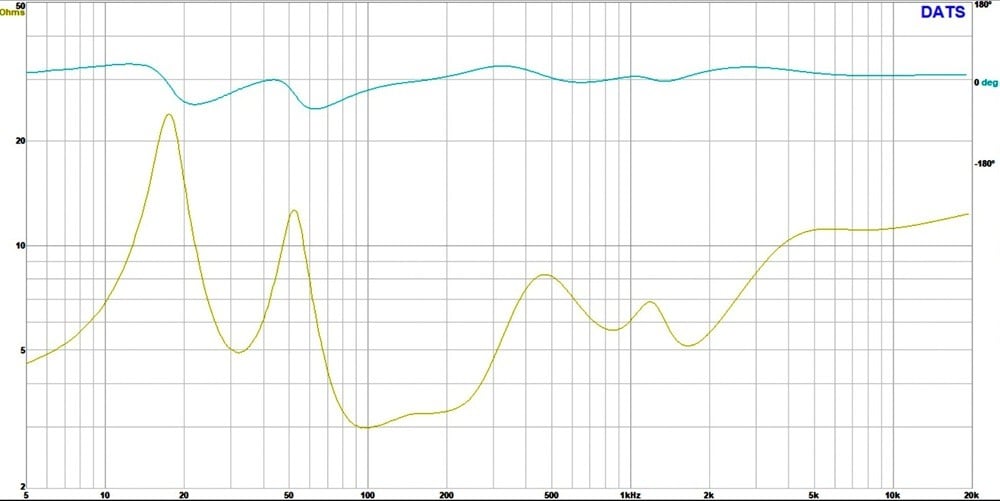
The above graph shows the electrical behavior of the 1610 Bookshelf 8 speakers. These speakers have a highly varying impedance response. What is concerning is the impedance minima around 100Hz, which dips to 3 ohms. That is pretty rough, especially for a loudspeaker that is on the less sensitive side. This is not a speaker that should be run on a flimsy or low-cost amplifier. The good news is that I think few users will run these somewhat pricey speakers on a cheap amp. Users will need to make sure their amplifier is comfortable with a real 4 ohm load. Something else to note is the dip in the low-frequency saddle, where we can see that the port tuning frequency is just above 30Hz, confirming that these speakers are relatively deep digging in bass, especially for their size.
Arendal Sound 1610 Bookshelf 8 Conclusion
Before bringing this review to a close, I will briefly go over the strengths and weaknesses of the product under evaluation, and, as usual, I will start with the weaknesses. With a product as strong as Arendal’s 1610 Bookshelf 8, there are not many weaknesses to speak of. The only point of criticism I can think of is their wonky impedance load combined with the low sensitivity, which means these speakers will need a stout amplifier to perform their best. But, as I mentioned, few people buying speakers at this price are going to run them on budget AVRs, so that shouldn’t be a problem. Any amplifier comfortable running a 4-ohm load should work fine with these speakers.
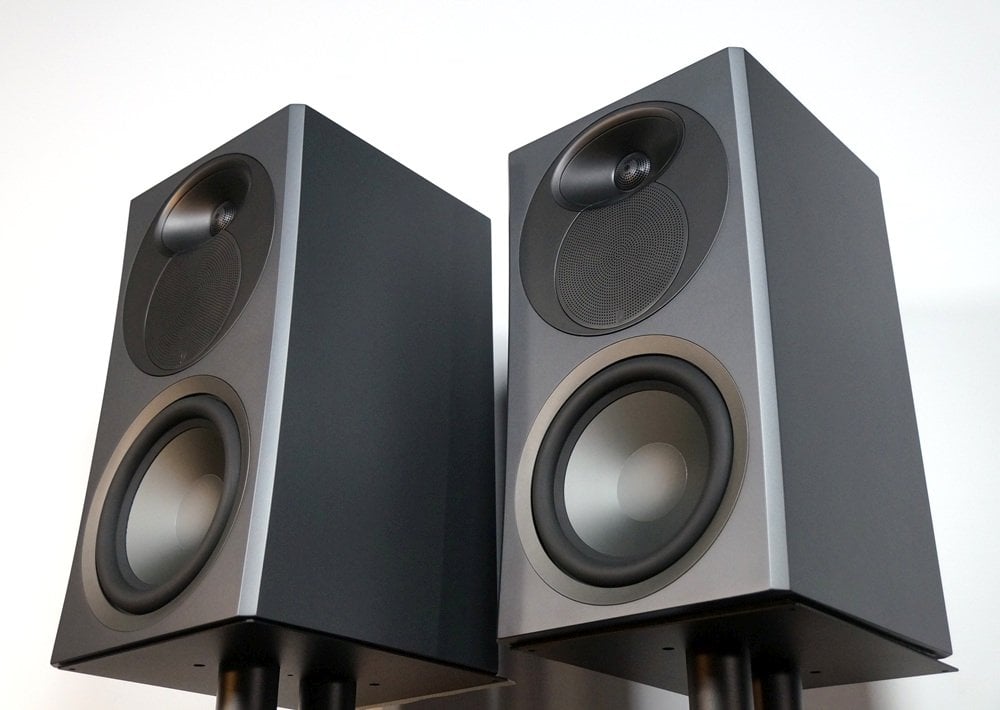
Beyond that, it’s pretty much all good news. At the top of the list of their strengths is their acoustic performance, i.e., their sound quality. These speakers have a balanced sound, and they hold that tonality over a broad angle. This means they will keep an even sound over a wide range of circumstances and uses. The 1610 Bookshelf 8 speakers are an accurate transducer of sound; they turn an electrical signal into an acoustic signal with very little distortion. They have deep bass extension for a standmount loudspeaker, and in the bass-heavy movies that I watched, I didn’t feel like I was missing anything for lack of a subwoofer. They can get loud, too, if they are provided with enough amplifier power. They might not be the most efficient speaker per watt, but they can handle a lot of power, so they can still blaze if fed a beefy amp.
 After
their sound quality, the next best thing about the 1610 Bookshelf 8
speakers would be their build quality. This is not surprising coming
from Arendal, who have always had the best-built speakers for the money.
These things have a solidity and heft befitting their price tag, and
many of the components are high quality. Arendal isn’t cutting corners
here, and despite their cost, a close look at their construction and
parts shows that Arendal is pricing these things pretty aggressively.
After
their sound quality, the next best thing about the 1610 Bookshelf 8
speakers would be their build quality. This is not surprising coming
from Arendal, who have always had the best-built speakers for the money.
These things have a solidity and heft befitting their price tag, and
many of the components are high quality. Arendal isn’t cutting corners
here, and despite their cost, a close look at their construction and
parts shows that Arendal is pricing these things pretty aggressively.
Arendal Sound 1610 Bookshelf 8 vs Competition
The 1610 Bookshelf 8 is a great speaker and is easy to recommend, but one thing that complicates that decision, ironically, comes from other speakers from Arendal Sound. Arendal Sound has two other very strong stand-mount offerings that do not cost that far off from the 1610 Bookshelf 8 speakers themselves. I am talking about the 1528 Bookshelf 8 at $5.2k/pair, and the 1723 Monitor THX at $2.8k/pair. Relative to the cost of the $3.6k/pair 1610 Bookshelf 8 speakers, the 30% cost increase of the 1528 Bookshelf 8s is not a huge step up, but they are a better-built and higher-performing speaker. It would probably be worth it for a lot of people to just swing the extra cost and get its higher-end sibling. On the other side, buyers who are looking to save a few dollars have a very strong offering in the 1723 Monitor THX speakers, as we found out for ourselves in our review. With its larger cabinet size and double 8” woofers, I would not be surprised if the 1723 Monitor THX speakers had a wider dynamic range than the 1610 Bookshelf 8s and thus might be the more suitable choice for higher loudness level listening especially for home theater centric buyers. In my view, this leaves the 1610 Bookshelf 8 speakers in a middle-child syndrome. And of course, there are other well-received larger standmount speakers in a similar price range from KEF, Wharefedale, MoFi, RBH Sound, and JBL, among others.
The 1610 Bookshelf 8 occupies a crowded segment in its market, but it has a lot going for it, so I believe it will fare well. Buyers looking for a beefy, full-range, high-fidelity loudspeaker have a great choice in Arendal’s latest offering. What is more is that buyers also get industry-leading customer service and extras by buying from Arendal Sound, which comes with a 60-day audition with free shipping both ways in case the buyer does not wish to keep the speaker for any reason. A 10-year warranty sweetens the deal. I enjoyed my time with the 1610 Bookshelf 8 speakers, and I think that most, if not all, buyers will feel the same way. Arendal Sound has yet to show me a mediocre product, and these speakers continue that trend; keep up the good work, Arendal Sound.
The Score Card
The scoring below is based on each piece of equipment doing the duty it is designed for. The numbers are weighed heavily with respect to the individual cost of each unit, thus giving a rating roughly equal to:
Performance × Price Factor/Value = Rating
Audioholics.com note: The ratings indicated below are based on subjective listening and objective testing of the product in question. The rating scale is based on performance/value ratio. If you notice better performing products in future reviews that have lower numbers in certain areas, be aware that the value factor is most likely the culprit. Other Audioholics reviewers may rate products solely based on performance, and each reviewer has his/her own system for ratings.
Audioholics Rating Scale
 — Excellent
- — Very Good
- — Good
- — Fair
- — Poor
| Metric | Rating |
|---|---|
| Build Quality | |
| Appearance | |
| Treble Extension | |
| Treble Smoothness | |
| Midrange Accuracy | |
| Bass Extension | |
| Bass Accuracy | |
| Imaging | |
| Dynamic Range | |
| Fit and Finish | |
| Performance | |
| Value | |
James Larson is Audioholics' primary loudspeaker and subwoofer reviewer on account of his deep knowledge of loudspeaker functioning and performance and also his overall enthusiasm toward moving the state of audio science forward.
View full profile Subscribe to our newsletter