


GoldenEar T44 Review: Hybrid Tower Speaker with Powered Bass
Goldenear T44 Tower Speaker
- Product Name: T44 Floor Standing Speaker
- Manufacturer: Goldenear
- Performance Rating:


- Value Rating:
- Review Date: July 02, 2026 00:00
- MSRP: $ 5,000/pair gloss black, $5,300/pair Santa Barbara
-
Tweeter: One High-Gauss HVFR™ High-Velocity Reference Folded Ribbon Tweeter
-
Midrange: One 4.5” High-Definition Cast-Basket MVPP™ Upper-Bass/Mid-Driver
-
Bass Driver: One 5” x 9” Long-Throw Quadratic Bass Driver
-
Passive Radiators: Two 6.8” x 8” Quadratic Planar Back-Wave-Driven Infrasonic Passive Radiators
-
32 Hz–25 kHz typical (-6 dB on axis @ 29 Hz, anechoic bass response)
-
Impedance: Nominal 4Ω (Compatible with 8Ω)
-
Sensitivity: 92 dB / 89 dB 1W/1m @ 4Ω (2.83V/1m)
-
Built-In Bass Amplification: 500 W peak / 250 W RMS, 56-bit DSP-controlled
-
Weight: 60lbs (27.2kg)
-
Dimensions:
Tower: 7.5" W x 14.75" D x 40.4" H (with base, no spikes)
Base: 11.8" W x 17" D
Pros
- Fairly balanced sound
- Deep bass extension for size
- Wide and articulate soundstage
- Stylish appearance
- Not huge
Cons
- Bass compression at high loudness levels
In 2023, GoldenEar announced the launch of a new series with the T66 tower speaker. It was an upmarket move relative to their Triton series speakers: a nicer, more luxury-oriented mid-sized tower speaker. The Triton speakers were an acclaimed series, but they had been around for a while without much change. The higher-end offered higher margins, and other manufacturers were doing the same pivot upmarket, a sensible move considering the rising costs of virtually every index of consumer electronics manufacturing. The T66 was well-received, so GoldenEar has now expanded that line with a smaller and more space-friendly tower in the T44. The T44 gives up dynamic range for its more reasonable size, but it looks like it should work well in small to medium-sized rooms. In today’s review, we look at the T44 to see what GoldenEar has done to justify this higher-end item. The T44 has a hi-fi price and hi-fi look, but does it have a hi-fi sound? And how does it compare to speakers within the same class? Let’s now dig in to find out…
GoldenEar T44 Appearance
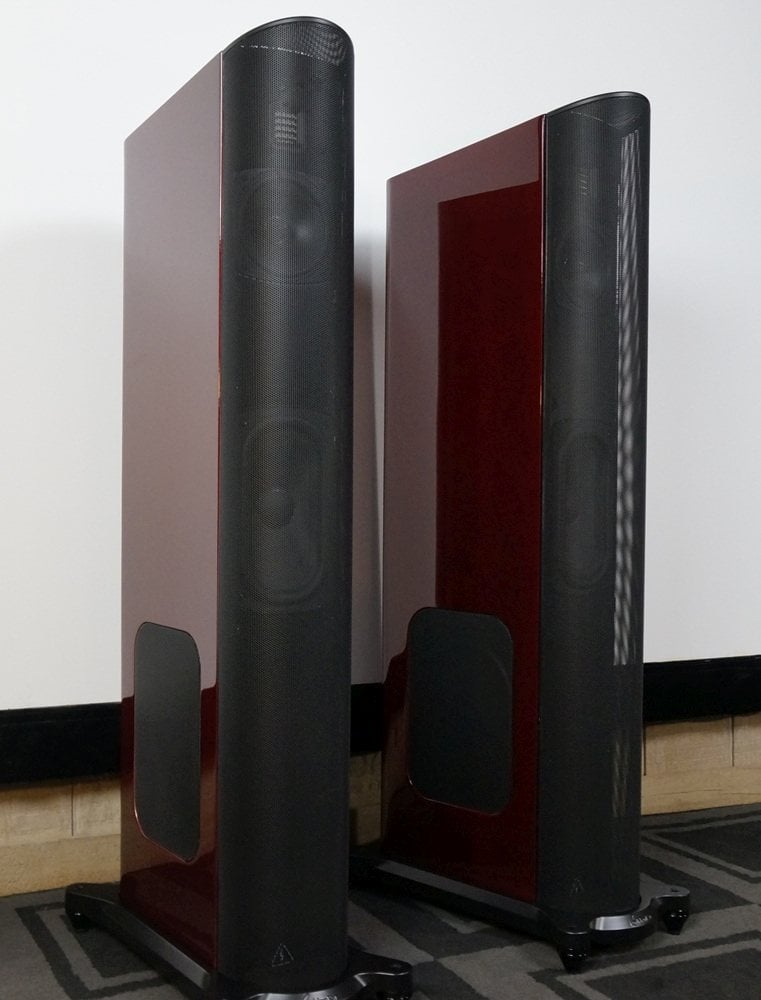 GoldenEar’s
T44 speaker is a unique-looking one and won’t be mistaken for anything else.
What has to be its most distinctive feature is its grille; it is a
non-removable, shaped metal mesh that extends the curvature of the cabinet for
a rounded front shape. It shades the front baffle but does not hide it
completely, and the outlines of the drivers can be discerned through the mesh.
It is an interesting design element that does heighten its attractiveness,
although those buyers looking for a more conventional-looking speaker may be
put off a bit.
GoldenEar’s
T44 speaker is a unique-looking one and won’t be mistaken for anything else.
What has to be its most distinctive feature is its grille; it is a
non-removable, shaped metal mesh that extends the curvature of the cabinet for
a rounded front shape. It shades the front baffle but does not hide it
completely, and the outlines of the drivers can be discerned through the mesh.
It is an interesting design element that does heighten its attractiveness,
although those buyers looking for a more conventional-looking speaker may be
put off a bit.
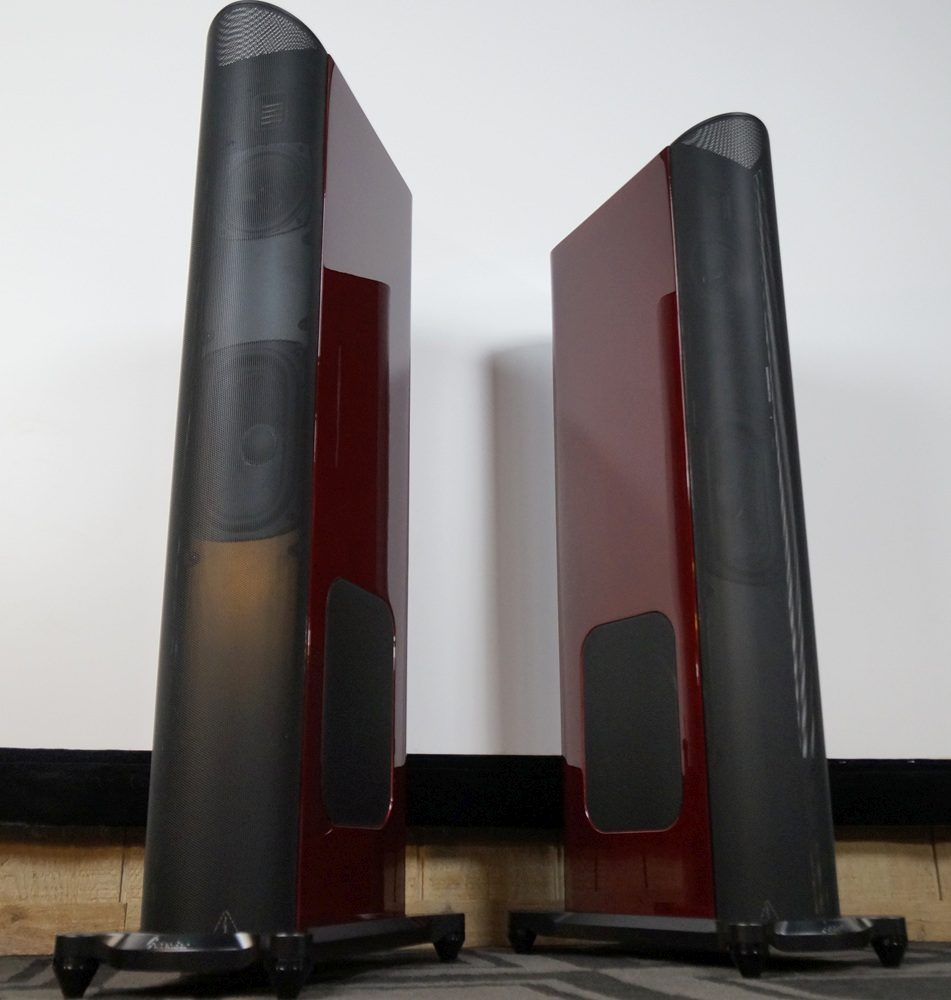
The top of the speaker is rounded and backward-sloping in order to get away from the usual boxiness of speakers. The side-panels are finished in a gloss paint and can be had in either piano black or Santa Barbara Red. Santa Barbara Red is the finish that I received, and it is a smooth, high-quality finish that looks very nice. It is a darker red that has a metallic sparkle that looks like an automotive finish. The red does have a $300 upcharge, but I think it is worth it to get away from the all-too-common black.
There are grilles that cover a pair of passive radiators mounted on the sides of the cabinet. The rear edges of the speaker are rounded- another nice detail that elevates this speaker away from a mere box. The cabinet rests on a black-anodized, precision-machined aluminum base with conical feet. Something to keep in mind is that since the speakers are only partially self-powered, they will need to be plugged in with a power cord as well as connected to speaker cable. And if you want to use the LFE outs to control bass, you need to connect subwoofer cables to each unit as well, so cable management is going to be something to think about in terms of appearance. On the whole, the T44 looks quite nice and is relatively stylish among loudspeakers but without being odd or garish. I think it will pass muster for those who have a demanding spouse-approval-factor to meet in order to get some high-performing loudspeakers in their living space.
At first glance, the GoldenEar T44s have the aerodynamics of a jet fighter, making them visually far less imposing in the room than their performance suggests.
- Gene DellaSala comments at the MaximumAV Listening Event
GoldenEar T44 Design Analysis
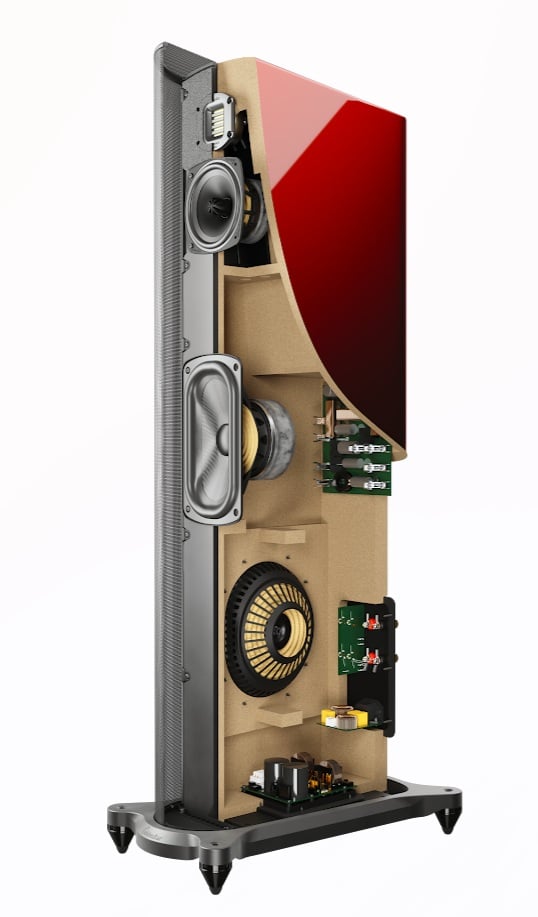
Along with its unique appearance, the T44 has some unique design attributes as well. At its core, it’s a three-way floor-standing speaker with a powered bass section. But of course, the design details are what make or break a speaker, so let’s dig into the details, starting at the top with the tweeter. GoldenEar uses what they term a ‘High-Velocity Folded-Ribbon’ tweeter (the HVFR), which is really just a fancy term for an AMT. I don’t know why GoldenEar would shy away from using the term AMT since they were one of the manufacturers that popularized AMTs in hi-fi applications, and AMTs can be very good and high-performance drivers. AMT tweeters can have a wide range in quality, but GoldenEar’s AMTs have historically been very good performers and are of their own design and not an off-the-shelf design.
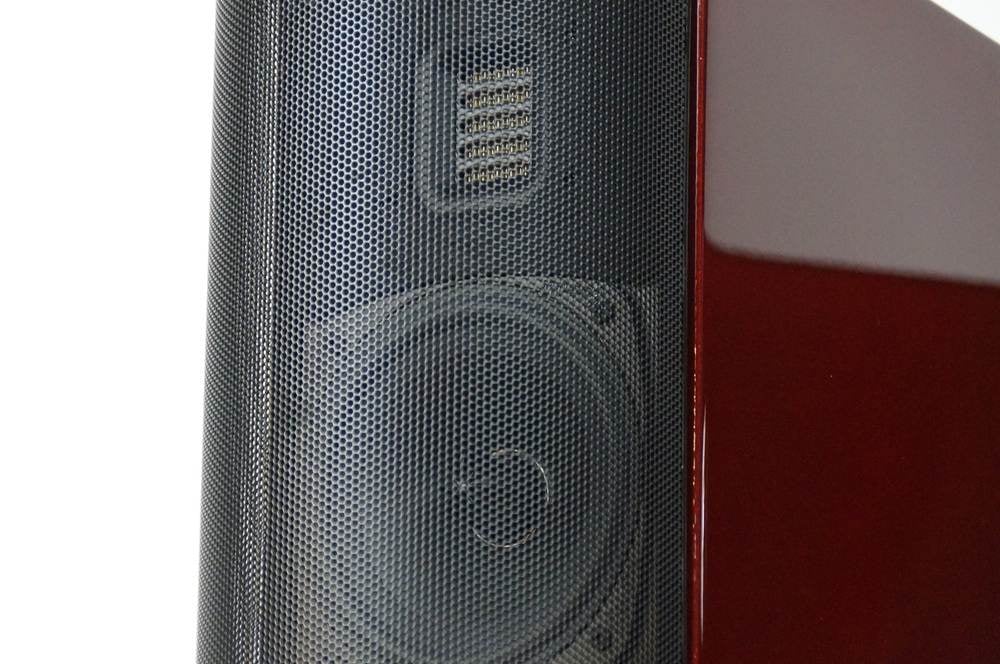
The tweeter is set in a shallow waveguide, and the baffle around the tweeter is covered by a soft fabric pad. The purpose of the pad is to absorb acoustic reflections that might otherwise radiate off the front baffle and cause interference with the direct output produced by the tweeter. This is a valid design strategy sometimes employed by manufacturers, but not often, since it can make the speakers look a bit strange. However, since the front baffle of the T44 is mostly hidden by its unremovable grille, it’s much more feasible to pull off here.
The midrange is handled by a 4.5” cone that uses GoldenEar’s proprietary MVPP (Multi-Vaned Phase Plug). This phase plug is fixed on the pole piece and has a shape that should be better at scattering slight off-phase acoustic radiation emanating from different areas of the cone. That can help to smooth out the top end of the driver’s bandwidth by reducing interference effects. The cone is made from a non-resonant polymer. It is mounted on a cast-aluminum basket, which is attached to a beefy-looking magnet. The pole piece is extended for a more symmetrical magnetic field, which results in lower distortion.
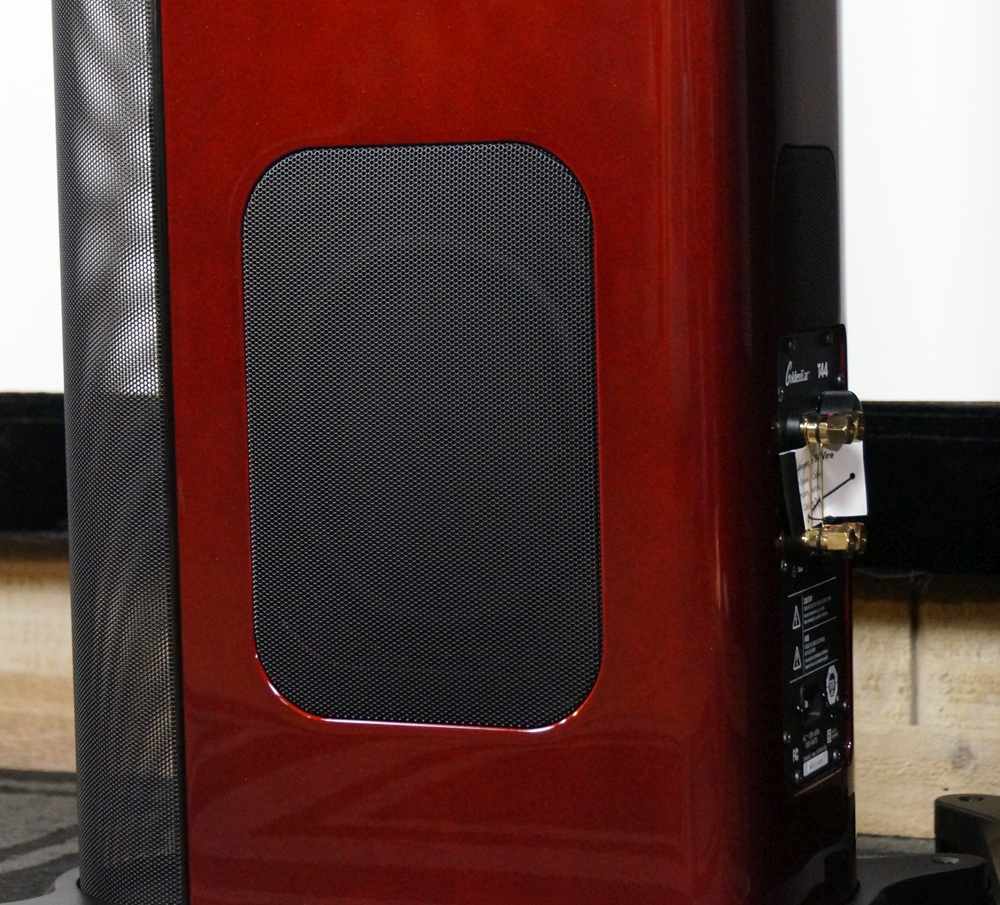
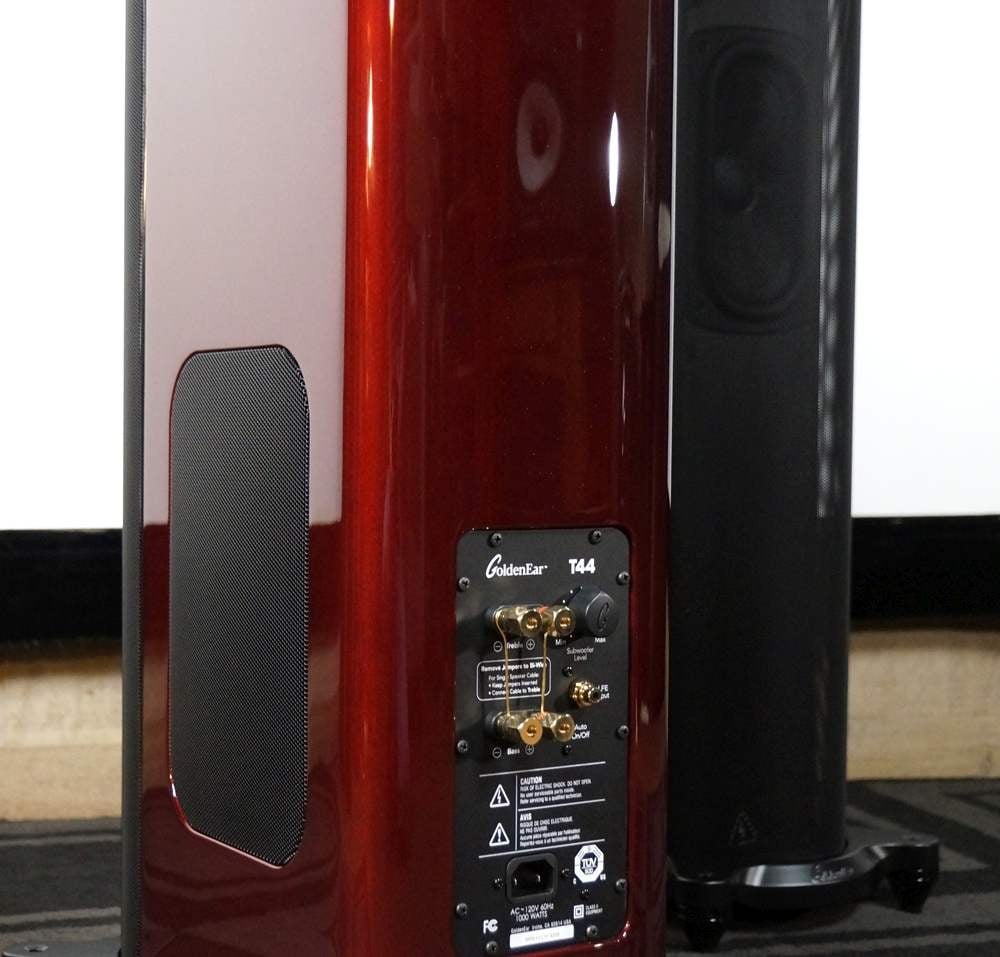
The bass driver is unusual in that the diaphragm is rectangular-shaped rather than circular and has a 5” x 9” dimension, which has about the same area as a 7.2” circular cone. Non-circular driver diaphragms do lose the stiffness of a cone shape, but they can more optimally utilize the surface area of a smaller enclosure. The loss in stiffness shouldn’t be an issue so long as the driver is not tasked with playing higher frequencies. It loads two 6.8” x 8” passive radiators, which are mounted on opposite sides of the enclosure to cancel out the rocking motion that each radiator imparts on the enclosure. I like that the bass driver is loading two passive radiators instead of just one long-throw radiator. Long-throw passive radiators can have a lot of moving mass (not good for responsiveness), and they also do not have the best record for reliability.
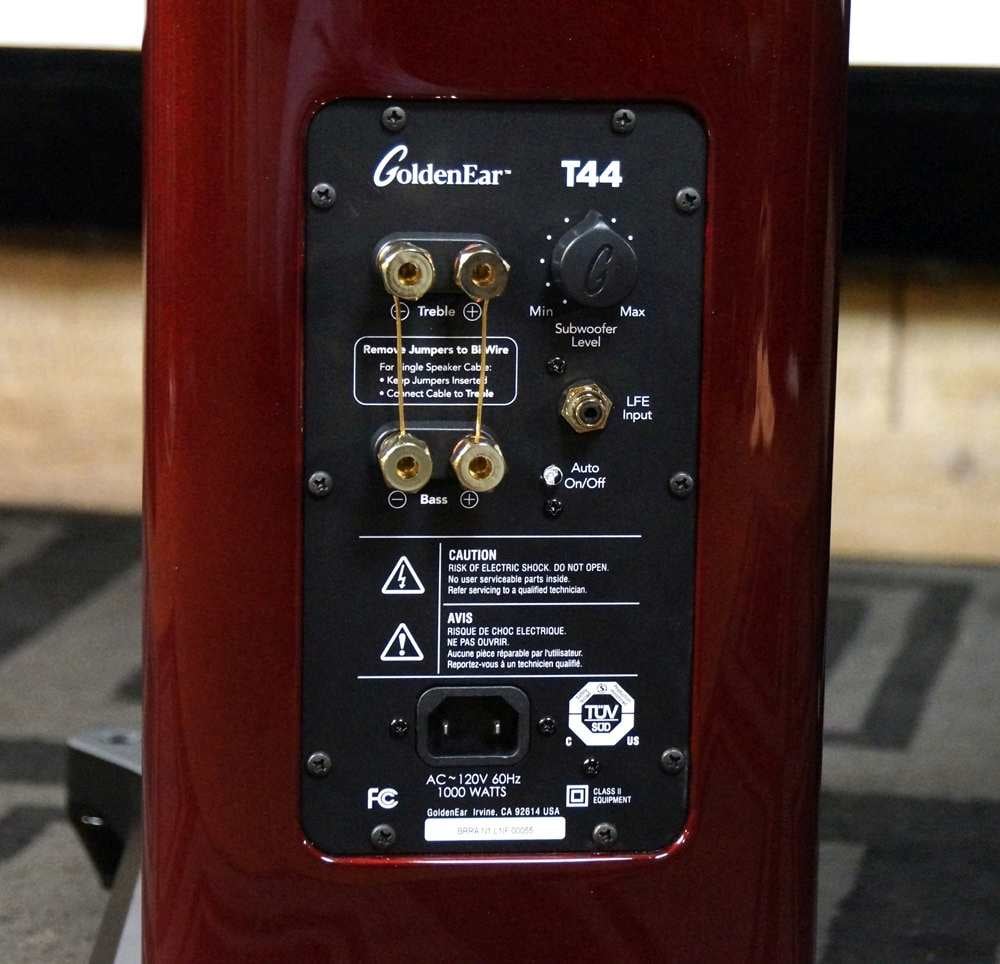
While the tweeter and midrange are a passive system, the bass driver is powered by a 250-watt RMS class-D amplifier. That is a lot of amplification for a single, smallish bass driver, so it must have a heck of a motor to handle all of that power. The signal is controlled by a 56-bit DSP, so GoldenEar should be able to leverage very tight control over its performance. The bass section can accommodate an LFE input for external bass management, or it can just use the signal sent through the speaker inputs to run as a typical full-range tower speaker. The terminal plate has a ‘subwoofer level’ knob that can adjust the bass level to suit users’ tastes.
 The
tweeter is crossed over to the midrange at 3.4kHz, and the midrange crosses
over to the bass driver at an unusually specific 113Hz. This gives the midrange
driver a relatively wide frequency band, which has advantages and
disadvantages. The advantage is that much of the most important range of human
vocals will be uninterrupted by the phase shifting of a crossover filter,
insofar as such phase distortion can be audible. It also increases headroom in
lower treble by taking a load off of the tweeter since the midrange will be far
more capable of displacement in that range than the tweeter. The disadvantage
is that headroom in midbass will be reduced since the 4.5” driver will be
tasked with much of the midbass band, and, overall, more dynamic range will be
lost with these crossover frequency choices than gained. That might not matter
much if the midrange driver is an overachiever.
The
tweeter is crossed over to the midrange at 3.4kHz, and the midrange crosses
over to the bass driver at an unusually specific 113Hz. This gives the midrange
driver a relatively wide frequency band, which has advantages and
disadvantages. The advantage is that much of the most important range of human
vocals will be uninterrupted by the phase shifting of a crossover filter,
insofar as such phase distortion can be audible. It also increases headroom in
lower treble by taking a load off of the tweeter since the midrange will be far
more capable of displacement in that range than the tweeter. The disadvantage
is that headroom in midbass will be reduced since the 4.5” driver will be
tasked with much of the midbass band, and, overall, more dynamic range will be
lost with these crossover frequency choices than gained. That might not matter
much if the midrange driver is an overachiever.
The enclosure seems to be well-built with a fair amount of internal bracing. The curvature of the cabinet serves double duty as something that not only makes the speaker look nicer but also helps to break up internal standing waves. The midrange/tweeter part of the cabinet is sectioned off so that backwave pressure from the bass driver does not affect the midrange driver cone. The cabinet rests on a heavy-duty cast aluminum base that gives the speaker a very stable placement. Metal spikes or rubber tips are provided as choices for the feet. Spikes help to give better footing on carpeted flooring, while rubber tips are what users will want for hard flooring.
As mentioned above, the grille is a shaped metal mesh and is not removable. The T44 uses some polished five-way binding posts for the tweeter and midrange driver and includes jumpers to connect the posts. The T44 speakers can be bi-amped or bi-wired. The gains that can be had from bi-wiring are so negligible that it wasn’t worth the effort or expense to implement this feature, but it probably didn’t cost much to do, and it ticks off a marketing check box for audiophiles who have been misled as to the benefits of bi-wiring. Bi-amping doesn’t seem worth the trouble either because neither the AMT tweeter or the 4.5” midrange driver will be able to handle a lot of power on their own. The lower intermodulation that can be had from bi-amping is also not worth the trouble, since most modern amps don’t push IMD into audible levels.
All in all, we have the ingredients for a modestly-sized floor-standing speaker that should excel in bass extension. Two good-sized passive radiators driven by a woofer that can handle 250 watts should give the T44 some real low-end grunt. Let’s see if that is the case in some real-world listening…
GoldenEar T44 Listening Sessions
In my 24’ by 13’ (approximately) listening room, I set up the speakers a few feet off the back and side walls, and with an equal distance between the speakers and the listening position. I angled the speakers with a slight toe-in toward the listening position. The listening distance from the speakers was about 9 feet. No room correction equalization was used. No subwoofer was used. Processing was done by a Marantz 7705.
Music Listening
To hear what the T44s could do for orchestral music, I looked for some high-definition recordings of Vaughan Williams' work, and settled on a 2003 album titled “Vaughan Williams: Symphonies No. 6, No.8, & Nocturne.” The performed pieces are an interesting selection: Symphonies No.6 and 8 were written late in William’s career, while Nocturne was crafted forty years earlier and has never been recorded as a performance until this release. These performances were led by the celebrated conductor Richard Hickox, who had tackled so much of Williams' work, and were performed by the London Symphony Orchestra. This was released by the Chandos label and features their usual terrific production quality, and I streamed it from Qobuz in a 24-bit/48kHz resolution.
In listening to “Vaughan Williams: Symphonies No. 6, No.8, & Nocturne,” what immediately leapt out was how authoritative a presentation that the T44 speakers gave to this full orchestra. This album starts off with a bang, with the first two movements of Symphony No.6 being very lively pieces of classical music. The low end of the spectrum, here rounded out by the kettle drums and double bass, were powerully relayed by the speakers. They aren’t large tower speakers, but they gave a full-throated rendition of the London Symphony Orchestra, and it was as if I had been plopped in front of a live performance at the Barbican in London. Aiding in that impression was the soundstage generated by the speakers; it had the depth and breadth of a symphonic hall performance. Imaging was very good, instrumental sections were easily discernible in the soundstage, and passages with solo instruments had a good sense of localization. There was a touch of acoustic reverb in the recording, but not enough to smear the positions of the performers. This was evidenced by a vocalist in “Nocturne,” where one could hear the size of the performance space yet understand where the singer’s position was. Tonality was very good, and I did not get a sense of any undue prominence or deficiency across the frequency spectrum. All the instruments sounded natural and not colored by any loudspeaker voicing. A good Vaughan Williams recording is always a treat, especially if heard on a very capable sound system, which the T44 speakers proved themselves to be in my experience with this album.

Eminent blues singer Mavis Staples had a major new release with “Sad and Beautiful World,” and I thought this album would give the T44 speakers a chance to show what they could do when focused on a single human voice. Staples has been a prominent singer since the 1960s, and she doesn’t seem to be slowing down, even at her present age of 86. On this album, she covers an assortment of pieces from songwriters such as Leonard Cohen, Curtis Mayfield, and Kevin Morby, among others. She makes these songs her own with her unique delivery and unmistakable voice. This production is an excellent exhibition of Staples’ tremendous talent and tight vocal control. I streamed this release from Qobuz in a 24-bit/88kHz resolution.
The first track, “Chicago,” was a rambunctious opener that was more rock than blues, and it demonstrated a surprising level of energy given Staples’ age. The T44 speakers delivered this track with gusto, and I actually turned the volume down a bit since I had settled in for a soulful blues album rather than a rowdy rock album. Subsequent tracks took down the energy levels a notch, which came as a relief since Mavis’ voice was not being crowded by busy instruments. Mavis’ weathered voice takes center stage in this album, and the T44 speakers reproduced her with crystal clarity and detail. One can hear that she isn’t young, yet she sings with vitality that would be enviable by anyone of any age. The speakers imaged her with pinpoint precision; track five, “Hard Times,” demonstrates this best and anchors her to the dead center of the soundstage. Likewise, instruments had their well-defined positions with the acoustic guitar slightly to her left, the electric guitar just to the right, and a saxophone at the far right. Mavis, as well as her instrumental accompaniment, sounded well-balanced. Staples’ voice was crisply rendered without becoming harsh or sibilant. The top-notch production quality was beautifully exhibited by the speakers, and I could not detect any shortcomings in their reproduction of “Sad and Beautiful World.” It’s an engaging album and deserves a quality sound system for a close listen.
Another brand new release from an entirely different end of the musical spectrum is Oneohtrix Point Never’s “Tranquilizer.” Oneohtrix Point Never is an electronic music artist and is no stranger to regular readers of my reviews on account of his idiosyncratic sound design, which pushes the soundstage towards the extremes of stereophonic sound. “Tranquilizer” does this as well, but it is on the calmer end of Oneohtrix Point Never’s spectrum, although not quite tipping over into ambient music. It is still a wild ride for an adventurous listener and is great for demonstrating what a sound system can do with some far-out imaging. This is another release I streamed from Qobuz on hi-res.
The first track, “For Residue,” was a taste of things to come in terms of soundstage experimentation, with sounds originating from physically impossible locations in any natural setting. The T44 speakers imaged these sound sources with a fine level of precision. The succeeding track, “Bumpy,” was a gorgeous rainbow of electronic sounds that the speakers spread out before me in an enveloping soundstage. Indeed, the soundstage seemed to expand beyond the width of the speaker’s placement. The next track, “Lifeworld” (which has a very cool music video, by the way), was a mellow and panoramic piece of music with a soundscape that was made tangible by the T44 speakers. Subsequent tracks kept up the inventive sampling, sound experimentation, and wild stereo imaging that Oneohtrix Point Never is famous for. It all sounded terrific on the GoldenEar speakers. There wasn’t a bad track on this album, but some highlights were “Modern Lust” with its striking vintage lead synths, the bizarre shifts in tone on “Fear of Symmetry,” the intricate multitrack sampling on “Vestigel,” and the kaleidoscopic effects processing on “DIS.” “Tranquilizer” was another great album from an artist who has already established a formidable body of solid albums. But music this extravagantly sculpted and sequenced really benefits from a high-fidelity sound system, and on that count, the T44 speakers delivered.
The legendary drum’n’bass trio Noisia has been disbanded for a few years now, but their legacy has been kept alive and well with the “Resonance” series: a string of albums that curate remixes of many Noisia classics. “ The latest in this series is the newly released “The Resonance VIII,” which features remixes from notable artists such as Posij, Spor, and Mefjus. As boundary-pushing electronic music, this album is ideal for demonstrating the dynamic range of a sound system, especially on the low end. The design of GoldenEar’s T44 speaker suggests it should have some hefty bass, but “The Resonance VIII” will put that to the test.
The first track, “Dead Limit (Simula Remix),” had a gradual intro that built up to a world-class drop, and when it hit, the T44 speakers brought the thunder. At that moment, these speakers brought the rave into my living room. From listening to other content, I knew these speakers were fairly capable in bass, but this was still a bit of a surprise. The following track, “Pleasure Model (Ring Nord 172 Mix),” took one of my favorite Noisia tracks to twisted new heights. It brought an even heavier bass line as well as a bonkers processing on the lead synth. It killed on the T44 speakers and might be a rare remix that I prefer to the terrific original. The ‘Breaks Remix’ of the D’n’B classic “Exodus” brought a rolling bassline that had some real meat thanks to the GoldenEar speakers. Similarly, the kick drums on Maudeep’s remix of “Voodoo” had a nearly physical punch. I cranked the system up to see how loud it could get, and, as expected, the bass could not keep up with the midrange and treble at truly loud levels. There is only so much a 5” x 9” driver can pump out, even when backed by 250 watts RMS. The system could get loud for any comfortable listening level, but beyond that, the low frequencies compress. Most listeners would be pretty happy with the dynamic range on tap, but the T44s wouldn’t be able to keep up with a house party or anything extreme. It looks to me like GoldenEar had a specific SPL target for dynamic range where they determined most users would not likely listen past, and met that target but did not try to exceed it, which is a sensible move to keep costs down. The T44s have their limitations, but I did not run into them at any level that I would typically listen at. As such, I enjoyed “The Resonance VIII,” and I think most lovers of electronic music would like what these speakers have to offer. However, those seeking truly club-like levels of loudness will want to look at loudspeakers with a wider dynamic range.
Movie Watching
For something to watch that would exhibit the T44’s ability to tackle an epic sound mix, I watched the fifth season of “Stranger Things,” which would surely have some real audio fireworks. Given the rumored budget of over 400 million dollars, it would surely have the best sound production that money could buy, including many nostalgic pop hits from the 80s. I have enjoyed the previous seasons of this show so far, so I was looking forward to binge-watching the fifth and final season of “Stranger Things.”
After having watched the fifth season, I get why it was met with mixed reception, but I was OK with it. Needless to say, the sound design was pretty epic, especially as heard through the T44 speakers. One highlight was the demigorgon attack on the military base in Hawkins, where the doomed soldiers haplessly attempt to stop the creatures with small arms fire. The popping of gunfire was energetically relayed by the T44s, especially the fifty caliber mounted gun, and the shrieking of the monsters as they leapt to attack was delivered with a piercing screech. Another scene that allowed the T44s to shine was when the ‘wall’ in the upside-down was breached, which created a hole that sucked in its environment like a giant vacuum. The colossal whooshing sound of the suction made the speaker’s bass drivers work overtime, but they conveyed the scale of the disaster with authoritative gusto. Of course, the climax that featured the final battle with Vecna was a buffet of wild sound effects, and the T44 speakers did not disappoint. Not to spoil anything for those who haven’t watched it yet, but the colliding worlds of the upside-down and the right-side up were reproduced with vivacity by the speakers. The bass was fairly deep and well-controlled, and the mids and highs were vibrant and forceful. Dialogue was always intelligible, even during the wild action scenes. The music was terrific, as usual, and the licensed pop music, as well as the original soundtrack, all sounded superb. I enjoyed the fifth season of “Stranger Things” and thought it was a proper send-off to this now iconic show. However, it really helps to have a good A/V system to bring such an effects-driven show to life, and the T44 speakers proved to be a part of that.


A movie I had been anticipating was Robert Eggers’ “Nosferatu.” I have a great admiration for both Robert Eggers' work so far as well as the original 1922 “Nosferatu,” so I was intrigued to see what Eggers could bring to this iconic horror classic. Nosferatu has proven to be a source of sonic inspiration, as we saw when we reviewed the DALI Rubikore 8 speakers with Christopher Young’s fantastic new score for the original film. “Nosferatu” should be a rich gothic horror palette to someone as inventive as Eggers, and I was sure it was going to be a real treat for a high-performing sound system.
This movie exceeded my expectations on nearly every level. It looked amazing, it moved swiftly, the characters were more fleshed out than prior versions of this story, and the sound design was spectacular. I am glad I had such competent speakers with which to experience this movie, because the sound was so important to the experience. The main character is a woman who is cursed by the titular creature, and the phantasmagorical sounds of her subjective haunting were vividly relayed by the T44 speakers. Her husband’s trek into Transylvania was also an aural delight, with the bizarre Romani celebrations, the threatening environmental sounds of the Carpathian mountains, and the ominous approaching of the carriage of Nosferatu. These scenes were all rendered with an unsettling fervency by the speakers. A highlight of the sound mix was Nosferatu’s guttural voice that seemed to emanate from everywhere. On the T44 speakers, it had a frightening ominpresence that was given real weight by the speakers’ bass capability. In my room, I was getting usable bass down to just below 30Hz. The orchestral score by Robin Carolan also deserves praise for its combination of gothic atmosphere and bombastic horror. Its articulate reproduction by the speakers made for a tense viewing. Dialogue intelligibility was good, and nothing spoken was lost on me, at least for any fault in the sound system. The dialogue was period accurate, and Nosferatu’s accent was extremely thick, yet the T44’s allowed me to follow it all without issue. Egger’s “Nosferatu” was a terrific movie and a lot of fun on a competent sound system. I am eagerly awaiting his next movie, “Werwulf,” which is coming out later this year.
Goldenear T44 Floor-Standing Loudspeaker Measurements and Analysis
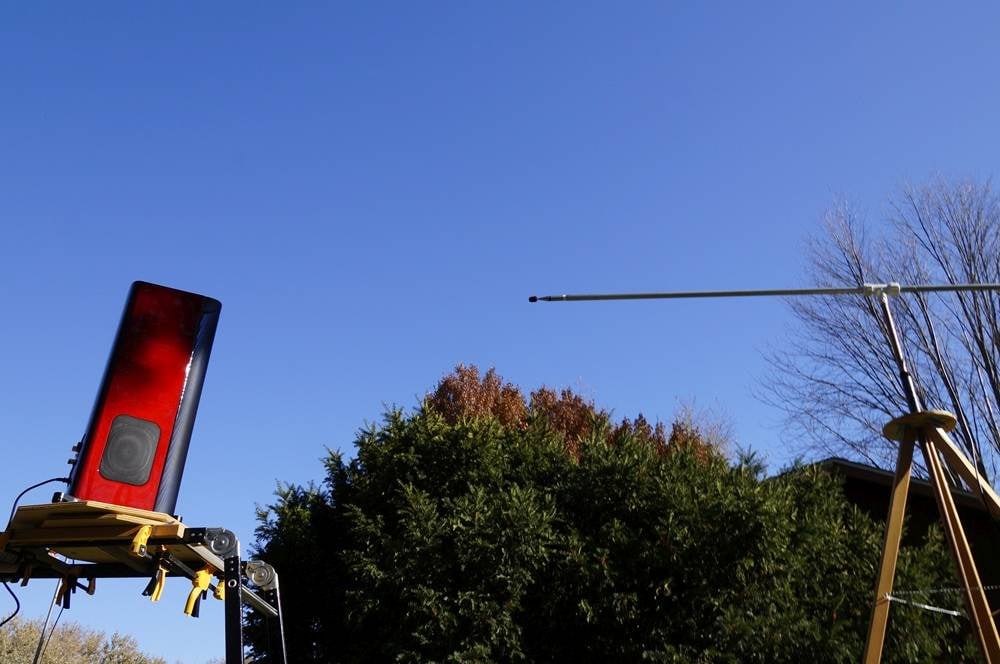
The GoldenEar T44 Tower was measured in free-air at a height of 4 feet at a 2-meter distance from the microphone, with the microphone raised to an 8’ elevation that was level with and aimed at the tweeter center. The measurements were gated at 8 milliseconds. In this time window, some resolution is lost below 400 Hz, and accuracy is completely lost below 200 Hz. Measurements have been smoothed at a 1/24 octave resolution.
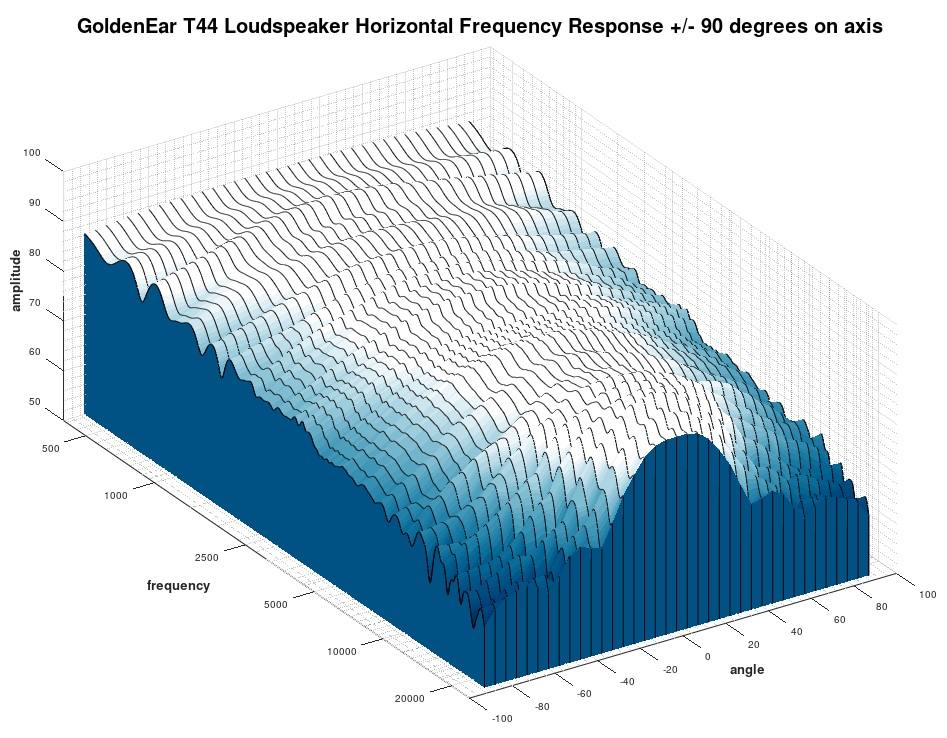
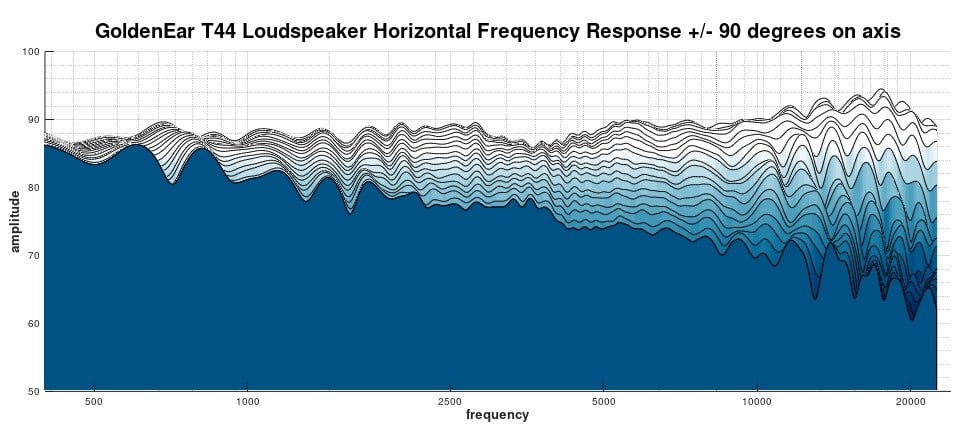
The above graphs depict the GoldenEar T44’s direct-axis and horizontal dispersion out to a 90-degree angle in five-degree increments. Information on how to interpret these graphs can be read in this article: Understanding Loudspeaker Review Measurements Part II.
The T44 holds a relatively neutral response overall, but with a couple of quirks. The most obvious trait is the rising treble, especially above 10kHz. This mostly just happens around angles near the on-axis angle, so users who would prefer a softer high-treble sound can simply not have the speakers face the listening position directly. This won’t have a dramatic effect on the sound since frequencies above 10kHz are not heavily used, and many adults’ hearing does become less sensitive to such a high frequency band, especially older adults. Nonetheless, some people are more sensitive to high treble, and simply angling the speaker outward a bit does attenuate that range by a substantial amount. Another quirk in the response that we see is a slight dip around the crossover region between the tweeter and midrange. This is barely a 2dB recession; however, it does occur in a region where human hearing is the most sensitive, plus it is somewhat wide in bandwidth. It may be audible in content that users are very familiar with, but I wouldn’t expect it to color the tonality by a whole lot. I don’t think many people would notice it unless they were trying to listen for it specifically. As with the high treble rise, it affects angles near the on-axis response. Again, a more neutral response can be had by simply not toeing the speaker inward. Having the T44 speakers face forward in parallel is going to yield the most balanced sound.
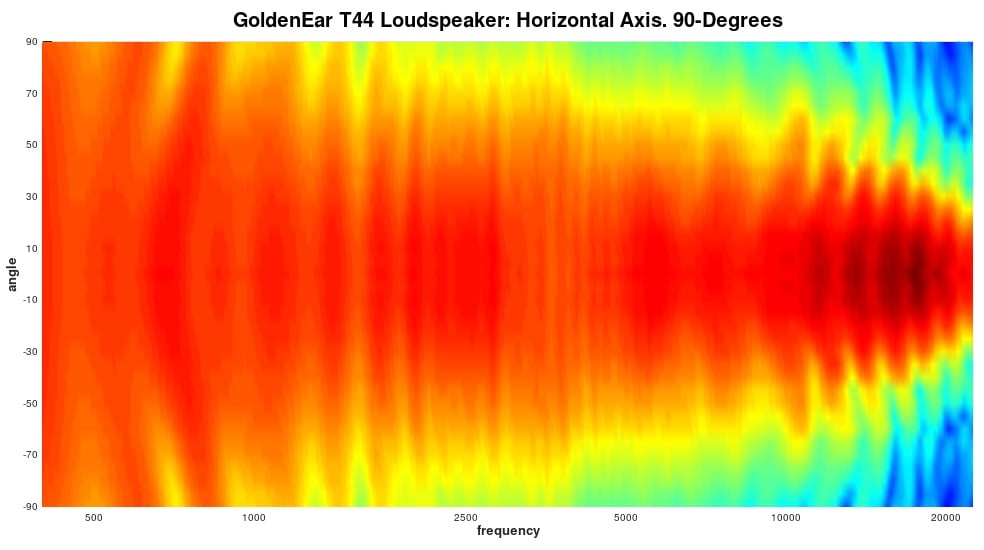
The above polar map shows the same information as the preceding graphs but depicts it in a way that can offer new insight regarding these speakers’ behavior. Instead of using individual raised lines to illustrate amplitude, polar maps use color to portray amplitude, and this allows the use of a purely angle/frequency axis perspective. The advantage of these graphs is they can let us see broader trends of the speaker’s dispersion behavior more easily. More information about interpreting this graph can be read in this article: Understanding Loudspeaker Measurements Part II.
The T44 has a fairly well-controlled dispersion pattern that, while it does gradually narrow as frequencies rise, doesn’t have much in the way of major flare-outs or inconsistencies. The only notable oddness in directivity comes from how hot the upper treble is near the front angle versus how quickly it subsides as the angle changes just a bit. Aside from that, this speaker largely retains its tonality over a wide angle. Again, we see a little bit of softness around 3kHz, but that shouldn’t contribute a major shift in tonality. To look for the most even sound, we want to follow an evenly red color across a horizontal line. Looking at this graph closely, it looks like that happens the most at around 30 degrees, which, as mentioned earlier, is about the angle they would be positioning at were the user to face them outward in parallel vectors.
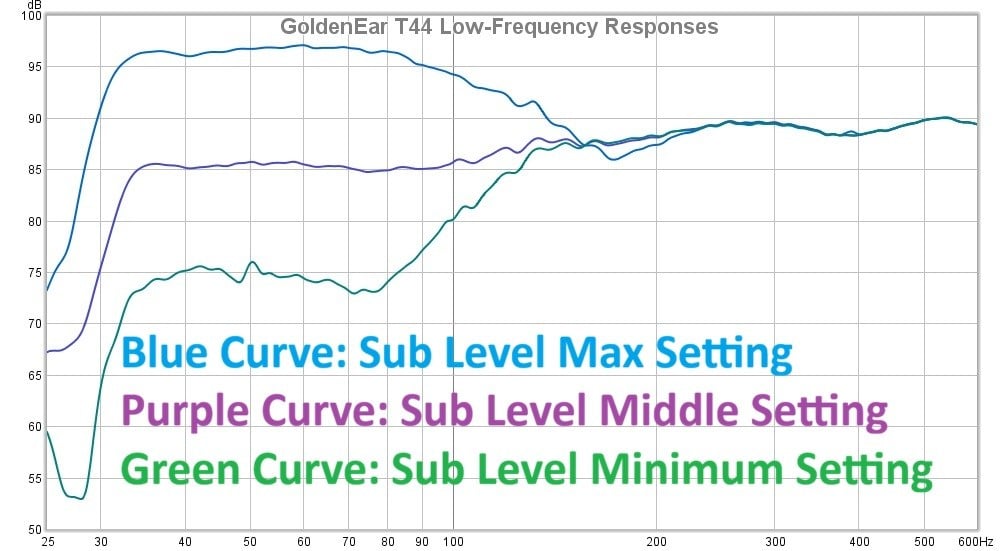
The above graph shows the T44’s low-frequency responses captured using ground plane measurements (where the speaker and microphone are on the ground at a 2-meter distance in a wide-open area). In this graph, we see how the ‘Subwoofer Level’ knob affects the response; at the maximum setting, middle setting, and minimum setting. We can see that, at the extremes, the ‘Subwoofer Level’ knob can add or subtract about 10dB from the low-frequency response. That is more than I was expecting. I would recommend most users keep it around the middle setting for the most even tonality, which is about 12 o’clock on the sub dial. Those who do love their bass can crank it up quite a bit, but remember that the T44 speakers only have so much low-frequency headroom before they start to compress.
I measured the T44’s sensitivity to be 87.5dB for 1 meter at 2.83V. This is a bit below GoldenEar’s spec of 89dB for the same voltage over distance. Either measurement is okay for a moderate-sized tower speaker and is around what one would expect. The T44 speakers do not have unusually high sensitivity or unusually low sensitivity. A typical amp should be able to get them loud enough for most users, and I don’t think anything heavy-duty is needed to power them, not that they could handle a whole lot of power. Remember, all that is being separately powered is the midrange driver and tweeter, since the bass section is self-powered. A hundred watts per channel is probably enough to get the most out of these speakers.
GoldenEar T44 Conclusion
 Before bringing
this review to a close, I will briefly go over the strengths and weaknesses of
the product under evaluation, and since I am the kind of person who always
wants the bad news first, I will start with the weaknesses of the GoldenEat T44
speakers. The T44 speakers are pretty well-rounded and don’t have any serious
weaknesses in my eyes. The one thing I might criticize them for is that they
don’t have a massively wide dynamic range for their $5k/pair cost. They get
about as loud as one would expect from a moderately-sized tower speaker and
certainly sufficient for typical living room use, but I would not try to use
them to power a dedicated home theater room. They have built-in subwoofers, but
don't mistake those subs for some heavy-duty 15s or even 12s. They aren’t bad
for the packaging, but they do not have the punch or rumble of a
high-performance subwoofer. If pushed hard enough, their limitations in
low-frequency dynamic range become fairly evident.
Before bringing
this review to a close, I will briefly go over the strengths and weaknesses of
the product under evaluation, and since I am the kind of person who always
wants the bad news first, I will start with the weaknesses of the GoldenEat T44
speakers. The T44 speakers are pretty well-rounded and don’t have any serious
weaknesses in my eyes. The one thing I might criticize them for is that they
don’t have a massively wide dynamic range for their $5k/pair cost. They get
about as loud as one would expect from a moderately-sized tower speaker and
certainly sufficient for typical living room use, but I would not try to use
them to power a dedicated home theater room. They have built-in subwoofers, but
don't mistake those subs for some heavy-duty 15s or even 12s. They aren’t bad
for the packaging, but they do not have the punch or rumble of a
high-performance subwoofer. If pushed hard enough, their limitations in
low-frequency dynamic range become fairly evident.
Aside from bass compression at high drive levels, it’s all good news for the T44 speakers, so let’s start listing their strengths by talking about the sound quality. The T44 speakers have a fairly balanced sound, especially if oriented to face straight ahead rather than toed inward. Users get a smooth and even sound without losing detail, so the music sounds clear and natural. Bass extension is good for the size of the speakers, and I was getting a bit below 30Hz in my nearly 4,000 cubic foot room. The ability to adjust bass level to user preference is a nice touch. Soundstage and imaging are good, and I had no problem placing sound sources throughout a wide soundstage. These speakers project sound at a fairly wide angle and so do not have a small sweet spot where everything sounds just right.
Aside from their sound, they look very stylish without being overdone or flamboyant. They are not a boring-looking speaker, nor will they be an eyesore, even within a more traditional interior decor. The Santa Barbara Gloss Red is a very nice finish that I think looks nicer than the typical gloss black and wood veneers of most speakers. They are not huge tower speakers and do not have a large footprint, and that will be a big plus to many people. The build quality is okay for the cost, and it gets the job done.
GoldenEar’s T44 speakers are a great choice for a full-range speaker system where appearance and size are important criteria. They sound great, and they look great. At $5k/pair, they are not cheap, but there is no way to get such a well-rounded system for a low cost. If I were to set up speakers in a room with a high-end interior decor, but I did not want to compromise sound quality, they would be hard to beat for the cost. The T44s proved that high-fidelity can co-exist alongside high style with ease. I enjoyed my time with the T44s, and I would encourage prospective buyers who are looking for a speaker system that sounds great without upsetting other household occupants by having a humdrum appearance.
The Score Card
The scoring below is based on each piece of equipment doing the duty it is designed for. The numbers are weighed heavily with respect to the individual cost of each unit, thus giving a rating roughly equal to:
Performance × Price Factor/Value = Rating
Audioholics.com note: The ratings indicated below are based on subjective listening and objective testing of the product in question. The rating scale is based on performance/value ratio. If you notice better performing products in future reviews that have lower numbers in certain areas, be aware that the value factor is most likely the culprit. Other Audioholics reviewers may rate products solely based on performance, and each reviewer has his/her own system for ratings.
Audioholics Rating Scale
 — Excellent
- — Very Good
- — Good
- — Fair
- — Poor
| Metric | Rating |
|---|---|
| Build Quality | |
| Appearance | |
| Treble Extension | |
| Treble Smoothness | |
| Midrange Accuracy | |
| Bass Extension | |
| Bass Accuracy | |
| Imaging | |
| Dynamic Range | |
| Fit and Finish | |
| Performance |  |
| Value | |
James Larson is Audioholics' primary loudspeaker and subwoofer reviewer on account of his deep knowledge of loudspeaker functioning and performance and also his overall enthusiasm toward moving the state of audio science forward.
View full profile Subscribe to our newsletter