


Focal Diva Utopia Active Loudspeaker Review
Focal's Diva Utopia Active Loudspeaker
- Product Name: Diva Utopia
- Manufacturer: Focal
- Performance Rating:


- Value Rating:
- Review Date: March 10, 2026 00:00
- MSRP: $ 39,999
- Product Type: Fully active, wireless, 3-way floorstanding loudspeaker system
- Price: $39,999 / pair
- Configuration: Factory-paired stereo speakers
- Tweeter: 1⅝-inch (27 mm) IAL2 pure beryllium M-profile inverted dome
- Midrange: 6.5-inch “W” sandwich composite cone
- Woofers: Four 6.5-inch “W” sandwich composite drivers (side-firing, push-push configuration)
- Amplification (per speaker):
- • Tweeter: 75 W RMS (Class AB)
- • Midrange: 75 W RMS (Class AB)
- • Bass: 2 × 125 W RMS (Class AB)
- • Total Power: 400 W RMS per speaker
- • Amplifier Design: Naim Audio
- Frequency Response: 27 Hz – >40 kHz
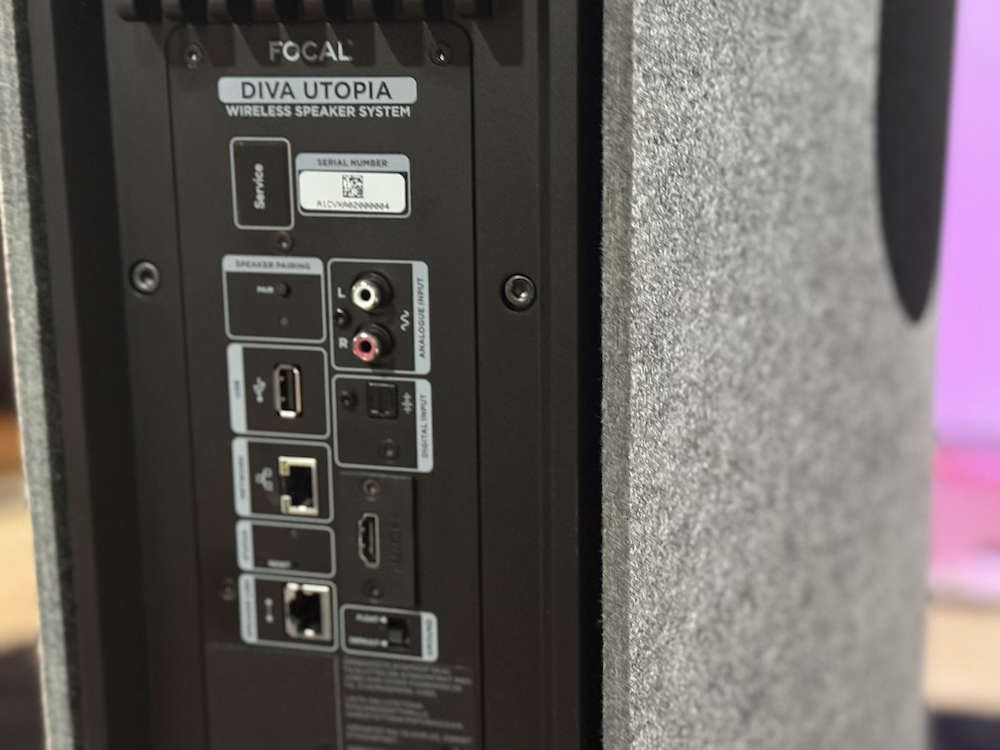
- Inputs: HDMI eARC (CEC), Optical Toslink, USB 2.0, Analog RCA, Ethernet (RJ45)
- Wireless Connectivity: Wi-Fi, Bluetooth 5.3 (aptX Adaptive)
- Inter-Speaker Link: Ultra-Wideband (96 kHz/24-bit wireless), RJ45 wired up to 192 kHz/24-bit
- Streaming Services: AirPlay 2, Google Cast, Spotify Connect, TIDAL, Qobuz, QQ Music (QPlay), UPnP
- Supported Formats: FLAC, ALAC, AIFF, WAV, DSD64/128, OGG, AAC
- Multi-Room: Up to 32 Focal/Naim devices
- Room Correction: ADAPT (Adaptive Acoustic Personal Tuning)
- Cabinet: High-density polymer, bass-reflex design
- Serviceability: Slide-out electronics and amplifier module
- Mobility: Integrated wheels; spikes and floor protectors included
- Weight: 141 lbs (64 kg) per speaker
- Finish: OEKO-TEX® felt side panels (standard)
- Optional Panel Finishes: Black High Gloss, Dune High Gloss, Off-White High Gloss
Pros
- Reference-grade sound in a fully active, integrated system — no external preamp, DAC, streamer, or power amps required
- Outstanding tweeter performance from the new IAL2 pure beryllium tweeter
- Excellent midrange clarity and imaging, with strong vocal focus and soundstage precision
- Powerful, controlled dynamics thanks to Naim-designed, Class AB amplification
- Ultra-Wideband (UWB) wireless connection provides stable, low-latency high-resolution wireless performance between speakers
- ADAPT room correction is simple, fast, and effective—especially for bass control in real rooms
- Smaller footprint than other Utopia tower speakers
- Thoughtful industrial design and serviceability, including interchangeable panels and slide-out electronics module
Cons
- High cost of entry. Optional high-gloss side panels add significant expense
- No subwoofer output or bass management, limiting flexibility for distributed bass
- No native Roon RAAT support, though you do have AirPlay and Chromecast workarounds
- Only one ADAPT calibration profile can be stored, reducing flexibility for multiple listening setups
- ADAPT Bass control is intentionally non-destructive and cannot match advanced room correction systems like Dirac ART and multiple subs
Focal Diva Utopia Introduction
Focal’s Diva Utopia line marks a historic turning point for the legendary French speaker maker. On one hand, it carves a clear path for Focal’s future — the company’s first fully active, wireless Utopia‑class loudspeakers. On the other, it underscores Utopia as the statement line for the exclusive luxury clientele. Having attended the Diva’s New York City launch and lived with a review pair for roughly six months in my acoustically treated theater, one thing is clear: The Diva Utopia is for the passionate music lover who wants true high-end sound married to high tech in an elegant, easy-to-use, cable‑minimal system. Let’s take a closer look.
Focal Design & Aesthetics
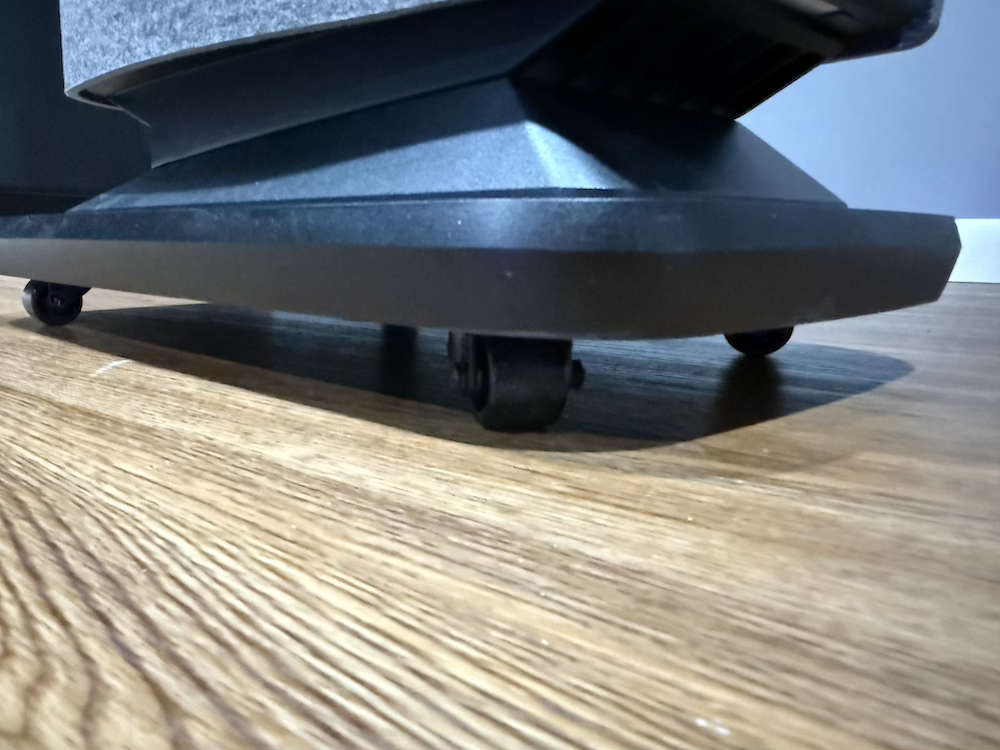
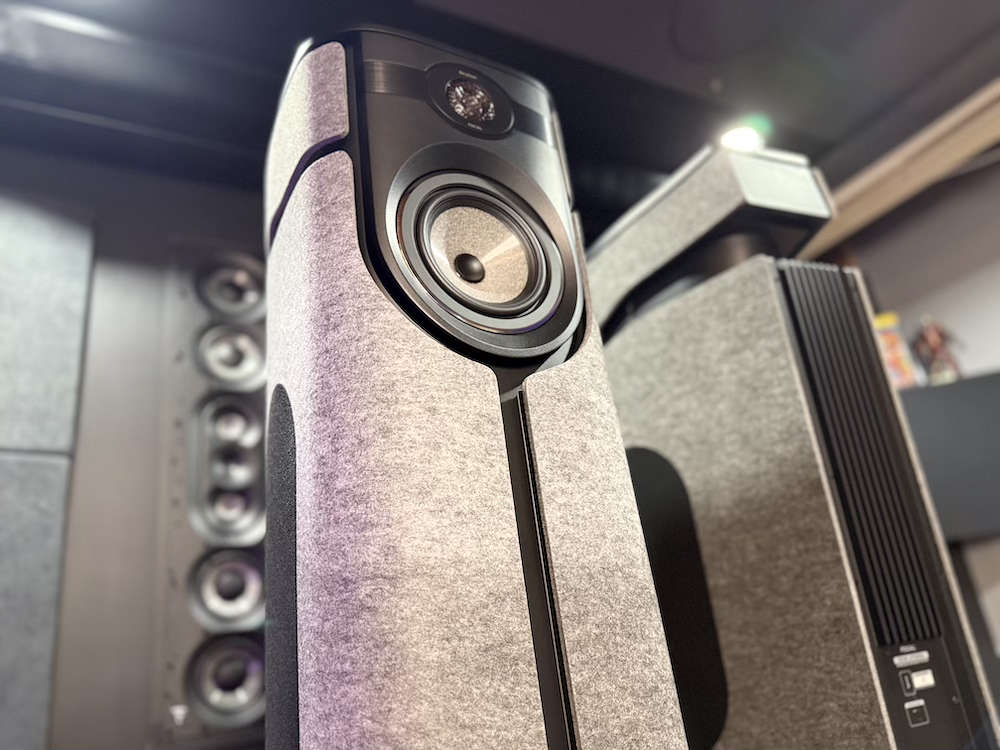
At first glance, Diva Utopia looks every bit a Utopia. It’s a three‑way floor-stander whose silhouette echoes the Utopia family design; think of it as a shorter, slimmer sibling to the Scala Utopia Evo, which I reviewed in 2024. The cabinet sits on concealed wheels (spikes and hardwood floor protectors included) and exudes the kind of industrial refinement you would expect from Focal.
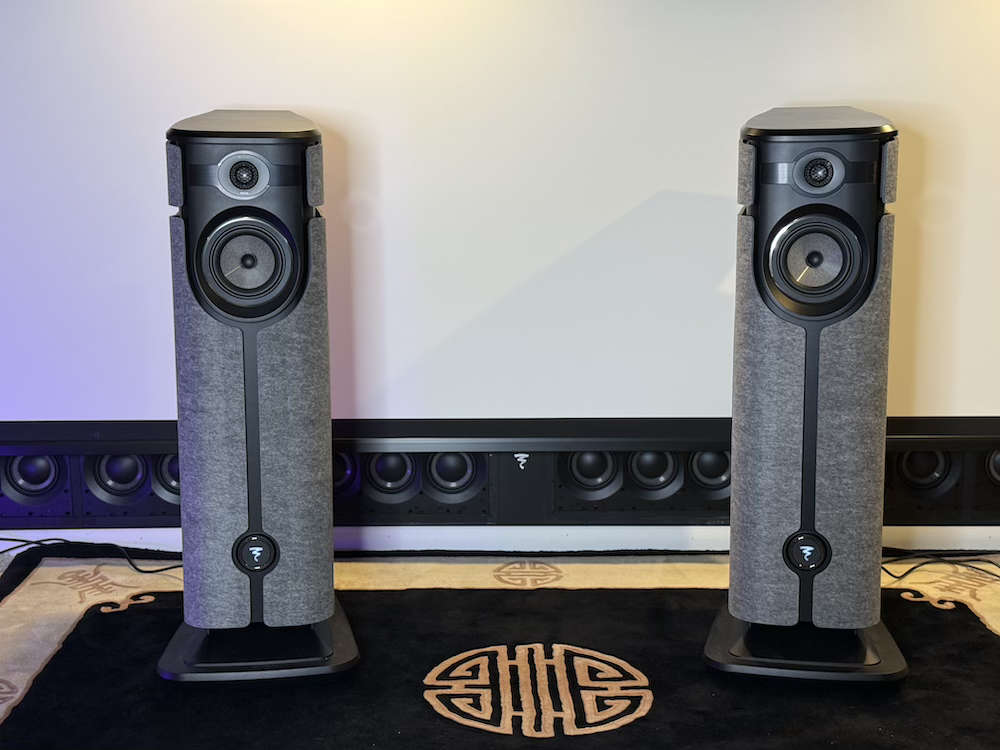
Focal Diva Utopia Active Loudspeaker
IAL2 Tweeter: Diva Utopia was the first Focal speaker to debut the IAL2 second‑generation pure beryllium tweeter, a 1 5/8‑inch M‑profile inverted dome with breakup well past 40 kHz. The Diva's larger sibling, the more powerful Diva Mezza Utopia, also sports the IAL2 Tweeter. In practice, this tweeter delivers everything a beryllium tweeter should: Exceptional rigidity, lightning fast transients, and extended highs with low distortion. In my room, the top end was effortless, airy, and non‑fatiguing — reaffirming why beryllium remains my reference choice at this level.
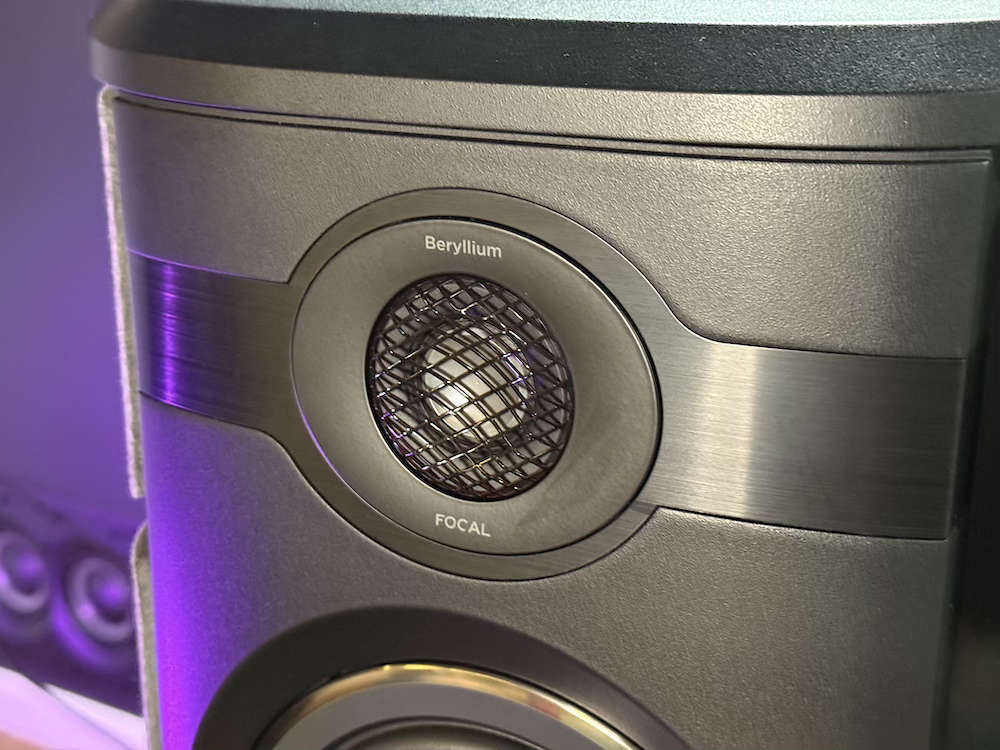
Detail of the Focal Diva Utopia IAL2 Beryllium Tweeter
Midrange Driver: The Diva has a 6.5‑inch W‑sandwich composite mid‑bass driver. Focal’s W cones sandwich one or more glass fiber skins around a structural foam core, delivering a balance of lightness, rigidity, and self‑damping. This tech is central to the Utopia line’s low coloration and transient speed.
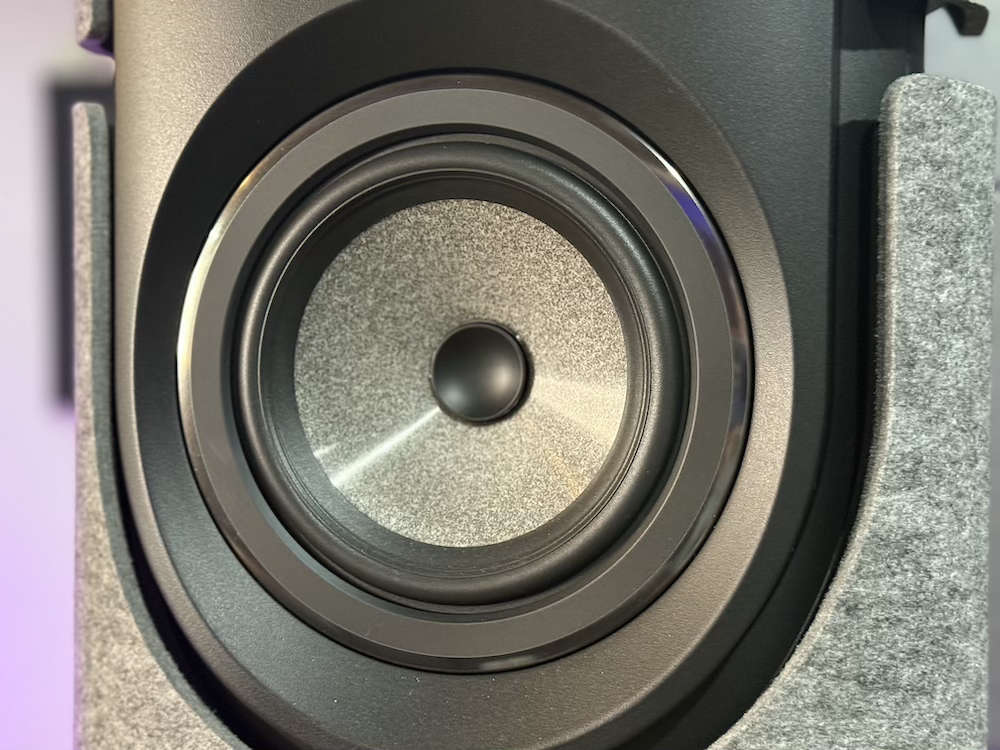
Bass Drivers: Low frequencies are anchored by four 6.5‑inch W‑sandwich woofers in a push‑push, side‑firing configuration, rated to 27 Hz (‑3 dB). Choosing four smaller side‑mounted drivers instead of a single large cone (e.g., the 11‑inch woofer found on Scala Utopia) enables a narrower baffle and smaller footprint. In my space, that made placement around my screen significantly easier—and more visually pleasing—than with the Scala.
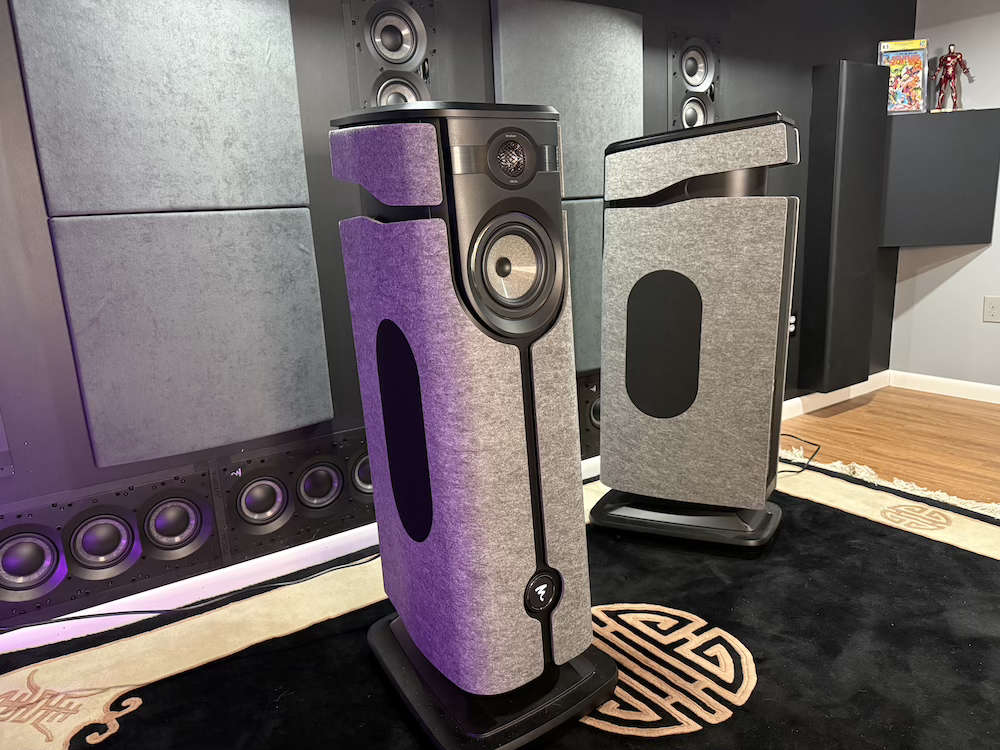
The Diva's Bass Drivers are hidden behind the pill-shaped black cloth on either side of the Diva
Focal Cabinet & Panels
The cabinet is formed from high‑density polymer, first seen in Focal’s Kanta line, and optimized for rigidity and damping. Regardless of source material — symphonic crescendos, modern bass‑heavy tracks, or movie LFE tests — cabinet resonance was a non‑issue as expected for a reference‑grade enclosure.
Visually, Diva stands apart with interchangeable side panels. The standard felt panels (a heathered‑gray, OEKO‑TEX®‑certified fabric) are floating/removable and purely aesthetic, without any acoustical impact on the speaker. While some Internet trolls early on poked fun at the fabric panels as “cat scratching posts,” in person the panels look gorgeous and are incredibly practical: I appreciated handling the speaker without worrying about marring a piano‑gloss finish with a ring or accidental bump.
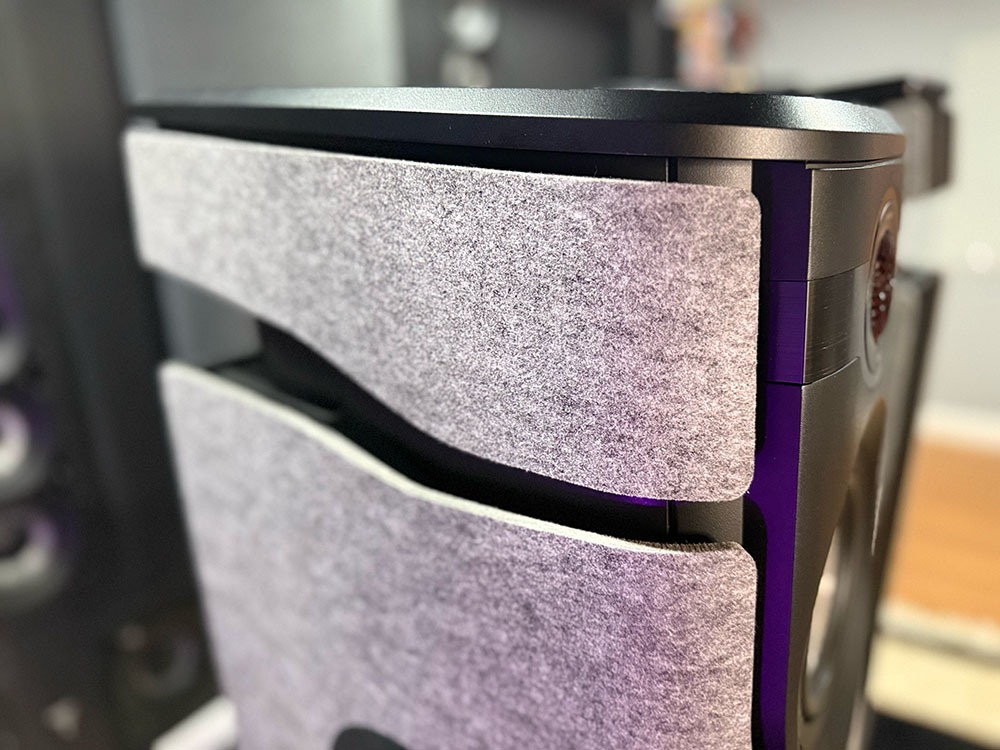
Detail view of the Diva's heathered‑gray, OEKO‑TEX®‑certified fabric
Focal has since added Black High Gloss, Dune High Gloss, and Off‑White High Gloss panel options. Dune shimmers with gold/silver highlights; Off‑White has a silky, modern sheen. The optional panel sets retail for $9,500 and are available at Focal powered by Naim stores. They can be swapped anytime to suit interior design changes — and they add a dose of real‑world serviceability should a panel get dinged.
The Diva has some other design easter eggs. If you look at the Diva’s baffle you’ll also note that the negative space forms a stylized tuning fork.
Focal Amplification, Electronics & Serviceability
Under the hood, Diva Utopia is fully active: It features a preamplifier (with analog/digital inputs), network streamer, and amplification are all built in. There’s nothing else to buy to start listening.
Amplification is by Naim, with power specifically optimized for each driver: 75 W RMS to the tweeter, 75 W RMS to the midrange, and two 125 W RMS (250 W total) channels dedicated to bass. Anodized aluminum heatsinks integrated into the rear of the cabinet dissipate any waste heat from the Class AB amps. Focal was sensitive to its audiophile heritage and audiophile leanings of its target customer. Therefore Focal chose to eschew any Class D amplification. Crossovers are active too, optimizing driver integration and dynamic headroom.
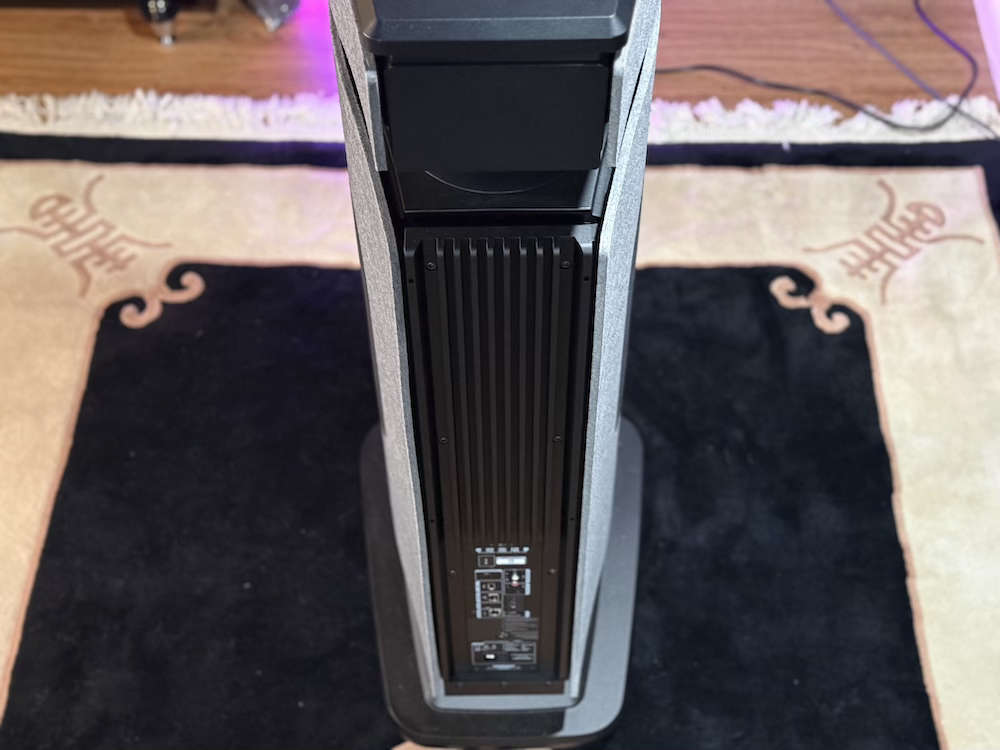
Detail of the Aluminum heat sink on the Diva's rear to dissipate heat from the Class AB amps and electronics
Serviceability is key to any purchase. What makes the Diva Utopia unique is that the entire electronics module slides out for rapid replacement or servicing. If anything ever fails, you don’t ship a 141‑pound cabinet — the module swaps in minutes. That’s a big deal at this level.
Focal Wireless Architecture & Connectivity
Just in case it’s not obvious, each speaker requires AC power. Focal pre-pairs each speaker at the factory to make them plug and play. If you do need to re‑pair, a factory reset does the trick. Speaker-to-speaker wireless communication employs cutting edge Ultra‑Wideband (UWB) wireless tech— not Bluetooth or Wi‑Fi. The UWB connection delivers 96 kHz/24‑bit wireless streaming and zero audible latency.
For maximum resolution, connect the speakers with the included shielded Ethernet (RJ45) cable for up to 192 kHz/24‑bit playback. The included cable is beautifully braided and matches the Diva’s aesthetic. I tested both modes; UWB was rock‑solid in my theater, though I ran the inter‑speaker Ethernet cable connection for roughly three‑quarters of my evaluation.
On the home network side, the Diva Utopia connects via Ethernet or Wi‑Fi. For power users, entering the speaker’s IP in a browser exposes advanced settings: AirPlay passwords, static IPs, MAC details, firmware management, diagnostics (downloadable as JSON), and more. Available are control system drivers for Control-4, Crestron, Crestron Home, Elan, RTI, and Savant that simplify custom‑installation integration
Streaming & Formats
Diva is a streaming maestro. AirPlay 2, Google Cast, UPnP, Bluetooth 5.3 (aptX Adaptive), Spotify, TIDAL, Qobuz, and QQ Music via QPlay are supported. Spotify subscribers take note: Spotify Lossless is now available and supported on Diva Utopia.
Supported codecs include: FLAC, ALAC, AIFF, WAV, DSD64/128, OGG, and AAC. The Focal & Naim app adds internet radio, podcasts, and multi-room sync with up to 32 Focal/Naim streamers. You literally just need the Diva Utopias and you’re ready to start listening without any additional equipment.
Roon fans (like me) take note: There’s no native RAAT support. You can, however use use AirPlay or Chromecast for Roon streaming to the Diva Utopia. Setting up the Diva Utopia in Roon was straightforward. You even have access to Roon MUSE (PEQ) to tailor in‑room response.
Connectivity
Inputs include HDMI eARC with CEC, Toslink, USB 2.0, and unbalanced analog (e.g., for a turntable with appropriate gain/EQ in the chain). Focal/Naim’s Dynamic Loudness setting maintains consistent tonal balance across volume. It gradually tapers as SPL increases and is effectively suppressed beyond the 50% volume marker. You can toggle it in the mobile app.
Note: Because the Diva Utopia is envisioned as a complete, two channel, full‑range system subwoofer integration is not supported.
Focal ADAPT Room Correction: “Simplexity” Done Right
Focal’s on‑board room correction, ADAPT (Adaptive Acoustic Personal Tuning), aims to simplify the complexity of EQ. No external mic, computer, or software is required — it’s done entirely in the Focal‑Naim app using test tones and your smartphone. If you have a modern iPhone with LIDAR/AR, it will auto‑calculate relevant distances. I verified those with a laser meter; they were spot‑on. You can check out the YouTube video linked here below for a full, step-by-step overview of the ADAPT room correction process and see it for yourself.
Focal Diva Utopia ADAPT Quick Overview
As you can see when you watch the video above, the ADAPT process runs in three logical steps: enter distances, balance L/R, then optimize in‑room performance. Your first run will probably take 15-20 minutes. Once you’re familiar with the process, you can run an ADAPT calibration in as little as 5–10 minutes. You can fine‑tune ADAPT’s intensity or defeat it entirely to A/B the impact. There’s one glaring limitation: You cannot store multiple ADAPT profiles (something I’d like to see added).
ADAPT uses ±10 “steps” of effect — not decibels — so adjustability is scaled to preference. After completing the setup in my room, ADAPT’s impact began around ~450 Hz (consistent with the Schroeder Frequency in many spaces) and was subtle but essential in the bass, particularly below ~70 Hz, where room modes dominate.
In-Room Measurements
Each Diva Utopia weighs 141 pounds, so I focused my measurements on in‑room frequency response at the Reference Seating Position (RSP) and the specific impact of ADAPT. I set up the Diva Utopia with slight toe‑in toward the RSP and the tweeters approximately three feet from the back wall. My long‑running experience with Focal’s beryllium tweeters — as seen in my measurements of the Focal 1000 Utopia and Scala Utopia — is that on‑axis anechoic traces often show a mild rise approaching 20 kHz, but in‑room that flattens nicely with appropriate placement and listening window integration. That’s exactly what I observed here.
With ADAPT at 70% (the default), left/right speaker tracking in my room was excellent, and the overall in‑room balance was very linear with a slight rise in the low end, delivering a good in-room response. All measurements are at 1/12 smoothing.
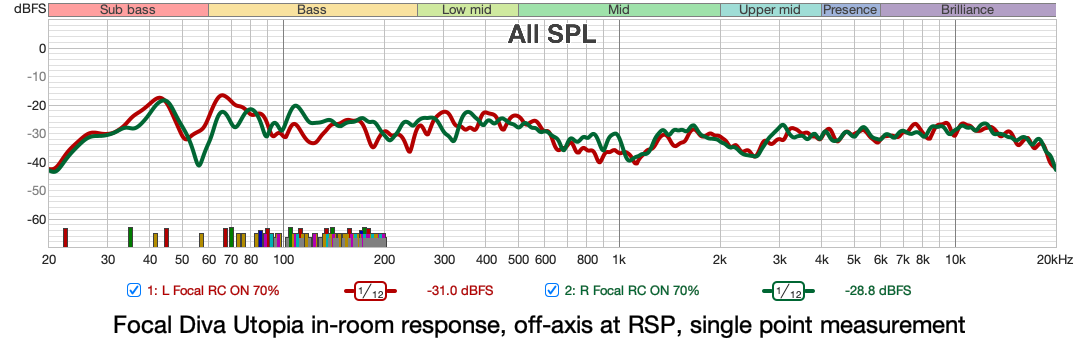
Measurements of the left (red trace) and right (green trace) Focal Diva Utopia, toed in, at the RSP, with ADAPT at the default 70%
Let's see the impact of ADAPT on the Diva Utopia's in-room response at the RSP. Here are measurements of the left and right speakers with ADAPT disengaged, at 70%, and 100%. Disregard the dip between 50Hz-60Hz as it is a room mode. Notice that ADAPT's affect in-room is subtle, but effective where it matters most. This performance reminded me of the Scala Utopia's attenuation jumpers.
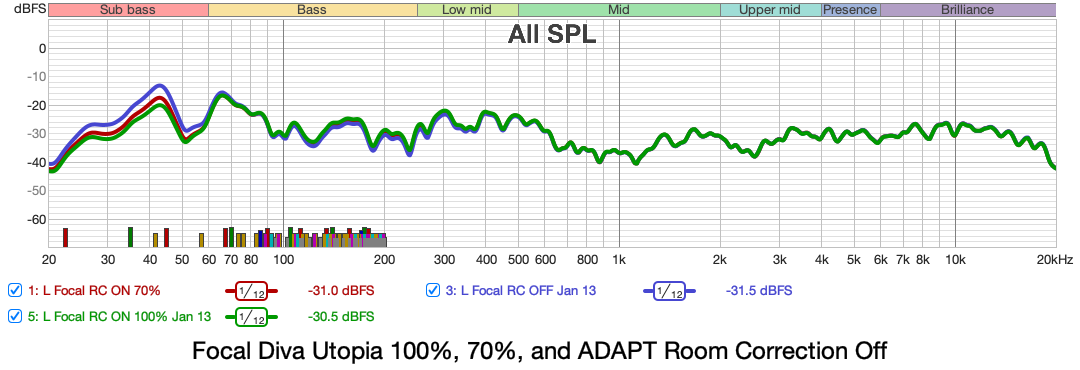
Single point measurement of the Focal Diva Utopia's in-room response (Left Speaker) measured at the RSP with and without ADAPT engaged.
Blue is ADAPT off, Red with ADAPT at 70%, and green with ADAPT at 100%.
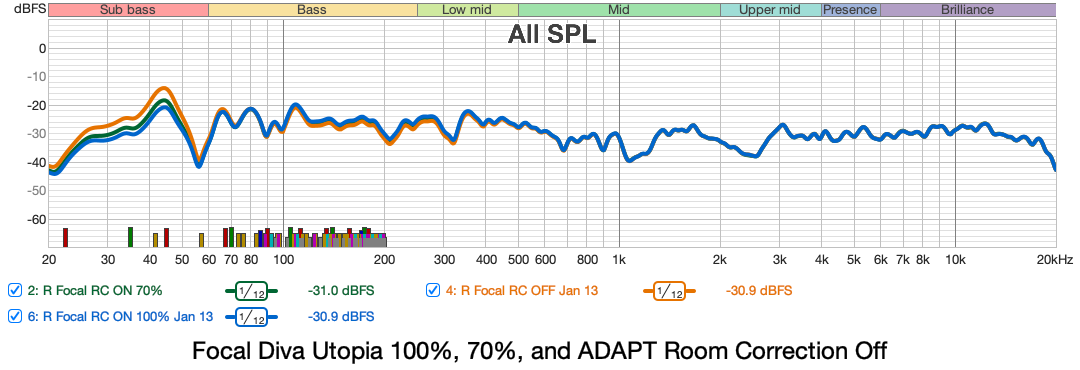
Single point measurement of the Focal Diva Utopia's in-room response (Right Speaker) measured at the RSP with and without ADAPT engaged.
Orange is ADAPT off, Green with ADAPT at 70%, and Blue with ADAPT at 100%.
As you can see, switching ADAPT off versus 70% and then 100% show's Focal's non‑destructive tuning philosophy: ADAPT tames excess bass without crushing system dynamics or affecting the tweeter's top end air. If your taste leans warmer or leaner, ADAPT’s ±10 steps provide flexibility to suite your taste.
Here’s a zoomed in look at what ADAPT did to the Diva Utopia left and right speakers' low end frequency response in my room measured at the RSP.
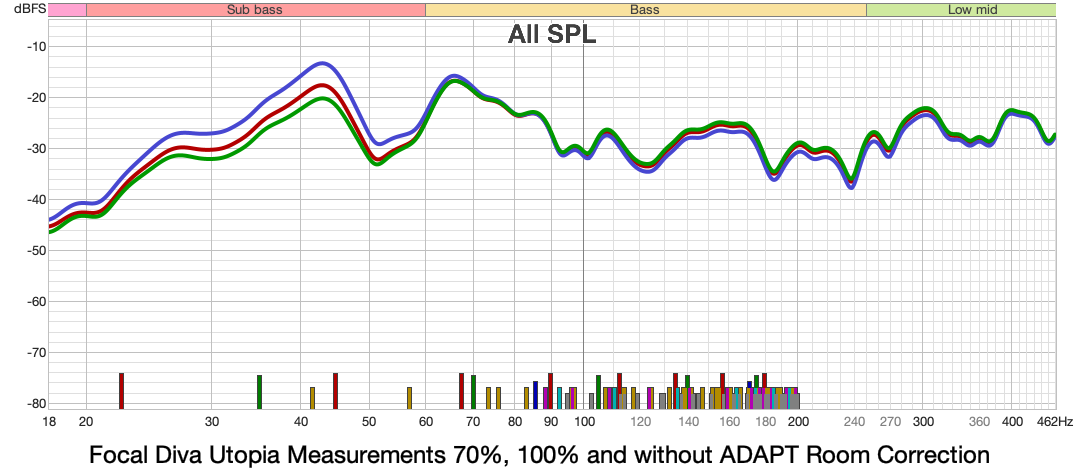
Detail of the Focal Diva Utopia's ADAPT on the left speaker at the RSP. Blue is ADAPT Off, Red is ADAPT at 70%, and Green is ADAPT at 100%.
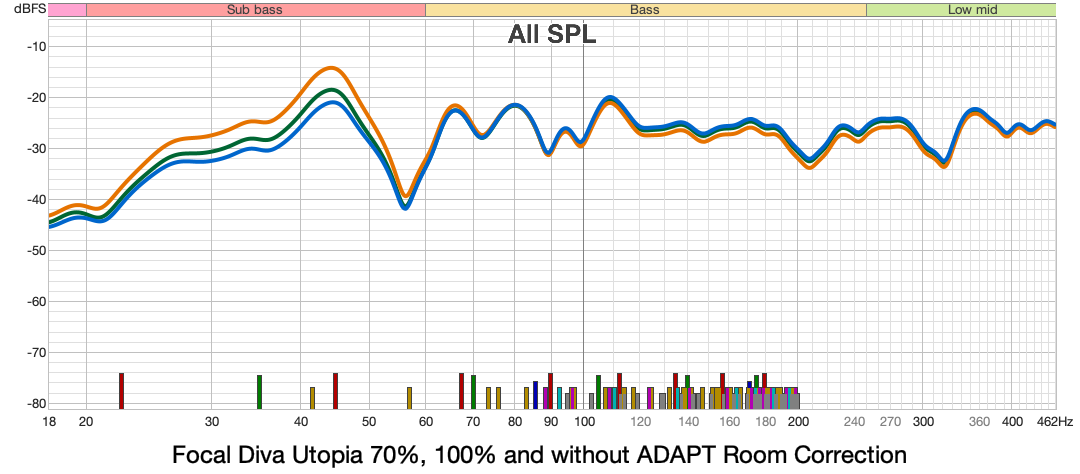
Detail of the Focal Diva Utopia's ADAPT on the right speaker at the RSP. Orange is ADAPT Off, Green is ADAPT at 70%, Blue is ADAPT at 100%.
Wavelets of the Diva Utopia at the RSP highlight differences between ADAPT’s approach and something more sophisticated like Dirac ART.
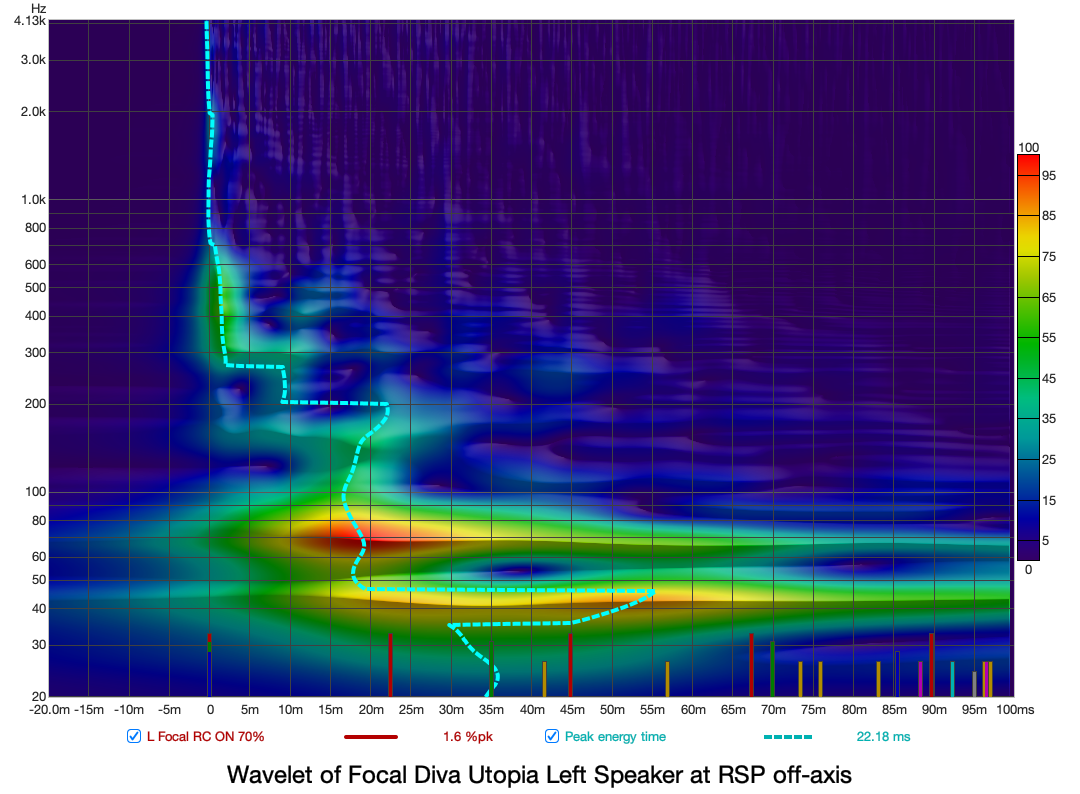
Wavelet of the Focal Diva Utopia left speaker. In-room response at the RSP, single point measurement with ADAPT at 70%
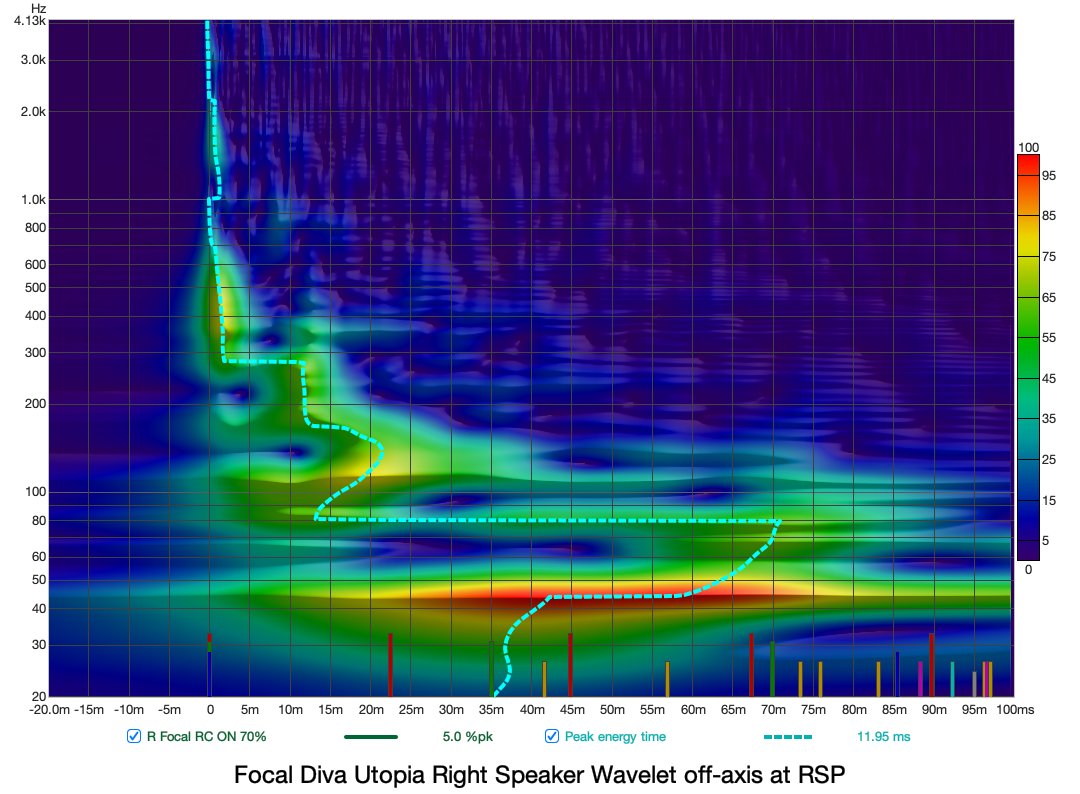
Wavelet of the Focal Diva Utopia right speaker. In-room response at the RSP, single point measurement with ADAPT at 70%
Dirac ART, by comparison, yielded almost textbook perfect performance on my Focal 1000 Utopia theater with RBH subwoofers driven by a Focal Astral 16 with Dirac ART. The bass response below 150Hz is totally linear and the wavelet is textbook. See my measuremens of the Focal 1000 Utopia for more information.
The Diva Utopia, being a two‑channel system with no sub integration and a minimalist correction philosophy, can’t (and isn’t trying to) replicate the spatial control of ART with it’s approach to bass management. Even so, both with and without ADAPT, Diva measured cleanly and performed exceedingly well in my room.
Focal Setup & Everyday Use
Focal makes unboxing and placement painless. Each carton includes a plywood ramp. Combined with built‑in wheels, rolling a 141‑pound Diva Utopia into position is effortless. After dialing in placement, thread on the included spikes and use the hardwood floor protectors as needed.
For my installation, I set the Diva Utopia in a known sweet spot with the tweeters approximately three feet from the front wall, flanking a 125‑inch Stewart Filmscreen StudioTek 130 G4 acoustically transparent screen, where I have dedicated 20‑amp outlets on each side. This made the setup visually minimalist.
Setup in the Focal‑Naim app was super easy: plug in the Diva Utopias, join a wireless network (or connect via Ethernet), and follow the prompts and finally run ADAPT. After 13 years of covering room correction and producing tutorials, I’ve seen advanced systems (Dirac, ARC, Audyssey) deliver astonishing results — but I’ve also seen users make common mistakes in mic placement, level setting, or target curves that derail outcomes. ADAPT trades that ultimate granularity for simplicity and effectiveness — an alluring option for custom installers and any prospective buyer of a two‑channel lifestyle‑reference speaker.
Focal Subjective Listening Impressions
My sources included Qobuz (via Focal‑Naim app) and my Roon server (via Chromecast), with ADAPT at 70% most of the time, the Diva Utopias connected via Ethernet and tethered to each other with the included, shielded RJ45 patch cord.
Focal’s new IAL2 beryllium tweeter just steals the show on the Diva Utopia. The top end is pristine, effortless, smooth, and airy without any harshness. Extended listening never felt fatiguing.
 Listening to some of my favorite vocalists such as Dido, Sara Bareilles, Sarah McLachlan, Dominique Fils Aime, Natalie Merchant, and Alycia Keys was truly a reference experience. The Diva Utopias excelled at imaging vocals, choral pieces, and instruments. On tracks like Sara Bareilles, “No Such Thing/Satellite Call” on Amidst the Chaos Live at the Hollywood Bowl, Sarah’s vocals were full-bodied and clearly distinct from the synthesizer bass lines, cymbals, and supporting vocals. It was easy to make out both the layers and their placement in the soundstage. On lesser systems you’ll have smearing or bloat in the upper bass that bleeds into the vocals.
In my room, the Diva Utopias placed the soundstage just at the plane of the speakers. They were never overly forward or relaxed in their musical presentation.
The Diva Utopia’s bass performance, however, was not as cut and dry. Purist audiophiles eschew any sort of digital room correction. That makes dialing in a full range speaker a bit of a challenge. As you can see in the measurements, Focal’s ADAP system did a solid job nullifying bass bloat in my room. However I felt that the ADAPT system was nowhere close to the textbook performance I get through the Focal Astral 16 with Dirac ART.
My subjective impression of the Diva’s bass is more nuanced. With four 6.5‑inch side‑firing woofers and no sub integration, Focal positions the Diva Utopia to be a true full‑range two‑channel system. In my room, ADAPT did a solid job taming bass peaks and tightening the low end, but its philosophy and toolset are intentionally lighter‑touch than Dirac ART.
On my Focal 1000 Utopia theater controlled by a Focal Astral 16 (Storm Audio) with Dirac ART, bass linearity and decay are absolutely textbook thanks ART’s superior bass control with multiple subs and support channels. The Focal Diva Utopia, by design, takes a more purist two‑channel audiophile approach similar to the jumpers on the Focal Scala Utopia or the contour switch on the Revel Ultima2 Salons. What you get is articulate, tuneful, and deep bass with excellent punch and texture on well‑recorded material.
I loved the Diva Utopia’s macro‑dynamics. The NAIM-designed active amplification delivered abundant headroom and precise transients; large orchestral pieces were wonderfully majestic.
What Makes Diva Utopia Unique
After six months of use, what stood out to me was not only the sound but also my interaction with the Diva Utopia and their aesthetic presence in my room. That being said, five things stood out:
- Truly component‑free listening. No external preamp, DAC, streamer, or power amp required. This changes the physical and aesthetic experience of high‑end listening: cleaner spaces, fewer variables, faster gratification.
- ADAPT room correction. One of the easiest and most repeatable room correction systems I’ve used. There's no mic, no laptop, no fuss, and it's fast. Yet, what ADAPT does is meaningful and deliversl Yes, it's not Dirac ART or Trinnov but it delivers impact where it matters most.
- UWB wireless speaker link. Zero‑latency, 96/24 wireless between speakers (and 192/24 over the included RJ45) eliminates timing gremlins, interference concerns, and hi-res audio limitations associated with other wireless technologies.
- Interchangeable panels. You get aesthetic flexibility that’s rare at the any level — not just the reference level. That means you can swap finishes later, match changing interiors, or replace a damaged panel without shipping back an entire speaker or living with cabinet scratches.
- Slide‑out electronics. This is a potential game-changer for real‑world serviceability that makes long‑term ownership less stressful — and less expensive. Think about shipping 300 pounds of cabinetry and the time it takes to get that delivered back to you!
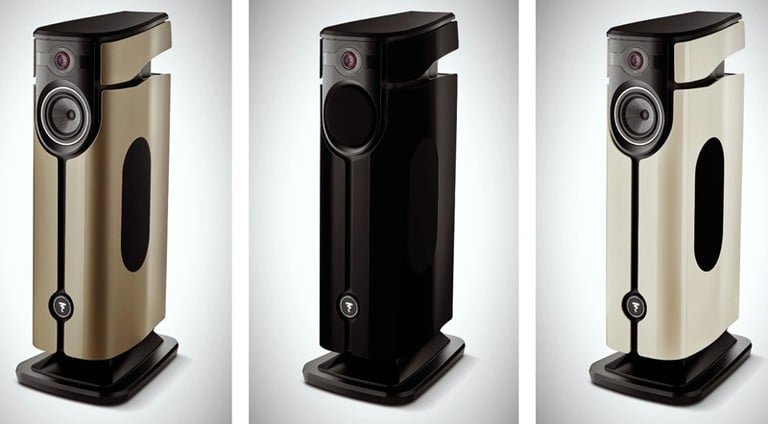
Focal offers lacquered finishes for the Diva Utopia: Dune High Gloss, Black High Gloss, and Off White High Gloss
Focal Diva's Limitations & Things to Consider
I have yet to come across a perfect speaker. Every speaker is designed for a particular customer segment and designed within a target budget. The Diva is no exception. I think you should be aware of the following:
- There's no subwoofer output/integration. It's not surprising considering this is a product for a two-channel aficionado. The Diva Utopia is designed as a self‑contained full‑range stereo system. If you want distributed bass arrays, dedicated subs, or multichannel expansion, you’re looking at a different ecosystem (e.g., Scala Utopia and separates with Dirac ART).
- No native Roon RAAT. AirPlay or Chromecast works well. RAAT purists (like me) will immediately note the omission.
- Lack of ADAPT profiles. You can’t store multiple correction profiles; I’d love to see Focal add that.
- Panel cost. Optional gloss panels are $9,500 — That's 23.8% of the Diva's MSRP! But then again, how many speakers give you the ultimate flexibility of changing panels. And given the Diva's target market the ability to change panels outweighs the cost.
Comparing the Focal Diva Utopia
In 2024, I had Focal’s Scala Utopia in for review in this same space, but driven by a Focal Astral 16 with Dirac ART and Naim mono block amplifiers. You can check out the Focal Scala Utopia review here. Compared to Scala Utopia Evo, The Diva Utopia has an immediately smaller footprint and different aesthetics. While the Diva’s bass is competitive, I found the Scala Utopia to be a bit more satisfying in the low end—both in frequency response and weight. Where the Diva may hold a slight leg up on the Scala Utopia, however is in the tweeter. I found the new IAL2 tweeter to be simply divine.
The overall experience (and price!) of the two is vastly different. You’re all-in with the Diva Utopia. It's that easy. Whereas with the Scala Utopia, you’re adding at least another $40,000 to $50,000 in electronics. That’s another huge advantage of an active speaker setup.
Where to Demo and Purchase
I should note that Focal has two active speaker models in the Diva Utopia line. The first, and subject of this review, is the Diva Utopia followed last year by the introduction of the $69,000/pair Diva Mezza Utopia. With the introduction and branding of these two models it's clear that Focal has future plans to expand the Diva Utopia active speaker lineup. Unfortunately, with the dearth of audio stores, you may be wondering where you can have opportunity to check out the Diva Utopia. The Diva Utopia is available exclusively through Focal Powered by Naim authorized dealers. You can search Focal's online portal at https://www.focalpoweredbynaim.com/stores to find a location near you where you can listen to the Diva Utopia first-hand.
Focal Diva Utopia Conclusion
The Diva Utopia is a groundbreaking product for Focal — a fully active, wireless Utopia that sacrifices none of Focal’s core strengths while embracing the realities of modern listening. The Diva Utopia is made for the discerning luxury audiophile who wants reference two‑channel performance without the stack of separates, cables, or complexity. The Diva is ideal for the New York apartment or a sprawling residence and for design‑forward buyers who value aesthetic flexibility and the ease of a tightly integrated solution.
Sonically, Diva delivers all of what you’d expect in a Utopia speaker: A sublime, extended, and effortless top end; an open, articulate midrange; and deep, articulate bass. Naim’s electronics and amplification are a perfect match.
While Focal’s traditional Utopia towers aren’t going anywhere. The Diva Utopia makes it clear that Focal is committed to a parallel path of active speakers up and down the range that complement their passive siblings.
For those who want state‑of‑the‑art sound with state‑of‑the‑art simplicity, Diva Utopia is the reference speaker for the modern audiophile. This is not your grandfather’s hi‑fi — and that’s precisely the point.
The Score Card
The scoring below is based on each piece of equipment doing the duty it is designed for. The numbers are weighed heavily with respect to the individual cost of each unit, thus giving a rating roughly equal to:
Performance × Price Factor/Value = Rating
Audioholics.com note: The ratings indicated below are based on subjective listening and objective testing of the product in question. The rating scale is based on performance/value ratio. If you notice better performing products in future reviews that have lower numbers in certain areas, be aware that the value factor is most likely the culprit. Other Audioholics reviewers may rate products solely based on performance, and each reviewer has his/her own system for ratings.
Audioholics Rating Scale
 — Excellent
- — Very Good
- — Good
- — Fair
- — Poor
| Metric | Rating |
|---|---|
| Build Quality | |
| Appearance | |
| Treble Extension | |
| Treble Smoothness | |
| Midrange Accuracy | |
| Bass Extension | |
| Bass Accuracy | |
| Imaging | |
| Soundstage | |
| Dynamic Range | |
| Fit and Finish | |
| Performance |  |
| Value | |
Theo Nicolakis has been reviewing high end audio, video, home theater, headphone, and portable music products. His reviews have appeared here on Audioholics as well as Techhive.com, and more. His reviews span high end two-channel and home theater systems, AVRs and immersive audio processors, room correction technologies, headphones, DACs, DAPs, music servers, sound bars, and display technologies. His breadth and depth of experience encompasses mi
View full profile Subscribe to our newsletter