Positioned between the compact Model Three and the acclaimed Model Five, the new Model Four combines elements from both speakers into what KLH describes as "its most placement-friendly floorstanding design yet". The speaker features an 8-inch acoustic suspension woofer derived from the Model Three alongside the same midrange driver, tweeter, and crossover topology used in the highly regarded Model Five. Meanwhile, its wide-baffle, shallow-depth cabinet design borrows heavily from the larger Model Seven, making it easier to position near walls without the boominess commonly associated with rear-ported designs. That design philosophy also runs counter to much of today’s loudspeaker industry, where ported cabinets dominate thanks to their higher efficiency, increased bass output, and ability to produce deeper low-frequency extension from smaller enclosures. As discussed in Sealed is Not Acoustic Suspension in Loudspeakers by Steve Feinstein, true acoustic suspension systems require more engineering precision, tighter tolerances, and often sacrifice sensitivity in exchange for tighter, more controlled bass performance and superior transient response.
KLH continues to lean heavily into the benefits of acoustic suspension loading, which remains relatively uncommon in today’s loudspeaker market dominated by ported cabinets. According to the company, the sealed design allows the Model Four to maintain tighter, more controlled bass response in real-world rooms where speakers often need to live closer to walls or corners. The cabinet itself is notably slim at just 8.25 inches deep before the included angled riser is attached, helping the speaker blend more naturally into apartments, lofts, and shared living spaces.

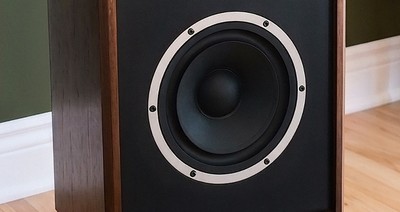
 Internally, the Model Four employs a three-way driver array consisting of an 8-inch pulp-paper woofer, 4-inch pulp-paper midrange, and 1-inch aluminum dome tweeter. Many respected hi-fi manufacturers continue using pulp-paper because paper cones offer a very natural tonal character with good self-damping properties. The biggest advantages of paper/pulp cones are their smooth breakup behavior, lower ringing compared to metal cones, and often more natural-sounding midbass and midrange reproduction. That’s especially relevant in a speaker like the new KLH Model Four because acoustic suspension designs already prioritize controlled transient response and lower distortion over sheer output efficiency. Pulp paper cones tend to avoid the harsher resonance peaks sometimes associated with stiffer materials like aluminum or magnesium.
There are disadvantages, though. Paper cones are generally less rigid than exotic materials such as Kevlar, carbon fiber, aluminum, or ceramic composites. That means designers have to carefully control cone breakup at higher output levels. Paper cones can also be more sensitive to humidity and environmental conditions unless properly treated or coated. In modern designs, however, manufacturers often use coated pulp blends or reinforced paper compounds that significantly improve stiffness and durability while preserving the sonic character people like.
Frequency response is rated at 46Hz–20kHz ±3dB with a claimed low-frequency extension down to 35Hz at -10dB. Sensitivity is listed at 88dB, while power handling is rated at 150 watts continuous and 600 watts peak. KLH also includes its signature three-position Acoustic Balance Control switch, allowing users to tailor the speaker’s mid and high-frequency balance to better suit different room acoustics.
Model Four represents exactly where KLH is headed: honoring the acoustic principles that made this brand stand out while designing products for how people actually live and listen today. This is not a bookshelf speaker, nor is it simply a smaller Model Five. It is a distinctive, full-range acoustic-suspension loudspeaker, meticulously built to deliver the natural, controlled and room-friendly sound that defines KLH in a form that fits more homes, rooms and listeners. Our responsibility is to protect the integrity of this brand while moving it forward, and Model Four is a major step in that direction.
At nearly $2,000 per pair, the Model Four enters a highly competitive segment filled with established standmount and compact floorstanding designs. Still, if KLH can successfully deliver the same rich midrange presentation and acoustic suspension bass control that made the Model Five such a standout, the Model Four could become one of the more intriguing lifestyle-friendly hi-fi options in its class. On paper, its performance goals and room-friendly tuning put it squarely in the conversation with larger, more expensive speakers like the Wharfedale Super Linton, making the idea of getting comparable sonic sophistication in a slimmer, easier-to-place cabinet particularly compelling for listeners shopping around the $2K mark.



 Subscribe to our newsletter