


Infinity Classia C336 Floorstanding Speaker Review
Infinity Classia C336
- Product Name: Classia C336
- Manufacturer: Infinity
- Performance Rating:

- Value Rating:
- Review Date: April 27, 2009 02:40
- MSRP: $ 899 (each)
Frequency Response (±3dB):
40Hz – 30kHz; 35Hz – 40kHz (–6dB)
Recommended Power Amplifier Range: 10 Watts – 250 watts
Sensitivity (2.83V @ 1m): 91dB
Nominal Impedance: 8 Ohms
Crossover Frequency: 500Hz, 2800Hz; 24dB/octave
Low-Frequency Driver: Triple 6-1/2" (165mm) CMMD®
Midrange Driver: 4" (100mm) CMMD
High-Frequency Driver: 1" (25mm) CMMD
Dimensions (H x W x D): 48-1/2" x 8-1/2" x 10-1/2" (1232mm 216mm
x 267mm)
Weight: 56.1 lb (25.4kg)
Pros
- Look great with the grills on
- Slim design
- Fantastic build quality on the cabinetry
- Drivers appear to be constructed of high quality parts
- Good bass extension
- Easy to setup/adjust with "vampire" spikes
Cons
- With the grills off they are a bit odd looking
- Front heavy
- Vinyl wrap
- CMMD looks cheesy
- Poor bass impact
- Slightly fatiguing top end
Classia C336 Build Quality
 For
those of you that have read the $1500 -
$2000 Floorstanding Speaker Shootout article, you've already heard of the
Infinity Classia C336s. Overall, they didn't do so hot in the shootout. But one
of the things that was supposed to
happen is that every speaker was supposed to get an individual review from me
before the shootout. The Infinitys were a late addition and there wasn't time
(I literally received them the week of the shootout). However, that's not going
to stop me from giving them a thorough review. Are my perceptions going to be
tainting by the shootout? Probably. But bias isn't exactly exempt from all
other reviews of these speakers. Some people will love or hate them for their
looks, brand, price, or whatever. I just have the opinion of a few of my peers
to contend with. I would like to point out that one of the three participants
did say that he liked and would buy these speakers in the blind portion of the
shootout. It isn't like they were panned.
For
those of you that have read the $1500 -
$2000 Floorstanding Speaker Shootout article, you've already heard of the
Infinity Classia C336s. Overall, they didn't do so hot in the shootout. But one
of the things that was supposed to
happen is that every speaker was supposed to get an individual review from me
before the shootout. The Infinitys were a late addition and there wasn't time
(I literally received them the week of the shootout). However, that's not going
to stop me from giving them a thorough review. Are my perceptions going to be
tainting by the shootout? Probably. But bias isn't exactly exempt from all
other reviews of these speakers. Some people will love or hate them for their
looks, brand, price, or whatever. I just have the opinion of a few of my peers
to contend with. I would like to point out that one of the three participants
did say that he liked and would buy these speakers in the blind portion of the
shootout. It isn't like they were panned.
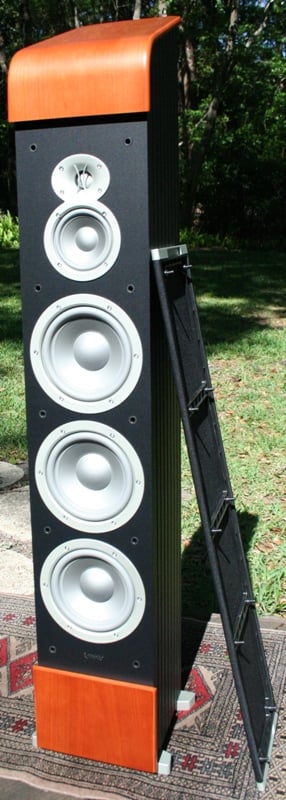
Disclaimer - I'm going to tell a trite but true wife story here. If you want to skip over this overused convention of audio reviews, go to the next paragraph, do not pass go, do not collection $200. My wife remarked after I had set up the Classias that these were the first speakers she's ever really noticed without me having to point out that I changed them out. It was because of the cherry wood and swept-back top. From a purely WAF factor, the Infinities have already gotten a check in the "yes" box.
I've recently completed a review of the Infinity Primus P162 bookshelf speakers. I'm sort of on an Infinity kick right now. Because of the aforementioned shootout article, many of my speaker reviews got pushed back which ended up with both of the Infinity reviews happening back to back. The Classias share a similar looking array of drivers to the Primus line but there the resemblances end. The Classias are priced much higher and their construction, weight, and aesthetics all show this. With a nod to my wife, these are one of the more unique looking speakers I've ever reviewed and that alone is something.
Build Quality
 As
you'd expect from a company like Infinity, the Classias arrived well boxed in
individual boxes. The "outriggers" came attached with the rubber feet
already inserted. The foam endcaps and side caps held the speakers firmly in
place and the speaker arrived with no damage. This was especially impressive
considering the weight. At over 55
pounds a piece, the Classias are by no means a lightweight speaker. This
contributed to the one problem I had with the speaker - the cotton sock. This ubiquitous
piece of audiophilia encourages some to associate the enclosed equipment with
quality. I'm not sure why this is but it seems to be the case. Even I, when
first presented with the cotton sock, was a little giddy. I had "made
it" as an audio guy when my first amp/speaker/whatever it was came in a
sock. Of course, just about everything comes in a sock these days so it's lost
a bit of its luster. When you unwrap a router in a sock, you don't look at the
sock the same way ever again. Plus, it gets fuzz everywhere. Who wants that?
And no, I'm not getting paid by the number of times I can mention sock in one
paragraph. Sock.
As
you'd expect from a company like Infinity, the Classias arrived well boxed in
individual boxes. The "outriggers" came attached with the rubber feet
already inserted. The foam endcaps and side caps held the speakers firmly in
place and the speaker arrived with no damage. This was especially impressive
considering the weight. At over 55
pounds a piece, the Classias are by no means a lightweight speaker. This
contributed to the one problem I had with the speaker - the cotton sock. This ubiquitous
piece of audiophilia encourages some to associate the enclosed equipment with
quality. I'm not sure why this is but it seems to be the case. Even I, when
first presented with the cotton sock, was a little giddy. I had "made
it" as an audio guy when my first amp/speaker/whatever it was came in a
sock. Of course, just about everything comes in a sock these days so it's lost
a bit of its luster. When you unwrap a router in a sock, you don't look at the
sock the same way ever again. Plus, it gets fuzz everywhere. Who wants that?
And no, I'm not getting paid by the number of times I can mention sock in one
paragraph. Sock.
The big problem with the sock vis à vis heavy speakers is unpacking them. It's like trying to wrestle a 55lb squirming fish up onto the deck of a boat - you need help. The slanted top of the speaker doesn't make this any easier as I would normally set the speaker on its top and slide the sock down. Luckily, Infinity designed their foam caps in two parts so that you could "undress" the speaker (mostly) before removing it from the box.
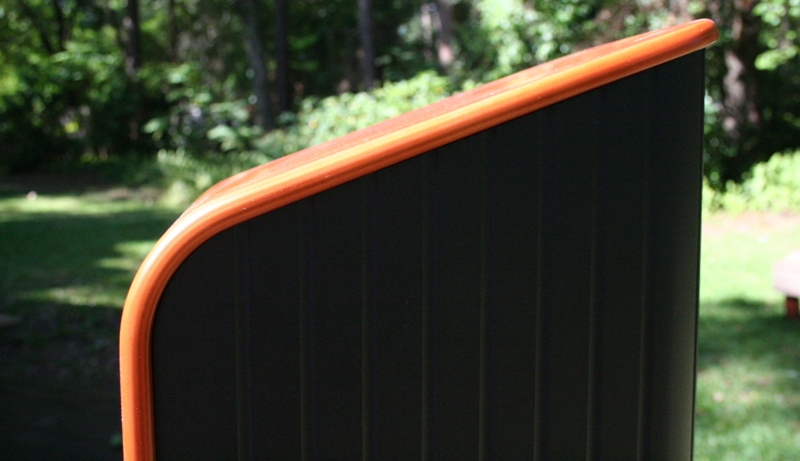
 The
top and bottom of the speakers have a cherry stained plywood face (high gloss
black is also available at no additional cost). The top is molded and swept
back. These plywood plates overhang the sides by a bit. The grill has a plastic
top and bottom cap and lines up with the overhang of the plywood plates. This
creates a very refined look to the front of the speaker. On the bottom, there
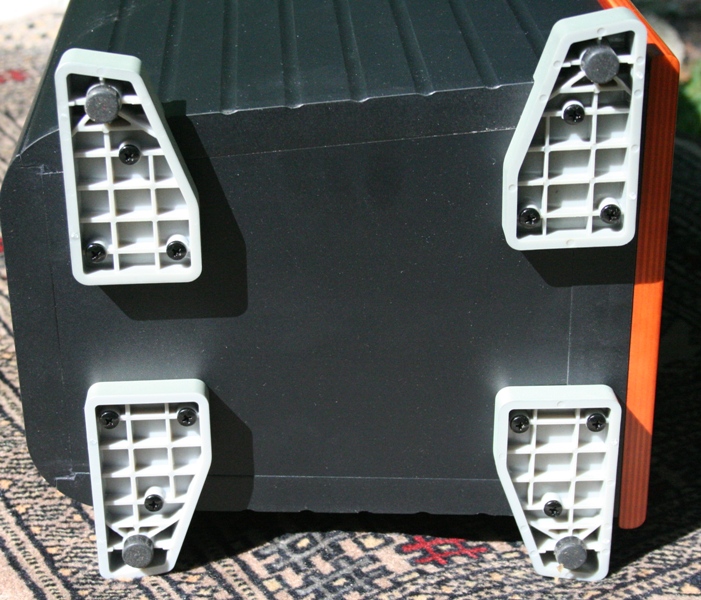
are four plastic outriggers that can be removed with three screws. There really
isn't any reason to unless you are going to add other aftermarket outriggers.
The
top and bottom of the speakers have a cherry stained plywood face (high gloss
black is also available at no additional cost). The top is molded and swept
back. These plywood plates overhang the sides by a bit. The grill has a plastic
top and bottom cap and lines up with the overhang of the plywood plates. This
creates a very refined look to the front of the speaker. On the bottom, there
are four plastic outriggers that can be removed with three screws. There really
isn't any reason to unless you are going to add other aftermarket outriggers.
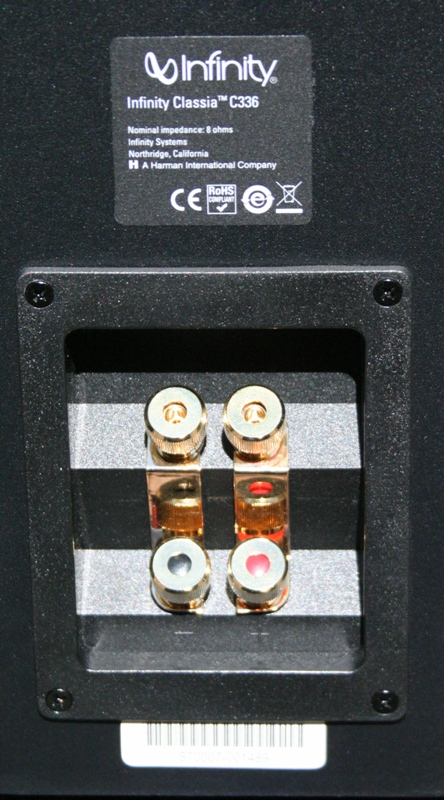
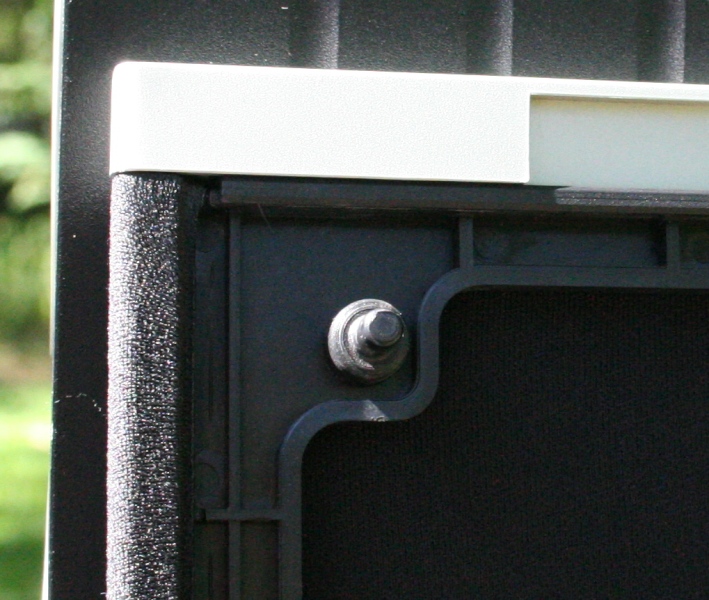
The sides of the speaker have vertical cutouts every 3/4" or so. The back is rounded to mirror the cut of the top plywood panel. On the back, there is a single port at the top (directly behind the tweeter) and two sets of binding posts at the bottom. Everything that is not covered by the plywood is wrapped in black vinyl. While the fit and finish of the vinyl is quite good, it is still a delicate material and scores easily. On the bottom you can see clearly where the walls meet the bottom by the seams in the vinyl wrap. The only exception to the vinyl wrap is the back which has a large, top to bottom plastic plate over it. While I probably would have complained either way, given the option, I'd wrap the MDF in a plastic plate rather than vinyl.
The front baffle is exposed once you remove the grill. The grill has large plastic posts which hold it securely but because of the size, it feels a bit more fragile than the Primus grill (which I liked a lot more). I've generally found that plastic bracing for grills work fine in smaller applications but for larger speakers they just tend to warp too much. I don't think I was ever at risk of breaking them as I removed or replaced them, but I did worry. The biggest problem with the aesthetics is that the speaker looks weird with the grills off. It is because of the overhanging plywood facades. The front baffle doesn't line up with the plywood like the grill does so it looks a little weird. Now, while my podcasting partner might think I'm a weirdo for removing the grills at all, I know that many of our readers are going to do just that - especially during critical listening sessions (usually with drinks and friends). If you're not a grill-remover type, rest assured that the speakers look best with them on.
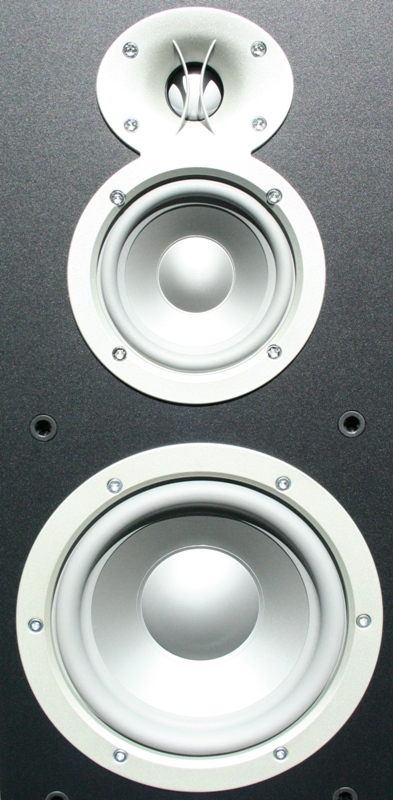 The Classias sport a 1"
tweeter, a 4" midrange, and three 6.5" woofers. All of the drivers
are made out of CMMD (Ceramic
Metal Matrix Diaphragms), a material that is engineered to be "stiffer
than standard metal diaphragms, moving the natural modes significantly upwards in frequency." Unlike the MMD drivers on the Primus that looked like plastic,
the CMMD drivers have a bit more
of a chrome look about them. Unfortunately, you'll only notice this if you get
up really close as the grey surround material makes the rest of the cone look
the same dull color. Infinity would probably have been better off going with a
black surround and letting the cone shine in comparison. What's really nice
about the CMMD cones (especially
for the woofers) is that the dust caps are REALLY stiff. Your child is going to
have to work to push those in. Oh, I'm sure they'll figure out a way of doing
it, but it won't be the faint pressure that it takes most other woofers. As I
mentioned, the front baffle is also covered in a vinyl wrap. While I'm not a
huge fan, I'm glad that Infinity went with a flat black instead of some sort of
woodgrain finish. The flat black tends to blend much better (especially from a
distance) with a darkened room and really sets off the plywood facades.
The Classias sport a 1"
tweeter, a 4" midrange, and three 6.5" woofers. All of the drivers
are made out of CMMD (Ceramic
Metal Matrix Diaphragms), a material that is engineered to be "stiffer
than standard metal diaphragms, moving the natural modes significantly upwards in frequency." Unlike the MMD drivers on the Primus that looked like plastic,
the CMMD drivers have a bit more
of a chrome look about them. Unfortunately, you'll only notice this if you get
up really close as the grey surround material makes the rest of the cone look
the same dull color. Infinity would probably have been better off going with a
black surround and letting the cone shine in comparison. What's really nice
about the CMMD cones (especially
for the woofers) is that the dust caps are REALLY stiff. Your child is going to
have to work to push those in. Oh, I'm sure they'll figure out a way of doing
it, but it won't be the faint pressure that it takes most other woofers. As I
mentioned, the front baffle is also covered in a vinyl wrap. While I'm not a
huge fan, I'm glad that Infinity went with a flat black instead of some sort of
woodgrain finish. The flat black tends to blend much better (especially from a
distance) with a darkened room and really sets off the plywood facades.
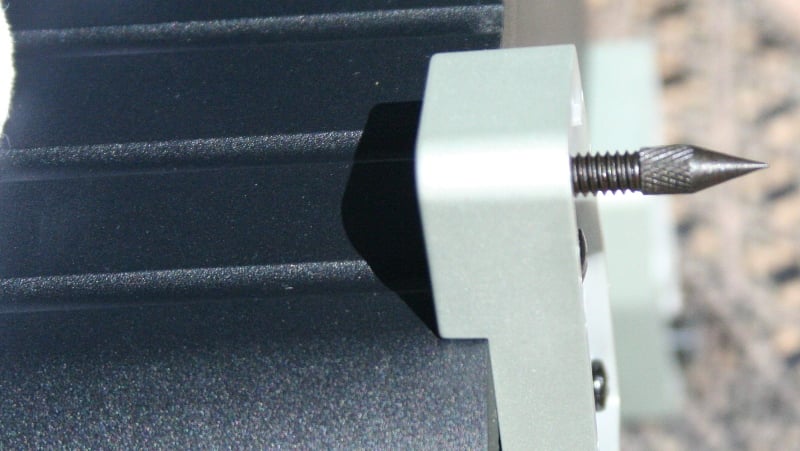 The Classias aren't a large speaker… well, they are tall but not wide.
While the tweeter height is about right, the top of the speaker is a good 10+
inches higher than that. Even with that extra height in the back, the speaker
is still a bit front heavy and tended to want to tip forward. This seemed
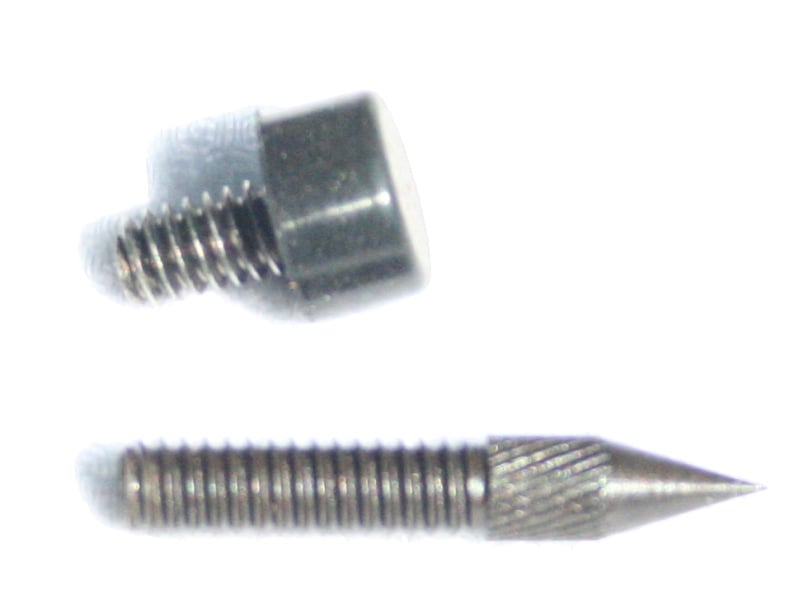
counterintuitive until I opened them up (see below). The rubber feet that came
installed on the outriggers were probably one of the nicer I've seen but the
carpet spikes were, in a word, scary. In the picture to the right, that spike
is installed as far as it will go! This is not a speaker you're going to want
to drop on your foot with the spikes installed. I suppose you can tell your
wife they are Twilight branded vampire speaker and that they'll sparkle if you
take them out in the sunlight.
The Classias aren't a large speaker… well, they are tall but not wide.
While the tweeter height is about right, the top of the speaker is a good 10+
inches higher than that. Even with that extra height in the back, the speaker
is still a bit front heavy and tended to want to tip forward. This seemed
counterintuitive until I opened them up (see below). The rubber feet that came
installed on the outriggers were probably one of the nicer I've seen but the
carpet spikes were, in a word, scary. In the picture to the right, that spike
is installed as far as it will go! This is not a speaker you're going to want
to drop on your foot with the spikes installed. I suppose you can tell your
wife they are Twilight branded vampire speaker and that they'll sparkle if you
take them out in the sunlight.
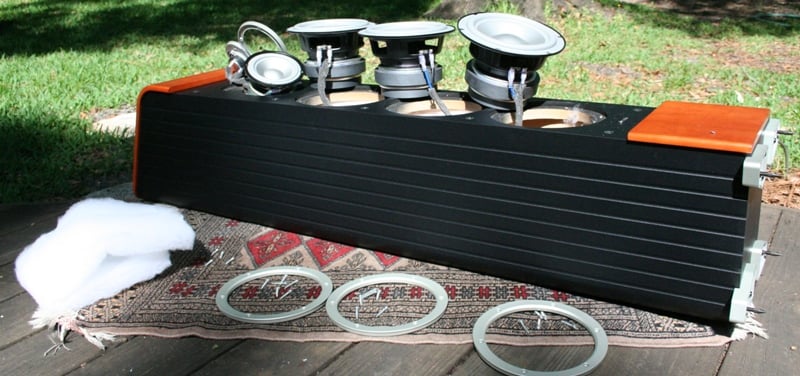 Opening up the speakers, I was amazed at the amount of engineering that
went into the Classia C336s. While not a huge speaker by any stretch of the
imagination, the inside was even tighter. It looked as if the cabinet was
constructed out of 5/8" MDF. The drivers, while sporting stamped baskets
(a disappointment at this price point), were heavy. Each had a huge magnet structure and were magnetically
shielded. This explained why the speakers were so front heavy. There were four
5/8" internal braces - one between each of the woofers, one beneath the
bottom woofer, and one between the top woofer and the midrange. The midrange was
enclosed in its own reinforced plastic backbox. The tweeter was mounted to the
plastic housing that served double duty as a vanity surround for the midrange.
Each of the woofers also has a plastic vanity surround. The knock test, as you
might expect, was incredibly impressive. A dull thud no matter where I hit. The
inertness of the cabinet on the Classia C336s is to be commended.
Opening up the speakers, I was amazed at the amount of engineering that
went into the Classia C336s. While not a huge speaker by any stretch of the
imagination, the inside was even tighter. It looked as if the cabinet was
constructed out of 5/8" MDF. The drivers, while sporting stamped baskets
(a disappointment at this price point), were heavy. Each had a huge magnet structure and were magnetically
shielded. This explained why the speakers were so front heavy. There were four
5/8" internal braces - one between each of the woofers, one beneath the
bottom woofer, and one between the top woofer and the midrange. The midrange was
enclosed in its own reinforced plastic backbox. The tweeter was mounted to the
plastic housing that served double duty as a vanity surround for the midrange.
Each of the woofers also has a plastic vanity surround. The knock test, as you
might expect, was incredibly impressive. A dull thud no matter where I hit. The
inertness of the cabinet on the Classia C336s is to be commended.
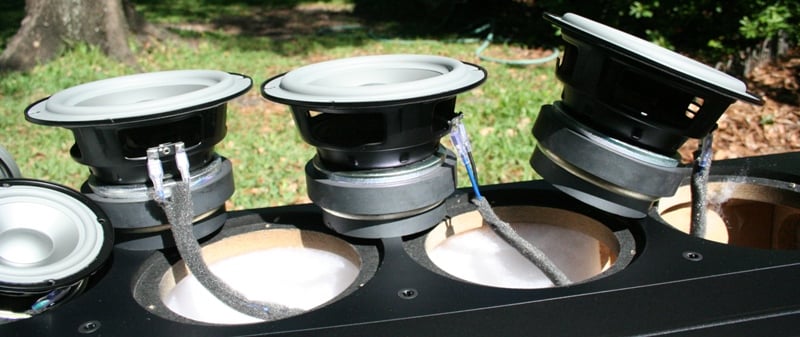 Behind each of the woofers
and the tweeter was a layer of polyfill glued to the sides and back. The inside
edge of the port was flared and looked to be covered in leather (more likely
pleather) probably to reduce chuffing. Every exposed wire was wrapped in foam
so you'll never have to worry about a wire rubbing and making noise. While
you'd think the top of the enclosure would be slanted like the outside, it
wasn't. The inside enclosure stopped before that and was actually parallel to
the floor. The whole top section is simply for looks and maybe to help balance
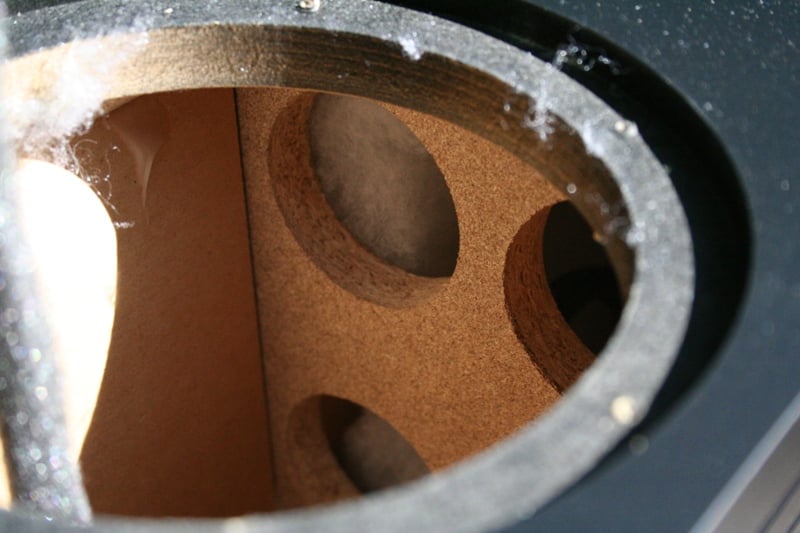
out some of the weight of the drivers. The only weird part was that the inside
walls and back of the enclosure looked to have a piece of wood glued to them.
I'm not sure what the purpose of this was as it didn't look to be structural.
At first I thought it was to make the inside look nicer but who does that? My
second (and only) guess is that their modeling program wanted them to reduce
the interior volume and this extra wood was for that purpose. It was a bit odd.
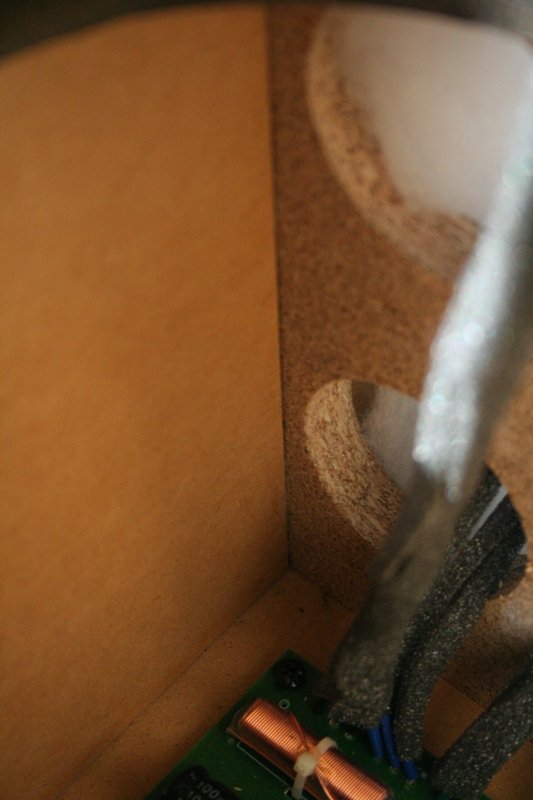
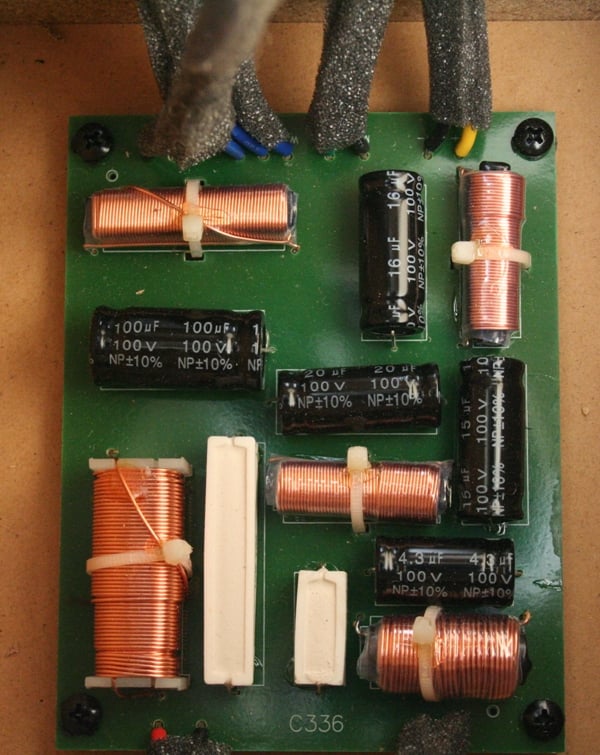
Infinity really seemed to cut a lot of corners in their crossover design by
employing cheap iron core inductors instead or air core and all electrolytic
capacitors instead of polypropylene. I suspect the poor selection of parts
choices here are largely the reason why these speakers left much to be desired
sonically with respect to transparency.
Behind each of the woofers
and the tweeter was a layer of polyfill glued to the sides and back. The inside
edge of the port was flared and looked to be covered in leather (more likely
pleather) probably to reduce chuffing. Every exposed wire was wrapped in foam
so you'll never have to worry about a wire rubbing and making noise. While
you'd think the top of the enclosure would be slanted like the outside, it
wasn't. The inside enclosure stopped before that and was actually parallel to
the floor. The whole top section is simply for looks and maybe to help balance
out some of the weight of the drivers. The only weird part was that the inside
walls and back of the enclosure looked to have a piece of wood glued to them.
I'm not sure what the purpose of this was as it didn't look to be structural.
At first I thought it was to make the inside look nicer but who does that? My
second (and only) guess is that their modeling program wanted them to reduce
the interior volume and this extra wood was for that purpose. It was a bit odd.
Infinity really seemed to cut a lot of corners in their crossover design by
employing cheap iron core inductors instead or air core and all electrolytic
capacitors instead of polypropylene. I suspect the poor selection of parts
choices here are largely the reason why these speakers left much to be desired
sonically with respect to transparency.

C336 Setup and Measurements
I wired the speakers up with Blue Jeans Canare 4S11 cable. Source was a Denon DVD-3910 universal player through a Denon AVR-2307CI pushing two Seymour AV Ice Block 5001 monoblock amplifiers. I was sitting about 8 feet from the speakers with the pair about 6 feet apart. The speakers were no closer (and in most cases quite a bit farther away) than 2 feet from any boundary. I've mentioned before the vampire spikes on the Classia C336s - they are outrageously long. That being said, there was both good and bad points to this length. The first obvious drawback is the danger of exsanguination from being impaled on one. The upside is that these were, with the exception of a professional outrigger solution like the offerings from Soundocity, the easiest spikes to adjust and level. What normally takes a lot of trial and error took moments - mostly because the speaker was practically floating off the floor. The only downside to that is that the outriggers actually looked like they were floating off the floor! They completely hid the spikes. This gave the spiked Classias on my medium pile carpet a sort of "penguin-eske" look.
 As I often do, I grabbed my
yello - the eye CD as I started
experimenting with toe-in. The speakers sounded, I thought, remarkably good
pointed straight out though some of the center imaging was a bit thin. The
soundstage seemed wide and pans mostly convincing. I experimented some more
with placement including pointing the speakers directly at me and just and a
few variations between. The more I pointed the speakers at me, the more solid
the center image became though often at the expense of soundstage width and
high end fatigue. I settled on a modest toe-in of around 15 degrees. One thing
I'm going to recommend regardless of your flooring type is that you determine
your toe in before you add the spikes. The spikes make moving the speakers very
difficult and I don't recommend it. The only problem I really had with
determining toe-in was a unique one for the Classias - the top. When I really
want to get anal about the whole thing (and what Audioholic doesn't get anal
about audio every once in a while?) I put a laser pointed on top of each
speaker just to make sure I've got them pointed EXACTLY where I want them.
Well, with the slanted top of the Classias, this isn't possible and it really
made determining the exact orientation a bit more difficult. Even when I
haven't busted out the laser pointer, I'm usually lying my arm across the top
of the speaker and using that as a guide - again impossible with the C336s.
This is just another reason why you want to make sure of your positioning
before you install the spikes.
As I often do, I grabbed my
yello - the eye CD as I started
experimenting with toe-in. The speakers sounded, I thought, remarkably good
pointed straight out though some of the center imaging was a bit thin. The
soundstage seemed wide and pans mostly convincing. I experimented some more
with placement including pointing the speakers directly at me and just and a
few variations between. The more I pointed the speakers at me, the more solid
the center image became though often at the expense of soundstage width and
high end fatigue. I settled on a modest toe-in of around 15 degrees. One thing
I'm going to recommend regardless of your flooring type is that you determine
your toe in before you add the spikes. The spikes make moving the speakers very
difficult and I don't recommend it. The only problem I really had with
determining toe-in was a unique one for the Classias - the top. When I really
want to get anal about the whole thing (and what Audioholic doesn't get anal
about audio every once in a while?) I put a laser pointed on top of each
speaker just to make sure I've got them pointed EXACTLY where I want them.
Well, with the slanted top of the Classias, this isn't possible and it really
made determining the exact orientation a bit more difficult. Even when I
haven't busted out the laser pointer, I'm usually lying my arm across the top
of the speaker and using that as a guide - again impossible with the C336s.
This is just another reason why you want to make sure of your positioning
before you install the spikes.
Measurements & Testing
For laboratory measurements I used the Sencore SP395A FFT Audio Analyzer and a Sherbourn 2/75B amp, I measured the Infinity Classia C336's in room on and off-axis frequency response with 1/12th octave resolution.
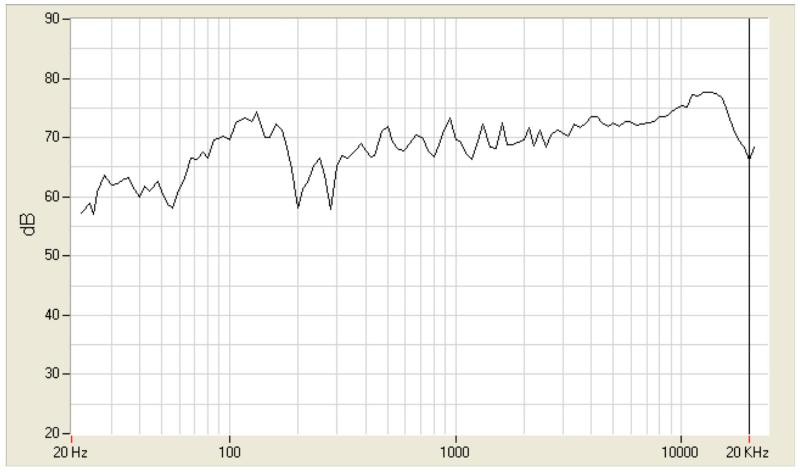
C336 1 Meter Frequency Response (1/12th
Octave) On Axis
Note:
this is NOT a 1 watt measurement
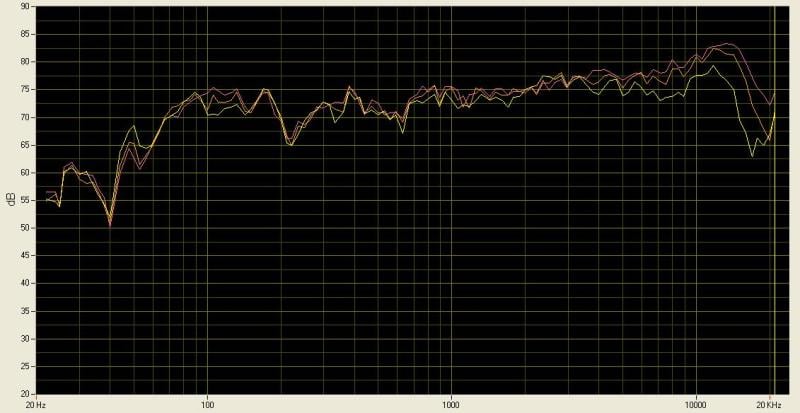
C336
1/2 Meter Frequency Response (1/12th Octave)
Pink - On axis, Orange - 15 degrees off axis, Yellow - 30
degrees off axis
As you can see, the Classias have a fairly flat speaker response with an on-axis bump in the high end. I played with the mic positioning quite a bit and determined that just below the 4" midrange was the best location. This works out well as from my seated position the "sweet spot" on the speaker is just about perfectly located at ear height. These speakers exhibit a much flatter response off axis rather than on where the high end is a bit strong. We recommend you sit off axis from the speakers in order to reduce these affects.
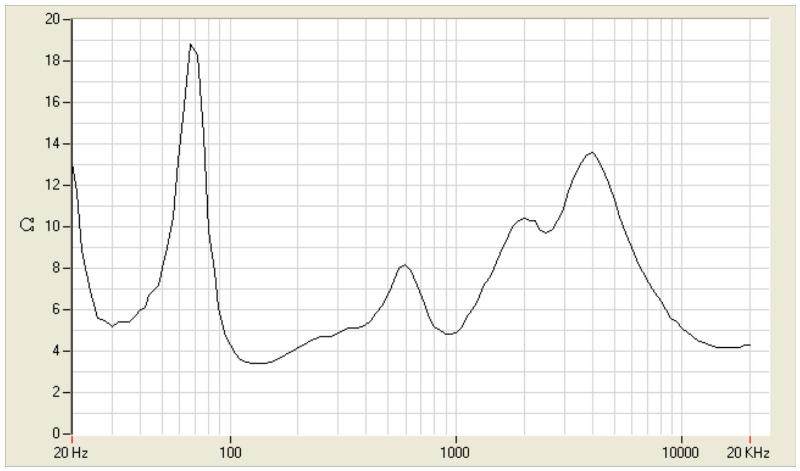
C336 Impedance
The Sencore consistently measures impedance one ohm low. Dr. Floyd Toole of Harman has stated that it’s a Harman requirement to have no speakers dip much below 4 ohms which is clearly evident in the design of this system. These speakers could benefit from additional amplifications but as long as you keep your room a reasonable size and your volume levels the same, just about any mid-line receiver should have little problem with them.
Classia Listening and Conclusion
 Bass response of the
Classias C336s are spec'ed at 40Hz. Using the Rives
Audio Test CD II, I would estimate that this is a fairly conservative spec.
While I felt that the Primus speakers were spec'ed generously, the Classias
seem the opposite. At 31.5Hz I was hearing strong output with no chuffing or
bottoming out at lower frequencies. The Classias should be able to handle all
but the most demanding low end musical content.
Bass response of the
Classias C336s are spec'ed at 40Hz. Using the Rives
Audio Test CD II, I would estimate that this is a fairly conservative spec.
While I felt that the Primus speakers were spec'ed generously, the Classias
seem the opposite. At 31.5Hz I was hearing strong output with no chuffing or
bottoming out at lower frequencies. The Classias should be able to handle all
but the most demanding low end musical content.
In the future, you won't see me comparing $1700 a pair speakers to $800 a pair RBHs anymore. I'll be comparing them to more comparably priced speakers. But I'm still operating under the pre-shootout mentality and that's what I did for the Salks, Dalis, and Krix speakers. I'll do the same for the Infinitys. The RBH TK-5CTs (cousins of the EMP EF30t speakers) have proven time and again to be a great bang for the buck speaker. They've held their own against speakers many times (well, at least 2x's) their price (many times if you consider some of the ridiculous sales the EMP versions have gone on over at the Audioholics Store). The comparison with the Infinitys, there was no comparison on the aesthetic front - the Classias were the clear winners. On sound quality, the bass was remarkably similar in general with the RBHs having a bit more impact. With that I mean that I could physically feel the bass more with the RBHs than with the Classias. This does not mean that I didn't hear it with the Classias, I did. It was all there, just with a little less oomph behind it.
The high end of the RBHs were more laid back in comparison with the Classias which tended to be very forward. The Classia are a speaker that you're going to remember when you test drive them on a sales floor. Like I found with the Primus speakers, I felt that the Classias were a bit fatiguing at higher volumes though not nearly as bad as the Primus. Even then, it was much more noticeable with some material (and volumes) than others. It was much harder to evaluate the midrange of the pair as the added kick from the RBH and forwardness of the tweeter on the Classias tended to make isolating the midrange differences between the two difficult. One side note, I use the RBH TK-5C as a center channel. This center has played nice with just about every speaker that has come through this house. With the Infinity Classia C336s, I'd suggest getting a matching center. The voicing of the C336s compared to the RBH was so different that I really couldn't get them to gel correctly. If you are going with a surround set, I'd suggest sticking with all Infinitys.
Yello
- the eye I don't normally use
this album any more for reviews mostly because I use it for setup and because I
overused it for a number of reviews in a row. Well, as I was finishing my
setup, I was writing the beginning of the review and I let the album run. The
Classias presented a very coherent front soundstage and I was impressed with
their ability to image. While not the best I've heard, I did feel like they had
a very good ability to present sounds in three dimensions. It wasn't as precise
as it could have been, but I could hear sounds moving around the room and even
sometimes behind me. This is a trick of playing with the phase of the speakers
and one of the reasons that I use the eye
for reviews. The better the speakers, the better these effects. The
Infinitys did pretty well overall.
I don't normally use
this album any more for reviews mostly because I use it for setup and because I
overused it for a number of reviews in a row. Well, as I was finishing my
setup, I was writing the beginning of the review and I let the album run. The
Classias presented a very coherent front soundstage and I was impressed with
their ability to image. While not the best I've heard, I did feel like they had
a very good ability to present sounds in three dimensions. It wasn't as precise
as it could have been, but I could hear sounds moving around the room and even
sometimes behind me. This is a trick of playing with the phase of the speakers
and one of the reasons that I use the eye
for reviews. The better the speakers, the better these effects. The
Infinitys did pretty well overall.
Morcheeba
- Charango Morcheeba's smoky
voice was mostly well presented by the C336s. They were very locked in the
center though she did feel like she might be a little far back in the
soundstage compared to other presentations I've experienced. For the most part,
I didn't find the Classias fatiguing except with the highest percussive
portions. There were definitely times when I found myself wincing at a sound or
two. The low end was tight and punchy without being overbearing. The Classias
are in no way boomy. There were times I definitely felt like they could have a
bit more punch on the bottom end but I didn't feel like I was missing any
extension. While you're definitely going to need a sub for movies, they aren't
an unpleasant speaker in the bass department.
Morcheeba's smoky
voice was mostly well presented by the C336s. They were very locked in the
center though she did feel like she might be a little far back in the
soundstage compared to other presentations I've experienced. For the most part,
I didn't find the Classias fatiguing except with the highest percussive
portions. There were definitely times when I found myself wincing at a sound or
two. The low end was tight and punchy without being overbearing. The Classias
are in no way boomy. There were times I definitely felt like they could have a
bit more punch on the bottom end but I didn't feel like I was missing any
extension. While you're definitely going to need a sub for movies, they aren't
an unpleasant speaker in the bass department.
The soundstage, as I've mentioned, was fairly wide - about what you'd expect at this price point. Imaging was solid as well. Dynamics with the speakers were OK though some of the softest parts of a song were occasionally overshadowed by the louder sections. At lower volumes, the bass pretty much lost all impact. I definitely enjoyed male and lower frequency material with the Classias. At higher volumes, I found that this sort of material really shone with the C336s.
Conclusion
 I've got to be honest, I'm not in
love with the Infinity Classia C336 speakers. They do look great and they have
very good bass extension. The bass punch was a bit weak and the high end a tad
fatiguing. At the price point, you can find other offerings
that will perform better. However, out of all the speakers I've reviewed at
this price point, the C336s are the most likely to go on sale. When they do,
you're going to want to take a second look at them. In a second setup or a
movie/family room, the Classias are going to both look and sound great. I just
don't really recommend them for critical music listening unless your particular
musical or sonic tastes line up with the Classia sound.
I've got to be honest, I'm not in
love with the Infinity Classia C336 speakers. They do look great and they have
very good bass extension. The bass punch was a bit weak and the high end a tad
fatiguing. At the price point, you can find other offerings
that will perform better. However, out of all the speakers I've reviewed at
this price point, the C336s are the most likely to go on sale. When they do,
you're going to want to take a second look at them. In a second setup or a
movie/family room, the Classias are going to both look and sound great. I just
don't really recommend them for critical music listening unless your particular
musical or sonic tastes line up with the Classia sound.
Infinity Classia C336
$899 (each)
Infinity Systems
250
Crossways Park Drive
Woodbury, NY
11797
516.674.4INF
About Infinity Systems
Infinity Systems is a unit
of Harman International Industries, Incorporated (www.harman.com). Harman
International designs, manufactures and markets a wide range of audio and
infotainment products for the automotive, consumer and professional markets,
and maintains a strong presence in the Americas, Europe and Asia, employing
more than 11,000 people worldwide.
The Score Card
The scoring below is based on each piece of equipment doing the duty it is designed for. The numbers are weighed heavily with respect to the individual cost of each unit, thus giving a rating roughly equal to:
Performance × Price Factor/Value = Rating
Audioholics.com note: The ratings indicated below are based on subjective listening and objective testing of the product in question. The rating scale is based on performance/value ratio. If you notice better performing products in future reviews that have lower numbers in certain areas, be aware that the value factor is most likely the culprit. Other Audioholics reviewers may rate products solely based on performance, and each reviewer has his/her own system for ratings.
Audioholics Rating Scale
 — Excellent
- — Very Good
- — Good
- — Fair
- — Poor
| Metric | Rating |
|---|---|
| Build Quality | |
| Appearance | |
| Treble Extension | |
| Treble Smoothness | |
| Midrange Accuracy | |
| Bass Extension | |
| Bass Accuracy | |
| Imaging | |
| Soundstage | |
| Dynamic Range | |
| Fit and Finish | |
| Performance | |
| Value | |
As Associate Editor at Audioholics, Tom promises to the best of his ability to give each review the same amount of attention, consideration, and thoughtfulness as possible and keep his writings free from undue bias and preconceptions. Any indication, either internally or from another, that bias has entered into his review will be immediately investigated. Substantiation of mistakes or bias will be immediately corrected regardless of personal stake, feelings, or ego.
View full profile Subscribe to our newsletter