


Rythmik FV15HP Subwoofer Review
- Product Name: FV15HP Subwoofer
- Manufacturer: Rythmik Audio
- Performance Rating:


- Value Rating:
- Review Date: January 24, 2011 19:10
- MSRP: $ 1199 (black oak PVC, as tested), $1399 (piano black)
-
DS1510 driver + H600PEQ Amplifier
-
Seamless aluminum cone with Santoprene edge
-
“Direct-Servo” amp design allowing for micro-fine tuning of system
output independently of speaker's Thiele Small parameters
-
Simple box construction & unobtrusive appearance
-
Tip-Toe style mounts available & Nutserts included on bottom surface of enclosure
-
(2) High flow, low distortion ports
-
18db/Octave Subsonic filter for loudspeaker and amplifier protection
-
Selectable 12 or 24db/Octave Low Pass filtering
-
“Q” adjustment for bass/room tuning and control
-
Size: 25” deep x 18" wide x 24" high (without grille). Grille adds 1-1/2”
-
Weight: 120 pounds
Pros
- Very High output capabilities
- Delivers true 20Hz performance
- Patented “DirectServo” technology for lowering distortion
- Well designed product
- 5 year warranty on woofer and 2 full years on amplifier
- 30 Day “Satisfaction” guarantee
Cons
- Big and heavy system requiring some real estate (like most high-performance subwoofers)
- Confusing labeling on literature and amplifier
Rythmik FV15HP Subwoofer Introduction
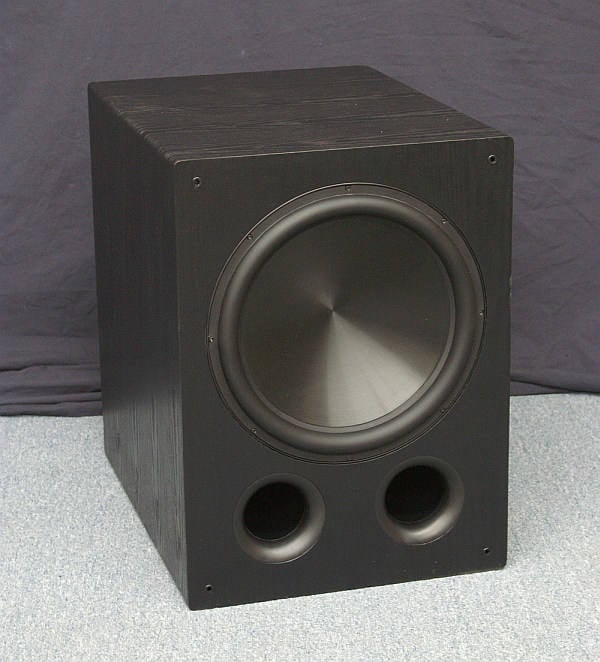 The Rythmik FV15HP is a self-powered front-loaded vented
subwoofer featuring a custom 15" Aluminum-cone driver and 600 watt
amplifier that utilizes a very unique servo-feedback system
for minimizing loudspeaker distortions, even at very high output levels (where
of course it is MOST important, since that is where subwoofers are quickest to
reveal their failings). Weighing in at
120lbs and standing two feet tall, this sub is an imposing presence, and when
excited will let you know in no uncertain terms it is in the room. Keep it away from glass or china or neighbors
prone to calling the police if they think the side of the building was just hit
by a truck. This sub goes from being
completely silent to massively loud in a few milliseconds. Priced at $1199, it's not a lightweight, and
requires more than a little bit of real estate.
From
its high output capabilities, true 20Hz extension, and ability to play clean
and distortion free, the Rythmik FV15HP is an impressive addition to any
high-performance, high end system, at a truly economical price. Read on for set-up recommendations and to see
how the Rythmik measured up in our exhaustive test suites to get a better
understanding of its superb output capabilities.
The Rythmik FV15HP is a self-powered front-loaded vented
subwoofer featuring a custom 15" Aluminum-cone driver and 600 watt
amplifier that utilizes a very unique servo-feedback system
for minimizing loudspeaker distortions, even at very high output levels (where
of course it is MOST important, since that is where subwoofers are quickest to
reveal their failings). Weighing in at
120lbs and standing two feet tall, this sub is an imposing presence, and when
excited will let you know in no uncertain terms it is in the room. Keep it away from glass or china or neighbors
prone to calling the police if they think the side of the building was just hit
by a truck. This sub goes from being
completely silent to massively loud in a few milliseconds. Priced at $1199, it's not a lightweight, and
requires more than a little bit of real estate.
From
its high output capabilities, true 20Hz extension, and ability to play clean
and distortion free, the Rythmik FV15HP is an impressive addition to any
high-performance, high end system, at a truly economical price. Read on for set-up recommendations and to see
how the Rythmik measured up in our exhaustive test suites to get a better
understanding of its superb output capabilities.
Product Overview
Rythmik Audio is an internet direct company specialized in servo subwoofers. Their mission is to bring affordable servo subwoofers to the consumers with the best combination of technology, sound quality and performance. They offer a line of servo controlled subwoofers with prices ranging from $549 to over $1299 using driver sizes from 12” to 15” in both sealed and vented configurations. This servo-only approach is quite unique in the industry and the enabling technology is the patented technology called DirectServo™. The technology got its name from the fact that its servo feedback path is direct coupled. In its current implementation, there are only 2 resistors and 1 capacitor between the sensor output and the power amplifier’s feedback summing point. There is no active component required to boost the signal strength out of the sensor. As a result, there is no so-called servo hiss noise, and the system is stable and free of oscillations which sometimes plague servo-controlled units. Rythmik believes this minimalist approach not only improves sound quality, but represents a real advancement over conventional nonservo technologies on 3 counts:
- Distortion reduction.
- Thermal compression:
- Out-of-box frequency response flatness.
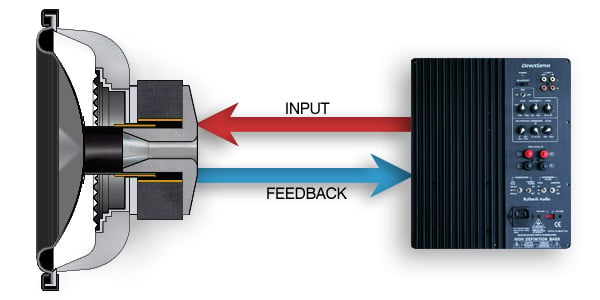
The root-cause of thermal
compression (the real-time loss of speaker efficiency resulting from high power
applied to the voice coil) is that high power creates high temperatures causing
the VC resistance to increase, which causes it to draw less power from the
amplifier. In Rythmik's DirectServo
subwoofers, the feedback is sent from the sensor output, not the amplifier
output. As a result, when voice coil
resistance increases, the servo will cause the power amplifier to increase
output until its senses the output reaches the desired level. (What it would be
without thermal compression).
Most non-servo subwoofers use equalization in one form or another to achieve flat response. In the case of DirectServo subs, the sensor output is representative of actual cone velocity which is used in a feedback loop to achieve flat response in one single gain stage without using equalization. As a result, the response is very flat and consistent. Most customers can get good results without going through complex tuning process. According to Rythmik, only customers with worse than average room acoustics need a dedicated EQ. While attempts to lower distortion using passive means require individually examining all the speaker components which contribute non-linearities, the advantage of the servo-feedback approach is that it can minimize several sources of distortion with the servo feedback alone. This helps to not only lower the distortion, but also to simplify both the driver and box design. One should note the use of a servo, while advantageous, does not create the ability to move more air than the inherent electrical and mechanical limitations of the driver, box and power amplifier combination used. The servo optimizes the physical (T/S) parameters to offer the cleanest possible physical output while achieving the best frequency and time domain response.
The Driver (Subwoofer)
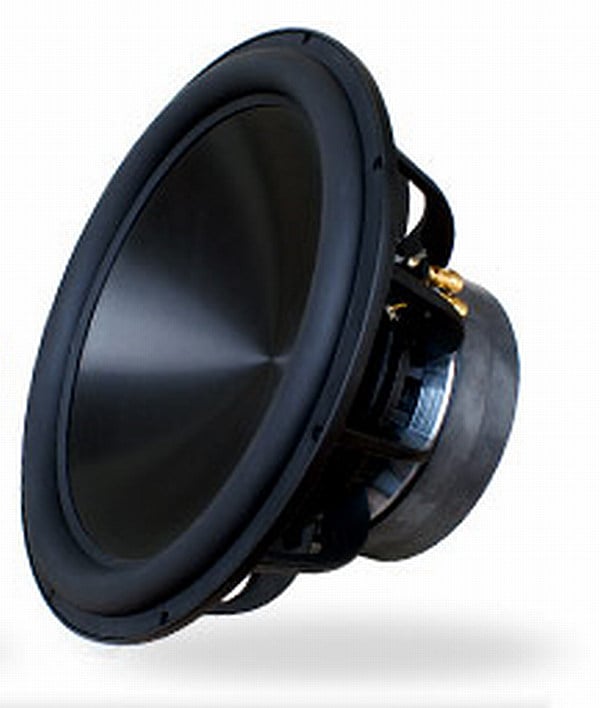 For use in the home, a 15” driver
is about as big as anyone is going to need, unless of course they are truly
unsatisfied till they can see the walls moving and shaking. A 15” driver has about 56% more surface area than
a single 12” speaker. Bottom line is for
the same excursion, you are moving more air with less motion, and for a
subwoofer more motion usually equates with more distortion. (This all assumes
of course, you have some clue as to how to design a good subwoofer driver and motor,
and don't end up putting the wrong VC or magnet or steel together). If the
designer is able to thermally couple the VC former (bobbin around which the
wire is wound which couples the VC rigidly to the cone) to that large aluminum
cone, then he is able to get a great deal of heat-sinking out of it. Since all
that surface area exposed to the air in the room is going to tend to keep the
temperature of a thermally conductive former (read aluminum, not Kapton) which
is bonded to this cone LOW, it will, therefore also keep the VC wire cool. This boils down to being able to handle more
power. More power into the VC
with less heating equals more power out.
(Ka-Boom!) Now with a 600 watt
amp, one should not really be able to burn up a 3 inch diameter voice coil,
because your peaks will be limited to about 1200 watts, and your RMS power is
likely not going to be any higher than about 300 watts. (That leaves you only
6db of dynamic range, which is really no where near enough for an accurate
subwoofer performance.) For a 15”
speaker, 300 watts or less should be easy.
Except but for the fact that many things can and do go wrong. I have one customer who is using a “600 watt”
18' speaker with a 4” diameter VC in a box with a 320 watt amp, and they
routinely see the speakers being returned by DJ's who have burned out the
VC. In short, it can and does happen
that things go horribly wrong. While it
is the job of the amplifier to send a clean signal to the speaker, if the user
is demanding more than the system can provide, something has to fail. That is where compressors, filters, and in
the case of the Rythmik, sensors come to the rescue. In this instance, Rythmik really did their
homework as we found this sub to be unbreakable in our torture tests.
For use in the home, a 15” driver
is about as big as anyone is going to need, unless of course they are truly
unsatisfied till they can see the walls moving and shaking. A 15” driver has about 56% more surface area than
a single 12” speaker. Bottom line is for
the same excursion, you are moving more air with less motion, and for a
subwoofer more motion usually equates with more distortion. (This all assumes
of course, you have some clue as to how to design a good subwoofer driver and motor,
and don't end up putting the wrong VC or magnet or steel together). If the
designer is able to thermally couple the VC former (bobbin around which the
wire is wound which couples the VC rigidly to the cone) to that large aluminum
cone, then he is able to get a great deal of heat-sinking out of it. Since all
that surface area exposed to the air in the room is going to tend to keep the
temperature of a thermally conductive former (read aluminum, not Kapton) which
is bonded to this cone LOW, it will, therefore also keep the VC wire cool. This boils down to being able to handle more
power. More power into the VC
with less heating equals more power out.
(Ka-Boom!) Now with a 600 watt
amp, one should not really be able to burn up a 3 inch diameter voice coil,
because your peaks will be limited to about 1200 watts, and your RMS power is
likely not going to be any higher than about 300 watts. (That leaves you only
6db of dynamic range, which is really no where near enough for an accurate
subwoofer performance.) For a 15”
speaker, 300 watts or less should be easy.
Except but for the fact that many things can and do go wrong. I have one customer who is using a “600 watt”
18' speaker with a 4” diameter VC in a box with a 320 watt amp, and they
routinely see the speakers being returned by DJ's who have burned out the
VC. In short, it can and does happen
that things go horribly wrong. While it
is the job of the amplifier to send a clean signal to the speaker, if the user
is demanding more than the system can provide, something has to fail. That is where compressors, filters, and in
the case of the Rythmik, sensors come to the rescue. In this instance, Rythmik really did their
homework as we found this sub to be unbreakable in our torture tests.
The Amplifier
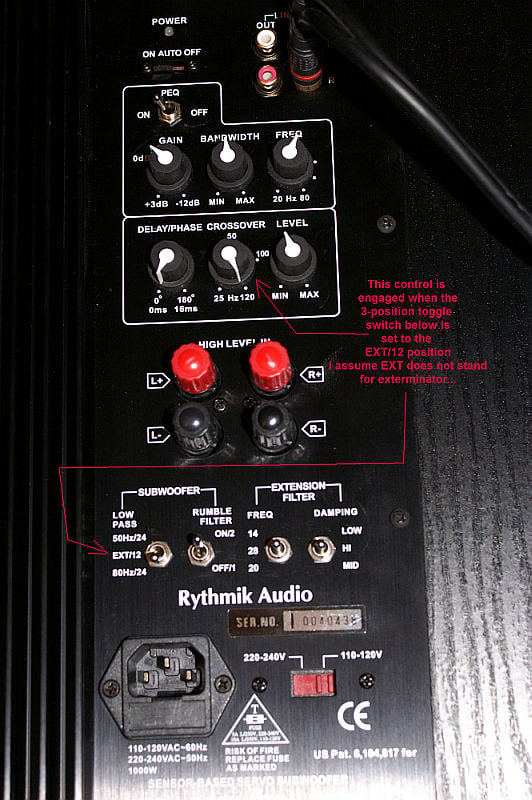 I had a number of usage problems with the
Rythmik H600PEQ amplifier which left me feeling less than satisfied
with the design of the product. First of
all, the markings on the amp are confusing, and much better information is
required to make it clear how the low pass filtering works. Take a close look at the amplifier to see
what I mean. While the switch above the AC power cord input is marked “EXT/12”
there is nothing external about it. This
switch simply disconnects one of two 12db/octave low pass filters in series
with the signal, and is still connected to the bottom center knob which is used
to vary the frequency of the variable 12db/octave filter. With the switch (bottom left) pointed at “80
Hz/24”, you don't get 80 Hz/24db per octave unless you make sure that knob
(bottom row center) is rotated to 80 Hz as well. I found this both confusing and frustrating,
as the nomenclature (white silkscreen on the amplifier panel) was in my
opinion, less than clear on this point.
While it is a beautiful thing to know that Rythmik is a small enough
company that when you call them, you can get the boss on the phone to explain
it to you, I suspect few of us using this amp for the first time would figure
out the meaning of its markings without making that phone call. If you've another filter to use instead of
the filter built into the amp; or better yet, in addition to it, I would use
it. In theory, having one second order
(12db/octave) filter to vary is a good way to fine tune the transition band of
the crossover region (that range of frequencies where BOTH the subwoofer and
the mid-high speakers have outputs which are significant and add together), it
would sure help to know what the designer had in mind before you start using
the product. Read the literature twice, then
call them anyways if you can't properly setup the subwoofer to your
satisfaction.
I had a number of usage problems with the
Rythmik H600PEQ amplifier which left me feeling less than satisfied
with the design of the product. First of
all, the markings on the amp are confusing, and much better information is
required to make it clear how the low pass filtering works. Take a close look at the amplifier to see
what I mean. While the switch above the AC power cord input is marked “EXT/12”
there is nothing external about it. This
switch simply disconnects one of two 12db/octave low pass filters in series
with the signal, and is still connected to the bottom center knob which is used
to vary the frequency of the variable 12db/octave filter. With the switch (bottom left) pointed at “80
Hz/24”, you don't get 80 Hz/24db per octave unless you make sure that knob
(bottom row center) is rotated to 80 Hz as well. I found this both confusing and frustrating,
as the nomenclature (white silkscreen on the amplifier panel) was in my
opinion, less than clear on this point.
While it is a beautiful thing to know that Rythmik is a small enough
company that when you call them, you can get the boss on the phone to explain
it to you, I suspect few of us using this amp for the first time would figure
out the meaning of its markings without making that phone call. If you've another filter to use instead of
the filter built into the amp; or better yet, in addition to it, I would use
it. In theory, having one second order
(12db/octave) filter to vary is a good way to fine tune the transition band of
the crossover region (that range of frequencies where BOTH the subwoofer and
the mid-high speakers have outputs which are significant and add together), it
would sure help to know what the designer had in mind before you start using
the product. Read the literature twice, then
call them anyways if you can't properly setup the subwoofer to your
satisfaction.
Visual Impressions
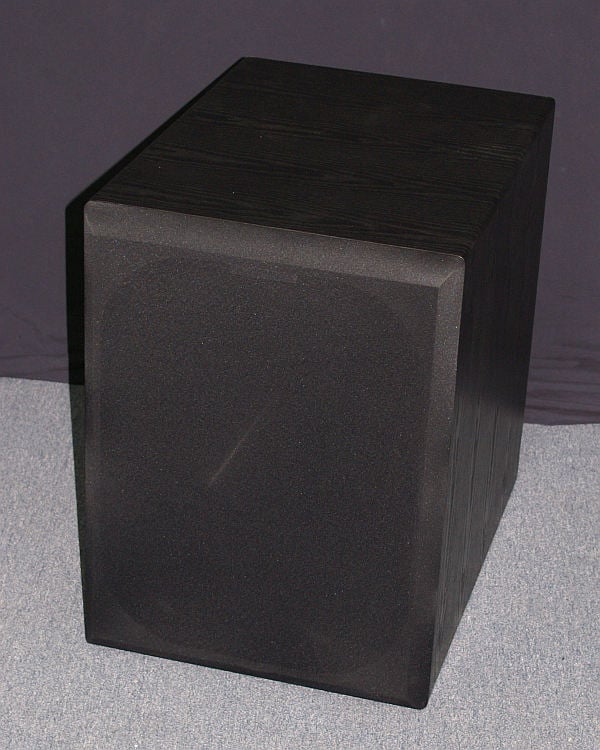 The finish of the
Rythmik is essentially a utilitarian black vinyl covering, the
likes of which you have seen many times, and have come to expect when shopping
for bargains in the speaker department.
It is so nondescript, no one would object to its presence or find it
particularly appealing or annoying. When
I placed it outside for ground plane testing, I found it was actually making
bubbles in the vinyl. I do recognize this is not an outdoor product and
by doing this, I exposed this black sub (remember black absorbs heat) to over 2
hours of direct sunlight which caused the PVC to become very hot. When I took
it out of direct sunlight, and put it back indoors, All of the bubbles went
away completely on their own!. It was
almost like it had a sunburn, and after coming out of the sunlight, everything
went back to normal. Easy fix! Rythmik has claimed to have both replicated
the problem, and found a solution. So
this finish issue dies with my review sample but the consumer is still advised
to NOT use this product outdoors since like all of the other subs we've tested,
it is not weatherproof.
The finish of the
Rythmik is essentially a utilitarian black vinyl covering, the
likes of which you have seen many times, and have come to expect when shopping
for bargains in the speaker department.
It is so nondescript, no one would object to its presence or find it
particularly appealing or annoying. When
I placed it outside for ground plane testing, I found it was actually making
bubbles in the vinyl. I do recognize this is not an outdoor product and
by doing this, I exposed this black sub (remember black absorbs heat) to over 2
hours of direct sunlight which caused the PVC to become very hot. When I took
it out of direct sunlight, and put it back indoors, All of the bubbles went
away completely on their own!. It was
almost like it had a sunburn, and after coming out of the sunlight, everything
went back to normal. Easy fix! Rythmik has claimed to have both replicated
the problem, and found a solution. So
this finish issue dies with my review sample but the consumer is still advised
to NOT use this product outdoors since like all of the other subs we've tested,
it is not weatherproof.
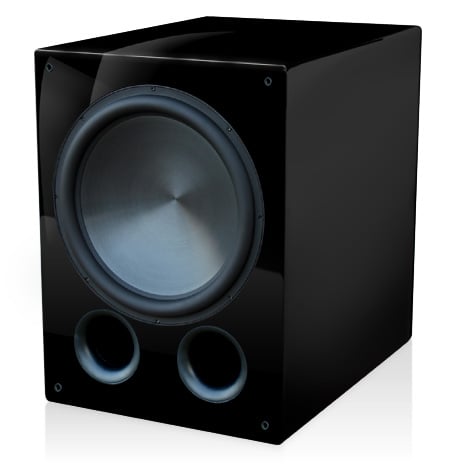
For those wanting to really spruce up the appearance of this subwoofer, Rythmik offers a stunningly beautiful piano black gloss finish with only a modest cost adder bringing the sub from $1199 to $1399. The extra $200 spent here in our opinion is money well spent as you can see how the gloss finish really adds a touch of class to the products appearance.
The Set-Up
 My biggest issue in using this product, came
during my listening tests as this sub proved to be more challenging to setup
properly. I made the choice (not quite
randomly) to use Joni Mitchell songs for testing. Rythmik was kind enough to
loan me 4 CDs of music for testing, and the (2) I happened to randomly choose
had no vocals, and only what I would call SLOW bass tracks, not really anything
with crisp clear attack, like a drum solo.
Those CD's I did listen to had low and clearly powerful bass. The Rythmik did an outstanding job of
reproducing very low, very loud and what I would call plodding bass.
My biggest issue in using this product, came
during my listening tests as this sub proved to be more challenging to setup
properly. I made the choice (not quite
randomly) to use Joni Mitchell songs for testing. Rythmik was kind enough to
loan me 4 CDs of music for testing, and the (2) I happened to randomly choose
had no vocals, and only what I would call SLOW bass tracks, not really anything
with crisp clear attack, like a drum solo.
Those CD's I did listen to had low and clearly powerful bass. The Rythmik did an outstanding job of
reproducing very low, very loud and what I would call plodding bass.
Since I am usually fixed behind a computer screen for most of the day, I have my mid-high satellites on either side of my monitor, running full range, which for this small 6” sealed box means 3db down at 100 Hz, with a natural 12db/octave roll-off. It should have been pretty easy to make them sound natural with the Rythmik FV15HP sub. All of the configuration options on the backpanel of the sub had me struggling to set them up optimally for my situation. I recognize the usage of an external bass management system would have made this task much easier and I encourage consumers utilizing this product for home theater to opt for that route. For most users connecting up a modern A/V processor or receiver, we strongly suggest you set the volume control of the Rythmik FV-15HP at a fixed position and utilize the level trim of your A/V processor which has a finer and accurate adjustment capability than we found using the analog control of the Rythmik. Careful level adjustment and placement is key for making this or any subwoofer seamlessly blend into your system while also preserving the stereo imaging of your front speakers.
For those of you new to bass management systems, Audioholics has written some excellent articles on this topic, which can be found here:
Hometheater Multiple Subwoofer & Setup Guide
Bass Management Basics - Settings Made Simple
Basic Subwoofer Setup Guide Not for Dummies
Rythmik FV15HP Subwoofer Measurements and Analysis
The first part of testing was to measure the frequency response from a modest output, all the way to the point where the system was clearly compressing and had hit the output wall, so to speak.
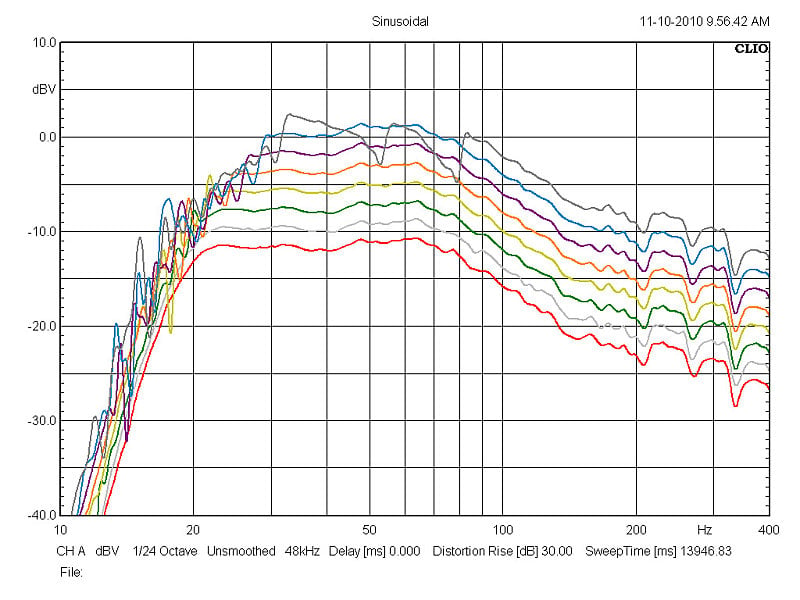
Rythmik FV15HP Subwoofer Frequency Response at Various Output Levels
The Rythmik sub was unique in one way during the compression testing vs frequency. As you can see from the curve above, at the highest output level (the gray curve, as this sweep, 14 seconds long from 400 Hz to 10 Hz) triggered the sensor or compressor about the time we hit 80 Hz. As the signal continued to sweep lower, in a very short period of time, the compression released, allowing the signal to peak again right at about 60 Hz, and then before it got down to 50 Hz, the compressor becomes active again. This happens AGAIN at about 32 Hz, and as you can see as the sweep runs lower, the compressor releases and then returns several times in quick succession. Now it could be argued that music does not have any sweeping tones that range across more than a decade (400 to 40 Hz is one decade) and last 14 seconds in length. They would be quite correct. However, I cannot help but relate this to instances where I was listening to music and the output seemed to suddenly jump out as if the volume control was being rotated without any help from my fingers. I would suggest that the use of a longer hold time or integration time be considered based not so much on the signal sweep test shown above, but on my own sense that the sub seemed to go from too quiet, to just too loud all on its own frequently during its operation.
As we can clearly see from the curves above, frequency response is NOT independent of level, and if the system is pushed hard enough, it will roll off below 30 Hz, yet at lower power outputs, is certainly flat down to 20 Hz. (Red curve) at the bottom.
Editorial Note about the Limiter Feature of the FV15HP Subwoofer
The limiter in FV15HP is defeatable. However, I had chosen to test the subwoofer with limiter ON. The curves with limiter off should be smoother and without this short hold time issue I noted. As for this hold time duration issue, it is a design trade-off. Shorter hold time can recover fast and provides more output over the same period of time. On the other hand, my preference is to have longer hold time duration as I stated above. I tested the H600PEQ amplifier with my review unit which engaged the limiter with the power switch set to "auto". Since that time, the amp has been updated to the H600PEQ2 model with a discrete on/off switch for the limiter.
CEA-2010 Test Results
On to the CEA 2010 testing. To understand the meaning behind the graphics below and testing methods used, please refer to the prior article (Subwoofer Shootout Measurements Overview) on this method. The process is a simple one. Drive the input to the system to the point where either the amp, its compressor, or its speaker simply refuses to give you more output, or the distortion created at that output level exceeds the CEA “redline”. In EVERY system tested, the result (if not the peak SPL) was similar in one regard. At the highest frequencies in the sub's bandwidth, we ran out of amplifier power, or the compressor refused to put out more power than the amp could cleanly deliver. At the lowest frequencies, the subwoofer runs out of excursion. This is completely normal and what is to be expected. It may also explain why the CEA standard does not bother testing higher than the center frequency of 63 Hz. Below is a spectrum capture of the Rythmik FV15HP system at maximum usable output from 20 to 63 Hz in 1/3rd octave steps.
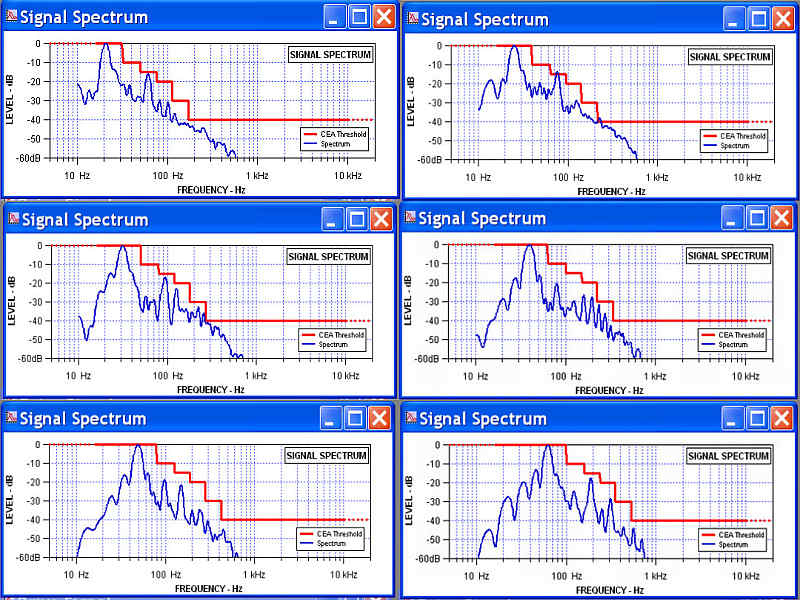
Rythmik
FV-15HP CEA-2010 Distortion Test Results
| Rythmik FV-15HP | CEA Test Performance | |
| Frequency | Maximum Peak SPL @ 1 Meter | RMS SPL @ 2 Meters |
| 20 Hz | 116.5 dB | 107.5 dB |
| 25 Hz | 122.0 dB | 113 dB |
| 32 Hz | 126.8 dB | 117.8 dB |
| 40 Hz | 129.0 dB | 120 dB |
| 50 Hz | 128.9 dB | 119.9 dB |
| 63 Hz | 128.7 dB | 119.7 dB |
Max SPL Output Data of the Rythmik FV15HP Subwoofer (1 meter groundplane)
Update: 3/08/12
In order to make it easier for our readers to compare our CEA data between subwoofers tested prior to our new Subwoofer Measurement Protocol, we scaled our 1 meter peak CEA data to 2 meter RMS by subtracting 9dB for each frequency. We also corrected our 1 meter data to peak by adding +3db from our first review which more closely matches the test data collected by Josh Ricci on the same review sample.
Discussion of Measurements
What is noteworthy about this sub, is that the second order distortion components at the three lowest test frequencies, are extremely low. Usually, 2nd order distortion components are those which are the most prevalent, and arguably the least objectionable. Removing them creates the largest measurable reduction in THD (in almost all circumstances) yet second order is the least objectionable of all the harmonics, hence the CEA tolerance of it is in excess of the tolerance for any other components. (Music is, mostly harmonics after all.) Second order distortion at 20, 25 and 32 Hz were so low in fact that with the normal 1/12th octave smoothing, the second harmonic is no where to be found in the spectrum curves. It appears that this is where the servo-feedback excels and Rythmik's claims of low distortion are validated.
The differences in outputs between 40, 50 and 63 Hz should be considered so small as to be negligible. Any decrease from one frequency to the other is likely caused by a small amount of VC heating, such that if I had tested from higher to lower frequency, these three numbers would likely have been reversed. In fact, the repeatability of these numbers should be considered no greater than within 1db. While I am listing them to three significant figures, we need to remember that precision is not accuracy, and that any other speaker within a db of these numbers is likely to be close enough that we will not be able to reliably or consistently hear a difference.
Rythmik FV15HP Subwoofer Listening Impressions
 The first song I
listened to just happened to be a Joni Mitchell tune from the late 1960's, and
if you are familiar with this artist, you are likely asking yourself why I
would test a subwoofer with program material which is mostly female vocals and
acoustic guitar. Certainly this is not a
treasure trove of deep bottom end. It
is, however, a great way to find out if the sub itself will disappear into the
background, or start introducing midrange sounds that will interfere with the
stereo image. I had the sub pointed
straight at my right ear, well off to the side, and double the distance (or
more) from me compared to the satellites.
After a good deal of fiddling, I managed to get the Rythmik sub to meld into the soundscape.
The first song I
listened to just happened to be a Joni Mitchell tune from the late 1960's, and
if you are familiar with this artist, you are likely asking yourself why I
would test a subwoofer with program material which is mostly female vocals and
acoustic guitar. Certainly this is not a
treasure trove of deep bottom end. It
is, however, a great way to find out if the sub itself will disappear into the
background, or start introducing midrange sounds that will interfere with the
stereo image. I had the sub pointed
straight at my right ear, well off to the side, and double the distance (or
more) from me compared to the satellites.
After a good deal of fiddling, I managed to get the Rythmik sub to meld into the soundscape.
I spent more time listening to the Rythmik, than all the other subs I reviewed for the CEA output article. I found the best blend with my satellite speakers when I set the Rythmik crossover frequency control to 50Hz and the low pass knob to "80Hz/24". For those using external bass management facilities, I still suggest starting at 80Hz 24dB/Oct. But, because this sub has so much tactile energy, if it's placed in close proximity to the listening area, you may want to experiment with a lower crossover setting.
Keep this in mind especially if you plan on using small satellite speakers requiring a higher crossover frequency and steeper rolloff of the sub to prevent it from being localized. Another setup tip when using this sub in close proximity to the listening area that may help is to orient the subwoofer sideways which will audibly reduce any higher harmonic frequencies emanating from the ports.
My testing were mainly concerned about usable low distortion output, so I paired the sub with a pair of the high efficiency (about 97.5dB/watt) prototype B52 Matrix 1000 Version 4 satellites driven with a 725 watt per channel amp. The Rythmik FV-15HP sub seemed to run out of steam at about 90-100 watts RMS level into my satellites, which is about 117 dB in my lab. That's very LOUD! That's the loudest of any sub in the group testing except for one folded horn I had lying around and put outside to prove a point. For the additional music and movie tests I performed on this sub, I was most astounded by the usable output and low distortion - this sub can crank out volume like you wouldn't believe!
Application
Given the range and output capabilities of this sub, I can recommend it for either Home Theater or Audiophile use. Home theater use is a bit more difficult as sound effects are often kicked up for dramatic effect to levels at extremely low frequency output (below 40 Hz) that you might only find at a Rave or a Rap concert. If you are more interested in music reproduction, you can push the box a little harder and count on more output. The Rythmik FV-15HP should be more than capable of filling medium to very large size rooms with more than adequate bass for all but the audio-insane. It is one more example that if you want real high-output performance down to 20 Hz, the wife needs to give up her coffee table or favorite floor lamp. While this subwoofer won't come home comfortably in your compact car, it will fit into your SUV or the back of your pickup truck. Don't count on lifting or placing it by yourself unless you routinely pick up hundreds of pounds in your daily life. Get a buddy to come over, and have him bring a bass-heavy CD or an iPod full of tunes.
Like with all subs used in a home theater environment, we highly recommend utilizing the internal bass management and level control of your A/V processor and either bypassing the sub's internal filters or using them in conjunction (if needed) to ensure the best integration with your speaker system.
Rythmik FV15HP Subwoofer Review Conclusion
The Rythmik FV15HP sub is a solid performer. It is amazing how much bass content in
program material has changed over the decades from relatively little to
overwhelming, all of which the Rythmik sub is capable of reproducing without
batting an eye or in this case without bottoming the driver.
While not expensive by today's standards, I think my satisfaction would have increased substantially had the unit had a nice high quality detent potentiometer used for the volume control. I would have been quite a bit less frustrated in making the filter settings with better nomenclature and a better manual as well. In the grand scheme of things, these are small annoyances. In terms of just plain knock-me-to-the-ground output, this sub had it in spades. Sadly, since I was the recipient of prototype product (like most of the other entrants I reviewed), I had some nits to pick, but don't let that deter you from your purchasing decision. Rythmik has been very open to my criticisms and has already implemented product changes as a result. You can rest assured a production unit shipping by the time this review posts is much better off than the review sample I received.
Powerful, rich, deep and solid is how I would describe the bass output of this sub. I found Rythmik Audio has a very talented engineering staff that produced a truly great high caliber subwoofer product at a very affordable asking price. I would recommend a pair of these subs for any upscale home theater environment where seat to seat bass consistency and ultimate output are paramount concerns. If you're just a bass nut - the Rythmik FV15H Psubwoofer will impress you to no end and leave you waiting to catch your breath. It's loud, clean, and fast... and for most - that's going to make this an extremely hard sub to beat.
Rythmik FV15HP Subwoofer Review
MSRP: $1199
Rythmik Audio
Phone +512 565 0292
FAX +512 266 2506
Office 9705 Burnet Rd. #315 Austin, TX 78758
Read Consumer Reviews on
The Score Card
The scoring below is based on each piece of equipment doing the duty it is designed for. The numbers are weighed heavily with respect to the individual cost of each unit, thus giving a rating roughly equal to:
Performance × Price Factor/Value = Rating
Audioholics.com note: The ratings indicated below are based on subjective listening and objective testing of the product in question. The rating scale is based on performance/value ratio. If you notice better performing products in future reviews that have lower numbers in certain areas, be aware that the value factor is most likely the culprit. Other Audioholics reviewers may rate products solely based on performance, and each reviewer has his/her own system for ratings.
Audioholics Rating Scale
 — Excellent
- — Very Good
- — Good
- — Fair
- — Poor
| Metric | Rating |
|---|---|
| Bass Extension | |
| Bass Accuracy | |
| Build Quality | |
| Appearance | |
| Dynamic Range | |
| Performance |  |
| Value | |
 Subscribe to our newsletter