


Outlaw Audio LFM-1 EX Subwoofer Review
- Product Name: LFM-1 EX
- Manufacturer: Outlaw Audio
- Performance Rating:


- Value Rating:
- Review Date: October 31, 2006 08:25
- MSRP: $ 649
- 12” downward firing long throw woofer
- Vented cabinet with dual 3” flared ports
- Amplifier: BASH 350 watts rms
- Frequency Response: 22-180Hz +/-2dB (2 port mode), 16-180Hz +/-2dB (1 port open mode)
- SPL: 118dB (Subject to placement and room gain)
- Finishes: Ebony black
- Dimensions (H/W/D): 22.75” x 17” x 24”
- Weight: 80 lbs.
- Warranty: 3 years (Bumper to bumper)
Driver features
- Rubber surround
- Inverted dust-cap
- Double sacked magnets
- Bucking magnet
- Vented pole piece
- Bumped back plate
Additional Features
- Variable low pass filter, 30-180Hz, 4th order Linkwitz Riley (Defeatable)
- Phase: Variable from 0 to 180 degrees
- Selectable power mode: On, Auto-On, Standby
- Selectable operation mode, 1 port or 2 ports
- Detachable power cord
- Detachable floor spikes
- Plexi-glass top
Inputs/Outputs
- Unbalanced (RCA) input
- Speaker level left and right inputs
- Speaker level left and right outputs
Pros
- Overall measured performance
- Huge bang for the buck
- Real 20Hz output
Cons
- Driver / enclosure system is not quite optimized to each other
- Limited connectivity
- Basic controls only
Outlaw Audio LFM-1 EX Review Introduction
Outlaw Audio is an audio company that has been dealing to consumers in an internet direct only manner for over 13 years. Their range of offerings ranges from pre-amplifiers to multi channel amplifiers, to speakers and powered subwoofers. Outlaw focuses on providing solidly engineered products with a very high value. Today we will be reviewing their top of the line powered subwoofer the LFM-1 EX, which is a bass reflex subwoofer built around a 12” driver and powered by a 350 watt rated amplifier.
Unpacking and Initial Thoughts
Th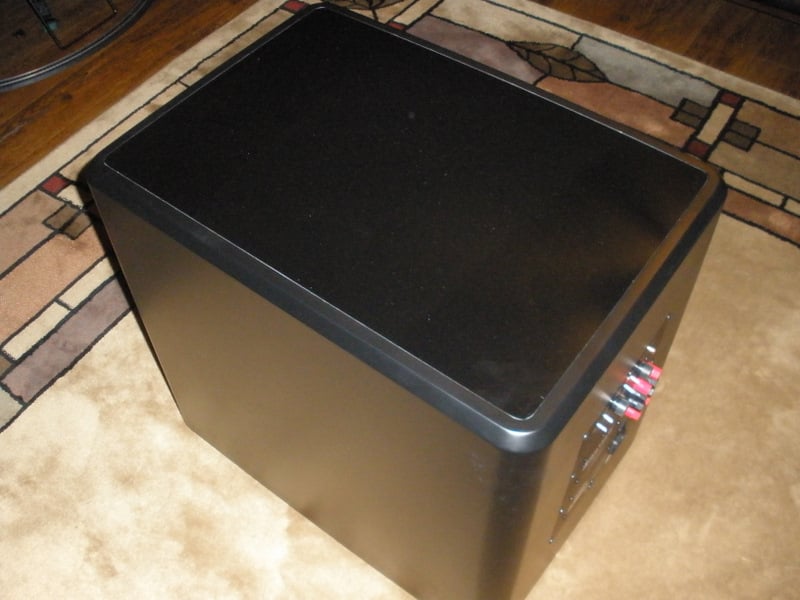 e Outlaw arrived in a generous sized
double box and was very thoroughly packaged. Protections for the subwoofer
seemed to be more than adequate and the LFM-1 EX arrived largely devoid of
markings to even the outer cardboard. Inside of the packing materials was the
LFM-1 EX wrapped in a cloth bag, the power cord, the owner manual, the port
bung and a packet containing the floor spikes and plastic cups for them. Unpacking
was an easy one person job.
e Outlaw arrived in a generous sized
double box and was very thoroughly packaged. Protections for the subwoofer
seemed to be more than adequate and the LFM-1 EX arrived largely devoid of
markings to even the outer cardboard. Inside of the packing materials was the
LFM-1 EX wrapped in a cloth bag, the power cord, the owner manual, the port
bung and a packet containing the floor spikes and plastic cups for them. Unpacking
was an easy one person job.
The LFM-1 EX is what I would consider to be an average to large size for a consumer level powered subwoofer. At 80lbs it is no lightweight but not what I would consider a back breaker either. The finish is a nice flat black which is not reflective. The glass top was covered with a peel off protective sticker which reveals a very nice looking, glossy and deep black color when removed. The cabinet corners are each rounded off with a large radius and the floor spikes are very large, heavy and high quality units. The unit has no grill since both ports and the driver are all down firing. The total package is a rather good looking affair in my estimation. I had no troubles moving the LFM-1-EX by myself but the floor spikes will mark any hard surface if you are not careful.
Design Overview
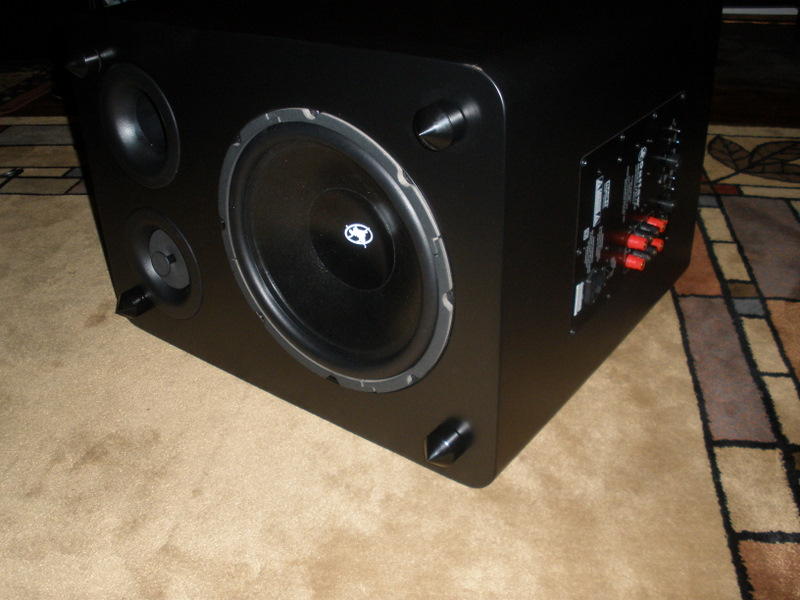 Outlaw’s LFM-1 EX is a
bass reflex design utilizing a single 12” driver and two 3” flared ports in a
down firing configuration. The system can be configured for a 25Hz tune with
both ports open, or an 18Hz tuning with one port blocked via the supplied port
plug. There is a switch on the amplifier which operates the necessary high pass
filter for each tuning.
Outlaw’s LFM-1 EX is a
bass reflex design utilizing a single 12” driver and two 3” flared ports in a
down firing configuration. The system can be configured for a 25Hz tune with
both ports open, or an 18Hz tuning with one port blocked via the supplied port
plug. There is a switch on the amplifier which operates the necessary high pass
filter for each tuning.
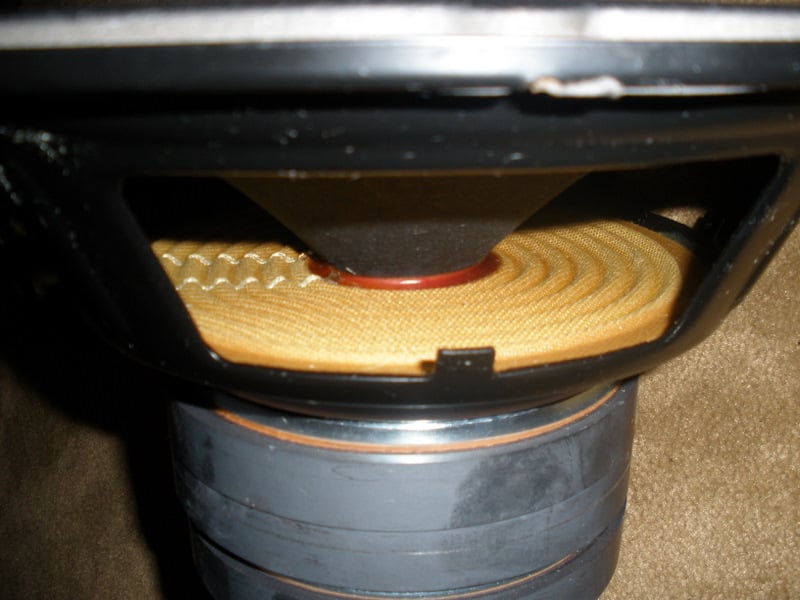
After pulling the driver out of the enclosure to examine it further it could be seen that it was a well built and substantial unit but of moderate cost. The 12” driver is built on a stamped steel frame and a good sized motor of roughly 6” in diameter with dual stacked ferrite magnets. The back plate is bumped and has a small pole vent with a screen to prevent debris from entering the gap. The cone appears to be pressed and coated paper attached to a 2” diameter voice coil and former. The suspension consists of what appears to be a 6” diameter single spider and a rubber half roll surround. Interestingly the motor also has a large bucking magnet attached to the back of it for magnetic shielding purposes. This is increasingly less of a concern since CRT televisions are becoming much less common. The driver is of a very humble pedigree and built of unassuming components but is not out of character for a subwoofer in this price range and appears to do the job well, which is what matters.
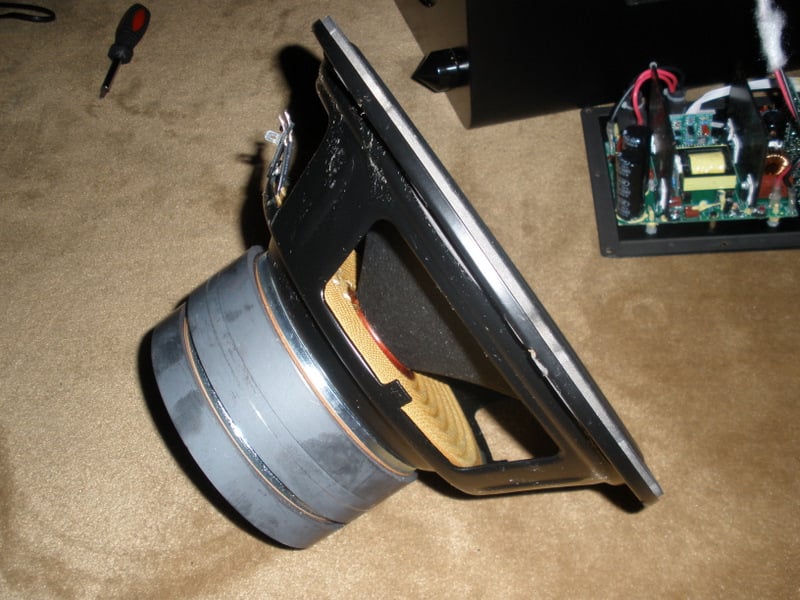
The BASH amplifier is rated for 350 watts. The literature also makes mention of the amplifier being capable of reaching peaks of 1300 watts but this seems to be a nebulous claim at best. In any event most other manufacturers do not list peak power of their amplifiers any more for comparison. As with most BASH designs this is a relatively simply constructed and very lightweight unit. There was no internal heat sinking other than the large aluminum faceplate of the amplifier. Two large reserve capacitors were in evidence.
Editorial Note about BASH Peak Power Rating by Gene DellaSala
We find the 1300 watt rating to be bunk. Even if the amp operates as an ideal voltage source doubling down power with halving load impedance, it would require the amplifier to see a 1 ohm load in order to achieve its 1300 watt peak rating. This is impossible since the driver impedance is 4 ohms. Alternatively if the rail voltage is high enough and the amplifier is able to take full advantage of it briefly, that would imply the amp is severely current limited. The fact that this amp had virtually no heat sinking on it makes it apparent it can’t produce more than about 40-45V across its rails when driving a 4 ohm load. In any event, we would really like to see BASH amps rated more honestly. If the amp does in fact deliver 350 watts continuously, then it should at best be able to deliver 700 watts peak for very short durations.The LFM-1 EX enclosure is constructed of what looks like ¾” MDF but the driver baffle appears to be a slightly thicker 1” material. Internally the ports are also flared and have plenty of clearance from the enclosure walls. There are small corner reinforcements glued to the enclosure panels and there is one large brace that connects the center of the 2 largest side panels. There is some fiberglass damping material behind the driver and on the panel opposite of the amplifier. The amplifier and driver are countersunk into their respective panels. The cabinet corners have a nice round over and the finish is an unassuming black. The glass top panel with its glossy black appearance contrasts well with it. Overall appearance, parts and build quality is good especially considering the cost of the unit.
Outlaw Audio LFM-1 EX Review Listening Tests
For all of the listening sessions the LFM-1 EX was placed in the front right corner of the room firing down into the floor of the corner about 2 inches from the walls. This places the subwoofer a little over 4 meters from the primary listening position. I have determined this to be the best available single subwoofer placement in the room for most units. Audyssey was run on the system to allow it to integrate the LFM-1 EX, which was then followed by a check and recalibration of the subwoofer and speaker levels prior to the listening sessions. I used the Outlaw in 2 ports open mode for all of the listening to give it more headroom since the room is large.
CD: 311: From Chaos
I ’ve been listening to 311 for many,
many years. While this is not my favorite effort from them I do like the album
and the mix. It features a very snappy and percussive drum sound locked in with
a round bass guitar tone, which only gets better the louder you turn it up.
Chad Sexton does his usual masterful playing on this disc as does Aaron Willis.
There is not much bass below even 35Hz here but what is there is very clean and
percussive and the LFM-1-EX delivered plenty of kick and subjective punch from
Sexton’s kick drum and toms. The bass playing by Willis is at times laid back
and open, while at other times he gets very busy. The LFM-1 EX had no trouble
keeping up with the bass lines as they wound their way through and around the
drum beat and easily resolved each individual note on tracks such as “From
Chaos”, “You wouldn’t Believe” and “Sick Tight” from in between the kick drum.
As usual I started cranking the level up to see how the subwoofer maintained
dynamics and note delineation at higher output levels. The Outlaw got quite
loud before any loss of resolution was noted. When it happened it was a sort of
cloudiness to the notes and rounding off of the kick drum hits. Things were
quite loud at that point. At more typical volume levels the LFM-1-EX was
thoroughly enjoyable to listen to and I noted no notable sonic irregularities.
’ve been listening to 311 for many,
many years. While this is not my favorite effort from them I do like the album
and the mix. It features a very snappy and percussive drum sound locked in with
a round bass guitar tone, which only gets better the louder you turn it up.
Chad Sexton does his usual masterful playing on this disc as does Aaron Willis.
There is not much bass below even 35Hz here but what is there is very clean and
percussive and the LFM-1-EX delivered plenty of kick and subjective punch from
Sexton’s kick drum and toms. The bass playing by Willis is at times laid back
and open, while at other times he gets very busy. The LFM-1 EX had no trouble
keeping up with the bass lines as they wound their way through and around the
drum beat and easily resolved each individual note on tracks such as “From
Chaos”, “You wouldn’t Believe” and “Sick Tight” from in between the kick drum.
As usual I started cranking the level up to see how the subwoofer maintained
dynamics and note delineation at higher output levels. The Outlaw got quite
loud before any loss of resolution was noted. When it happened it was a sort of
cloudiness to the notes and rounding off of the kick drum hits. Things were
quite loud at that point. At more typical volume levels the LFM-1-EX was
thoroughly enjoyable to listen to and I noted no notable sonic irregularities.
Blu-ray: Terminator - Salvation
 The latest movie in the long running
Terminator series, Salvation packs a powerful audio track that is mixed hot and
demands a lot from the subwoofer both from a standpoint of overall loudness and
depth of extension. There is plenty of action in this title and the bass is
varied throughout with nuanced parts, loud explosions, very deep powerful bass
rumbles and everything in between. The master volume was set to -15dB for the
movie. I briefly thought about trying the LFM-1 EX in 1 port mode for the extra
extension but decided not to in order to preserve the extra headroom and larger
vent area of having the higher system tuning and both ports open. Throughout this movie the LFM-1 EX did a very
good job filling the large room with whatever bass the sound track called for.
The amount of output headroom available from this $650 subwoofer is very
impressive. For the most part the LFM-1 EX delivered whatever types of bass the
situation called for whether it was loud, abrupt or percussive events, ominous
rumbles, or deep impacting thuds. All were produced quite well and with no lack
of accuracy. The deep bass was well represented as well, but some of the very deepest
frequencies present in the audio track seemed to be glossed over compared to
what I remember from watching this movie at other times. Using the deeper
tuning of 1 port mode would have no doubt helped out there, but at the cost of
diminished overall headroom. The Outlaw did seem to reach its limits and emit a
little distress noise or perhaps port noise on a few parts, most notably the
scene involving a giant robot devastating a gas station, which has absurdly
gratuitous amounts of 20-40Hz bass. There was also an odd sort of sound from
the Outlaw during the end of the scene with the flying hunter killer unit. This
was at rather loud levels in a big room though. The LFM-1 EX’s performance with
this piece of bombastic home theater bass was above and beyond what subwoofers
in its price range would usually be able to provide. Impressive.
The latest movie in the long running
Terminator series, Salvation packs a powerful audio track that is mixed hot and
demands a lot from the subwoofer both from a standpoint of overall loudness and
depth of extension. There is plenty of action in this title and the bass is
varied throughout with nuanced parts, loud explosions, very deep powerful bass
rumbles and everything in between. The master volume was set to -15dB for the
movie. I briefly thought about trying the LFM-1 EX in 1 port mode for the extra
extension but decided not to in order to preserve the extra headroom and larger
vent area of having the higher system tuning and both ports open. Throughout this movie the LFM-1 EX did a very
good job filling the large room with whatever bass the sound track called for.
The amount of output headroom available from this $650 subwoofer is very
impressive. For the most part the LFM-1 EX delivered whatever types of bass the
situation called for whether it was loud, abrupt or percussive events, ominous
rumbles, or deep impacting thuds. All were produced quite well and with no lack
of accuracy. The deep bass was well represented as well, but some of the very deepest
frequencies present in the audio track seemed to be glossed over compared to
what I remember from watching this movie at other times. Using the deeper
tuning of 1 port mode would have no doubt helped out there, but at the cost of
diminished overall headroom. The Outlaw did seem to reach its limits and emit a
little distress noise or perhaps port noise on a few parts, most notably the
scene involving a giant robot devastating a gas station, which has absurdly
gratuitous amounts of 20-40Hz bass. There was also an odd sort of sound from
the Outlaw during the end of the scene with the flying hunter killer unit. This
was at rather loud levels in a big room though. The LFM-1 EX’s performance with
this piece of bombastic home theater bass was above and beyond what subwoofers
in its price range would usually be able to provide. Impressive.
Outlaw Audio LFM-1 EX Review Measurements and Analysis
The Outlaw LFM-1 EX subwoofer was measured outdoors sitting on the ground with the microphone placed 2 meters from the front lip of the cabinet. The cabinet was laid over on its side with the driver and ports firing at the microphone which was centered at a point about half way between the center of the driver dust cap and the center of the 2 ports. The low pass filter was disabled and the subwoofer volume was set to maximum for all testing, except for those tests purposely conducted to examine the effects of the built in functions or different operational modes.
The overall approach to this testing along with the equipment and software used is outlined in the article here: Powered Subwoofer Testing Outline and Procedures Overview
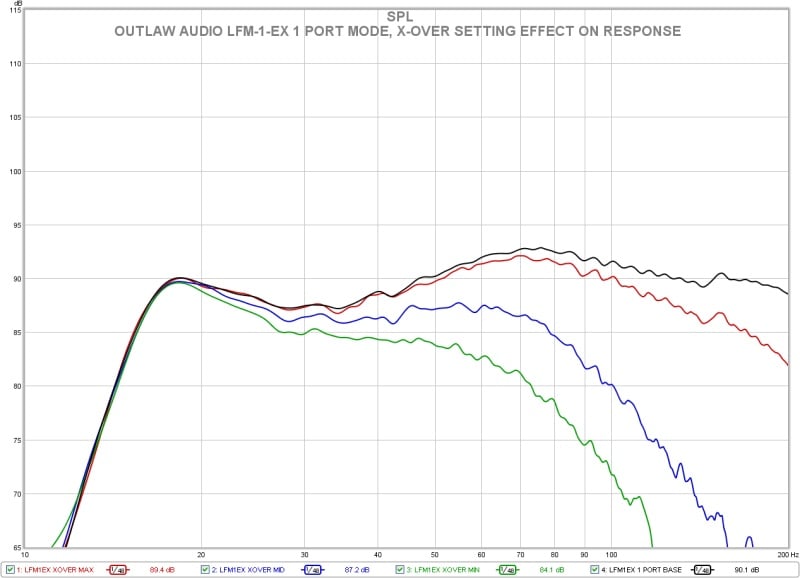
Outlaw LFM-1 EX: Effect of Low Pass Filter Settings
A measurement was taken of the LFM-1-EX with the low pass crossover bypassed using the LFE input and at its maximum, middle and minimum settings to observe its effect on the response shape. This is presented in the graph above.
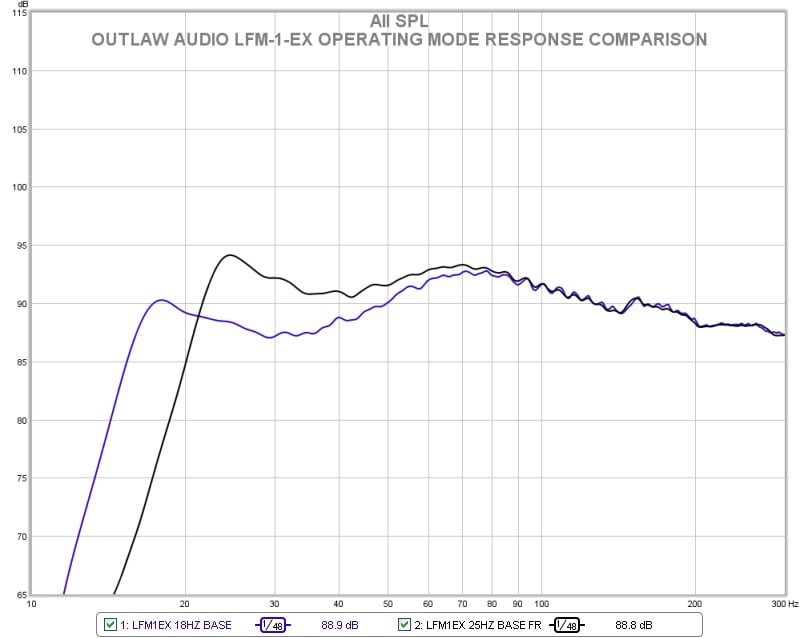
Outlaw LFM-1 EX: Basic Frequency Response as Tested
The responses above are of the LFM-1-EX with the low pass crossover bypassed and configured in both extension modes. In the 2 ports open configuration the response is within +/-3dB from 21-270Hz. In the 1 port open 18Hz configuration the LFM-1 EX was within a +/-3dB or 6dB total window from 16-300Hz. Outlaw specs their response within a +/-2dB window. Technically the measurements don’t quite meet Outlaw’s spec due to the tighter than normal window but there could easily be differences in the measurement methodology that caused the difference. Regardless the LFM-1 EX exhibits very wide bandwidth and uniform response regardless of the extension configuration. The extended upper range response above 100Hz mean that the LFM-1 EX could probably effectively be crossed over to small mains above 200Hz if necessary, but it would be best to use a transition point of 140Hz or lower. These response shapes are at the base starting drive level used for testing which is referenced to 90dB at 2 meters from the microphone at 50Hz. At higher levels the output will compress and the response shape deviates.
One thing to note here is that the LFM-1 EX appears to be slightly mistuned as evidenced by the slight amount of peaking at the port tuning. This indicates that the subwoofer could use either a little less enclosure volume for this tuning which would lower the efficiency at port tuning flattening out the peak. This would in turn require longer ports to achieve the same tuning range, or that the driver attributes could be tweaked a little to compensate. Conversely a small amount of EQ or perhaps moving the rumble filter up slightly higher in frequency could flatten this out.
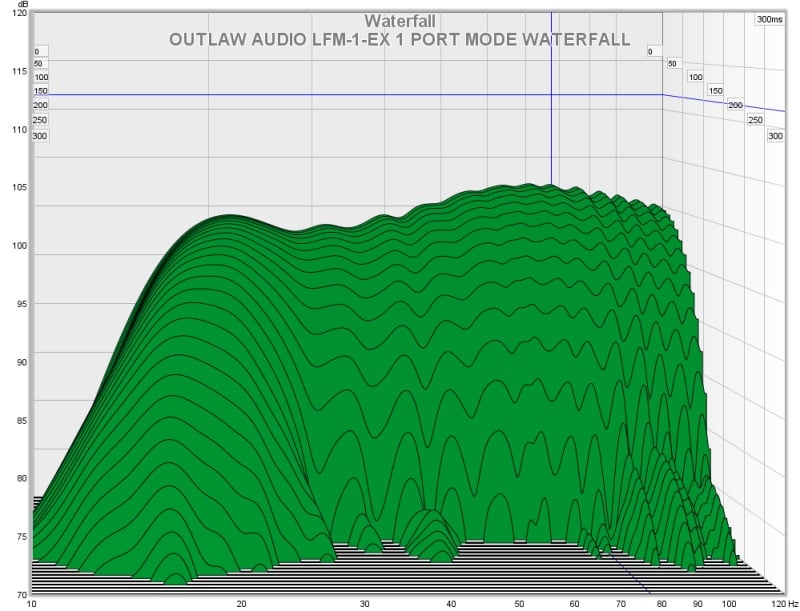
Outlaw LFM-1 EX 1 Port mode: Waterfall Decay
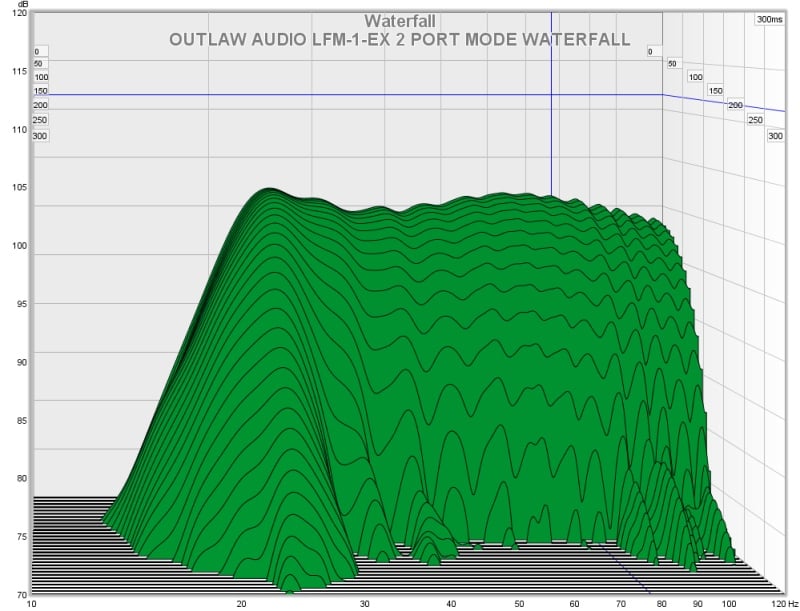
Outlaw LFM-1 EX 2 Ports mode: Waterfall Decay
Outlaw LFM-1 EX: Group Delay Both Extension Modes
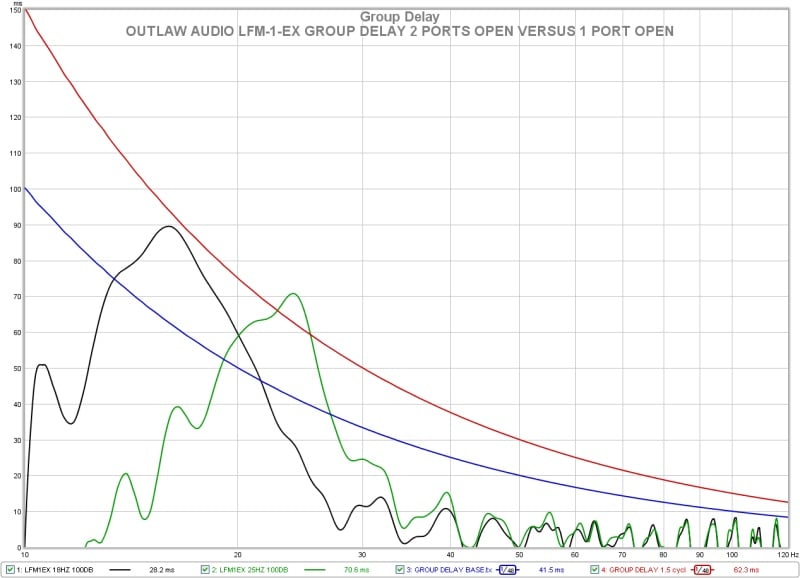
The waterfall and group delay plots for the LFM-1 EX are good for the most part but exhibit some ringing or delayed energy release near the tuning point of the ports. The group delay exceeds 1.5 cycles briefly near 24Hz while the deeper extending 1 port open mode never exceeds 1.5 cycles. This is typical for bass reflex alignments utilizing steep high pass filters at or below tuning.
Outlaw LFM-1 EX 1 Port Mode: Long Term Power Compression
Outlaw LFM-1 EX 2 Ports Mode: Long Term Power Compression
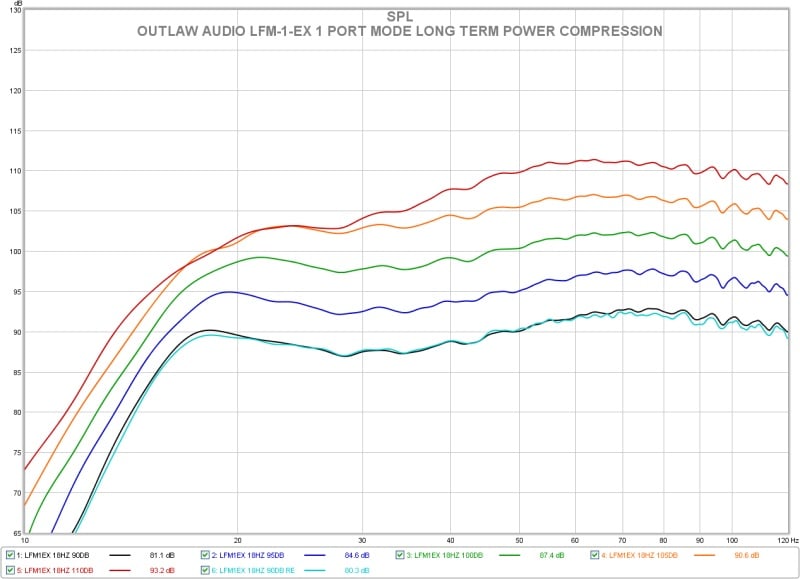
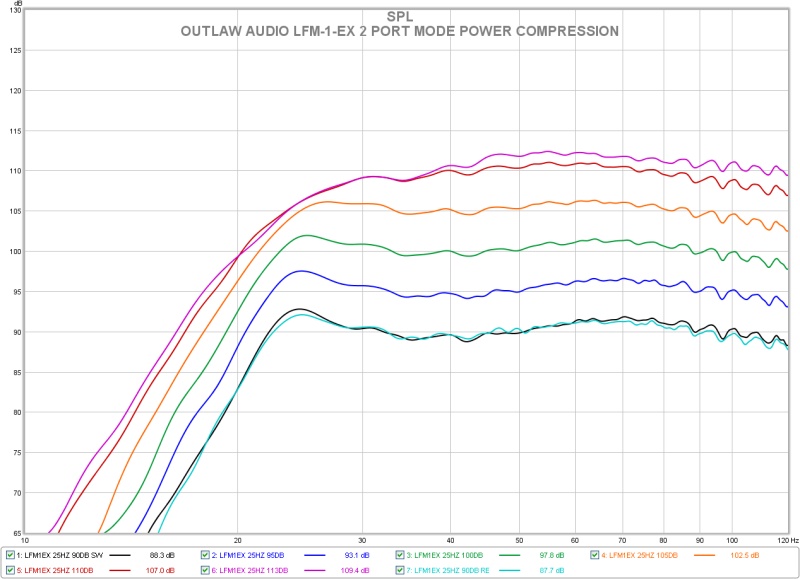
The long term power compression sweeps indicate that the LFM-1 EX does a decent job of maintaining its response shape in both one port open and two ports open operation. The compression in both instances appears to be largely related to overloading of the ports at the level that the sweeps were stopped. The LFM-1 EX exhibits much less overall compression in two ports mode than in one port mode. Likely due to the larger vent area, but the last two sweep levels still exhibit notable vent compression with both ports open. This is normal to see in most ported subwoofers. The LFM-1 EX did exhibit some distress noises and vent chuffing especially in one port mode at which point the sweep level was capped at 110dB. I also noted what may have been some cabinet or panel vibration on the loudest sweeps. With both ports open the LFM-1 EX was able to complete a nominally 113dB sweep level. Looking at the maximum output levels attained the LFM-1 EX exhibits good bandwidth uniformity maintaining a 6dB total response window from 25-120Hz in two ports open operation and in one port open mode a 10dB total response window is maintained from 19.5-120Hz.
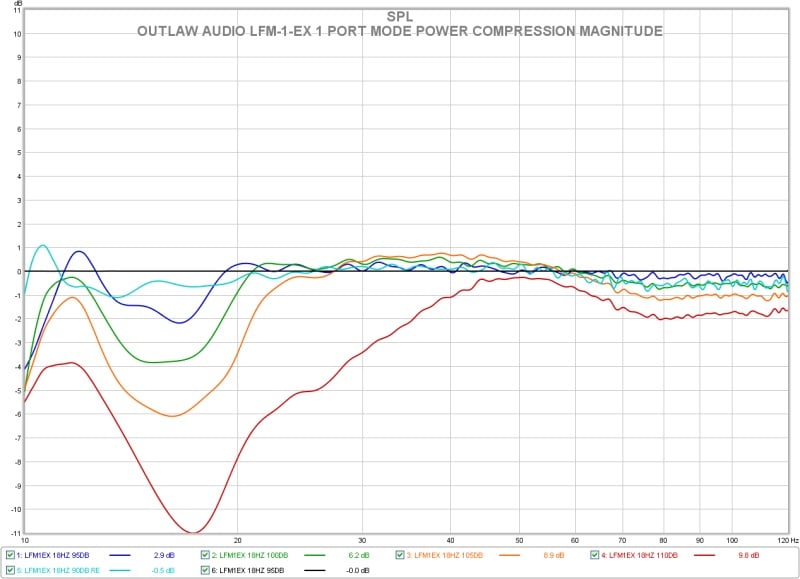
Outlaw LFM-1 EX 1 Port Mode: Power Compression Magnitude
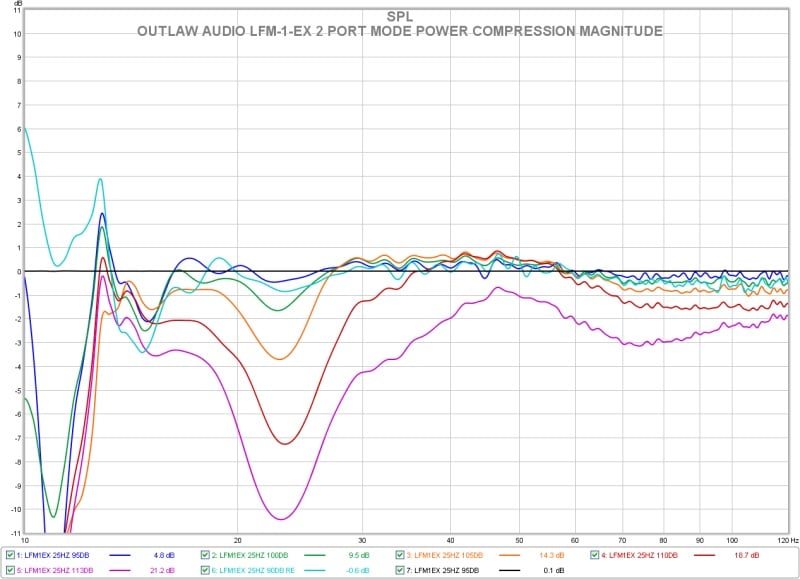
Outlaw LFM-1 EX 2 Ports Mode: Power Compression Magnitude
Looking at the amount of compression exhibited only it can be seen that the LFM-1 EX performs very well above 40Hz even at an 110dB sweep level. The compression is centered at the port tuning and the amount of compression due to the ports starts to get significant at the 105dB sweep level and higher.
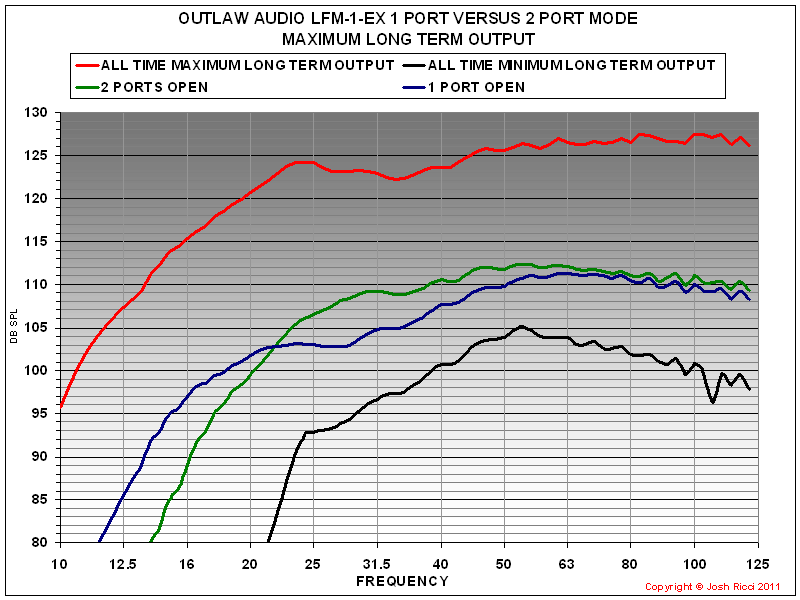
Outlaw LFM-1 EX: Maximum Long Term Output Level
The maximum long term output achieved by the LFM-1 EX during output compression testing is in the middle range of all subwoofers tested historically. This is a solid performance in light of the size and cost of the unit. Operating with two ports open the LFM-1 EX has slightly higher output everywhere above about 23Hz. The output advantage belongs to the one port mode in the deepest bass frequencies as expected.
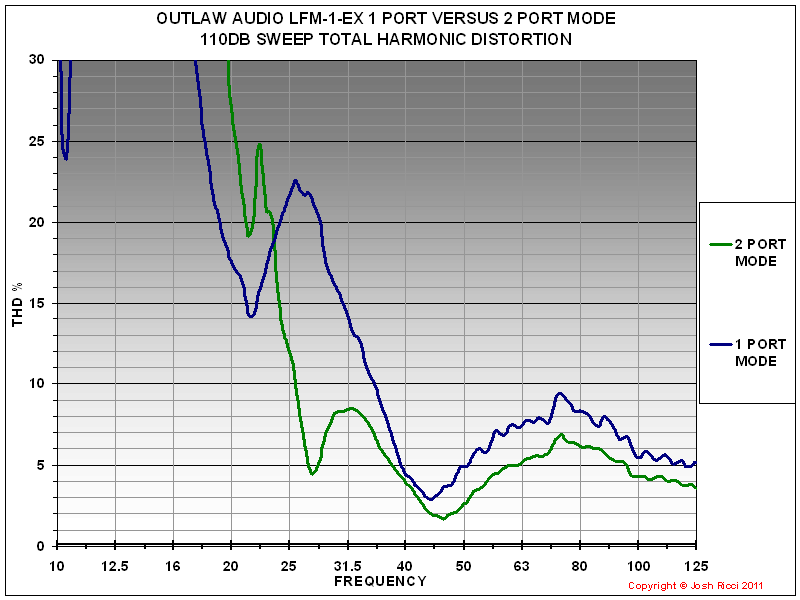
Outlaw LFM-1 EX: 1 Port and 2 Ports Mode 110dB Sweep THD Comparison
The total harmonic distortion results for the LFM-1 EX in both extension modes driven at the nominally 110dB sweep level are presented above. Overall the performance here is good. Distortion above 30Hz is under control for one port operation. With both ports open the THD level does not reach 10% until almost 25Hz which is a nice result.
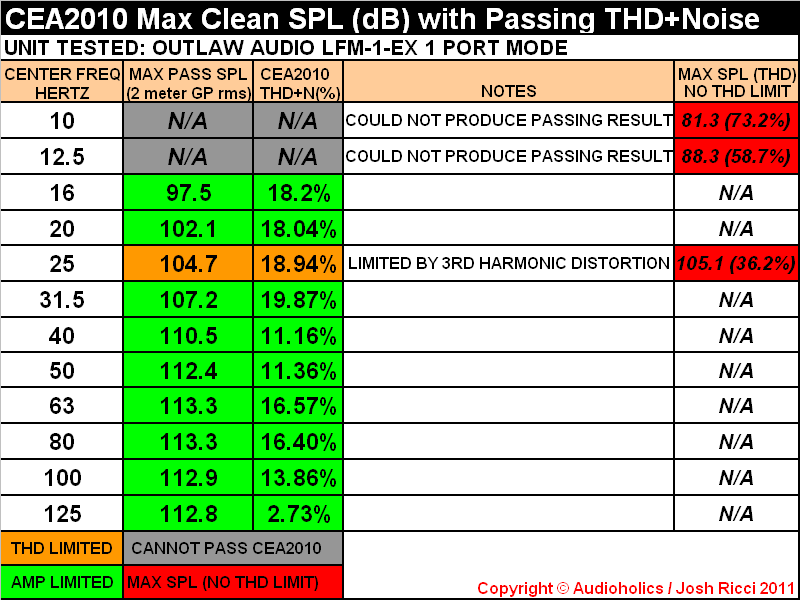
Outlaw LFM-1 EX 1 Port Mode: CEA2010 2 Meter Groundplane RMS Results
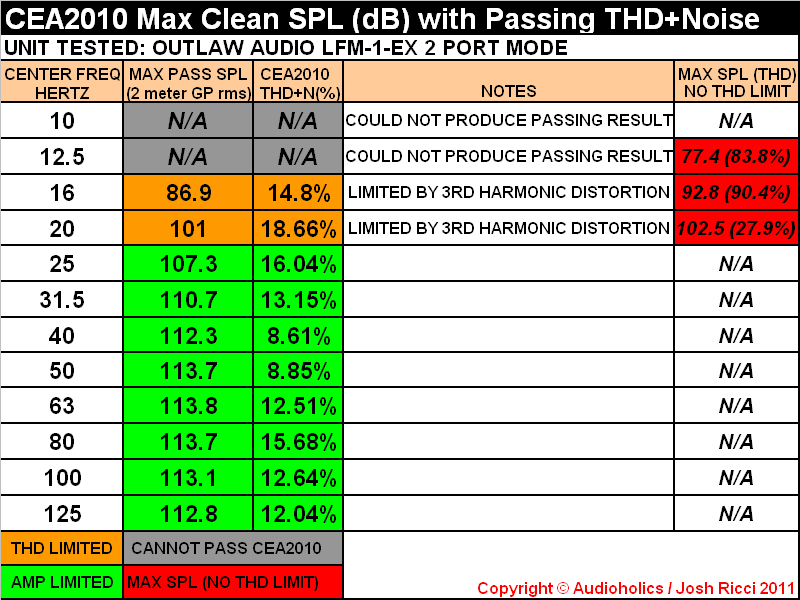
Outlaw LFM-1 EX 2 Ports Mode: CEA2010 2 Meter Groundplane RMS Results
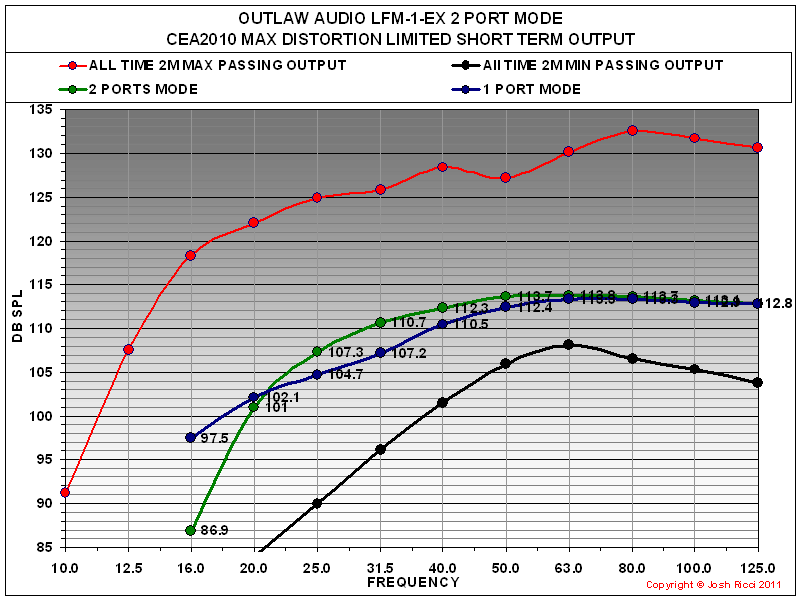
Outlaw LFM-1 EX: CEA2010 2 Meter Groundplane RMS Comparison 1 Port and 2 Ports Mode
CEA2010 Results
The CEA2010 maximum passing results for the LFM-1 EX show it to be in the middle range of all subwoofers that have been tested to date. In two ports open mode it has slightly higher maximum output above 20Hz and is effectively amplifier limited at 25Hz and above. In single port operation the LFM-1 EX has slightly lower overall maximum output but trades that off for higher output at 20Hz and below, recording a passing output of 97.5dB at 16Hz which is impressive. The LFM-1 EX is effectively amplifier limited at 16Hz and above in one port mode having only an extra 0.4dB of output past its maximum passing SPL at 25Hz. Overall bandwidth uniformity is +/-3dB from the 125 to the 31.5Hz band in both modes of operation which is quite good. From 20-125Hz the maximum passing output fits within a +/-5.6dB window in one port operation and within a +/-6.4dB for two ports open operation over the same range.
Outlaw Audio LFM-1 EX Review Conclusion
 Outlaw Audio has
created an over achiever with the LFM-1 EX by following a proven formula. A
bass reflex enclosure slightly larger than normal with a decent sized amplifier
and a cost effective driver. I really don’t have a lot of negative things to
comment on about it considering the total cost of the unit. The finish looked
nice but did appear to be perhaps slightly uneven and had a slightly cloudy or
uneven appearance to it. I thought that I detected some panel buzz from the enclosure during the
highest level sine wave sweeps but there isn’t much program material that is
similar to that signal and there is also usually masking content, not to
mention rattles and vibrations from the typical room or objects in it. The
ports did overload and limit the low bass output some, especially in one port
mode where chuffing was audible at times. Again this might be masked in a
typical scenario. Perhaps if they redesign the unit they could add a few more
internal braces, beef up the driver some and increase the vent area. The
LFM-1 EX also does not offer a lot in the way of connectivity or user
adjustment. This sort of thing does not bother me particularly but I would
like to see a line out to daisy chain other subwoofers from at least.
Outlaw Audio has
created an over achiever with the LFM-1 EX by following a proven formula. A
bass reflex enclosure slightly larger than normal with a decent sized amplifier
and a cost effective driver. I really don’t have a lot of negative things to
comment on about it considering the total cost of the unit. The finish looked
nice but did appear to be perhaps slightly uneven and had a slightly cloudy or
uneven appearance to it. I thought that I detected some panel buzz from the enclosure during the
highest level sine wave sweeps but there isn’t much program material that is
similar to that signal and there is also usually masking content, not to
mention rattles and vibrations from the typical room or objects in it. The
ports did overload and limit the low bass output some, especially in one port
mode where chuffing was audible at times. Again this might be masked in a
typical scenario. Perhaps if they redesign the unit they could add a few more
internal braces, beef up the driver some and increase the vent area. The
LFM-1 EX also does not offer a lot in the way of connectivity or user
adjustment. This sort of thing does not bother me particularly but I would
like to see a line out to daisy chain other subwoofers from at least.
Looking at the sum of the measurements the LFM-1 EX performs well in almost every major metric. The response is smooth enough and flat enough to be crossed over well above 120Hz. The output compression performance is not great due to the ports, but is not bad either. It has good THD performance especially in two ports operation where it is essentially below 10% everywhere at 25Hz and above even during the 110db nominal sweep level. The maximum sweep level and the CEA2010 results show that the LFM-1 EX has a generous amount of output and not just at the upper bass frequencies like many “subwoofers”, it has deep extension and produces an honest to goodness 100dB+ at 20Hz. There is a little bit of delay near the vent tunings when looking at the time domain measurements but certainly nothing out of the ordinary for a vented subwoofer. I do have to say that I would recommend running this subwoofer with both ports open as the single port mode is simply overloaded and compressed too easily in comparison. On top of that the maximum headroom at 20Hz and above is better as is the distortion performance with both ports open.
Taken as a whole the Outlaw Audio LFM-1 EX performed very well, but when you add in the fact that it came from a subwoofer which retails for under $650 it takes on a new aspect. I have a few things that I think could be improved sure like more bracing, a little higher quality finish, more flexible amplifier connections, more substantial driver, etc, but they are understandable traits when put in perspective of the cost of the LFM-1 EX. Don’t get me wrong the Outlaw looks great and didn’t have any serious cosmetic or build flaws, but it’s not quite as buttoned up as some multi thousand dollar subwoofers, which is understandable certainly. I thoroughly enjoyed listening to the Outlaw on movie night where it really did well reproducing a very strenuous movie sound track in a large room, including some solid deep bass. It also managed to sound very natural and just plain old good with music. Not the most articulate bass ever , but quite good. I still could use more output headroom for my listening habits and room but the LFM-1 EX makes a strong case for multiples with its frugal price point. The LFM-1 EX does a lot right and makes no major mistakes all while providing huge bang for the buck value. Outlaw has knocked this one out of the park as far as I’m concerned. Budget conscious sub shoppers looking to fill a large space take note.
The Outlaw Audio LFM-1 EX receives the Audioholics Bassoholic Large room rating, which means that this sub is recommended as maintaining adequate headroom in rooms or spaces of 3,000 to 5,000 cubic feet and/or for users who usually listen at moderate to high volume levels. For further information in how we make these recommendations see the full article here.
See: Audioholics Subwoofer Room Size Rating Protocol

Outlaw Audio LFM-1 EX
Review
MSRP: $649
Phone: 866-OUTLAWS (688-5297)
Web: outlawaudio.com
Outlaw Audio Support:
Support.OutlawAudio.com
Mailing address: Outlaw
Audio
P.O. Box 975
Easton, MA 02334
The Outlaw Audio LFM-1 EX is a moderately large 12” ported powered subwoofer with a built in 350 watt rated amplifier. We found it to be an overachiever earning our “Large Room” Bassaholic rating.
The Score Card
The scoring below is based on each piece of equipment doing the duty it is designed for. The numbers are weighed heavily with respect to the individual cost of each unit, thus giving a rating roughly equal to:
Performance × Price Factor/Value = Rating
Audioholics.com note: The ratings indicated below are based on subjective listening and objective testing of the product in question. The rating scale is based on performance/value ratio. If you notice better performing products in future reviews that have lower numbers in certain areas, be aware that the value factor is most likely the culprit. Other Audioholics reviewers may rate products solely based on performance, and each reviewer has his/her own system for ratings.
Audioholics Rating Scale
 — Excellent
- — Very Good
- — Good
- — Fair
- — Poor
| Metric | Rating |
|---|---|
| Bass Extension | |
| Bass Accuracy | |
| Build Quality | |
| Fit and Finish | |
| Features | |
| Ergonomics & Usability | |
| Dynamic Range | |
| Performance |  |
| Value | |
 Subscribe to our newsletter