


Funky Waves FW 12.X Subwoofer Review
- Product Name: FW 12.X Subwoofer
- Manufacturer: Funky Waves Audio
- Performance Rating:


- Value Rating:
- Review Date: February 22, 2011 21:30
- MSRP: $ 1750 as tested
Behringer™ EP-4000 2000 watt RMS Professional rack mountable amp included (https://www.behringer.com/EN/Products/EP4000.aspx)
Elemental Designs eQ.2 bass controller included (https://www.edesignaudio.com/product_info.php?products_id=657)
TC Sounds 12" Aluminum Cone Driver LMS-R (https://www.tcsounds.com/)
1.5" front baffle
High flow slot port with large radius's for low turbulence
Multitude of different cabinet finishes offered
Size: 24” deep x 14.5" wide x 24" high.
Weight: 115 pounds (Speaker & box only)
Pros
- Unsurpassed Cabinet workmanship & Aesthetics
- Delivers true 20Hz performance
- Very small enclosure – High Wife Acceptance Factor
- Separate amplifier means woofer and amplifier do not exacerbate each others performance
- No electronic equalization necessary for LF extension down to 20 Hz
- Small company to work with, so if you have an issue, the boss picks up the phone.
Cons
- Box is heavy even minus the amplifier
- Amp is best used for professional applications – contributes small amount of fan noise
- Very low driver sensitivity (84.5 db or 0.18% conversion efficiency)
- Not an integrated solution as submitted for review – No B.M.S. Available for the next 2 months without spending an extra $349
- No remote control
- No compression for speaker protection
- No subsonic filtering available from the only currently available BMS; the Antimode 8033
Funky Waves FW 12.X Subwoofer Review Introduction
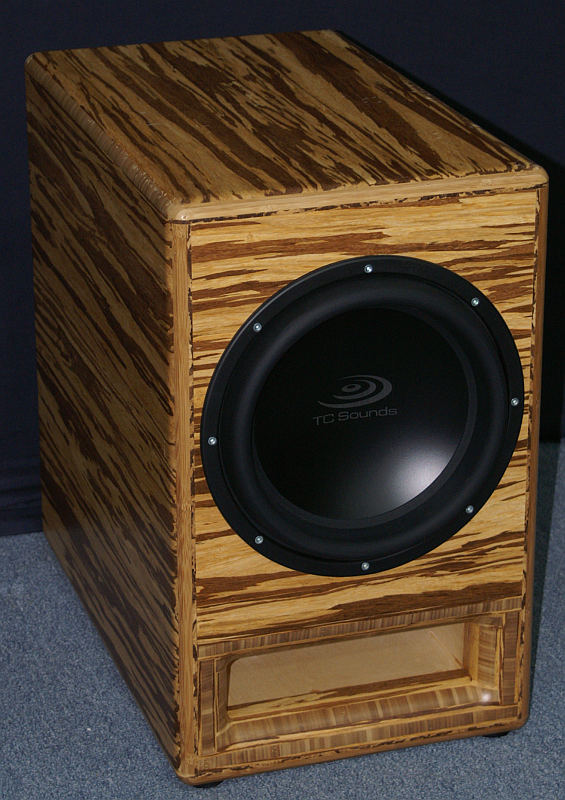 The Funkywaves FW 12.X Ported 12”
subwoofer is a beautifully crafted piece of furniture. It was quite interesting to see how much
genuine interest there was in the Bamboo finish box when it was removed from
the outside container. Literally
everyone filed into the laboratory to admire the uniquely beautiful
construction and finish. If the review
were based on looks alone, it would have been over as soon as the Funkywaves
left its cardboard container. The FW12.X
is a true subwoofer, offering flat performance all the way down to 20 Hz
without any electronic equalization whatsoever.
It uses a TC Sounds LMS-R driver which features a high profile surround,
and an all aluminum cone. This product
is, in a nutshell, very old school in its approach to making a small box go
down to 20 Hz. It does so, not by any
electronic signal manipulation, but by good old fashioned mass loading. There are definitely both advantages and
disadvantages to this approach which I will attempt to cover in some depth in
this review. The FW 12.X sub shines at the bottom of the spectrum, and shows
very little compression due to excursion or amplifier limitations.
The Funkywaves FW 12.X Ported 12”
subwoofer is a beautifully crafted piece of furniture. It was quite interesting to see how much
genuine interest there was in the Bamboo finish box when it was removed from
the outside container. Literally
everyone filed into the laboratory to admire the uniquely beautiful
construction and finish. If the review
were based on looks alone, it would have been over as soon as the Funkywaves
left its cardboard container. The FW12.X
is a true subwoofer, offering flat performance all the way down to 20 Hz
without any electronic equalization whatsoever.
It uses a TC Sounds LMS-R driver which features a high profile surround,
and an all aluminum cone. This product
is, in a nutshell, very old school in its approach to making a small box go
down to 20 Hz. It does so, not by any
electronic signal manipulation, but by good old fashioned mass loading. There are definitely both advantages and
disadvantages to this approach which I will attempt to cover in some depth in
this review. The FW 12.X sub shines at the bottom of the spectrum, and shows
very little compression due to excursion or amplifier limitations.
Product Overview
There are a few essential elements
that are necessary to make a subwoofer from a collection of parts into a finished product. The
driver, enclosure, the available power, the equalization (especially the
high-pass and low-pass filtering) and a compression circuit to stop abuse and
avoid woofer destruction. Without ALL of
these elements, the product will be incomplete.
The Funkywaves FW 12.X as submitted for review, was incomplete. It is possible to complete this product, but
not without a little effort being exercised on your part if in fact you have to
add to the products finished elements with a little care, knowledge and common
sense. In conversi ng with Nate Funk
during this process, he did agree with my criticisms but did not have a
solution ready for me to test. Nate did
tell me he is working on a "plug and play" BMS that will have all the needed functions
including compression, as even the EQ.2 does not have everything he wanted.
Until then Nathan does have a couple of different
options/products recommendations, depending on the customers
application and can help on a per person basis to find a solution to suit, as
not everyone needs the same functions.
Now that is custom service!
ng with Nate Funk
during this process, he did agree with my criticisms but did not have a
solution ready for me to test. Nate did
tell me he is working on a "plug and play" BMS that will have all the needed functions
including compression, as even the EQ.2 does not have everything he wanted.
Until then Nathan does have a couple of different
options/products recommendations, depending on the customers
application and can help on a per person basis to find a solution to suit, as
not everyone needs the same functions.
Now that is custom service!
I do offer some additional comments and propose a solution of my own for those impatient Funkywave customers that want to get their funk on right away.
This is a very small sub, and it is
narrow and not so deep that it cannot be easily accommodated even in a smaller
room. In fact this sub should perform
best when used with very low crossover point.
Sad to say, as it was provided to me for review, I did not have the
system as it is currently being offered. (Even sadder is the fact that neither
does Funkywaves for the next 60 days).
It is my understanding that the newer bass management device solves some
of the issue I had with the Reckhorn, B2 bass control/subsonic filter module
which was provided for my testing.
Because of the B2's low voltage output, it is not compatible with the
input voltage requirements of the Behringer EP-4000 amplifier. Since most “professional” gear operates with
higher voltages at line level, we found that the Reckhorn was limiting the
voltage to a point where I could not get the maximum output from the Behringer
amp, or the Funkywaves subwoofer. The
Reckhorn should have no such issues with typical consumer amps, but
professional amplifiers are another animal altogether. My inadequate and short term solution was to
perform my CEA testing, and listening tests by eliminating the Reckhorn from
the signal path altogether.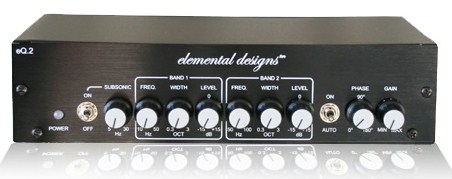
I have not tried the currently offered Reckhorn substitute (the Elemental Designs eQ.2). According to Alex at Elemental Designs, this product is back-ordered and not expected for another 60 days (as of the day of writing, 2-18-11).
Another option offered through the Funkywaves website but not provided for my review was the DSPeaker Anti-mode 8033 automatic subwoofer equalizer, which adds $350. While it will correct for room modes, it does not appear to add compression to protect either the speaker or amplifier from excessive signal content. It does have a switchable (in or out) subsonic filter, fixed at 10 Hz, which frankly is not going to cut the mustard; as by 16 Hz, the Funkywaves was already clearly in distress.
The product's manual can be found here: (http://www.dspeaker.com/fileadmin/datasheets/dspeaker/antimode8033CSen.pdf)
Since I was not afforded the chance to listen to either the Elemental Designs eQ.2 or the DSPeaker 8033, I used my laboratory loudspeaker management system, the Xilica XP-4080, as I did with all the other products tested. For the Funkywave listening tests, the Xilica was used as both crossover, subsonic filter and compressor. If you have your own bass management system, even one built into your receiver, this lack of integration by Funkywaves may not pose a problem for you. If not, be prepared for some effort in getting the necessary margin of safety you'll need by finding a compatible compressor, as Funkywaves does not include one in the package.
Sad to say, even with the incredible amount of available power, with a high crossover frequency, this subwoofer just doesn't rock the house when I crossed it over at 120 Hz. This is a product for those who already have a full range system, and want to add that very bottom octave of sound. To truly get your moneys worth from this box, you need to show off the box (which is really gorgeous), and cross it over no higher than 60 Hz. We found the subwoofer amp ran out of gas when mating this sub with our highly efficient satellite and fullrange speakers. The CEA generated Peak SPL numbers show a fall off even as low as 63 Hz. From 50 Hz to 20 Hz, the Funkwaves sub kicks some serious butt. Please note, the Behringer EP-4000 amplifier in combination with the FW 12.X WILL double as a space heater when played at or near its limits. I know it gets cold in Canada. (Funkywaves is located in the Canadian Province of British Columbia) So perhaps the design goal was part loudspeaker, part space heater. ;)
Editorial Note about Loudness
Because the TC Sounds driver used in this Funkwaves subwoofer product is relatively low efficiency (84.5dB/watt), its max output with the 2000 watt power amp powering it is about 117dB (not counting losses due to thermal compression). When using this sub with high efficient monitors like we did (97 dB/ 1 watt), it only took about 150 watts from our power amp for our monitors to exceed the output capabilities of the sub at or near its crossover point. Hence why we recommend using a lower crossover point if you're running high efficient speakers in conjunction with this sub. If your speakers are between 87-90dB efficient, than you may experience better results mating this sub with them at an 80Hz crossover point which is what we usually recommend for home theater applications.
For the above reasons, I cannot recommend this system for the inexperienced or faint of heart. This is not a finished, pull me out of the box and go complete solution for the uninitiated. If you have some understanding of how speakers behave, and the demands placed on them by certain signals, and have used compressors before, I think this is an easy matter for you, and should not put you off a purchase. If you lack this kind of component assembling and connecting experience, be prepared to climb the learning curve or break the driver when the right signal comes suddenly thundering out of your system.
Funky Waves FW 12.X Subwoofer Review Driver and Amplifier
 The Driver (Subwoofer)
The driver used in this system is a TC-Sounds LMS-R 12” woofer. TC Sounds is owned and managed byThilo Stompler. Thilo is one of those journeyman engineers who has been in the middle of the bass pounding woofer wars for about as long as I have. I consider him a respected colleague with a wealth of experience, and when it comes to making subwoofers, he has done and tried just about everything imaginable. I am a fan of his work for the most part. For an off the shelf part, it's an almost perfect fit for such a very small box. My main bone of contention with this driver is its electrical to acoustic conversion efficiency. According to TC-Sounds own numbers, it is 0.18% (Look again, that is not 18%,(0.18) that is 18 one-hundredths of 1% = 0.18% =0.0018) efficient. In short, it is a power hungry beast. Compared for example, to a typical DJ box, even one with relatively low sensitivity for DJ gear might have for example, 94.5 db, and for a 12” speaker in the DJ market even 98 db for 1 watt@ I meter is not uncommon. Consider the fact that you now need 1000 watts to power this where 100 watts would create the same SPL (at 60 Hz for example) in a DJ woofer. (At 20 Hz of course, the DJ speaker is useless, while this driver is just hitting its stride). This is the cost of making a true sub, that fits in a box that ALSO has true WAF (Wife acceptance factor). If you have just got to have this speaker, make sure you have stock in your local electric company. It is HUNGRY for watts, and its displacement capability is truly scary. Its linear Xmax (voice coil outside the gap) is 1 inch, and before you lose 30% of your motor force (considered a distortion limited Xmax) you have already traveled 1.25 inches in each direction, or 2.5 inches peak to peak. HELLO! Despite the fact that it is much smaller size than the other monster cabinets, this woofer put out more bass at 20 Hz than any other in the shootout. (Of course, with all the lights dimmed at the time, I had to get really CLOSE to my monitor to double check those results.)
The Amplifier
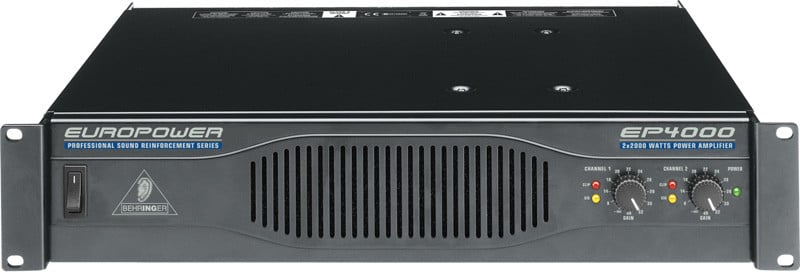 Behringer is one of the best known
names in professional audio despite being a relative newcomer. It is known for very high value for the
dollar products. In short, if you need a
big honking power amp, you get more watts for less dollars with a Behringer.
(The secret to their success). Since it is designed for DJ and or PA use, the
out of the box version has a fan as most DJ/Musician types will often run their
amplifiers into clipping 50% of the time or more. That would put a lot of
stress on the amp which audiophile subwoofer users would not. Since the
Funkywaves user is likely to be crossing the product over at 50 – 60 hz, you will be using the power amp for a narrow band and
therefore
the difference between the long term RMS power and peak power draw will be
substantial. (Smaller bandwidths equal
higher crest factors; crest factor = peak power/Rms power). For that reason, Nate Funk offers a product
modification to lower the fan noise. If
you have a location for the amp which is well ventilated, and not near your
listening position, it is not likely you will need this modification. But, if
you are an absolute perfectionist, and want the quietest room possible, the
tweak is available. For an additional $50, Funkywaves
will modify the amplifier fan for lower noise.
If
the amp is dropped shipped to your location, prepare to break out the manual to
set up the rear panel switch for proper use.
Behringer is one of the best known
names in professional audio despite being a relative newcomer. It is known for very high value for the
dollar products. In short, if you need a
big honking power amp, you get more watts for less dollars with a Behringer.
(The secret to their success). Since it is designed for DJ and or PA use, the
out of the box version has a fan as most DJ/Musician types will often run their
amplifiers into clipping 50% of the time or more. That would put a lot of
stress on the amp which audiophile subwoofer users would not. Since the
Funkywaves user is likely to be crossing the product over at 50 – 60 hz, you will be using the power amp for a narrow band and
therefore
the difference between the long term RMS power and peak power draw will be
substantial. (Smaller bandwidths equal
higher crest factors; crest factor = peak power/Rms power). For that reason, Nate Funk offers a product
modification to lower the fan noise. If
you have a location for the amp which is well ventilated, and not near your
listening position, it is not likely you will need this modification. But, if
you are an absolute perfectionist, and want the quietest room possible, the
tweak is available. For an additional $50, Funkywaves
will modify the amplifier fan for lower noise.
If
the amp is dropped shipped to your location, prepare to break out the manual to
set up the rear panel switch for proper use.
The manual for the amplifier can be found here:
http://www.behringer.com/EN/downloads/pdf/EP2000_P0A38_M_EN.pdf
The Behringer amp is nearly a perfect fit for the power demands of the TC sound driver, but while driving the system outdoors to find the maximum short term SPL's, I could hear the driver in distress at the 16 Hz, and 32 Hz band. If you foresee yourself running the FW 12.X to its output limits, it would be a good idea to implement a compressor to protect the woofer from over-excursion related damage. According to Alex at Elemental Designs Audio, makers of the eQ.2 bass controller with tunable subsonic filter, the output voltage of this unit is limited to 2.2 Volts RMS. Since there is no feedback loop, one will have to play around with the volume control settings on both the controller AND the Behringer power amp (front panel) before you can dial it in so that you are not running the amp with so much voltage gain so as to cause the driver to bottom. The frequency of maximum excursion for this system seems to be in the 32 Hz range, which is where movie creators love to turn up those sound effects for maximum dramatic impact. You will also need to be prepared to set the Behringer rear panel dip switches as per the manual directions if you expect to bridge this amp, and get all the power it has to offer, which according to Behringer is about 2000 watts RMS, and 4000 watts peak. (The amp is rated into 4 and 8 ohms, but the TC Sounds driver itself is a 6 ohm device). There are low frequency filters on the Behringer, but being for the professional market (where we roll things off at 40 – 50 Hz) you'll find the available filter frequencies a bit too high on the Behringer to be useful with this subwoofer.

The rear panel of the Behringer amp has a red “Dip” switch which must be
properly set so you do not filter out the very lowest frequencies or run the
amp without compression. It is also
necessary to set the switches properly in order to operate the amplifier in
Bridged mode. Your speaker will need to
be connected to both red terminals in order to get all of your 4000 watts of
available peak power.
Nate Funk (Owner/proprietor of
Funkywaves) was kind enough to send me some sound effect wave files to test his
system with. Finding music with true 20 Hz content is not so easy. Nate, of all the entrants in the Shootout was
by far the easiest to talk to. (Perhaps
it's a British Columbian Canadian thing or not, but if Nate was any more
relaxed, I might be tempted to check his pulse.) If you like buying from small companies, and
being treated special, then Funkywaves won't disappoint you. I suspect it is currently a one man
operation, so if you have to call to complain, you are sure to get the boss.
Now in the event you buy this and
find in fact the eQ.2 does not stop the input from overdriving the subwoofer,
you do have another option. Since the
compressor circuit in the Behringer amp is not suitable for this particular
woofer/box combination. With the right kind of signal, the amplifier has enough
power to cause the loudspeaker to bottom.
It is unlikely, but not impossible. To make it impossible, one needs an
outboard compressor. The compressor I use at home (so as to not get blown out
of my chair by the directors and sound engineers who decided than gunshots and
explosions need be recorded at levels 30 -40 db hotter than the vocal tracks on
my blu-ray discs) is a simple unit made by Alesis, the model 3630 which sells
for around $100 retail. If you are not
familiar with the concepts of attack time, decay time, gating, threshold and
the “knee of the curve”, be prepared to spend an hour playing around with this
until you get a feel for how a compressor works, and figure it out. While this is unnecessary if you are planning
on using a lower powered amp to drive the FW 12.X, you will not be able to get
every last bit of the output the system has to offer. If the subject of compression or compressors
is new to you, be prepared to read through the entire manual before you start
hooking things up.
PLEASE NOTE: This recommendation
comes from me, and not Funkywaves.
Neither Audioholics, Funkywaves or I myself have any association with
Alesis, and in no way gain from your product purchase. My sole point is, a subwoofer system with
this much raw available power is prone to self destruction UNLESS A COMPRESSOR
IS USED, and NONE was provided with the Funkywaves FW 12.X.
The compressor I use at home, and
can recommend from personal experience can be found here: (http://www.alesis.com/3630)
The compressor overview here:
(http://www.alesis.com/stuff/contentmgr/files/0/...)
and product manual here:
(http://www.alesis.com/stuff/contentmgr/files/0/...)

The Alesis 3630 – A compressor
specialized for use with professional level inputs such as those needed to run
the Behringer amp to full output without running it into hard clipping. The
Alesis unit, like the Behringer EP-4000 power amp is suited for a 19” standard
rack mount chassis. Its proper use will
insure that you can run your tracks without concern about the TC Sounds woofer,
suddenly leaving the beautiful wood box, and joining you in your listening
room. (Or at your local speaker reconer's shop.)
If the above recommendations regarding the
need for filtering and compression have you feeling like your head is about to
explode, and you are not sure if you will need to do these things or not. Gene Dellasala has written some excellent
articles on the topic of bass management systems, which can be found here:
- Hometheater Multiple Subwoofer & Setup Guide
- Bass Management Basics - Settings Made Simple
- Basic Subwoofer Setup Guide Not for Dummies
Funky Waves FW 12.X Subwoofer Review Measurements and Analysis
The first part of testing was to measure the frequency response from a modest output, all the way to the point where the system was clearly compressing and had hit the output wall, so to speak.

Funkywaves Frequency Response at Various Output Levels
Only some slight compression can be seen at the top most curve. If I had to guess (I am guessing) I would say this lessening of output is due to turbulence of air through the port. Since the curve does not tilt up prior to the cutoff (Like the Hsu does) it indicates the Driver is not losing motor force, nor should it be as the port and amp are doing all the heavy lifting at 20 Hz. Like all the other systems, this box was tested at 1 meter, lying on its side, microphone placed midway between the center of the port and the center of the driver so as to get the most accurate reading with the microphone very close. A 14 second sweep was used, and the data was smoothed to 1/24th octave resolution. (Translation, we don't make our curves with a ruler and graph paper like some folks...). We can also see that this driver loses about 3db of sensitivity from 50 Hz, by the time it reaches 100 Hz.
CEA 2010 Test Results
The next part of testing was to disconnect the Clio box, and connect the Earthworks M-30 microphone to a True Systems P-Solo mike preamplifier. This is set for minimum gain (click stop) and connected to the input of the computer's soundcard. We are running Don Keeles CEA test program version 1.62 which runs under Igor Pro which runs under Windows XP professional. (Whew!) The CEA program generates pulses 1/3rd of an octave wide, and centered at standard ISO frequency centers. (Meaning the 20 Hz pulse is -3db at 16 and 25 Hz.) This is superior to traditional tone burst testing and is the standard for which these measurements are gathered.
To understand the meaning behind the graphics below and testing methods used, please refer to the prior article (Subwoofer Shootout Measurements Overview) on this method. The process is a simple one. Drive the input to the system to the point where either the amp, its compressor, or its speaker simply refuses to give you more output, or the distortion created at that output level exceeds the CEA “redline”. In EVERY system tested, the result (if not the peak SPL) was similar in one regard. For ALL the other subwoofers tested, at the highest frequencies in the sub's bandwidth, we ran out of amplifier power, or the compressor refused to put out more power than the amp could cleanly deliver. The Funkywaves sub was different in this regard, and that may be due to its tuning, or possibly the fact that the peak powers the voice coil is experiencing is considerably higher than the other shootout entrants. Usually, at the lowest frequencies, the subwoofer runs out of excursion. With the Funkywaves, that does not happen at 20 Hz, as the port is doing all the work. Below is a spectrum capture of the Funkywaves FW 12.X system at maximum usable output for each of the 1/3rd octave centers from 20 to 63 Hz.

Signal Spectrum at
Maximum attainable Output of system 1 Meter Groundplane
Below are the results of the CEA peak SPL's are tabulated:
| FunkyWaves FW 12.X | CEA Test Performance | |
| Frequency | Maximum Peak SPL @ 1 Meter | RMS @ 2 meters |
| 20 Hz | 116.0 dB | 107 dB |
| 25 Hz | 121.3 dB | 112.3 dB |
| 32 Hz | 121.4 dB | 112.4 dB |
| 40 Hz | 123.0 dB | 114 dB |
| 50 Hz | 122.9 dB | 113.9 dB |
| 63 Hz | 122.1 dB | 113.1 dB |
Max SPL Output Data of the FunkyWaves FW 12.X Subwoofer
Why not test this speaker up to 80 Hz? Surely it is important, no? Yes of course. Two primary reasons I believe that the CEA standard excludes an 80 Hz measurement. Any large sub will be amplification limited by the time it is going as high as 63 Hz. While looking at 80 Hz will add little to the value of the testing, in the case of the Funkywaves sub, the driver sensitivity does roll off significantly over 50 Hz. This is because of the unusual set of parameters and driver construction particular to this model speaker. In short, our effective sensitivity, already low to start, has been halved again by the time this sub is up to 100 Hz. This may be in some part due to the drivers high mass, and no doubt the relatively high voice coil inductance. (Le) Let's also bear in mind the CEA pulse signal centered at 63 Hz is only 3dB down at 80 Hz, so the loss of sensitivity there is showing up in the “63 Hz” SPL number.
Update: 9/27/11
In order to make it easier for our readers to compare our CEA data between subwoofers tested prior to our new Subwoofer Measurement Protocol, we scaled our 1 meter peak CEA data to 2 meter RMS by subtracting 9dB for each frequency.
Funky Waves FW 12.X Subwoofer Review Listening Impressions
The Funkywaves FX 12.X is more the
kind of “I feel it in my gut” woofer, than “I can feel it in my chest”
subwoofer. True clean unadulterated 20
Hz is very rare in music, but easy enough to generate with a power amp with 2000
plus watts of power, a sound card, and a tone generating program. NCH Swift
Sound offers a simple to use tone generating program called “Tone Generator”
(proving categorically the company is run by engineers) and it is available as
a free download here. It is truly an awe
inspiring thing to watch the system operate with a single tone input right
around 32 Hz, pumping air from the woofer like crazy, and down at 20 Hz where
the box is tuned, to actually feel the air moving in and out of the port at
your feet from a distance of 10 ft away.
At 20 Hz, this loudspeaker limits only by the available current, voice
coil power handling, and the linearity of air passing through the well designed
and perfectly placed port. This is a
great sub for the guy who wants to feel the thumps and thunder of a movie
soundtrack. If you have a small set of
satellite speakers, or some very high efficiency, high-output satellites
however, this sub is not for you.
The satellite speakers I used in my
listening test were 10 inch two way systems with sensitivity of about 97 db @ 1
watt, 1 meter. I had them hooked to a
QSC PLX3002 amp, which can deliver about 720 watts per side into these
speakers. Sadly, being high efficiency
DJ speakers, they only go down to 100 Hz in my compact box, so I had to use a
very high crossover point with the FX 12.X which means it did not work at its
best, and simply could not keep up with my DJ boxes in terms of pure output.
(Yes, I know, I am the only one on Earth who does this, as my editor is fond of
reminding me)... Later on, with a much
lower crossover point (60 Hz) and another set of tops, the amp stopped running
out of power, and the sub seemed to hold its own regarding output capabilities
in my large laboratory/listening room.
To really show off the FX 12.X, it is best used with the lowest
crossover point your main speakers can tolerate. The reason is simple. As the low-pass crossover point increases in
frequency, so does the amount of signal content, and therefore the demand for
power on the sub amp. This is one power
hungry speaker. The Behringer amp is
very close to being a perfect fit, but while driving the system outdoors to
find the maximum short term SPL's, I could hear the driver in distress when
driven either below box tuning or at 32 Hz, no doubt the region of maximum
driver displacement above box tuning. If
you have to have the FW 12.X NOW, it is my opinion you will definitely need
either abundant caution or your own compressor.
This is one of the primary reasons why almost every subwoofer
manufacturer prefers the powered approach.
They can incorporate and integrate all the electronics the system needs
into one amp, and be absolutely certain of the relative levels and the
limitations of the speaker/box combination used. That of course, does not mean, they all get
it right.
Application
Given the small bandwidth and size of this box, I can recommend it for either Home Theater or Audiophile use with the proviso that you use great care in set up, and use the lowest feasible crossover point your system will allow. Home theater use is a bit along the lines of what I would expect the FW 12.X was designed for. If you are more interested in music reproduction, you should already have a “full range” set of loudspeakers that can go down to 40 or 50 Hz on their own. That will allow the Funkywaves to be crossed over low enough to shine. With that lower crossover point, you can push the box a little harder and count on more output. The Funkywave FW 12.X should be fine in small to large size living rooms, with more than adequate output for normal use. (Assuming of course you have an unused 15 amp breaker and circuit someone nearby your setup). The box is small and narrow, and you will likely find you have the space for it just about anywhere. While not as difficult to move as the larger boxes in this shootout, it is definitely a handful, and unless you used to make terminator movies and govern California, you might want to get an extra pair of hands in moving and placing it. Despite its small size, it still breaks the hundred pound barrier. The front baffle alone is 1.5 inches thick. It also does not come standard with a grille, so that may create an issue with the wife, if she is not so hip to watching aluminum cones moving back and forth two inches at a time. Funkwaves informed us they do offer several grille options which will be adding to their site as an accessory item. You should not have any issues putting this box in the back of a passenger vehicle, but unless you live in British Columbia and plan on driving over to visit Nate Funk, I doubt that will ever come up. As long as you exercise appropriate caution in the setup, you can expect the system to last for some years, and the enclosure itself to outlast all of us now reading.
Visual Impressions
 Of the several B52 employees who saw the
cabinet, EVERYONE really liked the appearance of the Bamboo finish. The quality of construction was unsurpassed,
and it was by far, everyones favorite box.
There are a lot of Ho-Hum finishes, and boxes which can disappear into
the overall décor, but the FW 12.X is not one of them. It is an absolutely beautiful piece of
cabinetry built to the highest standards, and is available in a wide variety of
custom finishes.
Of the several B52 employees who saw the
cabinet, EVERYONE really liked the appearance of the Bamboo finish. The quality of construction was unsurpassed,
and it was by far, everyones favorite box.
There are a lot of Ho-Hum finishes, and boxes which can disappear into
the overall décor, but the FW 12.X is not one of them. It is an absolutely beautiful piece of
cabinetry built to the highest standards, and is available in a wide variety of
custom finishes.
Funky Waves FW 12.X Subwoofer Review Conclusion
 While
the Funkywaves subwoofer is not inexpensive, it is essentially unique in its
ability to go to the lowest levels of frequency at high levels without taking
up a lot of real estate. That there were
sacrifices in the efficiency in order to passively achieve this goal are
undeniable. It must be said here,
measurements alone do not adequately explain the unique sound of this sub. The
tonal character is not matched by any of the other shootout entrants. To make a judgment on this sub, it must be
seen, felt and heard. It is not coming
at a discount price, but it is as close to that holy grail of 20 Hz from a
shoe-box as I have seen since the Sunfire. If
you liked Bob Carver's sub, you will probably like the Funkywaves as well. They are cut from the same cloth.
While
the Funkywaves subwoofer is not inexpensive, it is essentially unique in its
ability to go to the lowest levels of frequency at high levels without taking
up a lot of real estate. That there were
sacrifices in the efficiency in order to passively achieve this goal are
undeniable. It must be said here,
measurements alone do not adequately explain the unique sound of this sub. The
tonal character is not matched by any of the other shootout entrants. To make a judgment on this sub, it must be
seen, felt and heard. It is not coming
at a discount price, but it is as close to that holy grail of 20 Hz from a
shoe-box as I have seen since the Sunfire. If
you liked Bob Carver's sub, you will probably like the Funkywaves as well. They are cut from the same cloth.
Visit Funkywaves
Halfmoon Bay BC, Canada.
604-865-0550, 8am to 6pm Pacific Time
Read Consumer Reviews on
The Score Card
The scoring below is based on each piece of equipment doing the duty it is designed for. The numbers are weighed heavily with respect to the individual cost of each unit, thus giving a rating roughly equal to:
Performance × Price Factor/Value = Rating
Audioholics.com note: The ratings indicated below are based on subjective listening and objective testing of the product in question. The rating scale is based on performance/value ratio. If you notice better performing products in future reviews that have lower numbers in certain areas, be aware that the value factor is most likely the culprit. Other Audioholics reviewers may rate products solely based on performance, and each reviewer has his/her own system for ratings.
Audioholics Rating Scale
 — Excellent
- — Very Good
- — Good
- — Fair
- — Poor
| Metric | Rating |
|---|---|
| Bass Extension | |
| Bass Accuracy | |
| Build Quality | |
| Appearance | |
| Dynamic Range | |
| Performance |  |
| Value | |
 Subscribe to our newsletter