


Boston Acoustics Refection Series RS 334 Floorstanding Speaker Review
Boston Acoustics Refection Series RS 334
- Product Name: Refection Series RS 334
- Manufacturer: Boston Acoustics
- Performance Rating:


- Value Rating:
- Review Date: March 26, 2010 10:10
- MSRP: $ 699.99/each
-
Frequency Range (+-3dB): 43Hz – 26kHz
-
Recommended Amplifier: 10 – 250 Watts
-
Sensitivity: 89 dB SPL/2.8V/m
-
Nominal Impedance: 8 ohms
-
Crossover Frequency: 2,000 Hz
-
Bass Driver: Quadruple 4" (102mm) FCCM
-
High-Frequency Driver: 1" (25mm) Extended Wide Bandwidth
-
Dimensions ((H x W x D)): 42-7/16 x 8-1/2 x 9 -5/16” (1076.5 x 215 x 235mm)
-
Weight: 32.12 lbs (14.6kg)
Pros
- Very sleek design, slim profile
- Impressive bass response
- Fairly accurate overall sound
Cons
- Finish dust magnet
- No carpet spikes (new orders now shipping with spikes according to Boston)
- A bit thin through the midrange with an accentuated high end
Boston Acoustics RS 334 Build Quality
I have a bit of history with Boston Acoustics. A few years ago I was lucky enough to attend one of their press events in their lovely namesake city and got to see a few of their new speaker offerings before they hit the shelves. They are also part of the D&M Holdings brand which also has such names at Denon, Snell, McIntosh, and more. Boston has a long history in consumer electronics. This comes with a lot of name recognition. For many consumers, name recognition equates to quality. That's why manufacturers spend millions on advertising. They might not convince you that they are the best, but if they can get their name in your head then perhaps you'll pick them simply because you recognize the name over the other guy.
The Reflection Series speakers (indicated with the RS nomenclature in the model number) is a fairly new offering from the venerable manufacturer. Boston was looking to create "Good, Better, Best" lines of speakers. The VS (Vista Series though I'm not sure they are calling it that any more) represents the "Best" with the CS (Classic Series) representing the "Good." This has the RS series falling right in the middle in the "Better" category. Apparently, according to Boston, Good costs $229 each, Best costs $1250 or $1699 each (depending on the "Best" model) while Better cashes out at $700 each. While we haven't seen a lot of speakers with "each" pricing, it doesn't take a mathematician to figure out the per pair pricing. Perhaps they give a discount if you buy more than one. We doubt it but maybe.
First Impressions and Build Quality
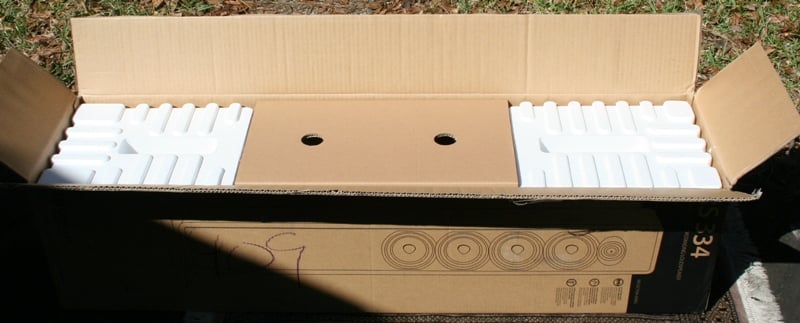
The Boston RS 334 speakers came individually boxed and well protected. Each box clearly outlined what was in it so if you are having these speakers shipped, you might want to make sure you are home to sign for them. Inside, the speakers are well protected around the top and bottom by foam with a middle section of cardboard for added benefit. The speaker is wrapped in a cotton sock and Boston even included a pair of Boston-branded cotton gloves to handle them with. I can remember the first time I received a pair of speakers wrapped in a cotton sock with the gloves. I was so impressed. But after years of doing this, let me say that the cotton sock is probably the number one over-hyped indicator of quality in all of electronics. I've had everything from DVD players to HDMI switches arrive in the dreaded sock. Yes, I said dreaded. While smaller devices just look ridiculous, large, heavy speakers, I'm semi-convinced, are wrapped just to cut down on minor blemish returns because you are certain to drop them.

 The
thing is the sock is useless. It's actually less than useless. If it
was useless, it would do nothing but the sock does have an affect -
actually a few. First, it virtually guarantees that your speaker will
arrive with a dusting of fuzz all over it (especially on the grill).
The point (I think) of the sock is that it supposedly protects the
finish. Well, maybe at the contact points with the packing material
but it certainly isn't doing much more. Foam paper (for lack of a
better term) is just as effective and can be removed much more
easily. Lastly, if your speaker is at all unwieldy (and believe me,
they just about all are) the sock is akin to lathering it up with
baby lotion. Sure, you might not drop it but in my experience you, at
the very least, almost will. With every cotton-wrapped speaker I've
ever received I've either almost or actually did drop it while
unpacking or repacking.
The
thing is the sock is useless. It's actually less than useless. If it
was useless, it would do nothing but the sock does have an affect -
actually a few. First, it virtually guarantees that your speaker will
arrive with a dusting of fuzz all over it (especially on the grill).
The point (I think) of the sock is that it supposedly protects the
finish. Well, maybe at the contact points with the packing material
but it certainly isn't doing much more. Foam paper (for lack of a
better term) is just as effective and can be removed much more
easily. Lastly, if your speaker is at all unwieldy (and believe me,
they just about all are) the sock is akin to lathering it up with
baby lotion. Sure, you might not drop it but in my experience you, at
the very least, almost will. With every cotton-wrapped speaker I've
ever received I've either almost or actually did drop it while
unpacking or repacking.
 On top
(or technically under) the sock, Boston has included an additional
layer of protection for it's "elegant, scratch resistant high
gloss black lacquer" finish - tape. I'm not sure the technical
name but for those that have received a TV with a high-gloss bevel,
you know what I'm talking about. It is that plastic tape that they
stick to the outside that doesn't leave a residue when you remove it.
They have this stuff on the three sides of the speaker not covered by
the grill. The grill is full length and has a small Boston logo on
the bottom. It has a slight overlap around the outside of the front
baffle so that it really holds securely but still sits flush to the
walls. There are magnets up the sides to hold the grill securely in
place. The grill is fairly flimsy when removed but feels fine when
installed. It is constructed out of a plastic rim with thin MDF
interior.
On top
(or technically under) the sock, Boston has included an additional
layer of protection for it's "elegant, scratch resistant high
gloss black lacquer" finish - tape. I'm not sure the technical
name but for those that have received a TV with a high-gloss bevel,
you know what I'm talking about. It is that plastic tape that they
stick to the outside that doesn't leave a residue when you remove it.
They have this stuff on the three sides of the speaker not covered by
the grill. The grill is full length and has a small Boston logo on
the bottom. It has a slight overlap around the outside of the front
baffle so that it really holds securely but still sits flush to the
walls. There are magnets up the sides to hold the grill securely in
place. The grill is fairly flimsy when removed but feels fine when
installed. It is constructed out of a plastic rim with thin MDF
interior.
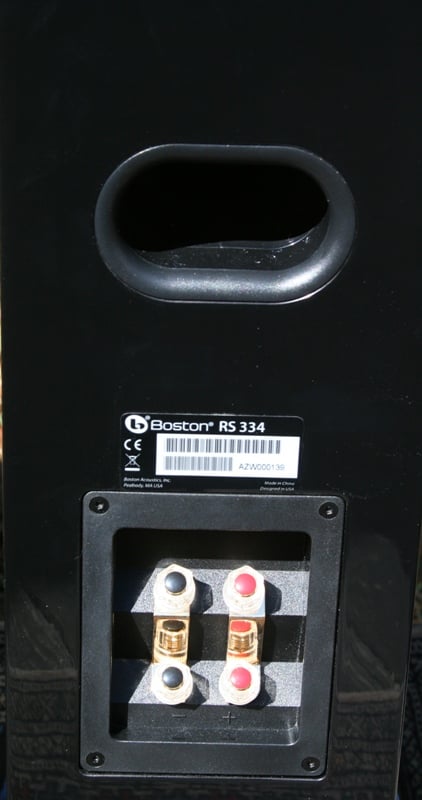
The back of the RS 334 has a slot style port near the bottom but above the dual binding posts. If you stick your fingers inside the port, you'll quickly realize that it has a 90 degree turn upward. This increases the length of the port on a speaker that clearly is looking to minimize its footprint. The port is flared at both sides and has about 6-7" additional length after the bend. The plinth at the bottom is removable (which is nice if you want to change it out for an aftermarket outrigger setup) but has no identifiable provision for carpet spikes. In fact, there are installed rubber feet. This is fine if you are setting the speakers on hardwood or tile but for those of us with carpet, it is not optimal. At only 32lbs a piece, the speakers aren't the heaviest and the wide plinth helps a bit with tipablility but we still would have preferred carpet spikes. At $1400 a pair, this is a curious omission. (Note - Boston now says they are shipping carpet spikes but they were not available on the review units.)
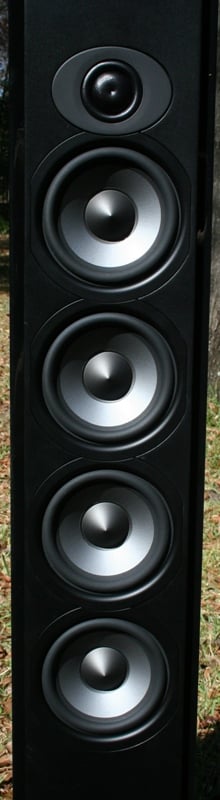 The driver compliment is fairly
generous in such a small cabinet. Boston has provided the RS 334 with
a 1" EWB tweeter (Extended Wide Bandwidth) and four, 4"
FCCM woofers (Fiber Ceramic Copolymer Material). One thing I got to
experience in my tour of the Boston facilities so many years ago was
their driver creation lab. There they could not only design their own
drivers, but build and prototype them. You can bet that Boston did a
lot of testing with these drivers before they decided on them for the
Reflection Series. The tweeter has a dimple in the center - something
that people familiar with soft dome tweeters will initially be
concerned by. Rest assured, that is part of the design. The woofers
all have a pointed dustcap that looks, at first glance, to be a phase
plug. It isn't and often we discourage the use of such drivers as the
"fake" phase plugs are often added aesthetically instead of
for sonic reasons. We will give Boston the benefit of the doubt as in
our experience they are above trying to "trick" consumers
(other than the sock thing and we'll chalk that up to industry-wide
peer pressure) into thinking their speakers are better than they are.
The driver compliment is fairly
generous in such a small cabinet. Boston has provided the RS 334 with
a 1" EWB tweeter (Extended Wide Bandwidth) and four, 4"
FCCM woofers (Fiber Ceramic Copolymer Material). One thing I got to
experience in my tour of the Boston facilities so many years ago was
their driver creation lab. There they could not only design their own
drivers, but build and prototype them. You can bet that Boston did a
lot of testing with these drivers before they decided on them for the
Reflection Series. The tweeter has a dimple in the center - something
that people familiar with soft dome tweeters will initially be
concerned by. Rest assured, that is part of the design. The woofers
all have a pointed dustcap that looks, at first glance, to be a phase
plug. It isn't and often we discourage the use of such drivers as the
"fake" phase plugs are often added aesthetically instead of
for sonic reasons. We will give Boston the benefit of the doubt as in
our experience they are above trying to "trick" consumers
(other than the sock thing and we'll chalk that up to industry-wide
peer pressure) into thinking their speakers are better than they are.
The size of the RS 334s has been mentioned a few times but really needs to be stressed. It is fairly easy for Internet direct companies to through a bunch of drivers into a big box because their customers won't really be able to see them until they arrive at the house. With a company like Boston that often sells in retail settings, that's not really feasible. Instead, they have to make sure not only that the sound is there, but that the form factor will at the very least not turn consumers off. The RS 334s are anything but a turn off. The speaker itself is only ~43" tall, 8.5" wide and 10" deep. Compared to many speakers I've reviewed in this price category, this is positively diminutive. The knock test revealed a very inert box - something you'd expect when Boston is shoving as much technology as they must be into such a small cabinet.
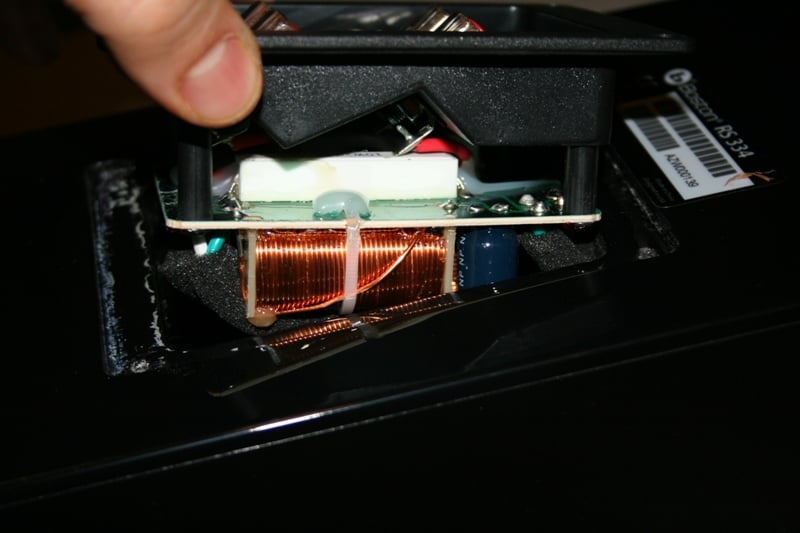
 Opening
up the speakers, I was surprised at how tight everything was in
there. The woofers were all shielded which creates a very large
magnet structure in the back. I was only able to remove three of the
four woofers because the openings were so tight and I couldn't get
the vanity cover off the tweeter to get at the screws. The tweeter
did not have a backbox. All the wires were covered in velvet tape to
eliminate any possible noise from the wires vibrating against the
cabinet, the drivers, or each other. The enclosure was constructed
out of 3/4" MDF - about what we'd expect at this price point -
with 1/2" MDF braces. I could identify four braces in the
cabinet but there may have been a fifth one lower down. The top brace
was parallel to the front baffle and seemed to be connected to the
top and the sides. This came down to just behind the tweeter. The
rest of the braces were parallel to the top and were connected to the
sides, front and back of the cabinet with openings in the center.
These were situated between the top and second woofer, between the
3rd and 4th woofer, and just below the port (before the binding post
insert). There was a ton of dampening material in the enclosure with
thick polyfill glued to each of the walls and back of the cabinet in
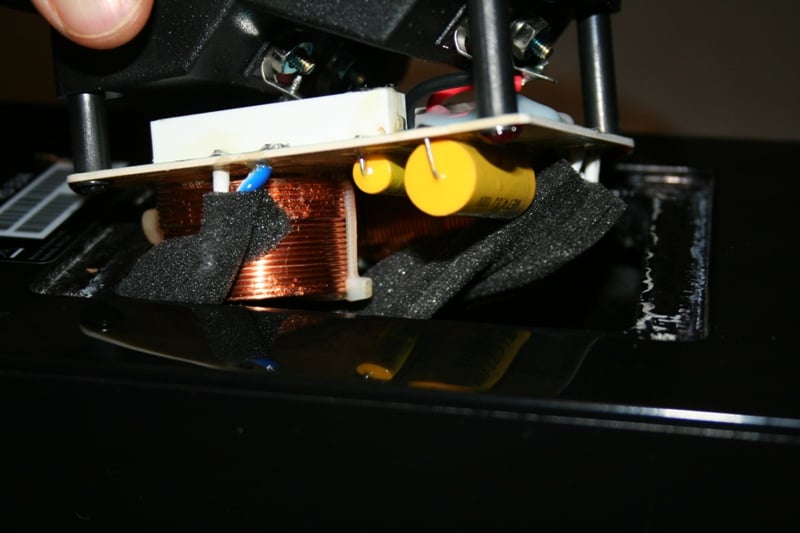
every place I could see or reach. The crossover was attached to the
back of the binding post insert. The wire runs were so tight that I
couldn't remove the crossover enough to get a good picture. From what
we can tell the crossover it was assembled on printed circuit board
(PCB) and utilized a combination of air and iron core chokes and
polypropylene capacitors and ceramic resistors. I'm guessing the
larger iron core choke is part of the woofer crossover which is a
good thing since most of the power is in bass and you don't want an
underrated iron core going into saturation causing distortion and
compression when playing at high listening levels.
Opening
up the speakers, I was surprised at how tight everything was in
there. The woofers were all shielded which creates a very large
magnet structure in the back. I was only able to remove three of the
four woofers because the openings were so tight and I couldn't get
the vanity cover off the tweeter to get at the screws. The tweeter
did not have a backbox. All the wires were covered in velvet tape to
eliminate any possible noise from the wires vibrating against the
cabinet, the drivers, or each other. The enclosure was constructed
out of 3/4" MDF - about what we'd expect at this price point -
with 1/2" MDF braces. I could identify four braces in the
cabinet but there may have been a fifth one lower down. The top brace
was parallel to the front baffle and seemed to be connected to the
top and the sides. This came down to just behind the tweeter. The
rest of the braces were parallel to the top and were connected to the
sides, front and back of the cabinet with openings in the center.
These were situated between the top and second woofer, between the
3rd and 4th woofer, and just below the port (before the binding post
insert). There was a ton of dampening material in the enclosure with
thick polyfill glued to each of the walls and back of the cabinet in
every place I could see or reach. The crossover was attached to the
back of the binding post insert. The wire runs were so tight that I
couldn't remove the crossover enough to get a good picture. From what
we can tell the crossover it was assembled on printed circuit board
(PCB) and utilized a combination of air and iron core chokes and
polypropylene capacitors and ceramic resistors. I'm guessing the
larger iron core choke is part of the woofer crossover which is a
good thing since most of the power is in bass and you don't want an
underrated iron core going into saturation causing distortion and
compression when playing at high listening levels.


Boston Acoustics RS 334 Setup and Measurements
 The
first thing I want to talk about with setup is the lack of carpet
spikes. While the RS 334s never went over, they definitely would have
been more stable with carpet spikes. On my medium-pile carpet the
speakers were easy to sway back and forth but not so easy to send
completely over (not for lack of my 6 month old trying). Also, there
is no way to adjust the feet. Unless your flooring was installed by
Mike Holmes, I'm guessing you'll have a less than perfectly level
floor. Without a way of adjusting the feet, you'll be left to use
folded paper or something. I did love the angled port for transport.
Honestly, this made these speakers really easy to move and I could
hold one in each had if I wanted to.
The
first thing I want to talk about with setup is the lack of carpet
spikes. While the RS 334s never went over, they definitely would have
been more stable with carpet spikes. On my medium-pile carpet the
speakers were easy to sway back and forth but not so easy to send
completely over (not for lack of my 6 month old trying). Also, there
is no way to adjust the feet. Unless your flooring was installed by
Mike Holmes, I'm guessing you'll have a less than perfectly level
floor. Without a way of adjusting the feet, you'll be left to use
folded paper or something. I did love the angled port for transport.
Honestly, this made these speakers really easy to move and I could
hold one in each had if I wanted to.
These speakers were mated with a lot of different gear. First and foremost most of the critical listening tests were done with the Denon DVD-3910 driving the analogue only Emotiva RSP-1/RPA-1 combo. This combo provides more power than most speakers will ever need and keeps everything in the analogue domain. Also, however, they were matched with the Denon AVR-4310CI, Seymour AV 5001 Ice Amps, and a myriad of sources. Wiring was provided by Blue Jean Cables and Ram Electronics. All listening tests were done in full range without the benefit of a sub and in pure direct mode (where applicable). All Audyssey and other processing was disabled. The room has been treated with some DIY treatments and GiK Acoustics Tri-Traps placed as recommended by Auralex via their Room Acoustics Plus consultation program.
Measurements & Testing
For measurements, I used TrueRTA with a Behringer ECM8000 mic and an M-Audio Fast Track Pro external soundcard. For amplification I used a Sherbourn 2/75B amp. This setup gives me a lot of flexibility as to where and when I can do measurement. To start with I placed the speakers in my Ready Acoustics treated AV Rant podcast room. This room is small but extremely dead with 19, four inch thick panels lining the walls and ceiling and straddling all the corners. While the room isn't exactly an anechoic chamber, it is a heck of a lot deader than most people would ever experience and almost every wife on the planet allow in their home. To start with I measured the speakers 1 meter on axis.

Boston
Acoustics RS 334 One Meter On Axis 1/24th Octave
(note - not a 1
watt measurement)
I measured the Boston Acoutics RS 334s at one meter between the tweeter and the top woofer. As you can clearly see the RS 334s are generally pretty linear from 100Hz up to 6kHz where there is a general trend up. This is pretty common in speakers there the high end is a bit accentuated. Consumers, especially those in retail settings, are listening to numerous speakers and will tend to prefer those with a hotter high end. This is not an extreme change though at only about 5dB over the average of the rest of the response.

Boston
Acoustics RS 334 1/2 Meter, 1/24th Octave
Purple
- On Axis, Yellow - 15 Degrees off, Orange - 30 Degrees Off
This graph gives us a little more information. As is often the case, off axis response takes a toll most on the high end response. This allows the end user to "tune" the speaker by adjusting the toe in. With the RS 334, the on axis response has the most high end energy with a light reduction at 15 degrees off and a more dramatic one at 30 degrees. For those looking for the flattest possible response, you're going to want to sit off axis from the speaker. There also seems to be a bit of a dip in the response in the midrange/upper bass. This was not as visible in the one meter measurement so will not be an issue.
Boston Acoustics RS 334 Listening and Conclusion
 As
always I started off with the RS 334 listening tests with trying to
determine in-room bass response. It's one thing for Boston to claim
they measured down to 43Hz in their anechoic chamber (they have one,
I've been in it) but that doesn't always translate into in-room
response. Depending on how you place your speakers, you may have much
better (or much worse) response. I placed the speakers a good 2 feet
off any wall with plenty of breathing room for the ports.
Subjectively I noted something as low as 32Hz with what I'll call
"usable" bass down to 40Hz. By usable I mean bass that is
loud enough compared to a 1kHz test tone - again, subjectively. This
is better than the spec'ed response which is what I'd expect for an
in-room response.
As
always I started off with the RS 334 listening tests with trying to
determine in-room bass response. It's one thing for Boston to claim
they measured down to 43Hz in their anechoic chamber (they have one,
I've been in it) but that doesn't always translate into in-room
response. Depending on how you place your speakers, you may have much
better (or much worse) response. I placed the speakers a good 2 feet
off any wall with plenty of breathing room for the ports.
Subjectively I noted something as low as 32Hz with what I'll call
"usable" bass down to 40Hz. By usable I mean bass that is
loud enough compared to a 1kHz test tone - again, subjectively. This
is better than the spec'ed response which is what I'd expect for an
in-room response.
Placement with the Boston RS 334s was easy to adjust because of their light weight and lack of spikes. As you might expect from the above measurements, I found these speakers much more enjoyable off axis. While I experimented a lot with different placements, I felt that having the speakers pointed nearly straight out was best. I placed them at just a fraction of a toe-in. If I didn't do this I felt the center image really suffered. This put me just about 30 degrees off axis from the speakers. I sat about 8-9 feet from the speakers with the speakers a bit under 7' apart.
The most obvious comparison I can make with the speakers I have on hand are with the Salk Sound SongTower QWTs. The Songs retail for just under $1700 a pair but they have similar specs (rated down to 42Hz) and are in a near price category (within $300). The Salks are a lot larger and heavier. They are an Internet direct brand that did very well against three other speakers in the same price category in our $1500-$2000 a pair floorstanding speaker shootout. Many people, myself included, consider the Salk SongTowers to be a value leader in the sub-$2000 price category. After level-matching the two and doing some quick A/Bs, a few things became clear. First, the Boston RS 334s held up very well. The high end was a bit more reserved and rolled off but the bass extension was very comparable. Imaging was good but not quite as three dimensional as the Salks. The Boston speakers seemed to be a bit more reserved and recessed overall but the overall presentation was very nice. As a speaker priced $300 lower than the Salks, the Boston RS 334s preformed very, very admirably. In general, when I listened to just the Bostons for any length of time, I found them to be an fine offering. It was only when I switched back to the Salks did I realize what I was missing. When going up against a class leader, holding your own is high praise. The Bostons did just that.
CD:
Shootout Disc
There
were a number of tracks on our $1500-$2000 Floorstanding Speaker
Shootout disc that we used for comparison and I've come to rely on
this disc to test nearly anything that comes through my room. One of
the reasons to invest in floorstanding speakers is because of the
added bass response. While you can't expect an offering in this price
range to negate the need for a sub with for movies and such, you can
expect for most musical content that the speakers will be enough. It
will also help with evening out bass response in your room if you can
run your speakers full range. I really appreciated the low end
extension of the RS 334 speakers. The bass I was experiencing was
very unexpected from such a small package. While the bass wasn't low
enough to be visceral, it was punchy and tight. Kick drums were
realistic and low bass notes were full and rich. It's honestly
amazing what Boston did with four little woofers and one curved port.
Many manufacturers would have to have a much bigger box or a
side-firing woofer to get the same results. Bass was quite linear and
musical. For most musical content, the Boston RS 334s should perform
admirably.
CD:
Bang & Olufsen Vol. XIII - The Sound of Perfection
This
is a disc I picked up from the manufacture during a press trip. It
has a variety of music on it that features everything from classical
to a cappella to guitar. Female and male vocals are included as well.
Basically, it is a one-stop-shop for many of the types of sounds that
will give a speaker problems. Imaging was fairly tight with female
vocals in particular sounding very good. The presentation as a whole
seemed very accurate if not particularly warm. The high-end, in
particular, seemed a little rolled off and was a little too crisp for
my liking - even off axis. At higher volumes it sounded like the
tweeter was compressing and distorting slightly. For this reason, I'm
going to have to recommend that the RS 334s be used in Medium sized
or smaller rooms. Great rooms might be a bit much for these speakers.
Of course, I was running them full range and the addition of a
subwoofer could definitely change things. Either way, for the lowest
notes or any sort of movie watching you'd have to add a sub. At this
price point, however, that's to be expected.
CD:
Rusted Root - When I Woke I
wanted to give the Boston RS 334s a bit of a workout and this disc is
perfect for it. Tons of percussion, female and male vocals, and the
ability to be fatiguing after only a few moments of playback on the
wrong speakers, When I Woke can really stress a pair of lesser
speakers. First of all, I found the movement between speakers to be
very good and the soundstage to be quite wide. As with previous
offerings, the vocals were well anchored in the center but overall
center imaging was just OK. While things moved between the speakers
just fine, their placement in three dimensional space at any
particular moment was really hard to discern. The top end again was a
little more forward than I would have liked but the speakers weren't
overly fatiguing. Bass again was impressive as was the
responsiveness. The midrange was a bit analytical overall and not as
warm as I've heard in other offerings but was overall fairly
pleasant.
I
wanted to give the Boston RS 334s a bit of a workout and this disc is
perfect for it. Tons of percussion, female and male vocals, and the
ability to be fatiguing after only a few moments of playback on the
wrong speakers, When I Woke can really stress a pair of lesser
speakers. First of all, I found the movement between speakers to be
very good and the soundstage to be quite wide. As with previous
offerings, the vocals were well anchored in the center but overall
center imaging was just OK. While things moved between the speakers
just fine, their placement in three dimensional space at any
particular moment was really hard to discern. The top end again was a
little more forward than I would have liked but the speakers weren't
overly fatiguing. Bass again was impressive as was the
responsiveness. The midrange was a bit analytical overall and not as
warm as I've heard in other offerings but was overall fairly
pleasant.
Conclusion
As one gets more and more experience with any particular subject, you run the risk of becoming an elitist. You start to think that any offering from a "known" manufacturer can't be any good because your mom recognizes their name. Well, that's not the case with Boston Acoustics. The RS 334 speakers pack a lot of sound in a very small package. If space is at a premium, this is a speaker you should take a hard look at. I really liked the overall look of the speaker and the bass response was just phenomenal. Will you still need a sub? Absolutely. But for the money, you are getting a lot of bass out of a speaker that commands almost no real estate. In a world where people are looking more and more for speakers to match their uber-flat displays, the Boston Acoustics RS 334s deliver both looks and performance. We can't really ask for any more.
Boston Acoustics RS 334
$699.99/each
Boston
Acoustics, Inc
300
Jubilee Drive
Peabody,
MA 01960
978-538-5000
www.bostonacoustics.com
Read Consumer Reviews on
About
Boston Acoustics
Founded
30 years ago, Boston Acoustics is a world-renowned leader in
high-performance loudspeakers, tabletop
products, and advanced car audio systems. The company's "Play
Smart™" approach is reflected in its product design, which
allows customers to enjoy high-performance audio while expressing
their personal style and tastes.
The Score Card
The scoring below is based on each piece of equipment doing the duty it is designed for. The numbers are weighed heavily with respect to the individual cost of each unit, thus giving a rating roughly equal to:
Performance × Price Factor/Value = Rating
Audioholics.com note: The ratings indicated below are based on subjective listening and objective testing of the product in question. The rating scale is based on performance/value ratio. If you notice better performing products in future reviews that have lower numbers in certain areas, be aware that the value factor is most likely the culprit. Other Audioholics reviewers may rate products solely based on performance, and each reviewer has his/her own system for ratings.
Audioholics Rating Scale
 — Excellent
- — Very Good
- — Good
- — Fair
- — Poor
| Metric | Rating |
|---|---|
| Build Quality | |
| Appearance | |
| Treble Extension | |
| Treble Smoothness | |
| Midrange Accuracy | |
| Bass Extension | |
| Bass Accuracy | |
| Imaging | |
| Soundstage | |
| Dynamic Range | |
| Fit and Finish | |
| Performance |  |
| Value | |
As Associate Editor at Audioholics, Tom promises to the best of his ability to give each review the same amount of attention, consideration, and thoughtfulness as possible and keep his writings free from undue bias and preconceptions. Any indication, either internally or from another, that bias has entered into his review will be immediately investigated. Substantiation of mistakes or bias will be immediately corrected regardless of personal stake, feelings, or ego.
View full profile Subscribe to our newsletter