


Aperion Audio Verus Grand Bookshelf Speaker Review
- Product Name: Verus Grand Bookshelf Speaker
- Manufacturer: Aperion Audio
- Performance Rating:

- Value Rating:

- Review Date: August 18, 2011 22:35
- MSRP: $ 598/pr (free shipping)
- Frequency Response: (+/- 3dB) 59Hz to 20,000Hz
(+/- 6dB) 54Hz to 20,000Hz
- Impedance: 6 ohms
- Sensitivity: 84dB
- Recommended Amp Power: 30-200 Watts
- Tweeter: 1" Custom Aperion ASR Soft Dome Tweeter
- Woofer: 5" Woven Kevlar Woofer with Aluminum Phase Plug
- Driver Configuration: 2-Way
- Enclosure Type: Anti-Resonant, Internally Braced, Rear Ported
- Dimensions: 13" H x 7.5" W x 9" D
- Weight: 14lbs
- Ten year warranty
- FREE SHIPPING - a $33 value per pair*
- FREE lifetime technical support
- FREE speaker care kit
Pros
- Pristine fidelity
- Furniture grade finish
- Excellent craftsmanship
Cons
- Limited bass output
- Raises the bar too high for the competition
Aperion Audio Verus Grand Bookshelf Speaker Introduction
We'v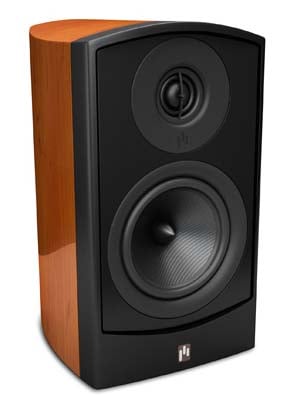 e been reviewing Aperion Audio
speakers pretty much since they began selling speakers online. In that time, they've always managed to
produce good-sounding, finely crafted speakers at reasonable prices. Over the years we planted a bug in their ear
for achieving higher aspirations. The
response seems to be the Verus line of loudspeakers. We were so impressed with their Verus Grand
towers that we decided it was time to give the Verus Grand Bookshelf speakers
their own dedicated review. Being a fan
of quality bookshelf speakers, I personally and quite eagerly took on this
task. I enjoyed my time with their
Intimus 5B bookshelf speakers and was curious to find out of their Verus
bookshelf was worth the extra $150 smackaroos.
e been reviewing Aperion Audio
speakers pretty much since they began selling speakers online. In that time, they've always managed to
produce good-sounding, finely crafted speakers at reasonable prices. Over the years we planted a bug in their ear
for achieving higher aspirations. The
response seems to be the Verus line of loudspeakers. We were so impressed with their Verus Grand
towers that we decided it was time to give the Verus Grand Bookshelf speakers
their own dedicated review. Being a fan
of quality bookshelf speakers, I personally and quite eagerly took on this
task. I enjoyed my time with their
Intimus 5B bookshelf speakers and was curious to find out of their Verus
bookshelf was worth the extra $150 smackaroos.
As with all Aperion Audio speakers, the Verus Grand Bookshelfs showed up well packaged (within a single heavily insulated box). The craftsmanship of their cabinets is well worth a little extra precaution on their part and appreciated by their customers and reviewers alike. The speakers came packed in socks for added high end appeal and included Michael Jackson style white gloves for careful handling.
I thought it would be good measure to do a quick comparison of the 5B vs Verus Grand products so potential buyers would have a perspective as to what their extra hard earned $150 would get them.
| Metric | Intimus 5B | Verus Grand Bookshelf |
| MSRP: | $450/pair | $598/pair |
| Frequency Response | (+/- 3dB) 75Hz to 20,000Hz (+/- 6dB) 62Hz to 20,000Hz | (+/- 3dB) 59-20,000 Hz (+/- 6dB) 54-22,000 Hz |
| Sensitivity | 84dB @ 2.83V | 87dB at 2.83V |
| Tweeter | 1" Audiophile-grade Silk-Dome Tweeter | 1" Custom Aperion ASR Tweeter |
| Woofer | 5.25" Woven-Fiberglass Mid-Woofer | Mid-Woofer 5" Woven Kevlar Woofer with Aluminum Phase Plug |
| Enclosure Type | 1" HDF | Anti-Resonant, Internally Braced, Rear Ported |
| Dimensions | 12" H x 6.75" W x 8" D | 13" H x 7.5" W x 9" D |
In addition to driver upgrades, the Verus Grand Bookshelf speaker is 3dB more efficient and is tuned lower (59Hz vs 75Hz) making it easier to blend with a sub to provide a truly full-range musical representation.
Verus Grand Bookshelf Product Overview

The Aperion Audio Verus Grand Bookshelf cabinet is crafted like a fine piece of furniture. From the radiused edges, to the contour shape of the box, this is not your typical boxy cabinet. Instead, the Verus bookshelf bestows a much more elegant appearance. The magnetic grille sits flush mounted against the cabinet, making the whole design fluid in appearance.
Aperion Audio products are offered in two finishes: high gloss black and cherry. We had cherry for our review samples. Just like I found with the Intimus products, the cabinetry of these babies is among the best I’ve seen regardless of price. There are no seams to be found anywhere on the cabinet as the veneer wrap seems to flow as one piece. Aperion Audio truly lives up to the furniture grade finish that they tout.
Popping the grille off, you're greeted with more silky smooth craftsmanship not apparent in many competitor designs at this price point. The drive units are all recessed into the baffle to minimize diffraction and dress up its appearance. No visible screws are seen on the front baffle thanks to the integrated ring flange that is glued over the driver baskets. These speakers sound good just looking at them, especially when parked near a traditional boxy looking competitor.
What's in the box?
 The
Verus Grand Bookshelf is a typical rear ported two-way bookshelf design
sporting a 5" phase plug Kevlar woven woofer (tongue teaser) and a 1"
axially stabilized tweeter custom
designed by Aperion Audio. What is NOT typical
is the quality level of parts used at this price point.
The
Verus Grand Bookshelf is a typical rear ported two-way bookshelf design
sporting a 5" phase plug Kevlar woven woofer (tongue teaser) and a 1"
axially stabilized tweeter custom
designed by Aperion Audio. What is NOT typical
is the quality level of parts used at this price point.
The 1.5" flared plastic port appears to have a cardboard ring glued around it which I could only surmise is for added rigidity. All of the speaker cables are wrapped in foam likely to reduce any turbulent noise of them flapping around inside the box. Aperion Audio dumped the magnetic shielding (good call) of their woofer for the Verus line. This not only increases woofer efficiency but also reduces cost of an extra bucketing magnet and metal can. Honestly, who needs shielded woofers anymore since the demise of CRT displays?
The 1" axially stabilized Verus tweeter has a very low resonant frequency (Fs) in the ballpark of 550Hz, which allows it to play down lower with less distortion than conventional designs. It's quite an expense to make a tweeter like this as it involves a more elaborate motor structure such as rear vented chamber. The main design benefit of the ASR is that it keeps the diaphragm from rocking, thus reducing distortion in the tweeter’s lower operating range.
The crossover is mounted to the back of the cabinet and utilizes high tolerance ceramic resistors, an air core and polypropylene capacitor in the critical high frequency circuits and an iron core choke and electrolytic capacitor for the woofer section. The Verus Bookshelf speakers are crossed over (1.2kHz 2nd order electrical, 3rd order acoustical) a bit lower than we normally see in two-way bookshelf speakers mostly because most tweeters can't effectively play low enough to achieve the benefits offered by such a low crossover point. Having a lower crossover allows the system to create a smoother, more natural off-axis roll off which is prevalent in our measurements as you will see later in the review.
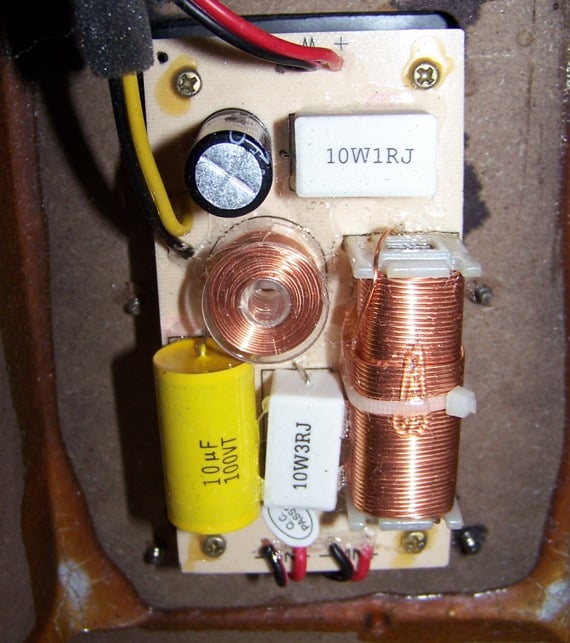
Aperion Audio Verus Grand Bookshelf Crossover
The Aperion Verus 5" woofer utilizes a true phase plug driver which serves 3 purposes:
- reduce cone mass
- reduce on-axis beaming
- vent the voice coil
The phase plug further reduces cone mass by physically having no dust cap. It also further reduces on-axis beaming, allowing the woofer to extend the response to higher frequencies and offer improved dispersion characteristics. The downside to using a phase plug driver in such a small woofer is the reduced cone area also means reduced efficiency at bass frequencies. It also creates a pressure release and leak in the center of the woofer. This can cause a chuffing noise when driven with percussive instruments at high output levels by allowing voice coil air gap turbulence to be heard directly. These trade-offs become a wash when mating these speakers with a powered subwoofer, which is what I would recommend in almost all applications if space and budget permits.


Aperion Audio Verus Tweeter (left pic); Woofer (right pic)
To further increase heat dissipation, the Aperion Verus woofer employees a vented pole piece and a cast basket. This is an expensive measure compared to stamped baskets found on many of their competitor products, but it allows for the system to play at higher output levels with less distortion. Many of the best loudspeakers on the market share similar design characteristics to what we are seeing here in the Aperion Verus speaker system, only the competitor products tend to be much costlier.
I recommend reading Tom Andry's Aperion Verus Grand Tower review for more information about these drivers as he goes into great detail on their design features.
Ba ckview
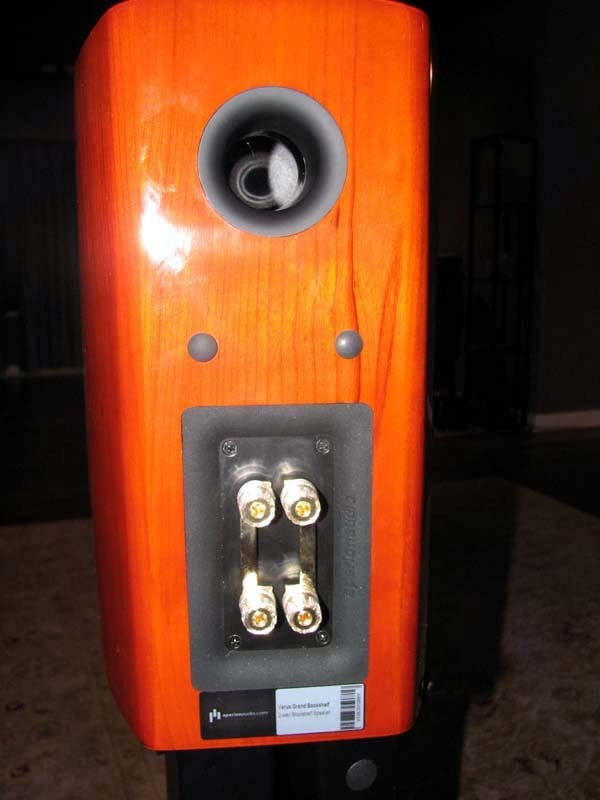
The Aperion Audio Verus Grand bookshelf speaker is just as appealing from the rear as it is from the front. The rear port is flared on both ends and the speaker terminal cup is constructed of very high quality plastic. I'm uncertain of the cabinet thickness, since I couldn't physically get inside the box to examine it. However the lower priced Intimus 5B was constructed of 1" thick HDF and the Verus bookshelf feels even more inert. Tapping all around the cabinet produced a consistently deadening thud sound. If you look closely inside the port, you can see the rear tweeter chamber staring back at you.
The grille is constructed of rigid sheet metal instead of flimsy plastic that you usually find in products of this price class. The grill cloth is a very tightly woven mesh to help minimize losses.
The plastic molded terminal cup is a thing of beauty. Flanked by 4 sets of high quality 5-way gold plated binding posts, the Verus Grand bookshelf can be bi-wired or bi-amped. The speaker comes with gold plated jumpers installed for single amp connection which is how the majority of users will use these speakers.
There are two milled holes below the port which is compatible with the Omni wall mounts they sell on their website as an accessory for this speaker. This comes in quite handy for mounting it as a surround speaker.
Set-Up
I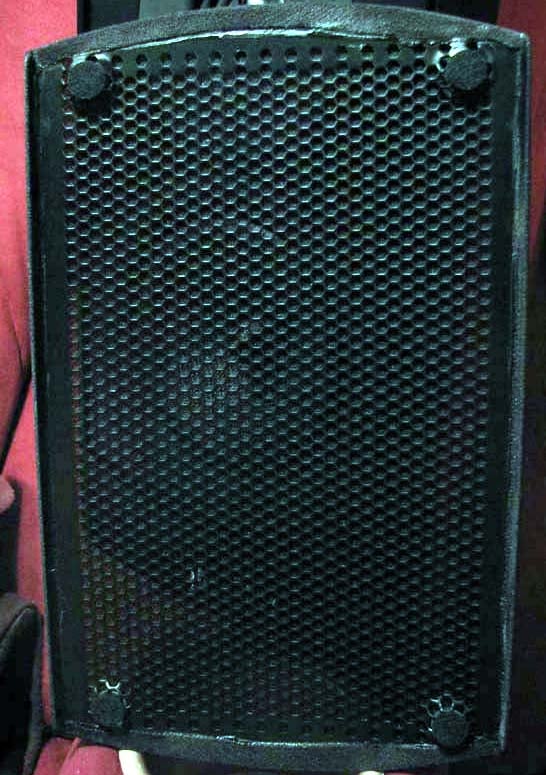 tested the Aperion Audio Verus Grand
Bookshelf speakers in two scenarios:
tested the Aperion Audio Verus Grand
Bookshelf speakers in two scenarios:
- Office - as a nearfield monitor on my computer desktop (10’ x 6’ office)
- Theater room - two-channel
utilizing the reference gear and premier listening space in the
Audioholics Showcase home
In the first listening scenario (office room), I used my Headroom micro preamp and DAC connected directly to my EMP VT-40.2 tube amplifier. I also had my Velodyne MicroVee on hand to supplement bass if needed.
For the second scenario (Theater room), I positioned the Aperion's about 5ft from sidewalls and around 6ft from the back walls and spread apart about 8ft from each other which was about two feet shy of the distance from my primary listening position. After experimenting, I found they sounded their best with moderate toe-in since these speakers don't have an aggressive top end and my theater room is large (6,000ft^3) and acoustically treated. I used my Marantz PM-11S2 200wpc integrated stereo amplifier and the Denon DVD-A1UDCI Universal Blu-ray player as the source connected via balanced cables. I had one of my Velodyne DD-15+ subwoofers connected up for bass supplementation when needed. All interconnects were furnished by Blue Jeans Cables (1694A Coax) and Kimber 8PR speaker cables with WBT compression banana plugs.
Verus Grand Bookshelf Listening Tests
Unless otherwise stated, all listening tests were conducted without a subwoofer in two-channel configuration with the Verus Grand Bookshelfs running full-range.
Office Room utilizing Pandora.com
To start off my listening tests, I began with the setup in my main office where I do all related works for Audioholics. I usually write my articles with music playing in the background, courtesy of the services of Pandora.com. With that, I captured some of my listening experiences with the following source materials.
Neal Diamond – Hello Again
I have to admit after watching the movie "Saving Silverman" I started taking a liking to some Neal Diamond music. His raspy voice was conveyed with conviction on the Aperion Verus speakers. The piano sounded tonally correct with no obvious coloration like I've heard on some speakers.
Norman Brown - That's the way Love Goes
Yes it's smooth jazz, but Norman is a great guitarist. He reminds me of a young George Benson back before he put his guitar down in place of a microphone. The Aperion's were pinning the guitars front and in my face just like they should sound. The bass was tight but not well-extended, which is to be expected for a speaker of this size. Once I turned on my Velodyne Mini-Vee, I was rewarded with rich full-range sound rivaling many floorstanding speakers I've reviewed. I was achieving that "better than being there" experience I often talk about when reviewing exceptional gear.
ABBA - Take a Chance on Me
I saw the Broadway production of Mamma Mia in Tampa last month with the misses and I we were blown away. Now it's got me listening to ABBA which I would have never done prior. The vocals were right out in the open. Aperion Audio doesn't hide or recess the midrange which many companies tend to do with budget products. The vocal clarity was among the best I've heard in bookshelf speakers regardless of price.
Michael McDonald - Sweet Freedom
This
song brings me back to the comedy classic Running Saced starring Gregory Hines
and Billy Crystal. Separation of
instruments was stellar. This song took
on a very 3D feeling to it when played back on the Aperion's. I can't ever imagine anyone not being a
Michael McDonald fan.
Theater Room
SACD: Gloria Estefan - Caribb ean Soul
It's been awhile since I listened to this disc and I almost forgot
what a musical treasure it is. Track#1
"Por Un Beso". Gloria's vocals
came through in crystal clarity. The percussions popped out at you with the
flutes and various background percussive instruments painting the landscape of
the song. About the only gripe I had
listening to this song on the Aperion's was the lack of deep bass which wasn't
surprising given their diminutive size.
Just for kicks, I powered up one of my Velodyne DD-15+ subwoofers and
threw it into the mix. It made a world
of difference. Bass was now fully
reproduced and the slight woofer strain I was hearing at high volume was
gone. Anyone considering using these
speakers for the main channels should definitely cross them over at 80Hz and
employ an excellent sub such as one of the Velodyne Digital Drive Plus
series. Track #2 "Punto de
Referencia" put forth a very wide stereo image between the acoustical
guitar on the left speaker and the percussions dominating the right
soundstage. The Aperion's were
delivering a stunningly good high definition three dimensional feeling that a
great recording like this can reproduce on only superb audio equipment. Track #4 " Como Me Duele Perderte", the knocking
sound eminating from the right speaker in this track was a bit freaky in that
it momentarily tricked me into thinking I was hearing a design artifact from
the speakers. The musical instruments
were separated with excellent delineation. Lesser systems tend to mush the
sound together losing the benefits of a high resolution recording.
Just for good measure, I brought in my EMP 41-SE/B bookshelf speakers which feature a 4" Beryllium cone phase plug driver and an upgraded Scan Speak 9500 tweeter. EMP doesn't offer this speaker with all the hot rods I made to it so I recognize it's not a fair comparison, but I wanted to see how the two speakers compared to each other. Overall the EMP's actually portrayed a wider soundstage with slightly more air on top than the Aperions. However, the Aperions sounded larger and more dynamic. As a nearfield monitor in a small office with a powered sub, I preferred the EMP's. In a home theater room environment, I definitely preferred the Aperions. The fact that the Aperions were holding their own speaks volumes for the caliber of product that they really are.
SACD :
Patricia Barber - Modern Cool
:
Patricia Barber - Modern Cool
The bass in track#1 "Touch of Trash" will literally
trash wimpy woofers as I've seen with some prior loudspeakers I've reviewed and
demoed. I was pleased that the Aperions
didn't falter here. Instead I heard
excellent clarity and realism in the instruments. Patricia's voice was a bit lispy but that was
part of the recording. On some metal
dome tweeter designed I demoed this song on, I experienced listening fatigue
within minutes. I didn’t have this
problem with the Aperions. The trumpets
literally poured out into the room sounding very natural and genuine. As I turned the volume up, it never sounded
edgy like I've heard on other speakers in this size class.
The Aperion Verus Bookshelf speakers showed off their delicate side in Track #6 "Silent Partner". The natural airiness in the cymbals was intoxicating and the piano just planted itself in the room as if Patricia was right there playing for me.
Track #7 "Company" is a tough song for most speakers to play at high SPL. The Aperion's definitely strained here during the percussive solo. Crossing them over at 80Hz to my Velodyne sub made a world of difference. I was now hearing this song as it was meant to be heard, loud clear and effortless.
Verus Grand Bookshelf Measurements and Analysis

Impedance / Phase Measurements of the Aperion Verus Grand Bookshelf
The Aperion Audio Grand Bookshelf speakers appear to be tuned into the 60Hz region as indicated by the saddle point in the impedance graph. They dip slightly below 5 ohms in the 150-200Hz range but maintain a high impedance at 20Hz and above 5kHz. The 6 ohm rating that Aperion gives these speakers seems very reasonable to me. These speakers staying within a +-30 degrees phase for the entire audio bandwidth shows Aperion spent some time designing the crossover to not only integrate the drivers well but to ensure the speaker system plays nice with all amplifiers. You don’t need an esoteric amp to run these speakers as any decent modern AVR will run them just fine. Aperion rates these speakers at 87dB sensitive but that is a 2.83V measurement, not 1 watt. The 1 watt sensitivity is more like 85-86dB which is what I measured.

In-room 1/2 meter SPL vs Frequency Aperion Verus Grand Bookshelf Listening Window
I measured the Aperion Audio Verus Grand Bookshelf speaker in-room at 1/2 meter with the microphone located at the acoustical center of the speaker which was stand mounted in 32" stands. For these measurements, the grille cover was removed. I took an on-axis measurement and averaged it with two horizontal measurements (+-15 degrees off axis) and two vertical measurements (+-15 degrees off axis). No smoothing was used. As you can see the speaker exhibited no off axis nasties and measured extremely linear in the critical midrange region all the way to the frequency extremes. This is an NRC's fantasy speaker measurement which is interesting considering Aperion Audio doesn’t necessarily design to NRC gospel, nor do they feel it necessary to design a loudspeaker in an anechoic chamber.

In-room
1/2 meter SPL vs Frequency Aperion Verus Grand Bookshelf (1/12th
octave smoothed)
purple
trace: on-axis; green trace: 15 deg
off-axis; purple trace: 30 deg off-axis
Here are some off-axis measurements for the Aperion Verus bookshelf speaker. Again this speaker measured so linearly it was like I captured the measurements in an anechoic chamber. Notice how the top end response isn't over done with these speakers. Aperion's design goal was neutrality and it really shows in these measurements. I can't tell you how many speakers we've measured in the past that boasted they make neutral speakers while we measured +5-10dB too much gain in the tweeter or a too heavy bottom end because of a poorly tuned bass alignment. This was obviously not the case here.

Summed Nearfield Response of Aperion Verus Grand Bookshelf
In order to take the room out of the measurement equation, I took a nearfield response measurement of the woofer and port. I then properly scaled them and applied a minimum phase transform. I then spliced the combined measurement at 200Hz with the 1/2 meter in-room measurement to get a full-range measurement. This isn't a perfect measurement but you can at least see the 60Hz rolloff and 12dB/octave slope the speaker exhibits.

1/2
meter in-room Aperion Verus Grand Bookshelf
measurement
blue
trace: no grille ; purple trace: with grille
There is definitely some loss associated with the grille cover (no surprise there). I was a bit vexed to see up to 2dB loss in the upper midrange area however. This wiggle in the 3 to 4 kHz region is caused by reflections from the step where the baffle transitions to the area outside the grill. I found this most predominant on-axis. It's not a huge deal, especially since all speakers exhibit some losses with the grille covers on. Some manufacturers even boost the high frequencies to compensate. Personally, I found the Aperion's sounded best with the grilles off and I recommend using them that way if small children and pets aren't a concern.
Verus Grand Bookshelf Conclusion
 Don't
be fooled by the modest asking price of these speakers. The Aperion Audio Verus Grand Bookshelf
speaker system is a high quality, high caliber compact system that is capable
of delivering pristine fidelity if used within their limitations. Because of their smallish physical size they
simply cannot produce a lot of deep usable bass. They will however happily cross over to a sub
at 80Hz where they would integrate exceedingly well to provide full range sound
at meaningful output levels. It almost
seems like a sin to run these speakers as rear surrounds unless you are mating
them with an entire Aperion Verus speaker package.
Don't
be fooled by the modest asking price of these speakers. The Aperion Audio Verus Grand Bookshelf
speaker system is a high quality, high caliber compact system that is capable
of delivering pristine fidelity if used within their limitations. Because of their smallish physical size they
simply cannot produce a lot of deep usable bass. They will however happily cross over to a sub
at 80Hz where they would integrate exceedingly well to provide full range sound
at meaningful output levels. It almost
seems like a sin to run these speakers as rear surrounds unless you are mating
them with an entire Aperion Verus speaker package.
We found the entire Verus line of products to be competently well designed high end speakers and these little babies are no exception. We preferred listening to these speakers with slight to modest toe-in, on stands with no grilles and mated with a sub for critical two channel listening. In such an installation, the Aperion Verus were able to literally disappear leaving you with nothing but the music to get carried away in which is a welcome and sometimes rare treat for a critical reviewer like myself. These speakers performance per dollar ratio is so good that I fear Aperion has raised the bar too high for its competition. These aren't just speakers, they are pieces of furniture that sounds good. In fact, those on the fence between the Intimus 5B's and the Verus Bookshelf speakers, I 'd advise to save your pennies as the $150 price premium for the Verus is well worth it.
About the only thing Aperion Audio has left us wanting is a matching dedicated surround speaker such as their Intimus 4BP and subwoofer that produces the caliber of performance that the rest of the Verus line offers.
Considering their very liberal return policy, FREE 30 day home trial program and FREE shipping (both ways) I can’t say anything else other than “highly recommended!”
Aperion
Audio Grand Bookshelf Scorecard
MSRP: $598/pair
Aperion
Audio Loudspeakers
18151 SW Boones Ferry
Road,
Portland, Oregon
97224
1-888-880-8992
About
Aperion Audio
Aperion Audio is an online direct-to-consumer speaker manufacturer for smart
shoppers who are frustrated with the retail experience. Aperion offers a better
value, meaningful information, generous service, and unlike other speaker
retailers and manufacturers, is the only company to deliver an honest and
Totally Risk-Free In-Home Audition. For additional information, visit www.aperionaudio.com
The Score Card
The scoring below is based on each piece of equipment doing the duty it is designed for. The numbers are weighed heavily with respect to the individual cost of each unit, thus giving a rating roughly equal to:
Performance × Price Factor/Value = Rating
Audioholics.com note: The ratings indicated below are based on subjective listening and objective testing of the product in question. The rating scale is based on performance/value ratio. If you notice better performing products in future reviews that have lower numbers in certain areas, be aware that the value factor is most likely the culprit. Other Audioholics reviewers may rate products solely based on performance, and each reviewer has his/her own system for ratings.
Audioholics Rating Scale
 — Excellent
- — Very Good
- — Good
- — Fair
- — Poor
| Metric | Rating |
|---|---|
| Build Quality | |
| Appearance | |
| Treble Extension | |
| Treble Smoothness | |
| Midrange Accuracy | |
| Bass Extension | |
| Bass Accuracy | |
| Dynamic Range | |
| Performance | |
| Value |  |
Gene manages this organization, establishes relations with manufacturers and keeps Audioholics a well oiled machine. His goal is to educate about home theater and develop more standards in the industry to eliminate consumer confusion clouded by industry snake oil.
View full profile Subscribe to our newsletter