


Bookshelf Speaker Faceoff 2007
2007 bookshelf speaker shootout
It's not often that we assemble for a good ole-fashioned speaker face-off. In fact, the last one was in May of this year and was handled solely by one writer. This time we brought in reinforcements from around the east coast offices. Participants included Gene DellaSala, Clint DeBoer, Tom Andry, and J. Walker Clarke. If you think that getting four professional reviewers into one room is guaranteed to yield solid, empirical results, then you are highly mistaken. While most of us did agree most of the time, there were several moments where we simply agreed to differ on some finer points of preference. What we've assembled below is an organized attempt to consolidate our experiences into a cohesive article that will guide you through the process of listening through seven (7) pairs of bookshelf speakers priced from $200 - $850 per pair (and we tossed in an unofficial $1800 "eighth" pair from Dali USA since they were on hand).
The Contenders
We had a nice sampling of speakers, and with the exception of the Dali's we had at least one pair that was price-matched to another. Given the arrangement we paired them off into 3 categories: $200-250/pair, $400/pair and $800-$1800/pair. We also recognized that the Dali's were priced too far out of the competition, but since they were on hand we wanted to see if they were a significant step up and thus included them in our later rounds of listening tests. The speakers we had on hand included the following:
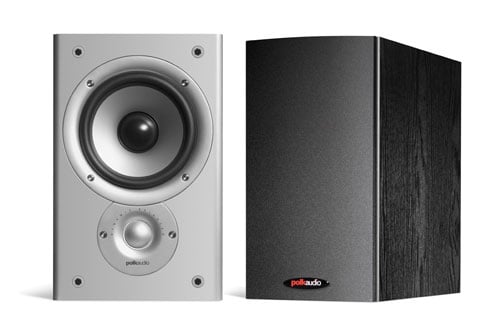
- Polk Audio Monitor 30s - $200/pair
- AV123 x-ls - $249/pair
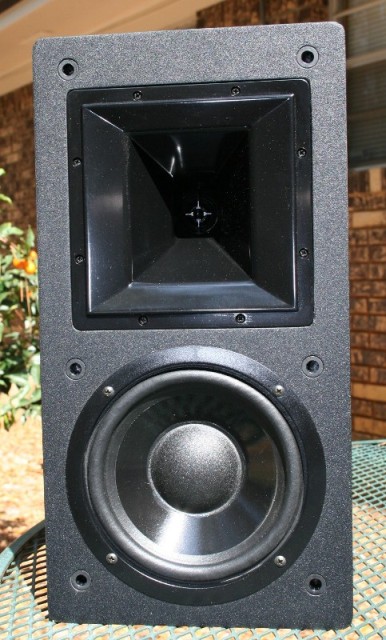
- Hsu Research HB-1 - $250/pair
- RBH Sound TK-5C - $400/pair
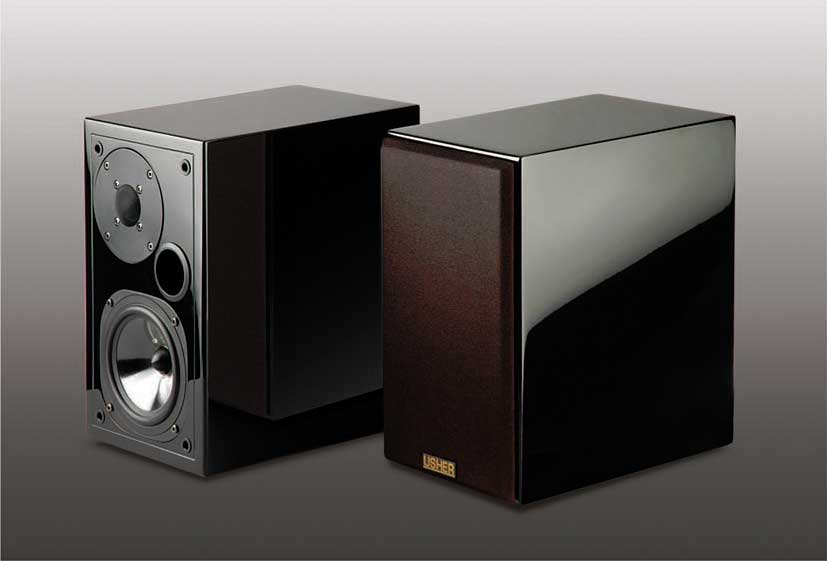
- Usher S-520 - $400/pair
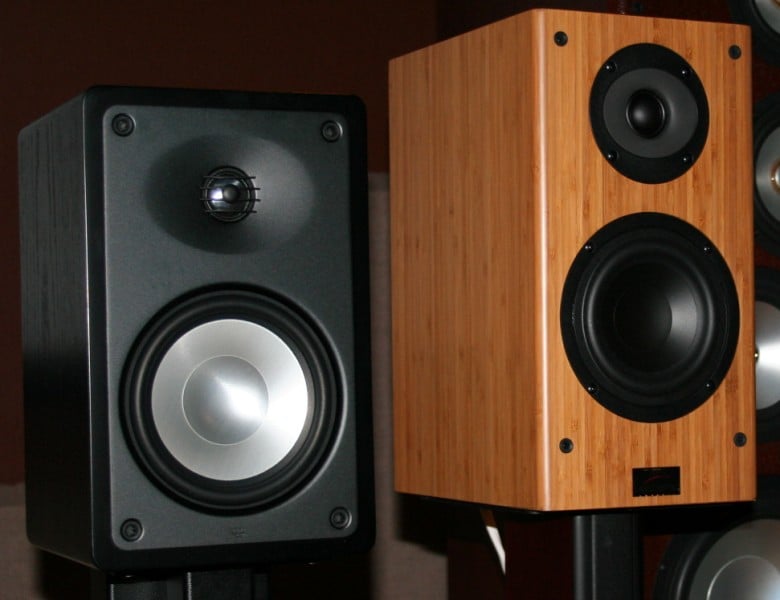
- Ascend Acoustics Sierra-1 - $798/pair
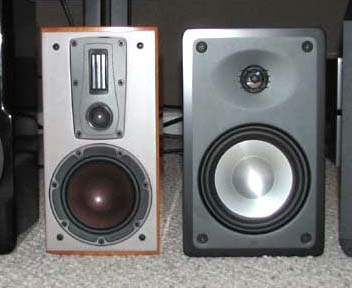
- RBH Sound MC-6C - $850/pair
- Dali Mentor 1 - $1800/pair
Each time a speaker is introduced we'll give its specs - but only once. You can cross reference as needed and reference the measurements at the back end of the review for more information.
The Speaker Shoot-out Process and Listening Environment
 We carefully selected
only a couple of tracks so that we could concentrate on various qualities of
each bookshelf speaker as it related to the limited program material. We also
used tracks that each of us was at least marginally familiar with to help us
know where to listen for various minutia and attributes of the music. For our
initial rounds we stayed with “Chant” from Fourplay's Greatest Hits album and “Cousin Dupree” from Steely Dan's Two Against Nature. The listening room was Reference System 1, which is a
larger room (over 5000 cubic feet) and features a complete room acoustics
treatment package from Auralex Acoustics. All of the speakers were, as a
result, driven very hard, enabling us
to see how they would fare in extreme situations. We also listened to all of
the speakers in 'Large' mode with no crossovers engaged and no subwoofer. When
we make comments about some of these speakers "bottoming out" realize
that in a smaller room, and with a properly configured subwoofer, this is not
likely to be an issue.
We carefully selected
only a couple of tracks so that we could concentrate on various qualities of
each bookshelf speaker as it related to the limited program material. We also
used tracks that each of us was at least marginally familiar with to help us
know where to listen for various minutia and attributes of the music. For our
initial rounds we stayed with “Chant” from Fourplay's Greatest Hits album and “Cousin Dupree” from Steely Dan's Two Against Nature. The listening room was Reference System 1, which is a
larger room (over 5000 cubic feet) and features a complete room acoustics
treatment package from Auralex Acoustics. All of the speakers were, as a
result, driven very hard, enabling us
to see how they would fare in extreme situations. We also listened to all of
the speakers in 'Large' mode with no crossovers engaged and no subwoofer. When
we make comments about some of these speakers "bottoming out" realize
that in a smaller room, and with a properly configured subwoofer, this is not
likely to be an issue.
 Some other configuration notes:
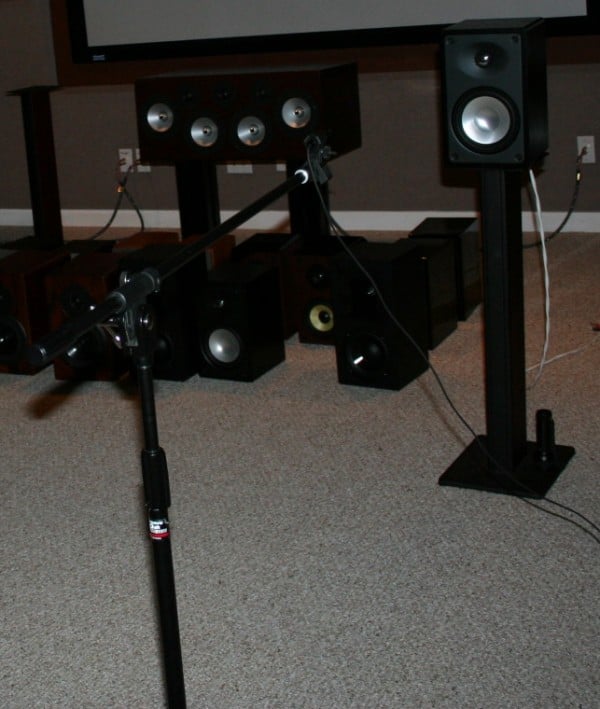
- We switched seats quite frequently to gain different perspectives on the speakers
- We level-matched the speakers by measuring each of them driven at 1 watt/meter and compensating for the level differences via the master volume controls of each zone. We also attempted to spot check to 82dB at 1kHz* prior to each comparison but later found this not to be accurate realizing the more accurate method was via pink noise comparisons.
- Only two speakers were ever compared at a time with a 5-10 minute interval (minimum) between listening sessions during which we set up a new test
- Loudspeakers were being fed signal from Zones 3 and 4 (level-matched) off of a Denon AVR-5805 AV receiver. Each channel was muted and unmated to enable us to switch signals
- Speakers were positioned on stands such that they were in a "1L / 2L - 1R / 2R" configuration. This ensured that the distance between the speakers was identical per pair and one had only to move their head 12-inches right or left to achieve a centered listening position for either pair.
We did sighted tests, but made rough attempts to pay little attention to which speakers were in positions 1 or 2. Gene set up each listening session so the rest of us were oblivious, at least until we got further along, which speaker we were initially listening to. We did not attempt to do a controlled blind test, nor did we desire to set up any sort of mechanism to remove all forms of bias during the process. This was mostly due to time and the equipment on hand to facilitate such a process. We used no speaker toe-in having all of the speakers firing directly ahead in the listening area.
*We also factored in speaker sensitivity (based on real measurements, not manufacturer specs) and the frequency response when setting levels. We can easily claim +/- 0.5dB accuracy or better.
Round 1: Polk Audio Monitor 30 vs. Hsu Research HB-1
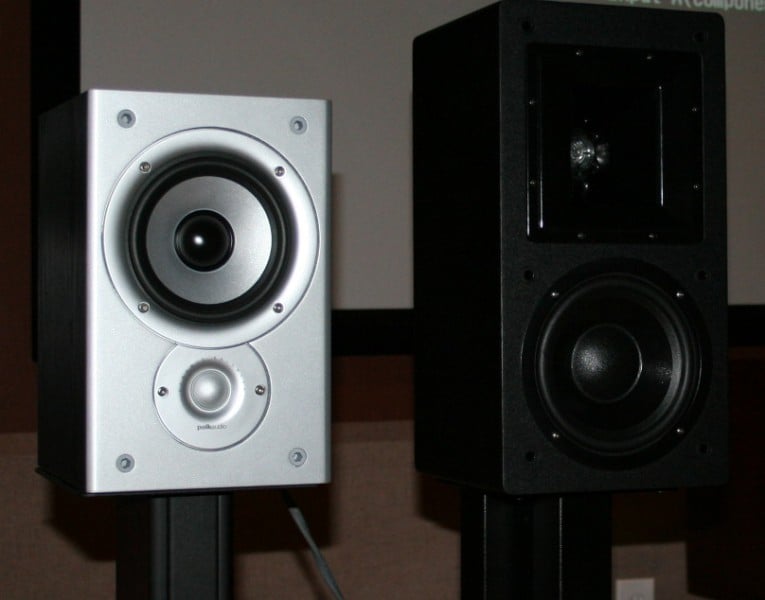 Round 1 Price Category: $200 - $250
Clint DeBoer: To us, we were listening to "Speaker 1" and "Speaker 2" but since this writing is occurring after the fact we will divulge information in a "hindsight" fashion as if we knew exactly which speaker we were listening to at the time of the face-off. This makes for easier reading and much less semantics as we explain what we heard. As we began, the Polk Audio Monitor 30s came up first and the first thing I heard was some hard-hitting upper-mids with somewhat crispy highs (perhaps a tad overaccentuated). Imaging was excellent - both wide and spacious. After some time we felt that the system was slightly fatiguing on the ears - keeping in mind of course that we were putting some serious power through these speakers due to the room size and acoustics. The Hsu HB-1 came across with somewhat muddy mids and loose bass. There is a nice tight bass line and kick drum on the "Chant" track by Fourplay and it wasn't nearly as pleasing on the Hsu as with the Polk Audio speakers. The speakers sounded recessed and imaging seemed to localize to the speaker whenever you moved your head to the side. It would be assumed that when paired with a good subwoofer, the bass would not be as much of an issue, but it seemed that the system went too low for its own good and the results were unflattering. The Polk Audio speakers took this competition, though I would have to listen at somewhat lower levels to avoid fatigue.
Gene DellaSala: I think this is one face off we all reached a consensus on. Switching between the Polk’s and HSU’s was literally a night and day difference. i was quite surprised that the little Polks were outgunning a speaker that was nearly twice its size. In a non-acoustically controlled room, I could see the Polk’s getting irritating real quickly so it’s really best to know your environment and listening preferences when choosing between speakers. I concur with J that the grills should definitely be left on with the Polks and I recommend no toe in and perhaps a small degree of toe out with these speakers. The HSU’s should be setup in more of a nearfield listening environment and bass managed to get the best performance out of them. It’s hard to really complain about speakers in this price class so it's important to keep that into perspective when reading our critiques.
Tom Andry: In my mind, the Polks were the clear winner in this contest. While I recognized the extreme treble (these speakers could quickly become fatiguing), the imaging and soundstange was significantly superior to the competition. The HSU HB-1's just seemed to be swallowed up by the room and I had a hard time discerning any sort of soundstage or detail. The lack of detail was most confusing as that is an attribute generally associated with horn-loaded speakers. The Polks were harsh, but from a consumer's perspective, that is something that could be tamed with a tone control or placement. You can get rid of too much treble; it's hard to get it when the speaker isn't producing it.
J. Walker Clarke: The Polk's were immediately impressive to me because of the detail in their higher frequency reproduction. The highs were bright, crisp and well defined. It could be argued that they were at times a little harsh, but as long as the grills remained on I found them to be pleasing to my ear. Detailed highs, with moderately tight bass for their size. The HSU's has much less definition in the high end, and displayed a noisy midrange. They had a more robust bottom end, but overall lost out to the Polk Audio pair. When listening to Steely Dan, I found them to sound muffled next to the Polk's, as if someone had thrown a quilt over them. The Polk Audio's were the clear winners to my ears.
Round 2: Polk Audio Monitor 30 vs. AV123 x-ls
 Round 2 Price Category: $200 - $250
Clint DeBoer: I almost hated to say it but the x-ls speakers were a tad boomy to me as well (we were going for a run of boomy speakers it seemed). During "Cousin Dupree" the Polk speakers seemed to hold themselves steady and deliver a tighter low frequency response that didn't extend past its given boundaries. For some, excessive boominess is a plus - but for me I favor accuracy over extension. That's why God invented subwoofers. During "Chant" I felt that the x-ls speakers lost a bit of midrange clarity and balance. Things seemed to come across a bit over-layered and slightly distorted to me. One thing that I could say, however, is that the x-ls was a speaker that you could listen to over a long period of time without getting fatigued, however the uneven response detracted from the overall experience. Of these two I would likely chose the Polk Audio speakers for my money, but neither was a show-stopper.
 Gene DellaSala: The x-ls fit and finish are an enigma at this price
range. I felt they were put together and
looked better than any other speaker in this entire face off. My beef with them is they didn’t sound nearly
as good as they looked. It's not that
they sounded bad, but based on their appearance, I was expecting more. The weakest link to these speakers is their
woofer. It cannot handle any amount of
bass at all and the speakers are tuned way too low for a woofer with such
limited excursion capability. Even at
moderate listening levels, the woofers continuously broke up and bottomed
out. In my opinion, it’s a must to bass manage these speakers as I
don’t feel they should ever be run full range.
That being said, the x-ls speakers were much easier on the ears than the
Polks, though I didn’t feel they imaged nearly as well as the Monitor 30s. Given the choice between these two speakers,
I’d pick the x-ls and use them with a sub.
I am willing to live with some of the sonic shortcomings of this speaker
just for its sheer beauty.
Gene DellaSala: The x-ls fit and finish are an enigma at this price
range. I felt they were put together and
looked better than any other speaker in this entire face off. My beef with them is they didn’t sound nearly
as good as they looked. It's not that
they sounded bad, but based on their appearance, I was expecting more. The weakest link to these speakers is their
woofer. It cannot handle any amount of
bass at all and the speakers are tuned way too low for a woofer with such
limited excursion capability. Even at
moderate listening levels, the woofers continuously broke up and bottomed
out. In my opinion, it’s a must to bass manage these speakers as I
don’t feel they should ever be run full range.
That being said, the x-ls speakers were much easier on the ears than the
Polks, though I didn’t feel they imaged nearly as well as the Monitor 30s. Given the choice between these two speakers,
I’d pick the x-ls and use them with a sub.
I am willing to live with some of the sonic shortcomings of this speaker
just for its sheer beauty.
Tom Andry: It's hard to say if the x-ls' were laid back or if they were only laid back in comparison to the Polk Monitor 30's. When directly comparing the two speakers, the Polk's sounded a little hollow on the bottom end while the x-ls' just seemed boomy and muddy. It didn’t help that the x-ls' bottomed out a number of times. The Monitor 30's seemed more spacious and accurate though I imagine that the x-ls' provide a very enjoyable overall listening experience. I wasn't able to pick a clear winner of this pairing as I felt that both had design compromises based on the price point. To me, this would be more a matter or personal preference for a certain "sound" though I would bet that the owners of both find them to be a very good value.
J. Walker Clarke: The x-ls has a better bottom end, even if at times in this test it was a bit muddy. I felt that what I loved about the Polks (a sizzling high end) might become something that would turn ugly after extended listening. This was a hard test - I loved the AV123 speakers several months ago when I had a pair in my home, but in this test, the Polks seemed to be equally appealing. The build-quality of the x-ls is much better than that of the Polks, but in the end the Polks may have sounded a tad better to me.
Round 3: AV123 x-ls vs. Hsu HB-1
 Round 3 Price Category: $200 - $250
Clint DeBoer: Coming full circle, we brought back the Hsu HB-1s and set them up against the AV123 x-ls speakers. During "Cousin Dupree" the HB-1s had plenty of highs, but they lacked detail, in fact we could hear compression during the cymbal crashes, which wasn't flattering at all. There did seem to be a more even frequency response overall with the Hsu speakers. The x-ls bookshelf speakers pushed quite a bit of bass, which we found to be overdone, as were the upper mids - pronounced and a tad too overzealous. This was a tough comparison and it was nearly impossible to select a winner.
Gene DellaSala: This was a tough call for me as well. Both speakers shared similar sonic attributes in terms of spectral balance. Too much bass, recessed mids and warm, almost dull highs. The x-ls’ to me had a more natural, less nasily sound to them. I suspect properly bass managed in an acoustically live room, the x-ls would be the clear winner. Again, I couldn’t get over the commanding appearance of the x-ls. They won based on sheer beauty alone. You won’t find a nicer looking speaker for under $2,000 / pair in my opinion.
Tom Andry: I found this pairing to be the most interesting as it was the two speakers that I felt had muted highs and were a bit boomy. I honestly didn't know what to expect. The HSU's sounded a bit better on the top end with a little more extension but with very disappointing imaging (something I found to be true during my review of these speakers). The midrange of the AV123's was nicer than the HSU's but only marginally. The AV123's speakers sounded too boomy even in comparison to the HB-1's. Imaging was definitely a step up from the HSU's. Overall, I'd probably go with the x-ls's as I know that a sub crossed over at 80hz would take care of some of that boominess I was hearing.
J. Walker Clarke: Both pairs exhibited a muted or muffled sound during this test. Heavy on the bottom, with more to be desired up top. I have auditioned a pair of x-ls in my room at home and had better results. This pair did not sound near as good as I expected, having heard the model before. Overall, the x-ls was a bit boomy. In this test, I found the HSU's to have a little bit better balance, especially up top. A difficult test, but for my money and ears (as well as earlier experience with another pair of the same model), I chose the x-ls as the winner.
Round 4: Usher Audio S-520 vs. RBH Sound TK-5C
 Round 4 Price Category: $400
Clint DeBoer: We began this listening session by handily bottoming out the Usher speakers on the first track ("Chant"). We dropped the volume and it still bottomed out. We dropped it again… and again. Due to the size of the room and lack of crossovers or subwoofer (these bookshelves were all configured as "Large" speakers) we were asking a lot - but the Ushers did indeed bottom out the easiest among all tested models (and on both tracks). Unless you plan on using them full-range this will likely not be a real issue for anyone using them in a complete system. Once we restarted at the proper threshold, the Ushers exhibited a nice wide soundstage with very natural-sounding vocals. "Cousin Dupree" was particularly "locked on target" with well-placed instrumentation and a lead vocal that was perfectly centered. They were quite pleasing to listen to. The RBH Sound TK-5C speakers had a very smooth top end with an abundance of detail. The vocals and reverb present in the "Chant" track came through in a way that they hadn't in any of the other speakers so far. Piano was particularly well-detailed as was the underlying percussion that laced its way through the track. If I thought the Usher speakers had a wide soundstage, the RBH's redefined the term. Instruments spread out further and the top end blossomed upwards and out to reveal a lot more of what was contained within the music. Even though the Ushers were very pleasing to listen to, the TK-5C speakers took this round in my opinion.
Gene DellaSala: The Usher S-520’s were a prime example of a small bookshelf speaker vented too low for its own good. Like the AV123 x-ls’, they simply couldn’t handle the bass. In comparison, the RBH TK-5CT has a similar sized woofer and vented enclosure, but the woofer had much better excursion ability. Not once did we hear the RBH woofers bottom in our tests. That being said, I think both of these speakers were quite good. The Usher’s sounded a tad more natural and detailed in the top end, while the RBH’s had a bigger soundstage, and more anchored vocals. I could hear a hint of coloration in the RBH’s due to cabinet resonance, but it didn’t take away from the experience that these were a lot of speaker for the money. I’d have to pick the RBH’s over the Ushers because of their ability to play louder stress free. Properly bass managed, the Usher’s would certainly serve music duties just as well and perhaps a tad better for instrumental music. It was clear in my mind that moving up to the $400 price point got us into a different realm of fidelity from what we were listening to before.
Tom Andry: Those poor little Usher's took a beating in this comparison. A speaker so small shouldn't be asked to play full range in a room that size. The upside? Anyone in the room that didn't know what a woofer bottoming out sounded like, surely did by the end of the test. Once we lowered the volume enough that the Usher's weren't trying to explode, we could get on with the test. Once again, I found the Usher's to have a phenomenal top end with a ton of extension for the price. The bass was weak (or sounded like *clack*) but detailed. The separation of the speakers was great and the imaging was way above par. The midrange of the TK's was much more pronounced and the sound was fuller overall. The soundstage was extremely large and there was considerably more bass. Both presented fairly lifelike vocals though I thought the Usher's were a bit better. Picking a winner in this one would be a tough one. In a small room with a sub, the Usher's are great choice though the extended soundstage and fuller sound of the TK's may be more to your liking. If you're interested in big accurate sound, go with the TK's. If you want pinpoint imaging and accuracy (see, you're getting accuracy with both), then go with the Ushers. Regardless, the step up in quality from the $200 speakers was like night and day. HUGE.
J. Walker Clarke: The Usher's, while looking really sharp, had trouble in this test with the woofer bottoming out. We were in a large room and we hit them hard, but out of all of the speakers tested, they ended up being the most susceptible. As far as their overall performance, they delivered nice, airy highs full of detail. The RBH's produced a very well balanced sound that delivered excellent imaging and very clear midrange. They displayed a wider soundstage than the Ushers, and had better mids and lows. The Usher produced a more natural vocal to my ears, as well as better highs. For critical listening at reasonable levels in a small room, I liked the Ushers. For the overall experience, the RBH's won my vote.
Round 5: RBH Sound MC-6C vs. Ascend Acoustics Sierra 1
 Round 5 Price Category: $800 - $850)
Clint DeBoer: The loudspeaker comparisons were getting harder and harder as we climbed the pricing scale. Honestly I had expected some products to poke above their pricing - perhaps some underdog revelations that a lower-priced product would smoke a higher-priced model, but so far that hadn't been the case. As we moved on, for the most part, the sound got progressively better - and we got progressively more critical. We continued our brief respites between listening sessions to recoup and discuss some of our findings - mostly in terms of "Speaker 1 and "Speaker 2" though we typically figured out who was who in short order. As we settled into the next phase I focused in on the MC-6C speakers. We were listening to "One" by Tina Dickow (aka Tina Dico) which has some beautiful female vocals, bass, guitar and drums (plus a smooth, pervasive shaker). This track was off the Bang & Olufsen Vol XIII compilation disc, but it made me want to run out and buy the whole In the Red CD. The RBH Sound MC-6Cs presented a thinner vocal sound, slightly unnatural in tone to my ears with an almost artificial edge to it that resulted in sibilance enhancement (easily detectable in this track). Regardless of these tonal issues, there did seem to be additional high-end extension in the RBH speakers, though after a while it felt a tad fatiguing. When we listened to this track again, it seemed like the vocals may have masked some of the background elements (drums in particular.) Drums and low-end hits came through like butter with no bottoming out or compression. In fact, we queued up the difficult "Cousin Dupree" track and even though we were slamming the speaker with tons of SPL output it never wavered on the bottom-end.
The Ascend Acoustics speakers were very natural sounding. They had a smoother bass sound and actually produced more low-end extension with a crisp and authoritative "thump" that didn't go unnoticed. The RBH Sound speakers had much more top-end "air" to them which was absent on the Sierra-1's. Soundstaging was about even on both. Based on looks and pure listening enjoyment alone I'd pick the Sierra-1's, but if you know you're going with a bass-managed system with sub the RBH Sound MC-6C speakers will deliver slightly more accurate sound and imaging overall.
Gene DellaSala: This was certainly the battle we were all waiting for. Having spent nearly 3 months with the RBH MC-6C’s, I was quite familiar with their sound character. The one thing I loved about the MC-6C’s was their very linear and pronounced midrange. In fact, as you will see in my measurements (formal review), these speakers have the most uniform on/off axis response of all the others in this comparison. The weak point about the MC-6C is actually a purposeful design attribute – they don’t have a lot of bottom end extension. According to RBH, these speakers are meant to be paired with a sub. Much like a THX speaker, they have a steep roll off (14dB/Oct) and a high system Q value approaching 1. This is one of the reasons why it’s virtually impossible to bottom the systems woofers out.
When directly comparing the MC-6C’s to the Sierra 1’s, I found the former to sound a bit thin since the latter had so much pronounced bass. Not since the likes of the Dynaudio 52-SE’s have I heard a bookshelf speaker with so much deep and extended bass. Unlike the 52-SE’s, the Sierra 1’s weren’t as prone to bottoming out which was a sign of a quality woofer with plenty of excursion capability. The bass on the Sierra 1’s wasn’t boomy, it was just too excessive for my tastes making them sound dull in the top end.
Trying to not focus on bass extension, I compared the rest of the frequency spectrum between the two speakers. I found the Sierra 1’s lacked width in soundstage and detail in the top end. The vocals were more laid back and a bit warmer, but just didn’t come through with has much clarity or authority. In contrast, the RBH’s to me had much more anchored vocals though they did sound a bit cupped which I wasn’t used to with these speakers. I later came to realize that these speakers sounded much better if they were placed a tad closer together with about 15 degrees of toe-in.
The one inherent problem with doing A/B testing of speakers is you cant optimally position either speaker which is why I recommend in addition to doing these type of tests, to supplement them with critical listening sessions of each speaker ideally set up for extended periods of time.
From the looks department, the Sierra’s were the clear winner but overall, I’d take the MC-6’s especially when mated with a subwoofer because I felt them to be more tonally accurate.
Tom Andry: The RBH's and the Sierra-1's were a very interesting pair in the comparison. If I had to use a word to describe each speaker, I'd say the RBH's were "sterile" and the Sierra-1's were "warm." There was little doubt in my mind that the RBH's had more extension on the top end and that the Sierra-1's had more bottom-end kick. Both of these speakers presented a convincing soundstage though the vocals were slightly better anchored with the Sierra's. The detail of the RBH's was superior though the midrange was a bit recessed and lifeless. While the Sierra's seemed to have a bit of holdover on notes giving them a slightly muddy presentation, the RBH's were a little sibilant. I felt that the RBH's were probably more true to the source material, but that I'd more than likely enjoy listening to the Sierra's more in the long run.
J. Walker Clarke: We had quite a bit of spirited debate on this matchup. I had strong opinions on the vocals between the two speakers. On the RBH's, Tina Dico's vocal sounded "cupped" to me, and was not as natural as with the Ascends. I thought the Ascend's displayed a cleaner timbre in the vocal, and warmer overall tone. I loved the wide soundstage and authentic vocal. The RBH's sounded a bit compressed and harsh to my ears. For me, the Ascend's were clear sonic winners, and as a bonus I loved the unique bamboo cabinets.
Bonus Round 6: RBH MC-6C vs. Dali Mentor-1
 Bonus Round 6 Price Category: $800-$1800
Clint DeBoer: In what has to be described as the most profound moment of the evening, the Dali Mentor-1's were pitted against the RBH Sound MC-6C speakers - just for fun. After all, they cost about $1000 more (over twice as much). We didn't know what to expect (at least I didn't having never heard them before.) The MC-6C's continued their excellent performance, though they also continued to fatigue my ears a bit. I did enjoy the additional top-end response, but combined with the mids it was a tad overbearing at high volumes. When we switched over to the Dali speakers it was as if the music took on a more natural sound. We had queued up Fourplay and the vocals, which I had thought sounded good before, sounded ABSOLUTELY LIVE. It was as if the lead vocals skipped over the whole A-to-D process and ignored the electronics to simply come straight at your chair. It sounded "realistic" for lack of a better term. So much so that I was consciously aware of my mind calculating how much time it would take to allocate the funds to pick up a pair of these speakers. When measuring these speakers we showed a 7dB bump at 10kHz from the ribbon tweeter (on-axis). When playing them back we didn't toe them in at all, which allowed the additional high frequency gain to be rolled off considerably. I never felt that they were fatiguing in the least or that they presented any sort of artificial distorted highs. They simply rang true and were the most transparent speakers I had listened to all evening - with a super-wide soundstage and a very pleasing sound. Save your money, these are worth it.
Gene DellaSala: I guess I am a lone wolf in my reporting here. I do however come from a unique perspective in that I spent over 3 months listening to these speakers and comparing them to everything that entered my listening space. When I first heard these speakers, I had many of the same experiences shared by the other listeners. WOW, these speakers were super detailed and very open sounding. The problem however is that over time, I found the top end to be too colored. I’d hate to use the word “bright” because the tweeters sounded so smooth and effortless regardless of playback volume. But the 7dB bump above 10kHz really wore down on me, especially for female vocals and string instruments. It was almost like cranking the last slider of a parametric EQ all the way up. At first it sounds more pleasing, but overtime… irritating.
Oddly during our face off, I wasn’t hearing this coloration. To me, the Dali’s seemed to have an infinitely wide soundstage with very precise imaging, definitely the best I heard in the face off. This puzzled me as during my listening session, I was clearly favoring the Dali's over the RBH’s which was the exact opposite conclusion I had while formally reviewing both speakers.
The next day, I went back and ran the comparison on my own with no distractions. I again was hearing an infinitely wide soundstage from the Dali’s that was impressive. I decided to switch over to music I was familiar with such as Dianne Reeves, Special EFX and Pat Metheny. I soon heard the high frequency coloration I remembered during my reviews. The vocals had too much lisp and the guitars just didn’t sound quite right tonally.
I then ran critical listening sessions of each speaker optimally placed. I again heard the coloration in the Dali's. While it never sounded harsh, it just didn’t sound right. The Dali’s had amazing bass extension and tightness. In fact, they had the most pleasing and accurate bass response of any of the speakers in this review. But, they couldn’t play loudly without bottoming out. I had to really watch the volume control on them, especially when listening to Pat Metheny “We Live Here”. The simple solution here, is, bass manage them and use a sub.
Overall, although the RBH’s didn’t have nearly the top end detail and presence of the Dali’s, but to me they sounded tonally more accurate and real. But the vocals rang truer with the RBH’s and the guitars sounded more like real guitars should sound. If Dali would have provided a compensation POT or switch to tone down that ribbon, I would have likely picked them as the winner. As it stands now, the Dali’s do so many things incredibly well, but their high frequency tonal balance is too hot for my liking. As a trained listener and an amateur musician that plays by ear I am blessed with good pitch and timber, perhaps in this case it’s my Achilles heel for not preferring the Dali's. For those who listening preferences favor a speaker with a lot of top end energy, the Dali’s are the one for you.
Tom Andry: Let me just give you my notes, verbatim so that you can understand my thoughts at the time.
RBH MC-6C = Recorded
Dali 1 = Live
'Nuff said.
J. Walker Clarke: Let me start with the RBH. I found them to have a wider upper end, but for my ears it was too bright, and borderlined on being harsh. As for the Dali's, they were very authentic and well-balanced, and had amazingly well-defined bass. I could not believe I was hearing this from a bookshelf sized speaker. The toms and timbale in a song we listened to was especially detailed. I can sum up the Dali's with this comment: they are possibly the most musical speakers I have ever heard. I would LOVE to have a pair of these in my study (even thought I don't have a study) for a system dedicated to two-channel listening. Amazing - this is truly a case of 'you get what you pay for'.
Measurements and Analysis
All measurements were conducted in room, on axis at the acoustical center of each speaker 1 meter away. The results were 1/3rd octave smoothed for easier readability.
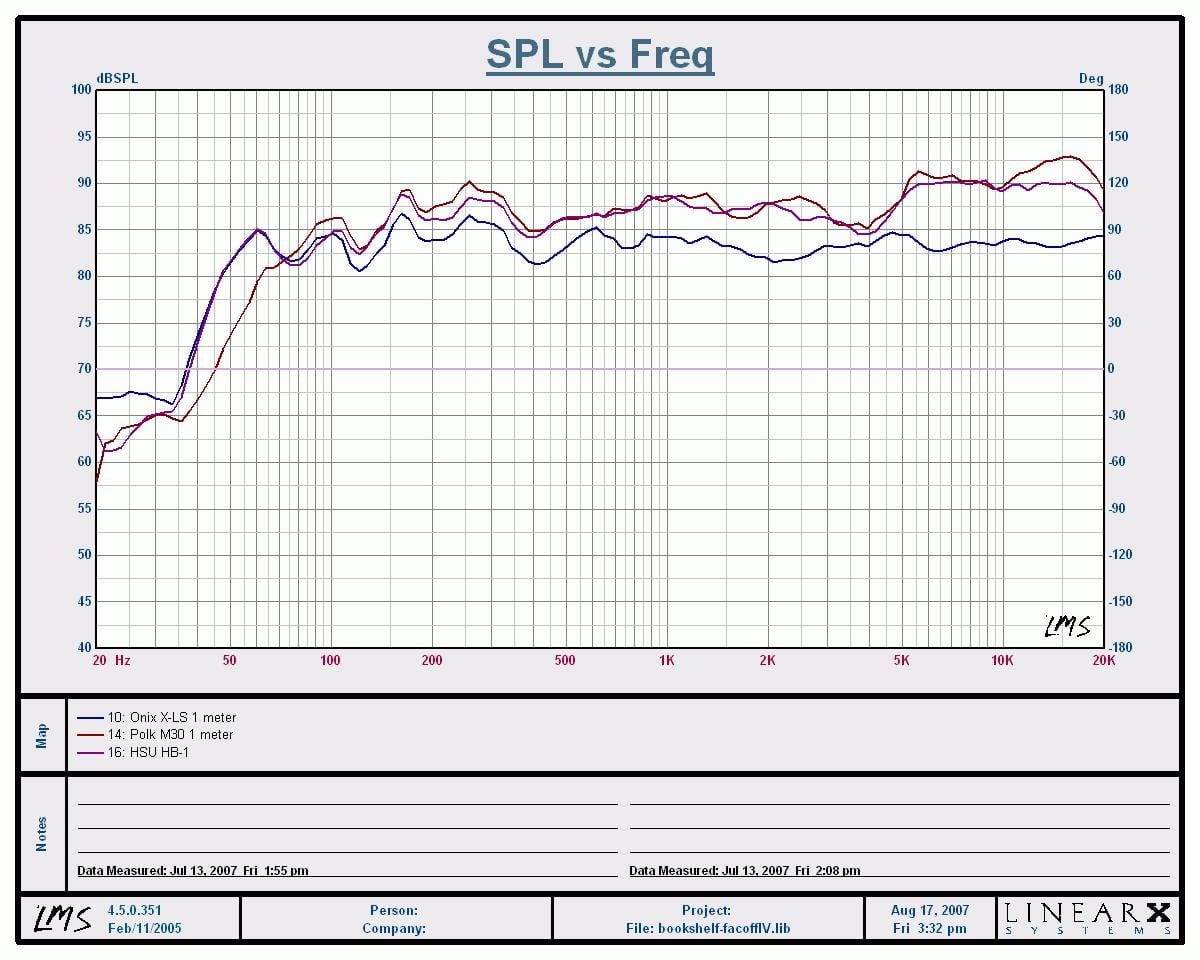
Onix x-ls, Polk M30 & HSU HB-1 Frequency Response
Onix – blue trace; Polk
– red trace; HSU – purple trace
The Onix x-ls measured the most linear of the group with usable bass extension down in the 45Hz range. The Polk’s had +5dB bump above 5kHz topping off at +7dB above 10kHz. These speakers were very bright making me wonder if they skewed our bias towards them in the instantaneous comparisons of the more tonally neutral x-ls and HB-1 speakers. The HSU HB-1’s surprisingly measured a few dB hot above 5kHz. I wish I would have pulled some off axis measurements to understand why they sounded more recessed off axis.
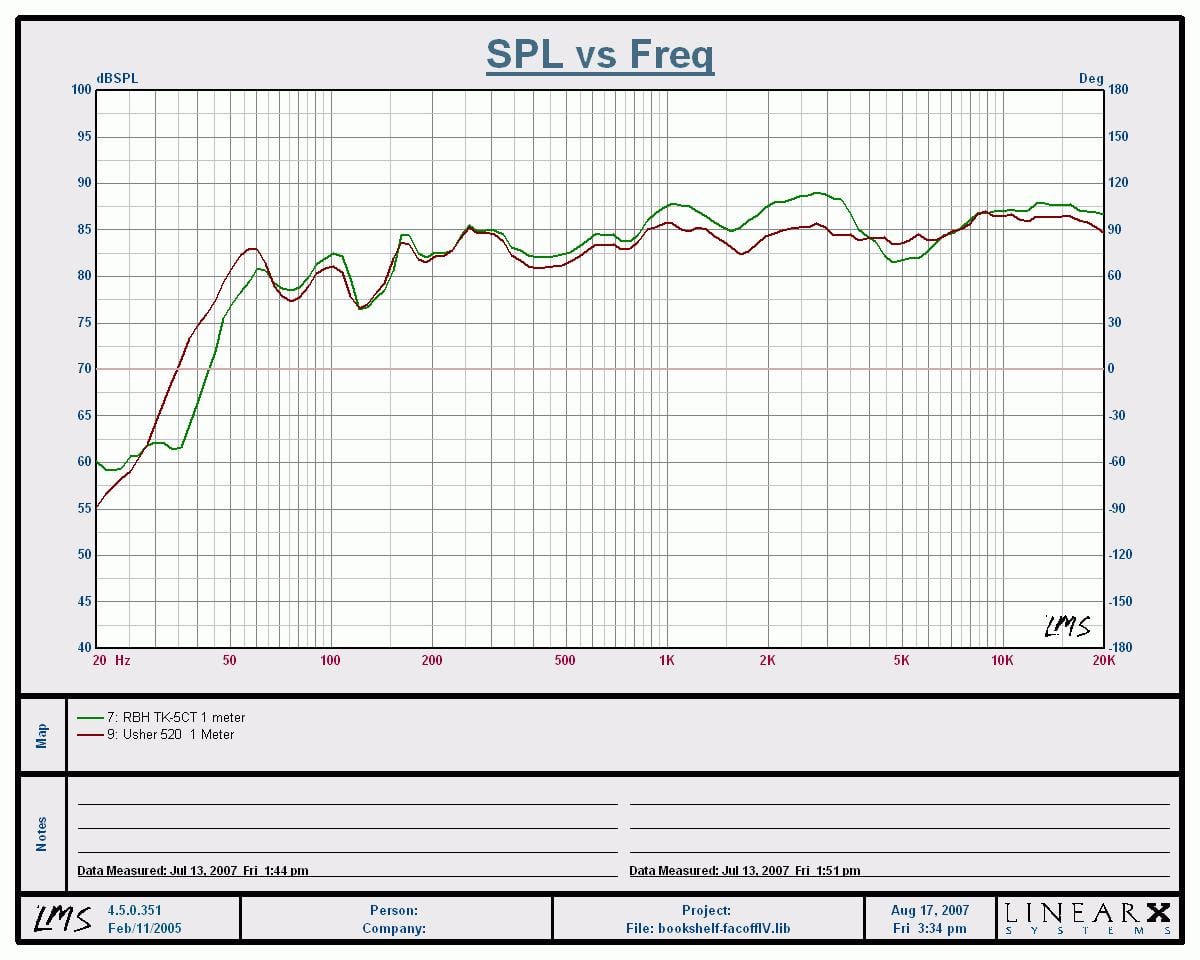
RBH TK-5CT & Usher S-520 Frequency
Response
RBH – green trace ; Usher
– red trace
Both speakers measured quite well, though the Ushers were a bit more linear in the upper midrange. The bump in the 1-2kHz range of the RBH’s may be attributed to the slight midrange coloration we heard due to cabinet resonance. The Usher’s appeared to have lower bass extension with a -3dB point around 45 Hz compared to the RBH’s 50Hz but it was a moot point since the Usher’s couldn’t play these frequencies at adequate SPL levels without bottoming out.
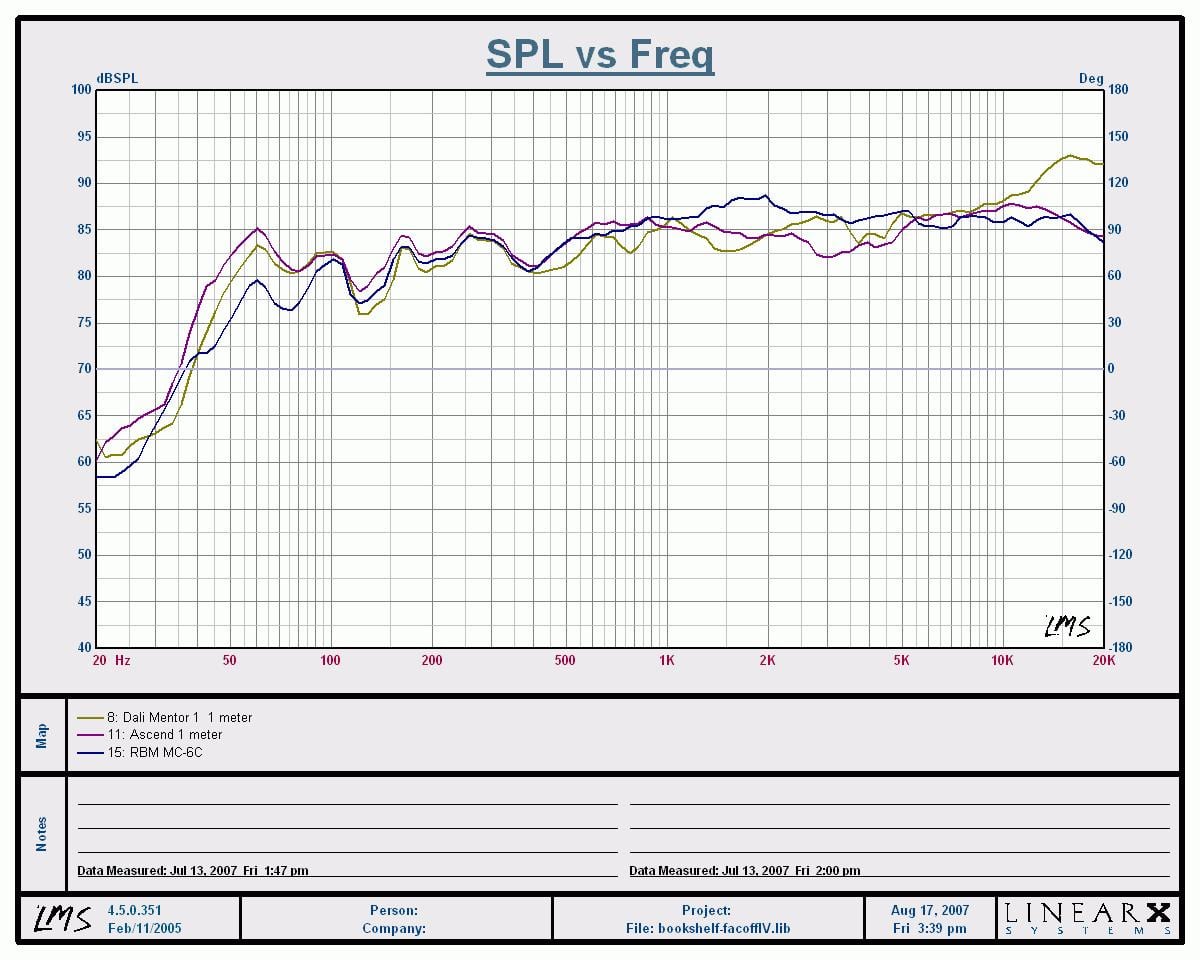
RBH Sound MC-6C; Dali Mentor 1, Ascend Acoustics Sierra 1
Frequency Response
RBH – blue trace; Dali
–yellow trace; Ascends – purple
trace
The RBH MC-6C measured the most linear of all the speakers in this review. it had a slightly elevated midrange response which most manufacturers tend to recess to hide speaker imperfections. They also had the steepest low frequency rolloff of the group and were the only sealed speakers in this comparison.
As you can see in this measurement, the Dali’s had a +7dB bump above 10kHz. I found it highly unusual that a speaker company would incorporate such a deliberate boost of the ultra high frequencies, but there is no denying our listeners preferences (at least short term). For such a small speaker, they had impressively low end bass extension (mid 40hz range) but were prone to bottoming out.
The Ascend Acoustics Sierra 1’s had the most pronounced bass extension of all the speakers in this review. They almost seemed like floorstanding speakers with usable bass extension in the sub 40Hz region. They had a slightly elevated response in the 5-10kHz region gradually tapering off above 15kHz.
For more detailed measurements and analysis, please refer to our formal reviews of these speakers.Conclusions and Observations
 Clint DeBoer: There really isn't a "conclusion" per se for this
article, however it is clear that we didn't find any speakers that were
"jumping the rungs" in terms of price for performance - at least not
this go-around. Considering some of the past shoot-outs we've done I wonder if
this is simply chance, or a change in the industry that indicates manufacturers
are putting more of their money into the design, construction and components
that go into the loudspeakers. If so, that's welcome news indeed and we're
happy to report as such. For me the two surprises for the evening were the
Ascend Acoustics Sierra-1 speakers and the Dali Mentor-1's. The Dali's may be
too bright for non-treated rooms, but in the scenario we were in during this
listening session they blew away the competition. The Ascend Acoustics only
surprised me because I hadn't heard them before. They are a very smooth,
refined-sounding speaker and they deserve some kudos. I didn't particularly
care for any of the ~$200-range speakers. I may be turning into an audio snob,
but if I have to be honest I'd have to say that if you are in this price range
DO NOT listen to more expensive speakers. If you keep yourself to this price
range you will likely be very happy with any of the models we listened to.
Clint DeBoer: There really isn't a "conclusion" per se for this
article, however it is clear that we didn't find any speakers that were
"jumping the rungs" in terms of price for performance - at least not
this go-around. Considering some of the past shoot-outs we've done I wonder if
this is simply chance, or a change in the industry that indicates manufacturers
are putting more of their money into the design, construction and components
that go into the loudspeakers. If so, that's welcome news indeed and we're
happy to report as such. For me the two surprises for the evening were the
Ascend Acoustics Sierra-1 speakers and the Dali Mentor-1's. The Dali's may be
too bright for non-treated rooms, but in the scenario we were in during this
listening session they blew away the competition. The Ascend Acoustics only
surprised me because I hadn't heard them before. They are a very smooth,
refined-sounding speaker and they deserve some kudos. I didn't particularly
care for any of the ~$200-range speakers. I may be turning into an audio snob,
but if I have to be honest I'd have to say that if you are in this price range
DO NOT listen to more expensive speakers. If you keep yourself to this price
range you will likely be very happy with any of the models we listened to.
If you are determined to go 2-channel and you have a larger room, the Usher's will likely cause some problems with bottoming out - they were unique in this respect in how easily they did it. Aside from that they sounded pretty darn good. RBH Sound as always makes speakers which excel - absolutely trump - midrange performance. If you aren't prepared, however, they can come across as a bit fatiguing. Good room acoustics minimizes this as does a well-balanced system with adequate bass management.
Tom Andry: While I'm a big believer in the laws of diminishing returns, don't kid yourself that you won't be able to hear the differences in your room between speakers priced many times more than your current speakers. The difference between the $200 and $400 speakers was immense. Night and day. Grand Canyon. Now between the $400 and $800 I felt the differences were less apparent. Sure, there were less design compromises in the $800 pairs, but not nearly as pronounced and much of this was aesthetics. Now, the Dali's were much better but at that price, they have to be. It's easy to say, "Oh yeah, if I was on the market, I'd buy those," but $1,800 is a lot of money for speakers. There are a lot of speakers between the $800 price point the $1,800 to look at before making that decision.
The room can play a huge part and I feel it did here too. Especially for the lower priced speakers that were never meant to be in such a large room. The upside is that Gene's room is designed to be as acoustically balanced as possible which should take the room out of the equation. Unfortunately, more than likely your room is not flat. Some of the "problems" we heard, you will not because of your room. Some of the good points will be accentuated to the point of discomfort because of your room. Some of you that have heard these speakers will wonder if we were all on crack because our description sounds nothing like your experience in your room. That's the way speakers work and that's why speaker reviews and shootouts are the hardest to do. We can measure transports, amps, displays, and just about everything else. But even speaker designers will tell you that a speaker measurement will only get you so far. You have to listen to them. I encourage you to do so if you are on the market for any of these speakers - preferably in your room.
Gene DellaSala: This was an interesting face off. I learned many things from this experience. For one, we all hear differently, and the room plays an integral part in how well a speaker will perform. A speaker with a relaxed top-end will likely sound muddy in an acoustically controlled listening space, while a bright speaker will sound bright in nearly any room. A speaker that measures linearly on/off axis, will sound the most consistent in a large variety of rooms. Thus it’s my opinion that starting with a linear speaker is usually a good idea so it’s more predictable of how it would sound in your room.
Brighter speakers tend to win in instantaneous listening face offs even when level matched. This is one reason why it’s equally importance that multiple listening sessions should occur between your choice speakers with plenty of rest in between, followed by individual testing of each speaker system optimally placed. It is my opinion we all suffered some degree of listening fatigue from doing these demos all day long towards the end of the face off leading us to varying conclusions. The next time we do a speaker face off like this, we will limit demos to 15-20 minutes with adequate breaks in between as well as using a wider variety of source material. Towards the end of this process, I felt my mind going to mush and it will take me months until I can listen to “Cousin Dupree” again from Steely Dan, despite I am a huge fan.
When choosing a speaker, it’s important to understand its application and how it will play in your listening space. Its not realistic to expect a bookshelf speaker to produce room shaking bass in a typical listening space which is why its so imperative to bass manage these speakers and mate them with a good subwoofer or two, especially in large listening spaces. I feel many of the speakers in this review would have performed much better by doing so, such as the Ushers and AV123’s. This would take unnecessary strain off the woofers and help clean up the vocals as a result.
In the sub $250 category, my pick was the AV123’s despite its shortcomings because I felt they would sound much better crossed over to a sub and their cabinetry was like a work of art.
In the $400 category, I preferred the RBH TK-5C’s but only by a small margin over the Ushers. I suspect the Usher’s would edge them out if crossed over to a subwoofer.
In the $800 and above category, I really liked the RBH MC-6C’s overall because of their spectal balance and linearity, but also couldn’t forget the incredible detail and wide soundstage of the Dali’s. I was so tempted to stick a resistor pad in the Dali’s to tone down the ribbon tweeter just to see how they would sound. If I owned them, I would have definitely done this experiment. If you’re not planning on using a sub, I’d lean towards the Sierra 1’s, especially if you’re in a lively listening space. Regardless of any product shortcomings, all of the speakers in the $800 and up price point put on quite an impressive display of fidelity and finesse. You truly do get more speaker for your money when dealing with legitimately good speaker manufacturers as evident in this face off review.
Clint Deboer was terminated from Audioholics for misconduct on April 4th, 2014. He no longer represents Audioholics in any fashion.
View full profile Subscribe to our newsletter