


GiK Tri-Trap Bass Trap Review
GiK Tri-Trap Bass Trap
- Product Name: Tri-Trap Bass Trap
- Manufacturer: GiK
- Performance Rating:

- Value Rating:
- Review Date: April 29, 2009 04:00
- MSRP: $ 258 (sold by the box, 2 Tri-Traps per box)
- 2 feet wide and 4 feet tall
- 6 Standard Colors
- Upgrade with Guilford of Maine FR701 in 48 different as low as $20.00 per Tri-Trap
- Come with plastic tops and bottoms that are colored - white tops on white Tri-Traps, black tops on all other standard colors
Pros
- Convenient
- Good size for most rooms
- Effective
- Price
Cons
- Feel a little empty
- No wall mounting system
- Info on website hard to find/inaccurate
GiK Tri-Trap Bass Trap Introduction
I've talked so much about room acoustics lately that I'm starting to feel like a broken record (or like I'm on the campaign trail). Let's assume that you understand and believe (though belief isn't really required since it is so well documented) that the room makes a huge difference in the sound quality of your system. At this point, you're looking around your room and trying to figure out the best placement of your furniture and speakers to optimize the sound. Maybe you have even used Auralex's Room Analysis service to figure out what you need to do in your room. Perhaps you have just listened to the AV Rant podcast and made some changes based on what you heard? Regardless, you've done all you can and now it's time to go from the no-cost solutions to something that will give you the most bang for your buck.
In my interview with acoustical expert Gavin Haverstick, he stated that bass trapping, specifically corner bass trapping was the single best thing you can do in your room. Along with treating first reflections and a few other tips (check out our section on Acoustics for specifics), corner trapping is on the top of the list of suggestions for making your room sound better. Gavin went so far as to say that you can't over trap your room. While some experts might not agree with that statement, what they will agree with is that corner traps are important and effective.
One of the more traditional ways of treating the corner of a home theater is to place a normal flat rectangular trap and straddle it across a corner. While this works, it isn't as good as filling that corner up with material. This material generally takes the form of fiberglass or rockwool insulation or foam. Acoustical foam is well known to be the red-headed stepchild of the acoustical world - cheaper but less effective. Rockwool and fiberglass are similarly priced and perform the same. When you straddle a corner, you generally take up more real-estate (panels are generally 2 feet wide) than if you fill it up with material. All that for less effectiveness. The problem is that filling a corner consists of buying a bunch of insulation, cutting it into triangles, stuffing it in a corner floor to ceiling, and then constructing some sort of cover for it (you don't want bare insulation in your room no matter how hardcore an audiophile you are). What about those who can't or don't want to go the DIY route? Honestly, one of the few non-custom corner traps on the market is from GiK. The difference? Price. The GiK Tri-Traps are considerably less expensive.
Build Quality
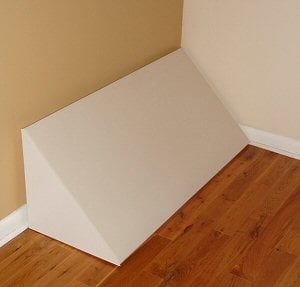
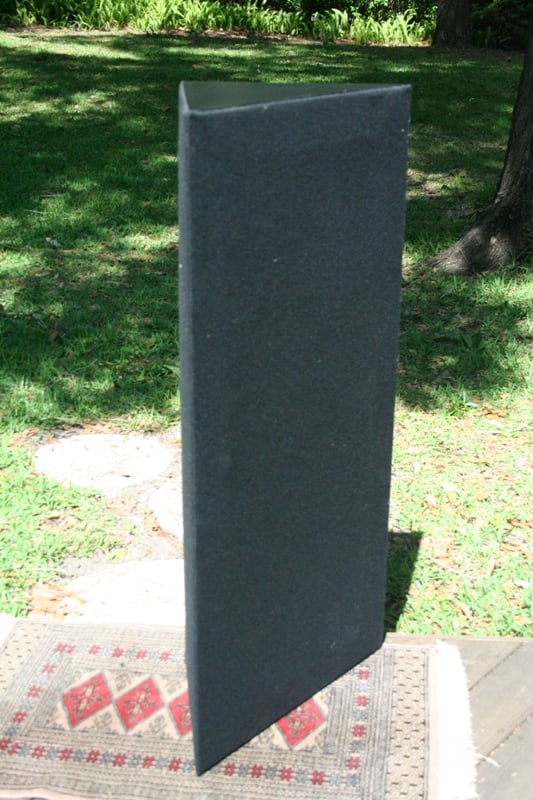 The GiK Tri-Traps are, as you might expect, triangular. They are also
shipped in large boxes of two. You must buy them in pairs so their quoted price
of $129 each is a little misleading. From a shipping standpoint, this makes a
lot of sense as there are a lot more rectangular boxes rather than there are triangular.
For all I know, the shipping companies might charge extra for an oddly shaped
box like that. Regardless, I ordered six tri-traps for my room, all in black.
They arrived in three large boxes. Each was wrapped in a thin plastic bag and was
tightly packed. There was no protection other than the box and bag though they
didn't really need it. The boxes (and traps) were quite light and arrived
without damage.
The GiK Tri-Traps are, as you might expect, triangular. They are also
shipped in large boxes of two. You must buy them in pairs so their quoted price
of $129 each is a little misleading. From a shipping standpoint, this makes a
lot of sense as there are a lot more rectangular boxes rather than there are triangular.
For all I know, the shipping companies might charge extra for an oddly shaped
box like that. Regardless, I ordered six tri-traps for my room, all in black.
They arrived in three large boxes. Each was wrapped in a thin plastic bag and was
tightly packed. There was no protection other than the box and bag though they
didn't really need it. The boxes (and traps) were quite light and arrived
without damage.
I ordered six traps because I was in the middle of the Auralex Room Analysis Plus review and their suggestion was additional trapping in all the corners (for a more detailed description please see the review). Well, I felt this was an excellent opportunity to review a product I'd long been intrigued by - the Tri-Traps. The triangular traps are meant to be placed in the corners of a room and are filled with insulation. The Auralex analysis said that I could use as much bass trapping as possible. Well, six was the most I could accommodate at the time - I could probably get four more in here now. Two stacked on top of each other placed in the back corners and two lying on the floor behind the couch. I was a bit concerned about one thing, however, the height.
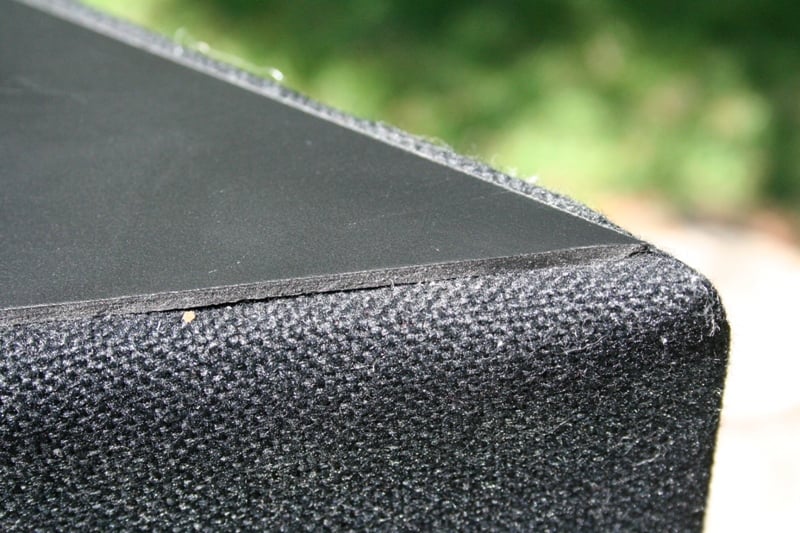 According
to the GiK website, the Tri-Traps are four feet tall. My room is technically 8
feet high so they should fit but if you factor in the popcorn ceiling and
medium pile carpet, it is a bit less than that. I didn't want to get them in
just to find out they wouldn't fit. So, like I often do, I called them and
asked about custom sizes not telling them I was a reviewer. I do this so I get
the real deal and not some wink-wink-nudge-nudge thing. For a custom size, it
is a $25 premium for the first trap and $15 each for every other trap of the
same size. This, of course, is for a trap that is smaller than normal. You
can't ask for a custom 7.5 foot trap. Those charges seem just fine to me and
perfectly reasonable. I especially like the fact that they charge less for the
additional traps of the same size. In reality, the first one tacks on most of
the extra work with the additionals not really adding that much. It smacks of
business ethics that GiK is recognizing that in their pricing.
According
to the GiK website, the Tri-Traps are four feet tall. My room is technically 8
feet high so they should fit but if you factor in the popcorn ceiling and
medium pile carpet, it is a bit less than that. I didn't want to get them in
just to find out they wouldn't fit. So, like I often do, I called them and
asked about custom sizes not telling them I was a reviewer. I do this so I get
the real deal and not some wink-wink-nudge-nudge thing. For a custom size, it
is a $25 premium for the first trap and $15 each for every other trap of the
same size. This, of course, is for a trap that is smaller than normal. You
can't ask for a custom 7.5 foot trap. Those charges seem just fine to me and
perfectly reasonable. I especially like the fact that they charge less for the
additional traps of the same size. In reality, the first one tacks on most of
the extra work with the additionals not really adding that much. It smacks of
business ethics that GiK is recognizing that in their pricing.
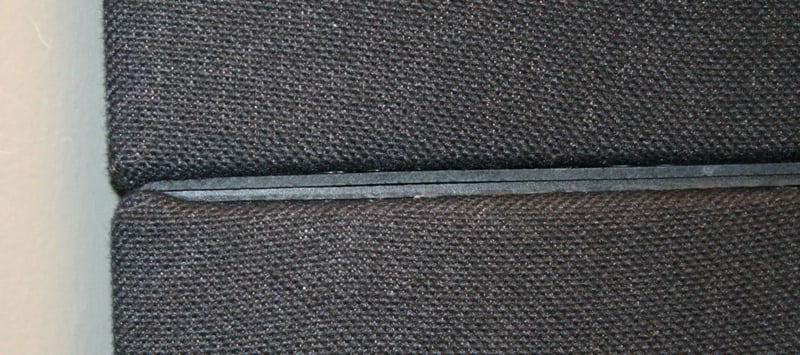 What
is a bit weird, however, is that regardless of what it says on the GiK site,
the Tri-Traps are not four feet tall.
They are about an inch and a quarter shy of that. When I spoke to them about
it, they said that it was because they wanted to take into account ceilings and
carpets just like mine. While I was relieved that I wasn't going to need custom
sizes, it did make me wonder why they don't just list the actual size on the
website. On top of that, info on the website is sometimes hard to find or
missing. You really have to look on the Tri-Trap page to find that the traps
are four feet tall and two feet wide (both incorrect as mine were 46.75" tall
and 23.5" wide). And what is wide anyhow? Well, it is the hypotenuse (the
part that faces the inside of the room for those that are having horrible
geometry class flashbacks). But what isn't on the website at all is the length
of the other two sides (the ones that would run against the walls of the
corner). Now, I could bust out my Pythagorean Theorem and assume that the squares of the
two sides added together would equal 552.25 (23.5 squared) but hey, I don't
really need to do math do I? These sides are the most important because they
will determine how far into your room the traps will go and whether they will
cover any outlets or vents. It is a serious omission from the info on the
website.
What
is a bit weird, however, is that regardless of what it says on the GiK site,
the Tri-Traps are not four feet tall.
They are about an inch and a quarter shy of that. When I spoke to them about
it, they said that it was because they wanted to take into account ceilings and
carpets just like mine. While I was relieved that I wasn't going to need custom
sizes, it did make me wonder why they don't just list the actual size on the
website. On top of that, info on the website is sometimes hard to find or
missing. You really have to look on the Tri-Trap page to find that the traps
are four feet tall and two feet wide (both incorrect as mine were 46.75" tall
and 23.5" wide). And what is wide anyhow? Well, it is the hypotenuse (the
part that faces the inside of the room for those that are having horrible
geometry class flashbacks). But what isn't on the website at all is the length
of the other two sides (the ones that would run against the walls of the
corner). Now, I could bust out my Pythagorean Theorem and assume that the squares of the
two sides added together would equal 552.25 (23.5 squared) but hey, I don't
really need to do math do I? These sides are the most important because they
will determine how far into your room the traps will go and whether they will
cover any outlets or vents. It is a serious omission from the info on the
website.
By the way, they said they were 17 inches (I measured them a hair more but close enough).
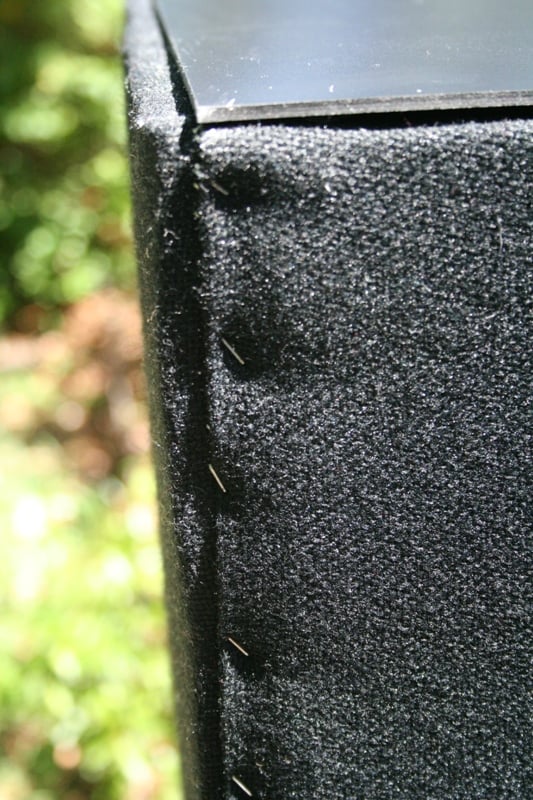 I, like probably most customers, ordered the Tri-Traps in black. Home
theaters are supposed to be dark, corners most of all. If anything is going to
blend, black is. They use the well known Guilford of Maine acoustically
transparent material for their coverings. You can order black, off-white,
bright red, bright blue, hunter green, or coffee at the standard prices. They
allow custom colors (any offered from Guilford of Maine) at a minimum of $20
premium. Just make sure you get a swatch from someone first - don't trust what
you see on the screen. The top and bottom of the Tri-Traps have a thin plastic
plate glued to them. For the white Tri-Traps it is white, for all other colors
it is black. This seems to be a vanity item to cover any staples or other
adherence methods. For probably 99% of the installations, you'll never see it.
The only time you do is when you stack them. Personally, I'd prefer if the
plastic plates were removable or if there was another option so that the two
sat fabric to fabric creating a more unified look.
I, like probably most customers, ordered the Tri-Traps in black. Home
theaters are supposed to be dark, corners most of all. If anything is going to
blend, black is. They use the well known Guilford of Maine acoustically
transparent material for their coverings. You can order black, off-white,
bright red, bright blue, hunter green, or coffee at the standard prices. They
allow custom colors (any offered from Guilford of Maine) at a minimum of $20
premium. Just make sure you get a swatch from someone first - don't trust what
you see on the screen. The top and bottom of the Tri-Traps have a thin plastic
plate glued to them. For the white Tri-Traps it is white, for all other colors
it is black. This seems to be a vanity item to cover any staples or other
adherence methods. For probably 99% of the installations, you'll never see it.
The only time you do is when you stack them. Personally, I'd prefer if the
plastic plates were removable or if there was another option so that the two
sat fabric to fabric creating a more unified look.
GiK Tri-Trap Setup and Conclusion
I placed the Tri-Traps in the two rear corners stacked two high and laid the two others on the floor behind the couch. At this point, you are pretty much done, right?
Mostly.
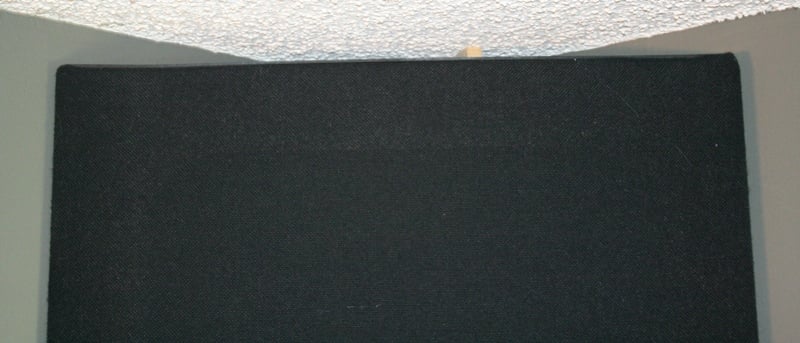 GiK doesn't really have any way of mounting the Tri-Traps in the corner.
Why would you need to? Well, no matter what your builder says, your corners
might not but perfectly square. If not, the Tri-Traps might stick out a bit.
The only way to combat this is to pull them in as tight as possible. Also
fighting against you is any trim around the bottom or top of your wall. Most
walls have at least a few inches of baseboard. Without some sort of cutout on
the bottom edge of the trap (something that might serious increase the construction
cost of the trap), the baseboard will push the entire trap off the wall. If you
are stacking them like I am, that means that the top trap can be over 2 inches
off the wall! Some of the solutions I've seen online have been industrial
Velcro (be careful, once it is on you'll probably have to destroy the trap to
get it off), L-brackets, and picture hangers. I'd like to see GiK come up with
a solution that can be integrated into the design. Since I'm stacking mine and
had a few inches between the ceiling and the top of the top trap, I went with a
more "removable" solution than the industrial Velcro. Basically, I
pushed the traps back into the corner and wedged some small pieces of scrap
wood between the ceiling and the top trap. This held both the traps in place
and minimized the gap between the traps and the wall without being
"permanent." If you have crown molding on your ceiling you're going
to need to order a custom height solution to get it under the edge of the
molding.
GiK doesn't really have any way of mounting the Tri-Traps in the corner.
Why would you need to? Well, no matter what your builder says, your corners
might not but perfectly square. If not, the Tri-Traps might stick out a bit.
The only way to combat this is to pull them in as tight as possible. Also
fighting against you is any trim around the bottom or top of your wall. Most
walls have at least a few inches of baseboard. Without some sort of cutout on
the bottom edge of the trap (something that might serious increase the construction
cost of the trap), the baseboard will push the entire trap off the wall. If you
are stacking them like I am, that means that the top trap can be over 2 inches
off the wall! Some of the solutions I've seen online have been industrial
Velcro (be careful, once it is on you'll probably have to destroy the trap to
get it off), L-brackets, and picture hangers. I'd like to see GiK come up with
a solution that can be integrated into the design. Since I'm stacking mine and
had a few inches between the ceiling and the top of the top trap, I went with a
more "removable" solution than the industrial Velcro. Basically, I
pushed the traps back into the corner and wedged some small pieces of scrap
wood between the ceiling and the top trap. This held both the traps in place
and minimized the gap between the traps and the wall without being
"permanent." If you have crown molding on your ceiling you're going
to need to order a custom height solution to get it under the edge of the
molding.
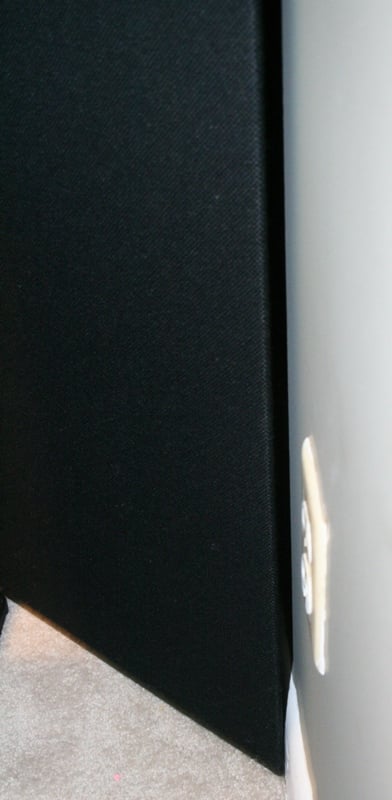 The traps are very light - almost too light. While GiK has had their traps measured
and I don't doubt their effectiveness, there does seem to be a lot of extra
room in there. I spoke to Glenn Kuras (owner/founder) of GiK about the traps
(specifically because I didn't want to take mine apart just to see the insides)
and he stated that they went with 4 lbs insulation and not a heavier one
because the performance differences in this application were nominal. While I
have no problem with that, having a trap with a lot of room between the front
fabric and the start of the insulation was a little disconcerting at first. I'd
expected a solid mass of insulation with maybe treated corners or perhaps some
wood/plastic bracing at the corners.
The traps are very light - almost too light. While GiK has had their traps measured
and I don't doubt their effectiveness, there does seem to be a lot of extra
room in there. I spoke to Glenn Kuras (owner/founder) of GiK about the traps
(specifically because I didn't want to take mine apart just to see the insides)
and he stated that they went with 4 lbs insulation and not a heavier one
because the performance differences in this application were nominal. While I
have no problem with that, having a trap with a lot of room between the front
fabric and the start of the insulation was a little disconcerting at first. I'd
expected a solid mass of insulation with maybe treated corners or perhaps some
wood/plastic bracing at the corners.
What I found particularly disconcerting was that the back two sides of the trap were solid. I'd much prefer a more "wire" frame around the insulation. According to GiK, this solid panel is by design:
The way we build them and the materials we use provide a membrane effect to boost the low frequency absorption while at the same time, roll off upper mid and high frequency absorption. This is done to be able to properly treat a room in the bottom end without overdamping the mids and highs. Most rooms already have plenty of upper mid/high frequency absorption with carpeting, curtains, etc.
A solid panel, especially as light as the material they used, is going to vibrate. This could add noise to the room. While they are claiming that this is acting like a diaphragmatic absorber, it really is a dangerous gambit. If that membrane vibrates at a frequency that you don't need dampened, it could be adding to your problems or perhaps creating new ones. The solutions could be to either to eliminate it and go with a more frame-less solution or to stuff the trap more solidly so that the insulation itself stops any possible vibrations.
Listening Evaluation
You only have to read the Auralex review to know what I thought of the Tri-Traps' performance. In my room, almost every metric was improved - at least subjectively. From an objective measurement standpoint, my improvements were not as dramatic but I chalk that up to the fact that I could only measure one speaker from one listening position. If you factor in the sub (which wasn't included in the Auralex measurement), I'm guessing you'll see a much more dramatic improvement (as my secondary measurements with the Velodyne SMS-1 showed).
I think the more dramatic subjective difference for me was the bass response and imaging. As I mentioned in the Auralex review, the bass problems were much reduced and I could tell dramatic differences between before and after listening sessions with material like Attack of the Clones. At the beginning of the movie there is a flyover of the ships as they are landing. The bass is dramatic, deep, and sweeping which is exactly what you want for a listening evaluation. In nearly every room I've been in (including mine) you can hear how the room (and speakers in some cases) affect the sound. Instead of a slow, steady sweep, it will get louder at times and cut out at other times. The Velodyne SMS-1 helped with this quite a bit but it was still there. When I added the Tri-Traps, while it didn't completely alleviate the problem, the differences were amazing. Much more linear, much tighter, the whole experience was better.
On a more questionable note, I felt that the imaging of the room increased. While a one eared man fighting an octopus could hear the differences in the bass response, the imaging was a bit subtler. Pans were more convincing, left/right separation more defined, and the overall listening experience was increased. The Tri-Traps seemed to be taking a lot of the "noise" out of the room. This is exactly what they are designed to do and I felt they really made a big difference.
While I would normally include aesthetics as part of the setup, since you're going to be "hearing" about them more from your spouse than actually "hearing" the bass traps, I'm including it here. Let's be frank, corner traps are never going to make your spouse as excited as they are going to make you. They don't get it and that's just a fact of most of our lives. But the Tri-Traps do everything they can to minimize the confrontation. They offer multiple fabric color combinations, they are designed (with a little DIY help) to sit flush to the wall, and they are relatively small. I think the most important thing is that the edges are pointed. Other corner solutions are circular which I think looks weird. Some of the others that I've seen are pointed but a fraction of the size of the Tri-Traps. I'm sorry but the whole point of a corner trap is to reduce bass frequencies. If you're going to go through the hassle and expense, you might as well do it right. Sticking a tiny bit of material in the corner just isn't going to do it (this is physics, people, no matter how many customer reviews the competition might have). No amount of engineering can replace the physics of needing material in there to combat the sound waves as they pass through. On top of that, I couldn't find a corner trap that was even close to the Tri-Traps for value. Most cost 2x's the price of the Tri-Traps. Some more. A deal is always a good argument on the spousal front.
Conclusion
 I very rarely say anything unequivocal in a review. Hold on to your hats
'cause I'm gonna to do it now. The GiK Tri-Traps will improve the sound in your
room. They will. It doesn't matter the speaker or the amp. The DVD player or
the processor. The Tri-Traps will help curb your bass problems. Are they a
panacea? Will the fix everything? No, of course not. But ask any acoustical
expert and you'll find that corner bass trapping is high up on their list of
"first steps to a better sounding room." GiK makes this easy and
frankly affordable. With the rest of the competition costing much more (for
products that are no better and many probably much worse), the GiK Tri-Traps
are a no-brainer for the enthusiast that is serious about making their room
sound better.
I very rarely say anything unequivocal in a review. Hold on to your hats
'cause I'm gonna to do it now. The GiK Tri-Traps will improve the sound in your
room. They will. It doesn't matter the speaker or the amp. The DVD player or
the processor. The Tri-Traps will help curb your bass problems. Are they a
panacea? Will the fix everything? No, of course not. But ask any acoustical
expert and you'll find that corner bass trapping is high up on their list of
"first steps to a better sounding room." GiK makes this easy and
frankly affordable. With the rest of the competition costing much more (for
products that are no better and many probably much worse), the GiK Tri-Traps
are a no-brainer for the enthusiast that is serious about making their room
sound better.
GiK Tri-Trap Bass Traps
$258 (for 2)
GIK Acoustics USA
3065 McCall Dr, Unit 8
Atlanta, GA
30340
1.888.986.2789
About GIK Acoustics
GIK Acoustics is committed to making sure all of our products have
certified testing. Would you buy a monitor without a data sheet? We think
acoustics should be the same. All GIK products are tested at Riverbank
Acoustical Laboratories and we are able to provide you with certified
absorption reports for the GIK 244 Acoustic Panel and the GIK Monster Bass
Trap.
The Score Card
The scoring below is based on each piece of equipment doing the duty it is designed for. The numbers are weighed heavily with respect to the individual cost of each unit, thus giving a rating roughly equal to:
Performance × Price Factor/Value = Rating
Audioholics.com note: The ratings indicated below are based on subjective listening and objective testing of the product in question. The rating scale is based on performance/value ratio. If you notice better performing products in future reviews that have lower numbers in certain areas, be aware that the value factor is most likely the culprit. Other Audioholics reviewers may rate products solely based on performance, and each reviewer has his/her own system for ratings.
Audioholics Rating Scale
 — Excellent
- — Very Good
- — Good
- — Fair
- — Poor
| Metric | Rating |
|---|---|
| Performance | |
| Build Quality | |
| Ergonomics & Usability | |
| Fit and Finish | |
| Appearance | |
| Performance | |
| Value | |
As Associate Editor at Audioholics, Tom promises to the best of his ability to give each review the same amount of attention, consideration, and thoughtfulness as possible and keep his writings free from undue bias and preconceptions. Any indication, either internally or from another, that bias has entered into his review will be immediately investigated. Substantiation of mistakes or bias will be immediately corrected regardless of personal stake, feelings, or ego.
View full profile Subscribe to our newsletter