


Twenty Questions Toward a Correct Home Theater Room
Let’s get right to it. You love audio, are passionate about your system and are always searching for a better experience, a more accurate response. You’ve heard the term “room correction”. You’ve heard speakers in various rooms, you are aware of acoustical treatments and active room correction systems (ARC). You know that your dedicated audio system is not in a purpose built room. You would like to make the room as “correct” as possible; however you have no clear idea what approach is best for your room.
What is a correct room? Depends…on the use of the space and how the listener perceives sound.. A pro studio has a completely different purpose than a home theater. A home theater that is primarily for movies verse one geared toward listening has different needs in terms of room correction. It should be pointed out that each person perceives sound in a unique manner. So there is no definitive “correct” room, only rooms where the compromises are known and addressed appropriately.
You certainly can get fooled by the frequency response data of speakers. You certainly can get confused by what types of audio/acoustical measurements can be gathered and interpreted. This article is intended to highlight the primary room correction options with enough background to help you select the best way to correct your room.
To do this, I created a version of the childhood game Twenty Questions. Yes, the game where one person selects a target and then compels others to guess this target using a series of questions- Is it...? Our target is Room Correction. There are a great variety of Active Room Correction Systems (ARC) today; more every year as technology rapidly opens new possibilities. When combined with a growing availability of quality acoustical control materials, I suggest it is difficult for a theater-phile to know how and where to start a room correction effort. I enlisted the help of pros across the board. The "guessers" are from different sides of this enticing topic: acoustics, active room correction, custom integration, musical content, and audio engineering.
Summary definitions for our purpose:
Active Room Correction (ARC) happens before the event using digital filters. These systems have the ability to address frequency response, time domain issues, spatial response (how the room sounds at various locations), impulse response issues, and phase response of the speaker itself. The room data is gathered by an acoustical mic/analysis process (each manufacturer typically offers their own system), and the DSP makes adjustments to the signal before it is transmitted by the speaker. The results are minimized room coloration of the content.
Acoustical treatments “work” at the boundaries and address issues by “absorbing” sound energy and/or scattering reflections. Devices include bass traps, absorption panels and diffusion panels. The type and placement of acoustical treatment will determine the frequency response, time domain and spatial response results.
In both cases, there are layers of complexity based on distances between source/surfaces/listeners and the physics of how sound behaves at different frequencies.
Let's get on with the Game!
Each of the participants was given the qualifiers and questions below:
Select one answer per question. Please answer in relation to your day to day efforts.
1- little/none
2- Minimal
3- Take it/leave it
4- Helpful
5- Crucial
The Questions-
1.
Room design
including sound isolation, room dimensions, and surface finishes?
2.
Use of
acoustical reflection control devices such as absorption and diffusion panels?
3.
Use of
acoustical low frequency control devices either passive or tuned?
4.
Acoustical
measurements of the room actual or predicted?
5.
Acoustical
coupling of speakers to surfaces, i.e mounting options (stands, in-wall,
shelves, etc.)?
6.
Speaker
positioning?
7.
Spatial
response, meaning how the room responds at various positions not just a single
location.
8.
Crossover
adjustments.
9.
Phase response
of speakers including subwoofer(s).
10. DSP design: number of filter points, measurement
points, etc…
11. Aesthetics including surface finishes, furnishings
and lighting?
12. Consumer demand for innovative acoustical treatment
products?
13. Consumer demand for innovative active room correction
products?
14. Use of specially trained room calibration
specialists?
15. Video Quality?
16. End user expectation is similar to control room
environment?
17. End user expectation is similar to a commercial
cinema?
18. Dynamic range of content
19. Changes in musical composition and sound effect
elements in relation to the advances in residential theaters?
20. Changes in surround mix techniques due to advances in
residential theaters?
and now on to the feedback from the various industry folk that I polled on these questions....
Russ Berger of RBDG
Russ Berger of RBDG is one of the leading media facility designers in the world. Russ has developed many of the most commonly applied design/build practices for professional audio and residential audio spaces. If you are unfamiliar with Russ Berger, it is worth your time to browse www.RBDG.com. Russ has a great “heart” for audio and excellence.
Question answers:
I guess I would have to answer 5-Crucial to each question you pose. There isn't an area that could I would consider unimportant.
Best
Russ
Here are Russ’s comments:
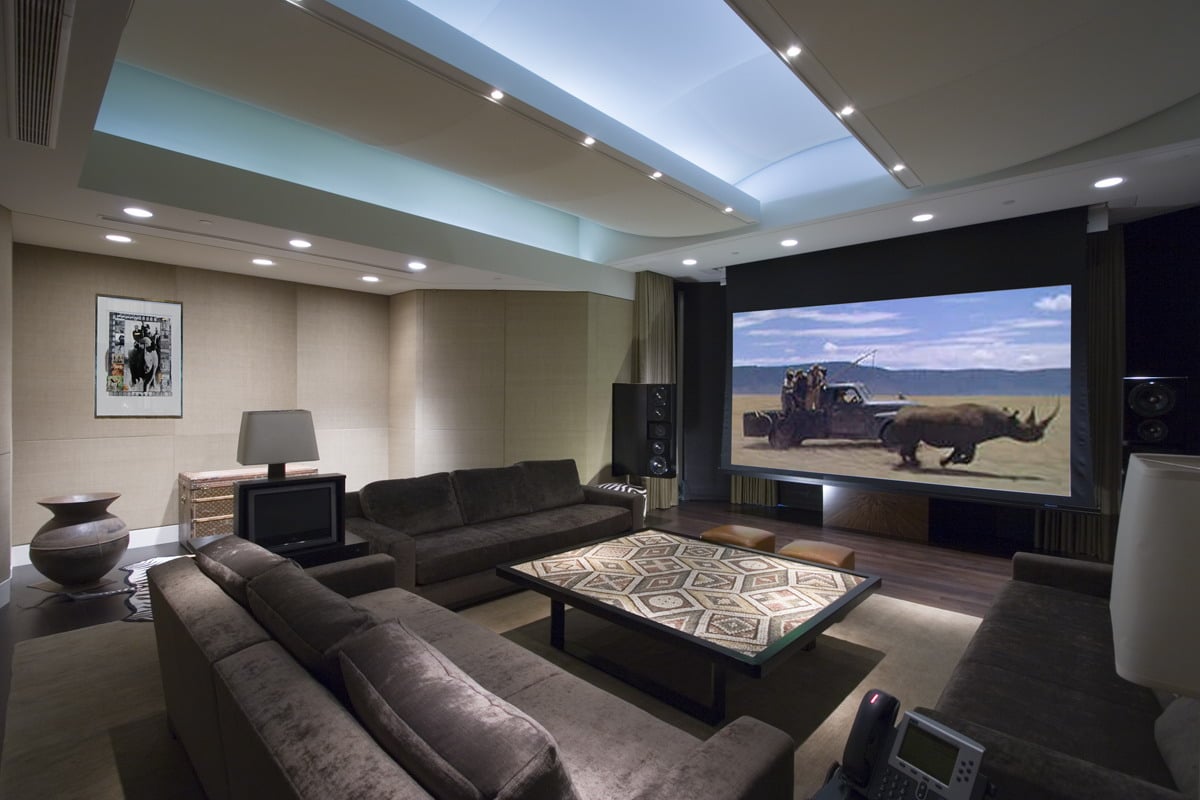
I am of the firm opinion that electronic measures cannot correct the majority of acoustical problems or address the challenges we face in the design of small room acoustics. We cannot electronically “fix” the results of inappropriate room dimensions, a lack of appropriate volume for the listening space, inadequate distance from source and boundaries, room mode anomalies, resonances related to room volume, poor source and listener placement, HVAC (Heating Ventilating & Air Conditioning) noise, inadequate sound transmission loss, acoustically driven mechanical buzzes and panel resonances, poor finish choices, inappropriate spectral decay time, etc…the list goes on.
That being said, there are many things that modern electronic techniques can do to make a good system sound even better, when the room's acoustical issues have first been properly addressed. We have been involved with electronic architecture from its very beginnings, incorporating it into our design work where appropriate. However, one must be careful to avoid the pitfalls of misguided and sometimes unscrupulous salespeople who would have you apply expensive electronic Band-Aids and perfume, trading one set of problems for another, only to mask an acoustical problem that should rightly be corrected via non-electronic means.
So, in planning an accurate and enjoyable listening and viewing environment there isn't one single area in the design process that is unimportant. Every material is an acoustical material and, for better or worse, the room and speakers act together as a system. The thing to remember in applying solutions is to keep a balanced approach (beware that “when the only tool you have is a hammer, every problem may begin to look like a nail”), manage the process (success is found in getting the details right), and above all listen (don’t be confused by what your are “supposed” to hear, trust your own ears).
Most of our clients are interested in the results, in achieving a reliable experience, not so much in understanding the actual process of designing, documenting, and constructing a theater. However, some clients really enjoy having a look under the hood. The avid audio/theater-phile is usually very engaged with the latest equipment and accessories, but significantly less so with regard to the acoustics, architecture, and interior design of these critical listening/viewing environments.
When we have the opportunity to work with a hobbyist that wants to get his hands dirty and be engaged in the design process, we love that, but to provide this educational service it usually costs a bit more and the process takes a little longer...like the old joke about design fees: it costs more if you watch and double that if you help. For those clients who express interest, we give them open sesame into our design protocol and include and immerse them in the process.
The wisdom and depth of understanding acquired through a lifetime's career experience of designing theaters, screening rooms, record studios, and broadcast facilities cannot be adequately communicated through an article filled with simplistic “cookbook” solutions on the subject. The best way to learn about these things is to hire someone who knows what they are doing and work through the design process with them. While I love sharing what I know and frequently lecture at universities and professional organizations around the world, I’m oftentimes pained to share in 10 minutes what took me 10 years of research and experimentation to uncover.
Acoustical design is part art and part science. It’s an applied science that deals with personal perception. So, if you don’t otherwise mind rebuilding your room a few times, then have fun experimenting, reinventing the wheel, and slogging through myth, in search of acoustical truths.
Russ Miller Professional Drummer
 Russ Miller
is internationally known as one of the top touring and session drummers of
today. As a Multi-Platinum, Grammy award winning recording artist, his
musical versatility has led him to work with an incredible list of over 50 international
artists including legends like Ray Charles, The Fifth Dimension, Cher, Natalie Cole, Tina Turner & Bobby Caldwell
through superstars such as Andrea Bocelli, Nelly Furtado, The Psychedelic Furs,
Al Jarreau, Hilary Duff, Daniel Bedingfield and Meredith Brooks. As a star
of the Los Angeles
studio scene, the Modern Drummer Magazine Readers Poll voted Russ in the top 5
Studio Drummers in the world, 3 years in a row. He has performed on more than
300 albums selling over 26 million copies and dozens of international movies
such as "Chicken Little", "O", "Rugrats Go Wild!”
"Boondock Saints", "Resident Evil Apocalypse", "Silent
Hill" and "Garfield". As a leading recording artist, Russ has
played on #1 songs/albums for three years in a row (2000-2003). Along with his many album credits, he
has two solo albums, Cymbalism and Arrival on R.M.I Records. In addition,
Russ performs clinics throughout the world. Russ also has authored two
books: The Drum Set Crash Course and Transitions, along with his two videos,
The Drum Set Crash Course and The Drum Set Crash Course Tuning Edition from
Warner Brothers Publications. A 5 time
Modern Drummer readers poll winner, Russ' solo projects were voted the
#1 educational books and videos in the world (2001-2004). For info
please visit www.RussMiller.com.
Russ Miller
is internationally known as one of the top touring and session drummers of
today. As a Multi-Platinum, Grammy award winning recording artist, his
musical versatility has led him to work with an incredible list of over 50 international
artists including legends like Ray Charles, The Fifth Dimension, Cher, Natalie Cole, Tina Turner & Bobby Caldwell
through superstars such as Andrea Bocelli, Nelly Furtado, The Psychedelic Furs,
Al Jarreau, Hilary Duff, Daniel Bedingfield and Meredith Brooks. As a star
of the Los Angeles
studio scene, the Modern Drummer Magazine Readers Poll voted Russ in the top 5
Studio Drummers in the world, 3 years in a row. He has performed on more than
300 albums selling over 26 million copies and dozens of international movies
such as "Chicken Little", "O", "Rugrats Go Wild!”
"Boondock Saints", "Resident Evil Apocalypse", "Silent
Hill" and "Garfield". As a leading recording artist, Russ has
played on #1 songs/albums for three years in a row (2000-2003). Along with his many album credits, he
has two solo albums, Cymbalism and Arrival on R.M.I Records. In addition,
Russ performs clinics throughout the world. Russ also has authored two
books: The Drum Set Crash Course and Transitions, along with his two videos,
The Drum Set Crash Course and The Drum Set Crash Course Tuning Edition from
Warner Brothers Publications. A 5 time
Modern Drummer readers poll winner, Russ' solo projects were voted the
#1 educational books and videos in the world (2001-2004). For info
please visit www.RussMiller.com.
Jeff, Here are you answers!
| Responder: Russ Miller | Answer ranking 1 - 5 |
| 1. Room design including sound isolation, room dimensions, and surface finishes? | 5 |
| 2. Use of acoustical reflection control devices such as absorption and diffusion panels? | 5 |
| 3. Use of acoustical low frequency control devices either passive or tuned? | 5 |
| 4. Acoustical measurements of the room actual or predicted? | 3 |
| 5. Acoustical coupling of speakers to surfaces, i.e mounting options (stands, in-wall, shelves, etc.)? | 3 |
| 6. Speaker positioning? | 4 |
| 7. Spatial response, meaning how the room responds at various positions not just a single location. | 4 |
| 8. Crossover adjustments. | 5 |
| 9. Phase response of speakers including subwoofer(s). | 5 |
| 10. DSP design: number of filter points, measurement points, etc… | 5 |
| 11. Aesthetics including surface finishes, furnishings and lighting? | 4 |
| 12. Consumer demand for innovative acoustical treatment products? | 4 |
| 13. Consumer demand for innovative active room correction products? | 4 |
| 14. Use of specially trained room calibration specialists? | 4 |
| 15. Video Quality? | 5 |
| 16. End user expectation is similar to control room environment? | 5 |
| 17. End user expectation is similar to a commercial cinema? | 4 |
| 18. Dynamic range of content | 5 |
| 19. Changes in musical composition and sound effect elements in relation to the advances in residential theaters? | 5 |
| 20. Changes in surround mix techniques due to advances in residential theaters? | 5 |
Comments from Russ Miller:
I have been a professional musician for over 25 years now. In the 1980’s, the tidal wave of electronic instruments, both musical and for production really changed the way we were doing our job. We suddenly had to become knowledgeable about sound design and sonic reproduction. Now the industry is absolutely overtaken by technology. The Irony of the business at this time is that, the most growing distribution format (MP3/ACC downloads) is actually reversing the listening quality of music. We are using high-bandwidth recording in the production of material. 24 bit rates, 96 and 192 Khz sample rates. The MP3 and ACC formats are not even 16bit 44.1khz (CD quality). They are hyper compressed versions of CD’s. It is the equivalent of movies being made in 1080i HD formats and sold to the consumer on VHS. Everyone seems to want the big HD 1080i T.V.’s. Yet they are using I-PODS for their music listening. Although, the I-Pod is very convenient, once you experience a high quality audio system for movie and audio reproduction, it’s impossible to go back. I really appreciate what many acoustical design firms are doing. With their expertise, consumers can experience audio the way we do in production. We are mixing my new album in 5.1 Digital 24bit/96khz surround. It really is a whole other world of listening to music. I highly recommend that consumers use their DVD players with optical 5.1 outputs direct to digital compatible amplifiers for music listening. There are many great albums available as DVD audio. Combining this with a properly designed listening environment is crucial. Enjoy music in its truest form, with the right equipment and environment!
Gavin Haverstick of Auralex Acoustics
 Auralex Acoustics is arguably the leading retail brand of acoustical products with a
“full service” offering of sound isolation, source isolation, absorption and
diffusion products. Servicing the
pro/project studio market, residential dedicated theater/media market, house of
worship and commercial markets, Auralex Acoustics offers professional product
application support via their room analysis form.
Auralex Acoustics is arguably the leading retail brand of acoustical products with a
“full service” offering of sound isolation, source isolation, absorption and
diffusion products. Servicing the
pro/project studio market, residential dedicated theater/media market, house of
worship and commercial markets, Auralex Acoustics offers professional product
application support via their room analysis form.
Gavin Haverstick is an Acoustical Engineer at Auralex. Gavin has designed acoustical treatments for literally thousands of spaces and he offered the following:
| Responder: Gavin Haverstick from Auralex | Answer ranking 1 - 5 |
| 1. Room design including sound isolation, room dimensions, and surface finishes? | 5 |
| 2. Use of acoustical reflection control devices such as absorption and diffusion panels? | 5 |
| 3. Use of acoustical low frequency control devices either passive or tuned? | 5 |
| 4. Acoustical measurements of the room actual or predicted? | 5 |
| 5. Acoustical coupling of speakers to surfaces, i.e mounting options (stands, in-wall, shelves, etc.)? | 5 |
| 6. Speaker positioning? | 4 |
| 7. Spatial response, meaning how the room responds at various positions not just a single location. | 5 |
| 8. Crossover adjustments. | 3 |
| 9. Phase response of speakers including subwoofer(s). | 4 |
| 10. DSP design: number of filter points, measurement points, etc… | 2 |
| 11. Aesthetics including surface finishes, furnishings and lighting? | ----- no reply |
| 12. Consumer demand for innovative acoustical treatment products? | 5 |
| 13. Consumer demand for innovative active room correction products? | 2 |
| 14. Use of specially trained room calibration specialists? | 5 |
| 15. Video Quality? | 2 |
| 16. End user expectation is similar to control room environment? | 5 |
| 17. End user expectation is similar to a commercial cinema? | 5 |
| 18. Dynamic range of content | 5 |
| 19. Changes in musical composition and sound effect elements in relation to the advances in residential theaters? | 5 |
| 20. Changes in surround mix techniques due to advances in residential theaters? | 5 |
With the rising popularity of high quality residential audio, there are a growing number of individuals who are searching for ways to optimize their setup. From speaker upgrades to high-quality cables, there seems to be an unlimited amount of options for ways to improve the sound quality of your space. The room itself should not be overlooked. The best equipment your money can buy will only be as good as the room that it is placed in. This is why acoustically treating your space can be one of the best decisions that you make during the creation of your dedicated theater, multi-purpose media room or listening room.
If the budget allows, it is best to contact an acoustical consultant to be involved in your project. The earlier you can get these professionals involved, the better your results will be. During the planning stages is typically the best time to contact a consultant. Numerous acoustical headaches can be alleviated by simply having professionals involved, who can make suggestions on how to improve the plans for a new space or how to alter the layout or structure of an existing space to best fit your goals for the room.
Gavin Haverstick
Acoustical Engineer
Regional Manager
Auralex Acoustics, Inc.
Bryan Pape of Gik Acoustics
GIK Acoustics offers acoustical absorption and diffusion products
for direct purchase. Rapidly growing, GIK
Acoustics offers detailed application support for their products upon request
through their website.
Bryan Pape is the Lead Acoustical Designer at GIK Acoustics and he offered the following:
| Responder: Bryan Pape from GIK Acoustics | Answer ranking 1 - 5 |
| 1. Room design including sound isolation, room dimensions, and surface finishes? | 5 |
| 2. Use of acoustical reflection control devices such as absorption and diffusion panels? | 5 |
| 3. Use of acoustical low frequency control devices either passive or tuned? | 5 |
| 4. Acoustical measurements of the room actual or predicted? | 4 |
| 5. Acoustical coupling of speakers to surfaces, i.e mounting options (stands, in-wall, shelves, etc.)? | 5 |
| 6. Speaker positioning? | 5 |
| 7. Spatial response, meaning how the room responds at various positions not just a single location. | 5 |
| 8. Crossover adjustments. | 4 |
| 9. Phase response of speakers including subwoofer(s). | 5 |
| 10. DSP design: number of filter points, measurement points, etc… | 4 |
| 11. Aesthetics including surface finishes, furnishings and lighting? | 3 |
| 12. Consumer demand for innovative acoustical treatment products? | 4 |
| 13. Consumer demand for innovative active room correction products? | 3 |
| 14. Use of specially trained room calibration specialists? | 4 |
| 15. Video Quality? | 4 |
| 16. End user expectation is similar to control room environment? | 2 |
| 17. End user expectation is similar to a commercial cinema? | 4 |
| 18. Dynamic range of content | 5 |
| 19. Changes in musical composition and sound effect elements in relation to the advances in residential theaters? | 4 |
| 20. Changes in surround mix techniques due to advances in residential theaters? | 4 |
Proper room construction and isolation techniques are largely ignored. People do not realize that it is as or more important (from a performance perspective) to keep sound OUT of the listening environment than it is to avoid bothering other people in other parts of the home. Having a quiet environment with a low noise floor yields a ‘free’ potential dynamic range increase from an identical system. If the system will do 100db and the ambient noise level is 55db – the best I can expect is 45 db. If I can drop the ambient noise level to 35db, then the same system can be expected to have an overall dynamic resolution of 65 db.

Also, improper fixtures and furnishings can cause issues: track lighting can buzz and rattle, a nice hard coffee table between the listener and the speakers can cause reflection issues, etc.
Many people also only concentrate on frequency response-related issues. Frequency response is only a small portion of getting a room right. Impulse responses and decay time control are just as important if not more so for proper dialog intelligibility, deep tight punchy bass, and proper imaging.
Room dimensions are another area that is largely misunderstood. There are NO perfect dimensions. All one can do is to avoid particularly bad combinations. ALL rooms will have modal issues. Identify how the room will be used and how many seats you want (be realistic here and avoid seats by walls, etc., that will NEVER sound good no matter what you do.) From there, one can identify appropriate locations, proper screen size, dimensions with the fewest issues that will allow all of the above. All else equal, I’ll take more space every time. When I design a room, the seating locations come first and don’t change. Seating location drives everything else.
Lastly, in my opinion, to properly deal with most rooms, a combination of passive (treatments) and active (parametric EQ) solutions are required for best overall performance. If one spends the time to get the best frequency response possible simply by adjusting speaker, sub, and listener locations, they are well on their way to a good solution. Treatments can then be used where applicable and overall for reflection control and decay time control, which EQ cannot do. The trick is to also identify which responses are best.
For instance, if I have a choice between 2 response curves that are similar but 1 has 3 peaks that are all similar for all seats vs one that has dissimilar peaks or large nulls, I’ll take the one with the similar peaks. This allows passive treatment to be used for general decay control and the EQ as the finishing touch to tame the peaks (tough to EQ out nulls if not impossible).
Also, one needs to identify what is causing the response aberrations. Is it a null off the rear wall where corner treatments will not help? Is it due to the typical 70ish Hz hump from seating in an 8’ high room? Is it something that can be corrected by tweaking crossover spacing between sub and mains? Can we play with phase to ‘lie to it’ a little bit to get rid of a hump in the crossover region? Again, I’ll take the one that is easily dealt with in terms of the particular room I’m working on. For instance, if the room has issues off the back wall but the back wall is open to a kitchen so I can’t treat it, then I don’t want to deal with that set of curves – because I can’t fix it…
David Frangioni of Audio-One
 Audio-One (Miami) is both a residential and pro audio custom
integration retailer. David Frangioni (president) is a professional mix
engineer as well and has to his credit the very first surround audio mix! He co-produced and engineered the first 5.1
digital surround sound music mixes ever on CD. This 1995 project, for DTS,
featured Boyz-II-Men, Seal, and Shoeless Joe. In addition to the over 50 DVD
titles he has mixed in 5.1 surround sound Frangioni has mixed such legendary
DVD releases as "Amnesty International: The Paris Concert,"
"Kiss; The Second Coming," and "MTV Superstars Unplugged." Awarded to Audio-One at this year’s CEDIA
were both the Gold Technical Design and a Silver Technical Design…Audio One
plays this “game” (custom integration) at the highest level.
Audio-One (Miami) is both a residential and pro audio custom
integration retailer. David Frangioni (president) is a professional mix
engineer as well and has to his credit the very first surround audio mix! He co-produced and engineered the first 5.1
digital surround sound music mixes ever on CD. This 1995 project, for DTS,
featured Boyz-II-Men, Seal, and Shoeless Joe. In addition to the over 50 DVD
titles he has mixed in 5.1 surround sound Frangioni has mixed such legendary
DVD releases as "Amnesty International: The Paris Concert,"
"Kiss; The Second Coming," and "MTV Superstars Unplugged." Awarded to Audio-One at this year’s CEDIA
were both the Gold Technical Design and a Silver Technical Design…Audio One
plays this “game” (custom integration) at the highest level.
David offered the following:
| Repsonder: David Frangioni | Answer ranking 1 - 5 |
| 1. Room design including sound isolation, room dimensions, and surface finishes? | 5 |
| 2. Use of acoustical reflection control devices such as absorption and diffusion panels? | 5 |
| 3. Use of acoustical low frequency control devices either passive or tuned? | 5 |
| 4. Acoustical measurements of the room actual or predicted? | 4 |
| 5. Acoustical coupling of speakers to surfaces, i.e mounting options (stands, in-wall, shelves, etc.)? | 4 |
| 6. Speaker positioning? | 5 |
| 7. Spatial response, meaning how the room responds at various positions not just a single location. | 4 |
| 8. Crossover adjustments. | 5 |
| 9. Phase response of speakers including subwoofer(s). | 5 |
| 10. DSP design: number of filter points, measurement points, etc… | 4 |
| 11. Aesthetics including surface finishes, furnishings and lighting? | 4 |
| 12. Consumer demand for innovative acoustical treatment products? | 3 |
| 13. Consumer demand for innovative active room correction products? | 4 |
| 14. Use of specially trained room calibration specialists? | 3 |
| 15. Video Quality? | 4 |
| 16. End user expectation is similar to control room environment? | 3 |
| 17. End user expectation is similar to a commercial cinema? | 3 |
| 18. Dynamic range of content | 4 |
| 19. Changes in musical composition and sound effect elements in relation to the advances in residential theaters? | 4 |
| 20. Changes in surround mix techniques due to advances in residential theaters? | 4 |
Great questions. Whatever I can do to support the advancement of better sound, including the use of acoustics, room corrections equipment, and/or techniques, I’m in.
Chris Kyriakakis of Audyssey Labs

Audyssey
is a forefront brand in active room correction systems. Audyssey is an innovator of technology and
applications. Many of their products are
now licensed in consumer level A/V receivers thus making this whole room
correction topic even more relevant (meaning this technology is increasingly
available).
Chris Kyriakakis is Chief
Technology Officer and he offered these answers and a concise gem in comment
form:
| Responder: Chris Kyriakakis from Audyssey | Answer ranking 1 - 5 |
| 1. Room design including sound isolation, room dimensions, and surface finishes? | 4 |
| 2. Use of acoustical reflection control devices such as absorption and diffusion panels? | 5 |
| 3. Use of acoustical low frequency control devices either passive or tuned? | 4 |
| 4. Acoustical measurements of the room actual or predicted? | 5 |
| 5. Acoustical coupling of speakers to surfaces, i.e mounting options (stands, in-wall, shelves, etc.)? | 3 |
| 6. Speaker positioning? | 4 |
| 7. Spatial response, meaning how the room responds at various positions not just a single location. | 5 |
| 8. Crossover adjustments. | 3 |
| 9. Phase response of speakers including subwoofer(s). | 4 |
| 10. DSP design: number of filter points, measurement points, etc… | 5 |
| 11. Aesthetics including surface finishes, furnishings and lighting? | 3 |
| 12. Consumer demand for innovative acoustical treatment products? | 3 |
| 13. Consumer demand for innovative active room correction products? | 3 |
| 14. Use of specially trained room calibration specialists? | 5 |
| 15. Video Quality? | 5 |
| 16. End user expectation is similar to control room environment? | 2 |
| 17. End user expectation is similar to a commercial cinema? | 4 |
| 18. Dynamic range of content | 4 |
| 19. Changes in musical composition and sound effect elements in relation to the advances in residential theaters? | 1 |
| 20. Changes in surround mix techniques due to advances in residential theaters? | 1 |
Room correction can make a terrible untreated room sound better, but when combined with proper (not snake oil) room treatments it can produce stunning results.
Curt Hoyt of Trinnov
 Trinnov is
a leading brand of active room correction in professional and high standard
audio applications. Based in France, their
technological edge is valued world-wide.
Trinnov is
a leading brand of active room correction in professional and high standard
audio applications. Based in France, their
technological edge is valued world-wide.
Curt Hoyt is US sales manager for Trinnov. Curt offered tremendous support and attention to this survey. That in itself is a great endorsement for Trinnov. It is obvious that Curt has a great passion for ARC present and future.
| Responder: Curt Hoyt from Trinnov | Answer ranking 1 - 5 |
| 1. Room design including sound isolation, room dimensions, and surface finishes? | 4 |
| 2. Use of acoustical reflection control devices such as absorption and diffusion panels? | 4 |
| 3. Use of acoustical low frequency control devices either passive or tuned? | 4 |
| 4. Acoustical measurements of the room actual or predicted? | 5 |
| 5. Acoustical coupling of speakers to surfaces, i.e mounting options (stands, in-wall, shelves, etc.)? | 4 |
| 6. Speaker positioning? | 4 |
| 7. Spatial response, meaning how the room responds at various positions not just a single location. | 5 |
| 8. Crossover adjustments. | 5 |
| 9. Phase response of speakers including subwoofer(s). | 5 |
| 10. DSP design: number of filter points, measurement points, etc… | 5 |
| 11. Aesthetics including surface finishes, furnishings and lighting? | 4 |
| 12. Consumer demand for innovative acoustical treatment products? | 4 |
| 13. Consumer demand for innovative active room correction products? | 5 |
| 14. Use of specially trained room calibration specialists? | 3 |
| 15. Video Quality? | 5 |
| 16. End user expectation is similar to control room environment? | 5 |
| 17. End user expectation is similar to a commercial cinema? | 5 |
| 18. Dynamic range of content | 4 |
| 19. Changes in musical composition and sound effect elements in relation to the advances in residential theaters? | 4 |
| 20. Changes in surround mix techniques due to advances in residential theaters? | 4 |
Comments from your perspective:
Thanks for the opportunity to participate in the Audioholics survey. We audio enthusiasts are indeed at the cusp of a revolutionary period for reproduction made possible by new acoustical research and affordable DSP processing power. Everyone has been looking for the next big improvement in sound. This is hinted to be a combination of room tuning and DSP software based acoustical solutions. We know room tuning can help- but how much? We know DSP acoustical solutions promise to help, but when will they be really useful? When should we adopt them? What will be the most useful balance between the two?
So we have Jeff Hedback’s “20 questions…” For us at Trinnov, our perspective comes from years of ongoing 3d audio research (we are audio enthusiasts with advanced acoustical and DSP degrees, and access to top acoustical labs). The answer lies in changing the game in one unique and profound way: considering audio processing in the context of 3d acoustic fields. To get it right in our listening environments we’ll have to fulfill three conditions- (1) get all loudspeakers to voice the same, (2) exactly duplicate the placement used in the studio where the mix was done, and (3) do it with detail intact. With those three things done we'll find the golden rainbow of audio.
Spatiality: the loudspeaker- "spatiality of the loudspeaker response" is a way of defining a loudspeaker's ability to provide uniform coverage over a listening area, and is a factor in the" sweet spot size." Trinnov views this as part of voicing or compensation.
Spatiality: the acoustic image- in the scientific context, spatiality is considered to be the "localization of sound sources," and Trinnov addresses this uniquely as a separate opportunity to improve the listening experience. Trinnov offers an advanced, patented solution for improving spatiality by actually remapping the speaker signals to precisely match their placement relative to the listener.
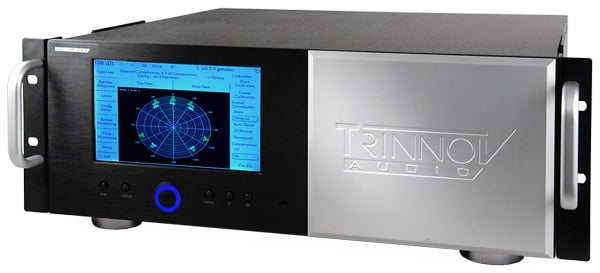
On the DSP side of integrating the speaker and room acoustic into a unified system, Trinnov offers an audio "Optimizer" toolkit that has four parts: (1) a calibration system that is smart enough to figure out all kinds of acoustical phenomena with respect to your loudspeakers and your listening room. The system accurately identifies in 3d where the loudspeakers are. (2) The Optimizer takes the 3d data from your “speaker/room” system, does an in depth analysis for solving the voicing/ spatiality equation, (3) processes the audio with appropriate correction and reproduces with transparent results, and (4) reports the before and after results of amplitude, phase, impulse responses, and speaker position. The report is then useful in determining what acoustical treatment might be suitable. The Optimizer puts the listener way ahead of where you were to begin with, and you know exactly where you stood with your system. Maybe the extra room treatment would help even more, but maybe not to the degree to be worth the effort. You decide.
So, to summarize: We’ve responded to the survey with one condition in mind: the Trinnov Optimizer is a part of the system. Trinnov has come up with a remarkable solution for audiophile reproduction: consistent voicing and spatiality. The result is truly liberating: (1) place speakers where you can, (2) use Optimizer to overcome the shortcomings of both loudspeaker placement and the room/speaker system. The Optimizer is a stand alone unit manufactured by Trinnov, and will soon be in selected surround processors.
Want to learn more? Visit the Trinnov Research Page: http://trinnov.com/research.php Or read the technical article: "Three Dimensional Manipulation of Audio leads to Universally Consistent Reproduction" from Resolution Magazine
http://trinnov.com/download_file.php?file=Resolution_April2006.pdf Professional
Curt Hoyt, Trinnov Audio USA curt.hoyt@trinnov.com
Jeff Smith of Majestic A/V
Majestic A/V is a custom installer (retailer) of media equipment specializing in dedicated theater rooms (Tulsa, OK market). Jeff Smith is founder and president of Majestic Audio Visual and offered the following:
| Responder: Jeff Smith from Majestic A/V | Answer ranking 1 - 5 |
| 1. Room design including sound isolation, room dimensions, and surface finishes? | 5 |
| 2. Use of acoustical reflection control devices such as absorption and diffusion panels? | 5 |
| 3. Use of acoustical low frequency control devices either passive or tuned? | 4 |
| 4. Acoustical measurements of the room actual or predicted? | 5 |
| 5. Acoustical coupling of speakers to surfaces, i.e mounting options (stands, in-wall, shelves, etc.)? | 5 |
| 6. Speaker positioning? | 5 |
| 7. Spatial response, meaning how the room responds at various positions not just a single location. | 4 |
| 8. Crossover adjustments. | 5 |
| 9. Phase response of speakers including subwoofer(s). | 4 |
| 10. DSP design: number of filter points, measurement points, etc… | 5 |
| 11. Aesthetics including surface finishes, furnishings and lighting? | 5 |
| 12. Consumer demand for innovative acoustical treatment products? | 4 |
| 13. Consumer demand for innovative active room correction products? | 4 |
| 14. Use of specially trained room calibration specialists? | 5 |
| 15. Video Quality? | 5 |
| 16. End user expectation is similar to control room environment? | 5 |
| 17. End user expectation is similar to a commercial cinema? | 4 |
| 18. Dynamic range of content | 3 |
| 19. Changes in musical composition and sound effect elements in relation to the advances in residential theaters? | 4 |
| 20. Changes in surround mix techniques due to advances in residential theaters? | 4 |
I believe the experience is what most people are looking for and they trust us to know how to define it.
How do we know what makes for a great experience? A person could say it’s the stuff (the products themselves), or the room environment…the ambience. Some may even say it’s all about the film production but ultimately it’s the balance of all those things!
Several areas are important in putting these elements together with synergy and balance. Knowledge, experience, skill set and training are important to name a few, and I don’t believe any one person has all of those elements.
My name is Jeff Smith, and I own a company in called Majestic Home Theaters, Inc. I’ve been in this business for 15 years professionally and believe that creating a “Round Table” of experts is what achieves this great experience! I’ve tried to be very careful and deliberate as to who sits at that table.
This “Round Table’s” ability to look at the end result (the experience) and back fill his way to the starting point…the concept to design is vitally important. Every project is like a blank canvas waiting to be painted. My “Round Table” is able to see the rendered painting before we start to paint. As I’m sure you can relate the client gives us a poor canvas to paint on more often than not.
Once a budget is established the room should be addressed structurally, dimensionally, and then interior finishes. The system design should be secondary…for what would a painting be without the right canvas.
This leads me into the topic of ‘active room correction”, something I feel is very important but not in place if “passive room treatment”!
I know I can’t sit here and argue with some of the great minds behind the “active room correction devices” but I can speak from experience. I like to relate the difference between acoustic treatment and active room correction systems to building a home. Acoustic treatment is like the foundation, implemented properly with knowledge and purpose; you’re creating an environment for a home that can stand for a very long time. Active room correction on its own would be like not paying attention to the foundation or earth it resides on. Sure you have the foundation (the room) to build on but not much attention to leveling it or getting the concrete mix right…not to mention it may be on soil with a lot of sand and very shifty.
I always go back to physics and balance, you need to treat the room first passively (acoustic materials) then correct the remaining set up and room anomalies electronically (active room correction). The key here is if you don’t have knowledge or software to provide accurate placement of the right materials you should work with someone who does! You could end up creating more problems than had originally.
Here is an actual project that used passive acoustical treatments and active room correction.
Belmont
We did a show home for a builder we work with called the “The Belmont Street of Dreams Tour”. Now, in most of these amazing homes we still get left over’s, in most cases low budgets and little design freedom…nothing different here! Although we had more budget than most projects with this profile there were still many compromises that had to be made. We couldn’t do much with room dimensions, which in this case were square, roof lines that prevented height flexibility, and overall structural integrity for sound quality and sound transmission. So we looked at the compromises and the budget and came up with a solution that would offer a “point of diminishing returns” with balance and purpose. We worked with Phase Tech and their DART System for speakers and Auralex Acoustics and their Custom Fabric System for acoustics.
One of the points I believe is critical for those believing that active room correction super seeds, replaces, or is more effective than passive acoustic treatments is the fact that you can only correct what comes out of the system. When you’re qualifying a client’s needs there’s so much more to consider than sitting in a chair quietly watching an event. Most people use these spaces for multiple types of events…for instance, watching sports with more than two people conversing and screaming and yelling for their team, maybe they want to hook a microphone into the system with a little monitor and have Karaoke night with the kids or friends, or possibly just sit in a space that’s audibly pleasing to read a book, all purposes that don’t come from the system…You address those needs with passive acoustic treatment.
Getting back to this room, not only was the show a success it was interesting to hear the feedback. We had many people sit in a chair and before the demo say “wow, this room just feels comfortable and it’s so easy to talk at low levels”, and that was with back ground music. Everyone commented on the performance and was surprised that other homes on the tour didn’t have the same quality or feel; nor did they understand why until we explained it. I always enjoy the look on their face when were comparing it to a room that’s considerably more money as well.
Again I want to stress that “Active Room Correction” is very important as well and was implemented on this project. Starting with the foundation, the room, the treatment then electronically correcting the anomalies that budget, location, and multiple seats present is the right approach. The balance between the two made for a great experience and the client that purchased the home during the tour said “this was the best Theater I have owned and is not the most expensive!
This client’s own words give good background to the use of acoustical treatments and active room corrections. The client heard the room on the first day fully calibrated with no acoustical panels on the treatment. The ceiling treatment didn’t show up until several days after the show had started…the client came back to show with a buddy after we installed the ceiling panels and asked why the system sounded better especially in the area of speech intelligibility. We pointed out the ceiling treatment that wasn’t there previously. The end result was the house was purchased in part because of the theater performance and his buddy asked us to address the needs of an existing system he owned, a new customer.
Great experiences create valuable referrals!
Jeff Smith
Conclusion
This is an exciting dynamic era in audio presentation. There are more effective options in terms of getting a tremendous experience than ever before. Still, one must search to define what a correct room is. We are 30 years past the proof that you cannot EQ a reflection yet technology is just now offering solutions in active room correction to deal with the complex spatial aspects of sound in a room. Active Room Correction is coming of age with many manufacturers offering options (including Audyssey and Trinnov). Speaker and Receiver manufacturers are jumping on board and licensing ARC technologies to offer with their products. Meanwhile, acoustical treatment materials are readily available. There is more application knowledge than ever before regarding acoustics. RPG Acoustics (not mentioned above) is a creative product design force with tremendous room solutions, Auralex and GIK Acoustics are caring manufactures who want your space to perform at the highest levels, and there are many others offering a variety of types of materials/finishes/price points.
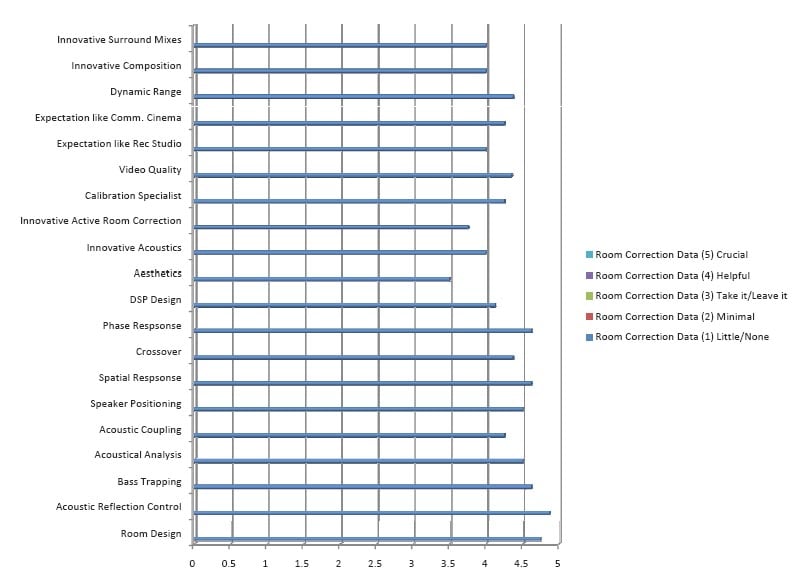
When the answers to the questions are compiled, one can quickly note that the items a “lay-person” may desire most in a home theater are inversely rated to the experts. Aesthetics are key because who wants an uninspiring room. However, a correct room is not directly related to how the room looks. Now in terms of the experience a room that is comfortable, visually appealing and has superior video can offer a fantastic theater experience…the psychoacoustic intangibles can help offset audio issues.
On the cautionary side, expect a growing onslaught of marketing spin on this topic from all sides. As more speaker and receiver manufactures embrace and offer ARC, the message that you can correct all room issues digitally will be loud. It certainly is easier to get wife approval on a black box than “bulky” things on the walls. Please understand that as great as the advances are in ARC, you have to put all results into perspective. I’ll restate there is no definitive “correct” room, only rooms where the compromises are known and addressed appropriately.
On a personal level, I greatly appreciate the input of all the participants. These pros offer tremendous insight. Don’t be fooled by the brevity of some. In fact, the response from Chris at Audyssey sums up the whole topic in my opinion. Also take to heart the depth of others, the carefully chosen words from Curt of Trinnov or the approach oriented comments from Bryan at GIK. Each of these individuals has a stake in your space, each wants your experiences to be tremendous, and each influences the advancements and tools that are available.
If you haven’t by now, take the Twenty Questions survey yourself and see how your room and knowledge fares. Each question is a topic worthy of in-depth study. As suggested by most, ask for professional help. There are levels of fee support and free support that in Russ Berger’s words can offer “the wisdom and depth of understanding of a lifetime's career experience”. Be wary of random bits of information because the “magic” lies in the balance of all of these tools.
Jeff Hedback is founder of Hedback Designed Acoustics which offers acoustical consultation design and support for home theaters, audio production facilities and rooms in need of acoustical “therapy” in general.
 Subscribe to our newsletter