


Bass Management: The Right Stuff
Bass Management Settings
It has been over a decade since the first generation of Dolby Digital Receivers hit the market. These Receivers implemented a crude and inflexible bass management system, had limited power for the rear channels, and did not have an upgradability path for future surround formats, or onboard DTS decoding for that matter.
Home Theater Receivers have since then come a long way. Each new generation offers more power, more features, newer technologies, added bells and whistles, etc. The idea of discrete surround sound even transcended into the high-end community as separate Preamp/Processors and multi-channel power amplifier combos for those audiophiles who demanded the pinnacle of performance.
So here we are in the 21st century, yet many of the audio companies who manufacture these home theater Receivers and Preamp/Processors still cannot correctly implement one very simple and fundamental concept into their products that is crucial for proper performance: FLEXIBLE BASS MANAGEMENT!
To make matters worse, many manufacturers tend to follow a standard such as Dolby Digital too closely without considering how exact implementation, according to the specification, may hinder user flexibility for two channel operation and various loudspeaker configurations. When the Dolby Digital processing standard was originally written, its target application was for movie theaters. At the time it was realized that speakers in movie theaters had limited bass capabilities. To achieve the full dynamics of these bandwidth limited speakers, as well as the modest amps that powered them, it was decided that a dedicated channel would serve to produce all Low Frequency Effects (LFE) bass, hence the 0.1 in the 5.1 discrete surround sound scheme.
Dolby labs defined the LFE as a supplementary bass boosted channel, which also may contain bass content derived from the five surround channels set to small (IE. Left and Right Front, Center and Left and Right Rear).
Thus it was assumed that 80 Hz would make for a good crossover point between bass incapable speakers and the subwoofer. In most movie theaters, all of the speakers are rolled off at 80 Hz because of their bass limitations and thus the bass from all of these channels is feed to the LFE, or subwoofer channel. This configuration serves movie theaters quite well and thus seems to have been a good choice for a huge movie theater like rooms where bass localization is not as critical. However, it may not always be the best choice for all home theater configurations.
Please review the article I wrote " Turn That LFE Setting Down" for more elaboration on this topic.
Those thin boxy horn loaded speakers may have worked for the movie theater environment, but they don't necessarily cut it for a serious audiophile who demands uncompromised home theater performance. Many of use prefer high quality loudspeakers that don't compress the sound to the nth degree to achieve more loudness with less required amplifier power. In fact, many of us, myself included, have large tower, bass capable, speakers that can handle music and movies with equal favor. That being the case, we enjoy listening to our bass capable speakers complimented by our powerful but musical subwoofers. To keep these subwoofers musical and non-localizable, while also avoiding bass doubling at frequencies typical of common room modes, the crossover setting of the subwoofer often needs to be adjusted below 80 Hz, especially for critical two-channel listening if the sub is in close proximity to the listener. Unfortunately the Dolby spec, as well as THX, recommends 80 Hz as the choice setting and thus 90% of the receivers and processors on the market are hard coded to this setting without the option of variation or bypass. Using the built in LPF of the receiver / processor in conjunction with the LPF of the subwoofer may lead to phasing problems causing cancellation of some bass frequencies and excessive additive properties of others.
Please refer to the article I wrote regarding the " Marriage between the Tower Speakers and Subwoofer " for further elaboration on this topic.
THX to the Rescue?
THX has become a recognized industry standard. Aside from THX's proprietary post processing, many of the requirements set by THX can easily achieved by quality electronics but several of these electronics manufacturers choose not to pay the premium to advertise this.
My biggest issue with THX is:
No channel shall have bass info below 80 Hz other than the subwoofer channel.
While this may serve movie theater purposes, it is not always acceptable for home theater in my opinion for my previously mentioned reasons that many of us utilize bass capable speakers in our systems that produce linear bass extension below 80Hz and that the pressure waves of 80 Hz bass frequencies can be localizable to the ear if the subwoofer is placed too closely to the listening position. I believe THX is configured like this for ease of speaker integration and to preserve dynamic range of all channels by limiting their received bandwidth. This in turn may allow for easier certification of less capable power amplifiers and speakers since they are not tasked to produce the low frequencies that require ample power and driver excursions. Therefore this helps manufacturers certify a greater amount of their products resulting in guaranteed system compatibility and consistency. THX carried over much of its philosophies of the movie theater environment to home theater, especially relating to the satellite subwoofer speaker systems. While these systems don't always offer the pinnacle of performance, they usually are easier to integrate and set-up in most home theaters. For those who don't want to fuss with the acoustical tribulations of multiple bass sources, this type of system with a fixed 80Hz crossover may be the right choice. However, for those who enjoy bass capable speakers supplemented with their subs, choosing a receiver/processor with multiple crossover settings and flexible bass management can offer more setup versatility.
THX is about two things in my opinion:
- Their spec.
- Compatibility.
The reason they stick to their spec is to promote compatibility. Then, regardless of which manufacturer you choose, if you go with a product with the THX certified good housekeeping seal of approval, you know they will work well together. This is turn allows them to attract more manufacturers, which increases the generation of licensing revenue.
Now Let's Talk About Flexible Bass Management
In order to achieve the most out of your home theater system, I have devised a flexible bass management scheme, regardless of standards, to realize all possible user combinations for maximum performance realization for all speaker, amplifier, and room combos.
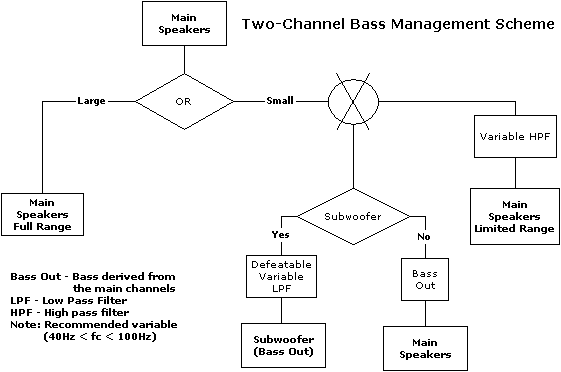
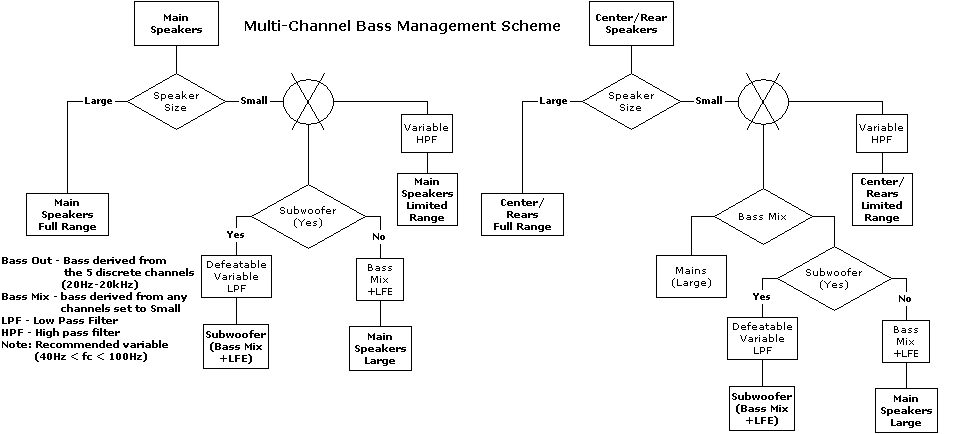
Summary of Flowcharts
The point I was attempting to convey in the bass management flowcharts was versatility in the system that can accommodate all speaker types and configurations. The same basic two channel audio bass management principals should be carried over for multi channel applications. For example, if you have large bass capable main speakers and a musical subwoofer that you wish to cross over below 50 Hz to provide added bass boost to your mains, your Receiver / Processor should have the ability to route bass signals to your subwoofer at the desired cut-off frequency, or offer a defeat option on its internal LPF for you to use the LPF of your sub, while still maintaining full frequency range output to your main speakers. There are so many Receivers / Processors on the market from the big name brands that still don't understand this concept and thus either do not allow you to operate your subwoofer in two channel mode at all, or if you have the mains set to large. In fact only about 10-15% of the Receivers and Processors on the market allow for an adjustable LPF for the subwoofer, and fewer units allow you to defeat the internal LPF in case you desire to use the one built into your subwoofer. Why?
The multi channel bass scheme does add complexity over that of the two channel one, but the fundamental concepts are the same. The bottom line is as follows:
Any speaker set to small must route the bass information for that speaker to the main channels if no subwoofer is present, or to the subwoofer if one exits.
Bass Management: Recommendations
In my opinion, I feel that one of the best speaker configuration for the typical large living room is as follows:
| Main Speakers: | *Large |
| Center Channel | Small |
| Rear Channel: | Small |
| Subwoofer: | Yes |
* assuming bass capable speakers are utilized.
The reason why I champion this type of speaker implementation is that in most cases, due to Wife Acceptance Factor (WAF) or other cosmetic reasons, you are not going to be able to implement large bass capable speakers for the rear channels. Even if you were able, it would be difficult to distance yourself from the rear speakers, given the proximity of the rear wall to your couch, if the speakers were at ear level from the listening position, without being able to localize them. The same applies for the center channel. Most people don't have the shelf space to implement a large center channel speaker. In addition, even if you were to utilize a large center channel speaker, placing it above the TV will surely reduce the bass capability of the speaker and thus undermine what you were trying to accomplish. That being said, I believe it is best for the Main speakers (assuming large bass capable ones), or the subwoofer (if optioned) to produce the bass from the rear and center channels. In addition, I really feel that in a large room, such as your living room, the ultimate combination for critical two-channel audio is large bass capable speakers with a musical subwoofer. Large speakers tend to blend better with a subwoofer in larger rooms, assuming proper phasing, which can result in a seamless transition of bass between the speakers and subwoofer. If too much bass gain is realized at frequencies where the subwoofer and main speakers overlap, active equalization can help to overcome this.
Alternatively the user may wish to bi-amp their main speakers running the woofers as dedicated subs playing the same info as the other powered subwoofer all feed from the subwoofer output of the A/V receiver/processor. Then you can apply a single correction curve to all subs simultaneously which will achieve the best blend and also allow you to maximize the standing wave reduction benefits multi subwoofer systems offer when playing identical signals and amplitude levels strategically placed in the room.
Choosing the Right Receiver / Processor
When you venture out on the market in search for your new Receiver or Processor, make mental note of how the unit handles bass management. If the unit does not have the bass management features that suite your speakers and/or application, don't buy it. Make the retailer aware of your concerns as they will surely get back to the manufacturer and will hopefully lead to design improvements in future models. Most importantly, make sure you get the right stuff for your hard earned dollars!
Key Definitions
| LPF: | Low Pass Filter. Blocks high frequency content from speaker. |
| HPF: | High Pass Filter: Blocks low frequency content from speaker. |
| Large Speaker: | Bass capable speaker able to produce full bass frequencies down to about 20 Hz. |
| Small Speaker: | Speaker, usually bookshelf type, incapable of producing bass frequencies below 60 Hz with much authority or freedom from excessive cone excursion or distortion. |
| Subwoofer: | Dedicated speaker, usually self powered, designed to produce bass frequencies only. |
Gene manages this organization, establishes relations with manufacturers and keeps Audioholics a well oiled machine. His goal is to educate about home theater and develop more standards in the industry to eliminate consumer confusion clouded by industry snake oil.
View full profile Subscribe to our newsletter