


Denon DVD-3910 Underwood Mod
Denon DVD-3910 DVD player
- Product Name: DVD3910 Audio Supplemental
- Manufacturer: Denon Electronics USA
- Performance Rating:

- Value Rating:
- Review Date: February 28, 2005 19:00
- MSRP: $ 2930
Modifications
|
Other Available Mods
|
Pros
- State-of-the-art video connections including DVI and HDMI.
- State-of-the-art video processing, including upscaling to 480p, 720p and 1080i.
- Outstanding 2-channel audio playback quality.
- Plays both hi-rez audio formats, SACD and DVD-Audio.
- Compatible with virtually all current disc formats and file types.
Cons
- Considerable investment in light of upcoming Bluray and HD-DVD technologies.
- Remote not programmable and only partially backlit.
- Voids manufacturers warranty, however Underwood offers a 90 day warranty on the entire machine and one year on all their work
DVD-3910 Mods Explained
Continuing on my series of disc-player reviews, I wanted to incorporate at least one "modded" unit. I am of the opinion that to extract the final ounces of fidelityacomponent has to be thoroughly tweaked; beef up a power supply here, change a connector there, upgradeacapacitor elsewhere, etc. Each change in itself may not yield an audible improvement or change, but layer on several changes and you can yield a substantial improvement. This pursuit is certainly as much art as it is science, and is also replete with snake-oil and dubious claims. In the end the only thing that matters is what a component sounds like, and that is what I intend to find out here.
Here is the basic jist of the high-end disc player market. The basic innards (drive, DAC, etc) are made by a handful of multi-nationals. Most high-end manufacturers then take these innards and add-on the rest of the componentry to their bent. That secondary effort (and cost) usually focuses on the power supply, output stage, connectors, chassis and cosmetics.
Without the benefit of having data to test my hypothesis, I would hazard a guess that the modded route would be more cost-effective for the consumer. This is mostly because the stock unit benefits from lower cost forassembly (due to high volumes and mass production) and cosmetics (since stock players usually do not feature expensive finishes). The added costs for a modded unit likely are; the minimal cost of the replaced (and discarded) parts, the labor to install the modsand maybe shipping to/from the mod shop. Again, I am just guessing, but I would estimate that a modded unit with the same components would cost a fair bit less than the same unit from a high-end manufacturer.
This review focuses on the quality of the two-channel audio playback of this player. Follow this link for an excellent assessment of the DVD-3910 stock unit, including video performance.
The Mod Shop
These mods are marketed in North America by Underwood HiFi and the modifications are done by Parts ConneXion.
The principal of the Parts ConneXion is Chris Johnson. Yes, the very same who founded Sonic Frontiers (in 1988). Sonic Frontiers operated three lines of business; high-end electronics under the Sonic Frontiers badge, mid-tier equipment under the Anthem label and a DIY business under the Parts Connection name. In 1998 the Paradigm Group purchased Sonic Frontiers, and since then Sonic Frontiers menu has been limited to solid-state home theater products under the Anthem badge.
In 2002 Chris Johnson and Victoria Switzer cut outand found Parts ConneXion,and took with them several of the design team from Sonic Frontiers. This new outfit offersaparts catalog for the DIY market,and after-market mods for a variety of product.
Eager to test out my theory on the economic efficiency of after-market mods, Iasked Chris why he choose to do mods when his team is fully capable of manufacturing disc players in-house. Especially considering this team in the past had produced many highly acclaimed models such as the Transport3, Processor3, SFD-2 mkIIand SFT-1. Chris' response confirmed my theory, and to my wife's chagrin gave my delusions of being a self-proclaimed economist more credence. Here is his take on mods.
Chris parted company from other modders I have talked with, when he says that not every product and every component is a candidate for modifications. Mods should only be made when the result yields significant sonic improvements for a cost that can be justified to the consumer. Specifically, he felt that to match the video performance and technology of the current stream of universal players (like this Denon), would require an investment so massive that only the large Japanese players have the sales volume to play that game. These huge investments include industrializing (bringing to production) DVI, HDMI, video upscaling, DVD-A and SACD licenses (an unverified source has quoted $80,000 annually for an SACD license). Unfortunately, these mass-produced units also save money by skimping on design and components in the power-supply, the analog output stage and analog output connectors. This is where the mod-house steps in, and augments only the analog audio performance, in this case. And who better to do this than a design team that has delivered much acclaimed products in the past, I cannot second that acclaim since I have not had first hand experience of those units.
According to Chris, in the case of this specific model, Denon is using the most advanced DAC on the market, but that is not what is significant, since the DAC is more advanced than the formats it is converting. So he focused his efforts on the areas of this player that he felt would yield the most improvements. Details of the mod are listed above, they can be summarized as upgrades to the chassis damping, linear power-supply for analog audio sections and numerous upgrades to components in the analogaudio output path after the DAC, including the all important op amp.
DVD-3910 Mod Listening Tests & Conclusion
The front panel features the following; starting from the left we have separate standby-on and power on-off buttons. The disc drawer in the center is positioned above a readout panel. The right side of the front panel has the usual navigational buttons and some very useful controls that enable selection of the video output, format and mode; SACD modes and the ability to switch off video and display circuits.
The remote is only partially backlit, is not programmable and cannot control other components. I expect more at this price point.
Listening Evaluation
As always, listening evaluations were done by multiple repetitions (10 to 20 times) of a short segment (30 seconds or less) on one player and then immediately repeating on the other player. This process is repeated several times for each segment used, till I can confidently establish a conclusion. These comparisons are done with both players being level matched, using a pink noise tone and SPL meter.
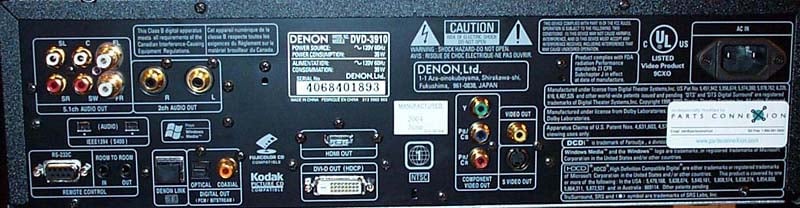
One important point of note. The mods on the review sample were done on the FL and FR jacks of the 5.1 outputs. This means that if I were to play a 5.1 track, the 2.0 jacks would play a down-mixed version and using the FR/FL jacks would only relay two of six channels of information. This of course is a major issue of you are using this player in a two-channel setup. Chris Johnson confirmed that the mods can be done to the 2.0 jacks (at no additional cost), but have to be specifically requested. Modifying the FR/FL jacks should be the choice for those intending to use the player in a 5.1 setup. Since I used this player in my two-channel setup I will limits my tests to those suitable for such a setup.
The first sets of comparisons were done with the Lexicon RT-10 universal player ($3,500). The following three tracks were used to evaluate SACD playback.
'Cheek to cheek'
(Ella
Fitzgerald and Louis Armstrong; Ella and Louis; Verve;314 589 598-2)
Differences between the players were not easy to discern, it took
several iterations of the process described above to reliably identify
audible differences. The differences I did find were so small, that I
would have to categorize them as 'impressions'. As much as I dislike
using such vague terms, I would have to classify the modded Denon as
sounding relatively more 'open'and the Lexicon sounding a bit 'darker'.
It probably comes down to personal preference on this trait, and I
preferred the Denon.
A definitely identifiable sonic trait was that the Denon seemed to highlight the sibilance inherent on this track a little more than did the Lexicon. I would not conclude that this indicates the Denon is a lesser player, but possibly that it renders the HF warts a little more bare.
'They can't take that away from me'
(Ella Fitzgerald and Louis Armstrong; Ella and Louis; Verve; 314 589
598-2)
I exhausted myself trying to find reliable differences between
the two players, but to no avail. Of the variances I did hear, I am not confident that it was indeed
perceived by my ears and not by some bias that may have crept into my mind.
As a reviewer, it is nerve-racking to not be able to hear reliable distinctions in sound quality. That is our raison d'être, and if we have nothing to report are we of any use to our readers? Absolutely, says this guy. We can report that there are no reliable differences found; there is value in that too. I would rather report finding no differences, and be accused of having 'tin ears'; than creating fictitious differences and hail myself as 'golden eared'. I will now get off my soapbox before I start foaming at the mouth.
'Big leg woman'
(Muddy
Waters; Folk Singer; MCA Chess; 088 11 940-2)
I sighed relief on this track when I could hear distinctions
again, albeit very slight. The upper-bass and lower-midrange were a bit more detailed on the Denon,
while the bass seemed a bit more extended on the Lexicon.
Finally, I compared the CD sections of these two players using the following tracks;
'Yesterdays'
(Dave
Bruebeck; Nightshift; Telarc; CD83351)
Differences between the two players were very small again. I could
not pick out specifics other than the soundstage seemed a bit more
expanded on the Denon. Though I dislike using such vague terms, the
Denon seemed relatively 'open and airy' compared to a 'darker'
presentation by the Lexicon.
'Bass resolution test'
(Chesky Records; Chesky Jazz and Audiophile tests Vol2; Chesky; JD68)
The unspecific 'warmer' versus 'open and airy' finding above
applies again on this track. The Lexicon definitely had a stronger bass
response, which did not seem natural/flat/balanced but certainly was
euphonic.
'General Image and resolution test'
(Chesky Records; Chesky Jazz and Audiophile tests Vol2; Chesky;
JD68)
Perhaps I had fatigued
myself during this session, but I was unable to find any reliably identifiable and significant
differences.
Next, I compared the CD playback of the Denon to the outstanding E.Sound CD-E3 ($700, previously reviewed).
'Bass resolution test'
(Chesky Records; Chesky Jazz and Audiophile tests Vol2; Chesky; JD68)
There were some slight differences on this track. The Denon made
the tape hiss standout relatively more and the
E.Sound
had more
punch in the lower bass notes.
'Coming of the Mandinka'
(V.M. Bhatt, Taj Mahal, N Ravikiran; Mumtaz Mahal; Waterlily Acoustics; WLA
CS46-SACD)
I could not find
any significant and reliably identifiable differences on this track.
Having established that the audio quality this player is as good or better than some esteemed competition, I only had one question left to answer. Do the mods improve the sound at all? At first I took the easy way out, and ran comparisons between the modded jacks and the mostly unmodded 2.0 jacks on the same player at moderate volume levels. Several tracks later, I was unable to find any reliable differences. Of course this was not quite a fair comparison, since even the 'unmodded' 2.0 jacks on this player benefit from the upgraded power supply. I needed a stock unit to find the truth.
Walter Liederman of Underwood HiFi obliged, and had a factory-sealed unit expedited. If nothing else this demonstrates his confidence that the modded unit would shine past the stock one. Here are my findings.
'Knives'
(Dave
Bruebeck; Nightshift; Telarc; CD83351)
I did hear some differences, but they were too inconsistent and small for me to
confident in reporting them.
'Liebestraume'
(Franz
Liszt, Sound
&
Vision test CD, Sound
&
Vision)
Again, I heard very small differences, and it seemed
like the modded unit had tamed some of the glare in the high frequencies. But again, I would have to
say that the differences seemed too small and inconsistent to rely upon.
'The four seasons - Autumn, allegro'
(Antonio Vivaldi, I Solisti Italiani, Sonic Boom,
Denon,
COZ17156)
Switching to a
high-resolution made quite a difference. This excellent DVD-Audio recording made a couple of
differences quite evident. The most obvious was the increase in the dynamic range, transient peaks
seemed higher and rise times seemed faster (a common benefit of output stages operating in class-a).
Also, the individual instruments seemed to have cleaned up as it was easier to sonically isolate and
identify them.
'Coming of the Mandinka'
(V.M. Bhatt, Taj Mahal, N Ravikiran; Mumtaz Mahal; Waterlily Acoustics; WLA
CS46-SACD)
The modded unit sounded slightly more detailed, as an example it
was easier to hear the start of the tape on the track. A philosophical
question for a potential buyer is, do you care if ambient noises are
better reproduced or would you rather not hear them? Some
dyed-in-the-wool audiophiles would say, "YES! If there is any iota of
information in the source I want it, even if it is not pleasant to
hear".
Others would say "I only want euphonic sounds, noise should be masked
as much as possible even if it means lower fidelity". You pick which
school you belong to, I am of the former.
'Bass resolution test'
(Chesky Records; Chesky Jazz and Audiophile tests Vol2; Chesky; JD68)
So far I had only been able to hear differences on high-rez formats
and not on standard redbook. As a final test I pulled out a track on CD
I have relied upon many times, and consider it to be of very high
resolution. The modded player made the double bass sound a bit fuller
and deeper, again transients seemed to rise faster and peak higher.
There also was a bit more low-level detail, mostly manifested in
ambient noises.
Conclusion
How does it compare to the competition? Not only does this player have cutting-edge video technology, in terms of digital connections and upscaling. It also plays all current audio formats, and audio playback quality is as well or better than the two units I compared it to. Of which, the Lexicon costs about $500 more, and third-party reports on it's video performance is not flattering in comparison to the DVD-3910. As far as relative value is concerned, this player rates very highly.
The other significant question is, does the sound quality improve with the mods or could you get the same sound quality in the stock unit? Yes, there is an improvement over the stock unit. Now, given the quality and resolution of the rest of my system [ and room acoustics ], I could only hear differences at fairly high volume levels and only on recording of very high resolution. Upgrading high-performance equipment usually has severe diminishing returns, i.e. a very small improvement for a great increase in cost. I can think of cases where performance is unchanged or even decreases for a greater expense. Without question, I can vouch that the modded version does indeed offer sonic improvements.
Will you be able to hear the improvements in sound? Yes, if the rest of your equipment, [room acoustics] and software is of equal or greater resolution than mine (given, it is nearly impossible to compare the resolution between systems).
Are the improvements offered by the mods worth the extra $1730? That is for you to decide. I would guide you by saying that a disc player is only one part of your system and room. Its performance should not be out of sync with the rest. If the rest of your system and budget are up to upgrading this fine sounding machine, this unit should be on your short list.
Level2 Underwood
HiFi mod -
Denon DVD-3910 Universal Player
www.underwoodhifi.com
MOD SHOP
Parts ConneXion
www.partsconnexion.com
The Score Card
The scoring below is based on each piece of equipment doing the duty it is designed for. The numbers are weighed heavily with respect to the individual cost of each unit, thus giving a rating roughly equal to:
Performance × Price Factor/Value = Rating
Audioholics.com note: The ratings indicated below are based on subjective listening and objective testing of the product in question. The rating scale is based on performance/value ratio. If you notice better performing products in future reviews that have lower numbers in certain areas, be aware that the value factor is most likely the culprit. Other Audioholics reviewers may rate products solely based on performance, and each reviewer has his/her own system for ratings.
Audioholics Rating Scale
 — Excellent
- — Very Good
- — Good
- — Fair
- — Poor
| Metric | Rating |
|---|---|
| High Definition Audio Performance | |
| Analogue Audio Performance | |
| Performance | |
| Value | |
 Subscribe to our newsletter