


Velodyne MiniVee Subwoofer Review
- Product Name: MiniVee Subwoofer
- Manufacturer: Velodyne
- Performance Rating:


- Value Rating:
- Review Date: February 01, 2011 20:45
- MSRP: $ 749
- Driver: 8" (6.5" piston) forward
firing Kevlar reinforced resin cone with 2 ½" dual-layer voice coil
Die-case aluminum basket - Magnet Structure: 204 oz. (12.7 lbs)
- Amplifier: 2000 watts Dynamic power, 1000 watts RMS power
- High Pass Crossover: 80 Hz (6 dB/octave) Low
Pass Crossover: 40 Hz - 120 Hz (12 dB octave
initial, 48 dB octave ultimate) or bypass with Subwoofer Direct - Frequency Response: 28 - 120 Hz
- Inputs: Gold plated RCA line and speaker level inputs
- Outputs: Line-level, high pass crossover, 80 Hz, 6 dB/octave
- Phase Control: 0 or 180 degrees
- Protection: Dynamic compression
- Dimensions (H/W/D): (inc. feet, grill and
knobs) 10.063" x 10.375" x 12.75" (27 x 26 x 33 cm)
Warranty:(parts/labor) Three years (electronics)
Five years (drivers) - Weight: 33 lbs. (15 kg.)
Pros
- Unimaginably great bass from such a small box
- No rattles or audible strain even at max output levels
- Unobtrusive easy to hide cabinet
Cons
- Premature high frequency rolloff above 70Hz
- No speaker level outputs
- No remote control
- pricey
Velodyne MiniVee Introduction
L ast year when I reviewed the Velodyne
MicroVee, a question was left in my mind of how it would directly compare
against their very own slightly larger, and less costly, MiniVee. The MiniVee is a sealed 8" subwoofer
design with a hulking 1000 watt amplifier. Not fully realizing that we already
reviewed a near-clone of the MiniVee via the Chrysalis Acoustics Photon-8
(identical performance, different cosmetics), I requested a review sample. This
gave me the opportunity to directly compare a MicroVee and MiniVee under the
same test conditions and listening environment.
ast year when I reviewed the Velodyne
MicroVee, a question was left in my mind of how it would directly compare
against their very own slightly larger, and less costly, MiniVee. The MiniVee is a sealed 8" subwoofer
design with a hulking 1000 watt amplifier. Not fully realizing that we already
reviewed a near-clone of the MiniVee via the Chrysalis Acoustics Photon-8
(identical performance, different cosmetics), I requested a review sample. This
gave me the opportunity to directly compare a MicroVee and MiniVee under the
same test conditions and listening environment.
Is this sub evil enough to satisfy Dr. Evil or will it become the illegitimate step child? You're gonna have to read on to find out.
Design Overview
The Velodyne MiniVee, like most upper echelon Velodyne products cabinet features beautiful radiused edges. The driver is internally mounted with no visible mounting screws and recessed into the baffle. The black cloth grille sits flush on the front baffle with a cutout displaying the Velodyne badge top and center. The MiniVee sports 4 rubber mounting feet with no provisions for carpet spikes.
The MiniVee comes in only one finish option which is a dullish black. It certainly lacks the charm of a real wood veneer, but given its small footprint and ease to blend into any nook or cranny of a room, it can easily be tucked away to be "heard but not seen" as my late uncle used to say about children, or was it the other way around? Hmm...

Velodyne MiniVee Backpanel View
The rear of the unit is home to the typical mounting plate for the amplifier and controls you find on most powered subwoofer products. To the left side is a large rocker styled master power switch and a non-detachable power cord. It's kinda a bummer Velodyne didn't make the power cord detachable. To the right side of the plate amp are all the controls and inputs. These controls include two knobs allowing continuously variable settings for volume and the low pass crossover frequency. There are toggle switches for activating the auto on/off feature, the internal crossover, and setting the subwoofer phase between 0 and 180 degrees. Below the controls are two pairs of gold plated RCA connections for line level input and output as well as two pairs of five way binding posts for speaker level input. There are no speaker level outputs. For those analog two-channel buffs wanting to apply bass management to their satellite speakers, you will need to do so via other means.
The internal
crossover system for signal input is adjustable from 40 to 120 Hz and uses
staged for low pass filtering that according to Velodyne varies between 12
dB/octave at the crossover frequency to 48dB/octave above the crossover
frequency. The line level output is fixed at 80Hz with a 6dB/octave slope
to Velodyne varies between 12
dB/octave at the crossover frequency to 48dB/octave above the crossover
frequency. The line level output is fixed at 80Hz with a 6dB/octave slope
The driver used in the Photon-8 has an 8 inch outside diameter with an actually 6.5 inch effective piston diameter. The cone itself is a composite resin that is reinforced with Kevlar fibers and is mounted to the frame with an oversized EPDM rubber surround while the internal suspension is said to use an oversized spider, both to accommodate high excursion but retain linearity.
The motor structure on the back of that cone is also appreciably oversized. The magnet structure weighs in at 204 oz (12.7 lbs) that effectively constitutes fully 1/3 of the entire subwoofer system's weight and weighs more than some comparably sized subwoofer systems. In between the cone and that magnet is a high temperature, 2.5” diameter, dual wound coil. Coupled with a cast aluminum basket frame and we have the makings of what should prove to be a very potent little driver.
The MiniVee is not video shielded but this is an ever diminishing problem in this era of post CRT display technologies. If video shielding is an important consideration the MiniVee-10 is shielded, which provides an accommodating option in the product line.
The Velodyne MiniVee also boasts a
digitally controlled class D amplifier (up to 95% claimed efficiency at full
load) section that is said to deliver 1000 watts rms power 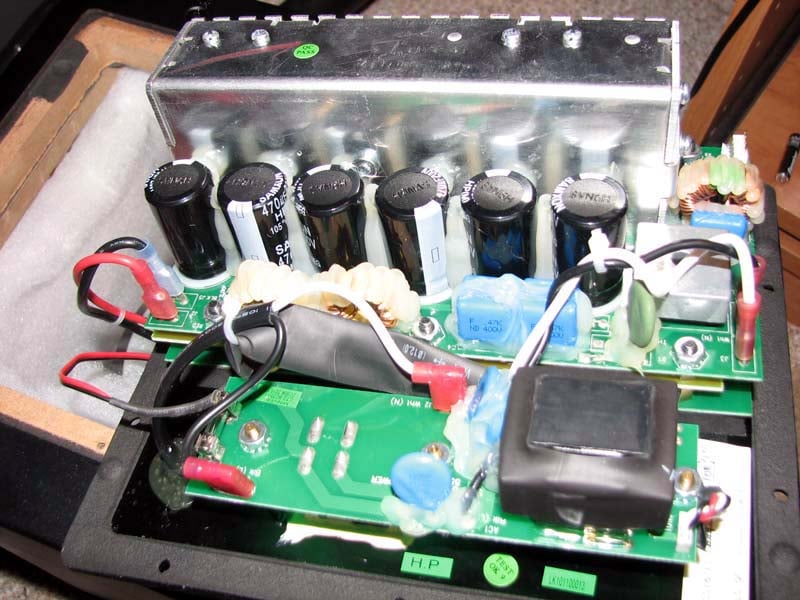 and 2000 watts
dynamic power. The amplifier, which is separated
into two sections, occupies the entire back plate. One board dedicated to the
power supply supporting the transformer and main fuses. The second tiered board
supports the preamp functions and six 470 microFarad, 200 V power supply
capacitors. There is a small heat sink to the side of the capacitors while the
majority of the circuitry lives under a grilled metal housing to reduce
radiated RFI noise inherent in high frequency switching amp designs. Based on
the power consumption rating of 8 amperes listed on the back of the unit at the
standard 120 volts we get a power rating of P = 0.95(8A * 120V) = 912 watts
which is close enough to the 1000 watt rating that with a slo-blow fuse leaves
little to suspect the rated power of the amplifier.
and 2000 watts
dynamic power. The amplifier, which is separated
into two sections, occupies the entire back plate. One board dedicated to the
power supply supporting the transformer and main fuses. The second tiered board
supports the preamp functions and six 470 microFarad, 200 V power supply
capacitors. There is a small heat sink to the side of the capacitors while the
majority of the circuitry lives under a grilled metal housing to reduce
radiated RFI noise inherent in high frequency switching amp designs. Based on
the power consumption rating of 8 amperes listed on the back of the unit at the
standard 120 volts we get a power rating of P = 0.95(8A * 120V) = 912 watts
which is close enough to the 1000 watt rating that with a slo-blow fuse leaves
little to suspect the rated power of the amplifier.
Both the amplifier and driver feature overload protection circuitry. The driver is digitally controlled with a current limiting driver servo to limit distortion by prevent clipping and over excursion. The amplifier section has thermal protection as well as protection against excessive voltage drops. As you will see in our measurements section, this little sub is unbreakable.
Velodyne MiniVee Internal View
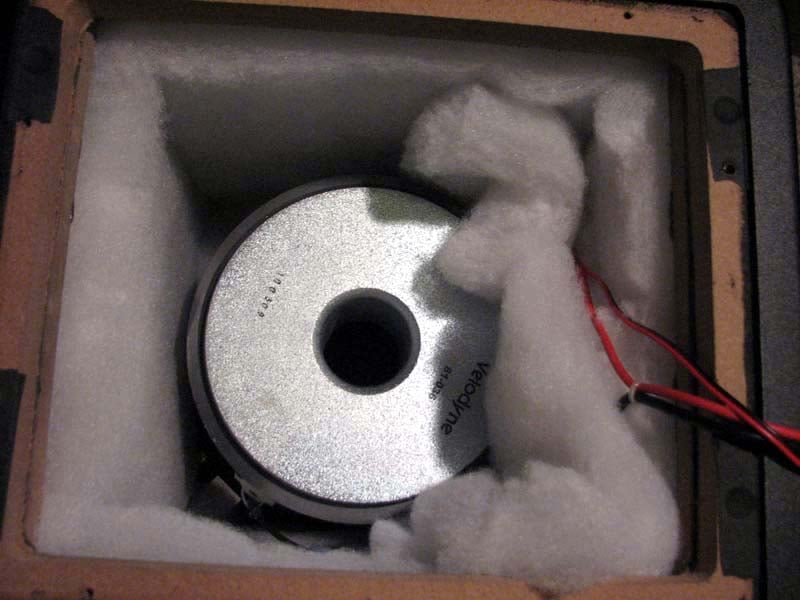
Disassembly of the MiniVee to reveal the internals can only (safely) occur through the rear amplifier plate, which is secured with 10 wood screws around the perimeter. Inside the cabinet, fiber batting is wrapped around the outside faces of the cube and a second piece separates the driver from the electronics mounted to the back. The cabinet itself is constructed of 1/2” MDF with glued joints and triangular wedges used to reinforce the outside corners. The driver is secured down with metal clamps. It's obvious Velodyne designed this sub to be rattle-free at even the highest power levels.
Set-Up & Installation
 I
tried the MiniVee in several locations in my office, but found it blended best
with my speakers when placed on the floor below the left speaker and flush to
my desk. I tried placing it under my
desktop by my feet but it produced such a large tactile response that it seemed
artificial when listening to bass-intense music. The MiniVee was connected to my EMP VT40.2
Hybrid Tube Amp Speaker System via speaker level paralleled to the 41-SE/B
speakers. I found the line level outputs
of the VT-40.2 amp to be about 10dB too hot for this sub which caused it to
reach excessively high output when the volume control on the sub was set any
higher than a finger nail thickness from zero.
A more graduated level adjustment would have been appreciated. I was unable to make coarse level adjustments
using the volume control because the sub reached a high gain state with the
volume barely turned a few clicks past minimum regardless of what source device
I connected to it. When using speaker
level connections to my EMP VT40.2, I still only needed to set the master
volume of the MiniVee just below 1/3 up from zero to reach the right output
level for my listening setup. The volume
control was quite finicky and I wished Velodyne would have instead employed a
stepped potentiometer so you could lock your setting in place without fear of
being blown off your chair because the volume control got accidentally bumped
higher when you were moving the sub to do some spring cleaning.
I
tried the MiniVee in several locations in my office, but found it blended best
with my speakers when placed on the floor below the left speaker and flush to
my desk. I tried placing it under my
desktop by my feet but it produced such a large tactile response that it seemed
artificial when listening to bass-intense music. The MiniVee was connected to my EMP VT40.2
Hybrid Tube Amp Speaker System via speaker level paralleled to the 41-SE/B
speakers. I found the line level outputs
of the VT-40.2 amp to be about 10dB too hot for this sub which caused it to
reach excessively high output when the volume control on the sub was set any
higher than a finger nail thickness from zero.
A more graduated level adjustment would have been appreciated. I was unable to make coarse level adjustments
using the volume control because the sub reached a high gain state with the
volume barely turned a few clicks past minimum regardless of what source device
I connected to it. When using speaker
level connections to my EMP VT40.2, I still only needed to set the master
volume of the MiniVee just below 1/3 up from zero to reach the right output
level for my listening setup. The volume
control was quite finicky and I wished Velodyne would have instead employed a
stepped potentiometer so you could lock your setting in place without fear of
being blown off your chair because the volume control got accidentally bumped
higher when you were moving the sub to do some spring cleaning.
Because of the premature rolloff above 70Hz of the MiniVee, I found running it full-range with no bass management worked best in my situation. The added output in the 70-100Hz region running the sub full-range really helped to provide the much needed bass fill for my desktop speakers.
Velodyne MiniVee Listening Tests
Unless
otherwise noted, all listening tests were conducted using the streaming
services of Pandora.com fed from my PC to my Headroom micro preamp and DAC
connected directly to the EMP VT-40.2 Hybrid Tube Amp Speaker system in my
office space which is roughly a 6' x 10' room. The source material was streamed from Pandora.com via their high resolution paid membership which is said to be 192 kbps/sec. Given the really good audio quality I hear from their service, I have no reason to doubt their claim.
Will Smith: Miami
This
song had my chest pumping. Bass from the
Velodyne MiniVee hit hard and tight without any hint of overhang. It was just clean, clean, clean. The MiniVee was providing real subwoofer action
to the music, not a fake one notey boom box that so many small high compression
subs tends to be.
Technotronic: Pump up
the Jam
This
is not music I normally listen to but I wanted to get some hard hitting bass
tunes to break in this little sub. Bass
enveloped my room with excellent sustain and clarity making me feel like I was
in a nightclub sans the smoke and cheesy dancing. Bass from the MiniVee seemed
like extension to the speakers not a separate entity which is a sign of good
integration.
Bluetech: Triangle
New
age music with some prodigious bass. The
Minivee really plunged the depths of this song that the MiniVee simply could
not. I felt the full tactile impact of
the bass. I was really digging the laser
and other keyboard effects of this song while being pelted with the
intoxicating bass.
Pat Metheny: H &
H
It's
an absolute must for me to throw in a little Metheny to any listening session.
The realness of the drums in this song was kinda freaky as the snare was so
lifelike and dynamic while the bass just thumped my chest. The EMP & Velodyne pair were belting out
the goods. Pat's guitar was like
butter. The Velodyne MiniVee never got
in the way, it just did its thing and provided a level of realism and depth to
the soundstage that would have otherwise been impossible without it. I was having that "better than being
there experience" I often notate in reviews of products that really dazzle
me.
Donald Fagen: On the
Dunes
I
always listen to Steely Dan / Donald Fagen music when testing a new sub. If a sub doesn’t sound right playing kick ass
music like this, what's the point?
Donald Fagen's "On the Dunes" was a great song to give the
MiniVee a good workout. Long sustain on
bass notes was heavenly. The thumping
had great impact and added a new dimension to this song that simply wasn't
there without the MiniVee pumping away.
When I switched over to the MicroVee, the bass was still tight and
plentiful but it just didn’t have the tactile impact that the MiniVee provided.
Steve Perry: Foolish
Hearts
Steve'
voice just captivates you making it impossible to just turn this song off when
I pops up on Pandora. The weight of the
bass in this song was so well delivered via the Velodyne MiniVee subwoofer. I loved how the bass struck while I was sitting
back enjoying pristine vocals overlayed with digital piano.
Tangerine Dream:
Scrap Yard
The
deep continuous bass in this song had my office shaking and my phone ringing
with complaints from my wife on the first floor being hammered with the
boom. Apparently I was distracting her
from her favorite cooking show on the Food network. I was quite impressed with how the Velodyne
just kept slamming out the bass with no signs of distress. This system just loved to be played loud,
which I especially took advantage of while the wife wasn't watching Giada.
Lee Ritenour: Module
105
Man
can Lee whale on the guitar like only a few handful of proficient jazz
guitarists can. I'm so glad he started
putting lumps in his Jazz again as for a time in the late 90s he like most jazz
musicians went the "smooth" Jazz route for radio playtime. The Velodyne sub just belts out tight snappy
bass from the bass drum which really provided a dimension of realism to the
music that was enjoyed more as the volume level was turned up.
Peter Gabriel: Down
to Earth
The
bass output was monstrous on this wonderful Peter Gabriel song popularized by
the Wall-E movie. I felt some good room
shake I just wasn’t expecting from this song.
Banzai Republic:
Faetter Dub
Holly
cow the bass had my ceiling lights in my main theater room adjacent to my
office rattling. I never heard of this
band, but I am totally digging and the MiniVee apparently was as well. Bassheads should definitely check this out!
Velodyne MiniVee Measurements and Analysis
I measured the Velodyne MiniVee in my office space using the antiquated but accurate Linear X LMS measurement system. No smoothing was used unless otherwise indicated. I also used the new Dayton Audio OmniMic system to measure system distortion.

Velodyne MiniVee Nearfield Frequency Response
I measured the MiniVee at various output levels using the groundplane technique at 3 inches from the front driver. The output was scaled -19dB down to give the actual SPL output I could hear at my listening position which was roughly 4 feet away. The subs highest output is centered around 50Hz but rolls off significantly below 30Hz where there is a deliberate HPF employed to protect the drive unit and keep things from getting ugly. I was a bit surprised to see about 5dB of rolloff at 80Hz even with the subs internal crossover bypassed. I could only surmise that the inductance of the large voice coil and heavy cone of this smallish driver was contributing to this phenomenon. It certainly explains why I opted to use no bass management at all on this sub when mating it with my EMP 41-SE/B desktop speakers.
Unlike the MicroVee that drops off like a rock below 50Hz, the MiniVee has about a 10Hz true usable extension advantage. I was able to hit 106dB SPL at my listening seat with this potent little sub which was about 5dB more output than I measured on the MicroVee at 50Hz and whole lot more below 50Hz as you will see in my comparative measurements below. Velodyne claims the -3dB point of the MiniVee is 28Hz. Because of the bump at 50Hz, it’s a bit hard to give an exact figure here. I would say its more like 30-32Hz. At high SPL however where the sub compresses and the limiter kicks in, we see a 38Hz -3dB point with about an 18dB/Oct roll off. This is very respectable performance for a product smaller than a shoebox.
I found it to be revealing to compare the output of the Velodyne MiniVee to the smaller but more expensive MicroVee model. I tested both subs identically using in-room nearfield groundplane scaled to the listening position 4ft away.
| Velodyne MicroVee | Velodyne MiniVee | |
| Drivers | 6.5" active, (2) 6.5" passive | 8" driver |
| Dimensional Box Vol | .45 ft^3 | .77 ft^3 |
| MSRP | $799 | $749 |
| Frequency | MicroVee Output | MiniVee Output | Net Difference |
| 20 Hz | 60dB | 84dB | +24dB |
| 30 Hz | 83dB | 96dB | +13dB |
| 40 Hz | 87dB | 103dB | +16dB |
| 50 Hz | 101dB | 106dB | +5dB |
| 60 Hz | 102dB | 104dB | +2dB |
| 70 Hz | 105dB | 102dB | -3dB |
| 80 Hz | 104dB | 101dB | -3dB |
| 100 Hz | 100dB | 97dB | -3 |
(in-room nearfield groundplane scaled to 4ft)
Editorial Note about Continuous Sweep testing vs CEA Burst Testing
Our sweep tests were conducted at a constant input level across the entire bandwidth whereas CEA burst tests are typically conducted at discrete frequencies (ie. 20Hz, 25Hz, …etc) by varying input voltage until max SPL per a fixed distortion limit is achieved at each test frequency. Our tests reveal max SPL where the subwoofers begin to compress but there is typically more output left above the compression point of each subwoofer if the subwoofer under test is not amplifier limited. For more info on this, read our 2010 Subwoofer Shootout Measurements Overview article.

Velodyne MiniVee (left pic); Velodyne MicroVee (right pic)
As you can see the MiniVee pwnes the MicroVee below 60Hz with a whopping 24dB output advantage at 20Hz. Only above 70Hz does the MicroVee exhibit appreciable (+3dB) more output than the MiniVee. The MiniVee is just a whole lot more sub than the MicroVee but it's also almost twice the size.

Velodyne MiniVee Distortion @ Max Output
At moderate listening levels which would equate to about (81dB @ 40Hz) at my listening position, I measured under 1% distortion below 60Hz on the MiniVee. It wasn't until I ran the sub to its max output that you could see distortion rise appreciably. At 31Hz max usable output, I measured 17.68% which is actually quite excellent for a subwoofer driver. Distortion below 30Hz dropped thanks to the HPF system limiter doing what its supposed to do to protect the driver and ensure you can't hear any audible distress.
I measured distortion of the Velodyne MiniVee sub used in conjunction with my EMP 41-SE/B bookshelf speakers as you can see below.

Velodyne MiniVee + Speakers System Distortion vs Frequency
If you subtract the frequency response curve (brown) from the distortion curve (blue), you can calculate THD +N. using the table below:
| dB Below Test Tone | % Distortion |
| -5 dB | 56.2% |
| -10 dB | 31.6% |
| -15 dB | 17.8% |
| -20 dB | 10.0% |
| -25 dB | 5.62% |
| -30 dB | 3.16% |
| -35 dB | 1.78% |
| -40 dB | 1.00% |
| -45 dB | .562% |
| -50 dB | .316% |
| -55 dB | .178% |
| -60 dB | .100% |
So in our case, above 200Hz we see 80dB SPL level - 40dB distortion level yielding 1% THD + N. The overall distortion profile of this system from 20Hz to 20kHz is quite excellent which explains why I enjoy listening to my desktop system often moreso than any other system in my home. It plays plenty loud and clean with great bass extension thanks to the MiniVee. What else could anyone want from a desktop system?

Velodyne
MiniVee + EMP 41-SE/B In-Room System Frequency Response
Green
Trace: 41-SE/B; Red Trace: MiniVee + 41-SE/B
As you can see in the measurement above, my little EMP 41-SE/B speakers don't have much usable bass below 80Hz. Adding the Velodyne MiniVee into the picture was like giving that system a shot of Red Bull. With the MiniVee playing in my little office, I had true mid 20Hz extension at my listening seat.
Velodyne MiniVee Conclusion
 Based on my time with the MiniVee, I
declare Velodyne the king of bass per square inch. Not only did the MiniVee simply deliver more
output and extension than I could have hoped for from such a small box, but it
delivered rich quality bass that never sounded muddy. The only minor criticism I have of the
MiniVee is the premature rolloff I measured above 70Hz. I would have liked to see this sub play flat
to 100Hz, especially since the majority of users are mating it with a small
satellite speaker system in need of more output in the 70-90Hz region. Bypassing the internal crossover of the
MiniVee helped to resolve this, especially since the sub is so well behaved
above its passband.
Based on my time with the MiniVee, I
declare Velodyne the king of bass per square inch. Not only did the MiniVee simply deliver more
output and extension than I could have hoped for from such a small box, but it
delivered rich quality bass that never sounded muddy. The only minor criticism I have of the
MiniVee is the premature rolloff I measured above 70Hz. I would have liked to see this sub play flat
to 100Hz, especially since the majority of users are mating it with a small
satellite speaker system in need of more output in the 70-90Hz region. Bypassing the internal crossover of the
MiniVee helped to resolve this, especially since the sub is so well behaved
above its passband.
I really can't think of any situations where I'd recommend their slightly more expensive MicroVee sub over the MiniVee unless you are really tight on space or need a little more output above 70Hz. This is no knock on the mighty little MicroVee as I still enjoy that sub for what it is. The MiniVee however is simply a MicroVee on steroids undergoing a serious workout regimen. Suffice it to say, I managed to work the larger MiniVee box into my tight office space and I have no plans on moving it out anytime soon.
Although the MiniVee doesn't come cheap, one must realize it's quite costly to engineer a small potent sub over a much larger alternative. Small subs require costly high excursion drivers and high power amplifiers. Velodyne managed to keep the cost reasonable considering the amount of performance they were able to eek out of such enclosure.
It wouldn’t be right for me not to mention the fact that Velodyne is offering a limited special promotion ($799) on the Audioholics E-store for the MiniVee-10. For an extra $50 you get the 10" version of this sub which is said to have 5Hz lower extension than the MiniVee. Wow!
With the Velodyne MiniVee on bass, mated with a potent pair of bookshelf speakers, you could very easily be enjoying full-range sound from a compact PC system that rivals most (if not all) of your friends dedicated home theater systems. Highly Recommended both by myself and the great Dr. Evil!
MiniVee Review
MSRP: $749
Velodyne Acoustics
345 Digital Drive
Morgan Hill, CA 95037
www.velodyne.com
Read Consumer Reviews on
About
Velodyne Acoustics
Velodyne Acoustics is the industry
leader in loudspeaker styling, performance, and value. Since the company's
inception in 1983, Velodyne has been acclaimed by industry experts, audiophiles
and home theater enthusiasts for its innovative designs, close tolerance
manufacturing and exceptional performance.
The Score Card
The scoring below is based on each piece of equipment doing the duty it is designed for. The numbers are weighed heavily with respect to the individual cost of each unit, thus giving a rating roughly equal to:
Performance × Price Factor/Value = Rating
Audioholics.com note: The ratings indicated below are based on subjective listening and objective testing of the product in question. The rating scale is based on performance/value ratio. If you notice better performing products in future reviews that have lower numbers in certain areas, be aware that the value factor is most likely the culprit. Other Audioholics reviewers may rate products solely based on performance, and each reviewer has his/her own system for ratings.
Audioholics Rating Scale
 — Excellent
- — Very Good
- — Good
- — Fair
- — Poor
| Metric | Rating |
|---|---|
| Fit and Finish | |
| Ergonomics & Usability | |
| Features | |
| Build Quality | |
| Bass Extension | |
| Bass Accuracy | |
| Dynamic Range | |
| Performance |  |
| Value | |
Gene manages this organization, establishes relations with manufacturers and keeps Audioholics a well oiled machine. His goal is to educate about home theater and develop more standards in the industry to eliminate consumer confusion clouded by industry snake oil.
View full profile Subscribe to our newsletter