


Velodyne DPS-10 Subwoofer Review
- Product Name: Velodyne DPS-10 Subwoofer Introduction
- Manufacturer: Velodyne
- Performance Rating:

- Value Rating:
- Review Date: April 09, 2005 20:00
- MSRP: $ 449
- 10" front firing woofer.
- Front firing slot-shaped port.
- Built-in 185 Watts (375 Watts Peak)
- Digitally controlled
- Some control functions on top-front panel.
- 4 preset equalization curves
- Night-Mode setting
- Speaker and line level inputs.
- Low-pass crossover variable from 40 to 120 Hz, defeatable.
- 0/180 phase switch.
- Auto on/off , defeatable.
- Amplifier: 185 watts RMS, 375 watts dynamic
Class A/B
-
Woofer: 10" forward-firing
-
Voice Coil: 2" four-layer copper
-
Magnet: 40 oz. (2.5 lbs)
-
High Pass Crossover: Passive 80Hz (6dB/octave)
-
Low Pass Crossover: 40Hz – 120Hz adjustable (12dB/octave initial, 48dB/octave ultimate)
-
Inputs: Line-level and speaker-level
-
Outputs: Line-level and speaker-level
-
Frequency Response: 28 – 120Hz (+/- 3dB)
-
Weight: 53lbs (approx.)
-
Warranty: 2 years parts & labor
-
Dimensions: 17.5" x 14.5" x 18.5" (43.75cm x 36.25cm x 46.25cm)
Pros
- Attractive high gloss finish.
- High SPL capability.
- Low price point.
- Small footprint.
- Built-in amplifier.
Cons
- Volume setting not visible.
- Information card glued to grill.
- Tapered response below 40Hz.
- Not intended for audiophile-level performance.
DPS-10 Company History
Velodyne was founded in 1983 by David Hall, who currently is the CEO and Chief Engineer. The company is still privately owned with a head count of about 55 employees. David has had an engineering bent since childhood (there is a claim on their website that he built an amplifier at age four), and he formalized that innate ability with a degree in Engineering. He has eight amplifier design patents, and is even known to be a robotics enthusiast participating in those 'robot battles' seen on TV. Under David, Velodyne patented their high gain servo-controlled subwoofer, in 1984.
Velodyne has long been a hallmark manufacturer of subwoofers, and currently subwoofers are all they produce. They offer a couple dozen models ranging in MSRPs from $149 to $15,000. According to Curt Chisholm of Velodyne, a significant portion of their business comes from the lower priced models, as is the case in almost any industry or company. There are, of course, the state-of-the-art offerings like their flagship Digital Drive 1812 SE, a no-compromise and cost-no-object product which incorporates their best and latest in every aspect of componentry and design; and could probably hold its own against if not trounce any subwoofer out there. I doubt if Velodyne sells more than a few handfuls of these in a year, and these products usually serve as a showcase of what the company is capable of producing. These flagship products also frequently serve to develop advancements in technologies that can then be trickled down into products at lower price points. Bread and butter is earned by the products in the bottom price tier and, needless to say, compromises have to be made when making these products. The DPS-10, priced at $449, was designed with very specific goals in mind (discussed further below). It is very important to understand the context of this product, so you can read my evaluation in that light.
My discussions with Curt elicited a refreshingly honest answer on this topic. All too often manufacturers attempt to convince the public (and reviewers) with rhetoric that their product has no compromises and is universally suited to all applications. I can think of several who would try to pitch me that nonsense with a product like the DPS-10. Thankfully, Curt was practical and open about the intended target for the DPS-10 subwoofer. He was very clear that this product was aimed at specific segments and applications; namely the upper entry-level home-theater and gaming enthusiast. He also indicated that no other manufacturer offered DSP functionality in this price range.
This is a consumer who likely has some of the following traits and is:
- using a surround receiver,
- has small satellite speakers and thus needs the sub to pickup from a relatively high crossover point (i.e. 80Hz or higher),
- desiring to enjoy listening without the expectation of audiophile-level performance,
- looking for high SPL capability,
- interested in convenient control features,
- excited about "digital-processing" to tailor in room response,
- concerned about price and wanting to limit their financial investment in a subwoofer.
At this point it is only fair to alter my usual approach. I typically only concern myself with how a product would perform in my two-channel setup. This is now a mostly meaningless concern since the manufacturer specifically stated that this product is not specifically intended as such. That's not to say that you cannot use this sub for two-channel listening, just that its best performance is more for home theater and gaming.
DPS-10 Features and Measurements

The rear panel features a low-pass filter on the upper-left which is continuously variable from 40 to 120Hz at 12db/octave. When the knob is at the extreme counter-clockwise setting the filter is defeated. The 10" driver has a natural roll off starting around 200Hz, and this is the only slope the signal is subjected to in the "direct" setting.
Lower on the rear panel is the phase switch, providing an option of 0 or 180 degrees. This is a useful feature where you are limited to placement options in the room (this applies to most of us with spouses). A continuously variable range would be better, but this feature is not so easy to use properly. Here is how I setup this feature. First you complete setup of the location, output level and low-pass settings. Use a track with a single bass instrument, such as 'Bass Resonance test' (Chesky Jazz and more Audiophile tests Vol2, Chesky, JD68). Play the track several times under each setting and try to observe where the sound seems more "right". Things to look for are:
- Is the entire sound coming from one point in space?
- Are the notes whole with no lag between lower and higher fundamentals and do the frequencies around the crossover point not have a severe dip?
Of course, all of these issues could also be driven by your room resonances and main speaker response, making this an admittedly difficult task to discern without the proper measurement tools. A choice of two settings is enough to drive one batty, and is more than the functionality I would expect to see at this price-point.
Under the phase switch is a pair of RCA jacks for line-level input. The left jack doubles as the input for a LFE signal from a receiver or processor. Below that are a set of spring-clip type speaker level inputs and outputs. Running the length of the center is the heatsink for the amp and on the other side is the "captive" power-cord and a rocker-type power switch.
DPS stands for 'Digital Power Slot'. Other than that being a trademarked name and referring to the digital-processing and slot-shaped port there is nothing of significance to discuss. The signal path in this unit takes an analog signal and converts it to digital, allowing all functions on the front panel to be done in that domain. The signal is then converted back to analog for the remaining processes. A purist approach would eschew the A-D and D-A conversion, but again I digress from the scope of this product.
A control panel is located on the front of the top side. This panel features presets for "Movies", "R & B/Rock", "Jazz/Classical" and "Games" - each of these yielding a different response curve (see measurements below). These presets were an early indication that this product may be geared to a novice audience, who would be impressed by such subterfuge. I would strongly suggest sticking with the "Jazz/Classical" preset, which yields the relatively flattest curve (see graph).
Also, on this panel are two buttons for increasing and decreasing the output levels. This is probably the worst design for level-control in a subwoofer. The actual level is not indicated, so you cannot really tell what setting you are at. The imbedded blue LEDs blink at an increasing or decreasing rate as you change the volume setting, but I found that of no practical help. Also, the control is placed in easy reach where children can (and mine did) change the settings. Finally, a single press of the button changes the output several decibels at a time, which does not exactly allow for fine tuning and system integration. The level-setting feature in most surround receivers will easily do a better job and we recommend you use that control to fine tune your volume. There also is a "Night" setting which limits the maximum level.
Audio Measurements
The following measurements were done outdoors, approximately 60ft from any structures (my neighbors think I am nuts), using a radio shack SPL meter. Tones were generated by the ACI test disk and the readings were normalized for the known errors of this meter, via a spreadsheet provided by ACI.
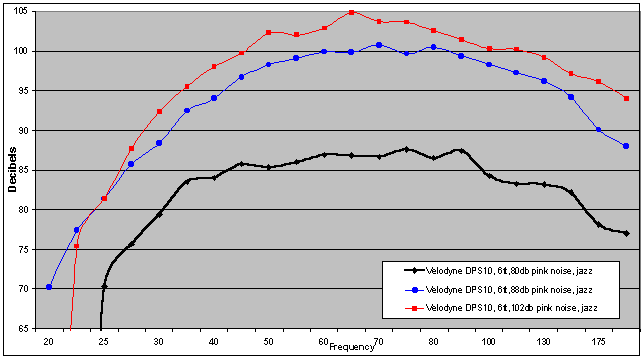
Graph1 Frequency Response Measurements at Various SPL Levels (Jazz EQ Mode Only)
Three curves were measured in an open space, you should expect about 6db of gain in an indoor setting. The first curve yielded a peak of 87db at a distance of 6 feet. Reducing that to a standard 1 meter distance would add 6db, as would placing the sub indoors. In other words, at this level you would have a peak of about 99db at one meter indoors, quite an output. You would be loco to listen to peaks much louder.
The other two curves, if measured indoors would have a peak at one meter of about 112db and 116db (now you would have to be muy loco ). However, you can see considerable compression kicks in. This is visually evidenced by a less flat curve at higher levels.
On the first curve the -6db point (from peak) is somewhere around the 35Hz mark, and -10 around 25Hz. This in effect would have the result of giving small and miniature speakers the low end extension of what would be considered "full-range" speakers. So your handful sized speakers with a high WAF rating, can now have respectable bass extension, for not a lot of money in a fairly small and attractive package, with no pretensions of aspiring to high-end performance. This really is what this subwoofer is intended for, and again, it is very important to understand this context.
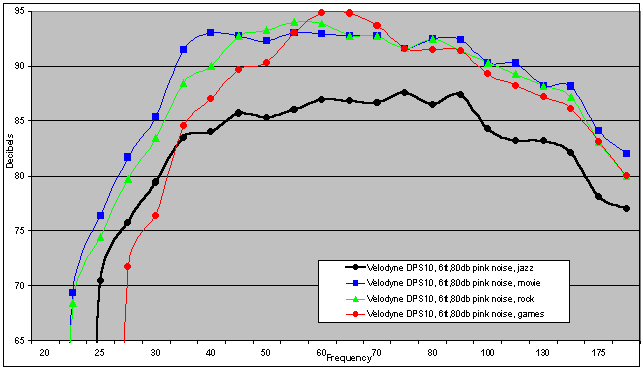
Graph2 Frequency Response Measurements for Various EQ Settings
For kicks I measured the various presets, and it pretty much reflects the intended spikes in response. The "Jazz/Classical" mode yields the flattest curve, and I would recommend sticking with it for all applications.
DPS-10 Listening Evaluation
Used in my home theater, the DPS-10 was compared to my reference Velodyne F1500R. This, of course, is a mercilessly unfair comparison. For one, the F1500R retailed for $1700 when last sold and is built to a hallmark standard. Both subwoofers were easily able to attain output levels to match the other speakers per the test tones from my receiver; this reinforces my long held belief that gross output levels are not the major challenge when building a subwoofer (unless they are to be used in cavernous halls or to molder your ears and home). To be fair to the price point this product is offered at, I did the Home Theater evaluations from three perspectives; no subwoofer ($0), the DPS-10 ($449) and the F1500R ($1700).
In my Home Theater I use NHT super-zeros all around, their mechanical cutoff and the crossover in my receiver is 80Hz. Output levels from both subs and all the speakers were adjusted using the test tones from the receiver and my handy-dandy Radio Shack SPL meter.
Over several movies, the results were pretty much consistent and predictable. I will use the "Tyrannosaurus Rex" scene from Jurassic Park to detail my findings. In the first scenario I used no subwoofer, which resulted in the dinosaur's foot stomps to sound like someone banging on a little tin can. This is what one would expect to hear when only the harmonics above 80Hz were being reproduced in this scene.
With the DPS-10 turned on, there was a dramatic improvement in the experience. The footsteps were heard at a fairly high volume, with the response being deep and extended enough to convince you that a T-Rex was headed your way.
I would have been quite happy with the DPS-10 experience if I had not heard the same scene with the F1500R. Now the experience changes in a couple of ways. The stomps were actually not quite as loud as with the DPS-10, but they were much deeper. So much so that, I actually felt the stomps more than I heard them. Nothing tells your brain to run for cover like sub-20Hz thumps getting progressively louder. Even though you know it is a movie, you do start to experience the feelings of dread and anxiety you were intended to. But, this small enhancement in experience will cost you a whole lot more money.
In summary, I would say that in a home theater application you could tremendously elevate your experience by adding this $449 subwoofer. And if you want to take it to a THX cinema level experience be prepared to spend multiples ($1700 in my case). The reasons for distinction are simple: the F1500R is rated flat to below 20Hz and would sound louder and deeper on frequencies about 50Hz and below. The DPS 10 has a peak around 70Hz and a sharp drop-off below 40Hz, and I can only suspect that an intentionally underdamped response to provide more resonance and the impression of more output.
Also, keep in mind that the distinction between the DPS-10 and F1500R would be most noticeable on passages where sonically there is not much else going on other than the LF effects. In passages where a lot more is going on at many frequencies (e.g. gun battles) it would be much more difficult to pick out the differences. The gun battle scene in the Matrix has a lot going on at many frequencies, and the boominess is hard to pickout. Actually, the overall sensation registers a bit deeper with the DPS-10 since the booms, bangs and crashes all meld into a terrifying sensation. But in scenes such as in Jurassic Park with the T-Rex approaching, the footsteps sounded much too boomy and muddy with the DPS-10; while much deeper, cleaner and convincing with the F1500R.
Now, I know I said that I would not evaluate this product from my usual context of two-channel music-only. But, the curiosity was just killing me, and I know my loyal readers (all three of them, including my mom) would want to see this as well. The critical listening tests were done in comparison to my reference ACI Force ($750). I originally intended to do these tests outside, at the same location I did the measurements at, but unfortunately the weather did not cooperate for weeks and the pressure of a deadline forced me to compromise. I conducted the tests indoors, with the two subwoofers placed side by side on a transverse axis of the room so each sub 'saw' the same room profile. The intent being, that if I cannot prevent room modes then at least attempt to have both units subject to the same modes, hence equalizing the playing field and making the comparison fair, if not accurate.
The units were calibrated for the same output level at 40Hz, and were connected directly to the outputs of my disc player. These tests were done at a distance of about three feet from the subwoofers and without the use of satellite speakers. The crossover was set to 200Hz on both units. The Velodyne was on the "Jazz/Classical" preset unless specified. Here is what I heard:
'Bass resolution test' (Chesky Records;Chesky Jazz and Audiophile tests Vol2;Chesky;JD68)
The Velodyne gave the double bass an excessive bloom, and sounded unnatural and underdamped. Although the peaks were a bit louder with the Velodyne, it was likely due to the ACI having a flatter response relative to 40Hz and did not sound better or convincing. Using the "R & B/Rock" or "Games" presets the sound was completely unbearable. Again, I would not recommend using those for music.
Without comparison to the ACI the Velodyne may have sounded like the bass was deep and extended. But in direct comparison it was appeared that the Velodyne had an exaggerated hump in its response curve (as is also seen in the measurements).
'Rimshot' (Eryka Badu; Baduism; Universal; UD53027)
The electric bass riffs on the start of this track run quite deep and loud. Again, the Velodyne sounded very loose and boomy, to the extent that the definition of the individual notes were lost in the resonances and the clattering of things in my listening room.
The difference in sound quality was more than subtle from a frequency response, speed, and control perspective. I did not even attempt to see how well the Velodyne would mate to an "agile" speaker such as the Triangle Titus. That may have been almost sadistic.
The price differential between these models is about $300, but they were designed with entirely different goals. The Velodyne DPS-10 focuses on low cost, SPL levels, features, aesthetics and digital processing. I would have to say that it successfully met all of its goals. The ACI Force on the other hand focuses on system integration and performance level to audiophile standards. The ACI also meets its stated goals, and for a ridiculously low price relative to the market (she ain't my baby for nothin'). These findings are a perfect example of why I advise folks to first understand what a designer's goals are for any product. Given an honest answer and a competent designer, you can quickly gauge if a product should interest you or not. While I have found most designers of audio products today to be quite competent, I do not always find an honest answer when inquiring about a product's limitations.
DPS-10 Review Summary & Conclusion
I have never evaluated a subwoofer at this price point. Based on an MSRP of $449, I would guess that the manufacturing cost of the DPS-10 is somewhere in the low hundreds. I cannot comprehend how a subwoofer can even be conceived at such a price. With that said, I suppose that is an accomplishment in itself.
As an entry-level product for home theater and gaming applications, this unit has the capability of delivering the needed SPLs and response low enough to significantly enhance the sense of realism and involvement. I do have reservations with the sound of this product from a two-channel audiophile perspective, but that is irrelevant to what this product is intended for. As far as I am concerned, this product meets all its stated goals.
The Score Card
The scoring below is based on each piece of equipment doing the duty it is designed for. The numbers are weighed heavily with respect to the individual cost of each unit, thus giving a rating roughly equal to:
Performance × Price Factor/Value = Rating
Audioholics.com note: The ratings indicated below are based on subjective listening and objective testing of the product in question. The rating scale is based on performance/value ratio. If you notice better performing products in future reviews that have lower numbers in certain areas, be aware that the value factor is most likely the culprit. Other Audioholics reviewers may rate products solely based on performance, and each reviewer has his/her own system for ratings.
Audioholics Rating Scale
 — Excellent
- — Very Good
- — Good
- — Fair
- — Poor
| Metric | Rating |
|---|---|
| Bass Extension | |
| Bass Accuracy | |
| Build Quality | |
| Fit and Finish | |
| Ergonomics & Usability | |
| Features | |
| Performance | |
| Value | |
 Subscribe to our newsletter
