


SV Sound PB2-ISD Subwoofer Review
SV Sound PB2-ISD
- Product Name: PB2-ISD
- Manufacturer: SV Sound
- Performance Rating:

- Value Rating:
- Review Date: October 31, 2006 08:25
- MSRP: $ 899
Driver Type:
2 down-firing 12” long-throw woofers
Ports: 3 rear-firing
(configurable)
Power: 600Wrms; 1450 peak
Freq Response: 16Hz
– 150Hz +/- 1.75dB
Crossover: 2nd Order Low Pass Network
Crossover Freq: 40Hz
– 120Hz; Bypass mode
Phase: 0-180 degrees variable
Dimensions: 28” x
18” x 25”
Weight: 140lbs
Pros
- Plays strong and low down to ~16Hz
- Very high SPL output capability
- Excellent value
- Excellent performance for both music and home theater use
- Variable phase adjustment
Cons
- Heavy (~$100 shipping)
- Extremely large enclosure; not for smaller rooms
- Can damage drivers with improper setup
As a teenager living in Orlando , I remember parking out near the International Airport to experience the jets as they came in for a landing – Wayne’s World style. Anyone who has lived in Orlando knows the “Jet City” is plagued with an almost non-stop barrage of aircraft coming in from all directions to land at what is arguably the world’s nicest airport. Trouble is, the surrounding area is naturally pummeled with the constant overhead noise of McDonnell Douglas/Boeing engines and the steady ring of planes on final approach. But up close, the jets take on an altogether different feel. Noise becomes power. Power is felt in a tactile way that pervades every part of your body and rattles you to the core. That feeling – the extreme low-end thrust that accompanied the landing was what I thought should be the mark of a great home theater subwoofer. In fact, I knew throughout the years that many of the subwoofers I experienced in people’s homes or as part of home theater satellite systems were merely toys – shadows of the “reality” they were attempting to portray.
Several weeks ago, during a discussion about surround sound system, one of my newest friends said to me : “All subwoofers are the same – boom is boom. It doesn’t matter who makes it.” I sat him down in my living room (it was the first time he had been to our home) and proceeded to play one of his favorite movies. After having him listen to my system, and with his mouth hanging open, he and his wife commented that it sounded “better than a movie theater.” It was at this point that I asked him if he would like to hear the same scene with the subwoofer turned on . The rest, as we say... was history.
Subwoofers can fall into one of two uses in any given home theater system. Quite often, in a budget system, they function to supply the required frequencies that a satellite system cannot attain on its own (sometimes including upper-frequency ranges that even allow dialogue through). Subwoofers in these systems cover a broader range of sound resulting in greater harmonic distortion, less efficiency at lower frequencies, and having to appropriate power across a wider range of material. The second use, where subwoofers are configured to handle frequencies anywhere from 80Hz and below, is where subwoofers have a fighting chance to really shine. Though capable of more, their amplifiers and drivers are used within a narrower frequency spectrum and the remaining home theater system is fully capable of driving the main thrust of the listening experience. Let’s begin here with the Outlaw Audio LFM-1 and SV Subwoofers’ PB2-ISD, two subs that are utilized in a system modeled after the second scenario.
SV Sound PB2-ISD Setup
Ron Stimpson of SV Subwoofers (SVS to their fans) made some pretty colorful claims about his subwoofer prior to our review. I recalled him using words such as “Hoochi MAMA …that’s bass!!” to describe our likely reaction to his product. While this may seem comical (OK, it was funny) it also shows the confidence and pride that SVS has in its products (just read through their website to find more, almost comical, marketing diatribes). One consistent claim made by SVS was that the louder you played their sub, the farther it would leave the competition behind.
We really liked the configurability of the PB2-ISD sub. For those who like to customize their sound, this SVS sub allows you to utilize a 1, 2 or 3 port configuration by way of dense foam inserts which can tune the sub to either 25Hz, 20Hz or even 16Hz depending upon the room and sub placement. A subsonic filter coordinates the electronics to match the desired tuning of the cabinet. Your listening preferences and mostly your room size will determine the settings you should select for the PB2-ISD sub. We ran the subwoofer with one port and the subsonic filter disengaged to allow the sub to reach to its lowest depths. In our medium-sized Reference System 3, this produced incredible low frequency response with no sign of bottoming out; however we never attempted to max out the capabilities of the system at this setting (which isn’t recommended). Adjusting the subwoofer to utilize 2 ports and a 20Hz setting on the subsonic filter seemed to be the best setting for cranking out ridiculous amounts of bass while not risking overdriving the unit. Even with subsonic filter and ports set to 20Hz, the sub was found to dip as low as 15Hz in our room.
Build Quality – SV Subwoofers PB2-ISD
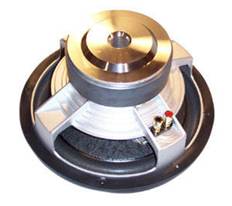 The
SVS PB2-ISD drivers are made at Destijl Engineering in Nevada and are by far one of the nicest subwoofer drivers I
have ever seen in a boxed enclosure. From the peek we give you of the inside of
the SVS sub, you’d expect to have a transparent plexiglas panel on the top
allowing you to see into the unit. From the chrome finish to the car-audio
style gold-braid cables, this sub spares no expense in the aesthetics of its
components.
The
SVS PB2-ISD drivers are made at Destijl Engineering in Nevada and are by far one of the nicest subwoofer drivers I
have ever seen in a boxed enclosure. From the peek we give you of the inside of
the SVS sub, you’d expect to have a transparent plexiglas panel on the top
allowing you to see into the unit. From the chrome finish to the car-audio
style gold-braid cables, this sub spares no expense in the aesthetics of its
components.
The 600W BASH amplifier employed in the PD2-ISD is manufactured by Indigo and sports a high-efficiency design that combines some of the characteristics of Class AB and Class D technology. The drivers are... well, they’re CHROMED! Okay, besides that, they employ similar vented pole piece cooling and are made with a cast aluminum basket and rigid Kevlar/pulp cone. The three ports are flared both inside and out, allowing for plenty of relief to help alleviate port chuffing, though you will undoubtedly hear it if you run this sub at high SPLs while in 16Hz tuning mode.
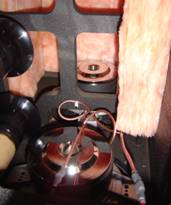 The
bracing and “owens-corning” style dampening found within the unit was top
notch, ensuring that the enclosure was as sufficiently neutralized as possible.
The cabinet itself is extremely dense and thick and comes with an integrated
base plate that ensures consistent source propagation of the sound and
eliminates problems due to excessively high pile carpet and typical floor
variances. Foam rubber feet are present on the bottom of the base, and though
we dragged the sub around the carpet quite a bit, not one of the feet fell off
or ever came loose.
The
bracing and “owens-corning” style dampening found within the unit was top
notch, ensuring that the enclosure was as sufficiently neutralized as possible.
The cabinet itself is extremely dense and thick and comes with an integrated
base plate that ensures consistent source propagation of the sound and
eliminates problems due to excessively high pile carpet and typical floor
variances. Foam rubber feet are present on the bottom of the base, and though
we dragged the sub around the carpet quite a bit, not one of the feet fell off
or ever came loose.
The external enclosure sports a unique polyurethane cured black top coat which provides a rather rough (yet almost indestructible) surface that can withstand stains and scratches, not to mention fingerprints. It is indeed something you could set your drink on without worrying if you would mar the finish. This polymer coating is pretty much seamless and surrounds the entire enclosure – which SVS claims adds to the dampening and structural integrity of the cabinet. Our opinion is that we’d probably opt for the PB1-Plus which is nearly the same SVS sub (though with a little less power and only 1 driver) available with five choices of hard maple veneers – for only $200 more (the PB1-Plus includes an upgraded TC Sounds driver and a single parametric EQ which is a great thing to have as well).
PB2-ISD Listening Tests and Conclusion
Like the ads for the 1998 remake of Godzilla stated: “Size Does Matter.” We configured the SVS PB2-ISD to 2 different frequencies, and ran listening tests on each. For the first round we set the subsonic filter to “Bypass” and left only the one (top) port open. This configuration basically allows the subwoofer to achieve the lowest possible frequency response at the sacrifice of some SPLs at higher frequencies (see inset below.)
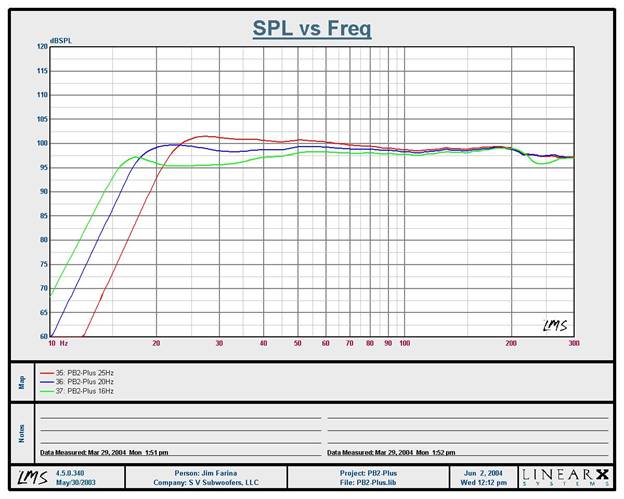
This graph is an anechoic chamber
measurement of the PB2-Plus subwoofer,
but is similar to the frequency response of the PB2-ISD and gives you an idea of how the subsonic filter and porting options affect frequency response.
It was during these listening tests that I was absolutely floored by the response and the felt realism of the subwoofer. Playing down to 15-16Hz is impressive, but playing that low at SPL levels that are actually audible (if you call it that) is something that needs to be experienced.
For the remainder of the listening sessions I altered the tuning of the SV subwoofer so that the subsonic filter was at 20Hz and 2 ports (the top two) were opened. There was a slight discernable drop in extension but a noticeable rise in SPL capability. We determined that this was probably the optimal setting for Reference System 3 (and probably for any medium-sized rooms that want to be able to play loud content without maxing out the driver and generating excess port noise.) Keep in mind that you will need to reset your reference levels with an SPL meter after altering the subsonic filter and port configuration. In this case, there was a 6dB gain in SPL simply from going from the 16Hz to the 20Hz tuning configuration.
All in all, the SVS sub picks up where the LFM-1 leaves off. Lower extension, even greater tactile energy transmission to the viewer, and the ability to quite possibly shake the foundation of a home, mark the characteristics of the PB2-ISD subwoofer. At equal SPL levels, the SVS subwoofer only slightly edges out the LFM-1 in terms of the above characteristics, however those gains are not as prominent in a medium sized room such as Reference System 3 . I did crank the SVS subwoofer to somewhat insane listening levels and have to admit – there is no substitute for the ability to play clean, hard and loud. Explosions took on a more realistic feel (and I mean feel) and the extra low frequency extension gave an ever so slight edge to many of the reference material scenes we listened to.
I would have to say that the SVS sub produces very theatrical sound. Indeed, it will provide more energy to the listening position than the local theaters - in this area at least. If you have a larger room, or need extreme SPL levels, this sub will perform.
We did some in-room measurements of the Outlaw Audio LFM-1 and the SVS PB2-ISD subwoofer using the Rives Audio Professional Test Kit and I think the results are surprising:
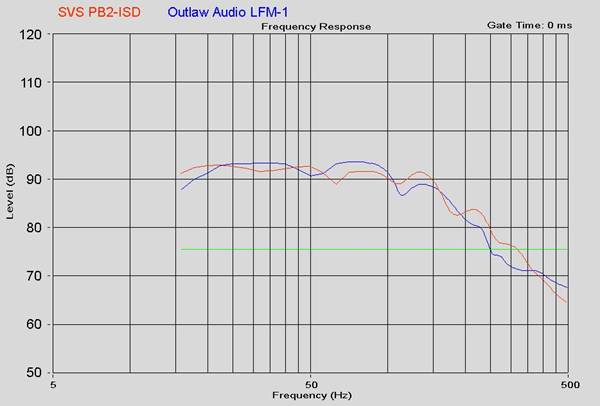
The above measurement is a low frequency sweep test using the Rives Audio Professional Test Kit. It was taken with the output of the sound card fed directly into each subwoofer and the microphone placed at the listening position. The units tracked fairly closely, with the LFM providing a bit more overall power around 50-60Hz and the SVS extending better down into the 20Hz region. Room modes aside, both subs provided excellent frequency response at 60Hz and below, which is where the system crossover point was set during most listening tests.
Subjective Listening Tests – Music
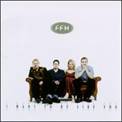
FFH’s I Want to Be Like You CD has always been an album I go back to when I want to clearly monitor, not the low end extension of a sub, but the gentle sound of understated and sustained bass guitar. Calling up the title track and track 10 “Breathe In Me” we were able to hear that the SVS sub rendered flavor to these songs in a way that was natural and complete. The melodic bass lines in the latter track would sound just awful on lesser subs that tend to blare out monotonous thuds instead of expressive frequency-rich music from what is supposed to fill the lower spectrum of your home theater system. It seems that Godzilla does indeed have a soul – and that’s good to know.

For heart-pounding bass, we popped in a trusty copy of Seal’s 1991 album and cranked it up with the sub set to a tuning frequency of 20Hz (two ports open). At SPLs measuring over 98dB from the listening position (yes we could have gone louder, but adding more hot sauce to your wings has a point of diminishing returns too, no?) the SVS sub was kicking into high gear where it was made to run free, unencumbered by such things as volume constraints and compact enclosures. Track 3 at about 5:15 yields some incredibly deep bass (around 22Hz) that just about rattled the teeth out of my head as I sat listening to the PB2-ISD punch through it with ease. Many 8” and 10” subwoofers won’t even play these notes audibly unless the system is turned up very loud – usually resulting in low frequency distortion or clipping. SVS’ tectonic plate shifter didn’t even break a sweat.
Conclusion
At the end of this review I had finished listening to two incredibly different and unique subs. The LFM-1 from Outlaw Audio is a stellar value performer – but it doesn’t stop there. It held its own against a much bigger, more expensive competitor under normal use loads. Producing an incredible (almost unbelievable) amount of tactile energy during home theater and music use, the LFM-1 had me constantly checking myself to see if I had mistakenly left the SVS subwoofer connected. That kind of frequency response and performance out of a package that is nearly 50% less in volume and about 40% lower in price is something to be acknowledged.
The SVS subwoofer is a bit of an enigma. Not because of anything bad, but because the unit sounds incredible but has none of the space-saving characteristics commonly found on other units. Is it the lack of self-imposed space constraints that makes the sub sound so good? Or is there something else at work? Its performance can be described as flat and yes, even musical. I couldn’t find a serious limitation or flaw, save overdriving the unit while tuned for 16Hz. The SVS has almost limitless power for most applications and doesn’t suffer from any of the typical constraints associated with making a subwoofer that fits through doors or doesn’t require a crane operator to get it into your house (OK, it’s not that big!) My overall impression of the PB2-ISD was that I wished it could pack this punch into a smaller package – but I still never wanted to let it leave my room – and that’s a pretty big compliment.
For those of you who still think “boom is boom. It doesn’t matter who makes it...” I offer these two subwoofers to you for trial. I think you’ll be pleasantly surprised.
The Score Card
The scoring below is based on each piece of equipment doing the duty it is designed for. The numbers are weighed heavily with respect to the individual cost of each unit, thus giving a rating roughly equal to:
Performance × Price Factor/Value = Rating
Audioholics.com note: The ratings indicated below are based on subjective listening and objective testing of the product in question. The rating scale is based on performance/value ratio. If you notice better performing products in future reviews that have lower numbers in certain areas, be aware that the value factor is most likely the culprit. Other Audioholics reviewers may rate products solely based on performance, and each reviewer has his/her own system for ratings.
Audioholics Rating Scale
 — Excellent
- — Very Good
- — Good
- — Fair
- — Poor
| Metric | Rating |
|---|---|
| Bass Extension | |
| Bass Accuracy | |
| Build Quality | |
| Ergonomics & Usability | |
| Performance | |
| Value | |
Clint Deboer was terminated from Audioholics for misconduct on April 4th, 2014. He no longer represents Audioholics in any fashion.
View full profile Subscribe to our newsletter