


Sunfire HRS-12 Powered Subwoofer Review
Sunfire HRS-12 Powered Subwoofer
- Product Name: HRS-12
- Manufacturer: Sunfire Corporation
- Performance Rating:


- Value Rating:
- Review Date: March 24, 2008 11:45
- MSRP: $ 899
Enclosure: Front firing sealed enclosure
Amplifier Type: Proprietary Tracking Down Converter Design
Amplifier Power (RMS): 1000 Watts
Power Consumption (avg./peak/stand by): 600 W/2000 W/16 W
Bass Extension (-3dB): 18 Hz
Woofer: 12" polymer treated paper cone
Preamp gain: Defeat to +15 dB
Crossover Frequency: 30 Hz to 100 Hz
Crossover type: Continuous variable low pass filter with bypass
Crossover Slope: -24db/octave
Phase: Continuous variable 0 to 180 degrees
Dimensions: (HxWxD): 13.5" x 13.5" x 13.5"
Weight (lbs): 38 lbs.
Pros
- A big subwoofer in a little subwoofer’s body
- Plenty of power, output, and depth
- Attractive finish and/or small size help with WAF
Cons
- Soft clipping circuitry does kick in at times
Sunfire HRS-12 Design and Construction
I have become Subwoofer Man.
At least that is what Gene and Clint seem to think now that I have that pair of Fathoms sitting in my home theater system. I’ve been asked to do more reviews of subwoofers since the JL Audio review than I have had a chance to get to, and now two of the last three reviews I’ve authored are subs.
That’s ok. Being subwoofer man can be fun, especially when I am sent subwoofers with power output that exceeds the total output from all channels of the majority of multi channel receivers on the market. Powerful, deep, clean bass is where all the fun is in movies and it certainly makes viewing much more engaging.
This is where Sunfire comes into this picture. Sunfire Corporation has brought a new line of subwoofers to market called the High Resolution Series (HRS), and Clint asked if I wanted to have a look at them. So, I asked for two.
For any readers unfamiliar with Sunfire Corporation, it is the brainchild of Mr. Bob Carver, a well known name that has been around in hi-fi circles for many years. Bob Carver is probably best known for his long history of manufacturing electronics and speakers that he sold under his namesake Carver brand. In the mid Eighties, Carver also gained some infamy with certain high end audio publications when he tweaked a $550 Carver amplifier to be indistinguishable from a $12,000 amplifier selected by the magazines using off the shelf parts and null difference testing to match transfer functions to -70 dB and the staff could not identify the copy from the actual amplifier.
Carver Corporation operated from the 1970s into the 1990s, primarily producing high end audio preamplifiers and power amplifiers. Much of Carver’s work became associated with Sonic Holography, a proprietary processing filter that was incorporated into many Carver products. Several notable products from Carver’s history include the Silver Seven and Silver Nine amplifiers as well as the Carver Amazing Loudspeaker, a design that utilized a full range, 60 inch long ribbon driver supplemented with four 12 inch woofers.
Bob Carver introduced Sunfire Corporation in 1994 and soon launched the Sunfire True Subwoofer, a diminutive 11 inch cube that boasted a 2700 watt amplifier with dual 8 inch drivers. The High Resolution Series (HRS) subwoofers are the latest in Sunfire’s product line and are said to draw from Sunfire’s current 2700 watt flagship SubRosa subwoofer. The HRS series consists of three different subwoofer models available with 8, 10, and 12 inch diameter drivers all powered by what appears to be an identical power amplifier design.
Design and Construction
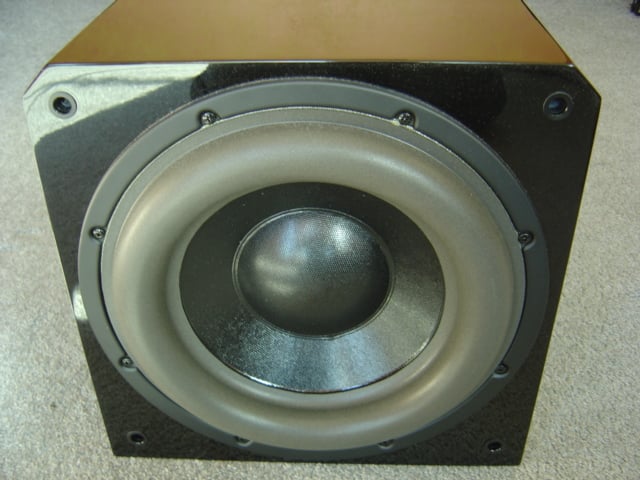 The HRS-12 is a
modestly sized powered subwoofer with a front firing 12 inch driver housed in a
cubic enclosure that is a mere 1½ inch larger than the driver. Considering that standard cabinet design is
¾” MDF, the HRS-12 is no larger than the driver and the thickness of the panel
to either side. The cabinet design is a
sealed enclosure that weighs in at a mere 38 pounds.
The HRS-12 is a
modestly sized powered subwoofer with a front firing 12 inch driver housed in a
cubic enclosure that is a mere 1½ inch larger than the driver. Considering that standard cabinet design is
¾” MDF, the HRS-12 is no larger than the driver and the thickness of the panel
to either side. The cabinet design is a
sealed enclosure that weighs in at a mere 38 pounds.
The HRS series subwoofers are available primarily with one finish: gloss black. The finish is not a true piano gloss black lacquer, but rather, a vinyl laminate that pulls off a very good approximation of a lacquer finish from a distance, so unless ones guests are poking around in the corners and under the end tables, it is very likely that no one will ever know the difference. The one exception to the single finish option is the HRS-8, which is also available in a glossy white finish, something they say appeals to the European crowd and those in southern climates.
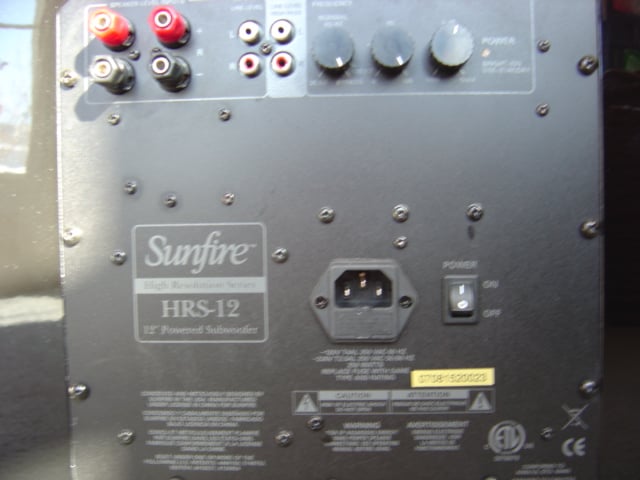 As is standard for most
subwoofers, the various controls, connections, and the internal amplifier are
plate mounted at the back of the HRS-12.
Audio connections and controls are located across the top of the back plate. Audio connection options include binding
posts for speaker level inputs, single ended (RCA) line inputs, and RCA high
pass outputs that have a fixed frequency crossover of 70 Hz. The inputs include automatic standby
capability that can detect input signal and move the subwoofer between on and
standby when the main power switch is left on.
As is standard for most
subwoofers, the various controls, connections, and the internal amplifier are
plate mounted at the back of the HRS-12.
Audio connections and controls are located across the top of the back plate. Audio connection options include binding
posts for speaker level inputs, single ended (RCA) line inputs, and RCA high
pass outputs that have a fixed frequency crossover of 70 Hz. The inputs include automatic standby
capability that can detect input signal and move the subwoofer between on and
standby when the main power switch is left on.
All of the controls for signal processing utilize knobs that allow continuously variable settings. The crossover on the sub can be set anywhere between 30 and 100 Hz and frequency bypass is accommodated when the knob is turned completely clockwise. The remaining knobs are for volume and phase, which can be set anywhere from 0 to 180 degrees of phase adjustment. Further down the back plate, near the center, is a connection for a detachable IEC power cord with fuse access located below it and a rocker power switch located next to it.
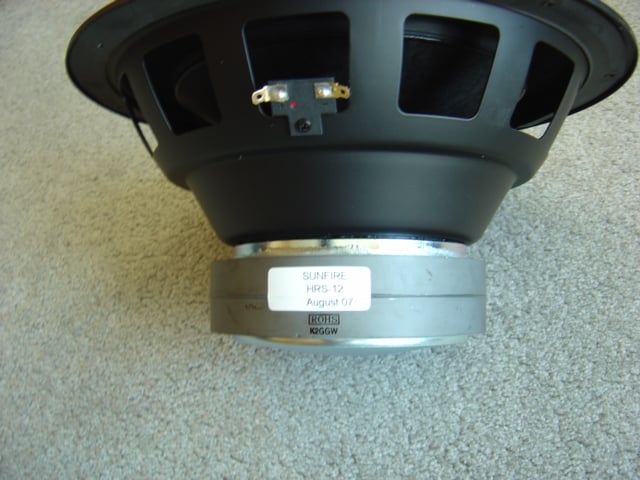
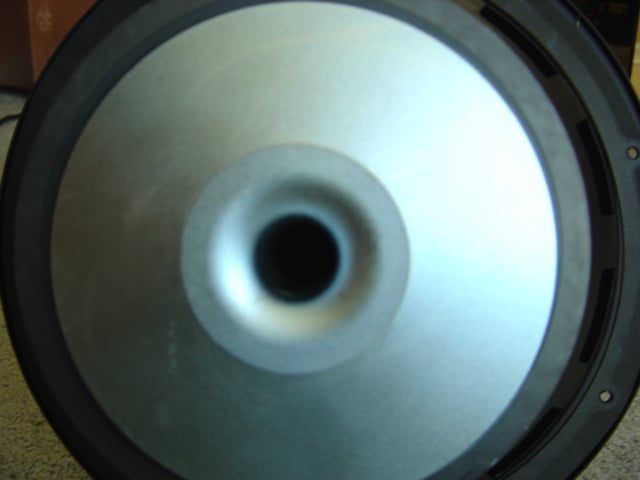
Disassembling the HRS-12 by removing the flange mounted driver, I found the cabinet construction to consist of 3/4” MDF panels with adhesive sealed joints. Internal bracing consists of mid-panel joint reinforcing which serves to stiffen the panels by restraining panel edge rotation. The driver assembly is flange mounted to the face with eight machine screws that supports a cast metal frame and a substantial motor structure. At the back of the motor magnet, there is a flared opening at the center, apparently to improve thermal venting.
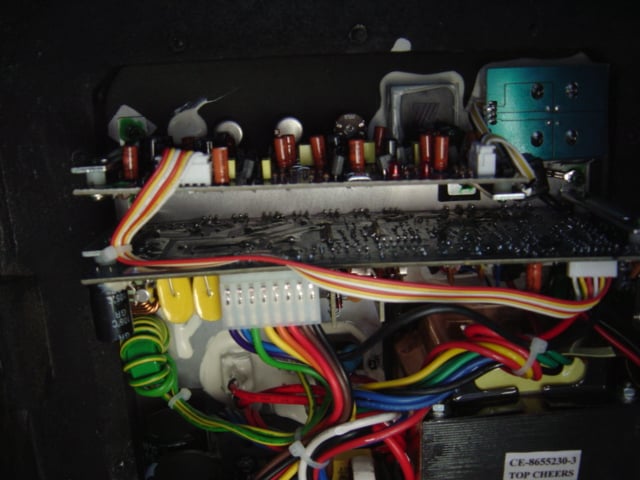
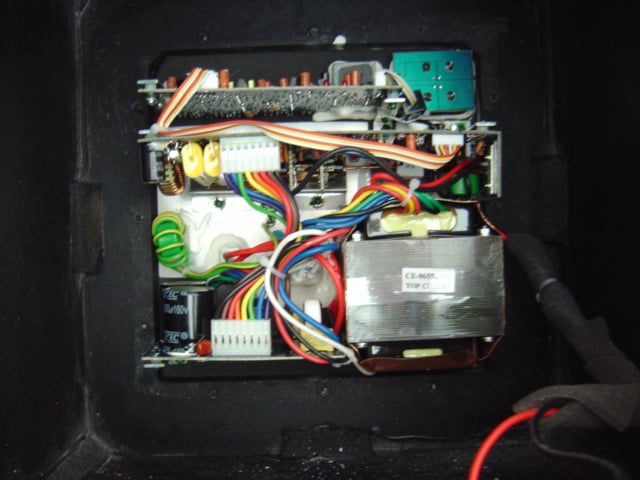 The
amplifier section is mounted to the back plate, occupying the entire available
surface area with functions divided up corresponding to the inputs and controls
on the exterior of the plate. The bottom
half is dedicated to power supply with a decent size EI core transformer to one
side and the main power supply board to the other. This main board is home to a couple of 1000 microfarads, 160V main power supply capacitors. Two boards for input/processing and
amplification occupy the top half of the plate. It’s little and its light, but the HRS-12 has it where it counts: a
kilowatt RMS rated amplifier section. That’s quite impressive for a 38 lb subwoofer. What is also impressive is a specified 18 Hz
–3 dB roll off point on an enclosed subwoofer design that is housed in a 13.5”
cubic cabinet.
The
amplifier section is mounted to the back plate, occupying the entire available
surface area with functions divided up corresponding to the inputs and controls
on the exterior of the plate. The bottom
half is dedicated to power supply with a decent size EI core transformer to one
side and the main power supply board to the other. This main board is home to a couple of 1000 microfarads, 160V main power supply capacitors. Two boards for input/processing and
amplification occupy the top half of the plate. It’s little and its light, but the HRS-12 has it where it counts: a
kilowatt RMS rated amplifier section. That’s quite impressive for a 38 lb subwoofer. What is also impressive is a specified 18 Hz
–3 dB roll off point on an enclosed subwoofer design that is housed in a 13.5”
cubic cabinet.
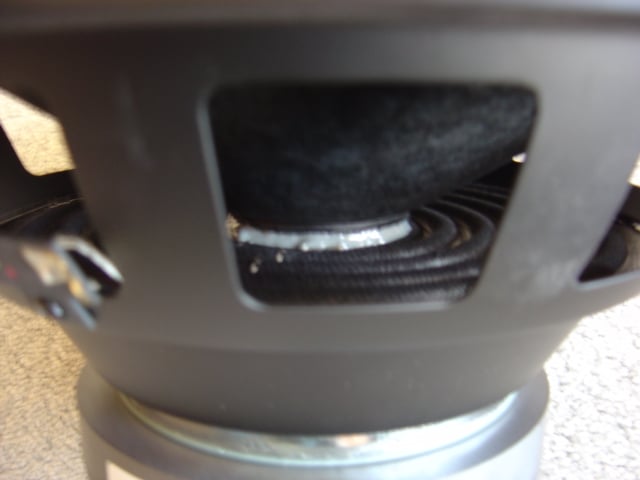
Sunfire says that the HRS drivers feature an extra long throw driver utilizing a new ultra low mass cone design. The HRS-12 drivers use an embossed 12” polymer treated paper cone with a treated foam surround roll. Movement of the driver cone is controlled and limited at two points in a standard dynamic driver, at the voice coil and the surround. The large surround gives the sub the ability to accommodate large driver movement while remaining in the linear range, which is important to move the amount of air required by bass frequencies to develop accurate high SPL output especially with such a small enclosure. The user’s manual qualitatively suggests that the HRS driver design allows for an excursion range that is five times greater than typical designs, but does not specify what that number in fact is.
 The driver motor utilizes Sunfire’s High Back EMF technology
(patent 5,937,074), which is said to allow substantial deep bass output from a
small cabinet. Small sealed cabinets
have to generate higher internal pressures to match the frequency response
depth and SPL output of larger cabinets.
This in turn requires larger motor forces to overcome the resistance to
driver motion at these high outputs.
Heat becomes a problem if the solution to providing the force is just to
dump additional amplifier power into the motor, which can lead to voice coil
damage. The High Back EMF driver
utilizes a long throw woofer design with a motor structure based around a small
bore, tightly wound voice coil with a large, oversized magnet that can develop
the high force levels required without the damaging heat levels.
The driver motor utilizes Sunfire’s High Back EMF technology
(patent 5,937,074), which is said to allow substantial deep bass output from a
small cabinet. Small sealed cabinets
have to generate higher internal pressures to match the frequency response
depth and SPL output of larger cabinets.
This in turn requires larger motor forces to overcome the resistance to
driver motion at these high outputs.
Heat becomes a problem if the solution to providing the force is just to
dump additional amplifier power into the motor, which can lead to voice coil
damage. The High Back EMF driver
utilizes a long throw woofer design with a motor structure based around a small
bore, tightly wound voice coil with a large, oversized magnet that can develop
the high force levels required without the damaging heat levels.
 The HRS series subwoofers
also employ several other proprietary Sunfire technologies. One that the HRS series has in common with
the SubRosa is referred to as Frequency Filtration Design, a sonic filter that
according to Sunfire tailors the sub’s sonic signature to provide improved
accuracy and depth. The HRS series
subwoofers also use Sunfire’s Tracking Down Converter amplifier design that is
said to run cool while capable of supplying twice the output voltage of
competing designs to provide better control of driver motion. The HRS-12s also include a signal compressor
and soft clipping circuitry to protect the units against audible distortion,
mechanical contact of the driver with supports, and voice coil damage from
amplifier clipping at high output SPL.
The HRS series subwoofers
also employ several other proprietary Sunfire technologies. One that the HRS series has in common with
the SubRosa is referred to as Frequency Filtration Design, a sonic filter that
according to Sunfire tailors the sub’s sonic signature to provide improved
accuracy and depth. The HRS series
subwoofers also use Sunfire’s Tracking Down Converter amplifier design that is
said to run cool while capable of supplying twice the output voltage of
competing designs to provide better control of driver motion. The HRS-12s also include a signal compressor
and soft clipping circuitry to protect the units against audible distortion,
mechanical contact of the driver with supports, and voice coil damage from
amplifier clipping at high output SPL.
System Setup
There were no surprises with setting up the HRS-12 subwoofer. Once an acoustically acceptable location has been preselected, place the sub, plug it in, and adjust the controls. If the subwoofer is used for an LFE channel with processor bass management, crossover bypass can be selected by rotating the crossover frequency knob fully clockwise, otherwise dial in an appropriate frequency based on the roll off point of the accompanying main channels. Next, using a full range source signal, adjust the phase to the setting that produces highest bass output with the main speakers. Finally, manually adjust the volume level to balance the overall system frequency response and use the processor functions for speaker setup to tweak the final output setting.
Sunfire HRS-12 Listening Tests
I evaluated the HRS-12 subwoofers using my A/V setup with a Toshiba HD-A2 used as source for HD-DVD, DVD, and CD content. Audio processing and amplification were provided for using the Rotel RSX-1067 to drive a 7 channel Infinity Beta speaker array and provide bass management at an 80 Hz crossover point. Source material used for the review was reproduced in its native format, either multi-channel or stereo, with the Rotel set to two channel mode for stereo material and the Beta 40 towers engaged for mid and upper frequencies.
After a recent bout of being provided a single subwoofer for review, I requested two HRS-12s and Sunfire graciously accommodated my request. Multiple subwoofers can be used to help limit modal coupling of bass frequencies to the room through judicious placement of the subs relative to the room, each other, and the listening position. I typically run dual subwoofers and shifting to a single sub presents an extra difficulty to sort out what is really coming from the sub and not from the room acoustics, which is best avoided if possible.
Editorial Note on Multiple Subwoofers
Multiple subwoofers are a good choice to smooth frequency response by minimizing room modal behavior through cancellation. Strategic placement of the subs at opposing nodal points for frequencies that trouble the listening area can be used to nullify the worst dips and peaks from the room modes. This is a distinct advantage over equalization, which can only trim peaks but not fill dips.My own experience with running multiple subs has been a stark improvement with smoother frequency response, improved bass detail, and increased depth at the bottom end beyond what a single well placed sub can muster.
As I listened, I found that these little subs pack quite a punch. At a kilowatt of output, each, these little guys have plenty of juice to do some considerable room shaking. And they do just that.
During my stint with the HRS-12s, I found that they were able to provide a satisfying musical experience with clean, accurate bass output that conveyed timbres and transients well. When asked to speak up, these diminutive subwoofers retained a high level of composure to high output levels. I also found that the HRS-12s sonically integrated into the system seamlessly, irrespective of output level, with an effortless and naturalness to the sonic presentation at the crossover between the main channels and the subs that remained transparent with all of the source material I threw at them.
It’s certainly no secret that movie LFE tracks contain an awful lot of intense deep bass content. That being said, I can not emphasize enough the benefits of depth and headroom in the subwoofer department, cracking plaster be damned. With an 18 Hz roll off point and 1000 watts RMS output, subs such as the HRS-12 can theoretically output as much as 6 dB to 9 dB more than typical subs in the 100 to 250 watt range, all other parameters being equal. Keep in mind it takes a 10 dB SPL difference in output for the ear perceives a doubling of loudness. I’ve said this before when I reviewed the Fathoms and I will say it again here, there is no reason to waste money on vibration actuators for the furniture, just get subwoofers that can do their own butt kicking.
As for the Fathoms, in comparison, the HRS-12s did not give quite the impression of guttural depth and I found them to be slightly more colored, exhibiting less control of the driver. While the HRS-12s do not have the visceral impact, shear brute force, or absolute clarity of the f112s at high SPL, $900 will get one far closer than they would expect thanks to the effect of heavy diminishing returns for a product like the Fathoms. The HRS-12 subwoofers were quite able to do a good approximation of the amount shaking that the Fathoms provided. And for the price of a single Fathom f112, one can buy two of these subs and still bank the better part of a grand for other theater components.
Under extreme
conditions, there were times I could tell when the output limiting on the
HRS-12s kicked in, but they were providing a significant bit of room shaking
when this happened. The casual listener
will very likely not notice, the softening will not be obvious to the untrained
ear, and when compounded with the amount of shaking, which will be a definite
distraction from noticing in the first place.
While any sort of compression can be considered disagreeable from a
purist standpoint, it is certainly much less disagreeable than hearing a driver
pop or bottom out. I’ve heard overtaxed
subwoofer drivers flapping about before and it’s a killjoy to be sure, and just
when the action is getting all hot and heavy.
The bottom line is that the HRS-12 is a surprisingly powerful subwoofer, particularly when considering its size, which is capable of high output and very good sonic accuracy up to the point that the windows rattle from their frames.
The Lord
of the Rings: The Fellowship of the Ring (DTS)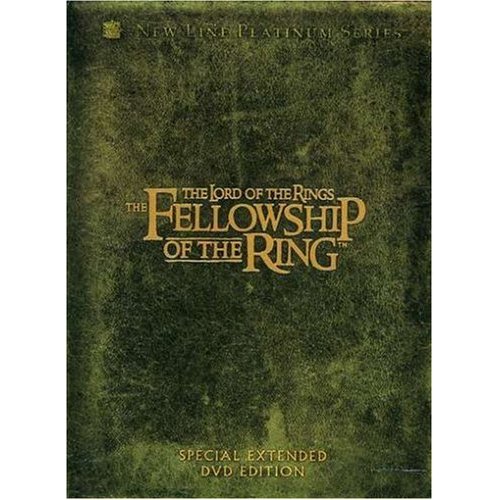 I have turned once again to
my trusty standby for evaluating subwoofers; of the three films, all with
excellent soundtracks, The Fellowship of the Ring stands out above the
other two. Using the DTS version of the
soundtrack, the audio quality is excellent and it has considerable low
frequency content in the score and the LFE to test any subwoofer
thoroughly. This combination allows one
to determine how a good sub can not only pound out special effects, but also
how well it can frame out the score with a solid foundation to contrast and
enhance the subtleties and nuance present in the midrange and treble.
I have turned once again to
my trusty standby for evaluating subwoofers; of the three films, all with
excellent soundtracks, The Fellowship of the Ring stands out above the
other two. Using the DTS version of the
soundtrack, the audio quality is excellent and it has considerable low
frequency content in the score and the LFE to test any subwoofer
thoroughly. This combination allows one
to determine how a good sub can not only pound out special effects, but also
how well it can frame out the score with a solid foundation to contrast and
enhance the subtleties and nuance present in the midrange and treble.
In many ways, familiarity with this soundtrack serves to underscore my previous assertion that the HRS-12s can hold their own among top tier subwoofers, even if they can not outperform such subwoofers in an absolute sense. Compared with the Fathoms, which are quite formidable, a soundtrack like this shows that the Sunfires could do plenty of room shaking of their own with only slight softening during extremes of output SPL and intensity. Unlike many mid-priced, midrange subwoofers, the HS-12s will have more sonic similarity to high-end products like the Fathoms than many direct peers in its price class.
Throughout the film, the HRS-12s drew attention to many of the highpoints I outlined when I first tested the Fathoms. I was supplied a copious quantity of deep, tactile bass from the LFE and the level of musicality from the presentation of the orchestral score was quite good with rich support for the reproduction of the low instrumentation. Quiet scenes where only orchestral content was present were supplied a rich and musical bottom end by the HRS-12s. Galloping hooves thundered solidly, the roar of fireworks and battles was deep and dynamic, visions of the Eye simply shook everything, and the voice of Sauron chanting spells through the Ring was penetrating. When the score and LFE competed for the HRS-12’s capacity, both were well handled well with the output from the subs staying musical and separated while they pounded away.
Matrix Revolutions (HD-DVD) The HD mastered
reissue of the Matrix Trilogy provides excellent reference quality audio
material for evaluating home theater equipment.
The remastered soundtrack is available in Dolby TrueHD and even down
mixed to DTS at 1.5 kbps for transmission via SPDIF by the HD-A2, it is clearly
superior to the Dolby Digital soundtrack available on the original DVD
release. The higher resolution codec results
in a clear improvement to the spaciousness, the amount of detail, and the
naturalness of the audio reproduction when compared to the original DVD
release.
The HD mastered
reissue of the Matrix Trilogy provides excellent reference quality audio
material for evaluating home theater equipment.
The remastered soundtrack is available in Dolby TrueHD and even down
mixed to DTS at 1.5 kbps for transmission via SPDIF by the HD-A2, it is clearly
superior to the Dolby Digital soundtrack available on the original DVD
release. The higher resolution codec results
in a clear improvement to the spaciousness, the amount of detail, and the
naturalness of the audio reproduction when compared to the original DVD
release.
The HRS-12s have the output capabilities to handle the LFE spectacularly with a disc such as this. Bass dependent sound effects such as gun fire and explosions had plenty of punch and the low end of the orchestral score was gorgeously deep, potent when demanded, but also subtle when required. Throughout the film, the Sunfires reproduced the constant low, deep rumble of machinery that is often obscured by less subtle subwoofers. The HRS-12s also distinctly conveyed quiet sections of the orchestral score where dramatic tension is underscored through subtle use of the low instrumentation that again is often ill defined by the presentation from many lesser subs.
The film opens with a staccato burst of percussion and brass that the Sunfires pumped out nicely. The depth of the low strings, both at the Train Station and while visiting the Oracle, emanated with enough intensity from the subs to slightly shudder and rumble the room, and they gave a realism to the solidity and weight of the passing trains. Heavy industrial music blared at the club where the Merovingian turns up contains a subterranean bottom end that the HRS-12s nailed. Absorption of the Oracle by Mr. Smith and Neo’s visions of the machine city were provided with a hefty rumble by the Sunfire subs. Gunfire and battle with the Sentinels in Zion was kept to a tight staccato by the Sunifres as they pulsed through my chair. Crashes, explosions, the emergence of the drillers, and the passing of the hover ship as it raced to the city were suitably intense through the HRS-12s that at times also drove my chair into resonance. All the while, the bottom end of the score stayed clean with the subs allowing a sonic independence to the music that kept everything from being compacted into the unintelligible bass bloat common in lesser subs. At the surface, the rumble of thunder, the roar of bombardment before the machine city, and the tactile depth of voice from the Source were quite intense, contrasting the quiet undulations in the low instrumentation that were given depth and subtlety as Zion waits. The same was also true of the final battle where the Sunfires kept the score dynamic, musical, and well separated while thunder and collision shockwaves rolled through the room. Closing, the score was kept deep, clean, and tight as transients in the percussion and electronics intermingled with the acoustic instruments.
The Mummy Returns (HD-DVD)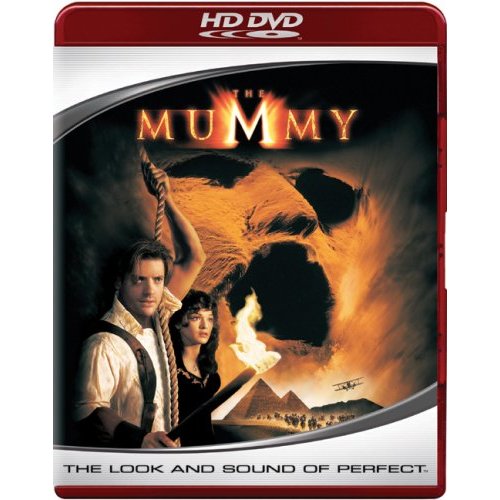 The HD remastered version of The Mummy Returns provides a
soundtrack that offers almost constant opportunity to put a subwoofer through
its paces. Despite use of only Dolby
Digital+, the soundtrack clearly shows the improvements due to the higher
resolution audio; done right with good source material, Dolby Digital+ can be
quite good. The film, of course,
provides the prerequisite LFE slam the accompanies any action movie, but it
also provides a score that makes constant use of demanding low frequency
instrumentation and percussion with a solid bottom end to the mix. The HRS-12s had both the muscle and dexterity
to do justice to the soundtrack by pounding out everything thrown at it while
retaining a musical presentation throughout.
The HD remastered version of The Mummy Returns provides a
soundtrack that offers almost constant opportunity to put a subwoofer through
its paces. Despite use of only Dolby
Digital+, the soundtrack clearly shows the improvements due to the higher
resolution audio; done right with good source material, Dolby Digital+ can be
quite good. The film, of course,
provides the prerequisite LFE slam the accompanies any action movie, but it
also provides a score that makes constant use of demanding low frequency
instrumentation and percussion with a solid bottom end to the mix. The HRS-12s had both the muscle and dexterity
to do justice to the soundtrack by pounding out everything thrown at it while
retaining a musical presentation throughout.
The soundtrack was constantly presented with all of its bottom end potency, detail, and clarity intact through the Sunfires. Even the score alone through the Sunfires, would frequently shake the room when the percussion, low strings, and brass would pipe up. The soundtrack captures the low frequency and infrasonic ambience effects from the concert hall, which features most prominently with what sounds to be a rather large concert bass drum that is given quite a beating during the entire movie. The HRS-12s did an equally admirable job when both the score and LFE picked up intensity simultaneously. With this much intense low frequency information all at once, many lesser subs would simply struggle with the peak output and make a sonic mush of the whole, compressing low instrumentation into the LFE effects, but not so with the HRS-12s, which presented the low frequency content with potency while keeping all the sonic information clean, separated, and open at the bottom.
Right from the opening, the HRS-12s were challenged with a churning low end in the score that came through both deep and solid. The Scorpion King’s army charged thunderously through these subs and after their defeat, the quiet percussion swells as the army wanders the desert were conveyed with depth and carried through with orchestral hall character. The rise of the Oasis of Ahm Shere and the destruction wrought by the Army of Anubis were dramatically propelled by the room shaking depths that the HRS-12s were able to obtain. Quiet scenes were equally stunning for quite the opposite reason as with the arrival of the O’Connells at home where piccacada double bass was light and nuanced and thunder rolls through the distance or during the dirigible flight past the Great Pyramids or as Imhotep shows Anck-su-namun her former life where swells of low strings and brass came through with a potent depth of feeling and timbrally rich through the HRS-12s. As the film comes to the climatic peak at Ahm Shere, believably deep thunder rolls though the valley with ominous low orchestration while driving percussion and gunfire displayed the excellent transients of which the Sunfires are capable. With the arrival of the Scorpiopn King, the rise of the Amy of Anubis, and the implosion of Ahm Shere at the end, the HRS-12s provided a solid bit of near seismic shaking.
Autolux: Future
Perfect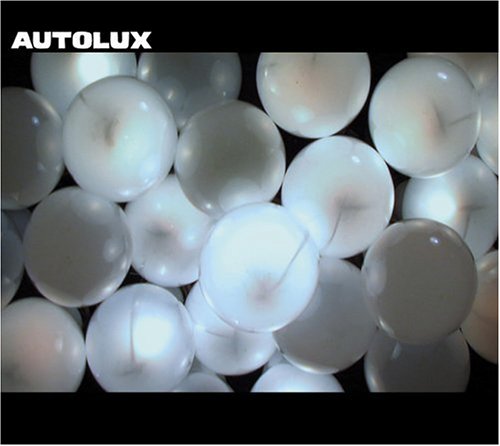 To listen to
this record, one would be hard pressed to guess that it was produced by T. Bone
Burnett. This excellent indie record
from 2004 has far more in common with the likes of Radio Head than with the
body of work Burnett has produced throughout his career as a musician. Full of dissonance, disjointed rhythms, and
nonstandard song structures, this is a fine collection of music for anyone who
appreciates a more modern, creative bent in rock music. From the standpoint of testing a subwoofer,
this musically dark album contains a lot of grinding guitar and bass work going
on at the bottom end and a drummer who makes excellent use of a low tuned bass
drum and the kind of intricate, taut interchange between bass drum and snare
that is uncommon in the majority of popular music.
To listen to
this record, one would be hard pressed to guess that it was produced by T. Bone
Burnett. This excellent indie record
from 2004 has far more in common with the likes of Radio Head than with the
body of work Burnett has produced throughout his career as a musician. Full of dissonance, disjointed rhythms, and
nonstandard song structures, this is a fine collection of music for anyone who
appreciates a more modern, creative bent in rock music. From the standpoint of testing a subwoofer,
this musically dark album contains a lot of grinding guitar and bass work going
on at the bottom end and a drummer who makes excellent use of a low tuned bass
drum and the kind of intricate, taut interchange between bass drum and snare
that is uncommon in the majority of popular music.
In particular, accurate rendering of low bass drum tuning is a difficult task as the deep rumble of the looser drum head sonically tends toward the shortcomings of poor subwoofer performance, easily become overly boomy if not handled properly. The HRS-12s did an admirable job of keeping this sound taut and presenting it as large as it was recorded. A number of songs feature sudden changes in rhythmic and harmonic intensity that the Sunfires handled equally well including several instances were the bottom drops out of the low frequency instrumentation. These intense sections were driven by the Sunfires and given appropriate weight, rumbling the room most satisfactorily when asked to.
Opening with Turnstile Blues, the HRS-12s provided a nice pop for the bass drum and a taut, meaty bass guitar with seamless transitions as the moving part transitions through the crossover point. Subzero Fun contains some of the sudden transitions in intensity that I spoke of previously with a solid dynamic jump at the chorus. The bottom end of the drumming was again taut and a bit of subtle deep bass guitar playing that is usually buried in the mix at the bridge and at the end was brought fourth by the Sunfires. Sugarless opens with bass guitar and drums playing in a sort of unison that was kept taut by the HRS-12s. Feed back distortion used on the bass guitar part slips periodically into infrasonic noises and transients that the Sunfire subs were able to capture and reproduce and during a bridge near the end that leaves the bass exposed, the character of plucked bass strings stood out nicely with these subs. The chorus of Here Comes Every One is one of the sections I mentioned earlier where the bottom drops out of the bass guitar and drums and got very tactile, rattling everything in the room as string bends stretch the bass frequency through resonance of various objects, yet all the instrumentation remains separated and clean. Asleep at the Trigger is a slower, eerily beautiful piece of music where the bottom end again dramatically drops out of the chorus. Chords played on the bass guitar are solid and tactile during this section and the drums pulse with a deep intensity that the Sunfires bring to life.
Sunfire HRS-12 Measurements and Conclusion
Initially, MLS time domain measurements were performed for the HRS-12s to determine frequency response and output characteristics. Unfortunately, subsequent review of the measured data indicated problems with the measurement itself after the subs had been returned to the manufacturer and as such, the plots will not be presented.
As part of the measurement process, I typically run an independent measurement with an SPL meter to provide a reference point when back checking the primary measurements.
Measurements performed nearfield at the approximate acoustic center of the driver, about 2 inches (5 cm), indicated a peak SPL of 120 dB. At this point, the protection/limiting circuitry kicked in and additional preamp gain would not increase the output.
Sunfire claims the maximum output that the HRS-12 subwoofers are capable of is 108 dB at 1 meter with room reinforcement. Acoustic losses into free space are widely known to be –6.02 dB for each doubling of distance from the sound source. The addition of reflective surfaces that are large compared to the wavelength of the sound near the source decreases the loss. With a single surface, also known as an acoustic half-space, the loss is –3.01 dB for each doubling of distance.
Correlating nearfield SPL output with the more common 1 meter anechoic measurement results in an acoustic half space yields the following results:
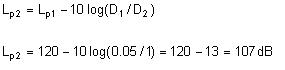
The calculated result is consistent with Sunfire’s claim of 108 dB at 1 meter in room where the addition of one or two walls to the presence of the floor would provide additional SPL reinforcement. The result is also consistent with my subjective observations about the HRS-12s ability to provide substantial bass output under real world usage conditions. This is a significant amount of output particularly when considering that it comes from a 38 lb sealed subwoofer with an internal cabinet volume that is defined by dimensions that are no larger than the diameter of the driver in any direction.
Conclusions & Recommendations
The Sunfire HRS-12 is quite a potent little package.
To get good monster bass, usually some fairly mongo subs are required. Brutes the size of tables, denizens of the corner, which make their presence obvious even without speaking. Those who have been constrained by space or WAF have had to go without. The HRS-12 can provide those poor, deprived souls with the bass they need without taking up significant room space or upsetting the Misses, at least, not too much.
It is rare to find a sub this small that can not only provide copious bass output, but also can provide deep and accurate bass output as well. Cabinet size, maximum SPL, and deep frequency response are competing demands in subwoofer design and these conflicts are more easily solved by throwing money at a design than by skillful balancing at a price point. While not cheap by some standards, the HRS-12 subwoofers do an excellent job balancing the design and providing outstanding performance without skyrocketing the price.
The HRS-12s represent what can be done in comparison with extreme designs and these Sunfire subs can certainly hang in there with products at that level even if they can not best them in an absolute sense. Considering that the HRS-12s can easily provide better than two thirds of the performance of subs like the Fathoms at a mere one third of the price, the HRS-12s are a well engineered, high value product that represents a very good bargain for anyone looking for extreme levels of bass performance at less than extreme prices.
The HRS-12 subwoofer can certainly belt out the bass, definitely making an excellent choice for anyone looking for depth, clarity, and good high SPL performance at a more reasonable size or price.
Sunfire Corporation
1920 Bickford Ave
Snohomish, WA 98290
800-554-0150
Canada 800-387-9101
www.sunfire.com
The Score Card
The scoring below is based on each piece of equipment doing the duty it is designed for. The numbers are weighed heavily with respect to the individual cost of each unit, thus giving a rating roughly equal to:
Performance × Price Factor/Value = Rating
Audioholics.com note: The ratings indicated below are based on subjective listening and objective testing of the product in question. The rating scale is based on performance/value ratio. If you notice better performing products in future reviews that have lower numbers in certain areas, be aware that the value factor is most likely the culprit. Other Audioholics reviewers may rate products solely based on performance, and each reviewer has his/her own system for ratings.
Audioholics Rating Scale
 — Excellent
- — Very Good
- — Good
- — Fair
- — Poor
| Metric | Rating |
|---|---|
| Bass Extension | |
| Bass Accuracy | |
| Build Quality | |
| Fit and Finish | |
| Ergonomics & Usability | |
| Features | |
| Performance |  |
| Value | |
Professionally, David engineers building structures. He is also a musician and audio enthusiast. David gives his perspective about loudspeakers and complex audio topics from his mechanical engineering and HAA Certified Level I training.
View full profile Subscribe to our newsletter