


Sonic Immersion Technologies I Beam VT300 Transducer
I Beam Tactile Transducer
- Product Name: I Beam Tactile Transducer
- Manufacturer: Sonic Immersion
- Performance Rating:


- Value Rating:
- Review Date: October 31, 2006 08:25
- MSRP: $ 399
|
System: Tactile special effects
transducer |
Frequency Response: 20Hz to 800Hz
|
Pros
- Huge vibro-tactile response
- Easy Installation
- Excellent Build Quality
- Huge wow effect
- Great price to performance ratio
Cons
- Only one year limited warranty
I Beam Transducer Features, Installation & Calibration
The I Beam VT-300 Transducer is very compact. Its design resembles a train track or sectional piece of steel, thus the name I Beam. The VT-300 transducer features push-style binding posts that can accommodate wire sizes from 18 AWG to 12 AWG. The bottom of the transducer has ten pre-drilled holes for mounting to a desired surface and wood mounting screws are even included. The manufacturer claims their design offers much better frequency response, efficiency, and “vibro tactile response” compared to other more conventional shaker devices.
Sonic Immersion Technologies specifies that the VT-300 should be used at frequencies up to 250Hz. Our experience with past tactile transducer systems is that frequencies should not exceed 80Hz and are really not that desirable for music listening sessions. Because the manufacturer feels so strongly that the device should be used at higher frequencies, we will evaluate it this way, as well as at the more conventional lower frequency limit.
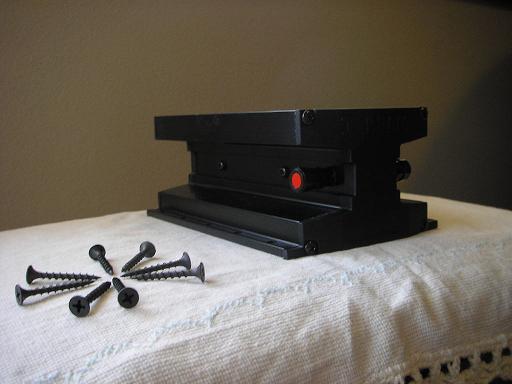
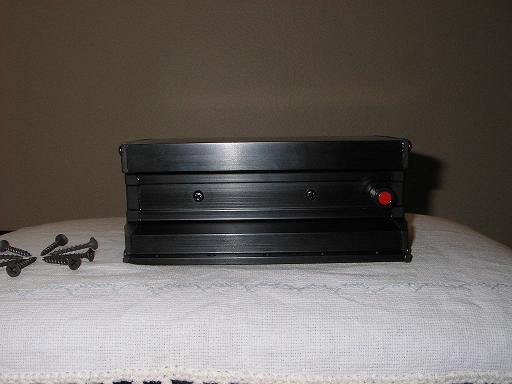
Installation
The I Beam’s low slim profile makes it perfect for installation in a wide variety of chairs, sofas and loveseats. It is often difficult to incorporate motion actuators into recliner chairs because of interference from the reclining mechanism. Sonic Immersion Technologies offers custom mounting brackets for many home theater-seating manufacturers. With a little ingenuity, the installer can manufacture a simple DIY solution for most chairs. We decided to take the DIY approach and manufacture our own simple bracket. We started by cutting a small piece of ¾-inch MDF that would fit onto our chair without interfering with the recline mechanism.
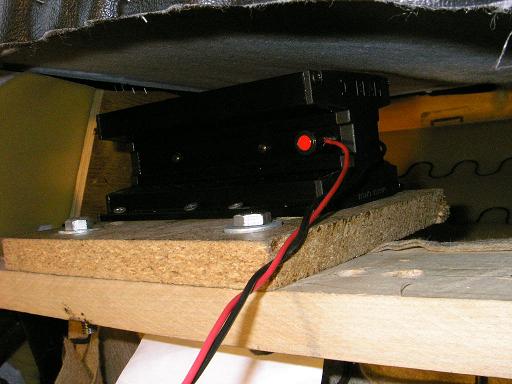
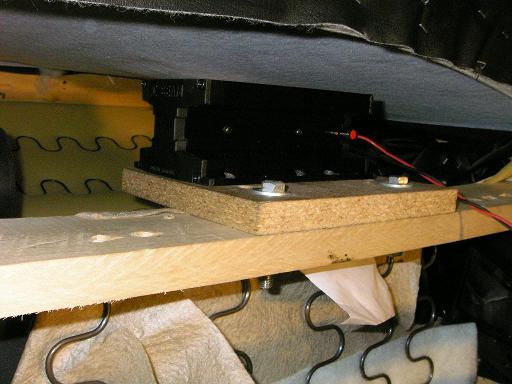
Using 5/8-inch deck screws we secured the I Beam VT-300 to the MDF. We also applied a small amount of clear silicone to the deck screws threads before screwing them into the MDF. The use of silicone on the threads will prevent them from backing out or working loose from the vibration action of the transducer. Next we drilled two 3/8-inch holes in the cross section brace in the chair and our DIY bracket.
We secured the DIY bracket to the cross section using two 3/8-inch bolts with washers and self-locking nuts. The use of self-locking nuts is important, as the locking function will prevent them from working loose from the vibration action. We also applied a small amount of construction adhesive between the bracket and the cross section brace of the chair. Verifying we had proper clearance when the chair is fully reclined, we wired up the I Beam VT-300 transducer and tacked the speaker wire to the frame of the chair to prevent the wire from getting tangled in the mechanism.
The VT-300 can be installed and terminated in different configurations. The most common approach would be to use an RCA “Y” splitter from the LFE output of your receiver or pre-amp and connect one RCA Interconnect from the splitter to your subwoofer and the other to the amplifier that is being used to power the I Beam VT-300. Then, connect speaker wire from the amplifier to the transducer. If your subwoofer has a bypass LFE output, another approach would be to daisy chain the subwoofer amplifier and the transducer’s amplifier and then follow the same procedure as above for the rest of the installation. The system can also be connected using your receiver’s right and left stereo analog pre-outs, outputs, or Aux or Tape monitor (we only recommend this type of configuration as a last resort).
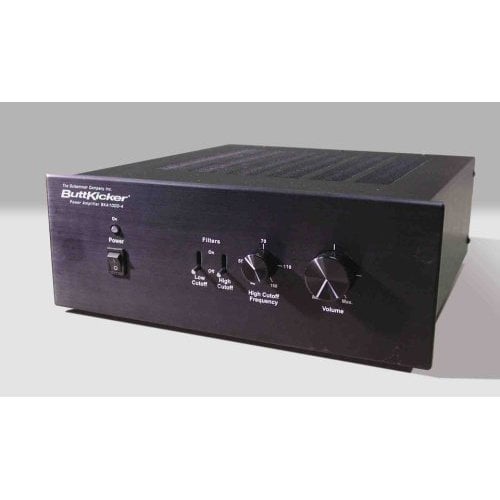
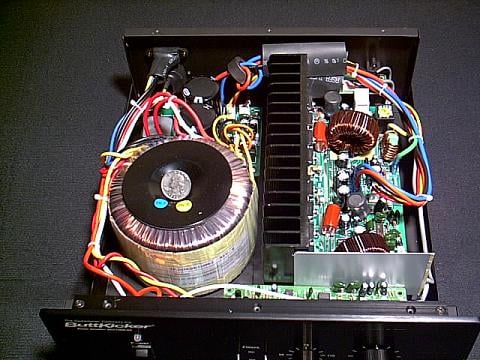
We used the excellent high bang for the buck Buttkicker BKA-1000 to evaluate the I Beam VT-300, this amplifier has to be considered one of the best buys in home theater. The BKA–1000 is very powerful, producing a whopping 1100 watts @ 4 ohms and 2100 watts @ 2 ohms. The BKA-1000 features a variable high frequency cutoff of 40-160Hz and a switchable low frequency cutoff. The huge power supply, filter capacitors, and features found on the BKA-1000 and the low MSRP price of just $499 make it an excellent amplifier for use with motion actuators and passive subwoofers.
Calibration
Now that the I Beam VT-300 transducer is installed and wired, it needs to be calibrated to the desired level. When calibrating any motion actuator or tactile transducer, it is important to keep in mind that actuators and transducers are designed to enhance the enjoyment of your system. Too little tactile action diminishes the experience; too much tactile action is distracting and can also diminish the experience. Finding the perfect balance will require some time and effort. Using DVDs that have excellent LFE content like U-571, The Haunting and War of the Worlds can make the task much easier. Just keep in mind that too much of a good thing can actually be bad. Take your time during the calibration process.
Adjust the volume control on your receiver or pre-amp to the SPL level that you normally use for listening to DVDs and other content. Then, adjust the volume control on the amplifier used to power the I Beam to the desired level. Once the correct volume level is obtained on the transducer amplifier it does not need to be adjusted again because the level will be increased or decreased with the volume control on the receiver or pre-amp in conjunction with the rest of the system.
Generally we have found that a crossover setting of about 50-80hz to be the best in our system for good tactile performance. However, experimentation is the key. We found that choosing a setting above 80Hz introduced some subtle dialogue into the tactile response. Additionally, we found that a setting below 50Hz is lacking sensation and impact. One important note: If you use an electronic crossover in your receiver or preamp and it is set to a low setting all content above that setting will be filtered out before it reaches the I Beam VT-300. Our internal electronic crossover was set for 80Hz and the crossover setting on the BKA-1000 amp was set at maximum preventing crossover cascading. Sonic Immersion Technologies indicates that they think the I Beam VT-300 should be used in conjunction with higher crossover settings. It has been our experience in the past that higher crossover settings for motion actuators and tactile transducers do not perform well. Because the manufacturer believes so strongly in this installation method, we will evaluate the I Beam VT-300 this way later in the review.
I Beam VT300 Evaluations and Conclusion
Evaluation: Movies
With the summer blockbuster, Pirates of the Caribbean: Dead Man’s Chest sweeping across movie theaters we thought it appropriate to select Pirates of the Caribbean: The Curse Of The Black Pearl to use as our evaluation DVD. This DVD features an awesome musical score and in various chapters has teeth rattling LFE effects, making this a perfect selection for the evaluation.
DVD: Pirates of the Caribbean: The Curse Of The Black Pearl
Chapter 11 “The Battle”begins with waves crashing against the bow of the British war ship, Interceptor, as she runs away from the Black Pearl. The I Beam transducer made this effect feel as though the waves were crashing against the front of the chair; each wave crash was in perfect sync with the image on the screen. As the chapter progresses, the ship drops the anchor in the club horn maneuver. The LFE effect as the anchor hits the surface of the water and then again as it strikes the rock below the surface was jarring and startling. The speed at which the I Beam VT-300 produced this effect was simply amazing. Many motion actuators and transducers that we have tried in the past with this particular scene produced the effect with lag and motion/tactile continuance after the scene had passed. The VT-300 did not produce any lag or continuance of signal with the brief effect; this indicates that this transducer is very efficient and accurate.
As the chase between the Black Pearl and the Interceptor gets closer, the soundtrack quickly escalates, immersing the audience in anticipation for the start of the battle. As the ship begins to fire its cannon and the Interceptor returns cannon fire, the I Beam transducer shook the chair violently with each blast and concussion. The vibro-tactile action produced with the installed I Beam VT-300 was huge. The lightning quick jolts transmitted through the chair by the I Beam with the LFE soundtrack really added a new dimension to our viewing experience. The added excitement and fun produced by the I Beam transducer was really effective and efficient.
Using pirate lingo to describe our experience with the I Beam VT-300 transducer, we would say: “Blimey these I Beam VT-300 transducers had us begging for parlay, fearing we would end up in Davey Jones’ locker where dead men tell no tales, pirates ye be warned.” Translation: the I Beam transducers were powerful, efficient and the response time was quick. These traits added excitement, exhilaration and fun to our viewing experience.
Evaluation: Music
Sonic Immersion Technologies feels very strongly that the I Beam VT-300 transducers should be crossed over at frequencies up to 250Hz for multi-channel and music playback. We tend to disagree, but we agreed to evaluate the VT-300 in this configuration.
Entering the GUI on our Yamaha RX-V4600 we set the crossover to its maximum 200Hz all speakers set to small. Using an older high power receiver with main pre-amp inputs we connected the
Impact Acoustics Sonic Waves subwoofer cable from the Yamaha RX-V4600 LFE amplifier pre-out to the receiver’s main channel amplifier preamp inputs and connected the speaker wire from the I Beam to the receiver. In this configuration, the receiver provides the power to the I Beam passing through the 200Hz signal without degradation. The older receiver has I/R remote capability and that gave us the ability to change the volume level of the I Beam transducer without leaving our seat.
An alternate (and preferred) method of configuration would be to take a parallel preamp output from the receiver and send it to a dedicated subwoofer amplifier with an internal crossover. In this way you can maintain your loudspeakers’ proper crossover point while still feeding a greater amount of low frequency energy to the VT-300. As we didn’t want to toss a subwoofer amplifier into the mix we went with the manufacturer’s requested method above.
CD: Patricia Barber - Café Blue
We chose the beautifully recorded, near flawless First impressions Music HDCD Patricia Barber Café Blue for our evaluation. Track number three Too Rich For My Blood begins with the bass guitar producing continuous deep notes combined with drums and Patricia’s voice. As the deep notes and the drum hits occurred the I Beam VT-300 transmitted the signal through the frame of the chair thus providing us with tactile-vibro sensation. Patricia Barber’s magical, swanky, seductive music is the kind of music that audioholics love to play when they come home from a hard day’s work. This is the music you listen to in your favorite reclining chair, lights dimmed, eyes closed and your favorite beverage in hand. Being deeply engrossed in this music, the last thing an audioholic wants is a distraction. That is exactly what the I Beam VT-300 produced during this evaluation. The vibro-tactile sensation was very disturbing; we did not feel at all comfortable listening to this type of music with the I Beam VT-300 vibrating our chair. We experimented with several different gain levels from very low to high but distracting results remained the same.
CD: Insane Clown Posse - The Wraith: Shangri-La
We decided to give the I Beam VT-300 one more chance with music. Switching gears we selected a CD from the shock rock group Insane Clown Posse for the second part of the evaluation. Track number 11 “Ain’t Yo Bidness” contains an insane amount of high-energy hard-hitting music. Starting with the deep bass notes and rapid drum hits, the I Beam VT-300 became an extension of the music low frequency information. The transducer, rather than becoming a distraction, enhanced the experience with this type of music. We would describe the experience as fun and exciting with a party like atmosphere.
Concluding our music evaluation we would say that if you like to listen to shock rock, hip-hop, rap, techno dance, heavy rock, grunge or metal music, the I Beam VT-300 would add to the listening experience with a higher crossover setting of 200Hz to 250Hz. For all other types of music we believe the best setting for the VT-300 would be the OFF position, but experimentation is encouraged.
Conclusion
The Sonic Immersion Technologies I Beam VT-300 transducer is a remarkable product. Its powerful tactile performance, speed, and accuracy place this transducer among the finest we have evaluated to date. The VT-300’s low profile and mounting configuration make it a perfect choice for chairs and recliners that have mechanical obstructions preventing conventional mounting options. The I Beam VT-300 is very efficient and doesn’t require a lot of power to generate huge amounts of vibro-tactile action, even a modest integrated amplifier or old unused receiver can be used for power.
The I Beam VT-300 generated huge amounts of WOW effect and added another dimension to our home theater listening experience, utilizing the proper crossover setting and calibration. We don’t recommend using the I Beam transducer when listening to audiophile type music. But, if you’re in party mode, give it a try - you may like the experience. The I Beams VT-300’s excellent build quality and high performance-to-price ratio make it an easy recommendation.
The Score Card
The scoring below is based on each piece of equipment doing the duty it is designed for. The numbers are weighed heavily with respect to the individual cost of each unit, thus giving a rating roughly equal to:
Performance × Price Factor/Value = Rating
Audioholics.com note: The ratings indicated below are based on subjective listening and objective testing of the product in question. The rating scale is based on performance/value ratio. If you notice better performing products in future reviews that have lower numbers in certain areas, be aware that the value factor is most likely the culprit. Other Audioholics reviewers may rate products solely based on performance, and each reviewer has his/her own system for ratings.
Audioholics Rating Scale
 — Excellent
- — Very Good
- — Good
- — Fair
- — Poor
| Metric | Rating |
|---|---|
| Bass Extension | |
| Bass Accuracy | |
| Build Quality | |
| Fit and Finish | |
| Ergonomics & Usability | |
| Features | |
| Performance |  |
| Value | |
 Subscribe to our newsletter