


SVS PB12-Plus DSP Subwoofer Review
- Product Name: SVS PB12-Plus DSP Subwoofer
- Manufacturer: SVSound
- Performance Rating:

- Value Rating:
- Review Date: January 04, 2011 20:50
- MSRP: $ 1199
- STA-800D Sledge™ DSP controlled amp
- SVS Plus 12.5” woofer with stitched, not glued cone surround assembly
- Flush-mount amp configuration
- Computer Assisted Design enclosure
- Perforated grill with hidden magnetic retention
- Detachable, compliant floor mounts
- Proprietary 3" high-flow flared ports
- SVS factory built, individually tested
- Heavy-duty detachable 8" power cord
- Wood veneer or gloss black accents
- 20 Hz mode Vented, 16 Hz mode sealedDigital
- Size: 25” deep x 19" wide x 21" high.
- Weight: 127 pounds
Pros
- Ungodly output capabilities
- Delivers true 20Hz performance
- Flawlessly engineered product
Cons
- Big and heavy
- Pedestrian aesthetics
- Single button amp interface a bit confusing
- No remote control
SVS PB12-Plus DSP Subwoofer Introduction
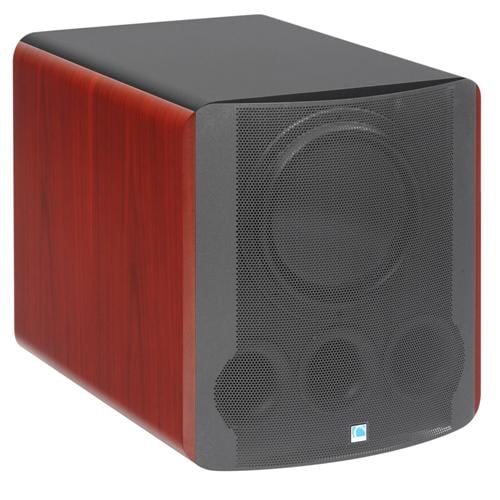 THE SVS PB12-Plus DSP is a self-powered front-loaded vented subwoofer featuring a proprietary 12" long throw driver and 800 watt amplifier with single knob DSP implemented control over filtering, equalization and compression functions. Weighing in at 125lbs+ and costing slightly under $1400, it's no lightweight, and requires more than a little bit of real estate. From its ungodly output capabilities, true 20Hz extension, and ability to play clean and distortion free, the PB12-Plus DSP has truly earned the right to be called a "subwoofer".
Read our review to understand why this product earned the Audioholics coveted 2010 Product of the Year award in the subwoofer category.
Product Overview
According to SV Sound, the PB12-Plus DSP was designed with the following features and engineering philosophy: “flat, deep, clean, linear, and dynamic”. It is a vented bass reflex design (with Sealed mode available) with sufficient cabinet volume for maximally flat alignment without resorting to excessive EQ boost. The large cabinet volume also improves sensitivity and deep bass efficiency, thus reducing amplifier power requirements. The PB12-Plus DSP employs triple ports with high cross-sectional area for reduced chuffing to help lower both distortion and port air-flow compression. Variable tuning with 20 Hz/16 Hz/Sealed modes is present to satisfy a wide range of room sizes and applications. The 800 watt (continuous power rating) DSP controlled amplifier has a single feature controller with digital read-out for all subwoofer functions for enhanced ease-of-use and utility. The DSP power/compressor/limiter settings are designed to control audible overdrive artifacts above Fb in each bass reflex tuning mode.
To elaborate more on the tuning modes; the 20 Hz mode is maximally flat while the16 Hz mode is slightly overdamped, which complements available room gain in a mid-size room. (Meaning composite power response of sub and mid-sized room are essentially flat). The sealed mode features a 2nd order roll-off and no HPF within the pass band for enhanced transient response and excellent coupling with room gain in smaller rooms.
The 12” high performance, long-stroke, FEA-optimized woofer is designed for high output and low distortion. Suspension geometry and VC length prevents bottoming of VC against the back-plate.
The PB12P Plus DSP subwoofer is designed to pass CEA-2010 at max drive levels at all test frequencies (20 – 63 Hz) within intended pass-band in both bass reflex tuning modes. This sub is designed for high bandwidth linearity with respect to distortion-limited output to ensure excellent clean output capability in the 16-32 Hz octave where most subwoofers traditionally struggle.
The Driver (Subwoofer)
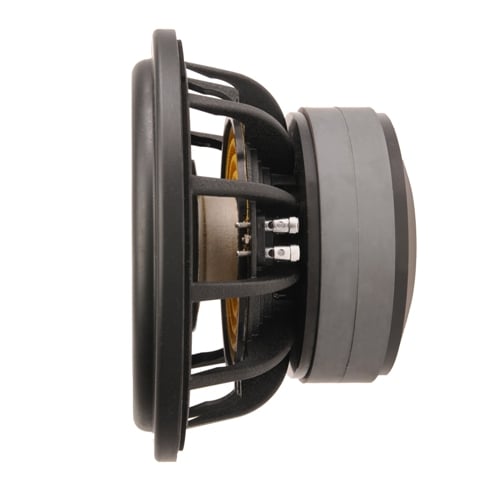 Many many years ago when we first started using Santoprene in the speaker business as a surround material, we had a great many problems in reliably gluing it to the cones. Foams, or cloths were never a problem, but rubber or Santoprene (a mixture of rubber and polypropylene) was another story. The first time I had seen it stitched to the cone, I had one of those Homer Simpson like “DOOH”, why didn't I think of that moments. Turns out that the nice thing about stitching the surround to the cone, while really expensive, is that it is the best possible way to guarantee the edge will NEVER tear free of separate from the cone. That might not sound important unless you have actually been in the room when it happened to a speaker you owned. Now not having taken apart the driver or been inside the factory to get a look at the assembly process, I can't speak to all aspects of the driver construction and quality. What I can tell you is this much. Anybody who goes to this extreme to prevent a glue bond failure is not going to be taking any shortcuts in making the best driver they know how to.
The Amplifier
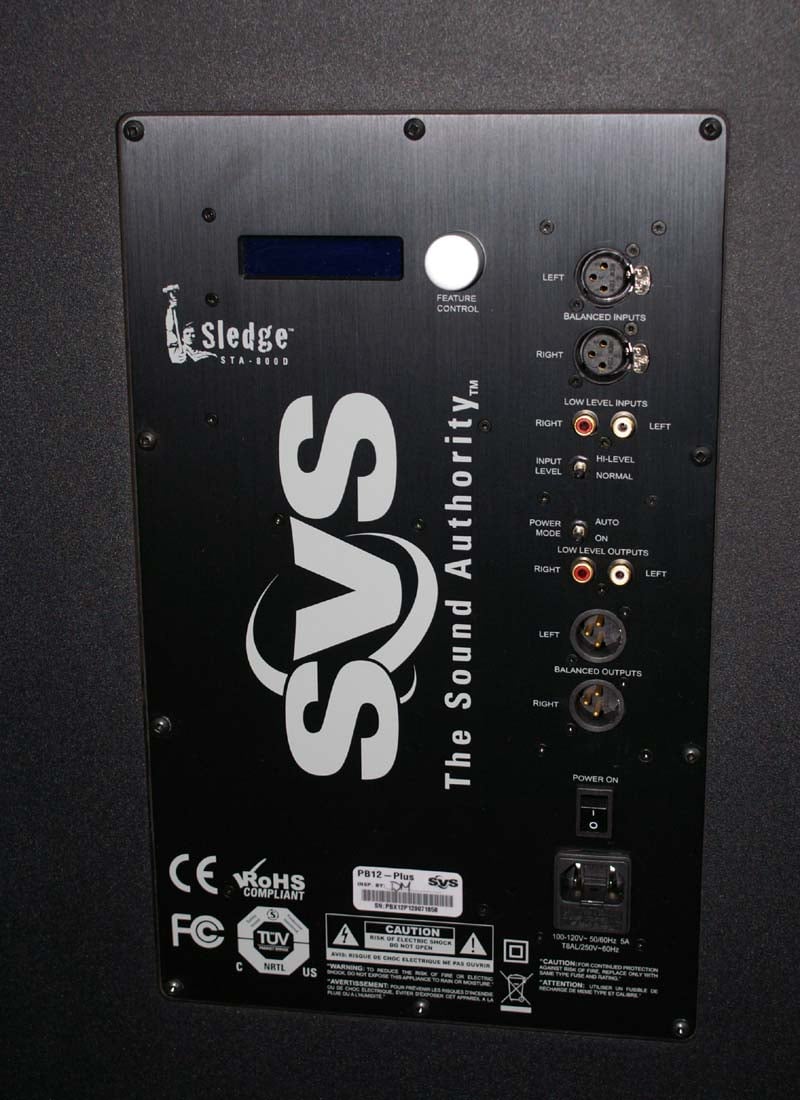 While I have no bones with the amplifier performance, I did get a little frustrated trying to operate the amplifier with only one knob, which handles several functions. This is not an uncommon approach with DSP, as all the settings are software based, not hardware based, so you do not turn a potentiometer (volume control) to reach the value, you simply dial in the number and the software does the calculation. Just tell it what function to do, and then select the value. While ALL the other amplifiers used had dedicated knobs for each function, being software controlled the SVS amp required you to tap the single control knob like a mouse (twice fast) for it to go between functions. At first I found it frustrating. Frankly, I don't care for having to guess what the programmer wanted to do, and I am not one of those folks who can pick up an Iphone and just start using it. Everyone else at Audioholics thinks I am not too hip, and they may be right. SV Sound has an online PDF format manual for those wanting to find out about using the products, so I guess I am complaining for being old and lazy. Seeing as how I have been around subwoofers for 20 plus years, I have no patience for these kind of ergonomics. I am old school and I want a knob for every function! I guess I will have to cope.
If you are comfortable with this kind of control, you will not find any issues with the parts efficient and completely digital SVS approach. In all, it took me about 4-5 minutes of playing around to get it, and that is without cracking the manual open. If you read through it, it should be very easy to set up. An advantage of the SVS approach is that their amplifier has a user selectable low pass filter with adjustable frequency and slope (12 or 24dB per octave) at the touch of the button. The amplifier also has a high pass filter for the line level outputs with the same frequency and slope selections as the low pass filter. This will allow the user to implement a true crossover (for both frequency and slope) between the satellite speakers and the subwoofer for 2-channel applications. The amplifier also includes a digital delay on the line level outputs to compensate for the latency of an external subwoofer equalizer, so that the subwoofer and the speakers can be time-aligned in 2-channel applications. These aren't features any of the other amps could boast about in our subwoofer shootout comparison.
My listening tests were performed at 24dB per octave low pass filter (LPF) settings. I find when you use a high cutoff frequency for the sub, it is necessary and advisable to use the higher roll-off rates. Those who will complain about the phase issues resulting from higher order filters have not spent much time measuring phase with a microphone. In truth the phase issues of having the subwoofer a large distance apart from the main front left and right speakers far outweigh the issue of phase shift and time delay caused by the electronic filters used. While the higher roll-off rates in filters may come with some small artifacts, they offer the benefit of having less overlap and therefore reduce the chance of out of phase acoustical behavior between the subwoofer and satellite speakers. That problematic band where both the satellites (or main speakers) and the subwoofer(s) overlap is called (in filter speak) the transition band. Having built and measured hundreds if not thousands of crossovers, my feeling is minimize the overlap, and to hell with the electronic delay. Since most of the sound reaching your ears has bounced off several surfaces on its way to your ear, our ear-brain mechanism is accustomed to integrating the sounds that reach it over tens of milliseconds. First order filters can claim perfect transient behavior and time domain addition, but few systems are built to avoid the problems that first order (6dB/octave) filters create. We recommend bypassing the LPF of the PB12-Plus DSP in favor of the LPF in your A/V receiver/processor. If your A/V receiver doesn't have a 24dB/octave LPF filter, then use the SV Sound LPF filter instead.
For those of you new to bass management systems, Gene Dellasala has written some excellent articles on this topic, which can be found here:
Hometheater Multiple Subwoofer & Setup Guide
Bass Management Basics - Settings Made Simple
Basic Subwoofer Setup Guide Not for Dummies
SVS PB12-Plus DSP Subwoofer Measurements and Analysis
The first part of testing was to measure the frequency response from a modest output, all the way to the point where the system was clearly compressing and had hit the output wall, so to speak.
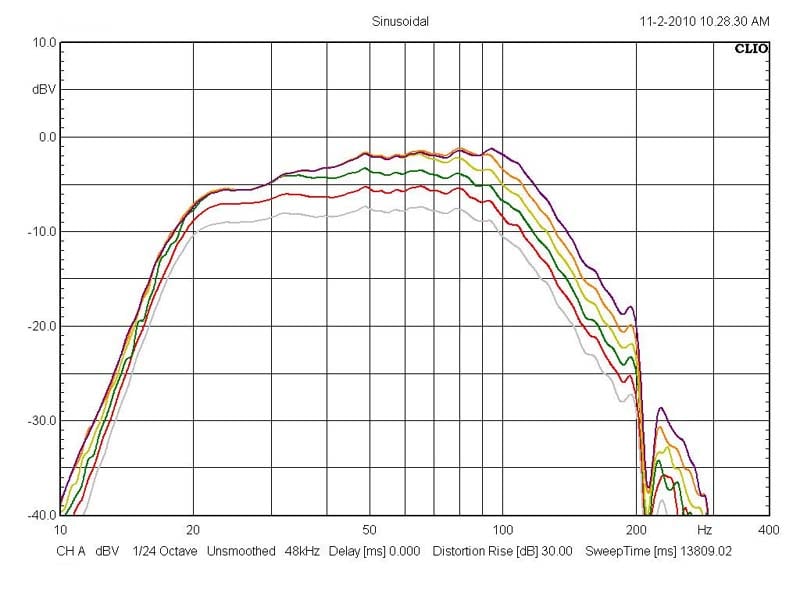
SVS PB12-Plus DSP Frequency Response at Various Output Levels
While there are a great many options to choose in the DSP controlled “Sledge” amp, I picked only one setting to use for the CEA testing. It is possible with the PB-12 Plus, to use the box in a sealed or "step down" mode of 16 Hz by inserting the supplied foam plugs into the ports. I chose not to do this, as the CEA testing standard has its lowest center frequency at 20 Hz, and because all ports open is the standard way in which the product is shipped. With all ports open for testing the box is tuned to 20 Hz. (Fb = 20 Hz). The high pass filter was set at 20 Hz and the low-pass set to 120 Hz, at 12 and 24dB/octave rolloffs respectively. I used these settings for both CEA testing as well as my listening. While 120 Hz is higher than 95% of you will use the product in practice, it creates additional stresses on the amp and can reveal some issues at the top end of the subwoofer or with the amplifier's compressor which may otherwise go unnoticed using a lower cutoff frequency. As you can see from the rapid roll-off below 20 Hz, the filter in combination with the natural port roll-off of 24dB/octave below cabinet tuning is close to the predicted 36dB/octave slope. It is not quite exactly this, as there is some equalization around the port tuning frequency so that maximum extension can be achieved without losing large amounts of driver sensitivity higher in the subwoofer's passband (50 - 100 Hz). At just above 200 Hz, we see a notch I believe is an anti-phase output from the port. Fortunately this is high enough that it should not prove audible with music. (I didn't hear anything objectionable while listening, even with the ports pointed in my direction).
If you look carefully at the curve above, you can see how the compressor unit deals with excessive power at low frequencies. Let's be clear, excessive power at what are for a subwoofer relatively high frequencies will simply burn out the VC. At low frequencies this is not the case. There, they will simply cause the driver to mechanically beat itself to death (excursion overload!). What is clear from the curves above, is that from 32 Hz and down, 4 different drive levels, 8dB apart, produced the exact same SPL between 20 and 32 Hz, but different SPL's at 100 Hz. So, the compressor is not acting on voltage limitations only, but is by utilizing the computational power of DSP, looking at the frequencies simultaneously so that it not only protects the unit from burning up, but what is a much more enduring and common problem for subwoofers that are overdriven, and that is, beating themselves to death at the lowest frequencies they handle. While this solution does not require DSP to implement, (not that it hurts) there are not too many engineers walking around with a clear idea about how this is to be done well. SV Sound circuitry reacts to overdriving by expertly compressing the signal in a way which is not clumsy, slow or leaves anything to chance. No driver complaints, and no nasty sounding amplifier compression artifacts. The only thing you could ask for is more output. To get that at this price, you'd likely better have family in the cabinet making business and friends who sell raw drivers and Kilowatt amps cheap.
CEA-2010 Test Results
On to the CEA 2010 testing. To understand the meaning behind the graphics below and testing methods used, please refer to the prior article (Subwoofer Shootout Measurements Overview) on this method. The process is a simple one. Drive the input to the system to the point where either the amp, its compressor, or its speaker simply refuses to give you more output, or the distortion created at that output level exceeds the CEA “redline”. In EVERY system tested, the result (if not the peak SPL) was similar in one regard. At the highest frequencies in the sub's bandwidth, we ran out of amplifier power, or the compressor refused to put out more power than the amp could cleanly deliver. At the lowest frequencies, the subwoofer runs out of excursion. This is completely normal and what is to be expected. It may also explain why the CEA standard does not bother testing higher than the center frequency of 63 Hz. Below is a spectrum capture of the SV Sound PB12-Plus DSP system at maximum usable output.
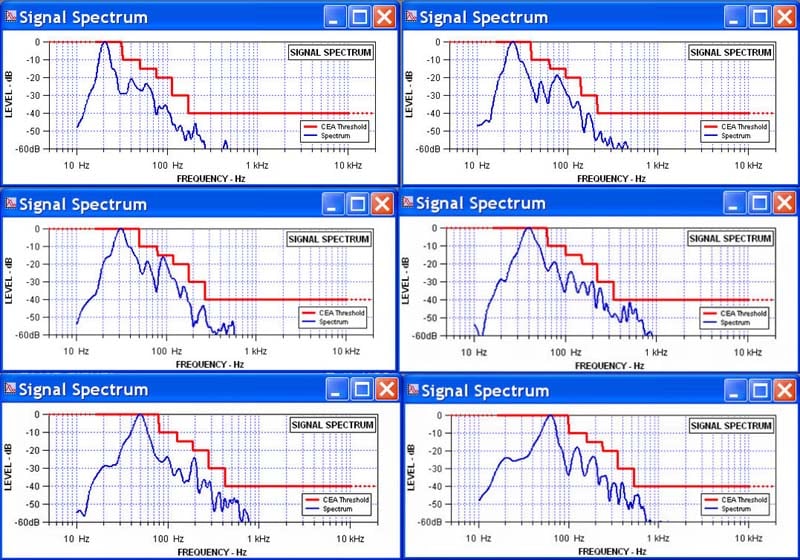
SVS PB12-Plus DSP CEA-2010 Distortion Test Results
| SV Sound PB12-Plus | CEA Test Performance | |
| Frequency | Maximum Peak SPL @ 1 Meter | RMS @ 2 meter with DSP Correction |
| 20 Hz | 114.4 dB | 107 dB |
| 25 Hz | 117.0 dB | 109.5 dB |
| 32 Hz | 119.0 dB | 111.5 dB |
| 40 Hz | 121.4 dB | 114.3 dB |
| 50 Hz | 122.8 dB | 115.3 dB |
| 63 Hz | 122.8 dB | 115.3 dB |
Max SPL Output Data of the SVS PB12-Plus DSP Subwoofer (1 meter groundplane)
Why not test this speaker up to 80 Hz? Surely it is important, no? Yes of course. Two primary reasons I believe that the CEA standard excludes an 80 Hz measurement. Any large sub will be amplification limited by the time it is going as high as 63 Hz. Looking at 80 Hz will add little to the value of the testing. The reason the SV Sound sub limits at 122.8 Hz for both 50 and 63 Hz is not simple coincidence. This is the point at which the amplifier “runs out of gas”, in this case the compressor itself puts on the brakes to continue the analogy. Going higher in frequency should not yield a different result with any real serious subwoofer. Let's also bear in mind the CEA pulse signal centered at 63 Hz is only 3dB down at 80 Hz, so if the sub was falling off that low it would affect the 63 Hz measurement as well.
Update: 9/27/11
In order to make it easier for our readers to compare our CEA data between subwoofers tested prior to our new Subwoofer Measurement Protocol, we scaled our 1 meter peak CEA data to 2 meter RMS by subtracting 9dB for each frequency. We then added 1.5dB to the final result since SVS recently updated the DSP in the PB12-Plus DSP to yield 1.5-2dB more output across the entire subwoofers usable bandwidth.
SVS PB12-Plus DSP Subwoofer Listening Impressions
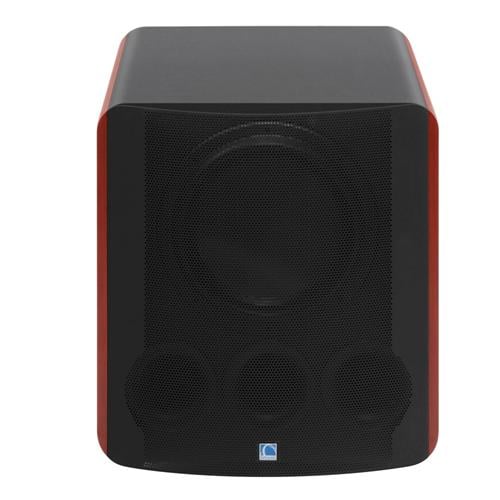 The SVS PB12-Plus DSP subwoofer has a solid sound, and overall
excellent performance. My testing was mainly concerned about usable
low distortion output, so I paired the sub with a pair of the high
efficiency (about 97.5dB/watt) prototype B52 Matrix 1000 Version 4
satellites driven with a 725 watt per channel amp. The SV Sound sub
seemed to run out of steam at about 80 watts RMS level into my
satellites, which is about 115dB in my lab. That's LOUD; REALLY LOUD.
I was able to play this sub about as loud as any other in the shootout
or more so. The system was pushed very hard, and with the low pass
filter set to 80 Hz, no matter how hard I pushed it, is sounded under
control and played without perceptible distortion. However, with the
crossover set up as high as 120Hz (necessary to allow some overlap
between the satellite speakers which only went down to 100 Hz),
Listening to the sub alone playing material, I thought I could hear
some distortion products from pushing the compressor hard. I am
doubtful that with the tops also playing, this would have been anything
other than a slight annoyance, if it was even audible at all. We
encourage anyone considering purchasing this subwoofer for home theater
usage to pair it with a multi channel speaker system that plays flat
down to 80Hz anyways. The SVS handled everything I threw at it, and
performed essentially without flaw. This is something we could not say
about some of the other subs in our comparative shootout.
The SVS PB12-Plus DSP subwoofer has a solid sound, and overall
excellent performance. My testing was mainly concerned about usable
low distortion output, so I paired the sub with a pair of the high
efficiency (about 97.5dB/watt) prototype B52 Matrix 1000 Version 4
satellites driven with a 725 watt per channel amp. The SV Sound sub
seemed to run out of steam at about 80 watts RMS level into my
satellites, which is about 115dB in my lab. That's LOUD; REALLY LOUD.
I was able to play this sub about as loud as any other in the shootout
or more so. The system was pushed very hard, and with the low pass
filter set to 80 Hz, no matter how hard I pushed it, is sounded under
control and played without perceptible distortion. However, with the
crossover set up as high as 120Hz (necessary to allow some overlap
between the satellite speakers which only went down to 100 Hz),
Listening to the sub alone playing material, I thought I could hear
some distortion products from pushing the compressor hard. I am
doubtful that with the tops also playing, this would have been anything
other than a slight annoyance, if it was even audible at all. We
encourage anyone considering purchasing this subwoofer for home theater
usage to pair it with a multi channel speaker system that plays flat
down to 80Hz anyways. The SVS handled everything I threw at it, and
performed essentially without flaw. This is something we could not say
about some of the other subs in our comparative shootout.
Application
Given the large bandwidth and output of this box, I can recommend it for either Home Theater or Audiophile use. Home theater use is a bit more difficult as sound effects are often kicked up for dramatic effect to levels at extremely low frequency output (below 40 Hz) that you might only find at a Rave or a Rap concert. If you are more interested in music reproduction, you can push the box a little harder and count on more output. The PB12-Plus DSP should be fine in medium to large size living rooms, with more than adequate output for normal use. It is not a small box, but if you want real performance down to 20 Hz, the wife needs to give up some real estate. While this won't drive home comfortably in the back seat of your compact car, it will fit nicely into your SUV or pickup truck. Don't count on lifting or placing it by yourself unless you move refrigerators for a living.
Visual Impressions
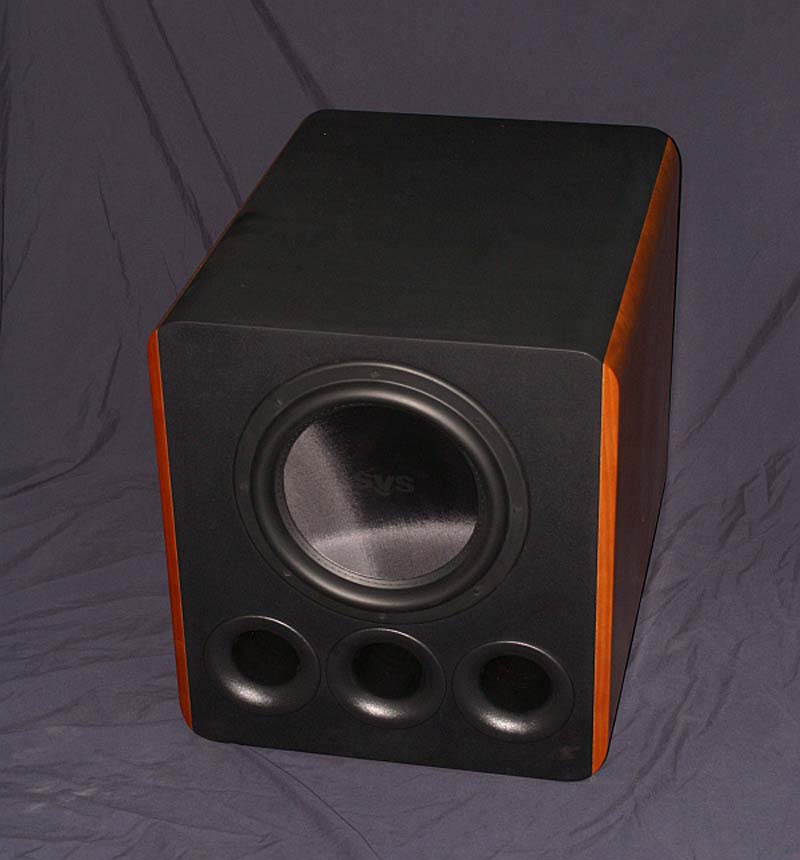 Of
the several B52 employees who saw the cabinet, no one really liked the
appearance of the American Cherry veneered cabinet. SV Sound offers
this cabinet in 4 finishes (1 more being closed out). When I first took
it out, I spent about 5 minutes looking at it, trying to decide whether
or not the finish was real veneer, or just vinyl. (If I was smarter, I
would have just checked the outside of the cardBoard box...) If vinyl,
I suppose that would be good. If veneer, not so much. The color was a
strange cast of red. Now Cherry is one of my favorite woods, and it is
supposed to be reddish. I prefer the darker reds to the lighter ones.
When our chief carpenter looked at it, his first impression was the
wood was pine. Then he said, no, maybe maple. It seems pointless to
argue taste, but no one who saw it really liked the veneer or the color
all that much. Everyone who saw it, had to look at it for a while, and
no one seemed really sure what they heck they were looking at! I was
surprised at how uniform the visual response to the cabinet finish was,
but felt better knowing it was NOT just me.... Having said all that,
after seeing it for a week, I have grown accustomed to its shade, and
am sure someone somewhere with a room full of Cherry furniture thinks
this reviewer simply has no taste. Since a picture is worth a thousand
complaints, you can judge for yourself by looking online and see if you
like the finish or not. http://www.svsound.com/products-sub-box-pb12plus.cfm#
Of
the several B52 employees who saw the cabinet, no one really liked the
appearance of the American Cherry veneered cabinet. SV Sound offers
this cabinet in 4 finishes (1 more being closed out). When I first took
it out, I spent about 5 minutes looking at it, trying to decide whether
or not the finish was real veneer, or just vinyl. (If I was smarter, I
would have just checked the outside of the cardBoard box...) If vinyl,
I suppose that would be good. If veneer, not so much. The color was a
strange cast of red. Now Cherry is one of my favorite woods, and it is
supposed to be reddish. I prefer the darker reds to the lighter ones.
When our chief carpenter looked at it, his first impression was the
wood was pine. Then he said, no, maybe maple. It seems pointless to
argue taste, but no one who saw it really liked the veneer or the color
all that much. Everyone who saw it, had to look at it for a while, and
no one seemed really sure what they heck they were looking at! I was
surprised at how uniform the visual response to the cabinet finish was,
but felt better knowing it was NOT just me.... Having said all that,
after seeing it for a week, I have grown accustomed to its shade, and
am sure someone somewhere with a room full of Cherry furniture thinks
this reviewer simply has no taste. Since a picture is worth a thousand
complaints, you can judge for yourself by looking online and see if you
like the finish or not. http://www.svsound.com/products-sub-box-pb12plus.cfm#
Strong Points in Favor of the SVS PB12-Plus DSP Subwoofer
The SVS engineering was flawless. I could not find any major or minor issues with the performance at all, save for what sounded a little like clipping with the LP control set to 120 Hz, which might well have been the signal, not compression artifacts. The cabinet build was solid, and there were NO audible artifacts from any overloading of the ports, even when driven with maximum pulse amplitudes at 20 Hz. SVS recommends a step down mode if the system is to be driven below 20 Hz, as the box unloads below this frequency, so the distortion rises quickly as does the driver distress. Just for the hell of it, I went down to 16 Hz, and near maximum amplifier power, the driver was definitely in distress. For those of you unwilling to give up anything between 20 Hz and 16 Hz, SV Sound even includes foam plugs to re-tune the box lower to avoid these ill effects. Seems they thought of everything! Remember, a sealed box will be much stiffer on the cone than a vented box driven below the box tuning frequency. That means a slower roll-off (12dB/octave vs 24 dB/octave) as well as the natural mechanical protection of the sealed box. The settings of the amplifier compressor were so conservative in fact, I suspect that this will provide high reliability and long service life. This is a product which is well engineered, fine tuned, and finished. (Unlike some lesser entries, it is ready for prime time!)
Conclusion
While the SV Sound subwoofer is not inexpensive, it is at a level of performance more than justified by the modest price. Those who have been to the CES Show can go from room to room looking at $50,000 per pair speakers, as if this were a common thing. I have done this, and after a while you begin to believe the prices set at this level are simply arbitrary. The SV Sound PB12-Plus DSP sub is solidly built, carefully and artfully engineered, and will no doubt give its owner years of worry free high performance service. SVS won't be winning any beauty contests for this product but that's not what it's all about. From its ungodly output capabilities, true 20Hz extension, and ability to play clean and distortion free, the PB12-Plus DSP has truly earned the right to be called a "subwoofer". It's no wonder this mighty sub was the recipient of the Audioholics coveted 2010 Product of the Year award in the subwoofer category.
Performance does come at a price however, SIZE and weight. Unless the prospective buyer lives in a large castle populated with multiple servants all capable of lifting this 100 plus pound box, I suggest you have a friend or two handy to help move it into your theater room. Of course before soliciting for some extra muscle, make sure you know exactly where you want to place this behemoth. This is not a portable product. The cleaning lady is not going to lift the corner to vacuum under it. Make sure, you have the space, and know where you are going to plant it. The physics of making loud low distortion bass demand this kind of size and weight, so be prepared for it.
About
SVSound
SVS
offers an extensive line-up of high-performance subwoofers and
loudspeakers. SVS has light manufacturing facilities in Ohio and Taiwan,
with several satellite offices spread across the United States. SVS sales in
the USA are internet-direct, with international sales worldwide via an
exclusive dealer network. Visit www.svsound.com for more information.
The Score Card
The scoring below is based on each piece of equipment doing the duty it is designed for. The numbers are weighed heavily with respect to the individual cost of each unit, thus giving a rating roughly equal to:
Performance × Price Factor/Value = Rating
Audioholics.com note: The ratings indicated below are based on subjective listening and objective testing of the product in question. The rating scale is based on performance/value ratio. If you notice better performing products in future reviews that have lower numbers in certain areas, be aware that the value factor is most likely the culprit. Other Audioholics reviewers may rate products solely based on performance, and each reviewer has his/her own system for ratings.
Audioholics Rating Scale
 — Excellent
- — Very Good
- — Good
- — Fair
- — Poor
| Metric | Rating |
|---|---|
| Bass Extension | |
| Bass Accuracy | |
| Build Quality | |
| Appearance | |
| Dynamic Range | |
| Performance | |
| Value | |
 Subscribe to our newsletter