


Onix x-sub Subwoofer Review
- Product Name: x-sub Subwoofer
- Manufacturer: Onix
- Distributor: AV123
- Performance Rating:

- Value Rating:

- Review Date: October 08, 2006 20:00
- MSRP: $ 199
Type: Slot ported single-driver system
Driver: 8" mass loaded woofer
Amplifier: 150 watts
Frequency Response: 28Hz - 150Hz +/- 3 dB
Inputs: Stereo high level input and output. Stereo low level and LFE input.
Phase Control: 0 and 180
Size (H x D x W): 17 3/4" x 12 7/8" x 9"
Weight: 44 lbs. (shipped)
Other Features: Gain, and HP crossover adjustments (40Hz - 150Hz), auto-on / standby mode.
3 Year Warranty
Pros
- Great aesthetics
- Performs above price point for music
- Small form factor which is easy to place
Cons
- Port chuffing during low bass
Onix x-sub Build Quality and Setup
In what I am quickly discovering is an AV123 tradition, the Onix x-sub came double boxed and wrapped in a cotton sleeve. The x-sub was easy to unload by grabbing onto the raised base and pulling the unit free. The first thing I noticed was that the base was a bit loose. The second thing I noticed was the pure beauty of the finish on the sub. I've seen pictures of the White Shadow Maple finish before but it was even more impressive in person. The seam between the pieces of veneer was visible on a close inspection and the color was a bit different but overall, at this price, I can't complain. Overall, the aesthetics of this subwoofer are outstanding. I thought I was going to hate the black risers and the front port, but I didn't. The finish is so light that it makes a nice counterpoint to the overall look.
Taking the unit apart, I found essentially an empty box with about an inch of damping material around the inside. The edges were glued together. The port is of the folded, slotted variety so that takes up a bit of the internal volume at the top. The entire unit is constructed out of 1" MDF (unheard of at this price point). The mass loaded woofer is down firing and it mounted near the front of the sub (where the port is).


Setup and Placement
The manual for the Onix x-sub suggests that corner loading the sub is the best location. Well, that will certainly net you greater bass output overall, but it may not be the best location for your room. Playing with placement with this sub is really a breeze. The sub is fairly light (especially compared to my reference Axiom EP500 ) and can be moved easily. If you have carpet, the base plate slides easily. You can even set it on your couch without fear of structural or superficial damage as you Crawl for Bass . I've played a lot with placement of my EP500 in my review of the Onix R-DES and I think I can definitely say that I've found the "best" position for my sub (within the strict guidelines of WAF). Leaving the R-DES in Bypass mode, I played with the placement a bit and determined that while the corner loading of the sub provided a bit more extension (to my ear) and output, I preferred the spot where I had calibrated my EP500. I found it to be a bit more linear. I went ahead set all my speakers to "Small" and set the crossover on my Denon 3805 at 80Hz. I connected the sub via the LFE in which defeats the sub's crossover. The sub has a non-defeatable standby mode that powers down the sub when not in use. Normally these modes don't work as well as I'd like, so I'd appreciate having the option to have the sub always on. With the x-sub I never noticed the auto-on to be slow to engage so it wasn't much of an issue.
I wanted to make sure that I ran the x-sub through its paces but I also didn't want to expect too much from it. It is a budget sub after all. My first thought was to test out that claimed frequency response - down to 28Hz. With a little sense of irony, I used the Onix R-DES test disc to see both if the Onix x-sub would have any meaningful output down to the claimed frequency and how it would handle lower frequencies. Well, on the first count, yes, the Onix x-sub definitely did have meaningful output down to 28Hz. That was reassuring. However, it did want to continue to try to put out something below that. That something normally took the form of port chuffing. With nothing but the sub playing, the chuffing was exceptionally loud (I kept expecting to hear a choo choo) so I was concerned that I'd notice it during playback. Read on to find out.
Onix x-sub Listening Tests
Most bookshelves will need at least a little help with bass. For music, 28 Hz should be plenty low enough for all but the most demanding musical tracks. Still, extension isn't everything. What I really wanted to know was whether or not the sub would be musical. The last thing you need to add to your system is a boomy, one-note wonder. That may work for movies but not for music.
Listening Tests: Music
Diana Krall Love Scenes
Not really needing an excuse to listen to this album again, I fired this one up just to see how the x-sub would deal with the walking bass line. I was pleasantly inundated with a nice blending of the sub with my mains. The x-sub contributed meaningfully to the lower bass notes for most of the tracks. The laid back walking bass line of "Peel Me a Grape" remained for the most part tight and focused. During some of the faster bass lines like in "How Deep is the Ocean" the sub had no problem differentiating between the different notes. There were moments that I felt the x-sub lost a bit of coherency and started to sound a bit boxy. Specifically during any sort of low slide the sub seemed to mush all the notes together into a sort of general hum. But for the most part I was very impressed with the sub's performance.
Porcupine Tree In Absentia
I've had a couple of discussions about this album in comparison with the other DTS Porcupine Tree release Deadwing . While I like them both, I find that the songs that I like on In Absentia, I tend to really like (and therefore the ones I don't, I really don't). With Deadwing, I feel like the whole album is a bit better but I don't really like any one song as much as I do some of the songs In Absentia . I chose this album to give the x-sub a little more rock bass and kick drum. There is a slow and low bass line in track 3 舠 Lips of Ashes 舡 that I let the little x-sub flex its bass muscles on. For the most part, the sub performed well though some of the lowest notes were taxing the limits of the sub's response (i.e. the output was softer than the other notes). The bass was well sustained through each of the notes and the response time to a new note was quite impressive. Very fast, very tight. The cabinet did seem to have a little resonance problem and probably could use a little extra (or some) internal bracing but I didn't notice any chuffing during any of the music portions of my tests.
Listening Tests: Movies
People on the market for a budget sub are looking for one of two things in my opinion - an affordable solution for a second setup (as in an office) or a low cost solution for a movie/TV system for your first time buyer (who can't fathom spending more than a couple of hundred on any one speaker). Option one would probably be used mostly for music, but the second option seems to me to be the most likely. Therefore, I really think the ability of the x-sub to perform in a small to medium sized home theater for movies is single most important test. If it can't give at least the modicum of a tactile response during an action flick, then this review will be headed south, fast.
The Cave
Why would I watch this movie when it got such dreadful reviews? Why would I waste my time putting it on my Netflix list when there are so many more deserving movies to watch? Because it's got climbing in it. And I climb. Just that simple. So, from a climbing perspective, the movie still stank. The monsters were stupid, the plot contrived, and interactions forced, and the emotions undeserved. The climbing wasn't all that bad (when compared to crapfests like Cliffhanger). What it did have was a couple of nice explosions and it was a fairly average amount of LFE for your cookie cutter action/horror genre.
The Onix x-sub held up well on most all the loud passages. There was a scene at the beginning where an old church is destroyed in a fairly cheaply produced CGI enhanced landslide. I could definitely feel the bass as the church was reduced to rubble. Even though I didn't get quite the sensation I would expect from a larger sub, the x-sub was still pumping out enough sound to make me feel the bass. At moments if did sound like the little sub was eeking over into the "one note wonder" area, but for the most part, it performed very admirably.
Finding Nemo
No test of a subwoofer is complete without a visit to the famous Darla tap scene. I may not always report on it but you can rest assured that I've run it. With my earlier discovery that there may be some port chuffing issues, I knew that this scene would bring them to light. Obviously, if I'm going to watch the Darla scene, I might as well watch the whole thing (or so my son insists). During the barracuda scene, the sub scene, the whale scene, and the tap scene the x-sub did all it could to keep up with the outrageous amount of subsonic bass Pixar, in their infinite wisdom, included in the soundtrack (God bless them). I tried low volumes, high volumes, and reference volumes all trying to hear the port chuffing that I knew was going on. The only time the chuffing was a problem was when the bass was pretty much the only thing going on. The tap scene was an issue as was the beginning of the whale scene (right before they get spit out). The chuffing could be heard at any volume that one would consider being reasonable for watching a movie like this (i.e. above background music level). Still and all, there was a tactile response during all these scenes that was very enjoyable.
Flightplan
Wow - this movie just dragged. By about half way through, I thought, "If they ever find her daughter, I hope they throw them both off the plane." Jodi Foster provides a commanding performance but the combination of a thin plot and weak premise made for little for the Oscar winning actress to hold on too. By the end, I was kind of getting into the movie but I never could get past the fact that simply by holding her 6 year old daughter while boarding, no one on the whole plane saw her. I'm all about suspension of disbelief but come on. No one saw her? Really? I'm supposed to just let that one go?
Flightplan didn't exactly have a ton of bass aside from a subway scene at the beginning and an explosion at the end but it did have a lot of low male vocals. Throughout the movie the x-sub provided both a convincing and engaging experience. I never really noticed the sub as it blended perfectly with the mains in my system. It provided enough tactile bass so that I found the explosions and low bass all very convincing.
Onix x-sub Conclusion and Measurements
Overall, this sub over-performs for the amount of money you put into it. At this price point, I wouldn't be surprised to find a boomy, muddy mess. What I found was a speaker that could make a worthy addition to any budget home theater. Will it fill a large room with bone crushing bass? No, but do you really expect it to at this price point? What it will do is provide convincing and at times tactile bass in a small to medium sized room. Port chuffing is a problem during certain scenes that you need to be aware of before you purchase. For a system that is mostly geared towards music, the x-sub is a no brainer. This sub would be an easy recommendation for any budget minded consumer in a small to medium sized room.
Measurements and Analysis
Even though this is a budget sub, we decided to do some basic measurements just to see how well this little sub preformed. My initial plan was to take the sub outside and do some ground plane measurements but was foiled by my old Onyko receiver that just up and decided that it wanted to go into protect mode. Instead, I placed the sub in the middle of the room and took the measurements at ½ meter to minimize any room interactions using the ground plane technique. I utilized the Rives Test CD 2 because of their Radio Shack SPL meter corrected tones. I adjusted the crossover on my Denon 3805 up to its highest setting (250 Hz), disconnected my mains, and calibrated the sub on the 80hz test tone (to 80dB, 90dB, and 100dB). The 100dB calibration was pushing this sub pretty hard though I never heard it clip (quite an accomplishment in my book).
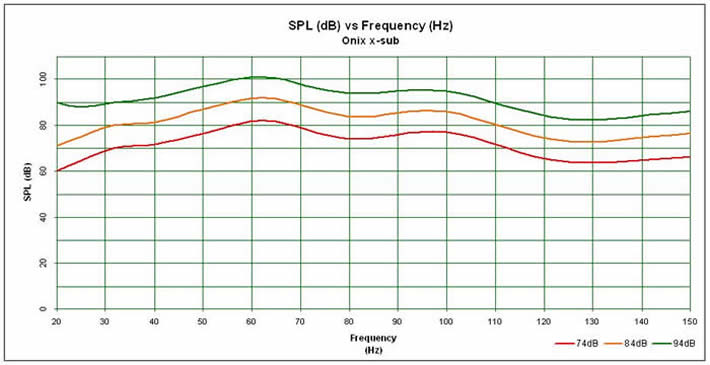
At ½ meter I could hear no port chuffing at during the 80dB test. I heard a bit of chuffing at the 20 and 25Hz test tone during the 90dB test (though it wasn't really measurable in my setup). During the 100dB test, I could hear port chuffing all the way up to the 40Hz tone. This definitely affected the measurement as the chuffing was louder than the tone coming through the sub.
The -3dB point of the x-sub is 28Hz just like the manufacturer claims. Upper bass extension is very linear up to about 120Hz making it a good match to blend with smaller satellite speakers that require a higher than 80Hz crossover setting. The sub runs clean and relatively flat (the bump centered at 60Hz was likely a result of the inroom measurement limitation). Once I drove the sub to around 100dB (1/2 meter), port chuffing became dominant below 40Hz which inadvertently showed up as the increased amplitude response below 30Hz in the 94dB graph.
The Score Card
The scoring below is based on each piece of equipment doing the duty it is designed for. The numbers are weighed heavily with respect to the individual cost of each unit, thus giving a rating roughly equal to:
Performance × Price Factor/Value = Rating
Audioholics.com note: The ratings indicated below are based on subjective listening and objective testing of the product in question. The rating scale is based on performance/value ratio. If you notice better performing products in future reviews that have lower numbers in certain areas, be aware that the value factor is most likely the culprit. Other Audioholics reviewers may rate products solely based on performance, and each reviewer has his/her own system for ratings.
Audioholics Rating Scale
 — Excellent
- — Very Good
- — Good
- — Fair
- — Poor
| Metric | Rating |
|---|---|
| Bass Extension | |
| Bass Accuracy | |
| Build Quality | |
| Fit and Finish | |
| Ergonomics & Usability | |
| Features | |
| Performance | |
| Value |  |
As Associate Editor at Audioholics, Tom promises to the best of his ability to give each review the same amount of attention, consideration, and thoughtfulness as possible and keep his writings free from undue bias and preconceptions. Any indication, either internally or from another, that bias has entered into his review will be immediately investigated. Substantiation of mistakes or bias will be immediately corrected regardless of personal stake, feelings, or ego.
View full profile Subscribe to our newsletter