


Rocket ULW-10 Subwoofer Review
Rocket ULW-10 350W Powered 10" Sub with Automatic Parametric EQ
- Product Name: ULW-10
- Manufacturer: Onix Rocket
- Distributor: AV123
- Performance Rating:


- Value Rating:
- Review Date: July 14, 2005 20:00
- MSRP: $ 499
- Acoustic suspension, single-driver system
- 10" black-annodized alloy cone woofer
- 350W built-in amplifier.
- Frequency Response: 26 Hz +/- 3 dB
- (W x D x H): 12.25" x 11.75" x 13.00"
- Weight: 39lbs each / 47lbs. Shipped
- Finish: Satin Black, White Shadow Maple and Dark Walnut
- SOS or Speaker Optimization System - an automatic 1-band parametric EQ.
- Continously (infinitely) variable phase, 0 to 180 degrees.
- Gain adjustment
- Continuous crossover adjustment (40Hz - 150Hz).
- Crossover disable setting.
- LFE summed R/L RCA input.
- Auto-on / standby mode.
Pros
- Attractive finish.
- High SPL capability.
- Low price point.
- Small footprint.
- Automatic 1-band parametric EQ.
Cons
- Single RCA jack for LFE input.
- No speaker level inputs.
Rocket ULW-10 Overview
Rocket is a brand of Onix Audio, a 20 year old British hi-fi manufacturer. Onix is currenty owned by a partnership between Mark Schifter and a Chinese entity. Onix owns a factory in China where Onix, Rocket and many other speakers are made under Mark's personal supervision. Reportedly, Mark spends about nine months a year in China and is very involved with all aspects of manufacturing. This is a considerably different setup from the current trend, of designing a product in North America or Europe and outsourcing production to a third-party in China. Mark actually goes to China to oversee manufacturing and design aspects of the product.
It seems Mark is bent on business models that break from tradition, both in manufacturing and retail. Established in Louisville, Colorado in 2000; AV123 was founded by Mark Schifter. They are an internet-direct retailer of consumer electronics. Though they carry a few conventional retail brands, most of the products they carry are made exclusively for them under the badges of Emotiva, Onix and Rocket.
The traditional retail model of a manufacturer to "brick and mortar" retailer to consumer, and sometimes even an importer/distributor layered in, has some inherent disadvantages. Each independent entity in the chain has a separate overhead structure and profit margin. From a cost-to-consumer perspective, this is not very efficient.
A somewhat common alternative is a factory-direct model. Here, of course, there is only one layer of overhead and profit margin. The big downside is the opportunity to audition before purchase, but the better outfits offer a reasonable return program. For example, AV123 provides a 30 day return policy and you only pay the two-way shipping expense. That is an extremely generous policy, many others also charge a re-stocking fee. Though AV123 is generous enough not to charge it, I feel the re-stocking fees are typically fair, since the seller then would have to markdown the product as "open box" to be able to sell it off.
Actually, while we are on the topic of personal auditions, it is time for another pontification by Arvind Kohli. Common conviction states that the biggest "benefits" of a traditional brick-and-mortar retail model are, that the consumer has a chance for personal audition and can benefit from the expertise of the retail staff. I do not think that there is any guarantee that a traditional retailer will deliver satisfactorily on either of those metrics. There, of course, abound horror stories of shopper snubbed by haughty staff at audio boutiques when seeking a personal audition, check out AudioAsylum for anecdotes. And even in the best cases, you may be permitted to take the product home for a couple of days. However, I do not think that is enough audition time, unless you did almost nothing but audition till you had to return the product. An extended in-house audition (30 days+), as provided by the better factory-direct outfits (and AV123), is more like what you will need to make a proper decision. And in the matter of expert opinion, I would say the consumer is better off gathering information independently from reviews, fellow-hobbyists and acquaintances. There is plenty of that resource freely available on the internet, though you have to keep your wits about you to filter out the pseudo-science and hack claims. So in the end, if you can get better pricing buying remotely, rely on an extended in-house audition and independently gathered information to cement your decision, you are probably better off than going to a "full-service" traditional retailer. Of course, there is a segment of the population (likely a sizeable segment) who could not be bothered with research. They want convenience, and that is where the "brick-and-mortar" folks fit in perfectly.
Summary:
Educated consumer + lower prices = Factory direct / Mail order / Internet retailer
Convenience oriented consumer + higher prices = "Full service" traditional retailer.
For folks who read reviews, participate in forums and constantly update their knowledge base; the AV123 business model is likely to deliver better value, since they are "informed consumers" and would not benefit much from knowledge and support given by traditional retailers. But that is just my guess, I will probably never have access to all the data I need to conclusively find that answer.
Sorry for the digression... now back to the review.
Rocket ULW-10 Features
I have noticed a paradoxical trend in the marketplace for audio products, the past few years. There are some manufacturers, who mechanically repeat their churn of new products and occasionally slide up their prices for no significant improvement in product (not that their claims will ever admit that). On the other hand, I see products like this and when I look at the features, I am floored. I am honestly mystified as to how AV123.com can afford to offer these features at this price point. Let me furnish you the details, and you can judge for yourself.


The rear panel features a single RCA jack for the LFE input. Obviously, this sub was designed with the assumption that it would mainly be used in systems with a receiver/processor sporting a sub-out feed. If you intend to use this with stereo pre-outs or speaker level feeds, then you will have to get the appropriate adapters in place. I would have preferred this unit supplied with stereo RCA inputs, an LFE input and speaker level inputs. I fed the sub either from the LFE out of my receiver, or a parallel feed from the speaker outputs of my integrated amp.

The 10" anodized alloy woofer is driven by an 8 lbs magnet and a 350W built-in amplifier. And then, of course, there is the SOS...
And the Main Event
The hottest feature of this beauty is the SOS or "Subwoofer Optimization System". What does that mean in non-hype? Well - it is a one-band parametric equalizer, with the settings automatically established by the subwoofer.
Huh - what does that mean? The subwoofer comes supplied with a microphone and 20' chord. You plug the mic into the back of the sub, place the mic in your normal sitting location, at your seated ear level. Turn on the "calibrate" mode, and abra-cadabra - you have the audio equivalent of a rabbit pulled out of a hat.
When you turn on the "calibrate" mode the sub generates a series of tones and measures the overall response at the listening position, including the impact of the room. The SOS module picks the single largest peak and flattens it, relative to the rest of the curve. Brilliant! Executed correctly, this should result in the elimination of a boomy or resonant artifact, as it did in my listening tests below.
The owner's manual is well written for this setup, but here are some points I feel need to be mentioned or reinforced;
-
You room should be setup pretty much the way you normally use it during listening. The placement of furniture and doors/windows being open/closed could have a considerable impact on the room response.
-
Dial the crossover a little above where you expect to finally set it, before you engage calibration. My first try, resulted in a large hump at about 120hz, and the SOS did indeed flatten it. Alas, none of the speakers I have would need the sub to operate in that range, so the SOS was wasted and I still had a big hump at about 40hz.
I have to applaud the designers to not try and use "digital processing" as a gimmick to sell this unit, and in the process introduce a set of A/D and D/A conversions that can only pollute the source signal. While this sub does employ "digital processing" to perform the SOS calibration, the digital portion of the circuitry is turned off after calibration so as to not interfere with the analog signal. Brilliant!
Rocket ULW-10 Audio Measurements
Figure 1:
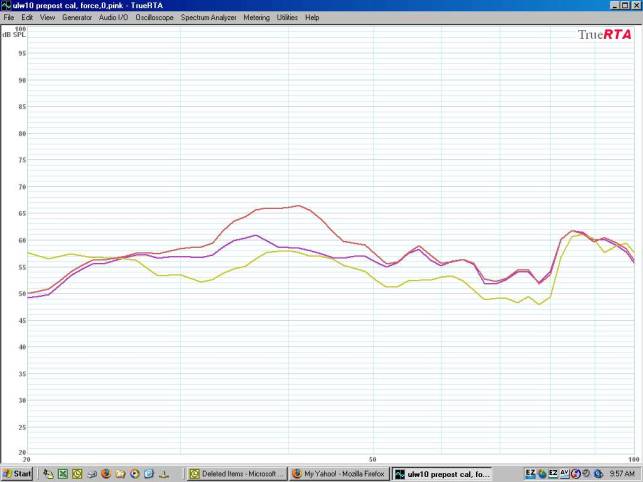
Pink curve = Rocket ULW10 without SOS
Purple curve = Rocket ULW10 with SOS
Yellow curve = ACI Force
With each sub placed in the same spot, I individually measured their in-room response. Using my True Audio TrueRTA, I measured the in-room response of the Rocket ULW-10 (with and without SOS activated) and my reference ACI Force ($799).
Now consider, that this is an in-room response and not the innate response of the sub itself. Nonetheless, since they were all measured at the same spot and using the same process the results are useful to explain comparative differences. Also, I intentionally measured the Force at a slightly lower level so the curves would show better, it is the relative differences that matter here.
The Force has a much more extended response, as expected. Its response is within
7db from 20 to over 60hz, not bad at all. If it were mated with speakers of a -3db point of 65hz or
lower (as most speakers are) the combined output would be fairly impressive, as far as in-room flatness
goes. My room would be troublesome with either subwoofer, if I tried to used speakers that rolled off
at a higher frequency.
The Rocket is fairly flat down to about 24hz and then drops sharply. This is outstanding performance at
this price point. Many budget units presume to call themselves subwoofers if they have an audible
response at 40hz
舰
making such claims should be illegal. The curve (pink) without the SOS activated
has a tremendous hump between 32 and 49hz, which I would attribute to the 'resonant' and 'boomy'
qualities I describe further on in my listening tests. This however, is not a design attribute but a
room integration issue based on my room dimensions and the location of the subwoofer relative to my
primary listening position.
Relatively speaking and considering an inherent room mode between 32 and 49hz, the Rocket (without SOS)
had a larger hump than the ACI. After SOS, that hump almost completely disappears (purple curve), and
the resulting response is within 7db from 24 to 65 hz, very close to the ACI.
Figure 2:
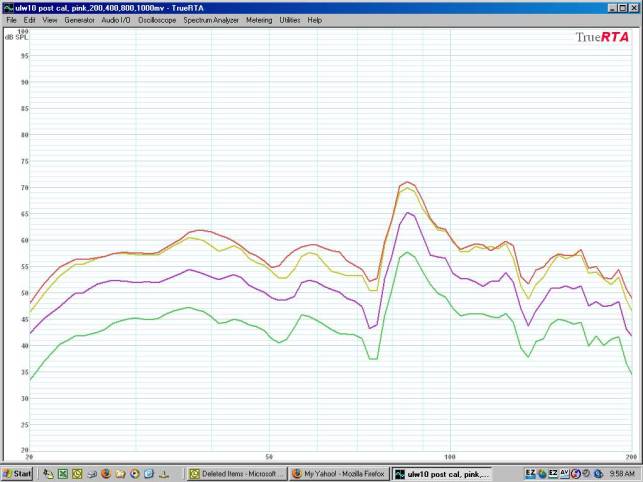
This test measured the response curves at 200, 400, 800, and 1000 mV of output. The editor's analysis concludes that there isn't any compression to speak of, and thus the preamp overload issue identified in our review of the Rocket UFW-10 has been addressed since then.
Rocket ULW-10 Listening Evaluation and Conclusion
One of the most telling movie passages for evaluating low-frequency response is the "Tyrannosaurus Rex" scene from Jurassic Park. I like this scene because the primary note on the foot stomps are reportedly at 15hz, and there is not much else happening sonically to distract you.
With the SOS function turned off , the SPLs on the ULW-10 were plenty engaging but there was a bit of resonance and boom. With the SOS feature turned on it was like listening to a whole different subwoofer. The bass was much tighter and the boom and resonance was almost gone.
To be completely unfair, I also compared it to my other reference, the Velodyne F1500R ($1700). The fundamentals were much deeper, and the response was absolutely tight. But that is a whole lot more money for a small improvement on an absolute scale, and an even smaller improvement on a relative scale. The purpose of comparing to the F1500R is to illustrate that there is a bit "more" you can get in terms of performance if you were to spend a few multiples more, and that the ULW-10 does not deliver the ultimate in performance, but its pretty darn good. That should be no surprise; reference level performance for $500 is simply not a reality in subwoofers. But this test should give you an idea of how far away the Rocket is from reference level.
Finally, I compared the ULW-10 to the previously reviewed and similarly priced Velodyne DPS10 ($449). With the SOS feature turned off, I preferred the Rocket slightly to the Velodyne. With the SOS turned on, the Rocket was in a different league, much closer to the Velodyne F1500R than the DPS-10 in terms of extension and tightness.
For the audio-only listening tests, I compared the ULW-10 (with and without SOS activated) to my reference ACI Force and the previously reviewed Velodyne DPS10 . I played the following tracks straight thru each sub and without the accompaniment of satellite speakers, so I could better evaluate the performance of each subwoofer. Keep in mind, this test is designed to pick apart and compare the smallest nuances of the audio performance of a subwoofer, and is suitable for units that cost beau coup . Subjecting an entry-level priced unit to such scrutiny may not be deemed fair by some manufacturers, and has not won me friends in the past. But I do not write reviews to make friends, and will not shy away from critical tests because of the price point of a unit. Here is what I heard;
'Rimshot' (Eryka Badu; Baduism; Universal; UD53027)
'All or nothing at all' (Diana Krall; Love Scenes; Impulse; IMPD233 )
'Bass Resolution test' (Chesky Jazz and Audiophile tests Vol2; Chesky; JD68)
All subs were easily able to deliver the required SPLs for these tracks. The ACI Force was able to plumb into greater depths, rendered each transient attack with requisite speed, the decay was without overhang and nary a hint of underdamped resonances. She is my reference for good reason.
Even without the SOS activated, the Rocket ULW-10 seemed to hold it 舗 s own in terms of speed to address transient attacks and was a bit shy in note depth. But it faltered in aspects of boominess and unwanted resonances. The peaks were rattling miscellaneous loose items around my room, and would make any SPL-bound teen piqued with envy.
With the SOS turned on (see Figure1) it was like I was listening to a completely different subwoofer. The peak at about 40hz was nicely suppressed, yielding a much flatter response and the measured improvement was also an audible one. The presentation was quite musical, and the boom and resonances were drastically reduced. Only in direct comparison to the Force did the ULW-10 seem a bit recessed and lacking in depth.
The Velodyne did not fare as well in this comparison, even when compared to the ULW-10 with the SOS turned off. This speaks quite well for the ULW-10, considering it only costs $50 more than the Velodyne.
Conclusion
On the plus side we have good extension, minimal unwanted resonances, fairly fast transient response, an exquisite finish, nicely appointed controls, small footprint and of course, the outstanding SOS feature.
Negatives? Well, on an absolute scale I would say that the musical performance and low-frequency extension did not match that of my reference units. But to expect a $500 subwoofer to meet either of those standards would be 舰 well, asinine to say the least.
On a more realistic scale, considering the price point I cannot think of any significant issues with this unit. Barring, a minor issue of a bit more flexibility on the input options, leaves me with nothing to kvetch about. Well done.
The Score Card
The scoring below is based on each piece of equipment doing the duty it is designed for. The numbers are weighed heavily with respect to the individual cost of each unit, thus giving a rating roughly equal to:
Performance × Price Factor/Value = Rating
Audioholics.com note: The ratings indicated below are based on subjective listening and objective testing of the product in question. The rating scale is based on performance/value ratio. If you notice better performing products in future reviews that have lower numbers in certain areas, be aware that the value factor is most likely the culprit. Other Audioholics reviewers may rate products solely based on performance, and each reviewer has his/her own system for ratings.
Audioholics Rating Scale
 — Excellent
- — Very Good
- — Good
- — Fair
- — Poor
| Metric | Rating |
|---|---|
| Bass Extension | |
| Bass Accuracy | |
| Build Quality | |
| Fit and Finish | |
| Ergonomics & Usability | |
| Features | |
| Performance |  |
| Value | |
 Subscribe to our newsletter