


Velodyne MicroVee Subwoofer Review
Velodyne MicroVee
- Product Name: Velodyne MicroVee Subwoofer
- Manufacturer: Velodyne
- Performance Rating:

- Value Rating:
- Review Date: January 11, 2010 21:25
- MSRP: $ 799
- Driver: Active 6.5" forward firing anodized aluminum cone (5" piston diameter), 2 x 6.5" side-firing passive radiators with aluminum cones (5" piston diameter)
- Magnet Structure: 64 oz. (4 lbs)
- Voice Coil: 2" Dual Layer
- Amplifier: (Class D) 2000 watts Dynamic power, 1000 watts RMS power
- Low Pass Crossover: 50 Hz - 200 Hz (adjustable) (12 dB octave initial, 48 dB ultimate)
- Frequency Response: 38 - 120 Hz (+/- 3 dB)
- Inputs: Speaker-level, mini-jack and gold plated line-level Outputs: Speaker-level (120 Hz high-pass crossover), mini-jack (thru) Phase: 0° to 180° (selectable) Subwoofer Direct(Crossover Bypass)
- Digital Dynamic Driver Control
- Auto On/Off
- Dimensions (H/W/D):(inc. grille) 9" x 9" x 9.6"
- Warranty:(parts/labor) Electronics: 3 years / Driver: 5 years
- Shipping Weight:(approx) 20 lbs. (9.1 kgs)
- Finish: Black Anodized or White Specifications are subject to change without notice.
Pros
- Small on size, big on sound
- Excellent fit and finish
Cons
- Touchy master volume control
- pricey
MicroVee Introduction & Design Overview
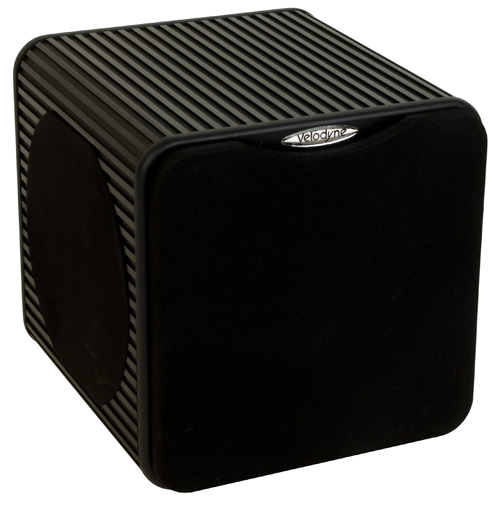
It's human nature to always want more. Why buy the 32 ounce fountain soda when you can get the 1 gallon high fructose corn syrup special for only 10 cents more? There comes a time in one's life where necessity triumphs over excess. Velodyne knows this better than any of their competitors which is why year after year, product after product, they've lead the market in making the most compact and potent subwoofers. Anyone can throw a large woofer in a refrigerator-sized box and slap a power amp on it to get lots of thump. The challenge is to get the thump in a box small enough to place out of sight. Velodyne's solution is a 9" cube with a 6.5" woofer and dual passive radiators which they refer to as the MicroVee. This subwoofer was designed for PC users that want to extend the bass response of their desktop speakers for gaming or music listening via their iPod. We put it to the test as such to see if it could produce bigger sound than its diminutive size suggests, or if it was simply the MiniVee's illegitimate child.
Design Overview
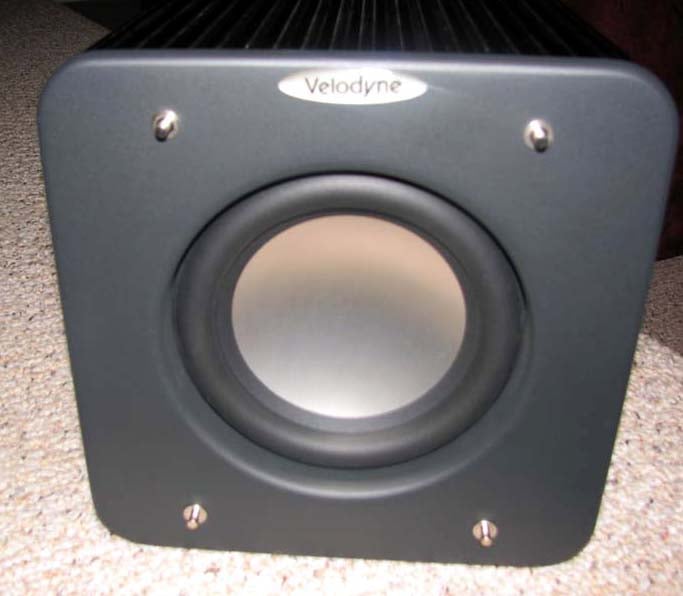
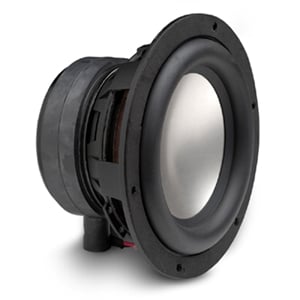 The Velodyne MicroVee is certainly the smallest subwoofer that has entered my sound labs for testing. Incidentally its one of Velodyne's only multi-driver subwoofer products sporting a sexy 6.5" (5" piston area) aluminum cone woofer and dual 6.5" (5" piston area) side firing passive radiators. The box is almost completely void of space thanks to large driver, passive cones and powerful 1000 watt amplifier. In order to get any appreciable SPL out of such a small enclosure, it is necessary to utilize a high excursion driver coupled with passive radiators to increase effective cone area and a hulking amp to equalize extended bass response. Unfortunately, this is a costly solution to implement, hence the $799 retail price which is incidentally $100 more than their next model up, the MiniVee. The MiniVee has a single 8" driver (6.5" piston area) with more output capability and extension than the MicroVee, but has a slightly larger enclosure taking up about 40 in^2 more floor space. The MicroVee has a pro-audio type look to it thanks to the ribbed extruded aluminum cabinet which is said to dissipate heat build up. Because of its small size, it can be neatly tucked under a desk or behind the office garbage can which is where I placed mine during this review. The MicroVee comes in black or white to blend into your room décor incase you can't find a small enough space to hide it out of sight.
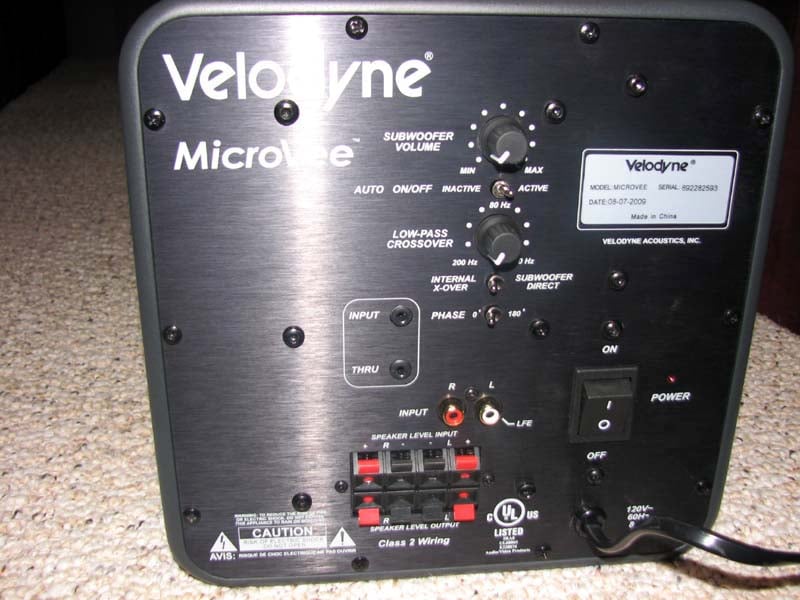
The back panel of the MicroVee has all of the functionality and connections you'd expect to see on larger subs, which includes volume level control, variable low-pass crossover from 50Hz to 200Hz, 0/180 degrees phase switch, crossover bypass, auto on/off, speaker level inputs and outputs and RCA and mini-jack connections. The power cord is a two-prong type and is not detachable.
Set-Up & Installation
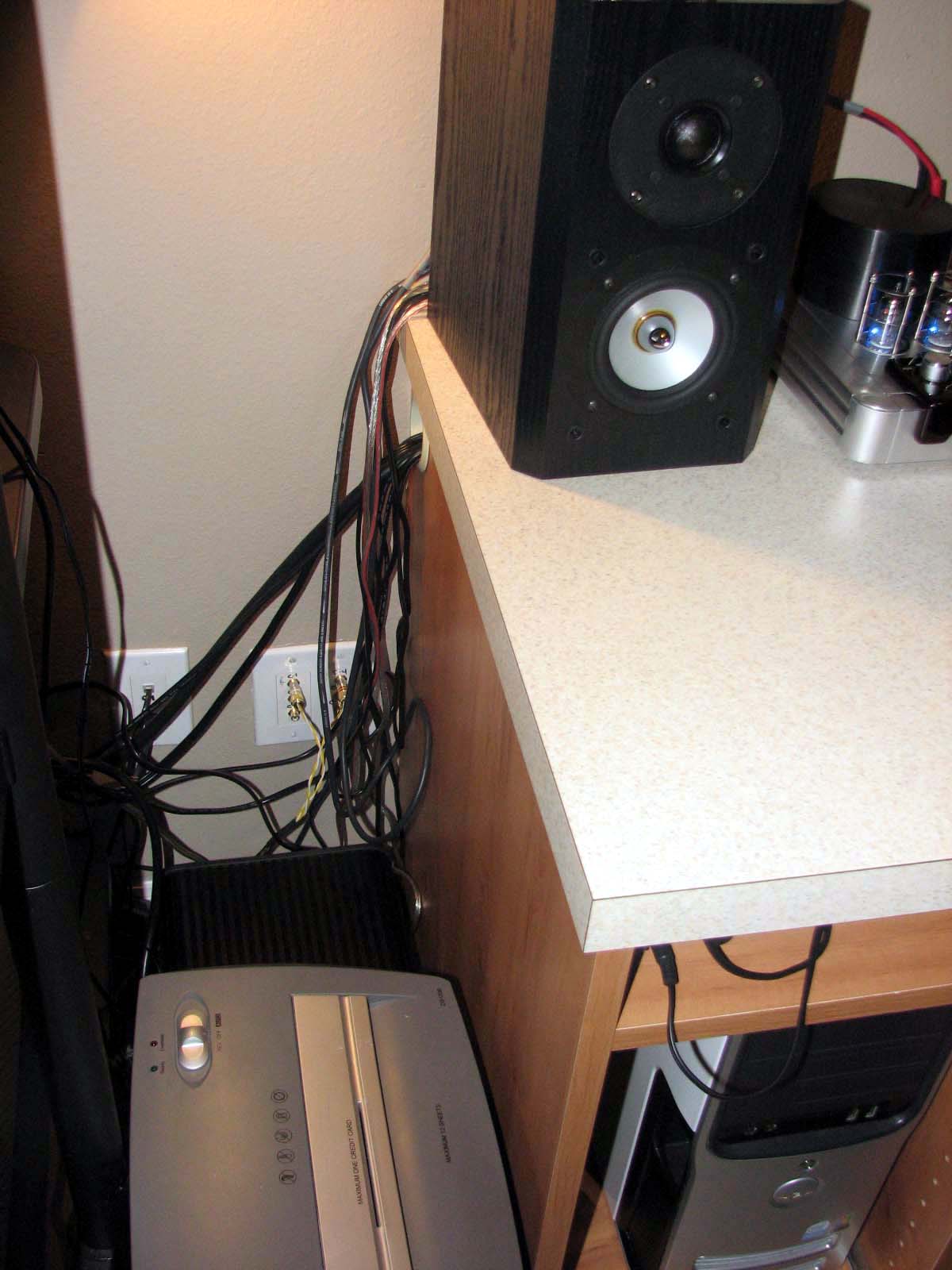
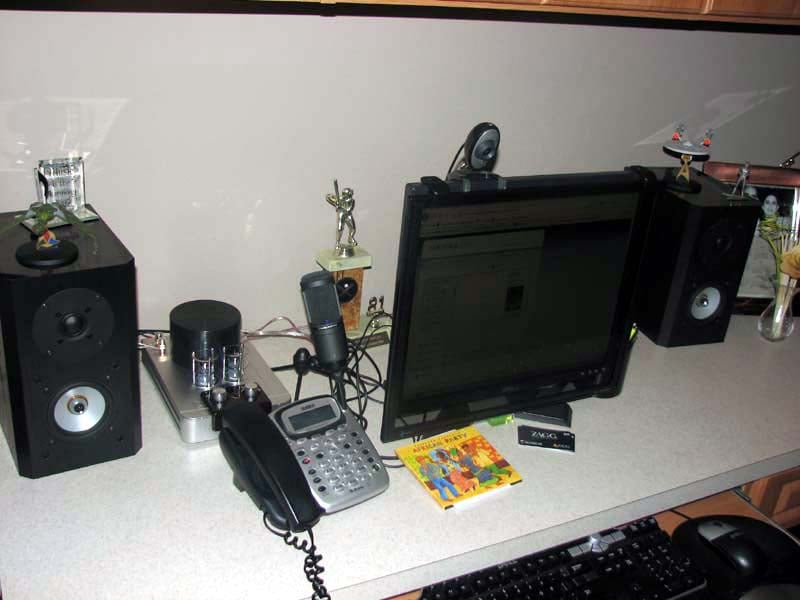 I tried the MicroVee in several locations in my office, but found it blended best with my speakers when placed on the floor below the left speaker and behind my trash can. I tried placing it on the desktop but it produced such a large tactile response that it seemed artificial when listening to bass intense music. The MicroVee was connected to my EMP VT40.2 Hybrid Tube Amp Speaker System via speaker level paralleled to the 41-SE/B speakers. I found the line level outputs of the VT-40.2 amp to be about 10dB too hot for this sub which caused it to reach maximum gain when the volume control on the sub was set any higher than a finger nail thickness from zero. A more graduated level adjustment would have been appreciated. I was unable to make coarse level adjustments using the volume control because the sub reached a high gain state with the volume barely turned a few clicks past minimum regardless of what source device I connected to it. When using speaker level connections to my EMP VT40.2, I still only needed to set the master volume of the MicroVee just below the second dot from zero to reach the right output level. The volume control was quite finicky and I wished Velodyne would have instead employed a stepped potentiometer so you could lock your setting in place without fear of being blown off your chair because the volume control got accidentally bumped higher when you were moving the sub to do some spring cleaning.
I found the MicroVee sounded boomy regardless of placement until I adjusted the crossover down to its lowest setting (50Hz) which still provided plenty of output for the 60Hz -3dB point of my speakers (more on this in the measurements section). I advise experimentation here and not to be fixated on using a specific setting based on the extension of your satellite speakers.
Unless otherwise noted, all listening tests were conducted using the streaming services of Pandora.com fed from my PC to my Headroom micro preamp and DAC connected directly to the EMP VT-40.2 Hybrid Tube Amp Speaker system.
MicroVee Listening Tests
Courtesy of Pandora.com
 Fourplay
I used
to dismiss this band as bubble gum jazz mostly because the radio only
played their bubble gum song selections. There is much more to
Fourplay, however, which isn't surprising considering the incredible
list of jazz musicians in this band. Luckily Pandora exposed me to
some of their finest works which the MicroVee happily provided the bass
thump for.
On the song "101 Eastbound", Nathan’s East's bass
exhibited solid depth and punch. You can’t truly appreciate this song
on a system that is bass deficient. The Velodyne MicroVee ensured that
wasn’t a problem. The bass line in "Bailrun" is so funky in this song
and the MicroVee simply loved to accentuate it which complimented my
speakers nicely. The little Velodyne sub really added a rich texture
to the music which seduced me to just sit back and listen. The
MicroVee provided plenty of bass fill in the song "Cinnamon Sugar" to
make my EMP speakers sound like fullrange towers. It wasn't just
thumpy bass I was hearing as I found the blend between the MicroVee and
my 41-SE/B speakers provided a good amount of tightness while also
preserving the attack and decay of the kick drums.
The Beatles – I Want You
This
song doesn’t slam with bass but the bass the MicroVee was playing
helped round out the overall system sound making the EMP 41-SE/Bs sound
larger than their diminutive size would imply. The MicroVee was
proving it could play nice for all musical situations I threw at it.
Emerson Lake & Palmer
The
piano solo at the beginning of the song "Trilogy" wasn’t tarnished by
the MicroVee at all. Instead it supplemented the bass of the lower
keys of the piano nicely when called upon. Once Greg Lake's bass
kicked in and Emerson switched to synthesizers, the MicroVee pulled no
punches and happily flexed its mighty little woofer.
Wailing Souls - Ghetto of Kingston Town
The
Velodyne Microvee really shines on Reggae music and this song
exemplifies the bass capabilities of this little sub. Although the
bass didn’t extend to the lowest octave that much larger subs could
delve into, there was still plenty of clean extension with good tactile
feel lacking an overly bloated sound typically heard in 3 piece desktop
systems of lesser design.
ATB - Renegade
This is not my
type of music but I added a "Bass Up!" channel to Pandora to really
test out the Microvee. The bass in this song shook my office but had a
slightly boomy feel to it which could be more program related than a
deficiency in the subwoofer. I could tell there was more depth to this
song than the MicroVee could belt out but the amount of bass it
produced for its size was truly astounding. After about five minutes
of sampling songs on this station, it was time for me to permanently
retire it. The MicroVee proved itself well here and my ears simply
didn’t want to continue this torture.
For the most part I was
pleased with the performance of the MicroVee during my listening
sessions. Although it wasn't always as articulate as I would have
hoped for, it always provided beneficial bass extension to my desktop
system. Fiddling with the level and crossover frequency really helped
to achieve a better blend making it sonically disappear so that the
bass appeared to be coming from only my speakers.
MicroVee Measurements and Conclusion
I measured the Velodyne MicroVee in my office space using the antiquated but accurate Linear X LMS measurement system. No smoothing was used unless otherwise indicated.
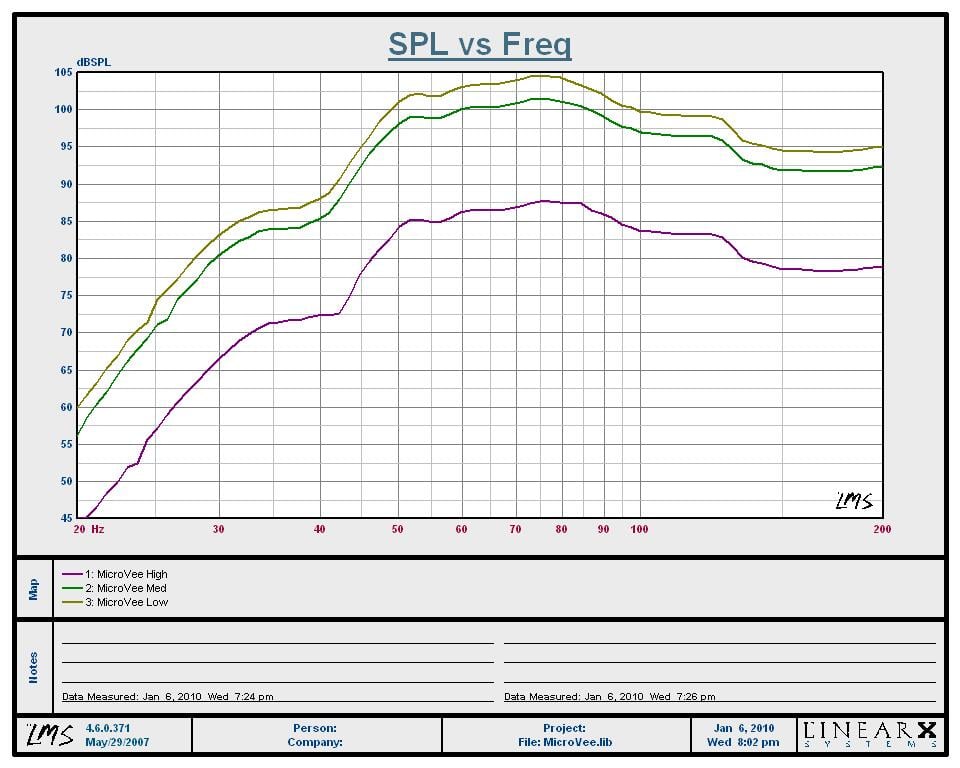
Velodyne MicroVee Nearfield Frequency Response
I measured the MicroVee at various output levels using the groundplane technique at 3 inches from the front driver. The output was scaled -19dB down to give the actual SPL output I could hear at my listening position which was roughly 4 feet away. The frequency response was pretty linear down to around 50Hz where it dropped around 15dB below 40Hz. Since the sub has multiple passive radiators, and the mic was in such close proximity, the roll-off was slightly accentuated so you could expect a bit more low frequency gain than is illustrated in this graph. I was impressed that this little sub was able to hit 105dB SPL levels from my listening position which is higher than I'd ever listen to my desktop system given the close proximity to the them. The MicroVee certainly has plenty of output for small office spaces.
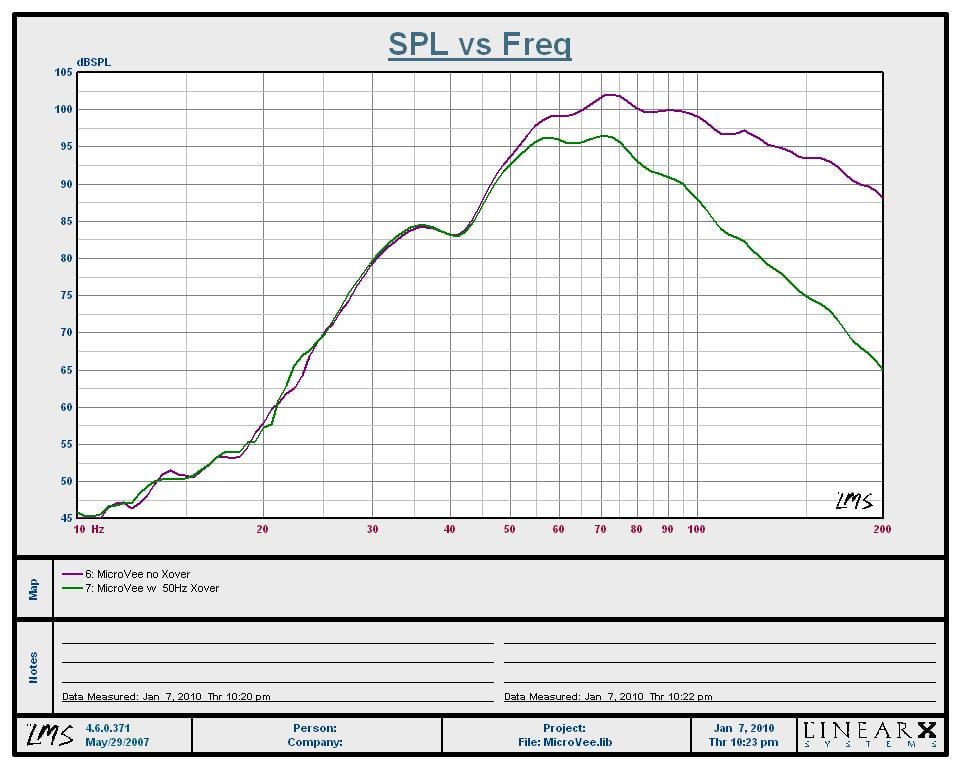
Velodyne MicroVee Nearfield Frequency Response with Xover
Purple trace: no xover ; Green trace: xover @ 50Hz
Oddly with the internal crossover engaged on the MiniVee at 50Hz, the output dropped about 4dB above 50Hz, but the -3dB point was 80Hz. This explains why I preferred the lowest setting as this sub simply doesn't have a steep low pass filter employed and provides too much output above 80Hz unless the lowest crossover setting is used. Bass above 80Hz is highly directional, especially when sitting in close proximity to the sub which most users will be doing with a MicroVee. I suggest starting at the lowest crossover setting or using the bass management of your receiver or source device if they have such facility (most desktop systems won't).
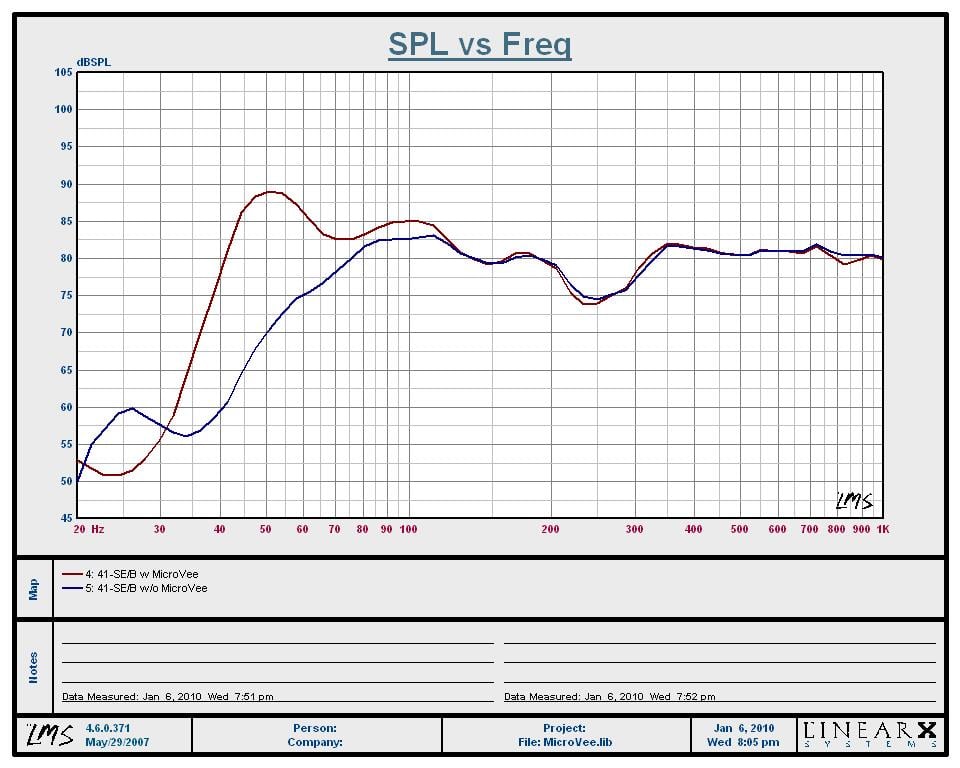
Combined Velodyne MicroVee + EMP 41-SE/B Frequency Response
1/3rd Octave Smoothed @ listening position
I measured the MicroVee in concert with one 41-SE/B speaker. The output of the sub was calibrated for both speakers playing thus why the level is about 3dB too hot in this measurement scenario. As you can see, the MicroVee extended the -3dB point of my desktop system from 60Hz to around 40Hz. With the MicroVee engaged for music listening, my desktop system sounds much fuller and tactile.
Conclusion
 Velodyne
has once again demonstrated it could provide the most amount of bass
per square inch that the laws of physics would allow. Unfortunately
this level of performance comes at a price premium resulting in a
product that costs $100 more than their higher performing next model up
- the MiniVee. If you have the space available, I'd strongly consider
the MiniVee over this product but if you are size constrained in a
small office space, I can't think of a better performing product in its
size class to recommend.
Velodyne
has once again demonstrated it could provide the most amount of bass
per square inch that the laws of physics would allow. Unfortunately
this level of performance comes at a price premium resulting in a
product that costs $100 more than their higher performing next model up
- the MiniVee. If you have the space available, I'd strongly consider
the MiniVee over this product but if you are size constrained in a
small office space, I can't think of a better performing product in its
size class to recommend.
I love seeing the reaction in my friends' and family's faces when they sit down to hear my computer system - not realizing there is a MicroVee sub hidden behind my trash can providing all the low end boom. It blended well with my desktop system, transforming its sheer depth and soundstage by providing the much needed low end extension my small speakers were incapable of producing. A MiniVee simply would have been too large for this application so the MicroVee fit the bill nicely. The MicroVee proved it was not an illegitimate child to the MiniVee (more like a slightly posh one), as it proudly lived up to the heritage Velodyne established when they entered the marketplace nearly 27 years ago. Dr. Evil would be proud!
MicroVee Review
MSRP: $799
Velodyne Acoustics
345 Digital Drive
Morgan Hill, CA 95037
About Velodyne Acoustics
Velodyne
Acoustics is the industry leader in loudspeaker styling, performance,
and value. Since the company's inception in 1983, Velodyne has been
acclaimed by industry experts, audiophiles and home theater enthusiasts
for its innovative designs, close tolerance manufacturing and
exceptional performance
The Score Card
The scoring below is based on each piece of equipment doing the duty it is designed for. The numbers are weighed heavily with respect to the individual cost of each unit, thus giving a rating roughly equal to:
Performance × Price Factor/Value = Rating
Audioholics.com note: The ratings indicated below are based on subjective listening and objective testing of the product in question. The rating scale is based on performance/value ratio. If you notice better performing products in future reviews that have lower numbers in certain areas, be aware that the value factor is most likely the culprit. Other Audioholics reviewers may rate products solely based on performance, and each reviewer has his/her own system for ratings.
Audioholics Rating Scale
 — Excellent
- — Very Good
- — Good
- — Fair
- — Poor
| Metric | Rating |
|---|---|
| Bass Extension | |
| Bass Accuracy | |
| Build Quality | |
| Fit and Finish | |
| Ergonomics & Usability | |
| Features | |
| Performance | |
| Value | |
Gene manages this organization, establishes relations with manufacturers and keeps Audioholics a well oiled machine. His goal is to educate about home theater and develop more standards in the industry to eliminate consumer confusion clouded by industry snake oil.
View full profile Subscribe to our newsletter