


Funk Audio 18.2 Dual 18" Sealed Subwoofer Preview
Funk Audio 18.2 Subwoofer
Summary
- Product Name: 18.2
- Manufacturer: Funk Audio
- Review Date: January 16, 2013 22:55
- MSRP: $8600 and up depending on configuration
- First Impression: Pretty Cool
- Dual opposed driver sealed subwoofer
- +/-3db variable, customizable, response to 10hz or lower depending on setup.
- 125db peak output, 2m Ground plane(power level two)
Amplifier Specifications
- Amplifier; One amplifier provided for power level one, two with power level two
- 2.4kW X2 M1
- Dual XLR inputs
- USB PC interface
- Full DSP control
- High current detachable power cord and 20A circuit breaker
- All CNC machined Aluminum Case, built in house
- Front DSP interface control
- 120/240V operation(240V recommended)
TSAD18V2 Driver Specifications:
- 18" Carbon fiber/paper composite cone
- Hand built in house by Funk Audio
- 4.5” Aluminum voice coil
- 44lb Neodymium magnet structure
- Dual Aluminum shorting rings for reduced distortion
- Linear Inductance +/-5% through 3 p-p travel, resulting in very low distortion, and clean midbass.
- Cast Aluminum frame
- Anodized aluminum dust cap
- Tall profile treated foam surround
- 10” diameter spider
- 3” P-P excursion
- Under spider venting
- Forced air cooling
- Assembled with high temperature epoxies
Pricing:
Power level one; $8,600 delivered in North America
Power level two; $11,200 delivered in North America
Pre release special prices:
Power level one; $6,995 delivered in North America
Power level two; $9,350 delivered in North America
Options:
Magnetic cloth grills $250(adds 2” to overall width)
Solid wood inlay corners $150
Custom finishes, contact manufacturer for prices.
Funk Audio, a relative newcomer in the ID subwoofer marketplace, has just put its competition in checkmate. The Funk Audio 18.2 subwoofer is their latest and most advanced subwoofer design. It is the culmination of the most advanced technology and rigorous testing and development, unhindered by their marketing dept which is virtually non existent. It was designed to provide the ultimate in power, sound quality, and output, in a package so compact the amplification system has to be separate from the subwoofer itself.
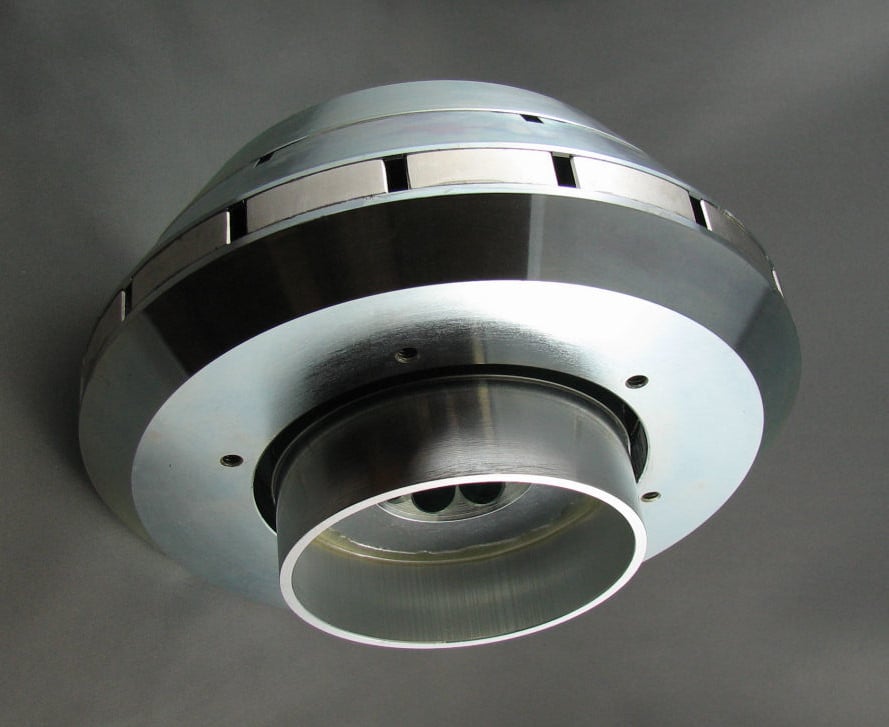
TSAD18V2 Motor Structure
The heart of this subwoofer is its incredibly powerful motor structure of the TSAD18V2 driver. The 18" driver for this sub is built in-house by Funk Audio. Starting with a 4.5” aluminum voice coil surrounded by a 44lb FEA optimized Neodymium magnet structure, featuring a 9” diameter segmented Neodymium magnet ring, dual shorting rings, and a very specialized “forced air” cooling system allowing the voice coil to keep its cool even when fed with the “high power” amplifier option that sends an unprecedented 4800 watts RMS (9600 peak) to each of the two drivers. The driver cone is constructed of a carbon fiber / paper composite with cast aluminum basket and anodized aluminum dust cap and is said to have a 3" pk-pk travel. With a 10" diameter spider, forced air cooling and such a powerful motor structure, its obvious this is one bad ass driver ready to be fed some wattage.
We are a bit skeptical on the power rating of the amplifiers so we inquired for a bit more detail from the manufacturer.
Editorial Note on Amplifier Power by Nathan Funk
The power cord, and circuit breaker/power switch, are 20A. Most often "220" is actually 240V which is 4800 watts at 20A. Electrical systems are rated at full duty cycle, and for anything less than 100% duty cycle will allow up to 10 times the rated current (for very short bursts). As I am sure you know, audio signals are never 100% duty cycle sine waves, so the amp can draw up to 4800 watts continuous from the wall, and put out nearly as much fully continuous, and much higher semi-continuous peaks, even for a few seconds at a time. Normal material and even tone bursts are quite low actual duty cycle, even a single 20A "220V" circuit will power two amps (power level two) to full power with most material. We do recommend an absolute minimum 15A "220V" for a each amp (or a 30A for two), any less and you can run the risk of blowing the breaker with material containing heavy sustained very low frequencies, where the most current demand is. These amplifiers use two of our 2.4kW amp modules, used in the 18.0/18.3 amp. For power level one, one module per driver is used. For power level two one module drives each of the voice coils. The power level two drivers are dual voice coil.
The 18.2 subwoofer is a dual opposed 18” design. The two TSAD18V2 drivers are contained in a very solid Baltic Birch plywood enclosure, featuring 1.5” thick baffles, top and bottom, curved laminated front and rear walls, and extensive bracing. All measuring in at 21” wide 22” high ans 24” deep, with a total weight, without amplification, of 175lbs. This subwoofer is definitely a two person installation.
Power Up
The 18.2 subwoofer is available in two power levels; Power level One provides a single amplifier (17”wide 13” deep 4.5” high) producing 2400 watts RMS for each driver, for a total power of 4800 watts RMS (9600peak), Power Level Two provides dual amplifiers, one for each driver, producing 4800 watts RMS for each driver, for a total power of 9600 watts RMS (19,200 watts peak). Power level two is said to enable the 18.2 sub to hit an ear drum busting 125dB peak output at 2 meters groundplane. Funk Audio provided 2 meter CEA test date with distortion for the 18.2 sub with Power II amplification as you can see below. You can rest assured that no matter what level you chose for this sub, it will surely make Grandpa Simpsons teeth explode and will probably loosen a few of your fillings too.
10 hz 31.6%
99.5 dB
12.5 hz 28.2% 106.7 dB
16 hz 22.4% 111.3 dB
20 hz 17.8% 113.7 dB
25 hz 8.9%
116.6 dB
32 hz 5.0%
119.6 dB
40 hz 10.0% 122.3 dB
50 hz 6.3%
125.3 dB
63 hz 4.4%
127.7 dB
80 hz 1.99% 128.8 dB
100 hz nill 130.4 dB
125 hz nill 131.4 dB
160 hz nill 131.2 dB
200 hz nill 130.3 dB
CEA 2010 Frequency vs Distortion & Output (2 meter GP) provided by Funk Audio
To get the 18.2 Power Level Two configured will set you back $11,200 and Power Level One $8,600 but if you preorder now, the prices drop to $9,350 and $6,995, respectively. Shipping is included in all prices. Click on the specs tab to get more product details. Let us know in the forum thread if you want to see us review this beastly subwoofer.
Unless otherwise indicated, this is a preview article for the featured product. A formal review may or may not follow in the future.
Gene manages this organization, establishes relations with manufacturers and keeps Audioholics a well oiled machine. His goal is to educate about home theater and develop more standards in the industry to eliminate consumer confusion clouded by industry snake oil.
View full profile Subscribe to our newsletter