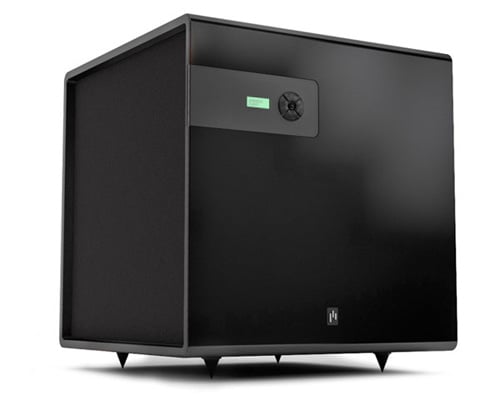
Aperion Audio Bravus 10D Subwoofer Review
- Product Name: Aperion Audio Bravus 10D Subwoofer
- Manufacturer: Aperion Audio
- Performance Rating:


- Value Rating:
- Review Date: March 17, 2010 22:25
- MSRP: $ 799
Frequency Response: -3dB -- 30Hz - 180Hz
Amplifier Power: 300W
Woofer: Dual 10" High Excursion Aluminum Cones
Driver Configuration: Dual Active Drivers Enclosure
Type: Sealed and Internally Braced 1" HDF
Dimensions: 15"H x 13.5" W x 13.5" D (with feet attached)
Weight: 44 Lbs
Pros
- Delivers good punch for such a small package
- Easy to blend into room décor
- Has remote control
Cons
- Limited low end extension
Aperion Audio Bravus 10D Introduction
 Lately it seems I've been on a personal crusade to
review small but potent subwoofers.
Aperion Audio seems to have built their entire subwoofer lineup on this
philosophy, with the Bravus 10D being their most popular offering. I'm a
champion of recommending multiple subwoofers in virtually all home theater
installations because of the superior bass response across all of the seats
that is inherent thanks to modal averaging.
If you want consistent bass for all seats, strategically positioning multiple
subs (2 or 4) is the best way of achieving this. It’s often impractical with large expensive
subs. But, my argument rather than spending $2k on a large sub is to spend $2k
on two smaller but competent subs (see: Are two subs better than one?) I recently
caught a glance at Aperions new subwoofer offerings
through a 5.1 system review Clint DeBoer
headed up. I was intrigued to check one
out myself. Could the reasonably sized
and priced Aperion Bravus 10D deliver the goods? Read on to find out….
Lately it seems I've been on a personal crusade to
review small but potent subwoofers.
Aperion Audio seems to have built their entire subwoofer lineup on this
philosophy, with the Bravus 10D being their most popular offering. I'm a
champion of recommending multiple subwoofers in virtually all home theater
installations because of the superior bass response across all of the seats
that is inherent thanks to modal averaging.
If you want consistent bass for all seats, strategically positioning multiple
subs (2 or 4) is the best way of achieving this. It’s often impractical with large expensive
subs. But, my argument rather than spending $2k on a large sub is to spend $2k
on two smaller but competent subs (see: Are two subs better than one?) I recently
caught a glance at Aperions new subwoofer offerings
through a 5.1 system review Clint DeBoer
headed up. I was intrigued to check one
out myself. Could the reasonably sized
and priced Aperion Bravus 10D deliver the goods? Read on to find out….
Design Overview
 The Bravus 10D is in the middle of the Aperion line
of subwoofer offerings. Aperion offers
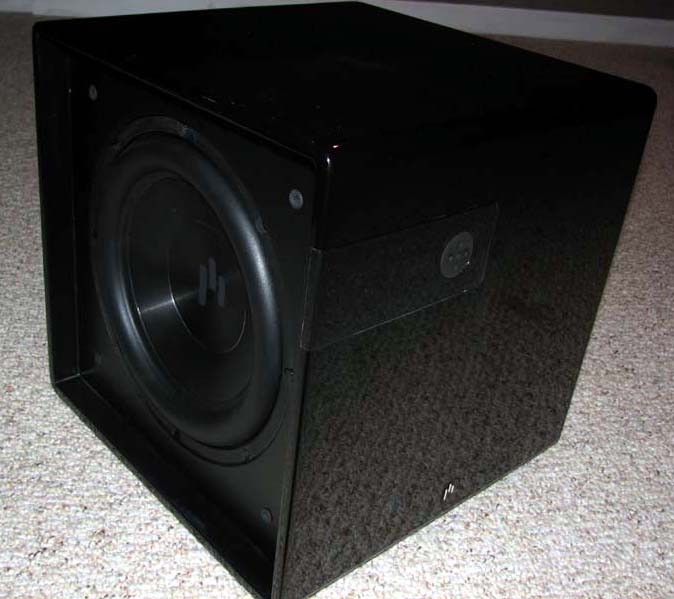
two finish options: cherry or high gloss black.
I selected gloss black for my review sample.
The Bravus 10D is in the middle of the Aperion line
of subwoofer offerings. Aperion offers
two finish options: cherry or high gloss black.
I selected gloss black for my review sample.
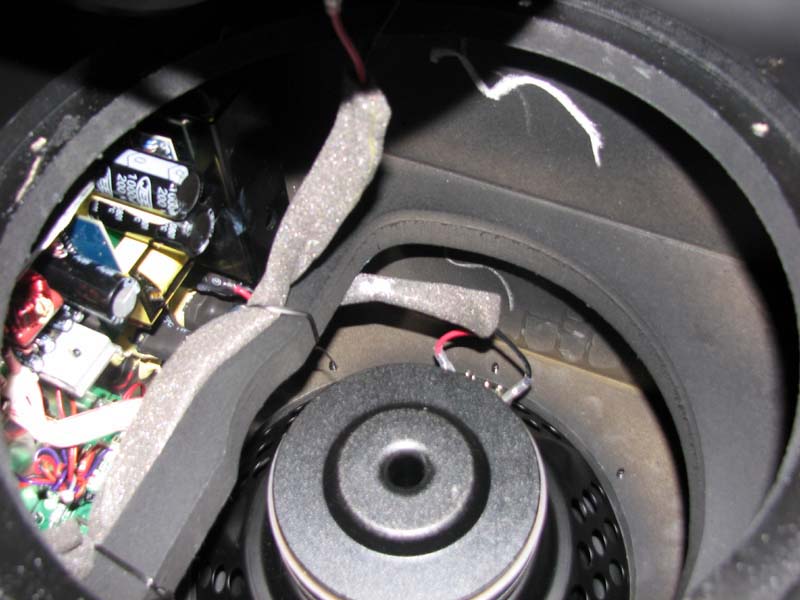
The 10D
features dual anodized black 10" Aluminum cone woofers with butyl rubber
surrounds firing on opposing cabinet walls. This is beneficial configuration
for the drivers to cancel one another's stress on the cabinet, reducing cabinet
coloration. Aperion claims the cabinet
is constructed of 1" HDF but when I pulled one of the drivers out, it
appeared more like 3/4" to me but Aperion Audio engineering assured me the side panels, front baffle and
bracing are all 1" thick. Needless to say the cabinet was well braced
and passed the knuckle rap test with a solid thud. The cabinet is rounded with NO sharp corners
or boxy look as can be found in many of Aperion's competitors. Aperion supplies both rubber cone (for
hardwood floors) and metal cone feet (for carpets) and even includes pads for
the metal spikes should you decide to use them on delicate hardwood
flooring.
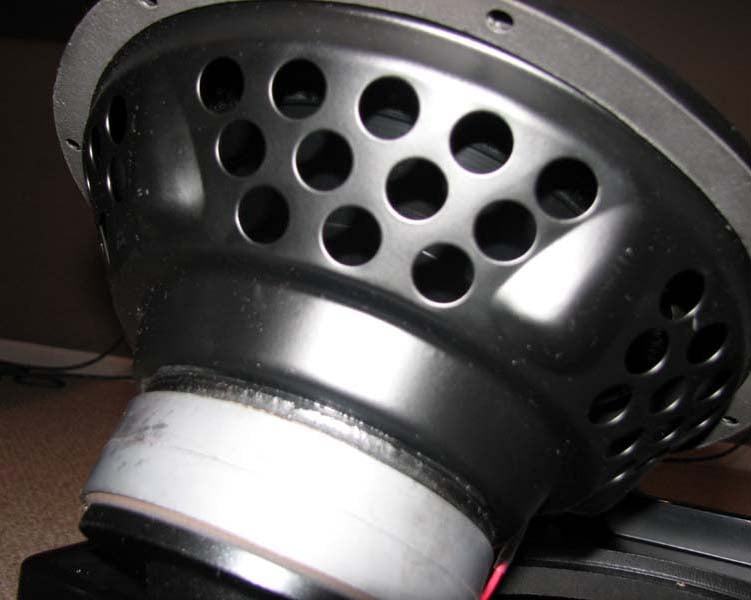 The woofers are stamped baskets but have a lot of
steel mass on the frame which helps to push the resonant frequency above the
woofers passband thus reducing their susceptibility to adding coloration. The
drivers are NOT magnetically shielded but the opposing magnets in close
proximity reduces the net magnetic field for those still using CRT screens in close proximity to the subwoofer. The 10D employees a 300 watt BASH
amplifier. It's unclear how the power of
this amplifier is rated but it's been our experience with other subwoofers
employing BASH amplifiers that their ratings tend to be a maximum best case
scenario rating and NOT even close to a continuous power rating. What matters most is how much clean SPL the
subwoofer can deliver which we will get to later in the review.
The woofers are stamped baskets but have a lot of
steel mass on the frame which helps to push the resonant frequency above the
woofers passband thus reducing their susceptibility to adding coloration. The
drivers are NOT magnetically shielded but the opposing magnets in close
proximity reduces the net magnetic field for those still using CRT screens in close proximity to the subwoofer. The 10D employees a 300 watt BASH
amplifier. It's unclear how the power of
this amplifier is rated but it's been our experience with other subwoofers
employing BASH amplifiers that their ratings tend to be a maximum best case
scenario rating and NOT even close to a continuous power rating. What matters most is how much clean SPL the
subwoofer can deliver which we will get to later in the review.
The side
firing woofers are recessed into the cabinet making the grills flush with the
box which is very aesthetically pleasing.
If you want to pull the grills off to get a glance at the woofers, you
will need to use their supplied tool to do so.
A simple insertion into the top of the grill, a twist clockwise and a
small pull will get the grills off. In
my opinion, Aperion should have included a holding spot on the amplifier
backplate as it's very easy to lose this tool. The 10D comes with a remote
control which is a rarity in a product
in this price class. Again it would have
been cool to be able to store the remote in the sub, perhaps via a small slot
below the front panel controls. It's
very easy to lose such a small remote control so be sure to stow the remote and
the grill tool in a safe place for future use.
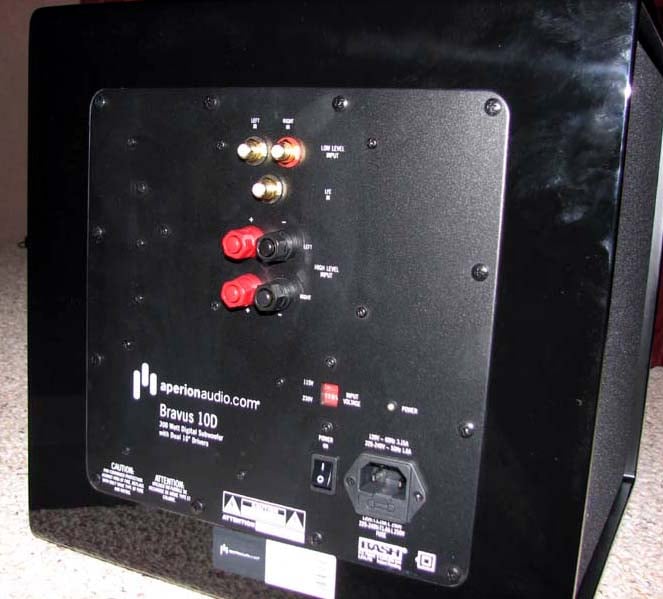 The
backpanel has both high level (stereo and LFE mono) and stereo speaker level
inputs, a 120/220V selector and power on/off switch. There are no speaker level outputs so if
you're planning on running a subwoofer-satellite system you're gonna need to
use the bass management of your A/V
receiver which, in most cases, is the preferred option anyways.
The
backpanel has both high level (stereo and LFE mono) and stereo speaker level
inputs, a 120/220V selector and power on/off switch. There are no speaker level outputs so if
you're planning on running a subwoofer-satellite system you're gonna need to
use the bass management of your A/V
receiver which, in most cases, is the preferred option anyways.
The 10D
sports three custom presets which are factory set with the same null settings.
The setup options include:
- variable and defeatable crossover from 50-150Hz in 10Hz steps
- low bass boost/cut from -6dB to + 6dB in 1 dB steps
- phase from 0 to 180 degrees in 30 degree steps
- single PEQ (Paramentric EQ) +-6dB gain/cut from 30Hz to 60Hz in 10Hz steps, with what Aperion refers to as "Narrow", "Normal" and "Wide" Q (aka. filter width) options. I tested the PEQ feature of the 10D and verified the variable Q settings to be between 2 for the "Low" setting and 6 for the "Narrow" setting which is what Aperion claims. The high Q setting is useful for taming real world real world bass issues if you have the proper tools to measure and analyze the problematic frequencies in your room.
 Set-Up & Installation
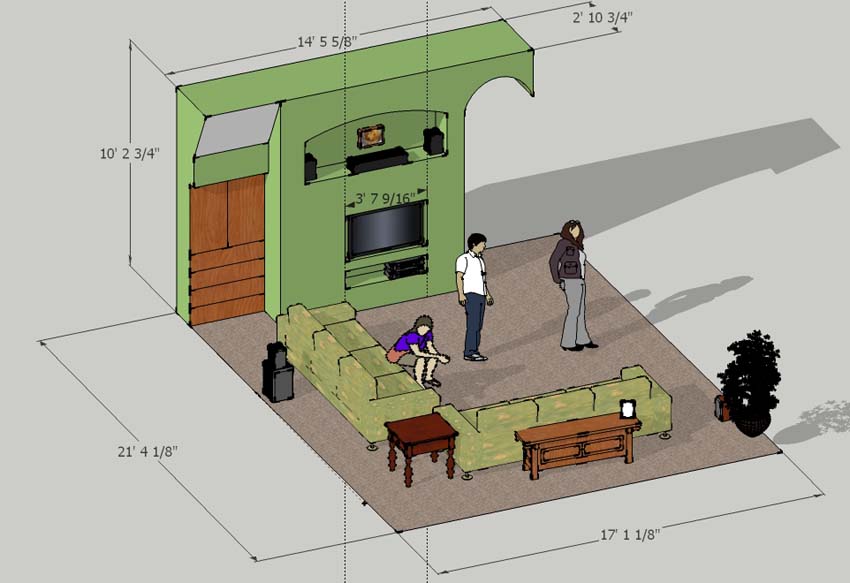
I tested the Aperion Bravus 10D in the Audioholics Showcase Home family room system which is a medium sized room opened to a kitchen, a room layout which is typical in Florida. In this system I am using a Yamaha RX-Z7 7.1 A/V receiver, Oppo BDP-83SE Universal player, RBH Sound Signature series speakers with Status driver upgrades and two JL f110 subwoofers. To be fair to the 10D, I disconnected one of my f110s and directly compared a single f110 placed side by side with the Aperion 10D both level matched to the rest of my system. Both subs are located towards the front left of the room behind the left couch about 4 feet from the corner. I also spot checked how the 10D sounded in my main theater room using my EMPtek 41-SE/B desktop speakers crossed over at 90Hz.
Aperion Audio Bravus 10D Listening Tests
 CD: Dianne Reeves Never Too Far
Yes, I use this disc often but I know exactly what to listen for when I pop it
in so expect to see me continually using it as a reference, especially for
loudspeaker and subwoofer reviews.
In track #2, “Never too Far”, I listen for the natural decay in the bass which
poorly designed systems simply muddy. The Bravus 10D did a very nice job of
keeping the harmonics in tact. I could
only imagine how much better the experience could have been running dual
10D's. Running dual subs, especially
with satellite speakers crossed over at 80Hz or higher can really provide a
more uniform bass response to better integrate with your speakers and also
provide a broader listening area.
Track #3 “Come In’ boasts some pretty deep bass extension. The 10D played this track commendably, though it lacked the tactile impact of my larger JL f110 which incidentally retails for almost 3X the price of the Aperion. Bass was nonetheless tight and well controlled.
Pandora.com & Yamaha MusicCAST
I use
Pandora.com streaming services quite often in our family room system which
supplies audio throughout the entire house where we entertain guests during
parties and social gatherings. I wanted
to give the Bravus 10D a workout by listening to some 90s dance and rap
music. I also pulled up some of my
favorite bass heavy jazz and rock tracks from my Yamaha MusicCAST MCX-1000.
Will Smith
- Get Giggy with It
My kids
love this song and I have to admit I still get Giggy with it too. Will Smith can really energize a party and
the bass in this song made the Aperion 10D come alive. Bass was punchy and clean. The 10D didn’t mind me really cranking it up.
Fourplay - Amoroso
When
Fourplay isn't playing bubble gum jazz, they really produce some great
music. It's no surprise given the
musical talents of the band. Amoroso is full
of sustained bass notes courtesy of Nathan East. The Aperion 10D did commendably well compared
with my JL f110 only giving up some of the weight but not the timber of the
bass Lesser subs would muddy the sound
here and I was happy to find this wasn’t the case with the Bravus 10D.
 Donald
Fagen - Morph the Cat
Donald
Fagen - Morph the Cat
Donald Fagen's latest solo CD has some good songs and
lots of very low bass response. The
Bravus 10D conveyed the depth of the bass on the title track "Morph the
Cat" without drawing attention to itself.
Instead it just really blended well with my Decimo bookshelf speakers
tricking me into thinking I was instead listening to full range speakers.
At high
SPL's if I run my Decimos full range, they tend to bottom with bass intense
music like this. Simply bass managing my
speakers and diverting the deep bass duties to the subwoofer nullifies this
problem and increases system dynamic range. Because the 10D has such solid
output beyond 80Hz, its able to seamlessly blend it with small speakers and
pull off the illusion of running a full range system instead of a subwoofer /
satellite system. This is especially
true if two subs are used in such applications and each placed in close
proximity to the front left and right speakers.
 Blu-ray: Terminator Salvation
Like the movie or not, Terminator Salvation has lots
of great LFE effects. The opening scene
introducing John Conner really shakes the room while Skynet drops bombs over
the resistance. The 10D provided good
rumble effects making me root for the terminators to deliver more carnage. Going though various clips, I tested the 10D
at high output levels to see if it would falter. At times I wished for more low frequency
extension and tactile response, but I was pleased that it never got nasty
sounding. There were no discernible
mechanical vibrations emanating from the cabinet even at high output levels. In comparison, I've tested competitor's small
subs that either produced audible port chuffing or cabinet rattles. Aperion did their homework with this sub
making it air tight and not allowing the amplifier to overdrive the drivers.
Aperion Audio Bravus 10D Measurements and Analysis
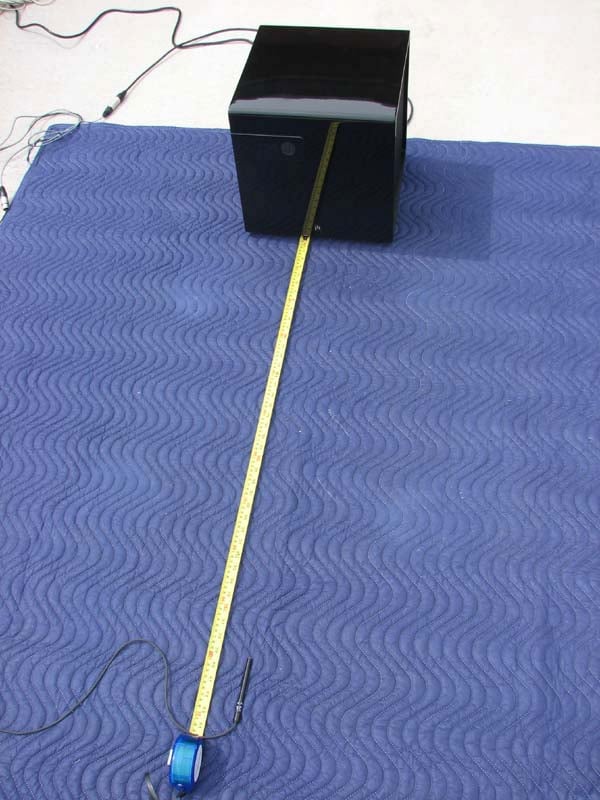 I braved
the bad Florida
weather and measured the 10D outdoors (1 meter groundplane) and also in-room (middle
of my 6000ft^3 theater room 1 meter ground-plane).
Unless otherwise noted, I positioned the microphone so it was facing the
front of the subwoofer which was the midpoint between the two drivers. I
utilized the brand new Ver2.5 acoustic measurement firmware for my Audio
Precision APx585 HDMI analyzer and the microphone and preamp from my Audyssey Pro calibration kit. I also used my antiquated LMS system
when I needed for more precise measurements for the compression testing.
I braved
the bad Florida
weather and measured the 10D outdoors (1 meter groundplane) and also in-room (middle
of my 6000ft^3 theater room 1 meter ground-plane).
Unless otherwise noted, I positioned the microphone so it was facing the
front of the subwoofer which was the midpoint between the two drivers. I
utilized the brand new Ver2.5 acoustic measurement firmware for my Audio
Precision APx585 HDMI analyzer and the microphone and preamp from my Audyssey Pro calibration kit. I also used my antiquated LMS system
when I needed for more precise measurements for the compression testing.
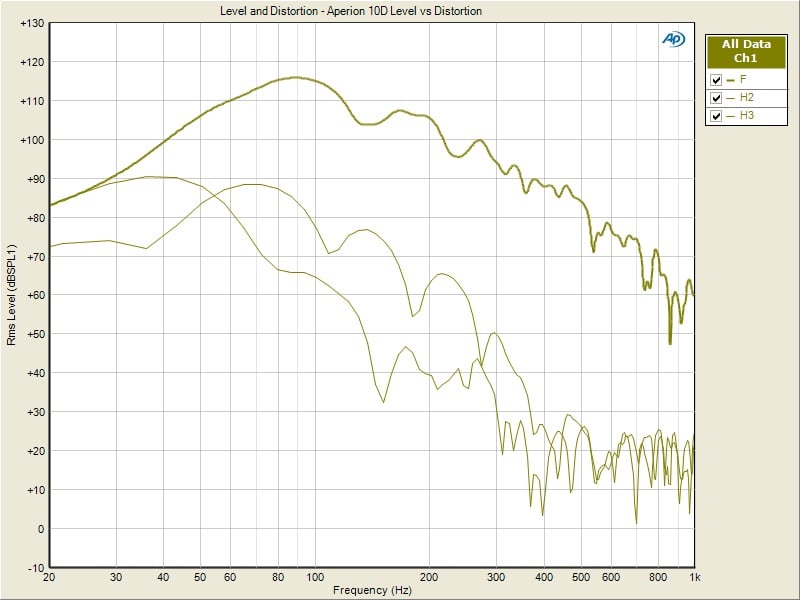
Aperion Bravus 10D Frequency Response & THD (in-room 1 meter ground-plane)
The Aperion 10D preamp distorted if the input signal exceeded 1Vrms. We've seen this on other subs utilizing BASH amplifiers and hoped by now they (BASH) would have addressed this as it's not abnormal for LFE tracks to approach 2Vrms at digital fullscale. I backed down the input level to 500Vrms for the cleanest possible signal and boosted the gain on the 10D for the frequency vs SPL sweeps.
Realize
since these are in-room measurements, there can be anywhere between 2-6dB of
room gain compared to an outdoor measurement.
I ran the Aperion sub up to its max SPL limit, which hit a whopping
115dB SPL at 1 meter at around 80Hz (no crossover engaged). Bass response sharply fell off below 40Hz as
expected given its diminutive cabinet size.
The 10D
appears to have usable bass extension down to around 30Hz though don't expect
much SPL at those frequencies. Below
30Hz the output is dominated by 2nd harmonic distortion. Trying to get this sub to play usable bass
below 30Hz at meaningful SPL levels is like expecting Sarah Palin to actually
be funny doing stand up comedy or Obama to grow balls and actually make good on
his promises.
I measured discrete frequencies vs max SPL at 1 meter with a fixed 10% THD +N and achieved the following results.
| Frequency | SPL |
| 40 | 90 |
| 50 | 90 |
| 60 | 115 |
| 80 | 120 |
| 100 | 116 |
Below 50Hz the clean usable output of the 10D is significantly lower both in SPL and perceived loudness to the human ear. Corner loading this sub will help boost those frequencies to provide more impact to the listener.
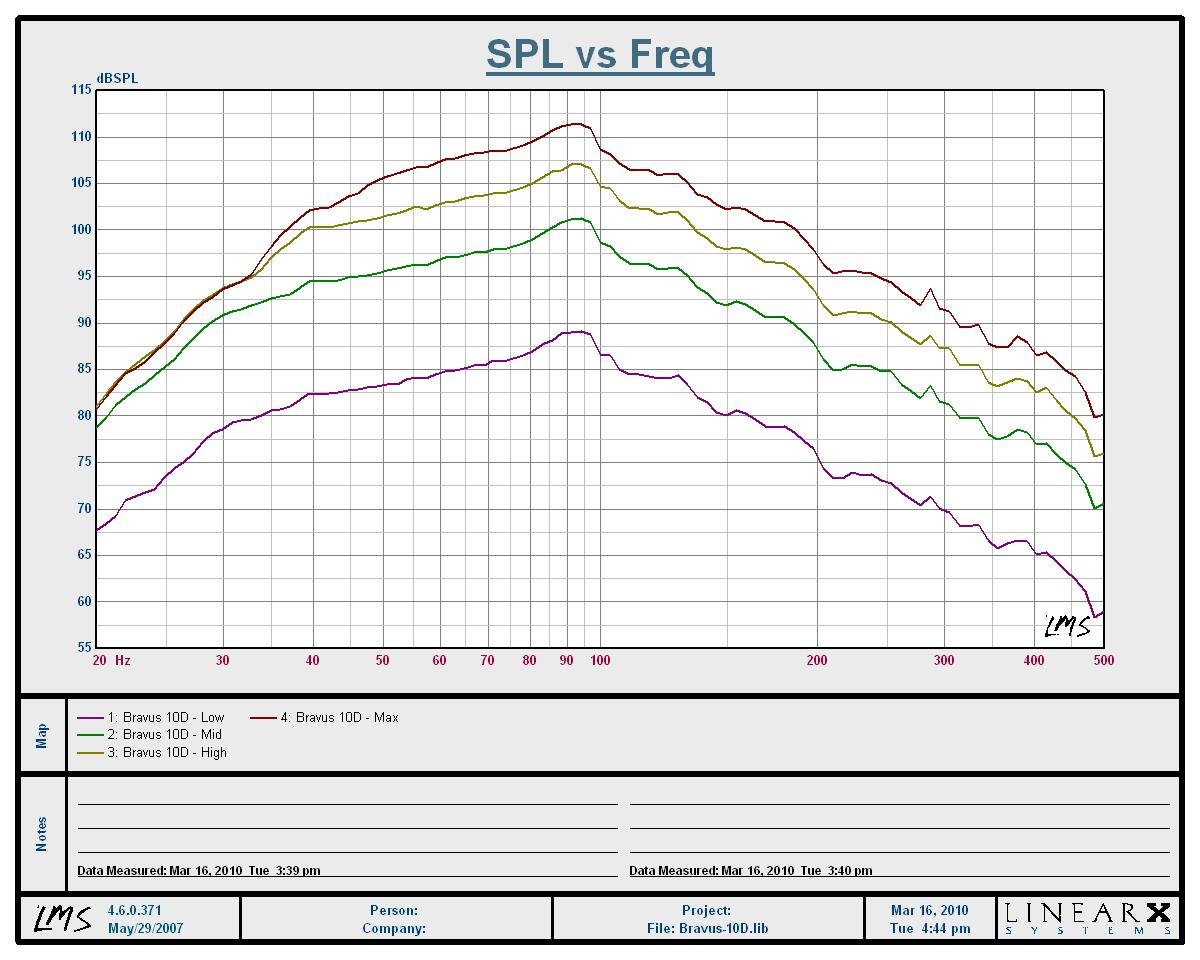
Aperion Bravus 10D
Compression Test (2pi 1 meter groundplane)
Purple - nominal SPL ; Red- Max SPL
Since Audio
Precision doesn't yet provide for scaling measurements, I broke out my
antiquated LMS system to better
illustrate the 10D's SPL vs compression limits.
All measurements were done outdoors via 1 meter groundplane
technique. The purple trace was
conducted at low SPL to show the best case bandwidth of the subwoofer. As you
can see the 10D enters compression slightly below 50Hz with about 20dB / Oct roll
off below 40Hz. Aperion Audio claims a
-3dB of 30Hz for the 10D which isn’t a stretch until the 10D is expected to produce deep bass at high
SPL's at which point the systems volume displacement limitation causes
significant compression. It can be
argued that the primary figure of merit for a subwoofer system is not the -3db
low end point, but rather the amount of air that can be moved by the cone and
vent combination (if applicable). At
some frequency, the thermal and displacement limitations are equal. For this system it appears to be around
50 Hz. Below 50 Hz, the system runs out
of displacement before it runs out of power, hence the resultant compression
meaning the maximum output curve (red) has a different frequency response below
50 Hz than the low SPL curve (purple).
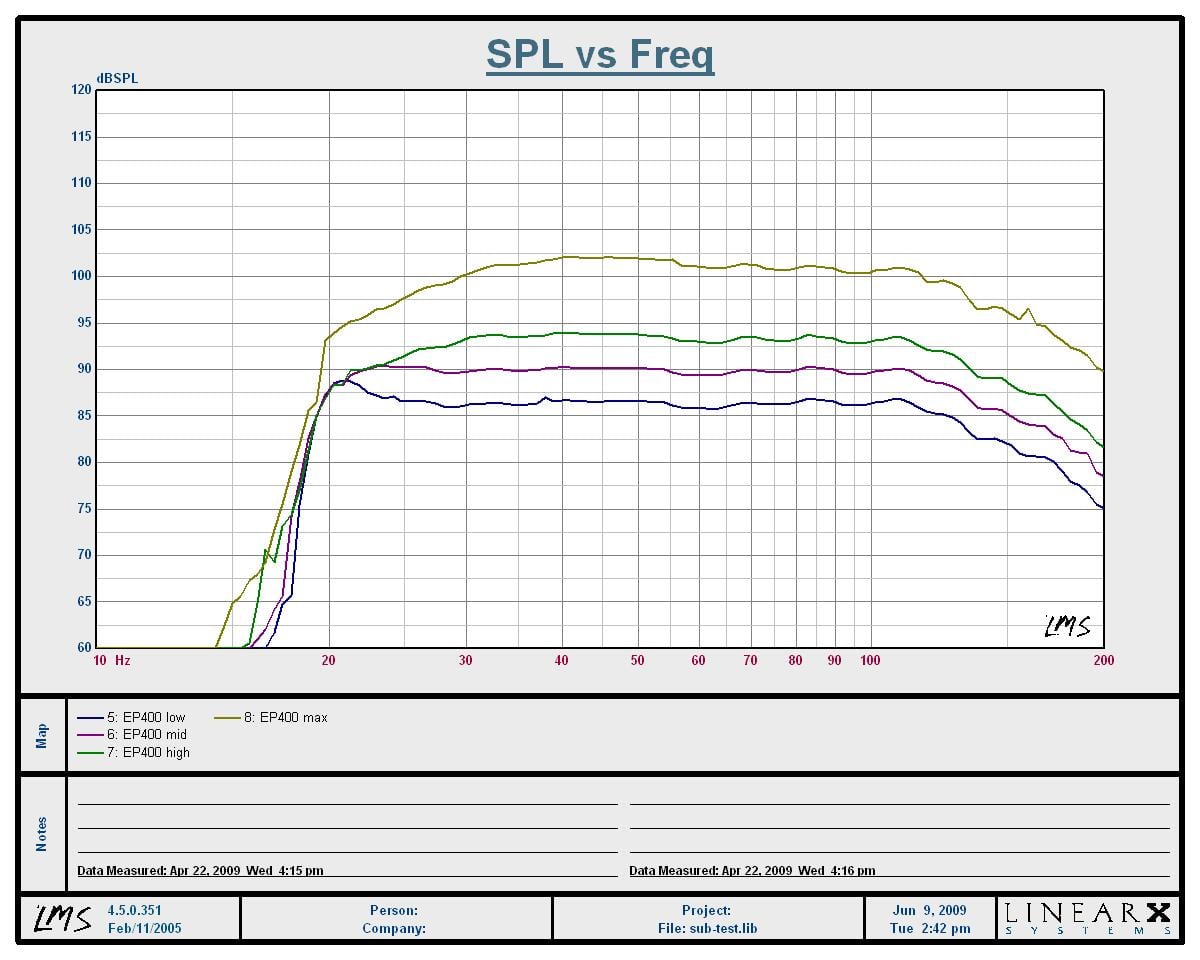
Interestingly
I directly compared the measurements of the Bravus 10D to an Axiom EP400 (MSRP:
$1100) subwoofer that I had on hand. The
Axiom has a single 8" driver with a huge 500watt Class D amplifier. The Bravus 10D has about 8dB more output than
the Axiom above 40Hz to around 120Hz whereas the Axiom has 6dB more output down
to 30Hz and almost 12dB more down to 20Hz.
See: Axiom EP400 SPL vs Frequency Measurements
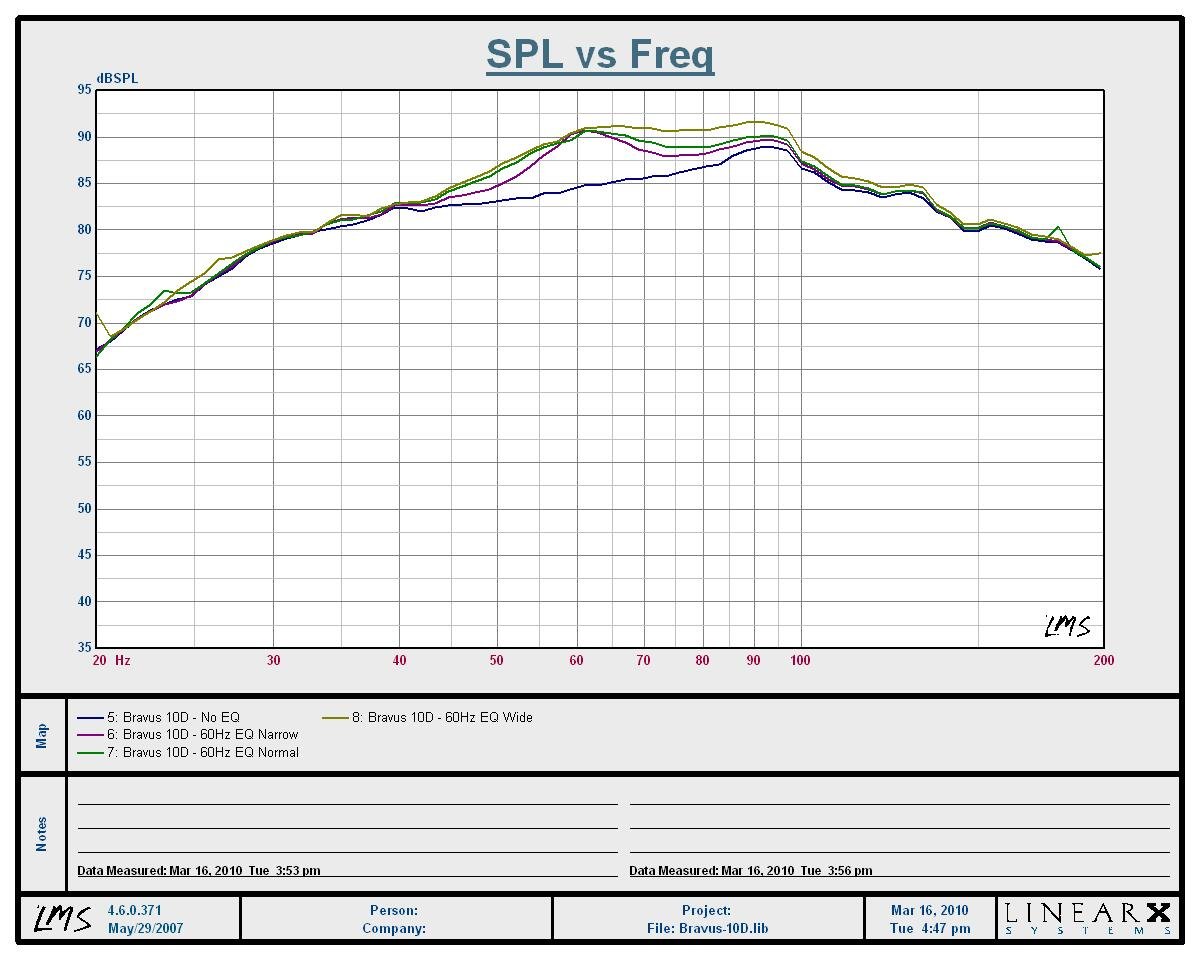
Aperion Bravus 10D PEQ
Frequency Response (2pi 1 meter groundplane)
Blue: no PEQ; Yellow: PEQ "wide"; Green: PEQ "normal",; Purple: PEQ "narrow"
I set the
PEQ for 60Hz with +6dB boost and tested the various settings. The PEQ feature of the 10D exhibits a very
low Q response (around 2) when the "wide" setting is used. This means the curve of the boost or cut is
quite wide when its frequency response is viewed. Wide filters are less selective in their
boost or cut action than are narrow band filters which makes them broadband. The "narrow" setting has a Q of around 6 which is more useful for dealing
with room nodal and modal issues. In
this case, setting the frequency to 60Hz provides a tunable response centered
at 60Hz 10Hz wide (55Hz to 65Hz). I do
suggest experimenting with this feature if you have the proper measurement
tools to fine tune your system response but you may ultimately achieve better
results using your A/V receivers room correction system, or even an outboard EQ
system.
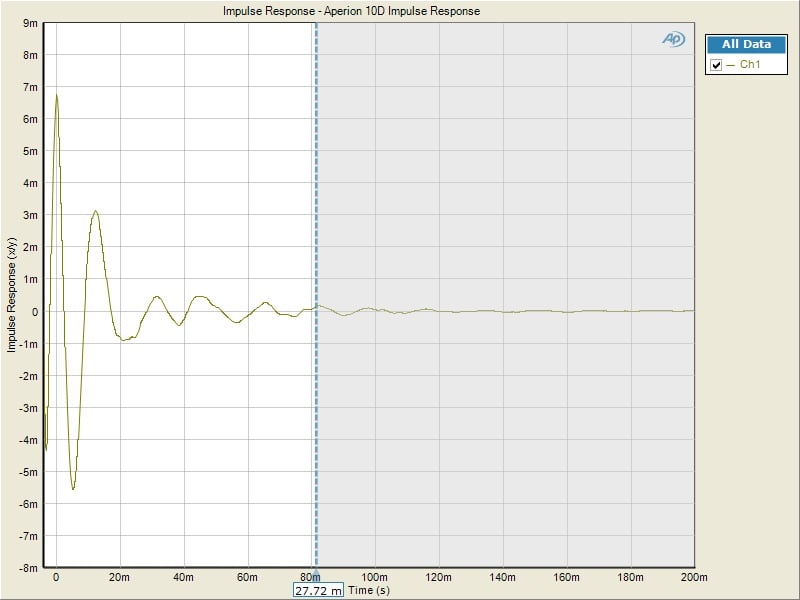
Aperion Bravus 10D
Impulse Response (nearfield)
I placed the measurement microphone in the nearfield at the right woofer and measured the impulse response. The rather long settling time indicated to me that this subwoofer is underdamped or in this case ringing. I suspect if Aperion ditched one of the woofers they would achieve a better low end frequency response, and impulse response while only sacrificing a few dB of efficiency and output above 50Hz. In speaking with Aperion Audio engineering they pointed out two reasons they chose to employ dual woofers in this design:
- the increased air moving capabilities (for max SPL but not for efficiency)
- It gives us a second voice coil to handle the power needed after increasing the power requirements.
Editorial Note on Driver Box Volume by Paul Apollonio
The ideal box-driver combination does NOT look like a box stuffed full of speaker cone. This is a marketing force exerted upon manufacturers who are trying to appeal to a mistaken consumer notion. It is basically giving the public what the eyes want, without respect for what the ears want. By using too much cone area inside of a box, we are trading off low frequency extension, for higher efficiency at the top end of a subwoofers bandwidth. As the compression curves show, efficiency (or output) is rarely an issue at the top end of a subwoofers bandwidth. So improving output at 100 Hz while ignoring performance at 40 Hz will result in a system which plays loud, but is not equally true to the program material at both ends of the spectrum. The reality is that the most important criteria for a subwoofer is Vd (volume displacement = Sd*Xmax). Surface area times linear excursion. The best criteria for judging how much low frequency energy a system can provide is much more a function of the size of the box, than it is the amount of cone area for the majority of commercially made boxes. This does not mean a 5 inch speaker in 5 cubic ft will make more bass than a 15" speaker in 4 cubic feet. It does mean that with all else equal, the bigger the enclosure the more low end bass you can enjoy. While this may not please the wife, it will satisfy the rules of physics. And, the inevitable tradeoff for more output at the top end of the subwoofers range is greater distortion at the lowest frequencies. As the efficiency at 100 and 150 Hz go up, while the efficiency at 50 Hz goes down (two subs in a box big enough for one sub) the 2nd and 3rd harmonic distortions of that 50 Hz fundamental tone inevitably go UP relative to the fundamental with this approach. (In other words, distortion increases for some drive levels.) The reality is that below 60 Hz, most recordings fall off quickly. Therefore, the designers are trying to get the LOUDEST sub in this size box. This gives the average consumer what they want. The reality of the marketplace is that loud bass is more important than low distortion and deep bass. For subwoofers, bigger is better, and the size of the box may be the most important specification of all.
Aperion Audio Bravus 10D Conclusion
 The Aperion Bravus 10D integrates well with low to
medium efficiency speakers and never sounds boomy. No matter how hard I drove it, it didn’t
bottom out or falter. Aperion Audio has
done their homework by employing good driver design in a small enclose that
limits the maximum excursion the drivers can reach ensuring they won't bottom
or stress when driven to maximum output.
The Aperion Bravus 10D integrates well with low to
medium efficiency speakers and never sounds boomy. No matter how hard I drove it, it didn’t
bottom out or falter. Aperion Audio has
done their homework by employing good driver design in a small enclose that
limits the maximum excursion the drivers can reach ensuring they won't bottom
or stress when driven to maximum output.
The Aperion Bravus 10D is an attractive, potent little subwoofer at a reasonable price. It certainly doesn't have the output and extension of its larger peers but that’s a tradeoff one must live with if they want a small box to better blend into their room décor. In that aspect the Bravus 10D is all aces.
While the Bravus 10D has impressive output for its size, I'd recommend it for small to medium sized rooms (< 2500ft^3). I'd personally recommend saving your dollars to purchase a second 10D which if strategically placed in the room provide the output of a single larger subwoofer, with smoother bass response for your entire listening area. After hearing dual subwoofers properly set up in a theater room you will find you can never go back to a single subwoofer system. Given the diminutive size of the 10D, it would be very easy to place two of these in most family rooms without drawing much attention to them. There should be no excuses for NOT setting up dual subs in your theater room. Aperion Audio makes this very easy for you with their small, potent Bravus offerings.
Bravus 10D Review
MSRP: $799
Aperion Audio
Loudspeakers
18151 SW Boones
Ferry Road,
Portland, Oregon
97224
Read Consumer Reviews on
About
Aperion Audio
Aperion Audio is an online direct-to-consumer speaker manufacturer for smart
shoppers who are frustrated with the
retail experience. Aperion offers a better value, meaningful information,
generous service, and unlike other speaker retailers and manufacturers, is the
only company to deliver an honest and Totally Risk-Free In-Home Audition. For
additional information, visit www.aperionaudio.com
For an alternate perspective on the Bravus 10D subwoofer please visit testfreaks.com.
The Score Card
The scoring below is based on each piece of equipment doing the duty it is designed for. The numbers are weighed heavily with respect to the individual cost of each unit, thus giving a rating roughly equal to:
Performance × Price Factor/Value = Rating
Audioholics.com note: The ratings indicated below are based on subjective listening and objective testing of the product in question. The rating scale is based on performance/value ratio. If you notice better performing products in future reviews that have lower numbers in certain areas, be aware that the value factor is most likely the culprit. Other Audioholics reviewers may rate products solely based on performance, and each reviewer has his/her own system for ratings.
Audioholics Rating Scale
 — Excellent
- — Very Good
- — Good
- — Fair
- — Poor
| Metric | Rating |
|---|---|
| Bass Extension | |
| Bass Accuracy | |
| Build Quality | |
| EQ System | |
| Fit and Finish | |
| Ergonomics & Usability | |
| Features | |
| Performance |  |
| Value | |
Gene manages this organization, establishes relations with manufacturers and keeps Audioholics a well oiled machine. His goal is to educate about home theater and develop more standards in the industry to eliminate consumer confusion clouded by industry snake oil.
View full profile Subscribe to our newsletter