


The Speaker Company TSAT-1000-HT8-B System Review
- Product Name: TSAT-1000-HT8-B System
- Manufacturer: tSc
- Performance Rating:


- Value Rating:
- Review Date: January 25, 2009 19:00
- MSRP: $ 399
tSc TSAT-1000 Satellite Specifications
Type 2-way acoustics suspension on-wall
satellite
Priced As: 5 pack
Mid-Woofer(s) 3.5” Aluminum
Tweeter Type 1” HiCell Dome
Magnetic Shielding Yes
Frequency Response 125 Hz – 20kHz
Impedance 8 Ohms
Power handling 15 – 100 watts
Sensitivity 85 dB
Dimensions (H x W x D) 8.63” x 5.31” x
3.25”
Weight 2
lbs, 13 oz / ea
Finish High
Gloss & Metal Grille
ASW-8 Subwoofer Specifications
Type 8" Powered Subwoofer
Woofer(s) 8" High Excursion Driver
Magnet 18oz ferrite
magnet
Cabinet Ported HD 5/8" MDF
Controls Phase switch / Volume
Magnetic
Shielding No
Frequency
Response 3 3-150Hz +/- 3dB
Crossover
Frequency Variable
Amplifier
type BASH®
Power
(watts) 50 watts RMS - 200watts Peak
Dimensions (W x D x H)
14.2" x 12.2" x 12.2"
Weight 22
lbs
Finish Black ash vinyl
Pros
- Unprecedented performance to price ratio
- Excellent built quality and appearance
- Impressive subwoofer bass extension
Cons
- Low efficiency of satellites
Introduction
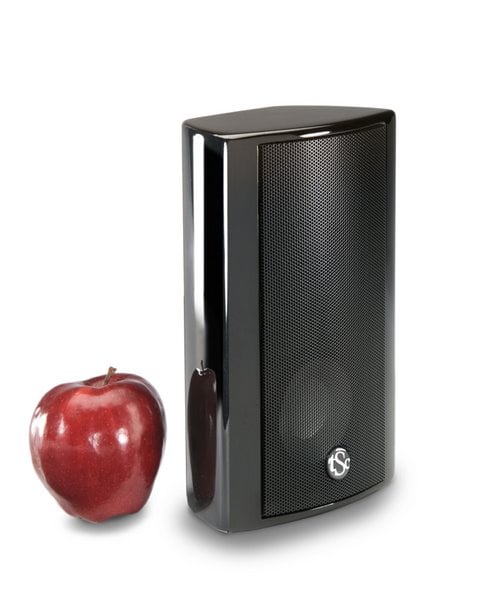 There’s the
famous saying that I usually follow “if
something sounds to good to be true, it usually is.” It does me well to
avoid scams and snake oil gimmicks. Last year an unknown online speaker company
came on the scene known as “The Speaker Company”. When they approached us, I
kinda brushed them off as a “White Van” speaker scam that wouldn’t last. Little did I know these guys were well
connected and part of the D&M Holdings group that also owns Denon, Marantz,
Snell, McIntosh and other high end A/V companies. I soon started seeing a lot of
buzz about this company on our forums and when I went to revisit their website,
I was floored by how much it has grown both in product selection and design
execution. It was time to put aside my preconceptions and give them a whirl. I
mean how critical could one be of a 5.1 system consisting of 5 two-way
satellites and an 8” powered subwoofer selling for under $400, especially when
the speakers are only about the size of two stacked apples?
There’s the
famous saying that I usually follow “if
something sounds to good to be true, it usually is.” It does me well to
avoid scams and snake oil gimmicks. Last year an unknown online speaker company
came on the scene known as “The Speaker Company”. When they approached us, I
kinda brushed them off as a “White Van” speaker scam that wouldn’t last. Little did I know these guys were well
connected and part of the D&M Holdings group that also owns Denon, Marantz,
Snell, McIntosh and other high end A/V companies. I soon started seeing a lot of
buzz about this company on our forums and when I went to revisit their website,
I was floored by how much it has grown both in product selection and design
execution. It was time to put aside my preconceptions and give them a whirl. I
mean how critical could one be of a 5.1 system consisting of 5 two-way
satellites and an 8” powered subwoofer selling for under $400, especially when
the speakers are only about the size of two stacked apples?
Build Quality
The TSAT-1000
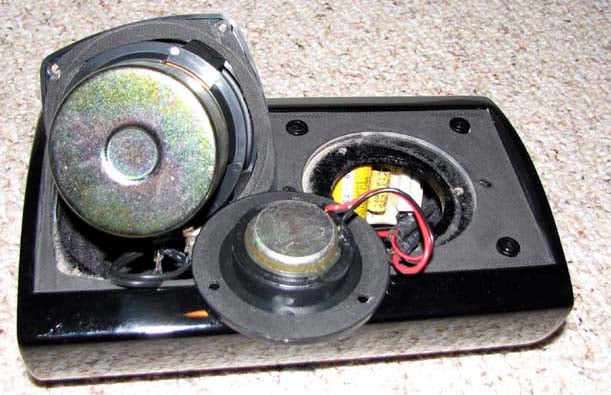 For this price, I was expecting cheap particle board
cabinets and plastic grills. Instead I was rewarded with a lacquered black
finish (TSAT-1000s) that rivals some speakers costing 10X the price. The
cabinets were very inert and the speaker heavier than its diminutive size would
suggest. What really floored me was the wonderfully contoured enclosures, flush
mounted magnetized metal grills and beautiful gold spring-loaded speaker
terminals that could accommodate my 10AWG speaker cable without any issues
other than you must apply a good deal of force to push the terminal down to
feed your speaker cable through. From an aesthetics standpoint, these speakers
look like they each cost the entire systems asking price. I was even surprised
to find they used a felt material on the front baffle to help reduce diffraction.
All of the drivers were recessed into the baffle as well. The latter point is
something many more notable speaker companies have still yet to figure out that
this helps ensure good off axis performance and it should be standard practice
in all of their product designs.
For this price, I was expecting cheap particle board
cabinets and plastic grills. Instead I was rewarded with a lacquered black
finish (TSAT-1000s) that rivals some speakers costing 10X the price. The
cabinets were very inert and the speaker heavier than its diminutive size would
suggest. What really floored me was the wonderfully contoured enclosures, flush
mounted magnetized metal grills and beautiful gold spring-loaded speaker
terminals that could accommodate my 10AWG speaker cable without any issues
other than you must apply a good deal of force to push the terminal down to
feed your speaker cable through. From an aesthetics standpoint, these speakers
look like they each cost the entire systems asking price. I was even surprised
to find they used a felt material on the front baffle to help reduce diffraction.
All of the drivers were recessed into the baffle as well. The latter point is
something many more notable speaker companies have still yet to figure out that
this helps ensure good off axis performance and it should be standard practice
in all of their product designs.
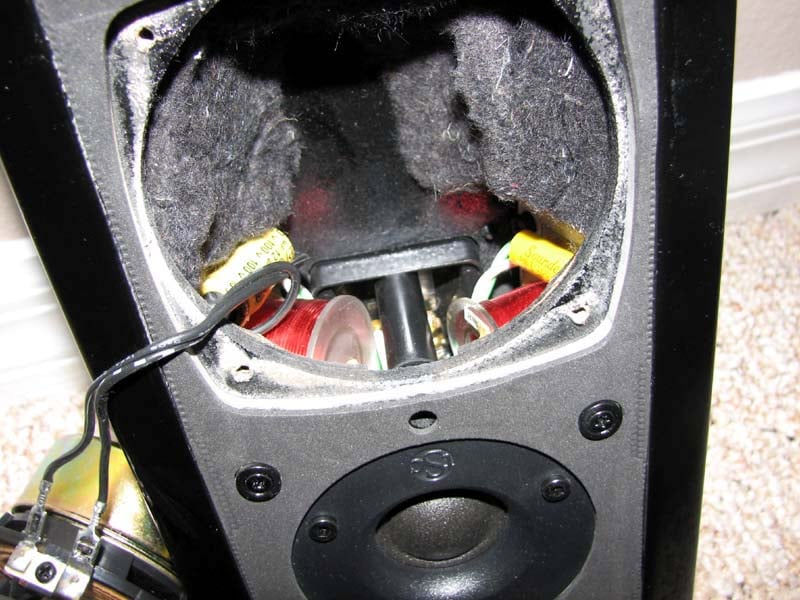 The drivers
of the TSAT-1000s utilize plastic baskets for the woofer which happens to be
properly magnetically shielded with a bucking magnet and encapsulated can. The
cone material is a doped aluminum with a butyl rubber surround. The tweeter utilizes a neodymium magnet
structure with a poly-cell dome reminiscent of the pre-Harman Infinity speakers
of the late 80s / early 90s. The crossover network was another big surprise to
me. Instead of using a cheap 1st order high pass filter with an
electrolytic cap in series with the tweeter like so many competitors do at much
higher asking prices, tSc put a lot of thought and high quality parts into the
crossover network of this system. This helps explain why the performance
exceeded my expectations. Almost half
the cabinet is stuffed with high quality air core inductors, high grade
polypropylene audio capacitors and ceramic resistors. From what I could tell,
the TSAT-1000s employ 2nd order high pass filters on the woofer and
tweeter network. This cabinet is packed with quality parts and should make
buyers feel good about purchasing a quality engineered product that just
happens to be priced below the real market value.
The drivers
of the TSAT-1000s utilize plastic baskets for the woofer which happens to be
properly magnetically shielded with a bucking magnet and encapsulated can. The
cone material is a doped aluminum with a butyl rubber surround. The tweeter utilizes a neodymium magnet
structure with a poly-cell dome reminiscent of the pre-Harman Infinity speakers
of the late 80s / early 90s. The crossover network was another big surprise to
me. Instead of using a cheap 1st order high pass filter with an
electrolytic cap in series with the tweeter like so many competitors do at much
higher asking prices, tSc put a lot of thought and high quality parts into the
crossover network of this system. This helps explain why the performance
exceeded my expectations. Almost half
the cabinet is stuffed with high quality air core inductors, high grade
polypropylene audio capacitors and ceramic resistors. From what I could tell,
the TSAT-1000s employ 2nd order high pass filters on the woofer and
tweeter network. This cabinet is packed with quality parts and should make
buyers feel good about purchasing a quality engineered product that just
happens to be priced below the real market value.
ASW-8 Subwoofer
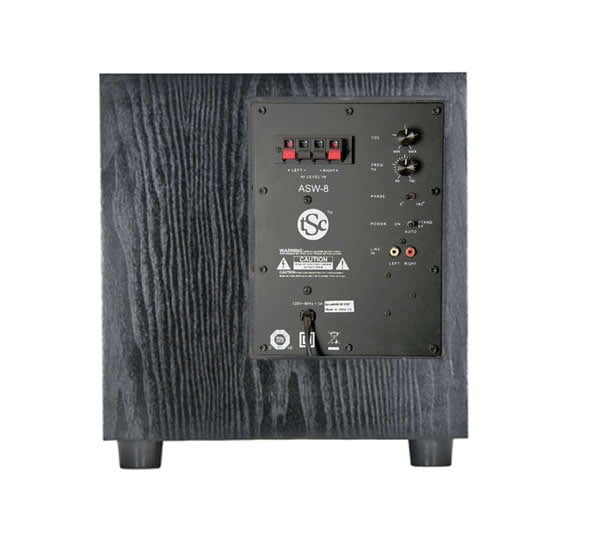 The ASW-8
subwoofer is a neat little sub. It features a downfiring 8” driver in a front
firing vented enclosure. On paper, the 50watt BASH amplifier doesn’t sound too
impressive but keep in mind this amp has 6dB of headroom which means it can
pump out 200 watts under short term peaks. The ASW-8 sports two line level
inputs and speaker level inputs but no speaker level outputs. If you plan on connecting this system to a
receiver with no bass management facilities, you may want to consider stepping
up to an ASW-10 which has both speaker level inputs and outputs. Both models
have an auto on/off feature, variable low pass filter and 0/180 degree phase
switch.
The ASW-8
subwoofer is a neat little sub. It features a downfiring 8” driver in a front
firing vented enclosure. On paper, the 50watt BASH amplifier doesn’t sound too
impressive but keep in mind this amp has 6dB of headroom which means it can
pump out 200 watts under short term peaks. The ASW-8 sports two line level
inputs and speaker level inputs but no speaker level outputs. If you plan on connecting this system to a
receiver with no bass management facilities, you may want to consider stepping
up to an ASW-10 which has both speaker level inputs and outputs. Both models
have an auto on/off feature, variable low pass filter and 0/180 degree phase
switch.
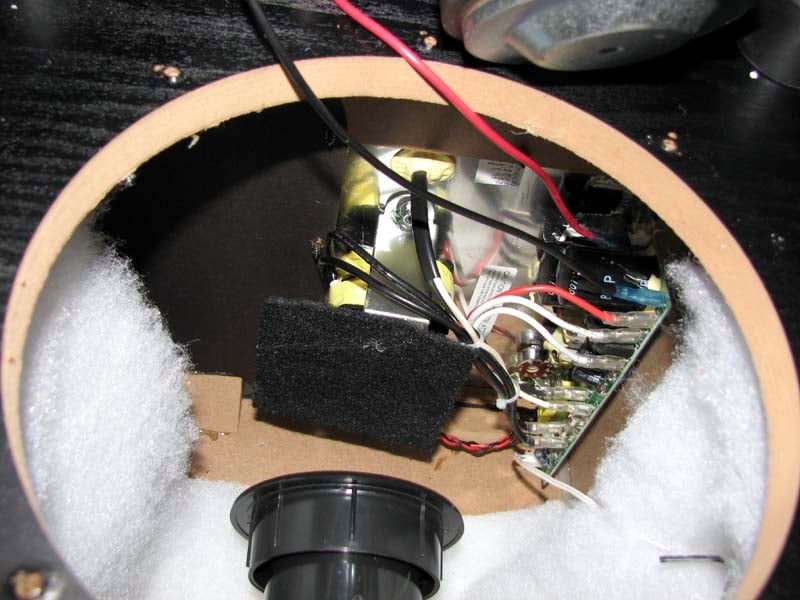
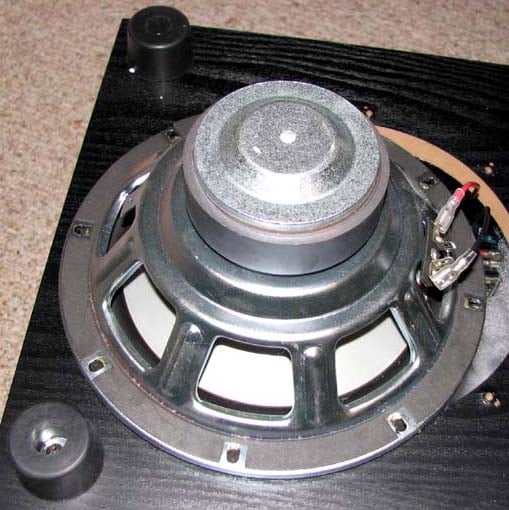
Getting inside the ASW-8, we see a nicely stuffed cabinet which appears to be molded from 5/8” thick MDF. The amplifier has a nice meaty power supply and the 8” driver with a 1” voice coil and 18oz magnet with a metallized stamped basket. The subwoofer is unshielded so keep that in mind if you plan on using this for a computer system. tSc claims the woofer uses a Santoprene surround featuring a ribbed shape to allow for a long travel without the woofer cone moving off center at either end of the stroke. The woofer cone seems to be a poly cone but has the appearance of an aluminum driver.
Editorial Note about Downfiring Subwoofers
Why use a downfiring bass driver like tSc does in their ASW-8? As you move further off the central axis, the ability of the speaker to radiate the sound diminishes. The rule of thumb often used is that when the wavelength (speed of sound divided by frequency) is about the same size as the circumference of the radiator, the speaker will begin to beam the sound towards the center axis, at the cost of off axis response. The directivity of the speaker increases. By placing a subwoofer facing the floor, one can gain advantage from this effect. The frequencies desired (low frequencies below 100hz), radiates omnidirectionally as desired, while the distortion products, that is to say frequencies 2, 3, 4, 5 or 6 times that of the fundamental driving frequency are going to be attenuated significantly by the inability of the speaker to radiate them at 90 degrees. These high frequencies simply go away, lost in your carpet, and your ears do not have to hear them.
The downside of this approach is a reduced life expectancy, as the constant pull of gravity will eventually wear against the suspension of the speaker, moving the voice coil off the desired center position, leaving the speakers ability to push as well as pull diminished.
Set-Up
Since these speakers are designed to be mounted on a wall, all of my listening tests were conducted with them placed directly against a wall boundary. I tested them in two scenarios: as a 2.1 computer system in a nearfield listening position and as a 5.1 theater setup in my large theater room. On my PC, I had them connected to my Headroom Micro Dac and Preamp powered by a Panasonic SA-XR50 receiver while in my theater room I connected them up to my Denon AVR-5805mkii and DVD-5910CI DVD player. All cables were furnished by Impact Acoustics (Sonicwave TOSLink) and Bluejeans Cable (10AWG speaker cable and analog interconnects).
tSc TSAT-1000-HT8-B Listening Tests
Two Channel Listening - Nearfield Computer System
CD: A Special Tribute
to Pink Floyd What do you
get when you mix in a group of rock legends such as Tony Levin from King
Crimson, Tommy Shaw from Styx and Chris Squire
from Yes? A tribute CD to Pink Floyd that not only at moments arguably rivals
the original instrumentally, but also sonically. The vocals sounded a bit thin
on track #1 “Money” which is to be expected with a small satellite speaker like
this. This is why I highly recommend running dual subs on systems like these
placed up front close to the satellites and equidistant from the main listening
area. Regardless, tonal balance was very good and the ASW-8 really belted out
the bass line in this song. Track #4 “Shine On You Crazy Diamond” showed off
the liquid smooth top end of the TSAT’s tweeter. Guitars were clean and loud
and the ASW-8 sub once again complimented the TSAT’s by fill out the sound
which would otherwise make these speakers unlistenable due to their lack of
bottom end.
What do you
get when you mix in a group of rock legends such as Tony Levin from King
Crimson, Tommy Shaw from Styx and Chris Squire
from Yes? A tribute CD to Pink Floyd that not only at moments arguably rivals
the original instrumentally, but also sonically. The vocals sounded a bit thin
on track #1 “Money” which is to be expected with a small satellite speaker like
this. This is why I highly recommend running dual subs on systems like these
placed up front close to the satellites and equidistant from the main listening
area. Regardless, tonal balance was very good and the ASW-8 really belted out
the bass line in this song. Track #4 “Shine On You Crazy Diamond” showed off
the liquid smooth top end of the TSAT’s tweeter. Guitars were clean and loud
and the ASW-8 sub once again complimented the TSAT’s by fill out the sound
which would otherwise make these speakers unlistenable due to their lack of
bottom end.
CD: Daryl Stuermer – Another Side of Genesis Track #1 “Follow You, Follow Me”
showed excellent ambience from the percussions and bass was tight and
clean. Imaging was good. At times things sounded a bit congested which
is typical of small systems, especially when played loudly. In this scenario, I
never had any issues of bottoming out any of the drivers.
Track #1 “Follow You, Follow Me”
showed excellent ambience from the percussions and bass was tight and
clean. Imaging was good. At times things sounded a bit congested which
is typical of small systems, especially when played loudly. In this scenario, I
never had any issues of bottoming out any of the drivers.
Track #10
“No Son of Mine” bass drum was surprisingly tactile. Electric guitars really
screamed out and I enjoyed turning the volume up. The ASW-8 and TSATs were
playing quite well together making things sound much bigger than their
diminutive size would suggest.
Despite I was doing this listening in a nearfield environment where the sub was literally 3 feet away from me, it didn’t draw attention to itself because it refrained from sounding boomy or one notey like so many low priced subs. Instead, my chest was pumping with bass as I visualized the boy running from his abusive father in the classic Genesis video for this song. Darly’s guitars exploded on the scene in a way Mike Rutherford (no offense Mike but you’re a bassist) could only dream of playing. The TSATs were right at home showcasing this marvelous performance.
Multi Channel Listening - Large Home Theater Room
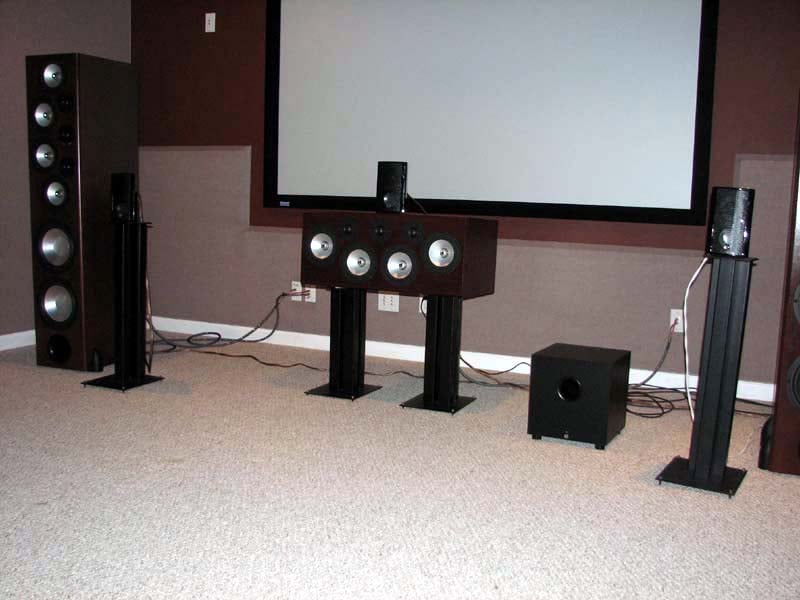 It was time
to move the tSC system into my theater room to gauge its performance as a full
fledged 5.1 system. I had low expectations for what this little system could do
in my nearly 6,000ft^3 theater room and I treated it more as a spot check to
ensure the system wouldn’t crap out at reasonably loud listening levels. I
placed the front speakers on 32” stands, the center channel on top of my RBH
Sound T-1/SER center channel and the rears on top of my chair riser elevated by
some disconnected bookshelf speakers. I had to place the rubber feet on all of
the speakers to keep them from moving during loud listening levels due to their
low weight, smooth cabinet surface, and ability to play louder than I expected.
It was time
to move the tSC system into my theater room to gauge its performance as a full
fledged 5.1 system. I had low expectations for what this little system could do
in my nearly 6,000ft^3 theater room and I treated it more as a spot check to
ensure the system wouldn’t crap out at reasonably loud listening levels. I
placed the front speakers on 32” stands, the center channel on top of my RBH
Sound T-1/SER center channel and the rears on top of my chair riser elevated by
some disconnected bookshelf speakers. I had to place the rubber feet on all of
the speakers to keep them from moving during loud listening levels due to their
low weight, smooth cabinet surface, and ability to play louder than I expected.
DVD:
Legends of Jazz with Ramsey Lewis For Jazz
lovers, this is a must have DVD. A
Blu-ray version is also available which I recommend assuming you have a Blu-ray
player. I started out with track #3 “The Panther” which features one of my time
favorite jazz guitarists Lee Ritenour. Right from the start, I was rewarded
with the deep, snappy bass I’ve come to expect from well engineered subwoofers.
The ASW-8 was delivering the bass
notes of Marcus Miller’s bass with aplomb. So much so that within a few minutes
of really cranking it up, I got a call from my wife downstairs complaining that the
ceiling was shaking and it was worrying our 21 month old
daughter who kept saying “daddy boom boom”. I honestly didn’t believe a little
8” sub like this was capable of such a feat until I ran down and took a listen.
The TSAT’s were doing an excellent job of reproducing all of the ambience of
the venue and the reverb of Lee’s guitars. Track #4 “Senor Blues” featuring
legendary jazz alto saxophone players David Sanborn and Phil Woods was up next
to test out the tSc system. The system
did a commendable job in recreating this performance but this time you could
tell the saxophones were being played on smallish speakers. The tonal balance was
good but the sound seemed a bit congested at times especially since I had
recently listened to this track on my $30k RBH reference system (not exactly a
fair comparison). Despite my criticism of how the saxophones sounded, the
TSAT’s were playing back cymbal brushes and piano admirably.
For Jazz
lovers, this is a must have DVD. A
Blu-ray version is also available which I recommend assuming you have a Blu-ray
player. I started out with track #3 “The Panther” which features one of my time
favorite jazz guitarists Lee Ritenour. Right from the start, I was rewarded
with the deep, snappy bass I’ve come to expect from well engineered subwoofers.
The ASW-8 was delivering the bass
notes of Marcus Miller’s bass with aplomb. So much so that within a few minutes
of really cranking it up, I got a call from my wife downstairs complaining that the
ceiling was shaking and it was worrying our 21 month old
daughter who kept saying “daddy boom boom”. I honestly didn’t believe a little
8” sub like this was capable of such a feat until I ran down and took a listen.
The TSAT’s were doing an excellent job of reproducing all of the ambience of
the venue and the reverb of Lee’s guitars. Track #4 “Senor Blues” featuring
legendary jazz alto saxophone players David Sanborn and Phil Woods was up next
to test out the tSc system. The system
did a commendable job in recreating this performance but this time you could
tell the saxophones were being played on smallish speakers. The tonal balance was
good but the sound seemed a bit congested at times especially since I had
recently listened to this track on my $30k RBH reference system (not exactly a
fair comparison). Despite my criticism of how the saxophones sounded, the
TSAT’s were playing back cymbal brushes and piano admirably.
FIOS TV Watching – Moving McAllister
& The Invasion


I decided to do a little channel surfing on the premium HD channels of my Verizon FIOS service and came across two movies that had some really good sound and looked interesting enough for me to PVR for watching at a later time. During the boxing match of Moving McAllister, the tSc system did a nice job enveloping me in the ambience of the arena. A few of the punches and slams worked the ASW-8 a bit beyond its limits where I heard a slight rattling sound emanating from the port. Turning down the sub a tad helped remedy this problem and I still had good impact for movie watching.
I caught the opening scene of The Invasion staring Nicole Kidman. The TSAT’s surrounded me with the freaky inner monologue of Nicole’s voice while the camera panned around the room. Vocal clarity was good but a bit thin which is to be expected on a system as tiny as this. The space shuttle explosion seemed frighteningly real via the ASW-8 subwoofer. In general this system did nicely at captivating my attention on two movies I ordinarily wouldn’t have considered.
tSc TSAT-1000-HT8-B Measurements and Analysis
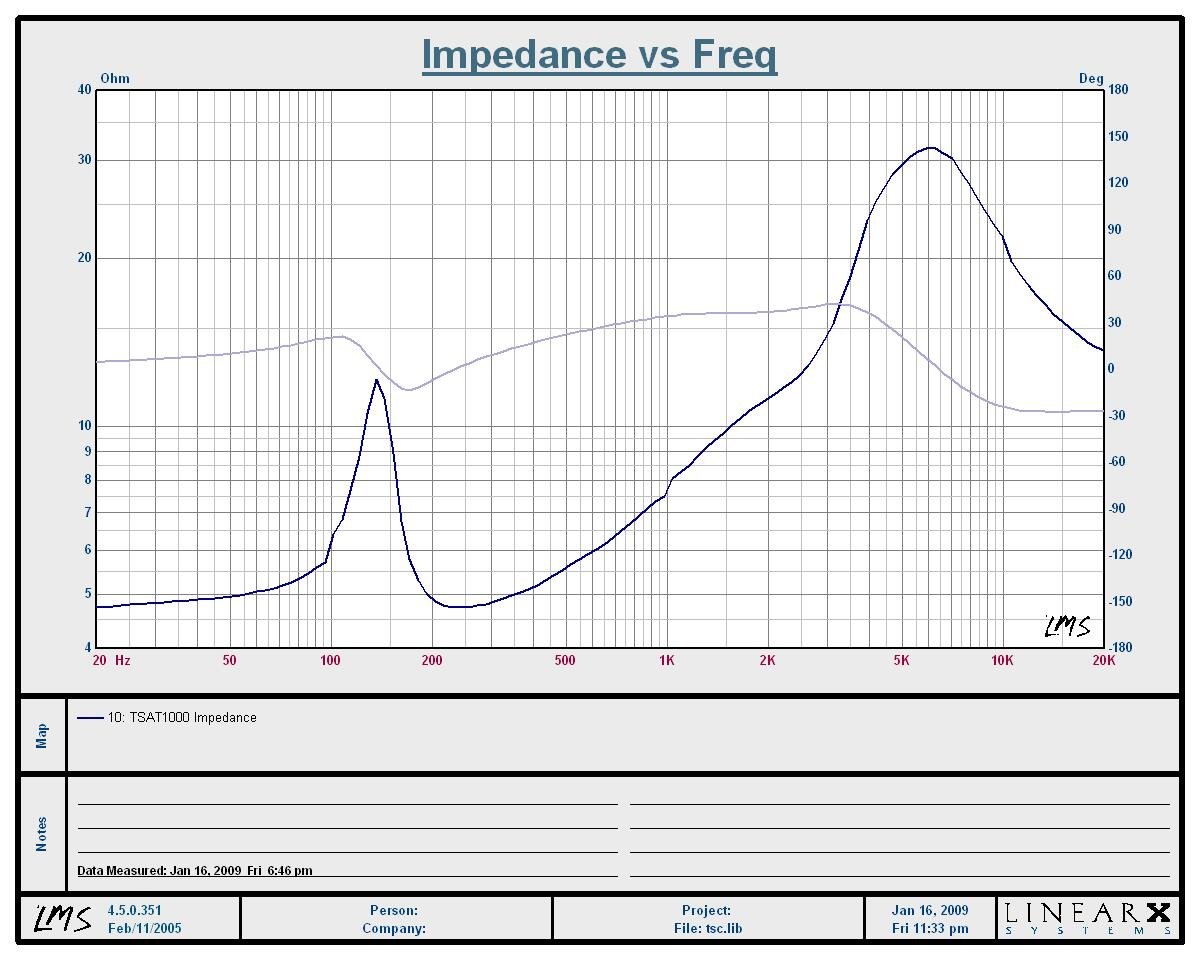
Impedance / Phase Measurements of the TSAT-1000
The TSAT-1000’s are rated as 8 ohm nominal speakers. I would consider them closer to 6 ohms due to the lowish sensitivity (85dB / 1 meter) and the impedance dip in the 200Hz to 500Hz range where spectrally there is a lot of musical content in that range that eats amplifier power. Phase is kept within +-30 deg throughout the entire audio band and the crossover design indicates some well thought out engineering. tSc did everything possible in eeking out the most bass response possible from such a small enclosure but due to their size there will always be compromises. Bass manage them and reward them with quality ample power if you plan on listening to them at loud sustained levels.
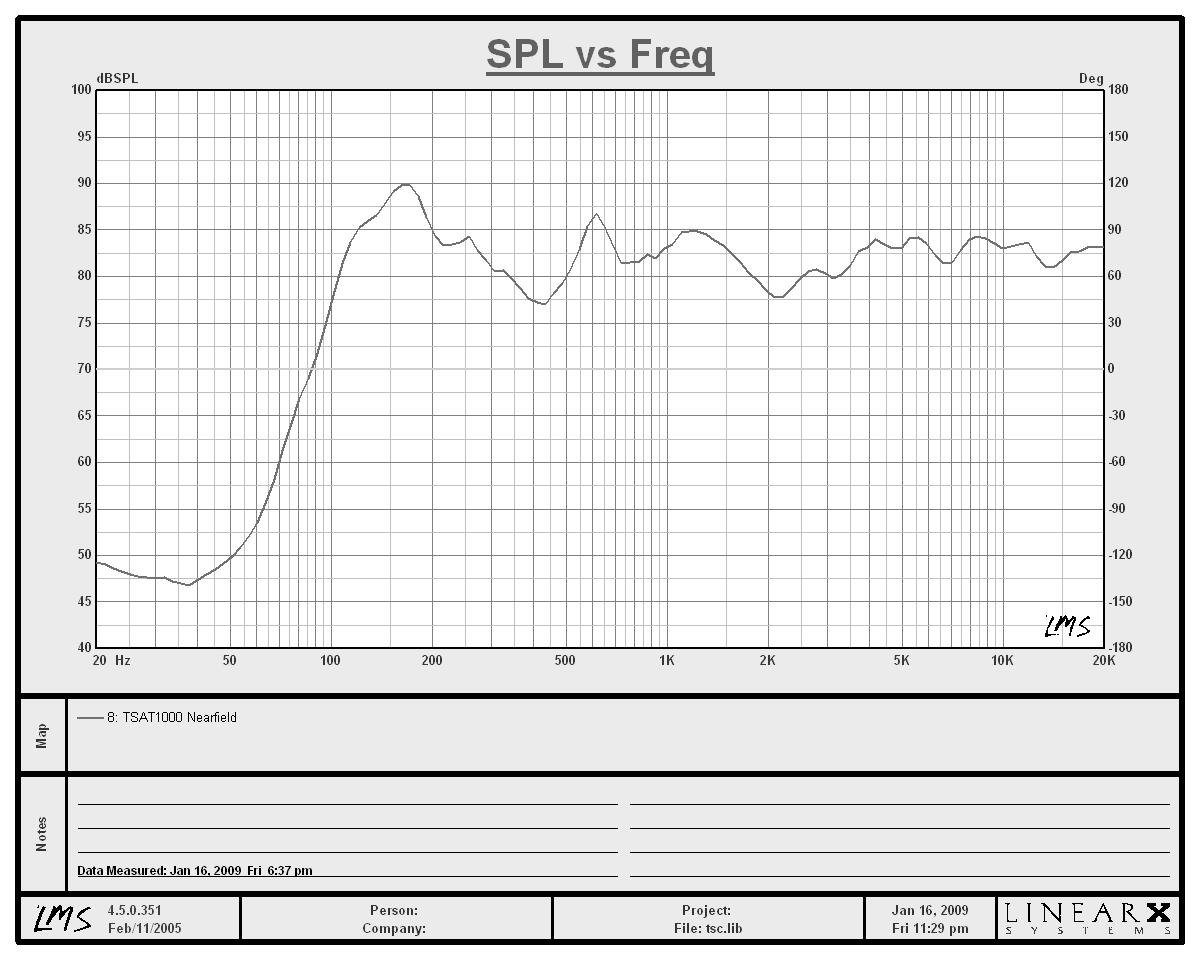
In Room Nearfield Frequency Response of the TSAT-1000 (1/12th octave smoothed)
The TSAT-1000 measured surprisingly linear - actually more so than far more expensive speakers that I’ve measured in the past. Usable bass response went down to about 100Hz but fell at a 30dB/Oct slope below that. I highly recommend crossing these speakers over at around 100-1200Hz and keeping the sub towards the front of the room somewhere between the main speakers to minimize localization and optimize integration with the satellites. The TSAT-1000s measured smoothest slightly below the axis of the tweeter so don’t worry about mounting these speakers above ear level as they will perform just fine.
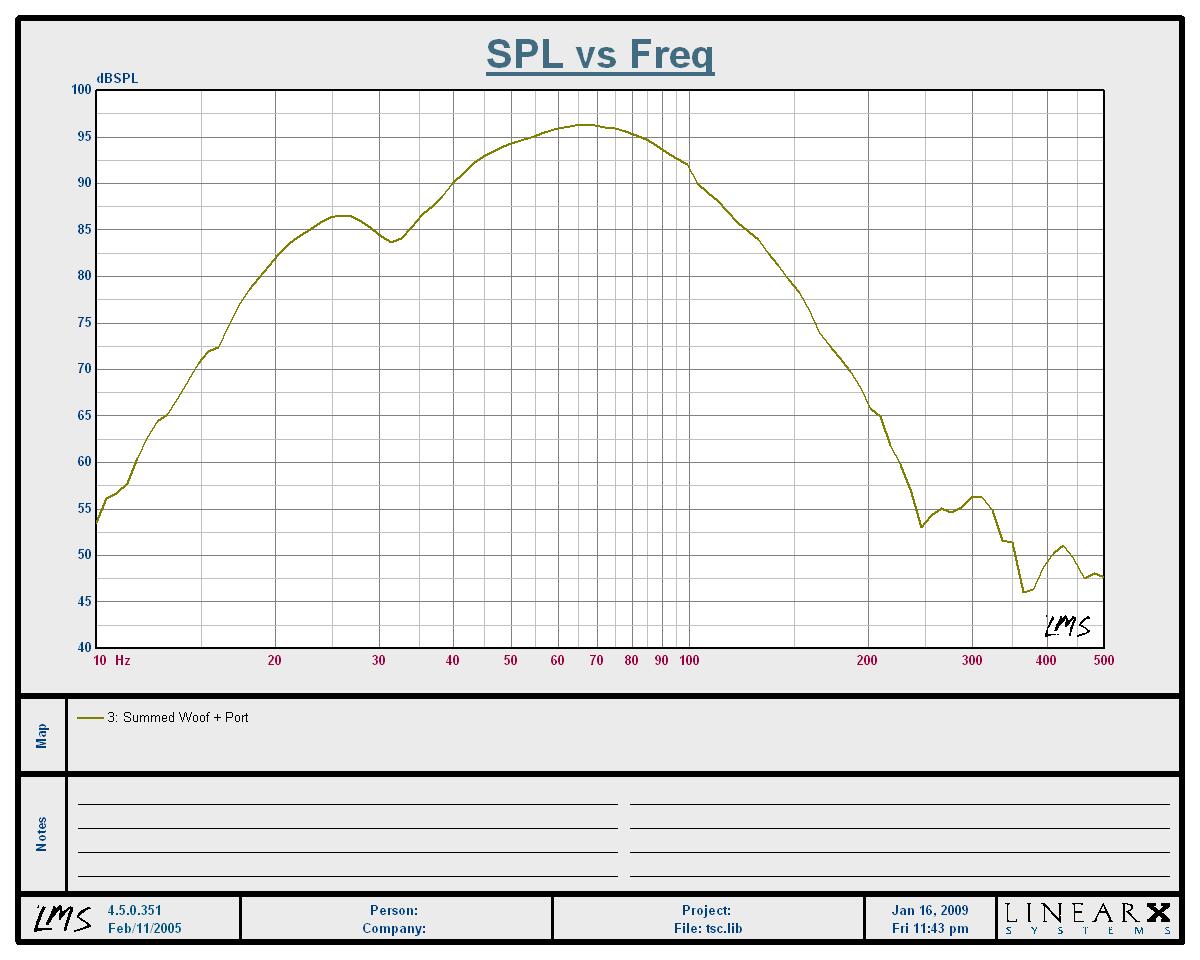
Summed Nearfield Frequency Response of the ASW-8
The ASW-8 exhibited impressive bass extension for such a small, lower powered / low cost design. The -3dB point was around the manufacturers claimed 33Hz. It has usable output to around 120Hz or so and then falls off rapidly. This response curve indicates a good match for the TSAT-1000s.
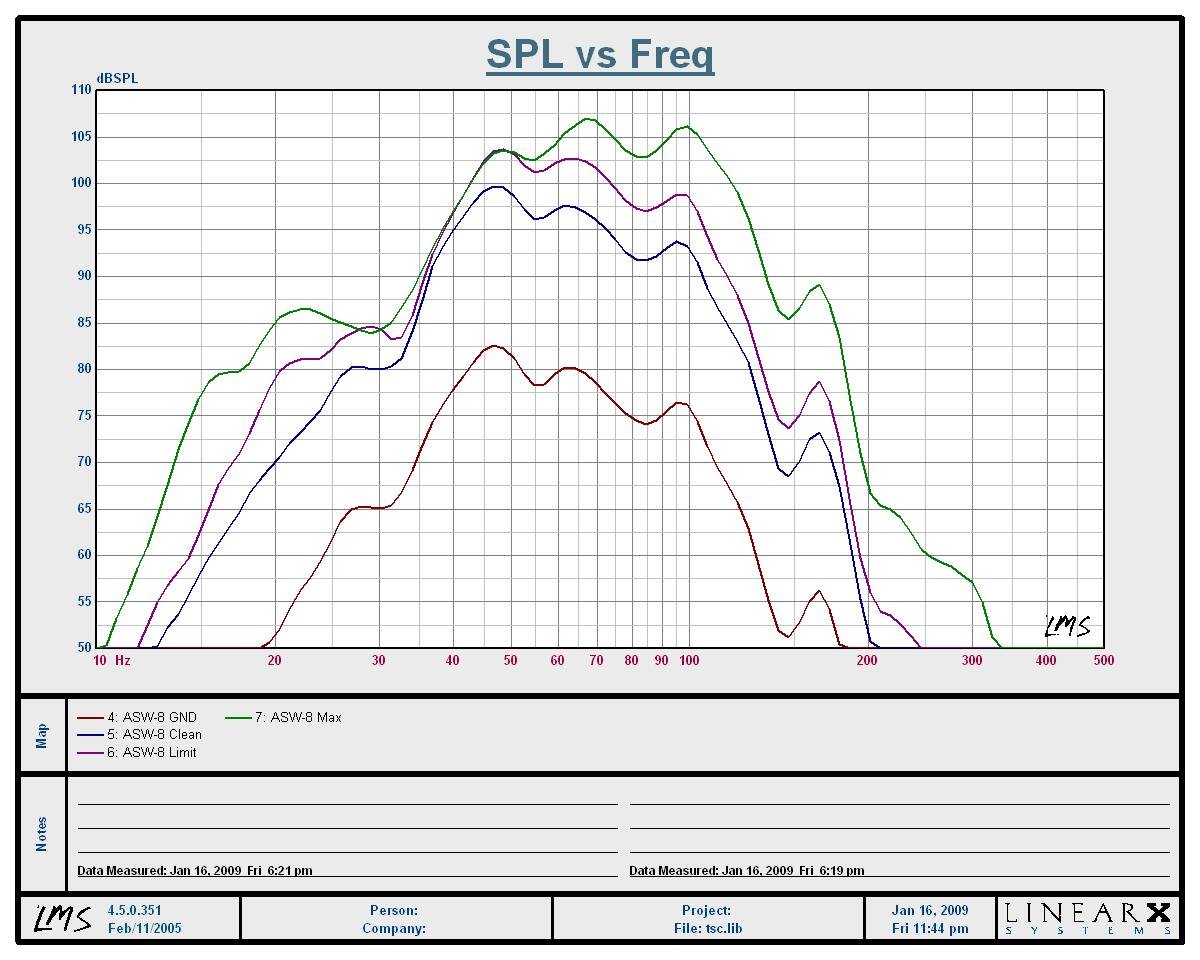
ASW-8 SPL vs Frequency (goundplane scaled from 20 inches to 2 meter)
Just for fun, I pulled some in-room groundplane measurements of the ASW-8 in my office. I put the measurement mic on the ground 20 inches from the ASW-8 and measured at various SPL points to find the max limit of the sub. The measurements were then scaled to 2 meter. The ASW-8 was able to cleanly deliver around 100dB SPL throughout its entire bandwidth. At this point the door in my office was rattling out of control and I felt like I was in one of those competition car stereo shows. As I drove the ASW-8 harder, I started to hear excessive port noise as you can see by the rising frequency below 25Hz in the 102 dB (purple) and 105 dB (green) SPL plots. All in all this is unbelievably juicy performance from something that costs less than a dinner at Bern’s Steakhouse.
Recommendations
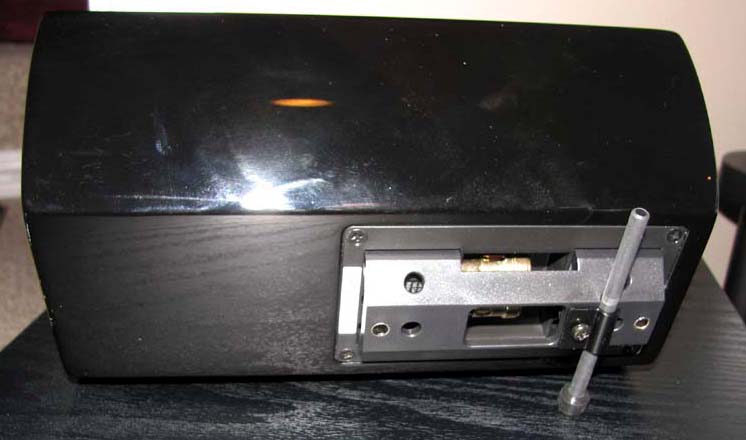 The TSAT-1000’s work best when mounted slightly above
ear level. Don’t forget to route your speaker cable through the bracket before
installing it on the wall. If your using the bracket as a bookshelf stand, make
sure you attach the cable to the speaker before installing the clamp to the
back of the speaker as its nearly impossible to run your finger though the
little opening to connect the speaker wires or banana plug terminations once
the bracket is engaged. I really don’t
recommend using the bracket this way as it forces the speaker to be placed
horizontally which will sacrifice performance due to driver lobing issues
associated with placing a two-way speaker sideways. These speakers are small
enough to not have to make such a placement compromise. If you must place them
on a bookshelf, do so vertically but it’s imperative that you attach the rubber
sticky feet else the speakers will vibrate right off the surface if played
loudly enough.
The TSAT-1000’s work best when mounted slightly above
ear level. Don’t forget to route your speaker cable through the bracket before
installing it on the wall. If your using the bracket as a bookshelf stand, make
sure you attach the cable to the speaker before installing the clamp to the
back of the speaker as its nearly impossible to run your finger though the
little opening to connect the speaker wires or banana plug terminations once
the bracket is engaged. I really don’t
recommend using the bracket this way as it forces the speaker to be placed
horizontally which will sacrifice performance due to driver lobing issues
associated with placing a two-way speaker sideways. These speakers are small
enough to not have to make such a placement compromise. If you must place them
on a bookshelf, do so vertically but it’s imperative that you attach the rubber
sticky feet else the speakers will vibrate right off the surface if played
loudly enough.
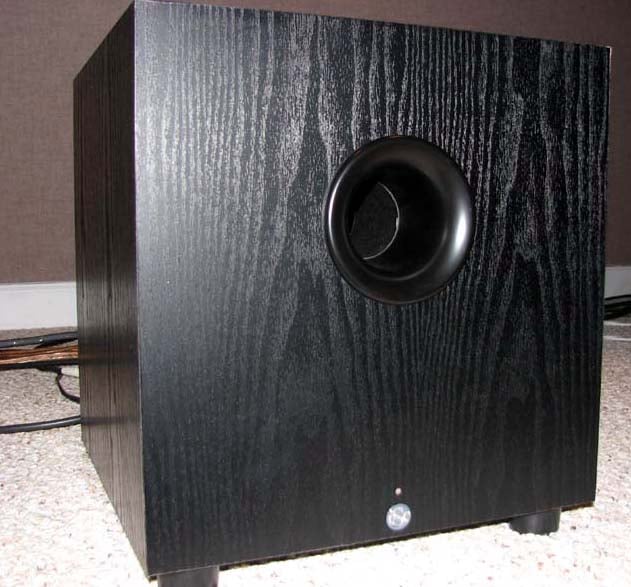 As good as the ASW-8 is for the money, I’d suggest
getting two to really round out the bass which will provide a much fuller lower
mid bass impact and tactile response if placed up front near the main
satellites equidistantly from the listening area. I have little to complain
about with respect to performance and features on this subwoofer other than
being a bit puzzled why tSc provided discrete left and right line level inputs
instead of a single LFE input for an easier connection to the receivers
subwoofer output.
As good as the ASW-8 is for the money, I’d suggest
getting two to really round out the bass which will provide a much fuller lower
mid bass impact and tactile response if placed up front near the main
satellites equidistantly from the listening area. I have little to complain
about with respect to performance and features on this subwoofer other than
being a bit puzzled why tSc provided discrete left and right line level inputs
instead of a single LFE input for an easier connection to the receivers
subwoofer output.
This system is optimally used for small to medium sized rooms. Don’t skimp on power however. Due to the systems low efficiency (85dB / 1 watt which is actually quite good for such a small speaker) it would be better to buy as many watts as you can afford if you’re preference is loud listening. They sounded best to me when I was seated no more than 10 feet away from the main channels. I found the optimal crossover setting for the TSAT’s to be at 110Hz. You can run them lower but under sustained loud listening levels, I heard distress and woofer bottoming when running them full range.
Conclusion
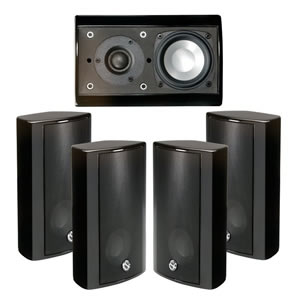 The tSc TSAT-1000-HT8-B speaker system performance defies its meager asking price. From an
aesthetics standpoint alone, the TSAT-1000s are all aces. While the TSAT’s will
by no means replace a full fledged bookshelf or tower speaker system in terms
of dynamics and soundstage, its basically the finest sounding compact system on
the cheap that I’ve heard. Fit and finish are second to none and it boggles the
mind how tSc managed to NOT cut costs in quality of parts at this price level.
The system works extremely well together and mated with a good sub like the
ASW-8, you’ve got great fidelity that doesn’t draw attention to itself until
your guests sit down for a listen and wonder how all that sound is coming from
such little boxes not much bigger than the much more expensive “cubed” systems
they own.
The tSc TSAT-1000-HT8-B speaker system performance defies its meager asking price. From an
aesthetics standpoint alone, the TSAT-1000s are all aces. While the TSAT’s will
by no means replace a full fledged bookshelf or tower speaker system in terms
of dynamics and soundstage, its basically the finest sounding compact system on
the cheap that I’ve heard. Fit and finish are second to none and it boggles the
mind how tSc managed to NOT cut costs in quality of parts at this price level.
The system works extremely well together and mated with a good sub like the
ASW-8, you’ve got great fidelity that doesn’t draw attention to itself until
your guests sit down for a listen and wonder how all that sound is coming from
such little boxes not much bigger than the much more expensive “cubed” systems
they own.
Although the ASW-8 is bland in styling, because of its smallish size, it doesn’t draw much attention to itself, at least until it's fired up. Make no mistake however that this little sub is much more capable than one would expect given its size and price. If I were on the market for a $300 subwoofer, I’d pocket $100 and buy two ASW-8s.
Based on our review of a few different system tSc sent us, their business model seems right on the money for offering the best bang for the buck in the industry. Their attached white paper (Hidden Cost of Speakers) explains how this is achieved and I have little reason to question its accuracy. What should scare the competition about this company is that they are redefining a benchmark of sound quality at these asking prices similar to what Panasonic did to Plasma many years ago. If this trend really catches on, then one wonders if profit margins in loudspeakers will disappear in a similar fashion. This is good news for consumers but not for competitor retailers and installers. Considering that they offer FREE shipping, FREE 30 day home trial policy and FREE return shipping if you don’t like the system, there is simply no risk in buying it. That being said, if a small compact inexpensive system is what you are looking for, than stop perusing the internet and buy this system!
The Speaker Company (tSc) Loudspeakers
100 Corporate Drive
Mahwah, NJ 07430
tSc TSAT-1000-HT8-B
MSRP: $399/ 5.1 system
[Buy Now]
The Score Card
The scoring below is based on each piece of equipment doing the duty it is designed for. The numbers are weighed heavily with respect to the individual cost of each unit, thus giving a rating roughly equal to:
Performance × Price Factor/Value = Rating
Audioholics.com note: The ratings indicated below are based on subjective listening and objective testing of the product in question. The rating scale is based on performance/value ratio. If you notice better performing products in future reviews that have lower numbers in certain areas, be aware that the value factor is most likely the culprit. Other Audioholics reviewers may rate products solely based on performance, and each reviewer has his/her own system for ratings.
Audioholics Rating Scale
 — Excellent
- — Very Good
- — Good
- — Fair
- — Poor
| Metric | Rating |
|---|---|
| Build Quality | |
| Appearance | |
| Treble Extension | |
| Treble Smoothness | |
| Midrange Accuracy | |
| Bass Extension | |
| Bass Accuracy | |
| Dynamic Range | |
| Performance |  |
| Value | |
Gene manages this organization, establishes relations with manufacturers and keeps Audioholics a well oiled machine. His goal is to educate about home theater and develop more standards in the industry to eliminate consumer confusion clouded by industry snake oil.
View full profile Subscribe to our newsletter