


ZVOX Z-Base 550 Surround Speaker System
ZVOX Z-Base 550
- Product Name: Z-Base 550 Speaker System
- Manufacturer: ZVOX
- Performance Rating:

- Value Rating:

- Review Date: January 05, 2009 04:00
- MSRP: $ 399
- 60 watt amplifier
- 2 analog audio inputs
- Subwoofer: 5.25"
- Drivers: 5 2" (ferrofluid & neodymium magnets)
- Frequency: 45Hz-20kHz
- Magnetically shielded
- Subwoofer output
- MDF construction
Physical Attributes
- Dimensions: 28" W x 3 3/8" H x 14 1/2" D
- Weight: 20 lbs.
- Cabinet Color: Black - High Gloss on the sides
Warranty
- 1 year parts & labor
Pros
- Surprisingly wide sound stage
- Virtual surround solution for rooms where a 5.1 system is not possible
- Accurate, detailed and clear sound
Cons
- Limited to 2 inputs
- Limits size of display if used as a base
- Lacks punch
- PhaseCue effect can cause a hollow effect when listening to music
- PhaseCue needs frequent adjusting
- Dual analogue inputs are always active
Z-Base 550 Build Quality, Remote and Setup
In this digital age we live in, sometimes we get locked into the "more-is-better" mode. How many formats can it decode, how many different inputs/outputs does it have, exactly how big is the birds nest of cables coming out of the back of the unit? Actually - that mode works most of the time, but thing is, sometimes you just need to shut up and listen before you pass judgment on it. If you are an old school guy (read - your VCR was always blinking 12:00) the Z-Base 550 does a decent job of creating surround effects by ignoring all the digital data available on a disk and manipulating the analog signal to reproduce what the digital signal contains. There is no doubt that the sound stage produced by the Z-Base 550 is far better than any speaker system included on a display; however during our review we found it to be a little quirky and never really producing convincing surround sound. What it does have is good build quality (with the exception of its dual analog inputs, but more on that later), solid construction materials, and sound quality that is way beyond what anyone would guess based on its rather simple look. So if you've got a room (bedroom, small family room, or apartment) that you'd like to have a high quality surround sound system in, but speaker placement just will not work for a traditional 5.1 system, I'd recommend you give this system an in-home audition and just shut up and listen!
ZVOX is a relative newcomer to the AV marketplace. However, the company is led by industry veterans and has a stout product line of innovative surround sound systems that might just be the perfect solution to those tough rooms we all struggle with from time to time. You know a company has an outside-the-box approach when they shrug off the digital world we are consumed with and tries to convince you that their analog surround system is the ticket for your bedroom or small theater. While it will never compete with a true 5.1/7.1 digital surround system (nor was it really designed to), after spending some quality time with the Z-base 550, we agree this is a great solution for situations where a larger system just will not work, but you still want a high quality product with a great sound.
Build Quality and Features
It is apparent as soon as you remove this system from the box that it is well put together. Although not heavy (it weighs in at about 20 pounds), it is a very solid piece of gear. The cabinet itself is constructed of MDF on top and bottom and the MDF panels with a painted high-gloss finish on both ends give it a pretty slick look. The system is magnetically shielded so it's a great fit for anyone using a flat screen display sitting on top of an AV rack. While the 550 is attractive, one of my favorite things about it was that it virtually disappeared in my room with my display sitting on top of it. According to the website, the base can hold most displays with a base less than 27" wide and 13" deep, and a weight of less than 90 pounds.
Reviewer's Note: I couldn't help but laugh when I got my box, unloaded this exciting new product designed to work as a base to sit your display on and found a sheet full of warnings that included: "Placing objects on top of this device can result in tippiness." and "Do not place anything on top of this device that might topple over." Gotta love those attorneys!
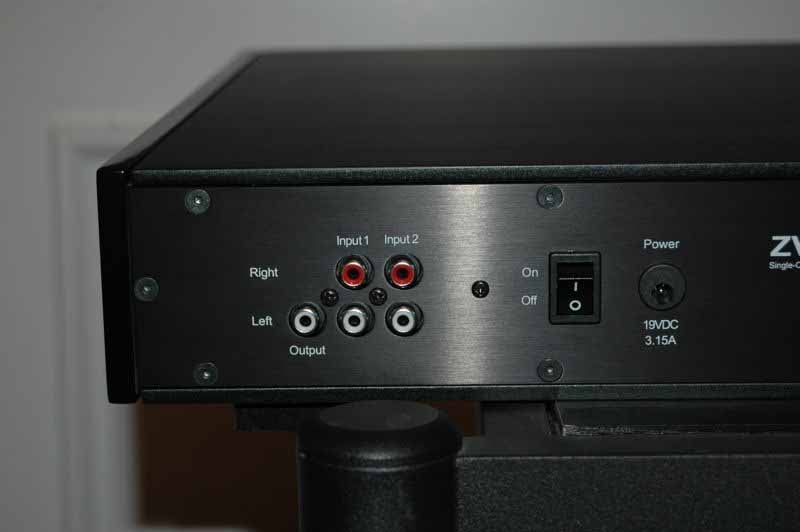 The 550 is bi-amplified (60-watt amplifier), and includes
five 2" main drivers, and a 5.25" subwoofer (bottom mounted) in a
ported enclosure. No skimping on speaker
components in this product. It uses
specially treated long-excursion main drivers with Neodymium magnets. The back panel includes 2 "mixing"
analog inputs, a subwoofer output, and a power switch. As an example of the great design of this
unit, it includes a subwoofer output on the far right side (if you are looking
at the back of the unit) of the panel.
One note on the mixing inputs, if you have two sources connected to the
Z-base and both are on, you'll hear both devices. This is a HUGE no-no and
we're at a loss to understand why ZVOX would do this, except to save money on
a true switching feature. While the system sounds great as is, if you're a true
home theater enthusiast or an audiophile, you're going to want to add a
subwoofer to this system. On the other
hand, if placement is intended for a bedroom system, you could easily get away
without a subwoofer - it's going to be better than most TV speakers.
The 550 is bi-amplified (60-watt amplifier), and includes
five 2" main drivers, and a 5.25" subwoofer (bottom mounted) in a
ported enclosure. No skimping on speaker
components in this product. It uses
specially treated long-excursion main drivers with Neodymium magnets. The back panel includes 2 "mixing"
analog inputs, a subwoofer output, and a power switch. As an example of the great design of this
unit, it includes a subwoofer output on the far right side (if you are looking
at the back of the unit) of the panel.
One note on the mixing inputs, if you have two sources connected to the
Z-base and both are on, you'll hear both devices. This is a HUGE no-no and
we're at a loss to understand why ZVOX would do this, except to save money on
a true switching feature. While the system sounds great as is, if you're a true
home theater enthusiast or an audiophile, you're going to want to add a
subwoofer to this system. On the other
hand, if placement is intended for a bedroom system, you could easily get away
without a subwoofer - it's going to be better than most TV speakers.
While the system is completely analog, it is not without innovation. ZVOX's PhaseCue system is the technology that produces the virtual surround sound. The short version of this technology is that it manipulates analog audio signals by mixing various levels of "in phase" and "out of phase" signals into its 5 drivers. The result is an impressive sound field that is truly bigger than would seem possible. While it cannot compete with a full blown (and full price) 5.1 or 7.1 surround system, it did generate very impressive surround effects during our review of several movies. Equally impressive was the wide sound field it generated with some of my favorite music discs as well. I spent quite a bit of time tweaking the PhaseCue setting during this review, with one end of the spectrum seeming to push the sound farther apart (although the extreme end seemed to cause some loss of mid-range and ended up sounding too tinny to tolerate) and the other end of the spectrum drawing them closer together. With no presets, you are free to find the setting that works best with the set-up in your room. I found that my favorite setting for music was definitely different than my favorite setting for movies. I suppose having the ability to set those levels once I dialed them in might be a convenience, but it was actually kind of fun picking the setting that worked best for the specific disc I selected. Perhaps that fun would diminish over time, but for the course of this review, it remained simply an exercise in dialing in each disc I picked out. The 550 system also takes advantage of ZVOX's Infinite Compliance system to generate bigger-than-expected volume using acoustic tubes within its MDF body. While it could not rock the house, it produced acceptable audio levels for watching movies and music in small rooms. The auto on/off circuit will also turn the power on and off when you turn your source on (or off) eliminating one step in the button pushing process.
Remote & Setup
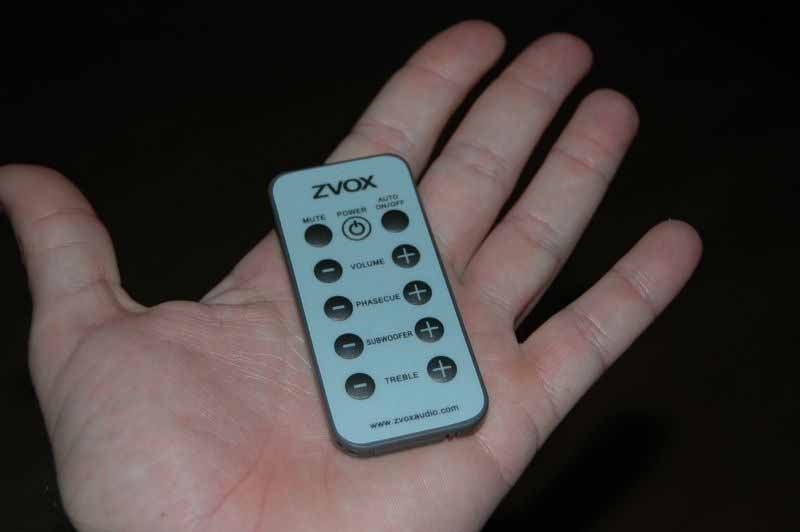 It also comes with a small (possibly too small if you lose remotes as frequently as I do!) remote that
operates volume, the PhaseCue effect, subwoofer levels, and treble levels. The remote also has a power button and mute
button. There is no display on the
remote or the Z-base 550 system to tell you where you are within each option's
range; nor are there any presets (say for a movie setting vs. music setting) to
help "memorize" your favorite settings. Everything about this system
is done by ear, by design, and with very few visual cues.
It also comes with a small (possibly too small if you lose remotes as frequently as I do!) remote that
operates volume, the PhaseCue effect, subwoofer levels, and treble levels. The remote also has a power button and mute
button. There is no display on the
remote or the Z-base 550 system to tell you where you are within each option's
range; nor are there any presets (say for a movie setting vs. music setting) to
help "memorize" your favorite settings. Everything about this system
is done by ear, by design, and with very few visual cues.
Manufacturer's Note: The blue LED beneath the grille flashes once for every "level change" for any setting - volume, PhaseCue, subwoofer or treble. Volume has 22 steps. The other settings have 9. If the user goes all the way up to max on any setting, the LED stops flashing and stays continuously on, informing the user he is "at max." From max, he can then back down two flashes/pushes and know that he is at 7. [This] lets us have the super-clean front panel we were striving for.
Setup is about as easy as you can possibly imagine. I can't remember the last time I bought anything that came with only 2 pages worth of instructions. No long list of acronyms on the box announcing the vast number of formats it can decode. No figuring which type of cable you need to carry signals amongst all your gear. Just 2 analog (yep that's old school, red and white) inputs on the back of the unit and one analog subwoofer output, oh yeah, and a power switch. That is it. No figuring ways to hide speaker wire either. No question this was the easiest set up of any review EVER! I can even add that it was so easy, even my technically-challenged spouse was able to figure it out without having to call me for help.
Z-Base 550 Listening Tests and Conclusion
Listening Tests - Music
To check out the ZVOX 550's musicality, I popped in a couple of my favorite discs running it through some test material that I am very familiar with. Because I decided to set the Z-Base up in the 2-channel music room, I could not help but draw comparisons between this system and my 2-channel system. While I'm not ready to throw out my 2-channel system, I was impressed with the soundstage produced by this system. Here are some of my thoughts as I ran through a couple of my favorite disks. While I enjoyed playing with the PhaseCue effect during this review, I almost always landed on the best sound at the far negative end of the range. With just a couple of clicks, I could definitely hear the effect of spreading the music around the room, but increasing the PhaseCue effect added a strange quality to the mid-tone of the track. But even with the PhaseCue pulled as far out as possible, the Z-Base provided an amazingly wide sound stage on most of the tracks I listened to.
One thing I noticed while listening to music (that I did not notice while watching movies) was an audible pop every time I changed tracks. I attempted to reconnect the CD player a couple of times to make sure I had all the connections in tight, but nothing I tried would put an end to the popping. This is likely due to the low-tech always-on dual analog inputs which likely don't have any way to deal with the small voltage spikes incurred during the switching process.
CD: Sugarland - Enjoy
the Ride OK
- So the fact that I'm an old country boy is now clearly out there. I won't even deny I like country music. The major test for me on any speaker system
is how it handles female vocals. I can
put up with some deficiencies, but I need for my ladies to come through strong
and clear. This is an area where I
typically run into trouble with iPod dock speaker systems and other smaller
systems. I didn't notice any of that
happening with Jennifer Nettles' vocals.
On "Want To" the system produced a great, wide soundstage, but
left Nettles vocal out front with a very natural sound. The mandolin section throughout "These
Are the Days" is successfully reproduced so that it sounded like finger
picking on a stringed instrument.
OK
- So the fact that I'm an old country boy is now clearly out there. I won't even deny I like country music. The major test for me on any speaker system
is how it handles female vocals. I can
put up with some deficiencies, but I need for my ladies to come through strong
and clear. This is an area where I
typically run into trouble with iPod dock speaker systems and other smaller
systems. I didn't notice any of that
happening with Jennifer Nettles' vocals.
On "Want To" the system produced a great, wide soundstage, but
left Nettles vocal out front with a very natural sound. The mandolin section throughout "These
Are the Days" is successfully reproduced so that it sounded like finger
picking on a stringed instrument.
CD: Lyle Lovett - Pontiac If
there is a better-recorded disk than this one, I don't think I've heard it. I'm amazed every time I sit down and really
listen to this disk. When I sat down
with it again during this review, it was no exception. However, the Z-Base really struggled with the
bass on this recording. Then again, no
system at this price (and with a 5.25" woofer) can handle the low end of
the bass line in "Simple Song".
At high volume, there was audible bass distortion, but once I turned it
down to more reasonable volume levels, the distortion went away and it did a
remarkable job with the vocal track. One issue I noticed with this CD is that
the system really cannot deliver the punch of the horn section and other
similar passages. While the system
sounded clear and very musical, it really never delivered any real oomph. If you added a subwoofer to the mix to help
out with the lower end, its performance could potentially be improved.
If
there is a better-recorded disk than this one, I don't think I've heard it. I'm amazed every time I sit down and really
listen to this disk. When I sat down
with it again during this review, it was no exception. However, the Z-Base really struggled with the
bass on this recording. Then again, no
system at this price (and with a 5.25" woofer) can handle the low end of
the bass line in "Simple Song".
At high volume, there was audible bass distortion, but once I turned it
down to more reasonable volume levels, the distortion went away and it did a
remarkable job with the vocal track. One issue I noticed with this CD is that
the system really cannot deliver the punch of the horn section and other
similar passages. While the system
sounded clear and very musical, it really never delivered any real oomph. If you added a subwoofer to the mix to help
out with the lower end, its performance could potentially be improved.
Toy
Matinee: Toy Matinee
The system really sounded impressive
with this disk. It probably doesn't hurt
that it's one of my favorites, but several of the tracks on this disk really
allowed this system to impress. One of
the most surprising things about this system was its accurate and detailed
presentation of the music. Often lost on
systems costing much more, the Z-Base 550 always allowed the music to sound
like music. For example, you could
actually hear the picking of strings in the intro to "The Last Plane
Out", while many systems at this price you get the gist of the song, but
you lose the details. I noticed all my
favorite details in the music on this system.
The toys chirping in the intro to "Toy Matinee" came in from
way off to the left of the room. If you don't believe me ask my dog! He immediately got up and went to left corner
of the room looking for a toy!
Listening Tests - Movies
DVD:
S.W.A.T. The
first movie I used the Z-Base for was S.W.A.T. I know it's not exactly a blockbuster, but my
wife was away for the week and my teenage son and I were in the mood for a
little good old-fashioned violence. I
must admit I was impressed with the way the ZVOX 550 handled the audio
track. While the explosions and fight
scenes didn't have great punch to them, the system was able to put out enough
volume to make it very enjoyable.
The
first movie I used the Z-Base for was S.W.A.T. I know it's not exactly a blockbuster, but my
wife was away for the week and my teenage son and I were in the mood for a
little good old-fashioned violence. I
must admit I was impressed with the way the ZVOX 550 handled the audio
track. While the explosions and fight
scenes didn't have great punch to them, the system was able to put out enough
volume to make it very enjoyable.
DVD: The Patriot The
Patriot has plenty of
scenes with surround effects coming from behind you, so I used it to test out
the Z-Base's ability to get effects to the back of the room. The numerous fight scenes (especially the
scene in the woods when they free Heath Ledger's character from the Brits) with
bullets whizzing on all sides of you had sounds coming from both sides, but I
never truly heard any surround information from behind me as I do with a 5.1
system. The musical soundtrack to this
film really does a nice job accentuating the wide sweeping visual vistas
throughout this movie. Another big bonus
is the unit's ability to leave the dialogue coming from straight ahead, while
allowing the soundtrack to spread out with its impressive sound stage.
The
Patriot has plenty of
scenes with surround effects coming from behind you, so I used it to test out
the Z-Base's ability to get effects to the back of the room. The numerous fight scenes (especially the
scene in the woods when they free Heath Ledger's character from the Brits) with
bullets whizzing on all sides of you had sounds coming from both sides, but I
never truly heard any surround information from behind me as I do with a 5.1
system. The musical soundtrack to this
film really does a nice job accentuating the wide sweeping visual vistas
throughout this movie. Another big bonus
is the unit's ability to leave the dialogue coming from straight ahead, while
allowing the soundtrack to spread out with its impressive sound stage.
High Definition & Standard Definition Television (via Comcast Cable)
We used the Z-Base 550 to watch a
variety of television shows in our family room.
The room is about twice the size of the music room where I did the music
and movie reviews in and has a 30-foot ceiling.
Generally I thought it filled the room adequately while watching
football (HD broadcast) or the old traditional Christmas specials (standard
definition). The sound stage and
surround effects were a little less impressive in the bigger room, but the
system was still a major step up from just using the speakers on our
display.
Conclusions
For the right situation, this may be an effective solution to achieve much higher sound quality than typical built in display speakers. While the unit generated an impressive sound stage, it never produced surround effects that made me think I was sitting in my 7.1 theater (I don't think that is what ZVOX is shooting for with this product). Nor was it capable of producing room-shaking volume and bass. However, during the review I did find myself amazed by the sound quality and wide sound stage created by this system. Were it not for the puzzling decision to use mixing analog inputs on the device, it would provide a nice upgrade for folks that didn't want to (or due to physical limitations could not) go with a full blown 5.1 system. However, the annoying pops (we suspect related to the analogue mixing inputs) with every change of channel or track will hamper its attractiveness to true audiophiles.
The Score Card
The scoring below is based on each piece of equipment doing the duty it is designed for. The numbers are weighed heavily with respect to the individual cost of each unit, thus giving a rating roughly equal to:
Performance × Price Factor/Value = Rating
Audioholics.com note: The ratings indicated below are based on subjective listening and objective testing of the product in question. The rating scale is based on performance/value ratio. If you notice better performing products in future reviews that have lower numbers in certain areas, be aware that the value factor is most likely the culprit. Other Audioholics reviewers may rate products solely based on performance, and each reviewer has his/her own system for ratings.
Audioholics Rating Scale
 — Excellent
- — Very Good
- — Good
- — Fair
- — Poor
| Metric | Rating |
|---|---|
| Build Quality | |
| Appearance | |
| Treble Extension | |
| Treble Smoothness | |
| Midrange Accuracy | |
| Bass Extension | |
| Bass Accuracy | |
| Imaging | |
| Soundstage | |
| Dynamic Range | |
| Fit and Finish | |
| Performance | |
| Value |  |
 Subscribe to our newsletter