


KRK Rokit Powered 6/10s Speaker System Review
KRK Rokit Powered 6/10s Speaker System
- Product Name: Rokit Powered 6/10s Speaker System
- Manufacturer: KRK
- Performance Rating:

- Value Rating:
- Review Date: July 13, 2009 03:30
- MSRP: $ 399/each Rokit 6, $599 KRK10s, $1397 group
Rokit Powered 6 Studio Monitors
- Drivers::Woofer - 6" Glass Aramid Composite Woofer Tweeter - 1" Neodymium Soft Dome Tweeter with Ferro Fluid
- Input::XLR (3-pin), RCA & 1/4" TRS - 10k Ohm, Balanced / Unbalanced
- Amplification::100 Watt Dynamic Power Bi-amp, 24 dB Octave Filters
- Freq Response::49Hz - 20kHz (+/- 1.5 db)
- Video Shielding::Yes
- Dimensions:(H x W x D):12 11/16" x 8 7/8" x 11 1/2"
- Shipping Weight::23 lbs
10s Subwoofer
- 225 Watt (peak) Powered Subwoofer for Studio Use
- SPL: 110dB Music and 113dB Peak
- 10” High-Excursion Glass Aramid Composite Woofer
- Frequency Response: 34Hz – 50Hz to 130Hz Variable (+/- 1.5 db)
- Variable and Sweepable Low Pass Filter
- 80Hz High Pass Filter
- Radically Curved Front Baffle Design for Amazing Performance
- Front-firing port provides low frequency extension without boundary coupling
- Bypass Control using Standard Footswitch
Pros
- Linear
- Easy placement on desk
- Front ported
- Accurate
- Wide sweetspot
Cons
- Crossover issues with the 10s
- Large sub
- No grills on the monitors
- Expensive at MSRP
Rokit 6 10s Build Quality
While KRK may not be a well known name in the world of home theater, they do have a reputation in the studio market. One of the dangers of getting involved in home theater and high fidelity is that you become incapable (or at least unwilling) to tolerate poor sound. What you end up with is a desire to upgrade every speaker or speaker system in your home lest you become loath to use it. Many an Audioholic has started with little cube-like speakers that they paid an upgrade price for when they purchased their desktop computer just to decide that they weren't worth the plastic they were made out of when they discovered true high fidelity. Also, many are the spouse to grimace and think of all the things they can wrangle out of yet another speaker upgrade negotiation. In the end, everyone wins.
KRK has upgraded their Rokit line with their new Generation 2 offerings. According to the company:
The Rokit G2's curved front baffle was engineered to minimize diffraction of high-frequencies, resulting in a sweet spot that is significantly larger than products with square or lightly rounded baffles. The baffle also houses a molded front-facing bass port that minimizes low-frequency phase distortion and unwanted frequency emphasis typical of rear-facing bass ports. The end result is a harmonious yet accurate blend of low and high-frequency components that result in a more accurate speaker. Additionally, the Rokit G2's voicing has been slightly enhanced to provide even better mix clarity and precision.
So there you are - some of the Gen2 changes are cosmetic (though not without purpose) and some are in tuning and design. The color scheme is the same but other than that, there is no doubt which are the Gen1's and which are the Gen2s.
Build Quality
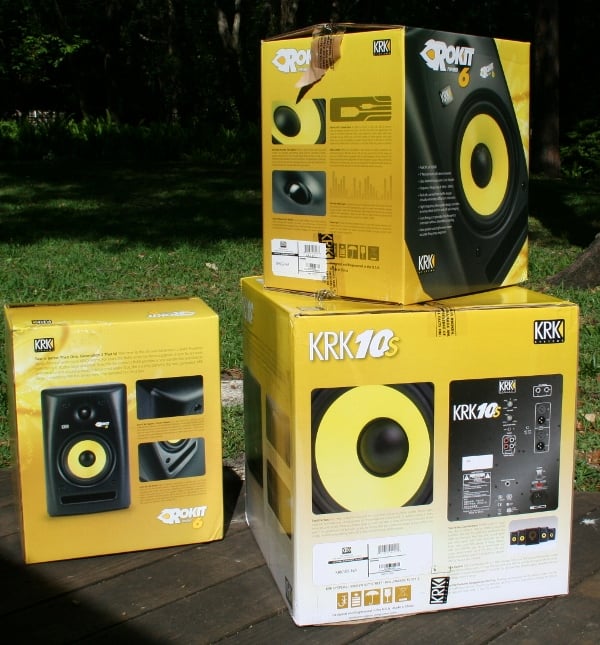 The KRK Rokit Powered
6 monitors (there is an unpowered version FYI) came in individual boxes as did
the 10s subwoofer. Each speaker is wrapped in a thin foam fabric with foam
endcaps. The speakers were all double boxed with the outer box still having all
the branding. The speakers arrived in good condition with no damage. There are
a few similarities across the entire line of speakers. First, they all have a
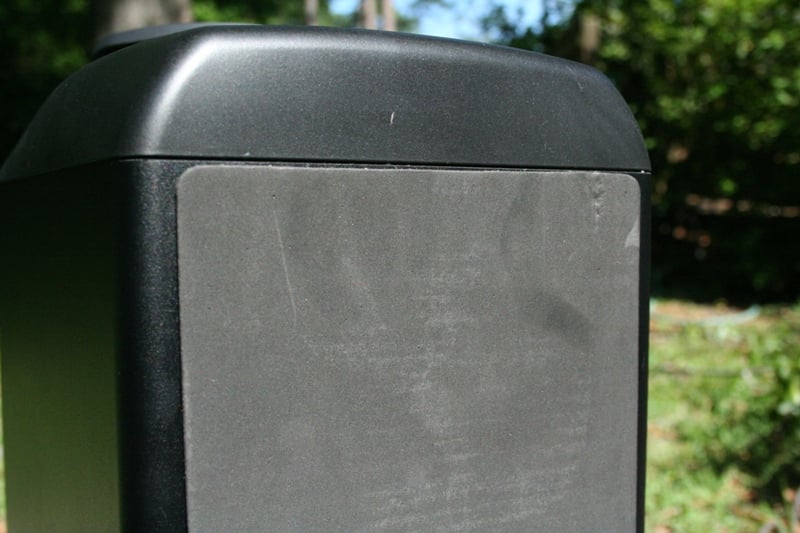
rounded front baffle (including the sub). The finish is all a semi-reflective
textured black. The finish resists fingerprints and stands up pretty well to
dust. It seems very resistant to scuffs and scrapes and promises to be very
durable. All the speakers have a front firing slot-style port near the bottom
on the cabinets. The woofers are all constructed out of glass
aramid composite and are bright yellow with a black dust cap. Distinctive? Yes.
Attractive? You decide. All the speakers weigh about as much as you'd think
considering their size. They feel
very quality in this respect without
being overly difficult to move.
The KRK Rokit Powered
6 monitors (there is an unpowered version FYI) came in individual boxes as did
the 10s subwoofer. Each speaker is wrapped in a thin foam fabric with foam
endcaps. The speakers were all double boxed with the outer box still having all
the branding. The speakers arrived in good condition with no damage. There are
a few similarities across the entire line of speakers. First, they all have a
rounded front baffle (including the sub). The finish is all a semi-reflective
textured black. The finish resists fingerprints and stands up pretty well to
dust. It seems very resistant to scuffs and scrapes and promises to be very
durable. All the speakers have a front firing slot-style port near the bottom
on the cabinets. The woofers are all constructed out of glass
aramid composite and are bright yellow with a black dust cap. Distinctive? Yes.
Attractive? You decide. All the speakers weigh about as much as you'd think
considering their size. They feel
very quality in this respect without
being overly difficult to move.
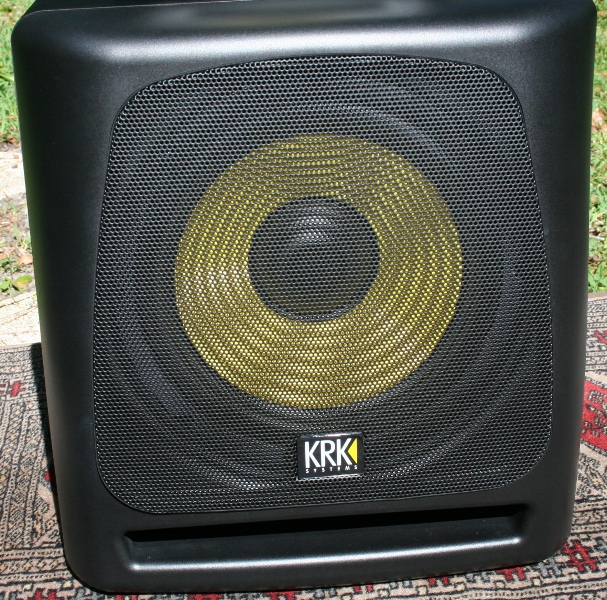
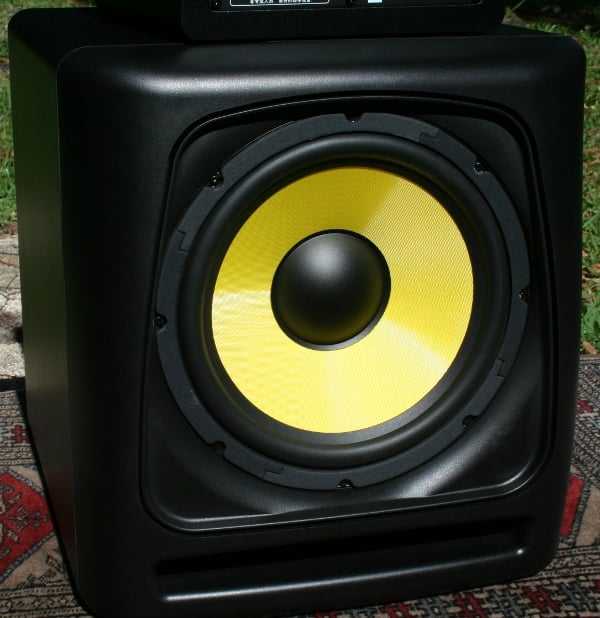
The 10s subwoofer is about the right size for a home theater sub which gives is a bit more bulk than you are used to seeing in an office. At 16" deep, 14" wide and 15" tall, you're not exactly going to shove this thing under your desk. You're definitely going to want to make sure you know what you are getting into with the KRK 10s. It sports a ten inch driver under a mesh grill. The grill is technically removable though it is a bit of a pain to do so, and the sub looks a little weird with it off. There are no feet of any kind nor are there provisions for such.
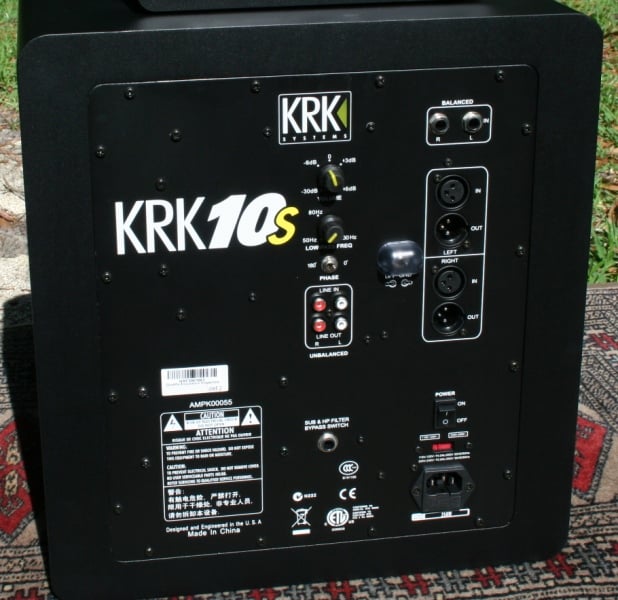 The back of the sub
may look a little unusual to home theater enthusiasts but it all makes sense
once you take a deeper look. Since all of the speakers have their own amp, the
idea is that you'll need to run them all through the sub in order to take
advantage of the crossover. Down the center of the sub, you'll notice a few
more common controls - volume (-30dB to +6 dB), crossover (50Hz to 130Hz with a
label at 80Hz), a 0/180 phase switch, and RCA line in and outs. I'll get to
that 1/4" plug at the bottom in a minute. To the right you'll notice TRS
(1/4") inputs and balanced inputs and outputs. A power switch (no auto-on
function) and detachable power cord are at the bottom. Under a small plastic
cover, there is a ground lift switch for those having problems with a grounding
buzz. This is a feature I wish they had on all subs and is a welcome find here.
The back of the sub
may look a little unusual to home theater enthusiasts but it all makes sense
once you take a deeper look. Since all of the speakers have their own amp, the
idea is that you'll need to run them all through the sub in order to take
advantage of the crossover. Down the center of the sub, you'll notice a few
more common controls - volume (-30dB to +6 dB), crossover (50Hz to 130Hz with a
label at 80Hz), a 0/180 phase switch, and RCA line in and outs. I'll get to
that 1/4" plug at the bottom in a minute. To the right you'll notice TRS
(1/4") inputs and balanced inputs and outputs. A power switch (no auto-on
function) and detachable power cord are at the bottom. Under a small plastic
cover, there is a ground lift switch for those having problems with a grounding
buzz. This is a feature I wish they had on all subs and is a welcome find here.
In order to use the 10s in a 2.1 configuration, you can use the RCA, TRS, or balanced inputs from your computer/soundcard. You can then connect your speakers by either balanced or RCA output. The any input can be matched with any output (you don't have to do RCA to RCA for example). But what if you don't want to use the sub, if only temporarily? Well, that's what that final 1/4" plug at the bottom of the center column is for. You can connect a foot pedal so that you can bypass the sub as you wish and send a full range signal to your monitors. Pretty cool.
 Because
the Rokit Powered 6s are studio monitors and not traditional home theater
speakers, they have their own included amp. They are also completely lacking a
grill, yet another in a long line of reasons to keep your kids out of our
office. Personally, I would have preferred a grill of some sort even if it was
perfunctory and throwaway. It just makes the speaker more versatile in
placement and gives those that don't like the yellow cones a way to hide them. The
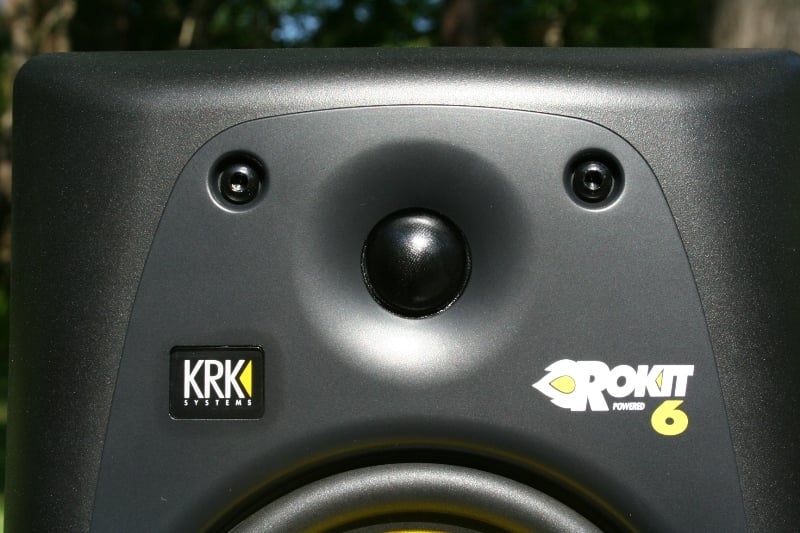
Rokit 6s sport a 6" woofer (hence the "6" designation) and a
1" neodymium soft dome tweeter with ferro fluid. KRK Systems also makes a smaller 4 and a larger 8
monitors with the appropriate sized woofers. The speakers are a bit bigger than
you might expect at over a foot tall, nearly a foot deep and almost 9"
wide. The bottom of the speakers have a rubber mat covering nearly the entire
bottom which means you can pretty much put them on anything. The mat didn’t
stick or mar any surface I put them on including a cherry desk.
Because
the Rokit Powered 6s are studio monitors and not traditional home theater
speakers, they have their own included amp. They are also completely lacking a
grill, yet another in a long line of reasons to keep your kids out of our
office. Personally, I would have preferred a grill of some sort even if it was
perfunctory and throwaway. It just makes the speaker more versatile in
placement and gives those that don't like the yellow cones a way to hide them. The
Rokit 6s sport a 6" woofer (hence the "6" designation) and a
1" neodymium soft dome tweeter with ferro fluid. KRK Systems also makes a smaller 4 and a larger 8
monitors with the appropriate sized woofers. The speakers are a bit bigger than
you might expect at over a foot tall, nearly a foot deep and almost 9"
wide. The bottom of the speakers have a rubber mat covering nearly the entire
bottom which means you can pretty much put them on anything. The mat didn’t
stick or mar any surface I put them on including a cherry desk.
The back of the Roket 6 has the amp with a number
of input and control options. You have your three different input options (RCA,
TRS, and balanced). Only two of them (RCA and balanced) are compatible with the
10s sub (it doesn’t have a TRS output). There is a volume control (again with -30dB to +6 dB control) with a High Frequency adjust
from -2dB to +1dB. This allows you to really fine tune your high frequency
experience. Lastly, you'll find a power switch and a detachable power cord at
the bottom.
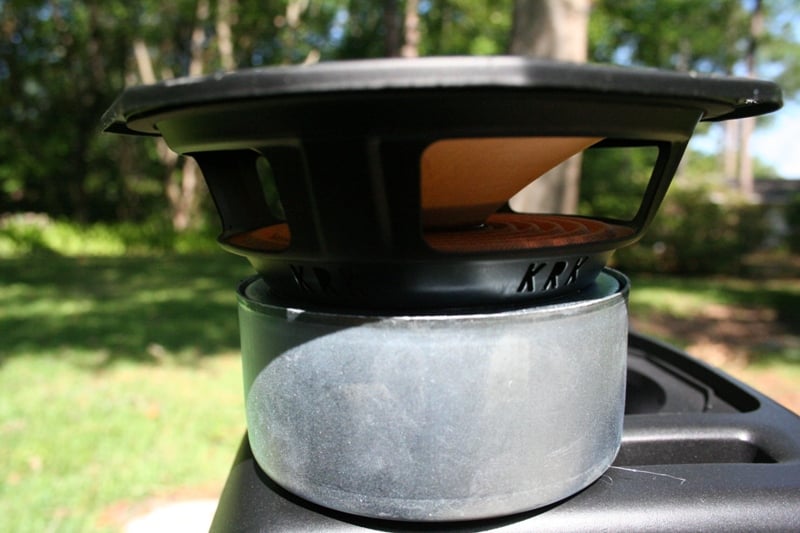
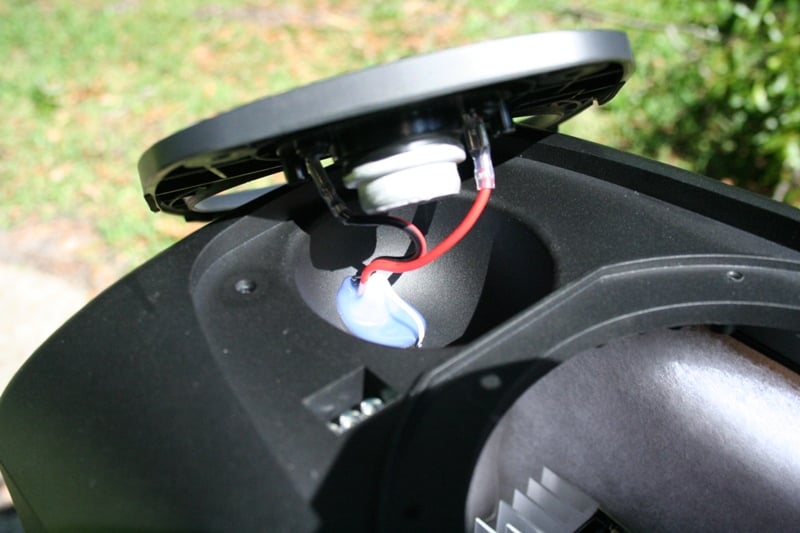
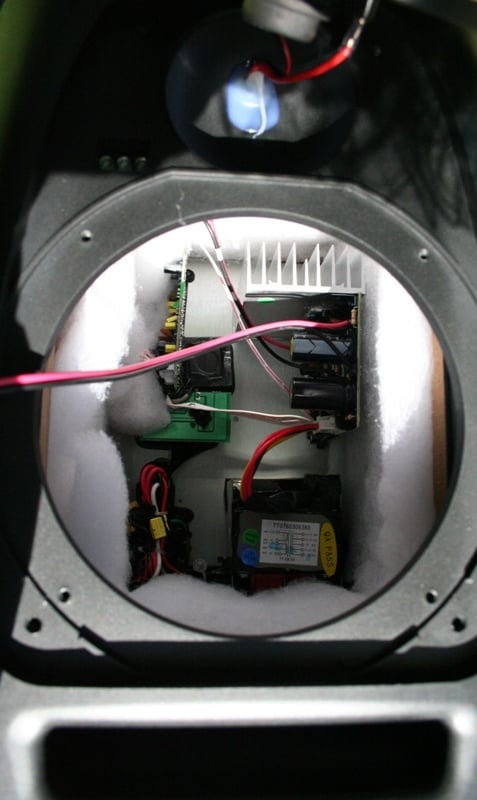
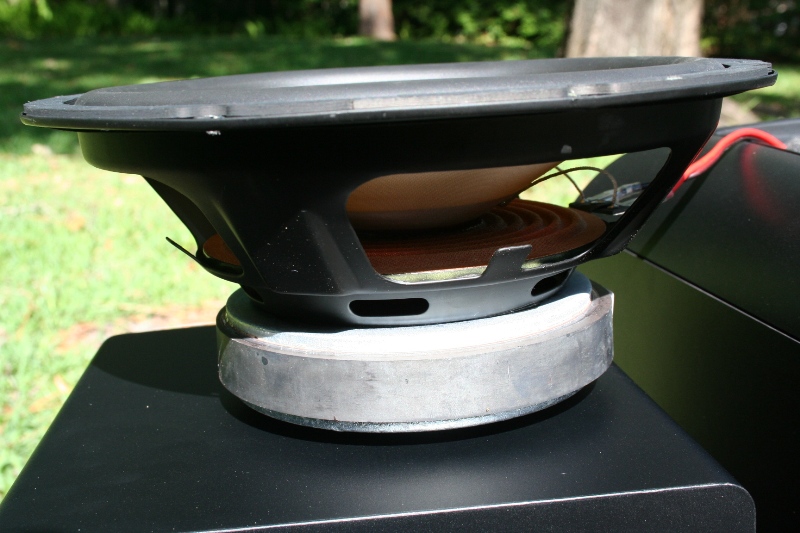
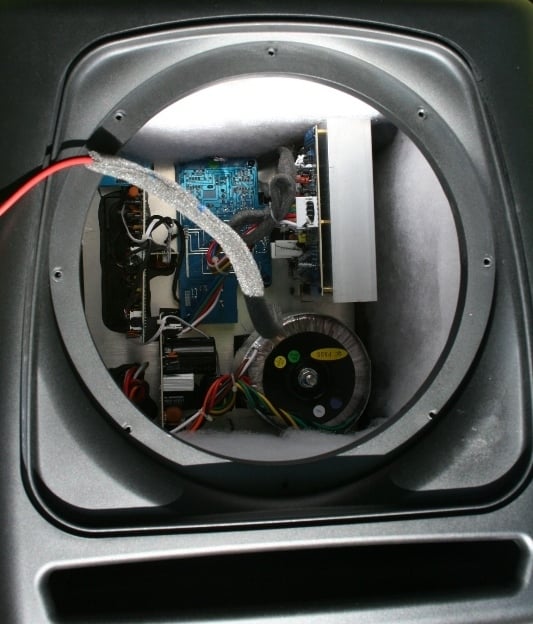
Cracking open the Rokit 6s I needed to remove a large front plate which doubled at the housing for the tweeter. The woofers were shielded with stamped baskets. The magnet structures looked about right. There were some braces glued to the sides and along the edges but none across the middle other than the structure for the slot-style port. The knock test was sufficiently dead. The speakers had a layer of polyfill glued to the walls. The amp appears to be housed into its own compartment which I’d surmise it’s likely a Class D design. They utilize a linear power supply with a fairly hefty torroidal transformer and a meaty power reserves.
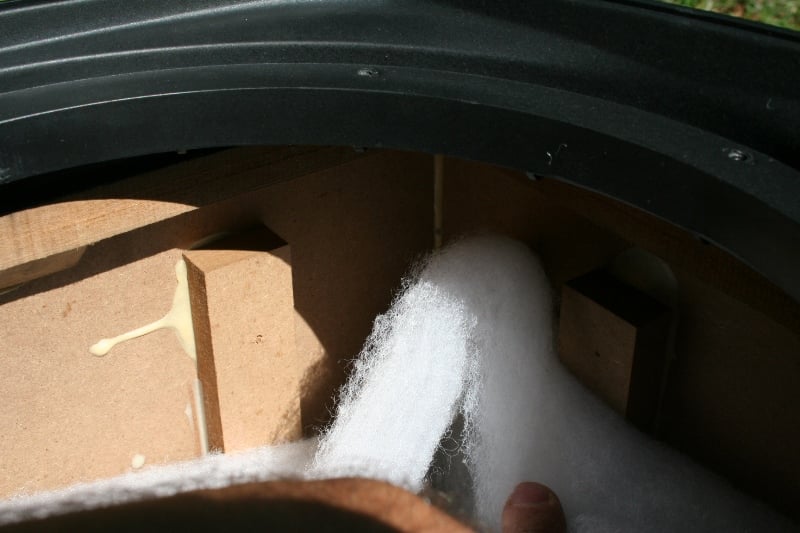
The 10s sub shared many of the same features of the Rokit 6s including the cabinet materials, stamped baskets, and polyfill on the walls. The differences were that the driver wasn't shielded, there was an extra layer of polyfil between the woofer and the amp, and the knock test wasn't nearly as satisfying. With a sub the size of the 10s, I'd expect at least one substantial brace but there were none. The magnet on the 10s looked a little less beefy than others I've seen on drivers this size. The amp appears to be housed into its own compartment which I’d surmise it’s likely a Class D design. They utilize a linear power supply with a fairly hefty torroidal transformer and meaty power reserves.
KRK Setup and Measurements
 In the past, I have set my Swan S200A
speakers on stands flanking my desk in my AV
Rant podcast room. The room is heavily treated with 19 Ready Acoustics
Chameleon panels. Echos are a thing of the past in this room. The Swans may
be a bit smaller overall than the KRKs but they are rear ported and I needed to
keep them off the wall. With the stands, I could do that without taking up too
much desk space. The KRKs were easier to place with their front port and large
pad on the Rokit 6s. This actually allowed me to hang them off the back of the
desk a bit without worrying if I would miss whatever "feet" were on
the bottom of the speaker. One thing about all the controls on all the speakers
is that they "click" into place rather than being continuously
variable. While a more continuous pot would give you finer control, one that
locks makes it easier to ensure that you have both speakers at the same level.
The sub controls are continuous giving you finer control on how the sub blends
with the speakers and where the crossover lands. Level matching the speakers is
a matter of sending a few test tones (you can get some online or from the Rives
Audio Test CD 2 disc) and measuring them with an SPL meter. For my setup,
having the speakers at the same volume was fine since I was equidistant from them
and while I initially set the sub with a meter, I ended up doing it by ear in
the end.
In the past, I have set my Swan S200A
speakers on stands flanking my desk in my AV
Rant podcast room. The room is heavily treated with 19 Ready Acoustics
Chameleon panels. Echos are a thing of the past in this room. The Swans may
be a bit smaller overall than the KRKs but they are rear ported and I needed to
keep them off the wall. With the stands, I could do that without taking up too
much desk space. The KRKs were easier to place with their front port and large
pad on the Rokit 6s. This actually allowed me to hang them off the back of the
desk a bit without worrying if I would miss whatever "feet" were on
the bottom of the speaker. One thing about all the controls on all the speakers
is that they "click" into place rather than being continuously
variable. While a more continuous pot would give you finer control, one that
locks makes it easier to ensure that you have both speakers at the same level.
The sub controls are continuous giving you finer control on how the sub blends
with the speakers and where the crossover lands. Level matching the speakers is
a matter of sending a few test tones (you can get some online or from the Rives
Audio Test CD 2 disc) and measuring them with an SPL meter. For my setup,
having the speakers at the same volume was fine since I was equidistant from them
and while I initially set the sub with a meter, I ended up doing it by ear in
the end.
 I placed the sub on the outside of my desk.
It was probably only a couple of feet or so from me. The speakers were on the
desk and about anywhere from a foot to two feet depending on where I sat. I connected the sub and speaker combination in
every available way. The system worked as advertised in just about every way. You'll
want to start with the volume of the speakers and sub at the minimum and then
work them up to an acceptable level. I found that if I had the speakers up too
high, I got a buzz from them. My only real problem was that I was getting output
from the sub far above the crossover point. Even when I bottomed out the
crossover, I was hearing output all the way up to 125Hz. Not faint output but
strong output. This could pose a problem with sub/monitor integration.
I placed the sub on the outside of my desk.
It was probably only a couple of feet or so from me. The speakers were on the
desk and about anywhere from a foot to two feet depending on where I sat. I connected the sub and speaker combination in
every available way. The system worked as advertised in just about every way. You'll
want to start with the volume of the speakers and sub at the minimum and then
work them up to an acceptable level. I found that if I had the speakers up too
high, I got a buzz from them. My only real problem was that I was getting output
from the sub far above the crossover point. Even when I bottomed out the
crossover, I was hearing output all the way up to 125Hz. Not faint output but
strong output. This could pose a problem with sub/monitor integration.
Measurements & Analysis
For laboratory measurements I used the Sencore SP395A FFT Audio Analyzer plugged directly into the internal amps of the Rokit 6 speakers and 10s subwoofer. The first thing I did was take the sub outside and do a groundplane measurement at one meter.
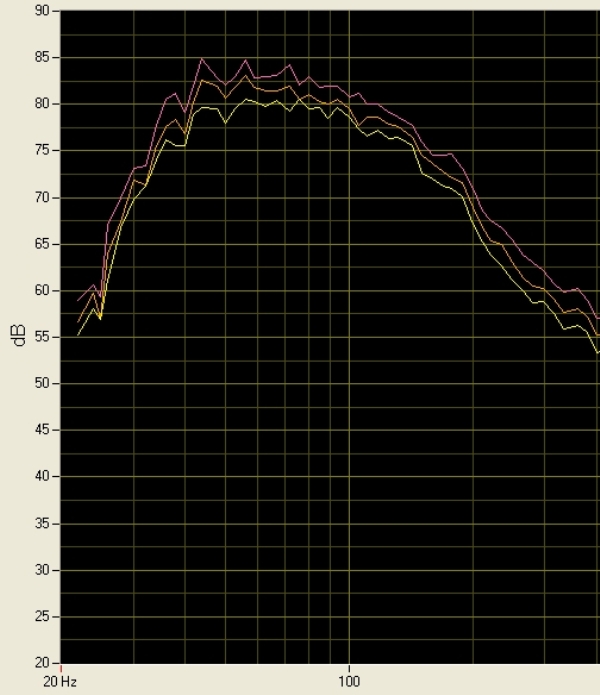
KRK10s Subwoofer Groundplane Measurement 1 Meter
As you can see the KRK10s subwoofer has very strong and linear output from about 100Hz to 35-40Hz. The bass response is definitely more linear at lower volumes (which is most likely how this sub will be run). Depending on the placement, your in room response might be a bit lower.
I measured the KRK Rokit Powered 6 speakers in-room on- and off-axis frequency response with 1/12th octave resolution.
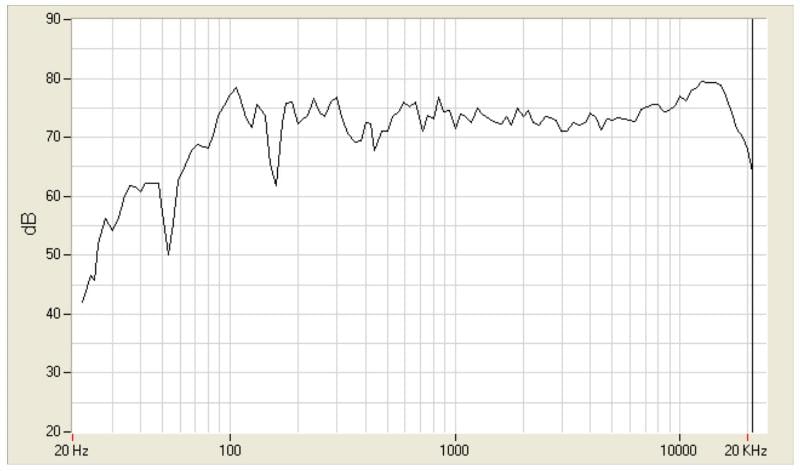
KRK Rokit Powered 6 1 Meter Frequency
Response (1/12th Octave) On Axis
Note
- this is NOT a 1 watt measurement
As you can see, the Rokit 6s measures incredibly flat on axis except for a bump around 12-15kHz with a fairly dramatic dropoff below 70Hz which is expected and likely deliberate to preserve system dynamics since these monitors are designed to work in concert with the 10s subwoofer.
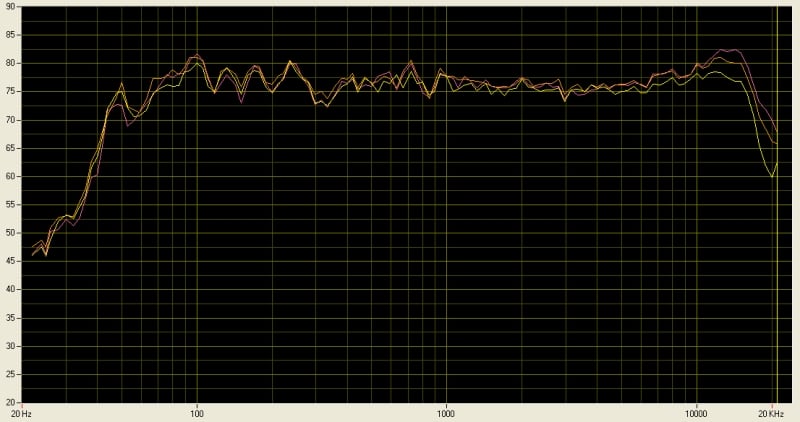
KRK Rokit Powered 6 1/2 Meter Frequency
Response (1/12th Octave)
Pink - On axis, Orange - 15 degrees off axis, Yellow - 30
degrees off axis
KRK specs these speakers to 49Hz which doesn't look very likely from the 1 meter graph but it much more plausible in the above. Since the speakers are probably mostly going to be used nearfield, this seems to be the most representative of actual use.
Rokit Listening Tests and Conclusion
When I first did the measurements, I was concerned about the 1 meter graph. I had already been listening to the speakers set up at my desk for a while and that graph did not translate into what I was hearing. The 1/2 meter graph quelled those fears since that better reflected my listening experience. I expect most people will sit within a meter and probably closer to a 1/2 meter so that is the graph you want to be looking at. The low extension of the bookshelves gives you a lot of flexibility setting the crossover and may even preclude the need for a sub in some situations. The 49Hz claim is definitely going to be realized in nearfield listening.
Pixies: Doolittle
While not the highest fidelity of
recordings, Doolittle has a lot of different… let's say frequencies involved. Everything from kick drums all the way up to
cymbals and Frank Black screaming. With this album I was more interested in
testing imaging and how well the sub integrated with the speakers in a
nearfield placement (the speakers are within a meter and the sub isn't that
much farther away). I ended up with the speakers toed in just a hair as their
off axis response was much more linear than on axis. I did the "chicken
dance" bobbing my head in and out looking for the perfect placement and
testing the size of the sweetspot. While there was some deviation as I moved my
head, overall the sweetspot was pretty large. The central image was always
solid as long as I kept my head between the two speakers though the overall
sound quality would change slightly. I found that it was fairly easy identify
the spot I liked and then reorient the speakers so that they were at that same
angle in a more comfortable working position.
Mating the 10s sub with the Rokit 6 speakers was much easier than I thought. After I level matched the two, I slightly tweaked the sub level and played a bit with the crossover. I was particularly vulnerable to localizing the sub if it played too high and ended up with a crossover point somewhere around 60-70Hz. With that crossover point, I generally had a hard time resisting the urge to go over and make sure it was still playing. It blended just perfectly with the Rokit 6's. The bass was suitably rich and punchy and didn't feel at all flabby or overdone.
Blue Man Group: Las Vegas Sampler
You can't get much better for bass, imaging,
and soundstage than any of the Blue Man Group's offerings.
This 4 song sampler I picked up in Vegas when I was there has come in handy a
number of times. The imaging of the Rokit 6's was pretty amazing with the first
track Drum Finale Throwdown.
Percussive instruments were flying around my head with reckless abandon. I was
impressed by the 3D soundfield the Rokit 6's provided. The midrange was deep
and clear with the upper end well extended without a hint of fatigue. The 10s
sub was definitely pushed with this test as the BMG
are known for their bass. I was impressed by the depths it managed to reach.
There is a part of the first track Drum
Finale Showdown that has some "lowrider" bass. At first I thought
the sub was breaking up but after a closer listen, it was just doing its job.
The 10s managed to shake the desk when it needed. It was closer to the
crossover point that I noticed some trouble. The overlap of the sub and
monitors was creating a muddier and more congested sound than I experienced in
the other frequencies. Whatever the problem with their crossover design, the
overlap of the sub and the speakers with this album was creating a fidelity
problem that I wasn't hearing in other recently reviewed systems with this listening
material.
Marillion: Holidays in Eden
With Marillion, I was more looking for the
high end of the speakers and perhaps seeing how the 10s handled different bass.
Again, I found that the high end of the Rokit 6's was smooth and clear. The
midrange really jumped out at me with this test. Very clear and articulate, I
could hear a lot of the richness of what the original recording engineer was
going for. The bass was again punchy and tight but it was mostly coming from
the speakers with the sub just reinforcing the lower harmonics. The dynamics of
the Rokit 6's really impressed with all the percussive and guitar elements plus
tempo and volume changes. It seems that the problem with the sub crossover will
really only manifest itself if you are listening to content with a lot of
material at that point.
Conclusion
 Overall, I was extremely impressed with
the performance of the KRK Systems Rokit 6's. For most people I’m tempted to
say that the bass response of the Rokit 6's might be enough, but for the
diehard bass heads, an addition of a sub is a must. Unfortunately, the 10s' integration
with the Rokit 6’s seemed to be less than ideal with some program material
which may be discernable during critical listening when mixing (or just during
playback) depending on the content. The biggest problem with this review is
that KRK is one of those manufacturers that advertise a MSRP that is never seen
at retail. As such, you can get the system for much lower than the MSRP would
suggest. You should be able to find a pair of the monitors for the MSRP of one.
So, while the value rating is fairly standard (as $400 a pop is a lot for the
speakers), consider them a 5 at half price. I also dinged the system as a whole
on Bass Accuracy because of the crossover issues with the 10s. The Rokits alone
would have scored much higher.
Overall, I was extremely impressed with
the performance of the KRK Systems Rokit 6's. For most people I’m tempted to
say that the bass response of the Rokit 6's might be enough, but for the
diehard bass heads, an addition of a sub is a must. Unfortunately, the 10s' integration
with the Rokit 6’s seemed to be less than ideal with some program material
which may be discernable during critical listening when mixing (or just during
playback) depending on the content. The biggest problem with this review is
that KRK is one of those manufacturers that advertise a MSRP that is never seen
at retail. As such, you can get the system for much lower than the MSRP would
suggest. You should be able to find a pair of the monitors for the MSRP of one.
So, while the value rating is fairly standard (as $400 a pop is a lot for the
speakers), consider them a 5 at half price. I also dinged the system as a whole
on Bass Accuracy because of the crossover issues with the 10s. The Rokits alone
would have scored much higher.
KRK Rokit Powered 6 Bookshelf/ KRK10s Subwoofer
$399/each Rokit 6, $599 KRK10s, $1397 group
KRK Systems, LLC.
3000 SW 42nd Street
Hollywood, FL 33312
About KRK Systems:
A member of the
Stanton Group of companies, KRK Systems is a leader in studio monitors and
control room solutions for the professional audio market. KRK products are
distributed throughout the world via a network of distributors and dealers in
more than 75 countries. For additional information on all KRK Systems products,
please visit us online at www.krksys.com.
The Score Card
The scoring below is based on each piece of equipment doing the duty it is designed for. The numbers are weighed heavily with respect to the individual cost of each unit, thus giving a rating roughly equal to:
Performance × Price Factor/Value = Rating
Audioholics.com note: The ratings indicated below are based on subjective listening and objective testing of the product in question. The rating scale is based on performance/value ratio. If you notice better performing products in future reviews that have lower numbers in certain areas, be aware that the value factor is most likely the culprit. Other Audioholics reviewers may rate products solely based on performance, and each reviewer has his/her own system for ratings.
Audioholics Rating Scale
 — Excellent
- — Very Good
- — Good
- — Fair
- — Poor
| Metric | Rating |
|---|---|
| Build Quality | |
| Appearance | |
| Treble Extension | |
| Treble Smoothness | |
| Midrange Accuracy | |
| Bass Extension | |
| Bass Accuracy | |
| Imaging | |
| Soundstage | |
| Dynamic Range | |
| Fit and Finish | |
| Performance | |
| Value | |
As Associate Editor at Audioholics, Tom promises to the best of his ability to give each review the same amount of attention, consideration, and thoughtfulness as possible and keep his writings free from undue bias and preconceptions. Any indication, either internally or from another, that bias has entered into his review will be immediately investigated. Substantiation of mistakes or bias will be immediately corrected regardless of personal stake, feelings, or ego.
View full profile Subscribe to our newsletter