


EMP VT-40.2 Tube Amplifier & 41-SE/B Speaker System Review
- Product Name: EMP VT-40.2 Tube Amplifier & 41-SE/B Speaker System
- Manufacturer: EMP Tek
- Performance Rating:


- Value Rating:
- Review Date: November 12, 2009 22:05
- MSRP: $ 749/system (special) normally $1200
Model Name: VT-40.2
- Amplifier Type: Integrated Tube/Hybrid
- AC Input: 110V +-10% 60Hz
- Power Output: 40 watts per channel @ 8 ohms
- Frequency Response: 20Hz to 20kHz
- Distortion (THD): < 2%
- S/N Ratio: > 80dB
- Signal Input (Analog): 10Hz to 100kHz; AUX, iPod/MP3 (1/8-inch Jack), L/R (CD) RCA
- Line Level Input Sensitivity: 450mV
- Dimensions: 6-5/8" W x 4-1/2" H x 10-1/4" D
- Weight: 8 lbs
- Warranty:1 year
Model Name: 41-SE/B
- System Type: Bookshelf Speaker
- Frequency Response: 60Hz – 30kHz +-3dB
- Sensitivity: 86dB (2.83 volts @ 1 meter)
- Recommended Power: 30 to 100 watts
- Drive Units: (1) 4" (102mm) Beryllium Cone Woofer; (1) 1" (25mm) Silk Dome Tweeter
- Tweeter Protection: Yes
- Crossover Frequency: 3000Hz
- Crossover: 12 dB/Octave
- Impedance: 8 ohms
- Cabinet: Black Oak woodgrain with gloss tops/bottoms
- Grille: Black cloth
- Dimensions: 6-3/4" W x 11-1/2" H x 10-1/4" D
- Weight: 12lbs / ea
- Warranty: 5 years
Pros
- Phenomenal audio quality in reasonable compact form factor
- Speakers good enough for audiophile applications beyond typical PC sound
- Own cool blue tubes at this price?
Cons
- VT.40 hybrid tube amp line level output too hot to use with most powered subwoofers
- Limited system output best suited for small office or room environments
- Speakers available in only black
EMP VT-40.2 & 41-SE/B Design Overview
I love my job. It’s taken me nearly a decade to make such a claim as I am now doing exactly what I want, playing with the latest A/V gear and critiquing its performance. Unfortunately, much of my time is spent in front of a computer writing and analyzing rather than listening. It becomes quite monotonous at times as the silence is often deadening. Imagine my excitement when I learned about a new audiophile compact audio system EMP designed with the purpose of using it in concert with your desktop PC. Enter the EMP Tek VT-40.2 hybrid integrated tube amplifier and 41-SE/B bookshelf speaker system. The model #s are a bit vague so I will refer to the system as the EMP tube amp speaker combo. This is no ordinary three piece meal mind you, as you will discover while I sink my teeth into reviewing this potent little system. 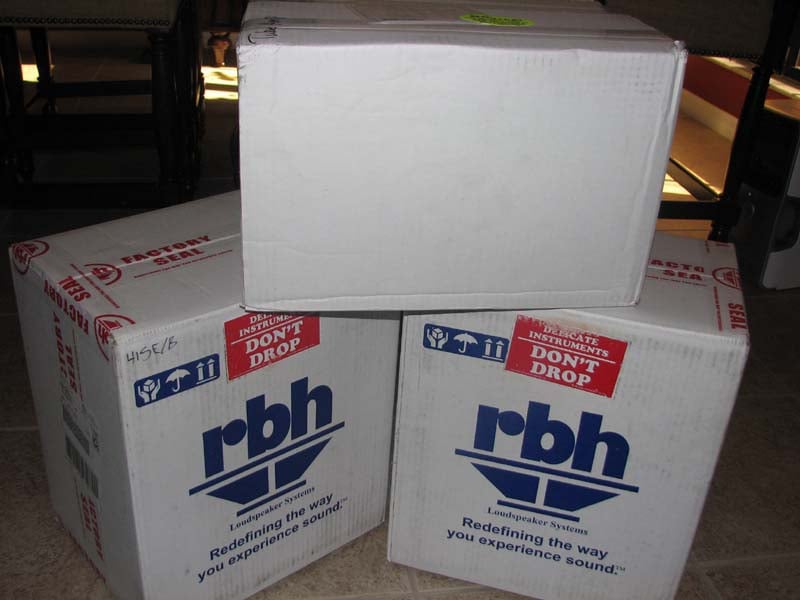 The EMP tube amp speaker combo showed up at my door in three individually packed boxes all labeled RBH Sound. In fact the boxes for the EMP 41-SE/B’s were the same ones used for the RBH Signature 41-SE models which should be of no surprise since they both share identical cabinets and virtually the same guts with a few exceptions I will expand upon in the next section of this review. I was so excited to open these speakers that I accidentally sliced my index finger with the scissor in the process. The VT-40.2 was single-boxed and stuffed with so much protective foam that I’d suspect one could roll it down a flight of steps without inflicting any damage to the tube amp, but it’s not something I’d recommend trying.
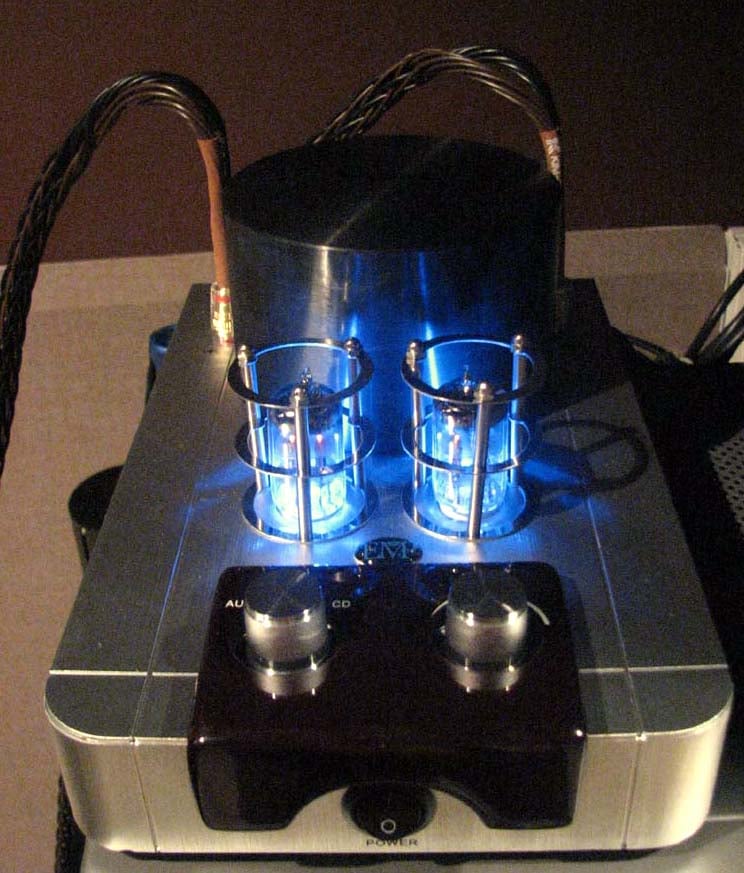 EMP VT-40.2 Hybrid Tube Amplifier
Let’s start with the VT-40.2 hybrid tube amplifier. Normally I’d scoff at anything with tubes but I’ve lately been keeping an open mind to new ideas. In this case, tubes are an old idea as they predate the transistor. There are audiophiles that simply love the sound of tubes, mostly because when they distort, their primary distortion is even order harmonic based unless it’s well into hard clipping. Even order harmonic distortion has a more pleasing sound than odd order harmonics which are inherent to solid state push-pull amplifier topologies. The problem with tube amplifiers however is they typically have a high output impedance, making their performance vary greatly depending on what type of loudspeakers are being driven by them. Incidentally many Class D amplifiers share similar attributes to tubes which may explain the love/hate relationship people tend to have towards both types of amplification technologies.
EMP’s approach in the VT-40.2 is to apply the tube technology to the preamp only acting as a unity gain buffer stage. The power stage is a traditional solid state linear A/B design. I suspect their goal was to capture the “warm” feeling of tube sound with the consistent performance of solid state amplification. Based on my listening tests, I’d say that goal was definitely achieved.
The VT-40.2 utilizes a toroidal transformer in the power supply, fully encapsulated but aesthetically visible as it towers over the two preamp tubes. It’s really cool to see the glow of the tube filament flanked by blue lighting. I swear it seems a trend these days in high end audio to douse the consumer with blue LED lighting. Let me be the first to say it works. I totally dig it.
The VT-40.2 sports a pair of analog RCA level inputs, two 1/8” mini plug inputs for iPod/MP3, etc and one 1/8” mini plug variable output incase you want to supplement the system with a powered subwoofer. Personally I would have preferred EMP replaced one 1/8” plug input and the output with RCA level connections. It’s a real pain to find a 1/8” plug to RCA when you’re in a pinch and want to hook up a powered subwoofer.
The 5-way gold plated speaker terminal binding posts are located on the top of the amplifier which is a bit unusual but it keeps the amplifier very low profile so I understand why they did that. Realize however that due to the close proximity of the shielded toroid and the speaker connectors, it’s a bit of a challenge to lock down compression banana plug speaker cables.
The power switch is located on the front panel and there are two silver rotating knobs above it, one for volume and the other for input selection. This is about as basic of an integrated amplifier that I’ve ever seen which made it a real snap to setup and start using right away. Powering up the VT-40.2 takes exactly 30 seconds before you can start to hear its magic. I estimate it takes about 1 second for the tubes to warm up leaving the extra 29 seconds purposely imposed to build listener anticipation. Once you realize how good this system sounds, it becomes quite agonizing to wait 30 seconds for your next listening session, especially when Pandora is streaming one of your favorite jazz tunes.
 EMP 41-SE/B Bookshelf Speakers
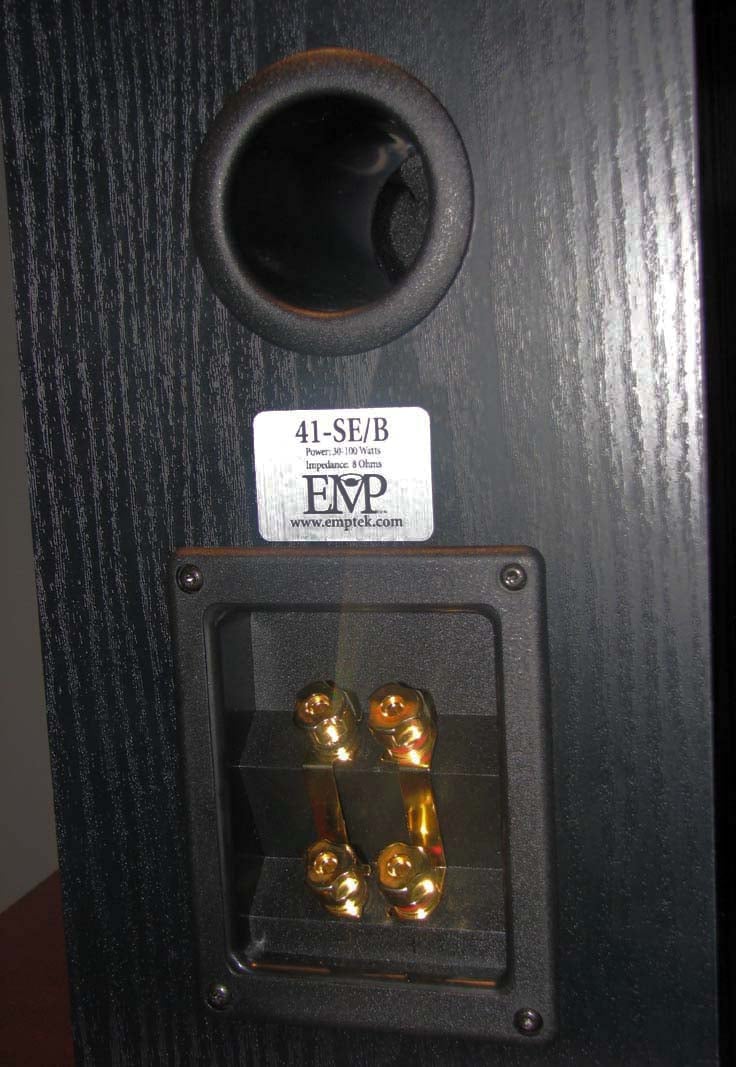
The 41-SE/B bookshelf speaker system is the crown jewel of this package. They share almost the same guts as the RBH Sound 41-SE speakers that retail for nearly $1k/pair in standard black finish - the only finish option for the EMP versions. Both models have identical specs on paper and both utilize the exact same crossover design and parts.
The EMP 41-SE/B’s come with no threaded holes on the bottom of the cabinet to utilize spikes or cones, nor do they come with rubber feet. This was a big oversight on their part in my opinion as it would have been very useful to at least include rubber feet for computer desk installs to help better dampen resonances between two adjacent hard surfaces.
The EMP 41-SE/B cabinets are constructed of ¾” MDF and are internally braced and amply filled with polyester fiber. They resonate with a nice thud sound when doing the knuckle test. They are rear ported so keep that in mind when placing them near a wall. I recommend at least 2-3 inches of breathing room for the ports (which I figured using a 1.5 multiplier factor times the port diameter). If you absolutely have to place them against a wall, it’s recommended to use a port plug or sock to stuff the port. The 41-SE/B’s are bi-ample though I couldn’t ever imagine an installation scenario where one would want to bi-amp such a small speaker but EMP makes it available to you.
The Drivers
The EMP model utilizes a newly developed 4” driver which uses a beryllium cone and phase plug, as opposed to the aluminum cone found on the RBH version. This driver utilizes a true phase plug, instead of the purely cosmetic style found on many speakers today that often makes the performance worse! The EMP woofer retains the exact motor structure and cast Aluminum frame of the RBH woofer. Most speakers at this price point use stamped steel baskets in comparison.
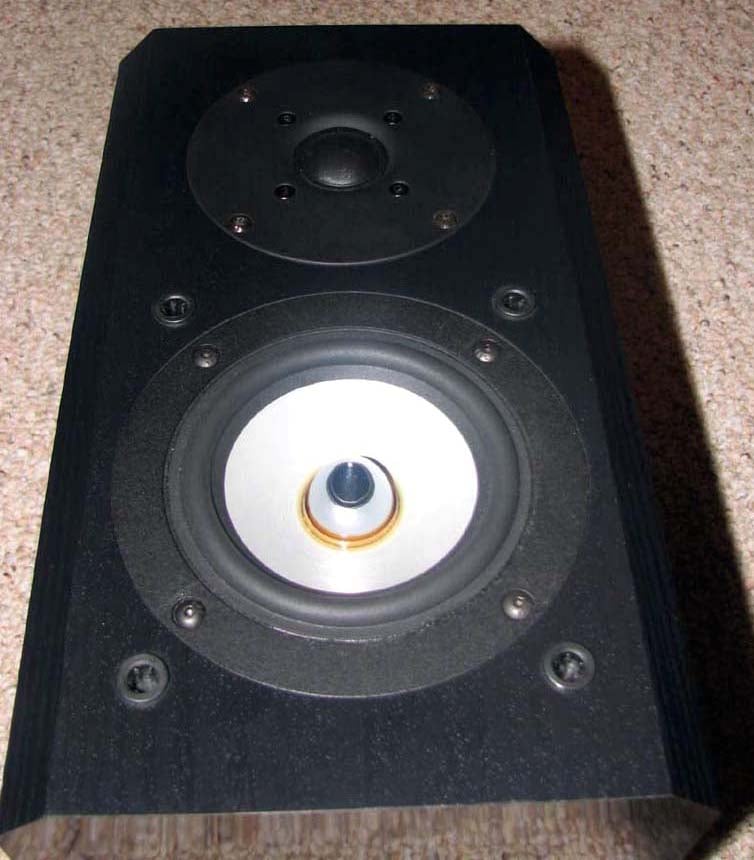
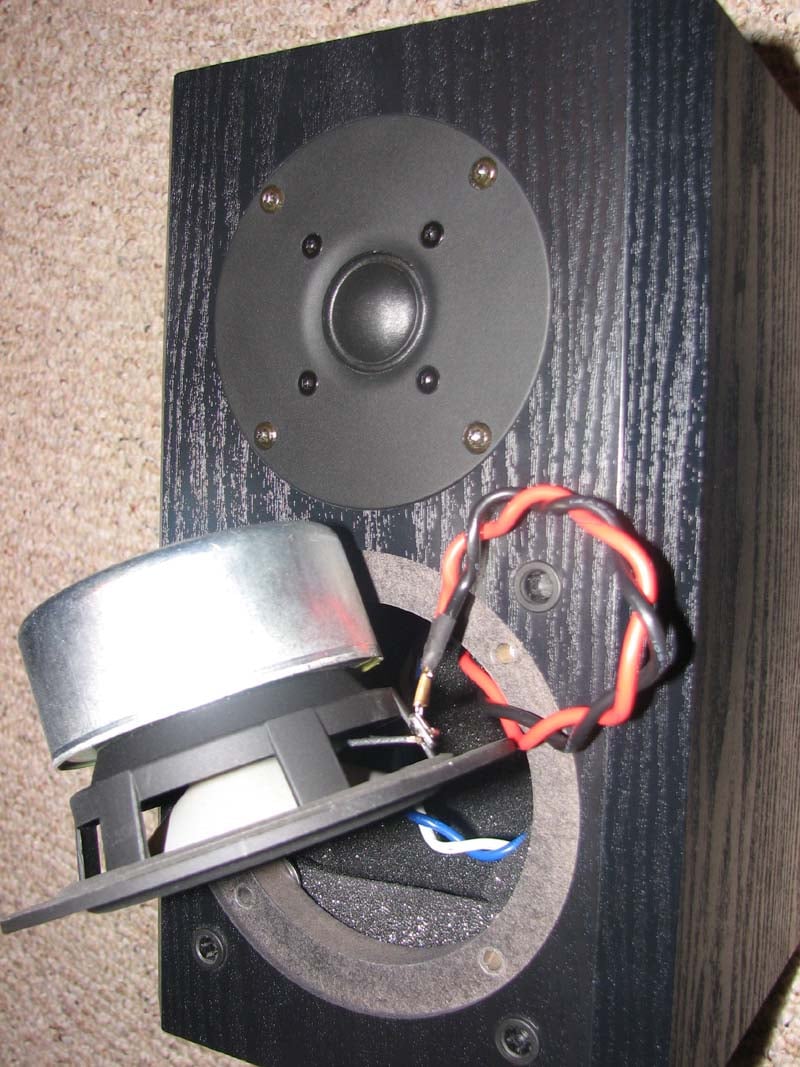
Beryllium is much lighter and more rigid (per unit of mass) than common aluminum. This means for a given level of cone stiffness, the material required, and mass of that cone is far less, making the loudspeaker more efficient by reducing the moving mass. This was evident when I physically compared the cone thickness between the EMP and RBH versions. The phase plug further reduces cone mass by physically having no dust cap. It also further reduces on-axis beaming allowing the woofer to extend the response to higher frequencies and offer improved dispersion characteristics. The downside to using a phase plug driver in such a small woofer is the reduced cone area also means reduced efficiency at bass frequencies. It also creates a pressure release and leak in the center of the woofer. This can cause a chuffing noise when driven with percussive instruments by allowing voice coil air gap turbulence to be heard directly. These trade offs become a wash when mating these speakers with a powered subwoofer, which is what I would recommend in almost all applications if space and budget permits.
The 1” silk dome tweeter in the EMP 41-SE/B is an EMP exclusive design meant to perform on par with the Vifa used in RBH Sound Signature product but at a greatly reduced cost. Based on my listening tests, I have no doubts that their design goal was achieved.
Editorial Note on Beryllium
Beryllium's very low density (1.85 times that of water), high melting point (1278 °C), high temperature stability, and low coefficient of thermal expansion makes it in many ways an ideal aerospace material, and it has been used in rocket nozzles and is a significant component of planned space telescopes and now high performance loudspeakers. Because of its very low mass, high Youngs Modulus (exceptional elastic rigidity) it’s truly an ideal cone material for loudspeaker drivers. To date only three other companies that we know of utilize this technology; TAD, Sonance and Paradigm (tweeters only).
A word of caution must be mentioned about the handling of Beryllium which in its powdered form can be extremely toxic. Just don’t burn or crumble the woofer cones and inhale the dust and you will have endless years of safe listening to these speakers.
The Crossover
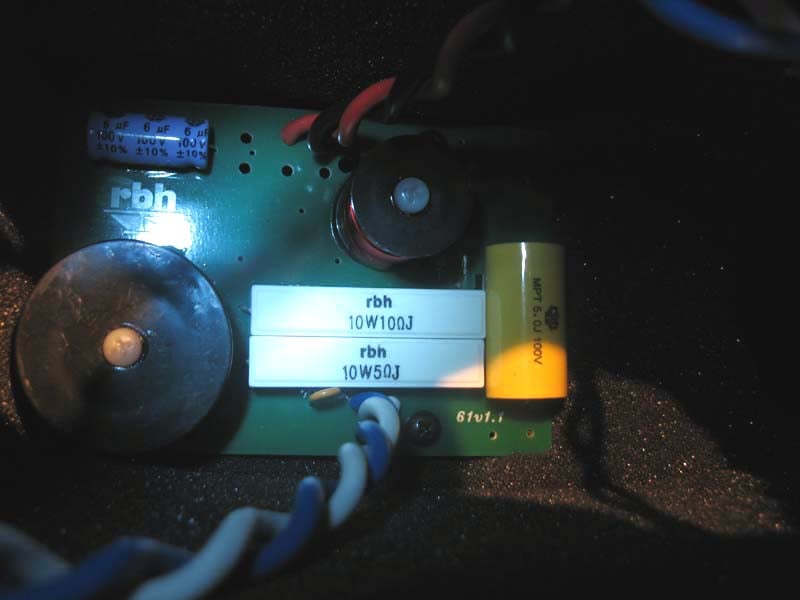 As I mentioned previously, the EMP 41-SE/B utilize the identical crossovers from the RBH Sound 41-SE version. RBH Sound cuts no costs on quality of parts utilized in their crossover designs. Opening up one of their speakers, or in this case the EMP 41-SE/B, you find air core inductors, polypropylene capacitors, ceramic resistors and thick twisted pair 14AWG internal wiring. The 2nd order crossover frequency is set for 3kHz which may seem a bit high until you realize that a 4” driver with such a low mass as this one, is more than capable of playing up well beyond this region. The phase plug improves off axis performance as well which makes for a drive unit capable of handling most of the midrange frequencies for a more seamless blend. The end result is incredibly natural sounding vocals because of extreme phase linearity the speakers exhibit in the voice band.
Set-Up
I tested the EMP tube amp speaker combo in two scenarios:
- Office - as a nearfield monitor on my computer desktop (10’ x 6’ office)
- Theater room - two-channel utilizing the reference gear and premier listening space in the Audioholics Showcase home
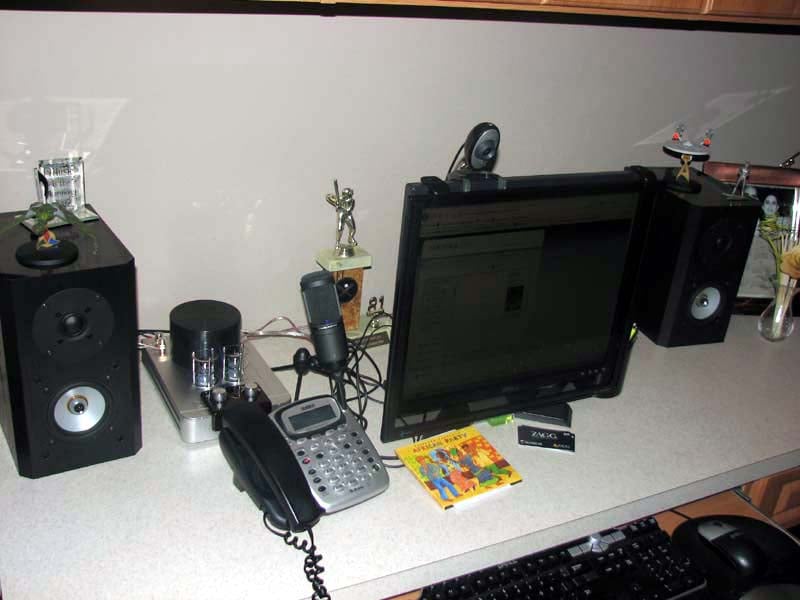
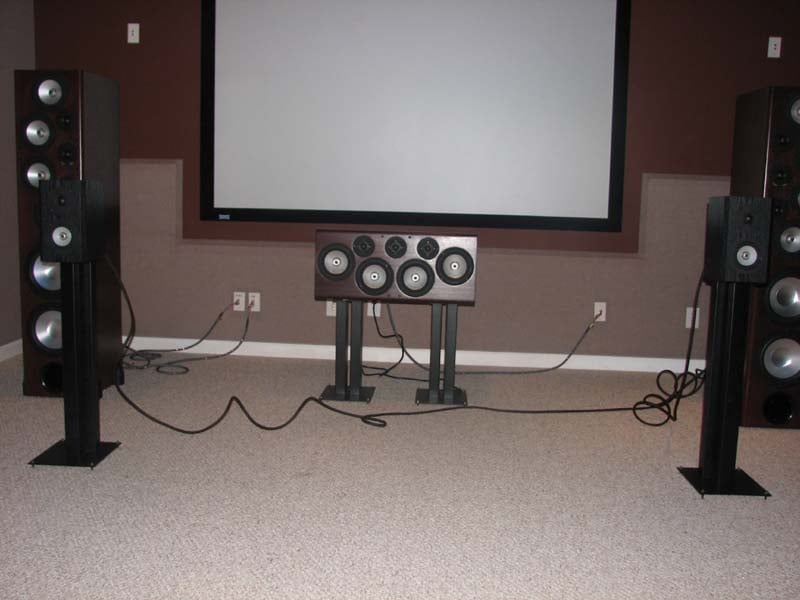
No subwoofer was used in either test configuration unless otherwise noted in the listening tests. In the first scenario (office room), I used my Headroom micro preamp and DAC connected directly to the VT-40.2.
For the second scenario (theater room), I placed the EMP 41-SE/B’s on 30” sand-filled Plateau speaker stands which puts the tweeter right at about ear level on my Continental theater seats. The speakers were positioned about 5ft from sidewalls and around 8ft from the back walls and spread apart about 10ft from each other which was about two feet shy of the distance from my primary listening position. I found applying a slight amount of toe-in helped focus the speakers better, but too much toe-in made them a bit too energetic up top for my listening preferences. I utilized my Sony CDP-CA-8ES CD changer as the source. All interconnects were furnished by Blue Jeans Cables (1694A Coax) and Kimber 8PR speaker cables with WBT compression banana plugs.
In both instances, it was a breeze to setup such a portable and basic system such as this one. For once I didn’t have to lug around a 100lb amplifier and it felt quite liberating.
EMP VT-40.2 & 41-SE/B Listening Tests
Office Room utilizing Pandora.com
To start
off my listening tests, I began with the setup in my main office where
I do all related works for Audioholics. I usually write my articles
with music playing in the background courtesy of the FREE services of
Pandora.com. Because I so greatly enjoyed my listening sessions of the
EMP tube amp speaker combo, I went over my 40 hours / month free limit
in just 2 weeks. Thus, I recently took the $36/year plunge to upgrade
to Pandora One membership which allows unlimited monthly listening
without the commercials. Well worth it in my opinion. With that, I
captured some of my listening experiences with the following source
materials.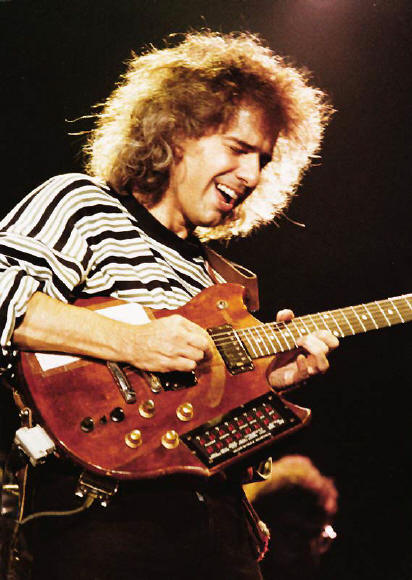 Pat Metheny
You can’t seriously evaluate a high
performance speaker system without the wonderful music of one of the
best jazz guitarists of all time - Pat Metheny.
Pandora took me
to “Lone Jack” which is a song from his Trio band playing straight up
bebop jazz. I couldn’t believe the dynamics in bass coming from the 4”
drivers of the 41-SE/B’s. The extension was of course a bit limited,
but the body was there and the snap in the drums was so laser precise.
The brushes had a nice airy decay that just never seemed to end. The
reverb in Pat’s electrical guitar in “Giant Steps (live)” was so fluid
while the brush on the snare drum sounded 3-D like. The cymbal crashes
were larger than life while the bass had nice body to it. Excellent.
Pandora
rewarded me with “Minuano (6/8)”, a classic from Still Life Talking
which is one of my favorite Pat Metheny Group CD’s. The vocals were
conveyed so neutrally and pure on the 41-SE/B’s that it had me yodeling
along. Pat’s acoustic guitar transported me back to the days I used to
cruise Clearwater Beach with my buds looking at all the wildlife
indigenous to Florida during the hot summer months. Paul Werico’s
stick work was just amazing. The surround envelope? I was hearing from
just two little speakers placed nearfield on my desktop can't be fully
translated to a review. You just have to hear it for yourself and at
the price of this system, the risk of investment is minimal.
The
respectable tactile presence of the 41-SE/B’s was displayed nicely in
“If I Could” as my computer desk resonated each time a bass note was
played. The plucks of the guitar strings had great detail and the
brushes provided huge ambience making the speakers seem lifelike.
The EMP 41-SE/B’s were playing Jazz music so well to my ears, it was almost like they were born for that very purpose.
Bob James
I
haven’t really followed Bob James much but I was happy that Pandora
reintroduced me. “Quiet Now” is an example of his finest work as a
jazz pianist. Bass was vibrating the floor in my office. How is this
possible for 4 inch drivers? With an ample motor structure, enough
excursion, amplifier power and plenty of box volume, you would be
surprised what little speakers can do. This is especially true when
placed in close proximity to a surface just like the 41-SE/B’s were on
my desktop.
The piano sounded like a live piano with no audible
distortion or compression even at loud listening levels. The VT-40.2
amp was clean and bold really showing off its sonic chops here. The
brushes just enveloped the listening space, and the subtle rim shots
were pronounced with utmost precision. This was a very satisfying
listening experience.
Joe Pass
I am not familiar with
this artist but like what I heard when Pandora played “Oh, Lady Be
Good”. Acoustic guitar sounded so genuine with all of the reverb from
the guitar bellow fully present. The plucking was right in your face
sounding more akin a live un-amplified performance in a small cozy jazz
bar than a reproduction on a computer desktop speaker system.
Acoustical music just shines on these little gems.
Steely Dan
Pandora
would be useless to me if it didn’t carry a wide selection of Steely
Dan music. I started with “Any World That I’m Welcome To” with backing
vocals from Michael McDonald. Donald Fagen’s voice was liquid smooth
and the harmony with him and Michael McDonald was like butter. It
makes you wonder why this style of music is on the endangered species
list these days. The piano conveyed very accurate tonal quality with
excellent imaging displayed between the 41-SE/B speakers. This VT-40.2
amplifier never seemed to whimper out during complex musical passages
or for instruments that contain very delicate harmonic structure such
as a piano. The EMP 41-SE/B’s had me thirsting for a Black Cow when
Pandora selected this tune for me to listen to. The soundstage was
enormous for such a small speaker. Donald Fagen - Nightfly
I
still consider anything with Donald Fagen to be Steely Dan, especially
since he plays with Walter Beck on all of his solo albums, but I guess
for accuracy I will separate his work. The background keyboard at the
begining of “I.G.Y.” was more front and center than I remember
listening to before. Listening to a very high quality speaker system in
the nearfield (very close to the speaker) can reveal subtle details you
simply can’t hear in larger rooms at distances where room reflections
obscure them.
Fagen’s vocals were money. Vocal harmony was
spectacular. The snap of the snare drum had good texture and all of
the percussive sounds came through cleanly.
You can’t have a
smoke out without Donald Fagen’s Nightfly album in the mix. “New
Frontier” is one of those pivotal tracks that define the album. Sound
came in crystal clear but with a bit of a bite because of the slightly
thin bass response I was hearing. Some of this could be blamed on
Pandora but I also suspect the 41-SE/B’s would greatly benefit from a
small but potent subwoofer placed under your computer desk. I am
thinking a Velodyne Micro-Vee here because of its diminutive size and
potency. The 41-SE/B’s conveyed fantastic imaging qualities and Walter
Beck’s guitar were surreal. There is so much going on in this song;
from the cow bell emanating from the right speaker, to the shakers from
the left speaker overlaid with piano front and center. It was just
simply awesome.
Doobie Brothers
Pandora played “It keeps you
Runnin’” and “Minute by Minute” back to back for me getting me
reacquainted with great music that just isn’t in the mainstream
anymore. Regardless of its age, the recording quality is excellent
making great demo material for a high quality playback system such as
the EMP. The reverb of the snare drum, the echo effect of the
stereophonic percussive instruments, was just incredible. Vocals
sounded natural and full, not cupped like so many little systems often
do. 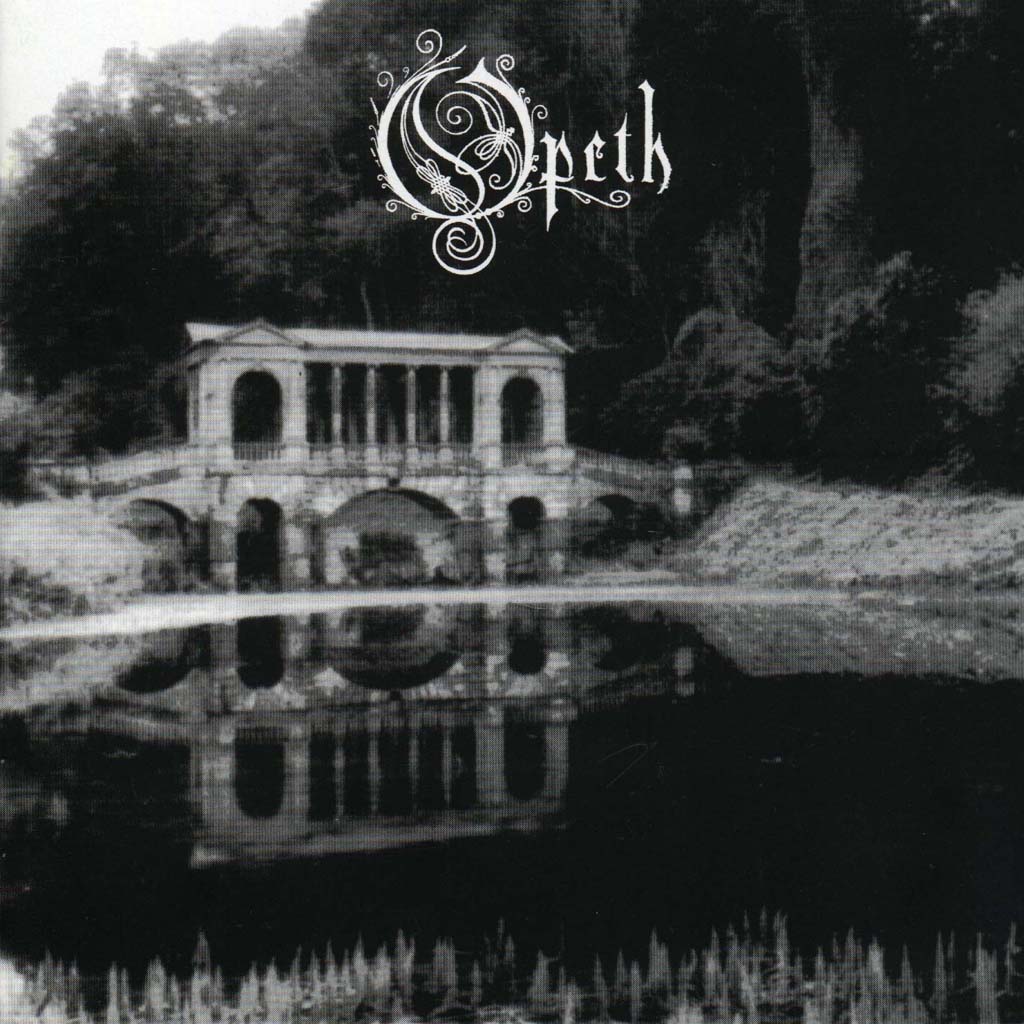 Opeth
Opeth
Pandora introduced me to Swedish heavy metal
band Opeth that instrumentally makes Metallica sound like child’s
play. Opeth also has a softer more progressive side which I captured
in the following songs during my listening session on the EMP system.
In
the song “Patterns in the Ivy” the guitar / piano duet combo showed off
just how at home the EMP 41-SE/B’s were at playing back acoustical
instruments with an uncanny realism. I had to remind myself I was
listening to streaming music from the internet it just sounded that
good. “Death Whispered a Lullaby” is one of my favorite songs by
Opeth. I was a bit disappointed in the playback of this track. The
cymbals sounded a bit splashy which was either a result of recording
quality or compression in the Pandora streaming. Regardless, fidelity
was still good. The drums were tight, guitar in your face and vocals
clairvoyant. The harmonious chanting of “sleep my child” was soothing
while the instrumentals were simply explosive.
Riverside
Another
Swedish band I discovered on Pandora, Riverside leans more towards
progressive rock which is what I long for in modern music. Electrical
guitar was just as satisfying on the EMP 41-SE/B speakers as acoustic
when listening to “Dna ts. Rednum or F. Raf” (yes weird name until you
read it backwards, but great song). There was good body to the music,
though I couldn’t help but wonder how much better it would have been
supplemented with a subwoofer or two. Vocals were imaging so well that
it sounded dead center despite my computer monitor was obstructing that
area causing unwanted refraction of the sound.
Dream Theater
In
“These Walls”, Electrical guitars very wide, with decent punch to bass
but a sub was really needed here. The cymbals were so crispy clean,
never sounding bright. The singer’s voice was a bit whiney but that’s
par for the course with Dream Theater. I was really admiring the
instrumentals of this song and the 41-SE/B’s were rockin just as I’ve
come to expect from them. The bass thumping at end of song had good
extension, certainly enough bottom end and output to mate well with a
sub. The clocks sounded so real that I had no idea they were part of
the song as I frantically started searched my office until I came to
the realization that I was being duped by the EMP system.
Eye of the Beholder – Metallica
I
really wanted to hear this system in an office environment with a small
sub, so I phoned Velodyne and requested a review sample of their
Micro-Vee. Double bass really had great slam now with the Velodyne sub
in the mix. It invited me to crank the system louder which was totally
appropriate given the source material. My head was banging to the
Metallica classic “Eye of the Beholder”. The added bass extension
really helped make the 41-SE/B’s sound bigger than they were. I went
back and revisited some of the previously mentioned source material and
found my enjoyment level was raised considerably, especially on bass
intense music like reggae from Bob Marley and progressive pop jazz like
Steely Dan.
Theater Room
With the EMP tube amp speaker
combo moved into my theater room, I was ready to hear the system in a
larger environment. I hooked up the VT-40.2 to my Sony CDP-CA-8ES CD
changer courtesy of Blue Jeans 1694A analog interconnects and connected
the 41-SE/B’s with Kimber 8pr speaker cables.
Unfortunately my
6,000 ft^3 Auralex treated theater room proved a bit too much for this
system dynamically. The VT-40.2 simply didn’t have enough juice to
play the 41-SE/B’s at levels other than moderately loud background
music. However even at its maximum volume setting, the VT-40.2 clipped
gracefully and never sounded harsh. I supplemented the 41-SE/B’s with
the amplification of my Denon AVR-5805mkii reference receiver which was
a transformational experience to put it mildly. The 41-SE/B’s really
breathed life with their newfound Denon power plant at the helm.
The
41-SE/B’s placed on stands away from the walls made them really open up
as sound seemed to radiate all around them portraying excellent imaging
characteristics and an impressive soundstage for such a small speaker
system. This is a huge benefit of having a very small baffle with
high quality drivers and crossovers.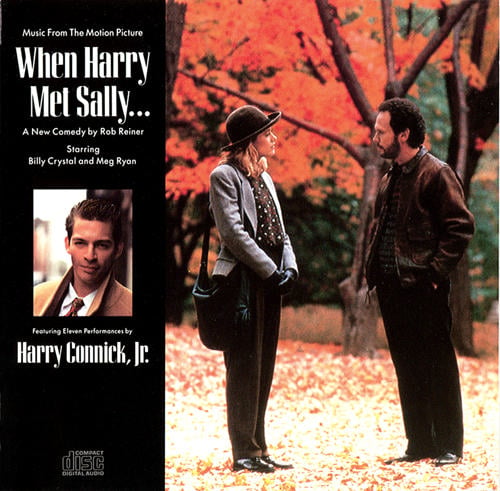 CD: Harry Connick Jr. – When Harry Met Sally
I
ran through the discs in my CD changer starting with Harry Connick Jr.
Harry’s voice was almost divine on Track #1 “Had To Be You”. The vocal
image was anchored dead center tricking me into thinking I was instead
listening to my massive RBH T1-SE/R center channel speaker. The brass
ensemble sounded crisp but a bit thin in the mid to lower bass. It was
at times quite obvious I was listening to smallish speakers in a huge
room. Flipping on one of my Velodyne DD15 subwoofers helped
considerably to provide a more tonally balanced presentation by
extending the lower octave of bass but the mid bass still suffered a
bit from a lack of punch I am used to hearing from much larger speakers
in this environment. Dual subs crossed over at around 100Hz in stereo
configuration would certainly benefit this type of setup scenario.
The
snapping of Harry’s fingers in Track #9 “Let’s Call the Whole Thing
Off” was surreal while the brushes had a lot of air to them really
enveloping you into the romantic mood of the song. The piano portrayed
excellent harmonic structure while the overall musical presentation was
greatly enhanced with the powered subwoofer thrown in the mix. The
imagining characteristics and openness in the top end of the 41-SE/B’s
really reminded me of my cherished Status Acoustics Decimo reference
bookshelf speakers that retail for more than five times the price of
these little gems. CD: Slivovitz – Hubris
I’m not sure how I
wound up on Moon June Records mailing list but they’ve consistently
been sending me new CD’s on almost a monthly basis from artists I’ve
never heard of. I decided to start listening to some of them and was
pleasantly surprised in the musical content. Slivovitz is an Italian
band that I’d categorize as progressive jazz.
The stick work in
Track #1”Zorn A Surriento” sounded expansive and real and contrasted
brilliantly with the Arabic female vocals in the background. I could
hear a slight buzzing sound emanating from the phase plug drivers from
the fretless bass when listening at high volume but I was surprised at
how loudly I could play these speakers without bottoming the woofers
out. In fact, the 41-SE/B’s were less prone to bottoming out than the
Usher S-520 and AV123 x-ls speakers we’ve previously reviewed, both of
which have larger woofers and enclosures.
Track #2 “Caldo
Bagno” portrayed excellent reverb in the percussions layered in African
chants that made me feel tribal. Track # 6 “Ne Pesce” contained a lot
of brass which sounded a bit thin and stringent on these speakers. The
presence of a sub helped slightly but it’s difficult for such small
speakers to accurately convey the sound of an alto saxophone at high
listening levels in such a large listening space. The ping pong
effects of the stick sounds at the beginning of track #7 “Dammi Un Besh
O” were really captivating making me listen to the entire track to be
rewarded with more of that effect which sadly it did not.
No
matter how good the 41-SE/Bs sounded in my theater room with the
supplementation I did, they simply seemed a bit out of place in such a
large venue. I ended this listening session after about an hour and
darted back to my office to get the system all hooked up again to enjoy
its musical magic while I worked.
EMP VT-40.2 & 41-SE/B Measurements and Analysis
VT-40.2 Hybrid Tube Amplifier
I purposely held off on measuring this system until I listened to it first since I know tube amps generally measure badly and didn’t want to bias myself against the system without first hearing it.
All measurements were conducted on the new Audio Precision APx585 8 Channel HDMI Audio Analyzer. The VT-40.2 system gain was around 23dB which is pretty standard. SNR @ 1 watt (A-wt) was around 75dB which is an ok number but I’d like to see this type of performance from a linear amp without using any weighting filters at all. Never did I find this amp to be noisy during my listening tests which were mostly conducted nearfield at low power where noise problems would have easily been an audible distraction.

Power Sweep @ 1kHz vs THD + N of the EMP VT-40.2
The distortion output even at low power levels seems absurdly high for a modern amplifier, but realize these are tubes and is to be expected. With solid state amplification, distortion levels this high usually show up as clipping on an oscilloscope but this wasn’t evident on this amp until I hit slightly above its 40 watt power rating. Although distortion deviation seems quite high, frequency response deviation was 0.041dB between channels at all power levels which was excellent.
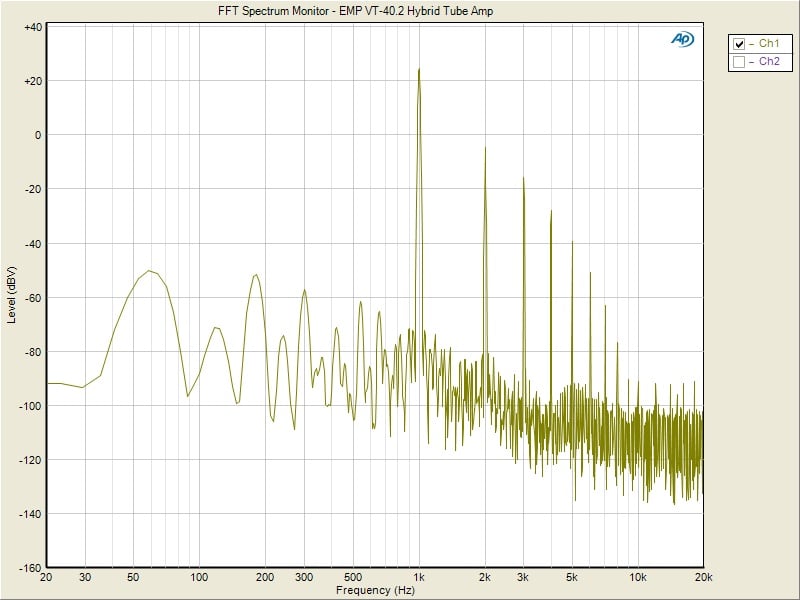
FFT Distortion Analysis @ 1kHz of the EMP VT-40.2
This amp exhibited a fairly normal harmonic distortion profile despite it being more elevated than I’ve seen in other designs Even-order harmonic distortion was dominant with the 2nd order distortion product about -35dB below the fundamental at full power rating. Notice however that the upper harmonics are cleaner than you’d see on most solid state or Class D amps driven near clipping like the VT-40.2 was. This may explain why this amp sounded much cleaner and bolder than it measured.
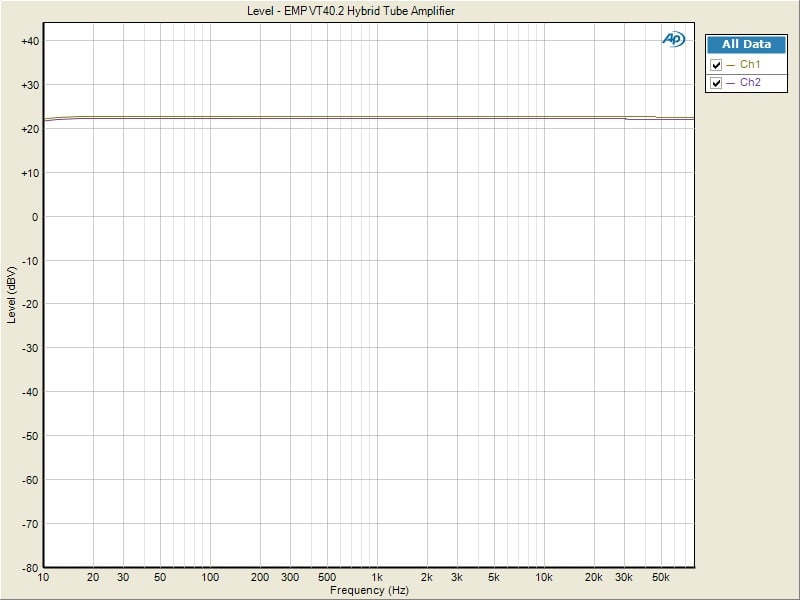
Frequency Sweep of EMP VT-40.2
The -3dB point of the VT-40.2 is above the limits of the Audio Precision test gear as can be seen from this ruler flat response from 10Hz all the way to 80kHz. I was actually surprised to see such a linear response and note this was at full rated power for both channels driven.
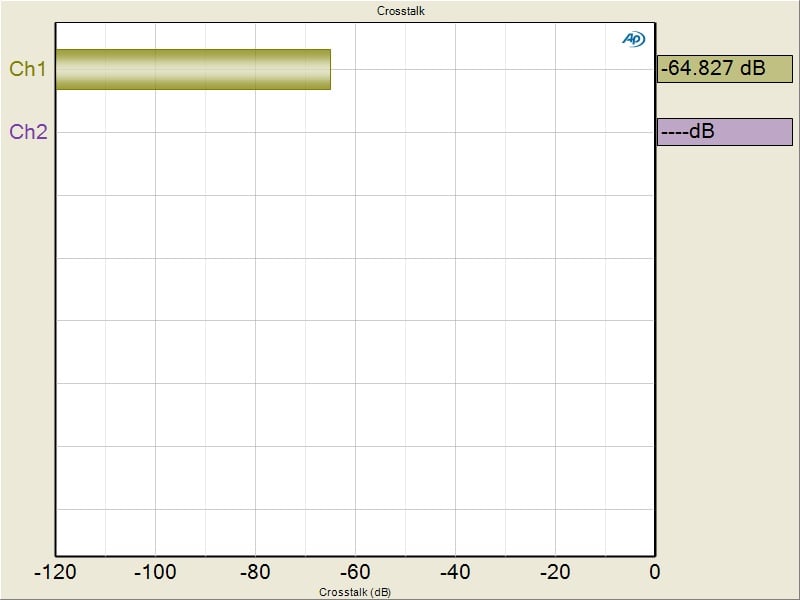
Crosstalk of the EMP VT-40.2
Channel to channel crosstalk measured about 70dB @ 1kHz and 65dB at 10kHz. This is not a stellar result but it’s certainly within the 60dB separation criteria at high frequencies that I like to see which I define as good stereo separation.
EMP 41-SE/B Bookshelf Speaker
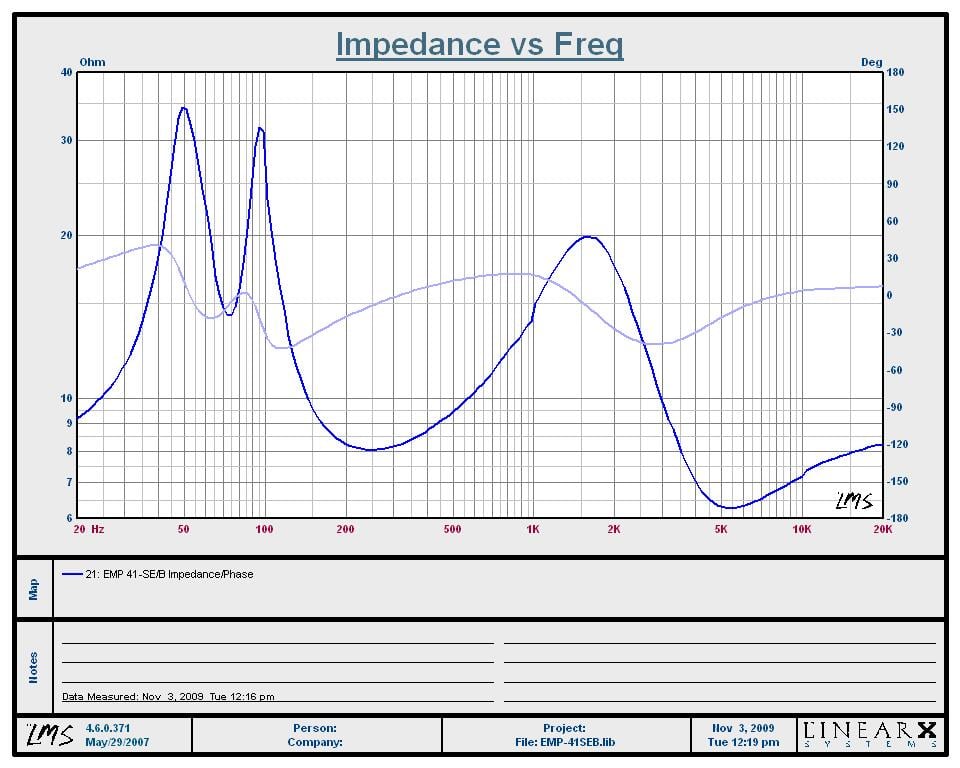
Impedance / Phase Measurements of the EMP 41-SE/B
The EMP 41-SE/B system appears to be tuned in the 70Hz region as indicated by the saddle point in the impedance graph. I was glad to see EMP did not attempt to tune these speakers lower for more perceived bass extension which would have made them more prone to bottoming out when playing bass heavy material.
Although these speakers have lowish sensitivity (86dB @ 2.83V), they are a nominal 8 ohm load and phase stays within a +30/-45 degree window for the entire audio band. There is an impedance minima of around 6 ohms in the 5 kHz which is well out of the bass region that consumes most of the amplifier power. These speakers are an easy load for virtually any amplifier to power, even an esoteric tube amp like EMP included with this system.
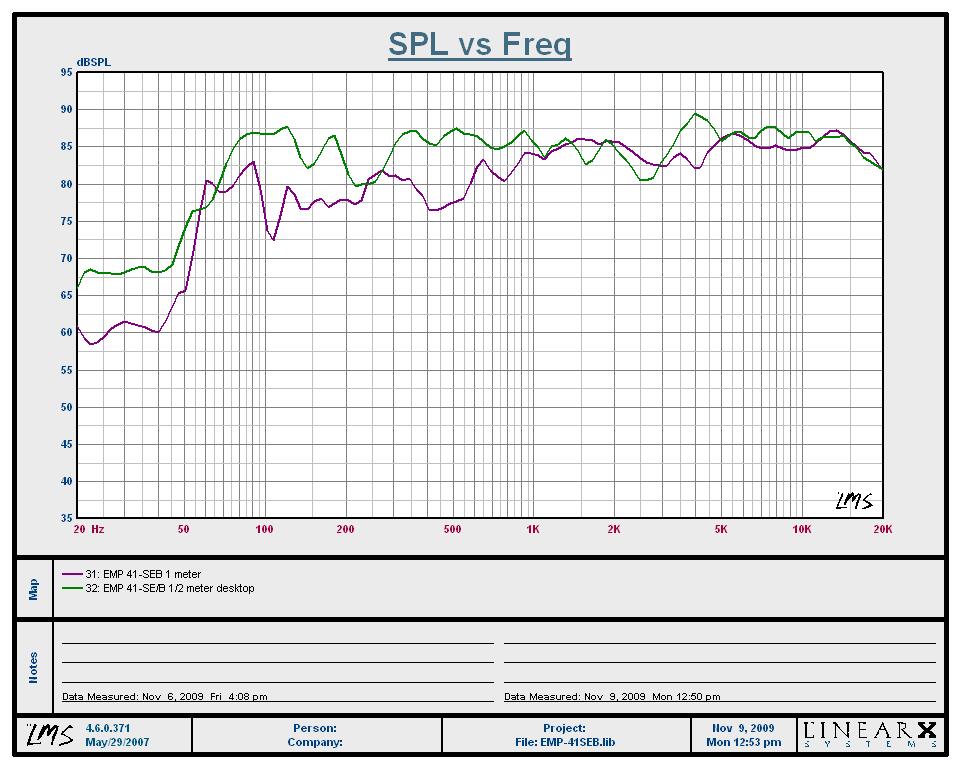
In-room1 meter SPL vs Frequency Response of EMP 41-SE/B
green trace: on-axis @ desktop ½ meter; purple trace: on-axis 1 meter theater room
It is interesting to note the slightly shelved response the EMP 41-SE/B exhibits below 500Hz. When this speaker is placed on a desktop, the bass boost from the added boundary gain flattens it out. When I questioned EMP about this, they stated the speaker was purposely designed to be placed on a desktop to take advantage of the added gain at low frequencies. This avoids it sounding boomy when placed near a wall or on a table top.
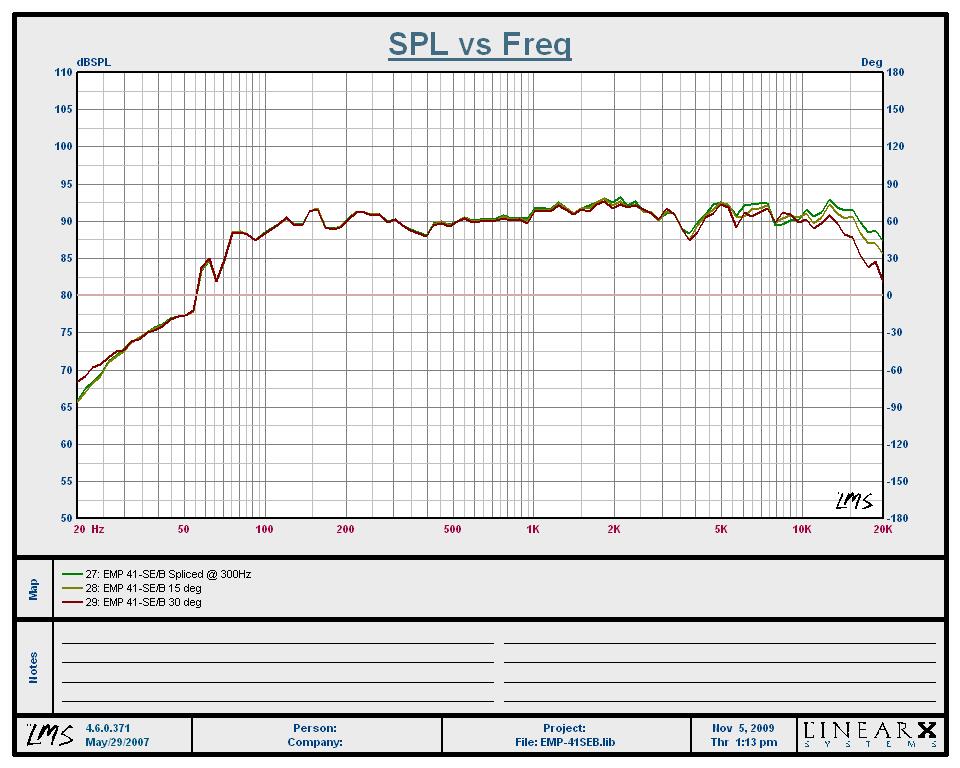
In-room 1 meter averaged SPL vs Frequency Response of EMP 41-SE/B
green trace: on-axis; yellow trace: 15 deg off-axis; brown trace: 30 deg off-axis
I measured the nearfield response of the 41-SE/B woofer and averaged it with the 1 meter in-room response to produce these curves. On-axis the 41-SE/B’s maintain a +-3dB frequency response from about 70Hz to 20kHz. The midrange measured very linearly just like I confirmed in my listening tests. Off-axis response was very smooth with a gradual roll off at high frequencies as expected. The speaker looked flattest 15 degrees off-axis and I’d venture to say the designer could have padded the tweeter down 1dB as a result but the speakers never sounded bright. Because of their somewhat anemic bass response, they often did sound a bit energetic in the top end which mating with a good sub certainly helped to round out.
Recommendations
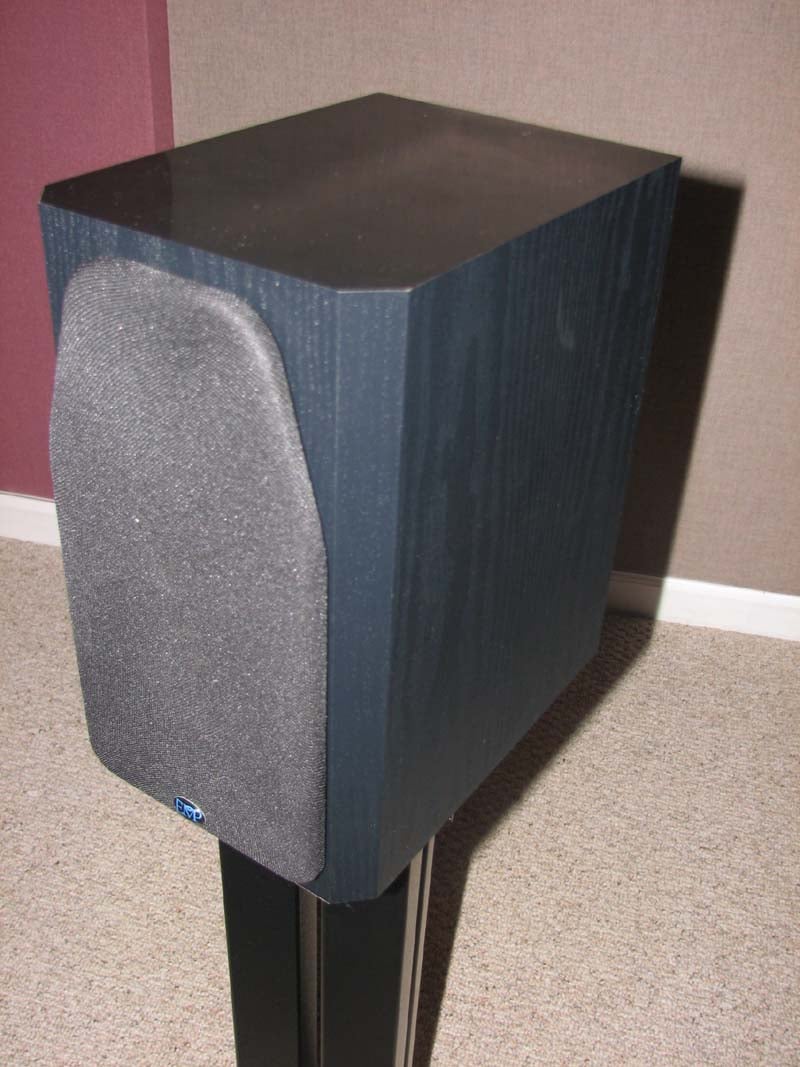 The EMP tube
amp speaker combo works best in small rooms such as an office or
bedroom. The VT-40.2 is simply too underpowered to take on any larger
role than that and the 41-SE/B’s are best mated with a subwoofer to not
only extend bass but to increase their overall sonic footprint. The
VT-40.2 does tend to warm up a bit after extended listening sessions so
I recommend you keep it out in the open to ensure it gets plenty of
ventilation. The 41-SE/B’s work really well placed in close proximity
to a back wall as I found the added boundary boost they get is
beneficial. Keep in mind however that the 41-SE/B’s are quite deep,
requiring almost 10 inches of depth should you decide to place them on
the desktop.
The EMP tube
amp speaker combo works best in small rooms such as an office or
bedroom. The VT-40.2 is simply too underpowered to take on any larger
role than that and the 41-SE/B’s are best mated with a subwoofer to not
only extend bass but to increase their overall sonic footprint. The
VT-40.2 does tend to warm up a bit after extended listening sessions so
I recommend you keep it out in the open to ensure it gets plenty of
ventilation. The 41-SE/B’s work really well placed in close proximity
to a back wall as I found the added boundary boost they get is
beneficial. Keep in mind however that the 41-SE/B’s are quite deep,
requiring almost 10 inches of depth should you decide to place them on
the desktop.
I initially utilized the mini plug variable line level output of the VT-40.2 to connect the Velodyne sub but found the gain on this output was way too high causing the sub to reach maximum output levels at even its minimum volume position. Until EMP can address this issue, I suggest using speaker level connections in parallel with the 41-SE/B’s to connect a powered subwoofer to this system.
EMP VT-40.2 & 41-SE/B Conclusion
 The EMP VT-40.2 hybrid tube amplifier and 41-SE/B Beryllium cone
speaker system was truly a delight to review. Its ability to transform
your PC desktop into a high end audiophile rig on a shoestring budget
is without peer. The 41-SE/B speakers alone are worth the full price
of admission of this system. Considering there won’t be too many pairs
of 41-SE/B’s constructed with the Beryllium cone phase plug woofer,
makes it a sort of audiophiles collectors item. The VT-40.2 hybrid
tube amplifier is a good performer for small rooms or office
environments and its savvy looks are certainly worth of a
conversational piece.
The EMP VT-40.2 hybrid tube amplifier and 41-SE/B Beryllium cone
speaker system was truly a delight to review. Its ability to transform
your PC desktop into a high end audiophile rig on a shoestring budget
is without peer. The 41-SE/B speakers alone are worth the full price
of admission of this system. Considering there won’t be too many pairs
of 41-SE/B’s constructed with the Beryllium cone phase plug woofer,
makes it a sort of audiophiles collectors item. The VT-40.2 hybrid
tube amplifier is a good performer for small rooms or office
environments and its savvy looks are certainly worth of a
conversational piece.
For the past few years I’ve been
using my trusty JBL Pro III’s restored by Simply Speakers and most
recently a pair of very competent Aperion 5B bookshelf speakers for my
desktop PC system. In all that time I never came close to running over
my 40 hour/mo Pandora limit on those systems and I will leave it at
that. The EMP sound continually seduces me to work longer at my
desktop PC which is good for Audioholics but not so good when I am late
to dinner. With my love of food equaling that of audio, that speaks
volumes for just how good this system is.
Considering their
very liberal return policy, FREE 30 day home trial program and FREE
shipping I can’t say anything else other than “hearty appetite” as this
is the meal your PC has been waiting for you to feed it. Once you dine
on this system, you won’t settle for fast food or crappy mediocre sound
again.
382 Marshall Way
Layton, Utah 84041
801-991-1308
www.emptek.com
About EMP Tek
Engineered
Music Products (EMP) was founded in 2007 by Industry professionals with
over thirty years experience in designing, engineering and
manufacturing high performance loudspeakers for companies such as
Parasound, McIntosh, JBL, RBH Sound, Destination Audio and Fosgate...
The
High Performance Loudspeakers designed by EMP differ greatly from the
products that sell in mass retail and big box stores. Manufacturers who
market their products through mass retail and big box stores have to
spend most of every dollar on marketing and advertising, leaving little
of that dollar for product development and build quality.
For thirty years, the founding employees of RBH Sound have focused on engineering and manufacturing loudspeakers that stand above the mass produced, profit focused brands that are offered by mass retail and big box stores. RBH has applied this same philosophy to their new sister company EMP Tek whose products are available exclusively online. In short - these are not your garden variety speakers nor company for that matter.
The Score Card
The scoring below is based on each piece of equipment doing the duty it is designed for. The numbers are weighed heavily with respect to the individual cost of each unit, thus giving a rating roughly equal to:
Performance × Price Factor/Value = Rating
Audioholics.com note: The ratings indicated below are based on subjective listening and objective testing of the product in question. The rating scale is based on performance/value ratio. If you notice better performing products in future reviews that have lower numbers in certain areas, be aware that the value factor is most likely the culprit. Other Audioholics reviewers may rate products solely based on performance, and each reviewer has his/her own system for ratings.
Audioholics Rating Scale
 — Excellent
- — Very Good
- — Good
- — Fair
- — Poor
| Metric | Rating |
|---|---|
| Build Quality | |
| Appearance | |
| Treble Extension | |
| Treble Smoothness | |
| Midrange Accuracy | |
| Bass Extension | |
| Bass Accuracy | |
| Imaging | |
| Soundstage | |
| Dynamic Range | |
| Fit and Finish | |
| Performance |  |
| Value | |
Gene manages this organization, establishes relations with manufacturers and keeps Audioholics a well oiled machine. His goal is to educate about home theater and develop more standards in the industry to eliminate consumer confusion clouded by industry snake oil.
View full profile Subscribe to our newsletter