


Boston Acoustics Voyager RK6T2 Review
Boston Voyager RK6T2 Rock Speaker
- Product Name: Voyager RK6T2
- Manufacturer: Boston Acoustics
- Performance Rating:

- Value Rating:

- Review Date: September 04, 2007 16:25
- MSRP: $ 599/pr
Bass Unit: 6 1/2” mica filled woofer with Butyl rubber surround
Tweeter: 2 - 1"
Soft Dome
Frequency
Response (±3dB) 60Hz–20kHz
Recommended
Amplifier Power 10-150 watts
Sensitivity 89dB
Dimensions*
(HxWxD) 16” x 12 3⁄5” x 11 1⁄5"
Special
Features: Waterproof
and Rustproof
*Dimensions vary by rock formation.
Pros
- They Rock!
- Great aesthetics and fidelity
- High efficiency
Cons
- No way to anchor speakers to ground
RK6T2 Design and Setup
Last Christmas I hosted a big party for friends and family at the Audioholics Showcase home. I had the whole house wired for music and entertainment with four independent zones. I even had my front yard pre-wired for four speakers during pre-construction phase so that entering guests could enjoy Christmas music while they approached our front door. There was only one problem; I didn’t have floor mountable speakers. Thus I had to use my trusty Klipsch AW-525’s. While these are very competent outdoor speakers meant to be mounted on a wall at or above ear level, they aren’t appropriate for floor duties because of their narrow horizontal and wide vertical omni polarization pattern. I could hear the excessive roll off of high frequencies, but tolerated it considering the application and lack of options at the time. Beside, none of my guests would know any better as I am likely the only one crazy enough to pay attention to such details.
So I pressed on with my quest to find rock speakers that match the décor of my home and offered at least acceptable fidelity. I wasn’t expecting much since past rock speakers I’ve heard from other brands never impressed me. I found them to be overly expensive and unappealing because they sounded like a speaker in an oil can. When Boston Acoustics displayed their new Voyager rock speakers at 2007 CES, I was intrigued. Knowing their past reputation for making great speakers, I signed up for a review pair. It only took me six months to secure a pair; and now it was time to see if they were worth the wait.
The Design
The RK6T2 is part of the Boston Acoustics Voyager series of outdoor speakers. They are fully weatherproofed designed and are constructed of highly durable plastics, rubber and other materials tested for outdoor environments. They are available in three finishes: New England Granite, Sandstone (my review samples), and River Rock.
The RK6T2 features a dual voice coil 6 ½” mica filled copolymer woofer with butyl rubber surround, and two 1” silk dome tweeters. According to Boston Acoustics, the woofers have stepped baskets that sets the cone forward to prevent “tunnel effect” and preserve smooth natural midrange sound. All of the drivers are angled upwards 20 degrees to optimize sound for the listening area when the speakers are placed at ground level.
The RK6T2 is a two way design that sports two 6ft underground rated speaker cables that can be configured as stereo or mono. To configure the RK6T2 as a stereo pair, all you have to do is connect the two speaker wires of each rock speaker in parallel to one channel of your amplifier. If your amplifier cannot handle 4 ohm loads, I suggest not connecting one of the wires which will defeat one of the tweeters and drop the net SPL level of each speaker down about 6dB. Alternatively, each individual rock speaker can be used as an integrated stereo solution by wiring each speaker cable to the respective left and right channels of your stereo amplifier. This gives you the ability to use two rock speakers to serve stereo purposes in two different locations of your yard or patio area.
The RK6T2’s also feature a recessed weatherproof cavity on the bottom of the speaker that can house an optional 70/100 volt transformer for use in light commercial installations such as restaurants and bars or in full commercial applications like malls, theme parks and large retail spaces using constant voltage to drive multiple speakers.
Set-Up
For my equipment, I used the zone 3 output of my Yamaha RX-V2700 receiver fed to two channels of my Emotiva MPS-1. The source was the Yamaha MusicCAST MCX-2000 and the cables were 10AWG from Bluejeans with a Speakercraft volume control located near the front door inside of my home.
There are basically three ways to setup these speakers:
- Stereo pair; 1 wire – each single wired to one channel
- Stereo pair; 2 wire – each parallel wired to one channel
- Stereo single – each speaker wired in stereo by two channels
Unless otherwise noted, most of my testing was done as stereo pair; 2 wire. Although I preferred the stereo separation of stereo pair; 1 wire at my primary listening location, I found that stereo pair; 2 wire offered a more broad sweet spot and increased the usable listening area by providing wider coverage. Stereo single is useful in areas where you want to have stereo sound using just one speaker and/or perhaps setting up stereo coverage in multiple listening zones such as a pool patio and front porch. Don’t expect to get the same sound and separation from just one speaker, but the RK6T2’s offer perhaps the best integrated one speaker solution that I’ve heard.
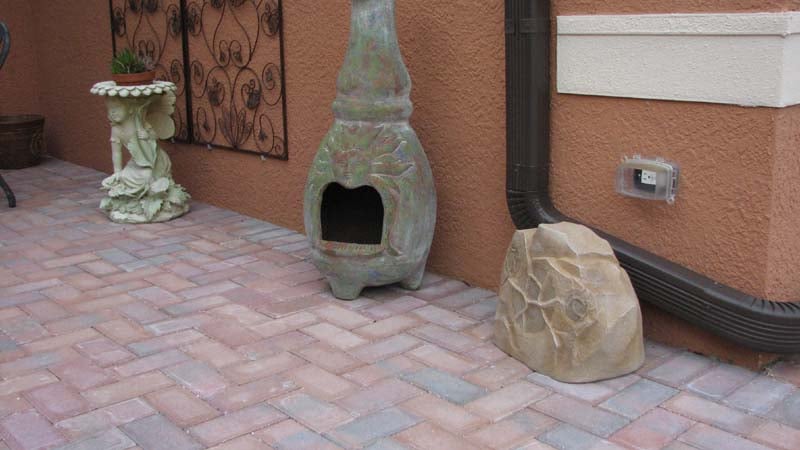 For my application, I was looking to install sound on
my front porch where I have setup a nice sitting area for those rare nights of
cool weather in Florida. I also wanted background music towards the
front of my house so that when I host parties, especially Christmas ones, my
guest could be greeted with some cool tunes.
Good sound quality was a must as I wanted people to really stand at
attention and know they were entering the Audioholics Showcase home.
For my application, I was looking to install sound on
my front porch where I have setup a nice sitting area for those rare nights of
cool weather in Florida. I also wanted background music towards the
front of my house so that when I host parties, especially Christmas ones, my
guest could be greeted with some cool tunes.
Good sound quality was a must as I wanted people to really stand at
attention and know they were entering the Audioholics Showcase home.
I prewired my home for four speakers in the front yard; two by the front of the house in the landscaped area to provide coverage to people walking on the sidewalk, and two by the front porch to cover the sitting area and front entrance. I installed the RK6T2’s at the porch zone, diagonally placed from the sitting area with one by the front door, and one by the entrance of the walkway.
Boston Acoustics discusses the differences of outdoor versus indoor speaker placement and that the former is setup more for wide coverage area while the later is positioned for a more focused sweet spot in a fixed listening area. They suggest placing the speakers where there is a solid surface directly behind them which will help reinforce the bass output.
I was a bit disappointed that the RK6T2’s didn’t provision for mounting straps like the Paradigm rock speakers I currently have under review. Not only is this a good idea for anti-theft, but it also ensures it keeps them well placed during storms which are plentiful in Florida. These speakers do however have considerable mass so this shouldn’t be much of a problem for all but extreme weather conditions. In those circumstances, I recommend bringing them indoors.
Editorial Note on Wiring:
I unfortunately took the pre-wiring of my home to the extreme by running all 10AWG speaker wires to every location. This made it quite a challenge to connect in wall volume controls as well as self containing the wires in junction boxes. A note to installers and audiophiles alike, you’re better off running 14/4 for redundancy and better flexibility. You can parallel them to yield an effective resistance of 11AWG.
 Boston Acoustics provided standard wire nuts you get
when buying ceiling fans or electronic fixtures. Though they added white sticky conductive
grease which created quite a mess for me when I had to disconnect the wires
after I realized I didn’t route the cables through my junction boxes. This is good foresight on their part, but
just remember to know exactly where you want your wires before tying them down. The manual warns about this, but of course, I
didn’t actually read the manual until I started writing this review. As an added precaution, I also used
electrical tape in conjunction with the wire-ties to ensure total isolation and
reduce the chances of oxidation from being outdoors.
Boston Acoustics provided standard wire nuts you get
when buying ceiling fans or electronic fixtures. Though they added white sticky conductive
grease which created quite a mess for me when I had to disconnect the wires
after I realized I didn’t route the cables through my junction boxes. This is good foresight on their part, but
just remember to know exactly where you want your wires before tying them down. The manual warns about this, but of course, I
didn’t actually read the manual until I started writing this review. As an added precaution, I also used
electrical tape in conjunction with the wire-ties to ensure total isolation and
reduce the chances of oxidation from being outdoors.
RK62T Measurements and Analysis
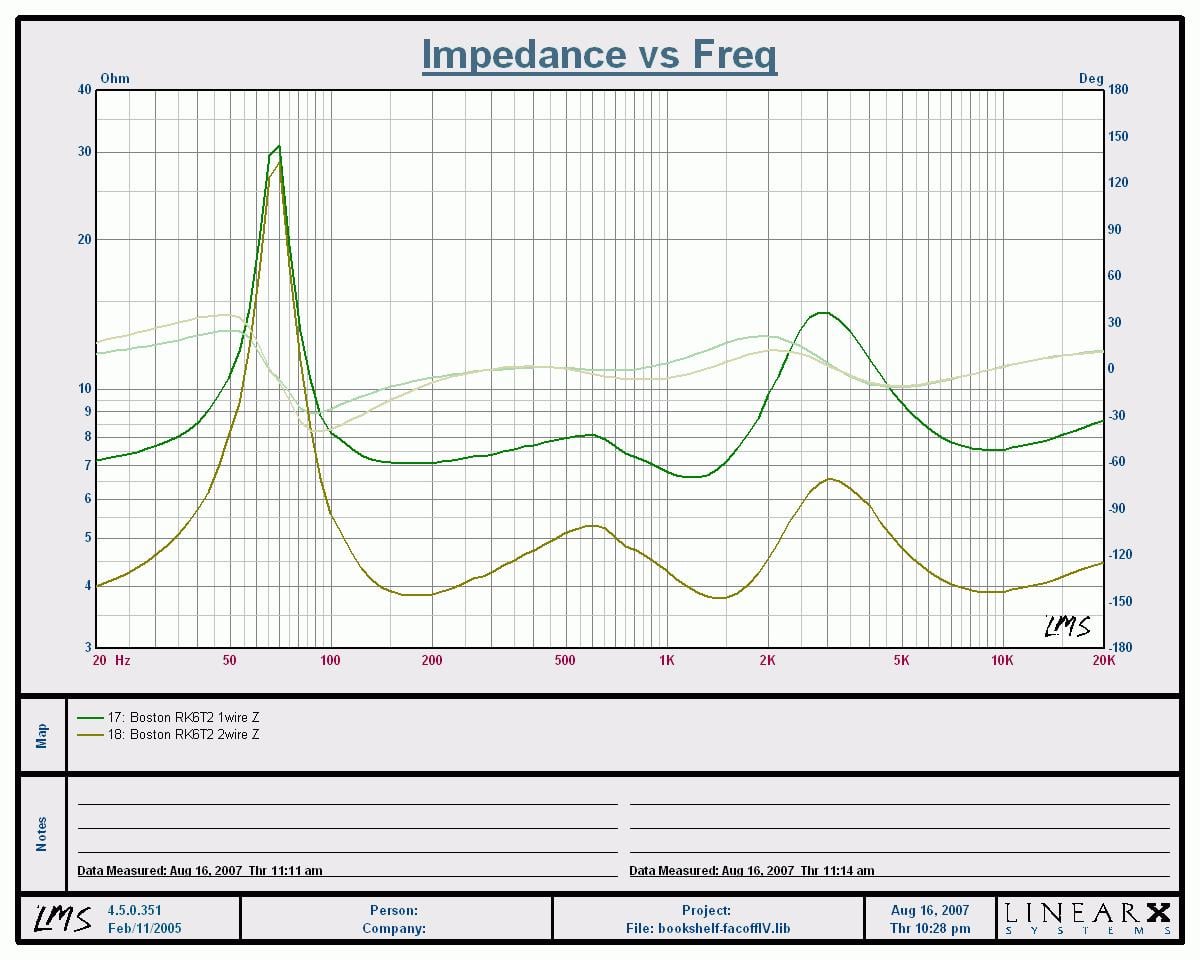
Impedance / Phase Measurements of the RK6T2
The single wired impedance of the RK6T2’s is roughly 8 ohms while the two wired impedance is (as expected) ½ of that – 4 ohms. The impedance of these speakers is rather benign maintaining +-30 degree phase within the entire audio spectrum and never dipping much below 4 ohms (two wire connection) at any frequency. This demonstrates deliberate and careful crossover design to ensure these speakers will work well with a wide variety of amplifiers.
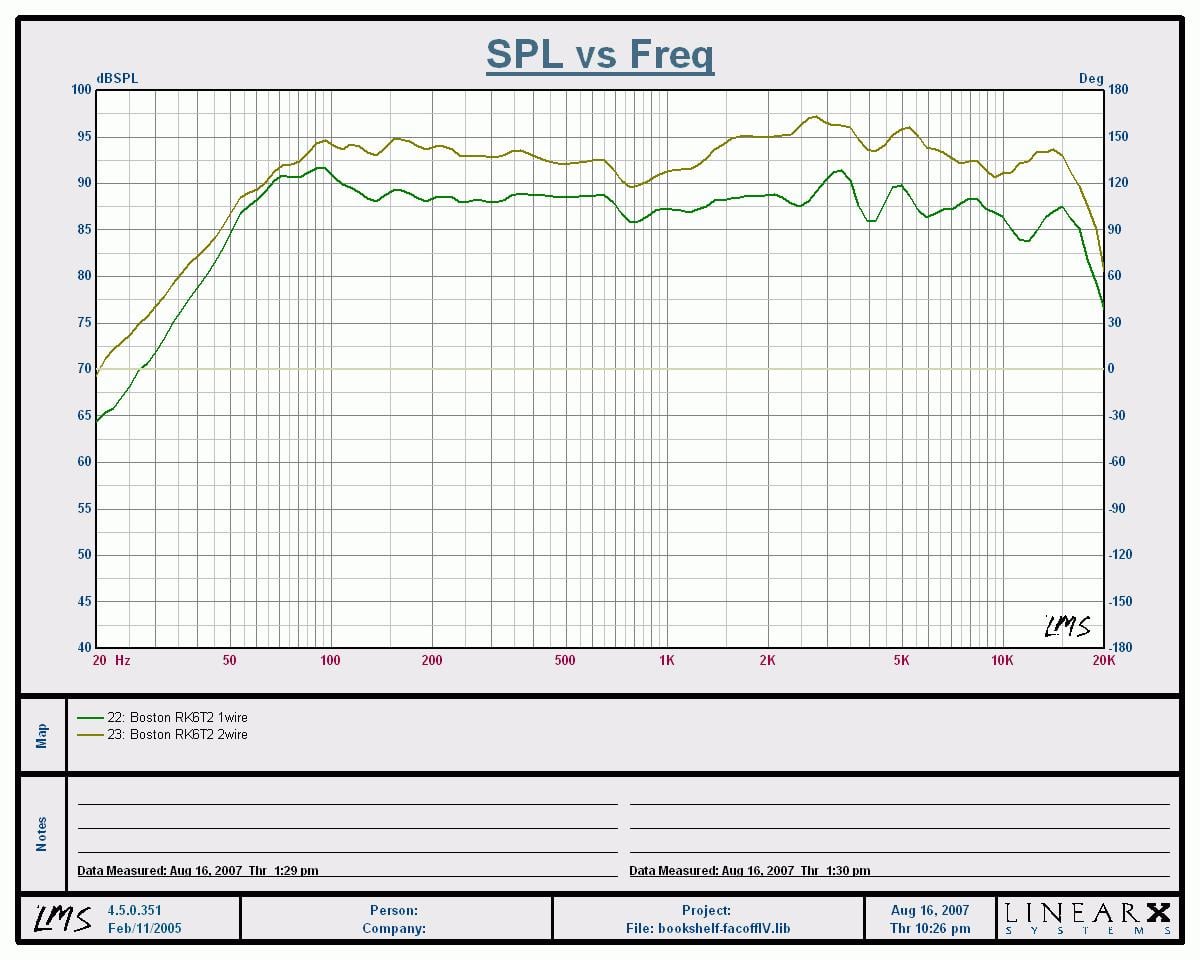
In Room Nearfield Frequency Response (1/12th octave smoothed)
I measured these speakers in the Audioholics showcase theater room placed on the floor with the mic 1 ft away and up slightly above the acoustical center of the speaker. The results were quite outstanding, maintaining a +-3dB frequency response from 60Hz to 16kHz. The one wire measurement was slightly more linear, while the two wire measurement showed an increase in loudness by about 6dB (as expected since the impedance was halved) and slightly more top end which is likely a function of mic positioning more than anything. The usable bass extension of these speakers appears to be in the mid 40Hz region. By placing them against a surface as Boston Acoustics suggests, you could achieve up to 12dB of gain in the lower frequencies by doing this.
RK6T2 Listening Tests and Conclusion
Ok, I was all set to put these babies to the test. Initially when they arrived, I wasn’t expecting much sonically as I never really heard rock speakers worth riding home about, but the RK6T2’s did seem to be constructed of sterner stuff so I was looking forward to hearing them.
CD: Larry Carlton & Lee Ritenour
I had this CD in my collection for a number of years but never added it to my reference set list until recently. This is one well recorded CD by two of the industries finest guitarists. I started with Track #1 “Crosstown Kids” and began turning the volume up. To say I heard the unexpected was an understatement, these speakers were rocking! I heard clear delineation between Lee Ritenoir’s and Larry Carlton’s guitars. There was plenty of reverb and decay in their instruments and the bass was pronounced, deep and tight. What blew me away was the clarity in the top end and the amount of effortless sound these speakers were producing. At my sitting area, I heard excellent imaging and stereo separation typically only found in competently designed bookshelf speakers. When I stood up and walked around my porch, the sound seemed to follow me. Up against the wall of my house, I stood there in awe as I felt as if I was listening to a live outdoor event. I further cranked up the volume to the point where I got the attention of my neighbors across the street. They all came over to see what the ruckus was all about, trying to figure out where I hid the speakers. When I told them all that sound was coming from those two decorative rocks sitting on the floor, they didn’t believe me until they were standing literally a foot or two away. One of my neighbors commented that he wished his home speakers sounded this good. Folks, this is no joke, these speakers were delivering high fidelity despite the venue they were playing in and the fact they were sitting on the floor. It appears Boston Acoustics angling of the drivers 20 degrees up and “stepped baskets” were working as claimed.
I tried track #3 “L.A.Underground” to see just how loud I could play these speakers before they bottomed out. Many of the speakers in our last face off article would choke on this song at loud listening levels. The RK6T2’s didn’t falter despite how much I cranked them up, instead, they welcomed the unadulterated power I was feeding them from my Emotiva MPS-1.
CD: Steely Dan – Two Against Nature

So far the Boston Acoustic RK6T2’s showed off their mettle with instrumental music. Now I wanted to put them to the test with music containing vocals. Thus, I picked one of my favorite CD’s I tend to listen to outdoors or when working out in my home gym. You really can’t go wrong with Steely Dan’s music in any setting. Track #7 “Cousin Dupree” is a perfect song to play in outdoor public venues. It’s got a good beat and some thought provoking lyrics. The RK6T2’s didn’t miss a beat. Donald Fagen’s voice rang true on these speakers. Though it wasn’t quite as concise and pinpoint as I’ve heard on a good indoor speaker system, it was much better than I expected and certainly clearer and more natural than any other rock, plant, tree or leaf speaker I’ve heard from their competitors. By now it was obvious to me that Boston Acoustics pushed the envelope of performance in this speaker category. I sat out on my 95 degree porch in the blazing heat with my neighbor sipping some cool suds enjoying the remainder of this CD.
Conclusion
The Boston Acoustics Voyager RK6T2 speakers rocked both figuratively and literally in every conceivable way an end user would expect them to. Not only did they exceed my expectations from an aesthetic standpoint, but their fidelity and linearity simply blew me away. I rarely get this excited about outdoor products and until now, I haven’t heard a rock speaker that I considered listenable. The RK6T2’s are a versatile, high value product that will dress up your patio, porch or other outdoor function area with unprecedented sound quality that will be a hit at your gatherings and the envy of your neighbors. Boston Acoustics truly sets the benchmark for others to follow in this speaker genre.
Boston Acoustics Loudspeakers
Boston
Acoustics, Inc.
300
Jubilee Drive
Peabody MA
01960
USA phone 978.538.5000
fax
978.538.5100
www.bostonacoustics.com
About Boston Acoustics
For over 25 years, Boston Acoustics has remained at the leading edge of
audio excellence, designing, manufacturing and marketing innovative
high-performance loudspeakers for use in home audio and home theater systems, as
well as aftermarket, OEM automotive systems, and custom installations. Highly
regarded for creating The Boston Sound, the company commits all of its
resources in design, engineering and manufacturing to create superior,
competitively priced products that emphasize performance, consistency,
reliability and value. For more information on the company’s full range of
advanced loudspeakers, as well as its unique Recepter Radio HD With HD Radio™
Technology by iBiquity Digital and more, please visit www.BostonAcoustics.com.
The Score Card
The scoring below is based on each piece of equipment doing the duty it is designed for. The numbers are weighed heavily with respect to the individual cost of each unit, thus giving a rating roughly equal to:
Performance × Price Factor/Value = Rating
Audioholics.com note: The ratings indicated below are based on subjective listening and objective testing of the product in question. The rating scale is based on performance/value ratio. If you notice better performing products in future reviews that have lower numbers in certain areas, be aware that the value factor is most likely the culprit. Other Audioholics reviewers may rate products solely based on performance, and each reviewer has his/her own system for ratings.
Audioholics Rating Scale
 — Excellent
- — Very Good
- — Good
- — Fair
- — Poor
| Metric | Rating |
|---|---|
| Build Quality | |
| Appearance | |
| Treble Extension | |
| Treble Smoothness | |
| Midrange Accuracy | |
| Bass Extension | |
| Bass Accuracy | |
| Dynamic Range | |
| Performance | |
| Value |  |
Gene manages this organization, establishes relations with manufacturers and keeps Audioholics a well oiled machine. His goal is to educate about home theater and develop more standards in the industry to eliminate consumer confusion clouded by industry snake oil.
View full profile Subscribe to our newsletter