


Tales from the Road Volume I
Accelerating Future Traveler
TRAVEL, in the younger sort, is a part of education; in the elder, a part of experience. He that travelleth into a country before he hath some entrance into the language, goeth to school, and not to travel. That young men travel under some tutor, or grave servant, I allow well; so that he be such a one that hath the language, and hath been in the country before; whereby he may be able to tell them what things are worthy to be seen in the country where they go; what acquaintances they are to seek; what exercises or discipline the place yieldeth. For else young men shall go hooded, and look abroad little. It is a strange thing, that in sea voyages, where there is nothing to be seen but sky and sea, men should make diaries; but in land-travel, wherein so much is to be observed, for the most part they omit it; as if chance were fitter to be registered than observation.
Francis Bacon almost certainly avoided travel by air, having lived in the seventeenth century and all. I can’t imagine what such genius would say about the sad, sad state of a contemporary culture. Today we are so mobile, so fluid and so self-absorbed by noxious cell phone blather, soulless blackberry text messages and nerve-jarring TSA announcements to “please place all your liquid items into a one-quart, clear, sealable bag for official examination and approval” that we, as a society, have forgotten the very point of art. Seriously.
Do you remember art? You’ve probably heard about it in school. Maybe a stray flyer from the local museum crossed your path. “What’s this?” you may have wondered. “From where did this bizarre image, soothing sound or disturbing thought come?” “And why is it sticking to me so desperately?” Art communicates. To paraphrase Leonard Bernstein, it names the unnameable and allows us to know the unknowable.
Rest assured, art is not measured in megabytes. Art is not contained in a meaningless number of forgettable songs residing on a hard drive. Art is not reflected in shallow commercials strategically placed to bypass the thought process and appeal directly to the unsuspecting lizard-brain between episodes of Everybody Loves Raymond. This does not mean, however, that art is not mobile. As a man condemned to traveling relentlessly and restlessly in search of profit for my masters I am loathe to abandon my love of culture in all its forms. Trust me when I tell you that Bacon brought his love for art, literature and discourse with him everywhere he went. In the manner of Uomo Universale, we too shall explore the many ways in which our connection to music, the spoken word, and the video arts can accompany us during our travels, enriching even the most disappointing of days.
I am, in the most basic sense, an extrovert. I gather my personal momentum and energy through interaction with others. This is a strength upon which any contemporary road warrior relies. There is a thorn on this rose, however. Constant travel often demands hour upon hour of waiting, sitting, shuffling, and waiting some more. Occasionally a flight is even on time, and then the only hardship is the confines of a seat with comfort approximating the sensation of lounging on the grip of a baseball bat padded with a doily. Seats are so close together that most normal human beings simply don’t have the space, in coach, to open the lid of a laptop computer. Gone are the days of glamorous travel. Frequent flyer status seldom rewards with a useful upgrade. We are now cattle herded into flying freight cars. Hotel rooms aren’t much better. It’s this slow torture and constant isolation that prompted my exploration of portable entertainment.
 I am the
proud owner of an Apple MA446LL 30G video iPod.
For the purposes of this column it will be my reference system. I have little interest in reviewing every MP3
player that comes down the pike, and even less in relating the innate details
of human interface with the various on-line content delivery programs. No, this is not the place to look for a
comparison of the sonics of a Sony PSP© versus an Apple Nano©. All portable content is a truncated,
pared-down digital facsimile of real music, anyway. If you think there is going to be a greater
difference in MP3 players than there is in the content you play, please return
to your digital fantasy now.
I am the
proud owner of an Apple MA446LL 30G video iPod.
For the purposes of this column it will be my reference system. I have little interest in reviewing every MP3
player that comes down the pike, and even less in relating the innate details
of human interface with the various on-line content delivery programs. No, this is not the place to look for a
comparison of the sonics of a Sony PSP© versus an Apple Nano©. All portable content is a truncated,
pared-down digital facsimile of real music, anyway. If you think there is going to be a greater
difference in MP3 players than there is in the content you play, please return
to your digital fantasy now.
For those who wish to understand the ‘calibration’ of my ears before accepting my status as a critic, my office system is a carefully set-up pair of JM Labs Cobalt 806S speakers atop sand-filled Celestion stands and driven by a friendly little stack of NAD electronics. The JM Labs can be a bit analytical and, when I need a break, I sometimes swap out the JM Labs for a pair of Wharfedale Diamond 7.2 Anniversary Edition speakers. I also have two other audio-only systems; one built around Magnepan speakers with Quicksilver electronics, and one built around vintage Klipsch Cornwall horn speakers with triode vacuum tube electronics. Oh yeah, and there’s also a couple theater systems. There is a small one built around a Dennon 4801 receiver and a larger one created on a JBL Synthesis platform. There’s certainly no lack of quality A/V entertainment in my life. And, for the record, I listen to as much live acoustical music as I do the recorded kind. A perk of life on the road, I guess.
In this column, on a more-or-less monthly basis, I’ll focus my attention on headphones, portable player accessories, and most importantly content. Each column will feature an in-depth, subjective review of a piece of gear, a “teaser” for the following month’s hardware, and an exploration of the various music, songs, words, pictures and podcasts available so readily (and often for free) from the great experiment known as the Internet.
I should mention here that you won’t find any specifications other than those provided by manufacturers in this column. Measuring the frequency response of headphones is tricky business and ultimately useless anyway. Only ears - experienced ears are best - can tell if the reproduction has any semblance to reality. When the suspension of disbelief is established then the hardware is successful.
In the course of this column I may be moved to describe sounds as grainy, dark, bright, golden, chocolate or enlightened. I guarantee if you read with intent you’ll get the message. If you need greater insurance than a lifetime of courting the muse of civility through art, both performed and recreated, then please gather your collection of Britney Spears songs and find a better place to spend your time. I will describe my auditory experiences using much the same vocabulary as I use to describe my culinary experiences. In this space we’ll talk about listening and the emotional reaction said listening can provoke in a moment of contemplative consumption!
Shure E4C Earbud Review
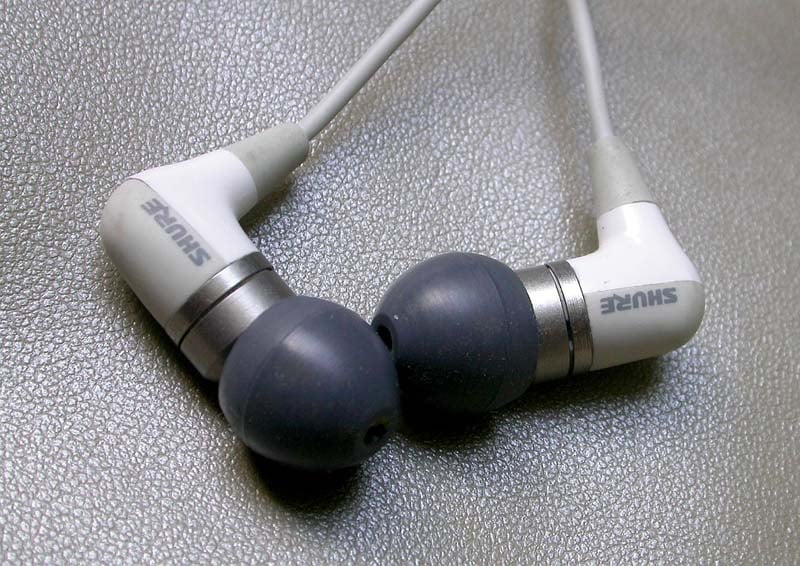 The package from Headroom
arrived right on time. Sometimes
international shipping can be dicey, but clearly these folks know exactly what
they are doing! In the package I found a
sample of the Shure
E4c headphones, a Gigabag
and Headroom’s own Total
Airhead in the clear finish. First
to the headphones, the sound of which I’ve been waiting to audition since I
first heard that Shure was going to challenge
reigning ear canal headphone party leader Etymotic.
The package from Headroom
arrived right on time. Sometimes
international shipping can be dicey, but clearly these folks know exactly what
they are doing! In the package I found a
sample of the Shure
E4c headphones, a Gigabag
and Headroom’s own Total
Airhead in the clear finish. First
to the headphones, the sound of which I’ve been waiting to audition since I
first heard that Shure was going to challenge
reigning ear canal headphone party leader Etymotic.
Shure has a long and lustrous history in the A/V industry. Founded in April,1925 by Sidney N. Shure, it began life as a one-man company selling radio parts kits in the days before factory-built radios. By 1932 Shure was creating a legacy in microphone design and manufacturing. Shure’s microphones are now as much industry standards as JBL monitors are on the other end of the production chain.
In the 1980’s Shure went so far as to create its own answer to Dolby’s surround sound technology. It was called the HTS 5000 and was a truly unique and inspired implementation of movie sound reproduction (I owned one). The Shure system caught on for a while as a broadcast encryption product, but their complete home theater system didn’t last long. That’s too bad, because it was a marvel of modern technology that reflected a very concise understanding of theater sound.
Of course no one with more than a few years in the consumer electronics industry can think of Shure Brothers, Inc without also bringing to mind the classic Shure V15 phono cartridge. To this very day there are few moving-magnet phono cartridges that can compete in terms of sonics or build quality with that iconoclastic product. I think I still have a couple V15 cartridges in the drawers of my music room!
It was 1997 before Shure introduced a headphone product. The PSM 600 was Shure's first entry into personal monitoring and continues to be recognized as an industry benchmark for wired and wireless In-Ear systems for professional broadcast, recording, touring and installed sound applications. It took until 2004 for Shure to focus its formidable prowess on the consumer electronics industry with its E Series Earphones. And that brings us to the product under scrutiny today, the E4c.
The E4c is a small package for such a larger performer. Billed as sound isolating earphones, the E4c uses a tiny high-definition speaker and Shure’s Tuned Port Technology to improve airflow around the speaker for “enhanced bass.” The E4c is designed for use with personal portable electronics and, as such, it is both highly efficient and very detailed. In fact, the qualitative difference between this $319 (MSRP)set of cans and the “earbuds” included with the iPod was nothing short of amazing.
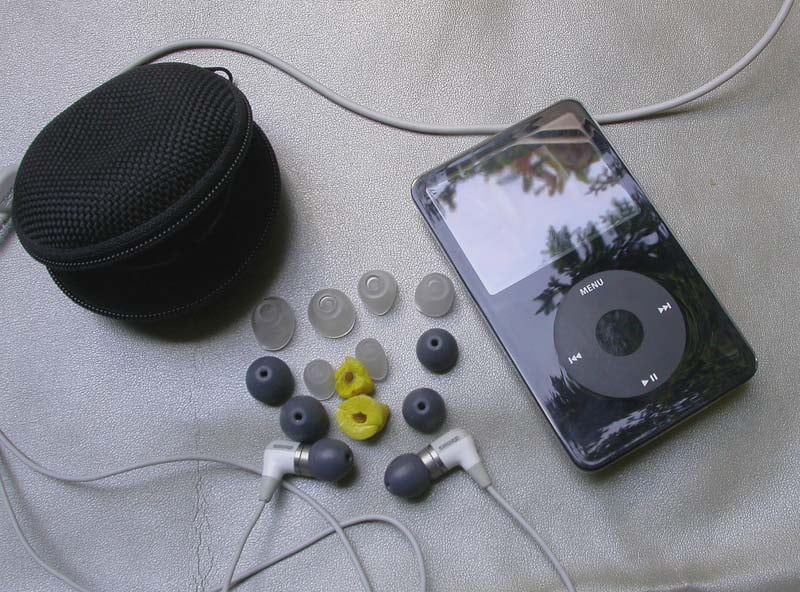 The E4c comes with seven sets of ear canal
adaptors. There are disposable foam
sleeves that appear to be made of the same material as disposable hearing
protectors, three pairs (small, medium, large) of Flex Sleeves, and three pairs
of Soft Flex Sleeves (small, medium, large).
The experience you get for your effort is entirely dependent on the
sleeves you use and the quality of the fit.
Unfortunately there isn’t much in the way of a detailed explanation
pointing you towards sonic nirvana included with the product.
The E4c comes with seven sets of ear canal
adaptors. There are disposable foam
sleeves that appear to be made of the same material as disposable hearing
protectors, three pairs (small, medium, large) of Flex Sleeves, and three pairs
of Soft Flex Sleeves (small, medium, large).
The experience you get for your effort is entirely dependent on the
sleeves you use and the quality of the fit.
Unfortunately there isn’t much in the way of a detailed explanation
pointing you towards sonic nirvana included with the product.
The disposable adaptors gave a quality experience immediately. Like the hearing protection product from which they are undoubtedly drawn, one simply ‘rolls’ them into small cylinders between the finger and thumb and inserts the compressed foam into the ear canal. The foam regenerates itself and, in doing so, creates a tight fit that blocks external sounds and loads the Shure’s drivers for best response. A leaky or improper fit will render the E4c as indescribably harsh and unmusical. This tendency is a result of the in-ear design and anything that inhibits proper fit will destroy the performance of these little gems.
The sound with the foam disposable plugs was fine, but the comfort level was a bit lower than I like. They weren’t uncomfortable, mind you. If you wear foam hearing protection when you run the lawnmower then you know what I mean. You can never seem to forget these things are stuck in your ears and that, in itself, is the distraction.
After my first impression was formed, I started playing around with the other adaptors. The Flex Sleeves are clear plastic and looked like a step in the right direction. Looks can be deceiving. The clear plastic Flex Sleeves are hard enough to push the meter to the “uncomfortable” level in short order for me. Beyond this, the stiffer nature of this material made the fit temporary at best. As soon as I got the ear canal adaptors properly seated they would begin the slow slide back out of my ear, breaking the seal and destroying the tonal unity of the presentation. The result was a very grainy and harsh sound, which was reminiscent of an early transistor radio. This inevitable slide into mediocrity was hastened by any kind of physical activity. Thirty minutes on the exercise bike in the Hilton’s “fitness spa” resulted in an almost constant need to push the earplugs back in. A bit of duct tape may have helped, but I believe that if that’s the solution then the tape should be included with the ‘phones!
Finally I tried the Soft Flex Sleeves. These are a handsome charcoal gray and are very supple. They insert into the ear easily and conform to the contours of the ear canal of their own volition. They are, by far, the most comfortable of the three. And they produce the best sound, too. The bass was very deep and detailed. Tuneful, even. Unlike loudspeakers, however, there is no physical sensation of the lowest octaves. This can be misleading for the uninitiated. Headphones produce prodigious bass but it is hard to notice without the tactile input of the rest of your body.
One thing of which you must take note; both ears are seldom the same size. For the absolute best performance with in-ear canal ‘phones you have to have a good fit and a quality seal as discussed above. I started using the supplied sleeves in pairs, but quickly noticed that when my left ear was properly sealed my right ear was not. At first I suspected a problem with one of the soft sleeves, so I swapped sides. The problem remained, indicating it wasn’t in the sleeve itself. Further experimentation with the other sizes demonstrated that I needed a small ear sleeve in my right ear and a medium in my left. Further, the size of the ear canal isn’t proportional to body size. I stand 6’1” and weigh 225lbs. This is the first time in my life that a small size was the one that fit me! (no off-color jokes, please)
The Shure website offers this slice of wisdom: “Although the E4c comes with an assortment of sleeves to ensure a comfortable fit, some users may want something even more personalized. In this case, we recommend contacting a hearing professional, such as an audiologist, to make custom-fit ear molds for your E4c.” This is quite likely the best solution of all. I only wish I’d had the time and opportunity to have custom molded sleeves made. At some point in the not-so-distant future I’ll decide on permanent travel phones and I’ll have custom inserts made just to test this theory. Stay tuned…
The midrange of the Shure E4c, when using the Soft Flex Sleeves, is among the best I’ve ever heard in terms of their ability to unearth subtle details and paint the sonic signature of the recording venue. With the E4c I could really hear into the recording in a way that even the amazing Stax SR007 system would be hard-pressed to better. And trust me, that’s saying a LOT. The Stax are one of the five or six best audio products I’ve ever lived with.
One podcast I enjoy and frequently listen to was exemplary in demonstrating this effect. While vocal articulation is always good, the ability to hear the ice cubes in the glass of the host’s drink and the slight squeak of the office chair as he moved about was almost uncanny. I didn’t realize this low level detail could even be captured in the primitive, minimalist recording techniques used for amateur talk radio, but there you go. Hidden details unearthed – and no, I didn’t notice those details during playback on my office system.
The highest registers of the E4c were smooth, if somewhat truncated. This might be an artifact of my iPod, I need to do more comparisons of uncompressed source material (read compact discs and uncompressed analog recordings) with the playback from the iPod to confirm this, but I believe the shortcoming, if it can even be called a shortcoming, comes from the ‘phones. The very highest frequencies such as the shimmer of a ride cymbal or the string overtone of an acoustic guitar or piano were slightly truncated in a “non digital” way. That is to say there wasn’t any grain structure associated with this departure from complete transparency, but instead a polite roll-off that was both consonant with the music and appreciated in the context of music played on-the-go.
Understand that in-ear reproducers like ear buds, ear canal ‘phones and other devices cannot exhibit a flat frequency response or they would sound terribly distorted. There isn’t room to go into detail in this article and we’ll tackle the concept of head-related transfer function in a future installment, one that focuses on binaural listening. That said, listening on headphones is a fundamentally different experience than listening to natural sounds or reproduced sounds via a hifi rig. This should seem painfully self-evident but it’s often an overlooked component of the listener’s paradigm. The headphone experience, unless you’re listening to a binaural recording of the kumpstkuff variety, places the soundstage and attendant spatial cues inside the head. Your auditory point-of-view is very close to that of the recording capsule. This perceived close proximity, coupled with the decreased frequency-dependent attenuation of sound associated with the pinneae and head-shadow causes gross nonlinearities in both frequency and phase response. Any attempt to counter this for the average listener will, of necessity, be wrong to some degree for all listeners. Shure’s decision to shape the frequency response of the E4c the way they did is a fine compromise and I applaud their success.
In comparison the stock ear buds supplied with an iPod are quite grainy in the midrange presentation, totally lack real deep bass information, and are wickedly peaked in the lower treble (near the 5KHz “sensitivity” zone) while simultaneously being rolled off in the upper treble. If you listen to compressed, synthesized artificial pop you might never notice. If you’ve ever actually listened to a human voice or an acoustic instrument you’ll never be able to get the “cupped hands” coloration and grainy presentation out of your thoughts.
The Shure E4c is an awesome bit of technology. While they were connected to my iPod I was never less than impressed. The performance is so far beyond the quality of the included ear buds that it’s almost not worth discussing. Of course when the headphones cost more than the iPod, great things should be expected. Great things are delivered here. And the best part – the E4c’s are now on sale for about half the retail price point! For a Hamilton and a Grant you simply can’t do better than this. Get yours before they’re gone and you’re back to paying full boat retail – they’re that good!
Check out the Shure E4c Earbuds
Headroom Total Airhead Headphone Amp and Gigabag Review
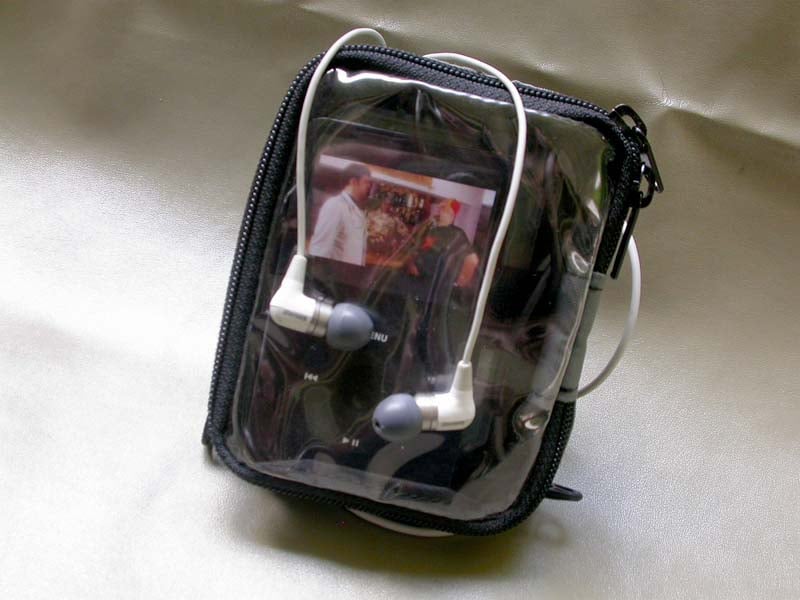 It’s not enough to test a new set of headphones. To
really make things challenging the
intrepid reviewer should always change several things at once to make sure no
opinion is immune to dissent. At least
one of these items doesn’t affect sonics at all, and that’s the Gigabag. This delightful little ditty, a product of
the inimitable Headroom, is a welcome
accessory. Designed to hold an iPod or
other personal portable and an AirHead headphone amplifier, the Gigabag even
has a clear top cover to allow an easy view of the menu or screen on your
device. The Gigabag is nicely built, but
just a bit clunky for the streamlined jet-setter. Look for an in-depth review in our next
installment.
It’s not enough to test a new set of headphones. To
really make things challenging the
intrepid reviewer should always change several things at once to make sure no
opinion is immune to dissent. At least
one of these items doesn’t affect sonics at all, and that’s the Gigabag. This delightful little ditty, a product of
the inimitable Headroom, is a welcome
accessory. Designed to hold an iPod or
other personal portable and an AirHead headphone amplifier, the Gigabag even
has a clear top cover to allow an easy view of the menu or screen on your
device. The Gigabag is nicely built, but
just a bit clunky for the streamlined jet-setter. Look for an in-depth review in our next
installment.
The AirHead isn’t a new product, but the Total Airhead is a refinement of the original design – a product I owned more than five years ago. According to the Headroom web site, “The Total AirHead is a true miniature power amplifier for headphones. It isolates your player from the complex load of the headphones (which make the player even sound better), and it drives them with the authority and finesse of quality power amplification. The result? Exquisite audio right between your ears.“ And for once in my life I’m pleased to say that advertising copy isn’t entirely fiction.
The Total AirHead runs on four AAA batteries which are said to last 40 hours. They do. Almost exactly 40 hours, in fact. And that’s not very long when you forget to turn the thing off, which I often did as it was buried in the Gigabag. The Total Airhead doesn’t make your cans play louder but it might make them play sweeter. My iPod can’t drive my Sennheiser HD600’s for a darn, and my first generation Sennheiser noise-cancelling phones are even worse. The Total AirHead made both of these products a worthwhile match with my portable player.
The Total AirHead didn’t do too much for the Shure E4c/iPod combination. There was a very slight increase in bass impact and control but this was only noticeable when I was sitting quietly in a very quiet environment. While walking or moving the difference was completely swamped by “body noise.” Body noise is the self induced noise of footsteps, breathing, chewing, etc… One unwelcome feature of ear canal headphones is the tighter coupling of the normally isolated hearing physiology from the self-induced noise of the rest of the body. Stick your fingers tightly in your ears when you are walking or drinking coffee and you’ll immediately know what I mean. Ear canal phones are wonderful at shutting out the outside world at the cost of increasing the volume of the inside world. This is something the Total AirHead can’t affect.
The Total AirHead/Shure E4c combination may have exhibited just slightly improved detail retrieval, but this is a subtle effect. The Shure phones are efficient enough that the additional current delivery of the Total AirHead didn’t make a big difference. It was about on par with the difference you might experience in putting your loudspeakers on quality spiked inert stands versus sitting them on top of un-spiked, light-weight stands… very subtle indeed. With other headphones the difference wasn’t subtle at all.
A final feature of the Total AirHead is the proprietary crosstalk circuitry that Headroom developed. From the web site; “In the process, so to speak, we also include a special circuit you can switch on/off called "crossfeed" that makes headphones more natural sounding by improving soundstage imaging on headphones.” There is much to be said about this feature, it’s based on good science. We’ll explore this in the full review coming up in our next installment. In the interim, the Total AirHead is also on sale – and worth every penny of its $99.99 asking price.
NPR All Songs Considered
No review of audio or video gear can be completed in a vacuum. The gear itself is worthless if not for the content we enjoy. I currently subscribe to 32 podcasts and that number is growing. Go to the iTunes sight and explore what they have to offer, you’ll be amazed at the variety. NPR’s All Songs Considered is one of the very best.
Each week host Bob Boilen delivers an eclectic mix of interesting and sometimes challenging music by emerging artists and breakout bands. This is a web-only presentation and the production quality is superb. It’s not quite as transparent or dynamic as the best of compact discs, but this podcast certainly gives satellite radio a run for its money. And with the Tivo-like flexibility afforded by RSS content (RSS stands for Really Simple Syndication and is a bit of computer code that allows your iTunes program or other aggregator to automatically download and store new additions or episodes) you’ll find that you never have a time when you are lacking for something interesting into which you can tune your imagination.
A great example of the quality of programming you’ll enjoy from NPR’s All Songs Considered is the March 16th South By Southwest review. This show features a special roundtable discussion on SXSW, plus a sampler of some of the standout acts. SXSW is one of the world's most lauded showcases for groundbreaking artists in Austin, TX. You’ll get a real feel for the excitement, the energy and the variety of music you can experience in Austin every March. If you’re looking for a good vacation idea that will take you to a scenic wonderland and allow you to indulge your monkey-bone in some of the hottest live rock, country and alternative music performances, maybe you should mark your 2008 calendars now!
NPR’s All Songs Considered is a great meal for your iPod or MP3 player, and it will feed your head at the same time. Published weekly, there isn’t a focus on any particular artist or genre. As I write this the newest installment is featuring music from The White Stripes, the Battles, a reissue from Emerson, Lake & Palmer, music from Tunng, pop tunes from Rufus Wainwright and a few unreleased rarities from Elliott Smith. Now that is an example of eclectic! Don’t delay, sign up today. It’s free, and there’s precious damn little that you can say is free and valuable in today’s world. Get it now before they decide you need to pay a membership or subscription…
Paste Magazine
A magazine recommendation in an audio product review? What foolishness is this? Paste Magazine is one of the fastest growing independently published entertainment magazines in the country, recently named "Magazine of the Year" at the 2006 PLUG Independent Music Awards. Paste is cool. Paste has their finger on the pulse of the entertainment industry. And best of all, Paste included a free CD in every issue. You won’t be stuck in one rut, Paste covers it all from hip-hop to country and everything in between. There is a theme, of a sort, for each issue. If you love music you’ll find yourself craving just a bit more every time the postman brings a copy.
I’ve subscribed for more than three years and I’ve never regretted the cost for even a second. Each and every disc is a keeper. You’ll find music by groups you’ve never heard of, and artists with instantly recognizable names. I first heard John Hiatt’s Master of Disaster on a Paste sampler! Production quality is superb as these are full resolution releases from the studios. And best of all, your iTunes program will fill in the track names and artists from the on-line CDDB data base. This is a no-brainer. Get Paste!
 Subscribe to our newsletter