


RBH Sound TK-5CT Floorstanding Speaker Review
RBH Sound TK-5CT
- Product Name: TK-5CT
- Manufacturer: RBH Sound
- Performance Rating:

- Value Rating:
- Review Date: July 22, 2007 20:00
- MSRP: $ 949 / pair
System Type: 3-way Sealed & Bass Reflex
Frequency Response: 45Hz-20kHz ±3dB
Sensitivity: 87dB (2.83 Voltz @ 1 Meter)
Recommended Power: 70-150 Watts
Drive Units: (1) 8" (203mm) Pulp Kraft Cone Subwoofer
(2) 5 3/4" (146mm) Fiberglass Cone Woofer
(1) 1" (25mm) Silk Dome Tweeter
Tweeter Protection: Yes
Crossover Frequency: 120 Hz/3000 Hz
Crossover Slope: 12dB/Octave
Impedance: 8 Ohms
Color: Black/Rosewood (gloss black accents)
Grille: Black Cloth
Video Shielding: Yes
Dimensions: 11" W x 42 1/2" H x 13 3/4 D
(279mm W x 1079mm H x 349mm D)
Weight: 40 Lbs.
Warranty: 5 YearsPros
- Full range speaker for $800 a pair?!?
- Phenomenal upper end
- Great imaging
- Pretty much does everything right sonically
Cons
- Average aesthetics
- No biamping ability
RBH TK-5CT Build Quality
 You’ve read
a lot of RBH reviews over here and if you’re anything like me, you’ve thought,
“Well, that’s nice, and if I ever hit the lottery, I’ll look into those.” At
CES this year, we were sitting in the RBH room listening to the T-30LSE
speakers (the very same ones Gene has) and I kept staring at the TK-5CT’s thinking, “Why aren’t we
auditioning those?” We’d all already heard the T-30’s, and these newest RBH’s
are actually within financial reach of a lot of our readers. As we stood up, I mentioned
to Gene that I thought we should do a review and bada bing, bada boom, here we
are.
You’ve read
a lot of RBH reviews over here and if you’re anything like me, you’ve thought,
“Well, that’s nice, and if I ever hit the lottery, I’ll look into those.” At
CES this year, we were sitting in the RBH room listening to the T-30LSE
speakers (the very same ones Gene has) and I kept staring at the TK-5CT’s thinking, “Why aren’t we
auditioning those?” We’d all already heard the T-30’s, and these newest RBH’s
are actually within financial reach of a lot of our readers. As we stood up, I mentioned
to Gene that I thought we should do a review and bada bing, bada boom, here we
are.
Build Quality
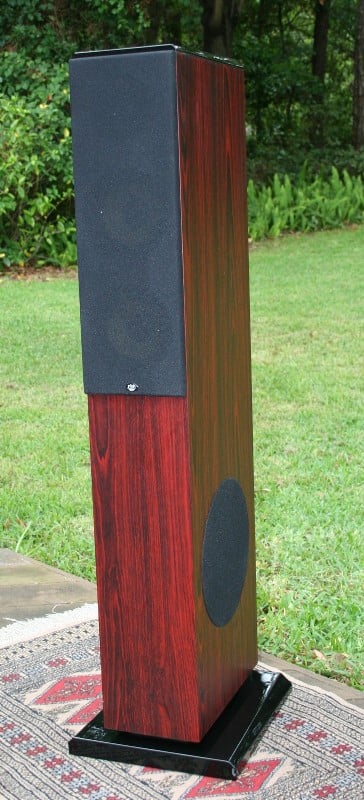
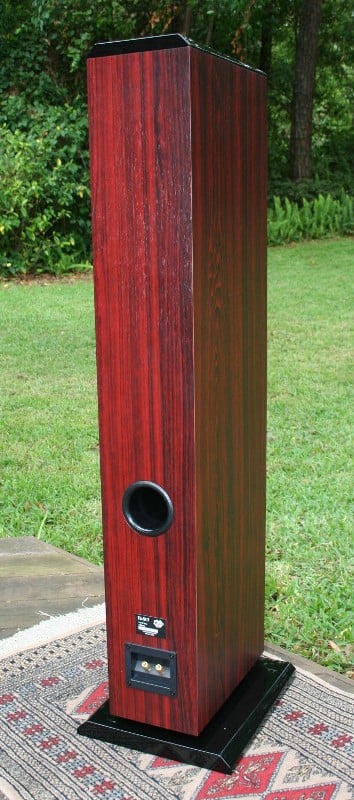
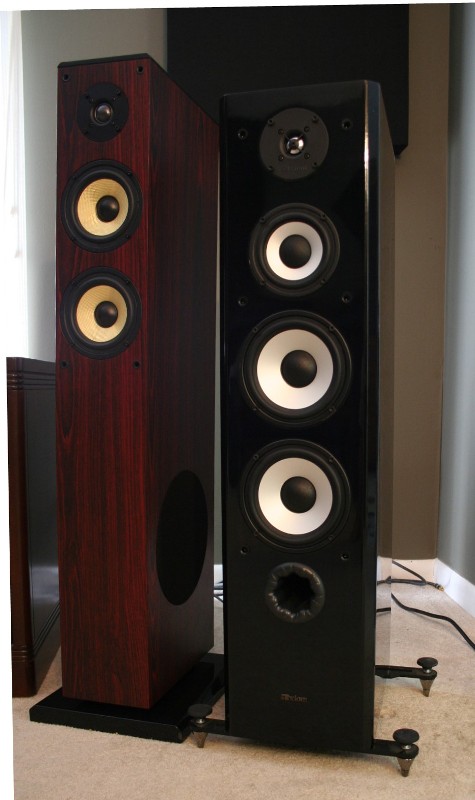
The RBH TK-5CT’s come in three boxes – one for each speaker and one for the two bases. The high gloss black tops and bases were covered with a film of plastic to keep them in pristine condition during shipping. The towers are thinner than any of the towers I’ve reviewed and the bases are quite large which makes them the steadiest towers to date. The plinth (I love using that word) has a matte finished wood block that holds the main speaker away from the piano gloss base.
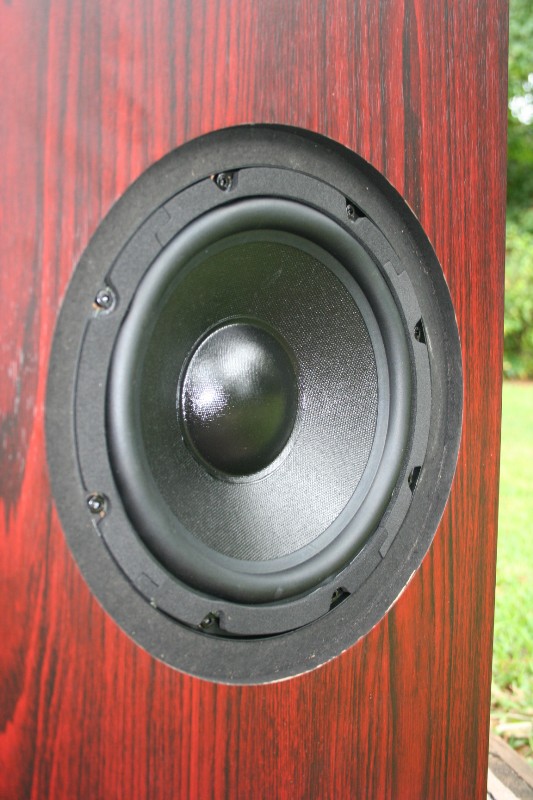
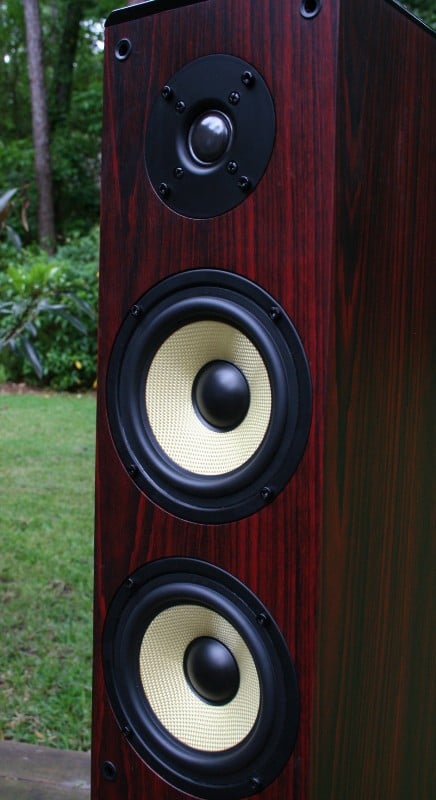 The TK-5CTs have a soft dome tweeter, two 5 ¾”
midrange drivers, and an 8” side firing woofer. The woofer section has a rear
port to increase the amount of usable bass the speaker can provide. The front grill
is probably the sturdiest I’ve ever seen consisting of a 1/2” MDF and chrome
posts. The grill came off and on easily and at first I was afraid that it was a
little too easy but I never had a
problem with them working themselves loose. The side grill is also removable
and is constructed of the same quality of materials as the front grills with
the exception that it doesn’t have posts. Instead they just sort of wedge in
the hole enough so that they stay securely but not so much that they are
impossible to take off. It is hard to take them off (this is a good thing in my
opinion) but not impossible. The center of the tweeter is 39 ½ inches off the
ground. This is a little taller than most of the towers I’ve reviewed including
the Axiom m60’s that I use as a reference in my system.
The TK-5CTs have a soft dome tweeter, two 5 ¾”
midrange drivers, and an 8” side firing woofer. The woofer section has a rear
port to increase the amount of usable bass the speaker can provide. The front grill
is probably the sturdiest I’ve ever seen consisting of a 1/2” MDF and chrome
posts. The grill came off and on easily and at first I was afraid that it was a
little too easy but I never had a
problem with them working themselves loose. The side grill is also removable
and is constructed of the same quality of materials as the front grills with
the exception that it doesn’t have posts. Instead they just sort of wedge in
the hole enough so that they stay securely but not so much that they are
impossible to take off. It is hard to take them off (this is a good thing in my
opinion) but not impossible. The center of the tweeter is 39 ½ inches off the
ground. This is a little taller than most of the towers I’ve reviewed including
the Axiom m60’s that I use as a reference in my system.
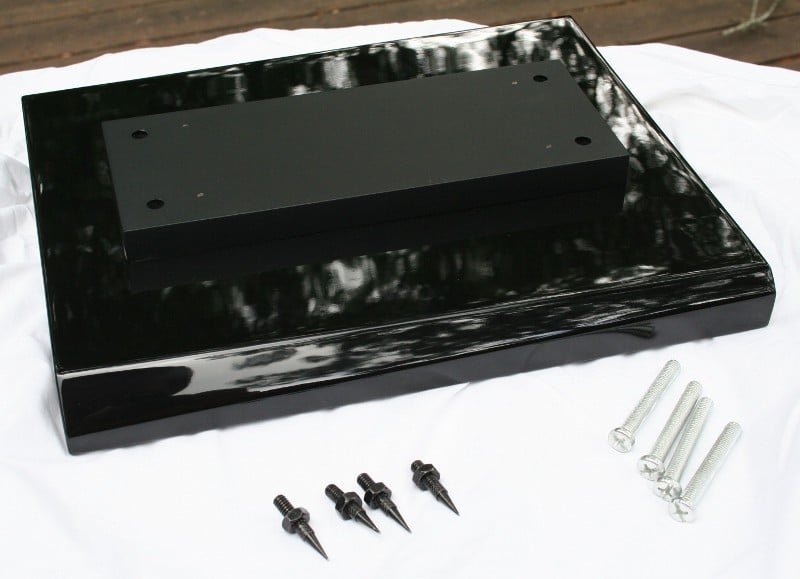 The
speakers are caped with a piano gloss black plate that angles up away from the
front of the speaker. The remainder of the speaker is wrapped in a rosewood-colored
vinyl veneer which is as good as any other vinyl veneer I’ve seen. The vertical
edges of the speaker are harsh but the horizontal ones are pleasantly rounded.
The high gloss piano black base is secured using four provided screws which
mount into metal threaded inserts in the bottom of the speaker. I actually had
a pretty hard time with these screws as they didn’t seem deep enough for a
Phillips head screwdriver but were so wide that I had a hard time finding a
flat head wide enough to tighten them without slipping. Make sure you are
careful when installing the base. It is very easy to pull the threaded inserts
loose. You’re not trying to torque them on, just get them good and snug and
walk away. The top edge of the base is mitered so that the front of the base is
slightly thinner in appearance than the back. This follows the angle of the top
nicely and is a very interesting aesthetic touch. Near the four corners of the
base are brass inserts to accept either a carpet spike or a screw with a
rounded rubber head. The spikes actually have a nut adjustment which, while not
as aesthetically pleasing as some of the spikes I’ve used, is infinitely easier
to adjust. At a maximum useable length of about an inch, you may have to look
into aftermarket spikes for your longer pile carpets.
The
speakers are caped with a piano gloss black plate that angles up away from the
front of the speaker. The remainder of the speaker is wrapped in a rosewood-colored
vinyl veneer which is as good as any other vinyl veneer I’ve seen. The vertical
edges of the speaker are harsh but the horizontal ones are pleasantly rounded.
The high gloss piano black base is secured using four provided screws which
mount into metal threaded inserts in the bottom of the speaker. I actually had
a pretty hard time with these screws as they didn’t seem deep enough for a
Phillips head screwdriver but were so wide that I had a hard time finding a
flat head wide enough to tighten them without slipping. Make sure you are
careful when installing the base. It is very easy to pull the threaded inserts
loose. You’re not trying to torque them on, just get them good and snug and
walk away. The top edge of the base is mitered so that the front of the base is
slightly thinner in appearance than the back. This follows the angle of the top
nicely and is a very interesting aesthetic touch. Near the four corners of the
base are brass inserts to accept either a carpet spike or a screw with a
rounded rubber head. The spikes actually have a nut adjustment which, while not
as aesthetically pleasing as some of the spikes I’ve used, is infinitely easier
to adjust. At a maximum useable length of about an inch, you may have to look
into aftermarket spikes for your longer pile carpets.
Editor’s Note: One often hears that carpet spikes “tighten up” bass. But why? Well, think of it this way, the driver is moving in and out in order to make noise. If the cabinet is “floating” on the carpet rather than securely anchored to the floor, it is moving too. This can lead to a “muddy” sound that many notice. Coupling the speaker to the ground can help clear this up by increasing accuracy. As always, experiment for yourself and see if it makes a difference in your room.
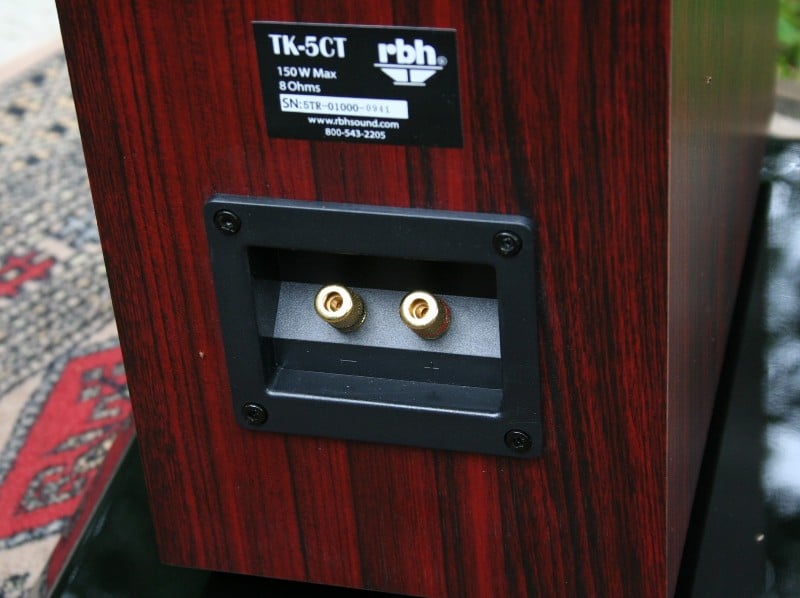 One glaring omission on the TK-5CT’s is the lack of bi-amping ability.
Even though this is an 8ohm speaker, it is relatively insensitive at 87dB (2.83
voltz @ 1 meter). When I first hooked them up, I used the Denon AVR-2307CI.
This mid-level receiver has a number of very convenient options including the
ability to choose a different setup for stereo versus multi-channel inputs.
What does this mean? Well, with the TK-5CT’s, it means I can run them with a
sub for movies and multi-channel music and then full range for two channel
music – all without hitting a button! While the 2307CI powered the TK-5CT’s adequately, switching over to the
Emotiva RSP-1 reference stereo processor and RPA-1 reference stereo amplifier
brought a whole new level of audio quality. Most notably, everything was crisper,
less muddy, with an overall increased fidelity to the playback. It takes a
quality speaker to reveal those differences in electronics and the TK-5CT’s are just such a speaker.
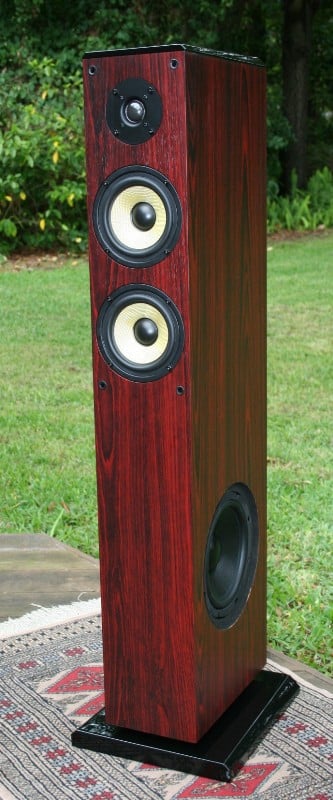
Aesthetically, I wasn’t very taken with the TK-5CT’s. They look fine with the grills
on but the yellow fiberglass drivers just look wrong surrounded by the red
finish. This is one of the few speakers that I prefer the grills on.
One glaring omission on the TK-5CT’s is the lack of bi-amping ability.
Even though this is an 8ohm speaker, it is relatively insensitive at 87dB (2.83
voltz @ 1 meter). When I first hooked them up, I used the Denon AVR-2307CI.
This mid-level receiver has a number of very convenient options including the
ability to choose a different setup for stereo versus multi-channel inputs.
What does this mean? Well, with the TK-5CT’s, it means I can run them with a
sub for movies and multi-channel music and then full range for two channel
music – all without hitting a button! While the 2307CI powered the TK-5CT’s adequately, switching over to the
Emotiva RSP-1 reference stereo processor and RPA-1 reference stereo amplifier
brought a whole new level of audio quality. Most notably, everything was crisper,
less muddy, with an overall increased fidelity to the playback. It takes a
quality speaker to reveal those differences in electronics and the TK-5CT’s are just such a speaker.
Aesthetically, I wasn’t very taken with the TK-5CT’s. They look fine with the grills
on but the yellow fiberglass drivers just look wrong surrounded by the red
finish. This is one of the few speakers that I prefer the grills on.
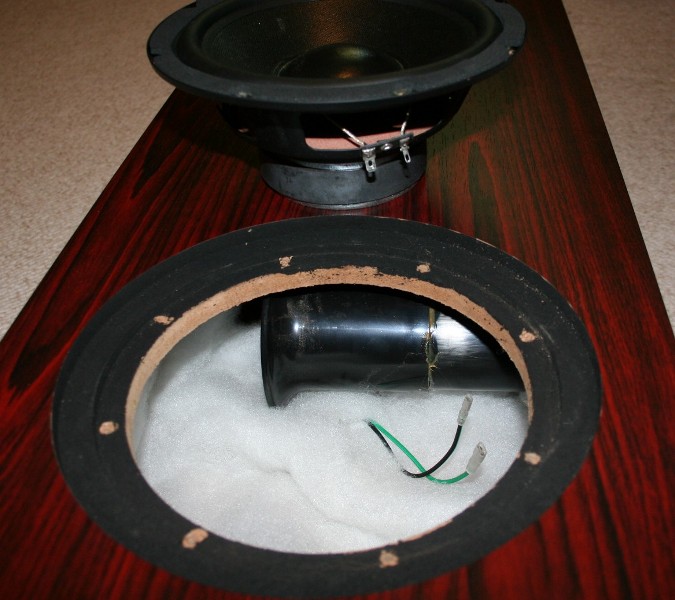
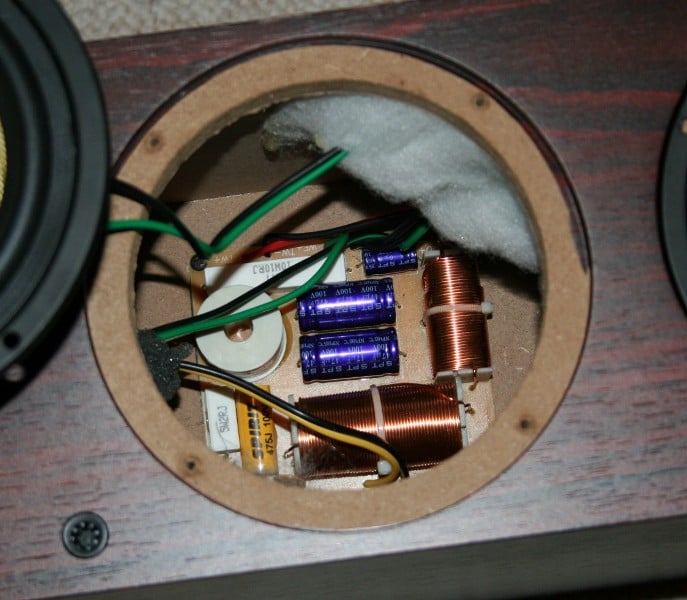
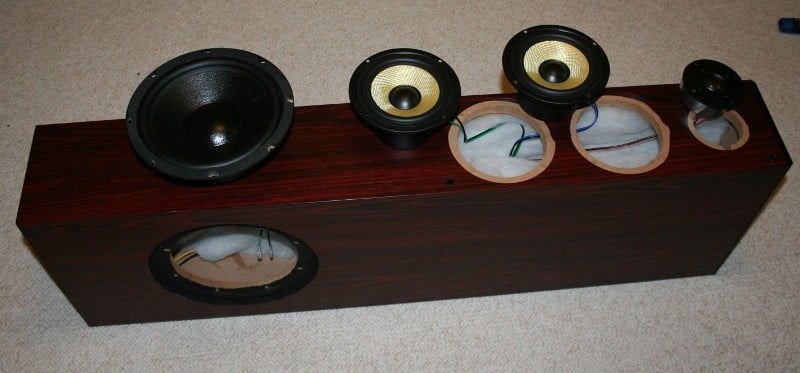 Taking the speakers apart I noted that each of the
drivers save the 8” woofer was fully shielded, the baskets were all stamped and
the enclosure was constructed out of ¾” MDF. The rear port was flared at both
sides to reduce port chuffing or noise. The interior is lined with a thin layer
of white polyfill that appears to be
mostly used to keep wires from vibrating against the side of the cabinet rather
than any real dampening. When I first started exploring the insides, I thought
that there was a solid brace across the speaker just below the bottom 5
3/4" woofer. This would make sense as it would isolate the 8” woofer from
the other drivers. But when I got behind the tweeter and two 5 3/4"
woofers, I realized that they were incased in a box that was only about half as
deep as the speaker. A few minutes of investigation later and I found a hole
leading up the back of the speaker just above the port. This means that the
midranges and tweeter are enclosed in a smaller box but that the unused space
behind them is still being used for the woofer (explaining the bass extension I
experienced). Now, what is amazing is that I’ve seen this design before from
RBH – on their flagship T-30LSE towers! It would have been cheaper and easier
to just put a solid cross brace in there and forget about that unused space
behind the mid/tweeter box. But that’s not a concession that RBH is willing to
make. And I appreciate that.
Taking the speakers apart I noted that each of the
drivers save the 8” woofer was fully shielded, the baskets were all stamped and
the enclosure was constructed out of ¾” MDF. The rear port was flared at both
sides to reduce port chuffing or noise. The interior is lined with a thin layer
of white polyfill that appears to be
mostly used to keep wires from vibrating against the side of the cabinet rather
than any real dampening. When I first started exploring the insides, I thought
that there was a solid brace across the speaker just below the bottom 5
3/4" woofer. This would make sense as it would isolate the 8” woofer from
the other drivers. But when I got behind the tweeter and two 5 3/4"
woofers, I realized that they were incased in a box that was only about half as
deep as the speaker. A few minutes of investigation later and I found a hole
leading up the back of the speaker just above the port. This means that the
midranges and tweeter are enclosed in a smaller box but that the unused space
behind them is still being used for the woofer (explaining the bass extension I
experienced). Now, what is amazing is that I’ve seen this design before from
RBH – on their flagship T-30LSE towers! It would have been cheaper and easier
to just put a solid cross brace in there and forget about that unused space
behind the mid/tweeter box. But that’s not a concession that RBH is willing to
make. And I appreciate that.
RBH TK-5CT Set-up and Listening Tests
 Attaching the bases took little time and a small
wrench made short work of the carpet spikes. With my carpet, I decided to just
set the speakers up on their bases without attaching the spikes while
determining the proper placement. Even though we here at Audioholics don’t
recognize speaker “break-in” as a real physical phenomenon, we understand that
many people do. More to the point, “ear” break in is a very real phenomenon and
“encouraging” people listen to their speakers for a number of hours isn’t such
a bad plan. Most companies like to quote 40-60 hours while RBH suggests only
10-15. I interpret this in one of two ways: 1) RBH doesn’t really buy into the
whole “break-in” but has to put it in there because many of their customers expect
it or 2) they DO believe in break-in but they believe that their speakers are
of such high quality that they don’t need that much. Either way, RBH is at
least getting closer to the Audioholics recommended break-in time of 2 minutes than
any other manufacturer I’ve come across – and that should be commended.
Attaching the bases took little time and a small
wrench made short work of the carpet spikes. With my carpet, I decided to just
set the speakers up on their bases without attaching the spikes while
determining the proper placement. Even though we here at Audioholics don’t
recognize speaker “break-in” as a real physical phenomenon, we understand that
many people do. More to the point, “ear” break in is a very real phenomenon and
“encouraging” people listen to their speakers for a number of hours isn’t such
a bad plan. Most companies like to quote 40-60 hours while RBH suggests only
10-15. I interpret this in one of two ways: 1) RBH doesn’t really buy into the
whole “break-in” but has to put it in there because many of their customers expect
it or 2) they DO believe in break-in but they believe that their speakers are
of such high quality that they don’t need that much. Either way, RBH is at
least getting closer to the Audioholics recommended break-in time of 2 minutes than
any other manufacturer I’ve come across – and that should be commended.
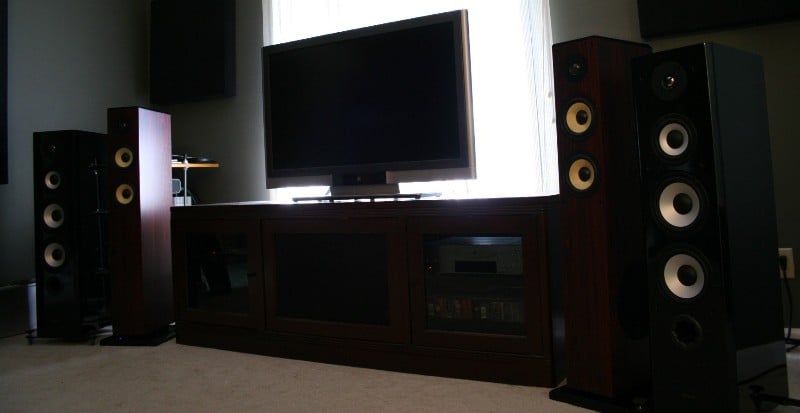
 The side
firing woofer really needs a little room to breath so I suggest you point it
out rather than in. If you’ve got furniture that the speakers are flanking then
this is imperative but even for your dedicated home theaters with projection
screens and no furniture up front, then having the woofers pointed at each
other can cause some cancellation effects (two drivers firing in phase can do
that). You’d risk negating some of that bass that you paid good money for.
Also, the speakers are rear ported so you’ll want to give a little room behind
the speaker to let it breathe. Even at high volumes I never had any problems
with port noise.
The side
firing woofer really needs a little room to breath so I suggest you point it
out rather than in. If you’ve got furniture that the speakers are flanking then
this is imperative but even for your dedicated home theaters with projection
screens and no furniture up front, then having the woofers pointed at each
other can cause some cancellation effects (two drivers firing in phase can do
that). You’d risk negating some of that bass that you paid good money for.
Also, the speakers are rear ported so you’ll want to give a little room behind
the speaker to let it breathe. Even at high volumes I never had any problems
with port noise.
 I experimented a lot with toe in and was amazed at
the results. In no position did the TK-5CT’s sound bad. Imaging was good
whether the speakers were pointed straight forward or directly at me. But, of
course, that isn’t all that amazing; lots of speakers can claim that. What WAS
amazing however was the difference I experienced when the speakers were pointed
directly at me versus any other position. In this configuration I experienced a
significant increase in the clarity and presence of the music WITHOUT any
deleterious effects that normally come with on axis listening. So many times in
the past I’ve reviewed speakers that sound great off axis (pointed away from
me) but when I point them directly at me they become bright and fatiguing. Not
so with the TK-5CT’s. Much like an electrostat, I
found that having the speakers pointed directly at me gave me a very small but
very clear sweet spot. However, unlike electrostats, having them toed out a bit
didn’t destroy the soundstage as much as it just widened and diffused it. In my
opinion, for critical listening by yourself, pointing the speakers directly at
you will increase your enjoyment but in a group (or for non-critical listening)
you’ll find that the TK-5CT’s perform far above average if you point them
straight out or with a slight toe in. This makes for a very versatile speaker.
I experimented a lot with toe in and was amazed at
the results. In no position did the TK-5CT’s sound bad. Imaging was good
whether the speakers were pointed straight forward or directly at me. But, of
course, that isn’t all that amazing; lots of speakers can claim that. What WAS
amazing however was the difference I experienced when the speakers were pointed
directly at me versus any other position. In this configuration I experienced a
significant increase in the clarity and presence of the music WITHOUT any
deleterious effects that normally come with on axis listening. So many times in
the past I’ve reviewed speakers that sound great off axis (pointed away from
me) but when I point them directly at me they become bright and fatiguing. Not
so with the TK-5CT’s. Much like an electrostat, I
found that having the speakers pointed directly at me gave me a very small but
very clear sweet spot. However, unlike electrostats, having them toed out a bit
didn’t destroy the soundstage as much as it just widened and diffused it. In my
opinion, for critical listening by yourself, pointing the speakers directly at
you will increase your enjoyment but in a group (or for non-critical listening)
you’ll find that the TK-5CT’s perform far above average if you point them
straight out or with a slight toe in. This makes for a very versatile speaker.
Listening Tests
 Floorstanding
speakers have gotten, to a certain extent, a bad rap. So many times you come
across people that have “towers” that won’t go low enough to really be
considered “full range.” For the uninitiated, this means that they’ve set their
receiver for “large” or just forgone the purchase of the subwoofer thinking
that they don’t need it. More often than not, this is a grave mistake. It is
always with a bit a trepidation that I throw in a test disc and examine the
“useable” bass of a tower as I’m often forced to report that they should be set
to “small” and that you’ll still need to fork over cash for a sub. For the
first time, I don’t have to say that. At $800 a pair, I can’t believe I’m about
to say that I heard real useable bass as low as 25Hz and strong output from
31.5Hz and up! Now that all of you are back from checking the specs on the
introductory page, yes, RBH rates them down to 45Hz. The speakers were placed
at least 2 ½ feet from the side walls and 2 feet from the back so NO I didn’t
corner load them to get this result. Obviously the room is playing a factor
here and I can’t guarantee that you’ll have the same results but in my room, I
can EASILY go without a sub for 99% of the music out there. Of course, I still
want a sub for movies but if you have the option of sending just the LFE of the
mains to the sub (essentially running them as “large”) then you can safely do
that. It may even help smooth out the bass response in your room.
Floorstanding
speakers have gotten, to a certain extent, a bad rap. So many times you come
across people that have “towers” that won’t go low enough to really be
considered “full range.” For the uninitiated, this means that they’ve set their
receiver for “large” or just forgone the purchase of the subwoofer thinking
that they don’t need it. More often than not, this is a grave mistake. It is
always with a bit a trepidation that I throw in a test disc and examine the
“useable” bass of a tower as I’m often forced to report that they should be set
to “small” and that you’ll still need to fork over cash for a sub. For the
first time, I don’t have to say that. At $800 a pair, I can’t believe I’m about
to say that I heard real useable bass as low as 25Hz and strong output from
31.5Hz and up! Now that all of you are back from checking the specs on the
introductory page, yes, RBH rates them down to 45Hz. The speakers were placed
at least 2 ½ feet from the side walls and 2 feet from the back so NO I didn’t
corner load them to get this result. Obviously the room is playing a factor
here and I can’t guarantee that you’ll have the same results but in my room, I
can EASILY go without a sub for 99% of the music out there. Of course, I still
want a sub for movies but if you have the option of sending just the LFE of the
mains to the sub (essentially running them as “large”) then you can safely do
that. It may even help smooth out the bass response in your room.
CD: Yello – the eye
 While I usually just pop in this album for a few
seconds to check out the imaging of the speakers in question, I ended up
spending a lot more time than I normally would. My reference speakers, not so
long ago, were right in the price range (without the upgraded finish) of the
TK-5CT’s and have long been considered a performance leader in this price
bracket. This seemed to be a very good comparison set and I wanted to do it
justice. Imaging by both speakers was very good with a slight edge given to the
TK-5CT’s. And by slight I mean ever so
slight. It was a close match. The separation seemed a little clearer, the
soundstage a little larger, and overall the imaging was more 3-D than my
reference speakers. I spent a lot of time switching back and forth in order to
come to this conclusion so you know it was a close race. With the TK’s pointed
directly at me, the imaging tightened up even more and became more present
handedly beating my reference set which became fatiguing in the same
configuration.
While I usually just pop in this album for a few
seconds to check out the imaging of the speakers in question, I ended up
spending a lot more time than I normally would. My reference speakers, not so
long ago, were right in the price range (without the upgraded finish) of the
TK-5CT’s and have long been considered a performance leader in this price
bracket. This seemed to be a very good comparison set and I wanted to do it
justice. Imaging by both speakers was very good with a slight edge given to the
TK-5CT’s. And by slight I mean ever so
slight. It was a close match. The separation seemed a little clearer, the
soundstage a little larger, and overall the imaging was more 3-D than my
reference speakers. I spent a lot of time switching back and forth in order to
come to this conclusion so you know it was a close race. With the TK’s pointed
directly at me, the imaging tightened up even more and became more present
handedly beating my reference set which became fatiguing in the same
configuration.
CD: Bang & Olufsen Vol. XIII – The Sound of Perfection
Listening to Track 1 and Track 4, the most noticeable difference between the TKs and my reference speakers was the bass. Out of all the comparisons I did, the difference in the bass was the most noticeable. Tighter, cleaner, deeper and more lifelike all describes the TK-5CTs. The clarity in the lows and lower midrange was significantly better than what I was used too. I was quickly convinced that not only was I standing in the presence of full range speakers, but I was standing in the presence of full range speakers for $800! I still think that price is somehow wrong and that when the accounting department over at RBH gets wind of it, there’s going to be hell to pay. For someone that is used to working with a sub (even one as capable as the Axiom EP500), running full range speakers takes a little getting used to. You don’t have to worry about crossovers, placement, or any of that. You just plug in the speakers and walk away. There is something about that lack of action that I find strangely comfortable. I also think that running the speakers full range added a dimension to the music that a sub just doesn’t seem to provide. Not that a sub can’t provide it but it takes a lot of sub (or perhaps lots of subs) to provide the deep impact for movies while remaining clean and tight up near the crossover point. The TK-5CT’s won’t give you that gut shaking bass during explosions but it will give you bass deep enough for most music at insane listening levels.
 Using the
Emotiva Reference Audio Series RSP-1 and RPA-1 along with the Denon 3910, I
pushed the TK-5CT’s as hard as I dared. I was amazed
to find that the top end of the speakers seemed to have no limit (yes, I know
they have a limit but this is a subjective listening test). When the tweeter on
my reference speakers began to break up and distort, the RBH tweeter held firm
and kept its composure. The highs of cymbals, strings, and snare drums stayed
crisp, clean and lifelike at volumes I thought impossible. Overall, I found
there to be a very airy and lifelike quality to the highs. Sounds seemed to
float and hover all around me. Just when I thought one more decibel or one more
hertz would push the TK’s past their limits, they would take all that and more.
For $800, these are some pretty amazing speakers.
Using the
Emotiva Reference Audio Series RSP-1 and RPA-1 along with the Denon 3910, I
pushed the TK-5CT’s as hard as I dared. I was amazed
to find that the top end of the speakers seemed to have no limit (yes, I know
they have a limit but this is a subjective listening test). When the tweeter on
my reference speakers began to break up and distort, the RBH tweeter held firm
and kept its composure. The highs of cymbals, strings, and snare drums stayed
crisp, clean and lifelike at volumes I thought impossible. Overall, I found
there to be a very airy and lifelike quality to the highs. Sounds seemed to
float and hover all around me. Just when I thought one more decibel or one more
hertz would push the TK’s past their limits, they would take all that and more.
For $800, these are some pretty amazing speakers.
TK-5CT Measurements & Analysis, Conclusion
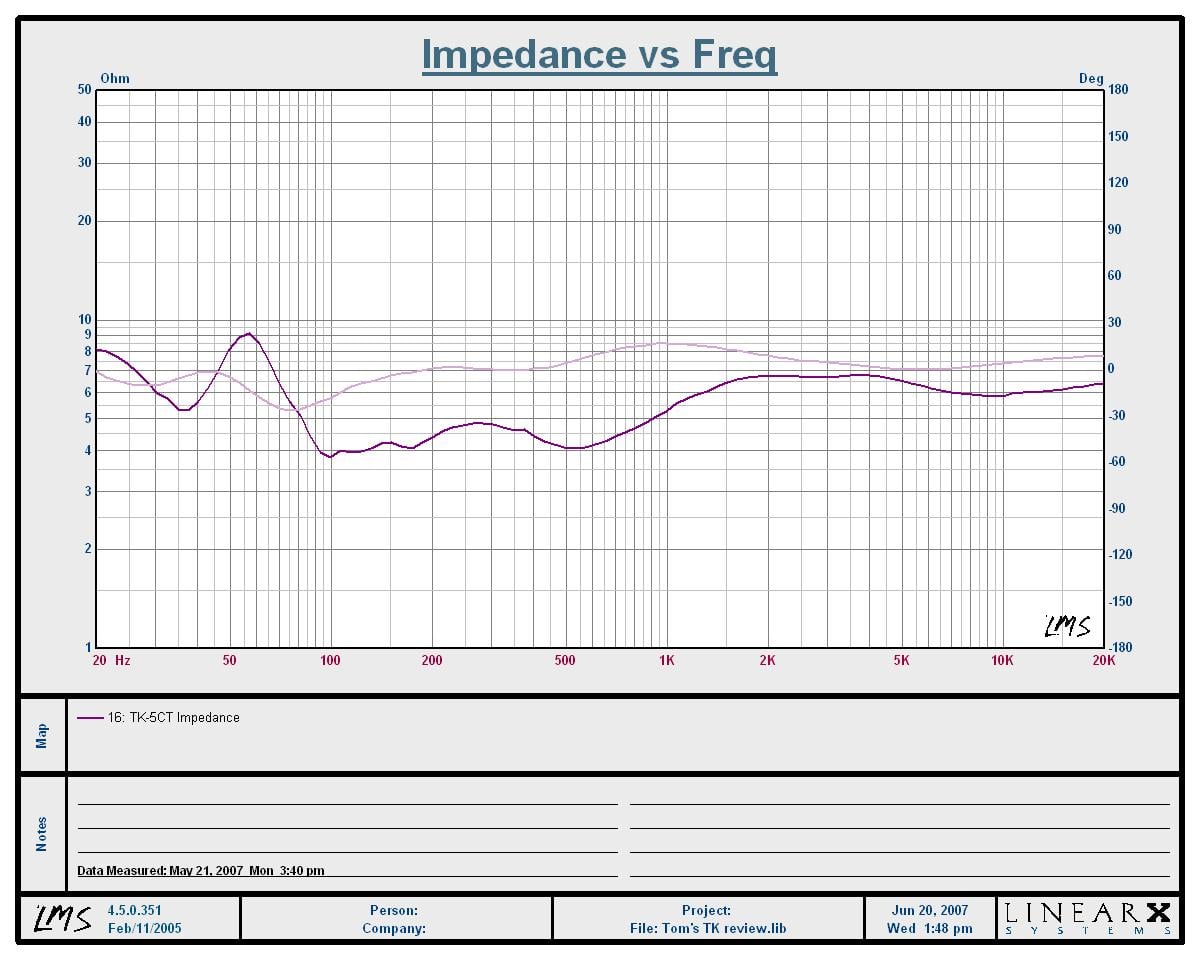
TK-5CT Impedance / Phase
As can be seen in the plot, the RBH TK-5CT tower is roughly a 6 ohm speaker. Given its moderate sensitivity and dip to 4 ohms in the mid bass region, it is advisable to use an amplifier that can safely handle low impedances and put out an honest 100wpc or more. The phase response is extremely linear, maintaining +-30deg within the entire audio band demonstrating the designer really knows what he is doing to make a speaker that can consistently perform well regardless of what type of amplifier is powering it. Based on the saddle point centered around 38Hz, the manufacturer does seem to be conservatively rating the systems bottom end response.
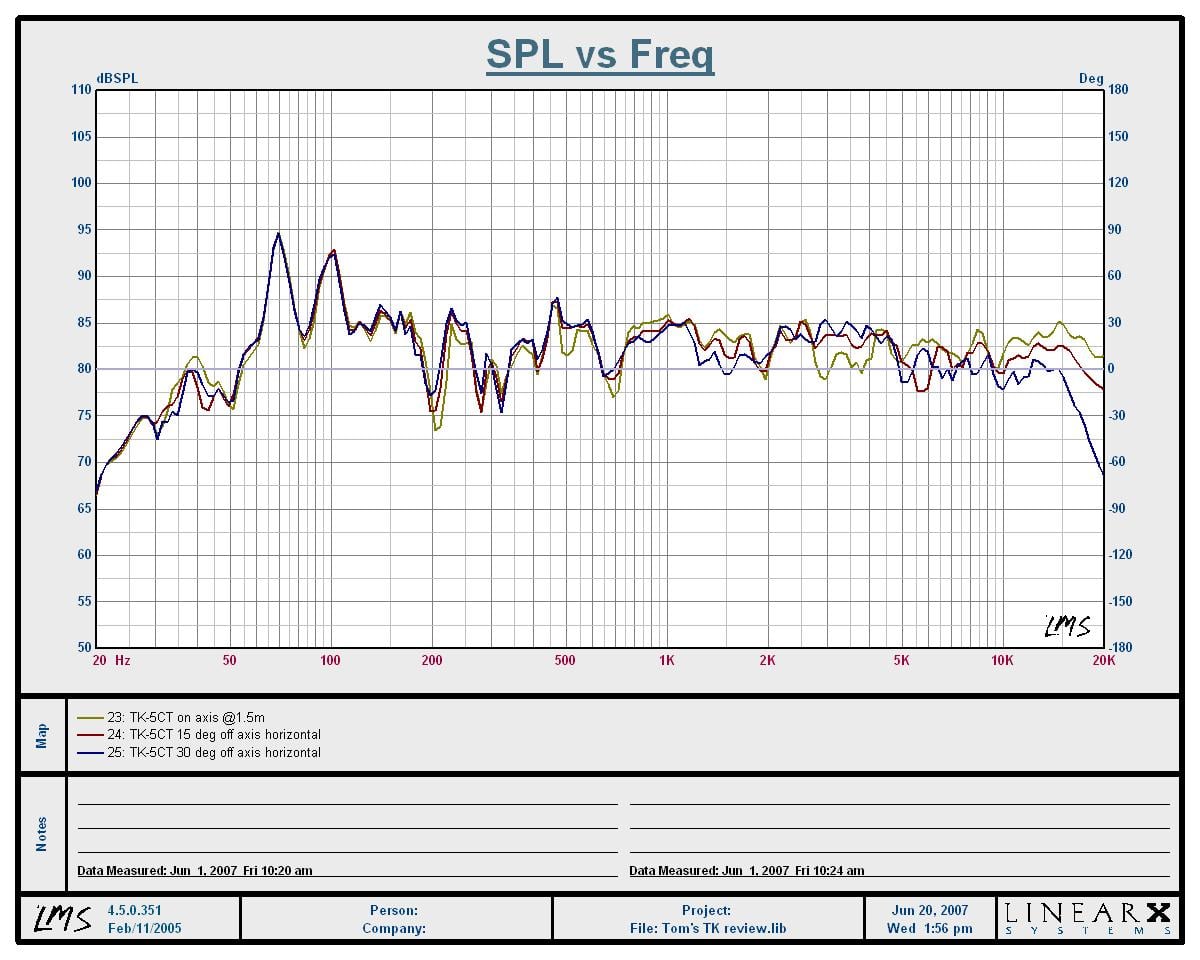
TK-5CT In Room Frequency Response (1/12th Octave Resolution)
Yellow – on axis
Red – 15deg off axis
Blue – 30deg off axis
The TK-5CT towers exhibited a very linear frequency response on and off axis. Notice the on axis plot doesn’t reveal a tweeter level deliberately set to high as we often see in budget towers to win over that “wow” effect. There also is not smiley face response where the midrange is recessed to hide speaker deficiencies. This helps explain why Tom enjoyed both on and off axis listening with this speaker system.
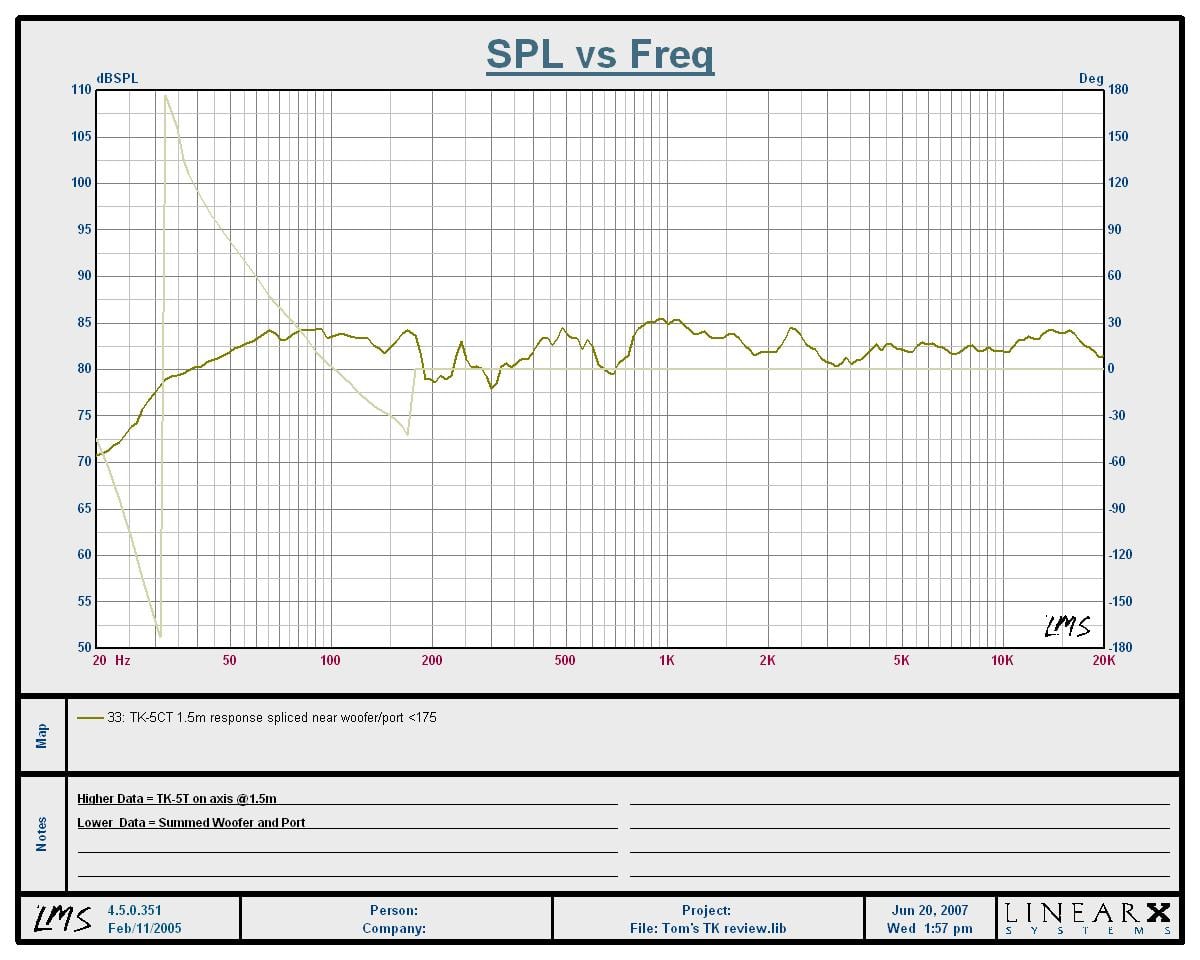
TK-5CT Spliced nearfield (woofer + port) response
To get a
better idea of speaker performance and take the room out of the equation, we
measured the nearfield woofer + port response and implemented 1/3 octave
smoothing above 200Hz. As you can see,
this speaker is tonally neutral, without overemphasis in any frequency
spectrum. The 3dB point does appear to
be around 45Hz but with a very gradual and smooth roll off of around 10
dB/octave below that.
Recommendations
I’ve got very little to say for recommendations for these speakers. At this price point, everything feels like nitpicking. The spikes seem a little cheesy (though they are functional) and I’d like to see dual binding posts at the back (though they probably aren’t needed). For $800, I’m looking at way more speaker than I have any right to expect so I should just shut my trap.
Conclusion
 A big part
of me was hoping I’d hate these speakers. Always the one to be critical, I’d
relish the thought of going against the grain over here. It’d help give us that
“fair and balanced” look that would placate some of our dissenters. But the
fact is, and I can no longer deny it, that RBH makes great speakers. So, what
do you do when you get a great set of speakers in for review? What do you do
when politically it would make sense to slam them or be overly critical and
nitpicky? Well, if you are swayed by polls and what the people on the forums
are going to say about you, you slam them and never look back. But if you’ve
got some integrity, you bite the bullet and get ready for the slew of, “You
guys are just RBH fan boys,” comments. Everyone knows Honda makes good cars.
You just have to drive one to realize it. The same is true of RBH. You just
have to hear one to know. And now that I’ve heard one – I’m convinced. Finding
a dealer may be a problem for some (not everyone is Internet Direct you know)
but at this price, for this performance, if you’ve got the opportunity, you owe
it to yourself to hear these speakers. They are the new King of the Hill for
budget towers.
A big part
of me was hoping I’d hate these speakers. Always the one to be critical, I’d
relish the thought of going against the grain over here. It’d help give us that
“fair and balanced” look that would placate some of our dissenters. But the
fact is, and I can no longer deny it, that RBH makes great speakers. So, what
do you do when you get a great set of speakers in for review? What do you do
when politically it would make sense to slam them or be overly critical and
nitpicky? Well, if you are swayed by polls and what the people on the forums
are going to say about you, you slam them and never look back. But if you’ve
got some integrity, you bite the bullet and get ready for the slew of, “You
guys are just RBH fan boys,” comments. Everyone knows Honda makes good cars.
You just have to drive one to realize it. The same is true of RBH. You just
have to hear one to know. And now that I’ve heard one – I’m convinced. Finding
a dealer may be a problem for some (not everyone is Internet Direct you know)
but at this price, for this performance, if you’ve got the opportunity, you owe
it to yourself to hear these speakers. They are the new King of the Hill for
budget towers.
RBH Sound TK-5CT Floorstanding Loudspeakers
MSRP: 800/pair
RBH Sound
382
Marshall Way
Layton, Utah 84041
General phone & FAX
Toll-free: (800) 543-2205
Local: (801) 543-2200
FAX: (801) 543-3300
About RBH
Though RBH Sound isn’t yet a household name that people relate to as they do
Sony TVs or Kenmore Refrigerators, they are one of the oldest speaker companies
in the USA still run and operated by the original founder - Roger
Hassing. In 1976 RBH Sound produced its first loudspeaker.
RBH soon began to OEM for McIntosh, (back in the days of Gordon Gow), providing
cabinets for their speakers. This set the stage for doing a superb job
since McIntosh didn’t worry about how to cheapen the product, but to make it
better and, at least at the time, class leading in performance.
Later on RBH Sound began producing loudspeakers for a retailer in
LA called Northridge Audio. They didn’t advertise or market these
products to avoid a conflict of interest with their other OEM customers (i.e.
McIntosh, Parasound, Fosgate, etc). People nonetheless sought them out because
of their high performance, which lead to a good success story and response for
their products. Over the years RBH Sound was successful at helping other
companies in achieving their goals. Based on their strong engineering
background and sourcing ability, they took it upon themselves to enter the
market under their own banner.
The Score Card
The scoring below is based on each piece of equipment doing the duty it is designed for. The numbers are weighed heavily with respect to the individual cost of each unit, thus giving a rating roughly equal to:
Performance × Price Factor/Value = Rating
Audioholics.com note: The ratings indicated below are based on subjective listening and objective testing of the product in question. The rating scale is based on performance/value ratio. If you notice better performing products in future reviews that have lower numbers in certain areas, be aware that the value factor is most likely the culprit. Other Audioholics reviewers may rate products solely based on performance, and each reviewer has his/her own system for ratings.
Audioholics Rating Scale
 — Excellent
- — Very Good
- — Good
- — Fair
- — Poor
| Metric | Rating |
|---|---|
| Build Quality | |
| Appearance | |
| Treble Extension | |
| Treble Smoothness | |
| Midrange Accuracy | |
| Bass Extension | |
| Bass Accuracy | |
| Imaging | |
| Soundstage | |
| Dynamic Range | |
| Fit and Finish | |
| Performance | |
| Value | |
As Associate Editor at Audioholics, Tom promises to the best of his ability to give each review the same amount of attention, consideration, and thoughtfulness as possible and keep his writings free from undue bias and preconceptions. Any indication, either internally or from another, that bias has entered into his review will be immediately investigated. Substantiation of mistakes or bias will be immediately corrected regardless of personal stake, feelings, or ego.
View full profile Subscribe to our newsletter