


RBH Sound Signature Reference 8300-SE/R Loudspeaker Review
RBH Sound 8300-SE/R
- Product Name: RBH Sound 8300-SE/R Loudspeaker
- Manufacturer: RBH SOUND
- Performance Rating:

- Value Rating:

- Review Date: December 13, 2009 01:00
- MSRP: $ 9,700/pair MSRP
Enclosure Type: Three-way ported tower
Frequency Response (+/-3dB): 22 Hz to 20 kHz
Recommended Power: 100 to 400 Watts
Sensitivity (2.83V @ 1m): 91 dB
Impedance (nominal): 4 ohms
Crossover Frequency: 100 Hz and 2700 Hz
Crossover Slope: 18 dB/octave
Driver Compliment:
Tweeters: (1) 1.1 in silk dome
Woofers: (2) 6.5 in aluminum cone
Subwoofers: (3) 8 in aluminum cone
Dimensions: (HxWxD): 55 3/8” x 10 7/8" x 17"
Weight (lbs): 115 each
Pros
- High quality fit and finish with a myriad of veneer options
- Superb sonic control and clarity through the audible range
- Timbrally natural presentation of the human voice
Cons
- You have to have the room for them as they are rather large
RBH Sound 8300-SE/R Introduction
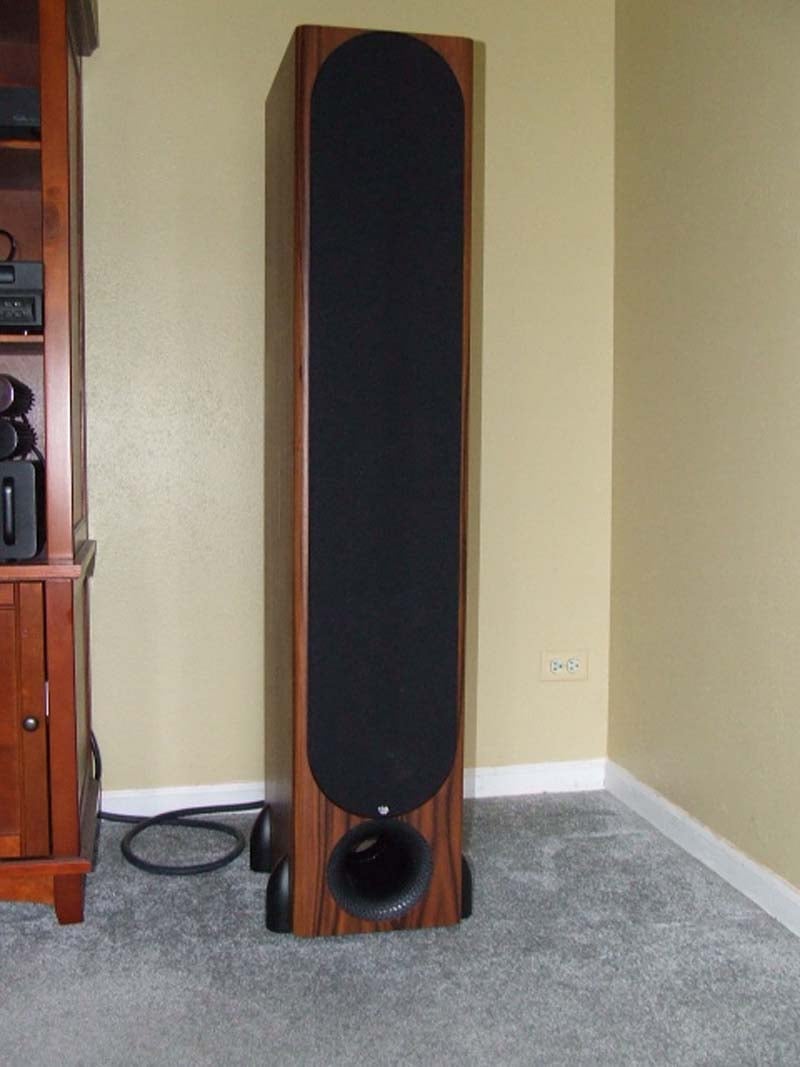 RBH Sound has been around since 1976, quite some time, but has really only marketed products under their own name for the last decade or so. In that relatively short time, the former OEM component manufacturer to a number of prominent brands has built a reputation for high quality loudspeakers and relatively reasonable prices. They have also built up something of a small, loyal following as their name reaches further into the audio mainstream.
Personally, I have never had a chance to audition any RBH speakers, so I was enthusiastic when Gene asked if I would like to get my hands on a pair of the new signature series 8300 towers for a review. Gene is obviously a strong supporter, so I was happy to have a chance to hear for myself if this speaker company, which has earned strong praise among some reviewers, actually lives up to the reputation.
The 8300 SE/R speakers were recently introduced at the 2009 CES and represents near statement/reference quality loudspeakers for RBH Sound. Aside from some of the T Series modular speakers and the limited edition T-30LSE, the 8300 SE/R represents what RBH Sound is really all about, what they think speakers should sound like, without the compromises required to hit a market price point. At $9,700 per pair, the 8300 SE/R loudspeakers are not cheap, but they are far less pricey than where some loudspeaker companies mark their high-end products. Diminishing returns dominates at these prices with little gained, objectively, between large price differences such that as long as a speaker performs well, it often becomes more about subjective preference for voicing and very subtle minutia than about any concrete gain from spending more or less money leaving ardent audiophiles to argue nuanced subtleties until their dying breath. There will be many fine sounding loudspeakers available for top dollar; it becomes a matter of if ones wallet can keep up with ones preferences.
So, we will now see how the 8300 SE/Rs perform, both objectively as well as subjectively.
Design and Construction
 An imposing loudspeaker system that will command attention, to say the least, the nearly 4’-8” 8300 SE/R towers will stand out in just about any room. So it is a good thing that considerable care was put into the cabinet construction to produce furniture quality finishes because these speakers will not be hidden from view easily.
The Signature Reference Series loudspeakers are available in 30 wood veneer finishes in combination with black or white grille colors, with the review pair finished in South American Rosewood matched with black cloth grilles. The slender, rectangular towers feature radiused vertical front corners, semicircular grille ends and a large flared tuned port on the front, exposed below the grille. The grille frame appears to be composite construction with a 3/8” MDF layer backed with a layer of 1/8” plywood and has six metal lugs to attach it to the towers. Around the back of the 8300 SE/R speakers are dual gold plated binding posts to allow bi-amping or bi-wiring.
The basic design of the 8300 SE/R is that of an MTM over three woofers. Trifle if you want, but tweeter, woofer, subwoofer or tweeter, midrange, woofer: same thing. The former attempts to suggest a two-way design with the additional of lower frequency drivers included while the latter is a nomenclature that is more commonly used with three way designs. In a two-way design, the lower frequency driver is referred as a woofer but also does the duty of the midrange as well because it isn’t coming out of that other, tiny driver above it. Most two-way designs are small and with the limited bass extension coming from such speakers, it suggests that the driver would be more aptly referred to as a midrange anyways. Coupled with the fact that the majority of two-way designs are relegated to lower end models in a product series with three-way speakers, which in turn are commonly based on the two-way designs where all of a sudden the two-way woofer is now called the midrange, I think that any nomenclature quibbling really is moot.
Either way, the subwoofer/woofer and woofer/midrange drivers are both based on RBH’s proprietary aluminum cone design. The three 8” subwoofer/woofers are standard dynamic driver designs while the two 6½” woofer/midrange drivers have fixed phase plugs, which is also part of the upgrade from the base 8300 SE model loudspeakers. The other upgrades between the SE and the SE/R versions include using an upgraded Scanspeak 9500 liquid cooled, silk dome tweeter rather than a standard 1” soft dome tweeter and an upgraded crossover network tuned to the other improvements, all of which is said to both increase power handling and improve sonic clarity.
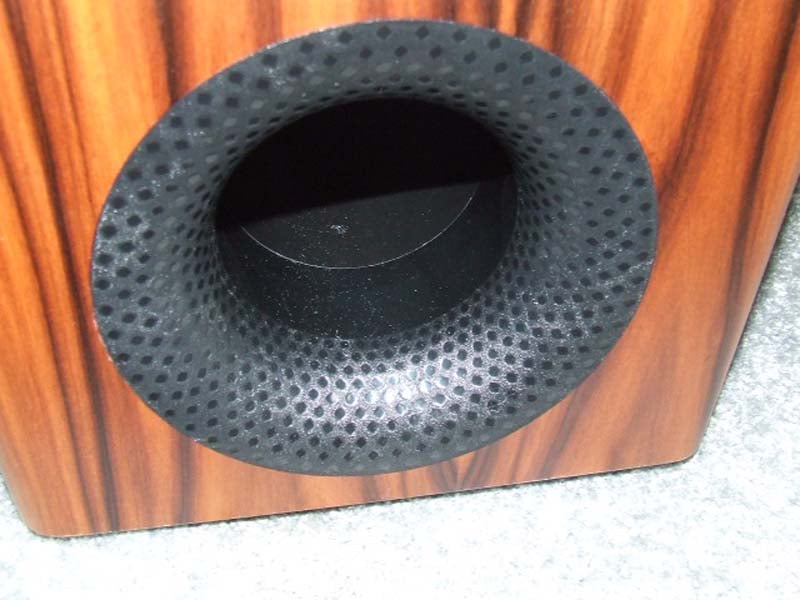

RBH claims that the ported 8300 SE/R is tuned to hit an impressive 22 Hz, a bass extension that few dedicated subwoofer designs actually hit. The large diameter tuned port is dimpled, presumably to raise the critical velocity that helps prevent those untoward noises that occur after the transition from laminar to turbulent airflow. This is an important consideration for any loudspeaker design that is intended to move a lot of air at low frequencies.
Stability for the slender towers, which turned out to be better than I initially suspected, mainly due to the speaker weight, can be improved by using the mountable metal feet that widen the base in the short direction. Each tower comes with four black, machined metal feet shaped like a half bullet with a leg that forms an L bracket that wraps under the speaker. The brackets are lined with a thin layer of foam to protect the wood finish and are mounted with three wood screws each to the underside of the speakers. There are internally threaded screw holes located towards the outer radius that accept either carpet spikes or domed rubber feet for use on various other surfaces, both of which are included.
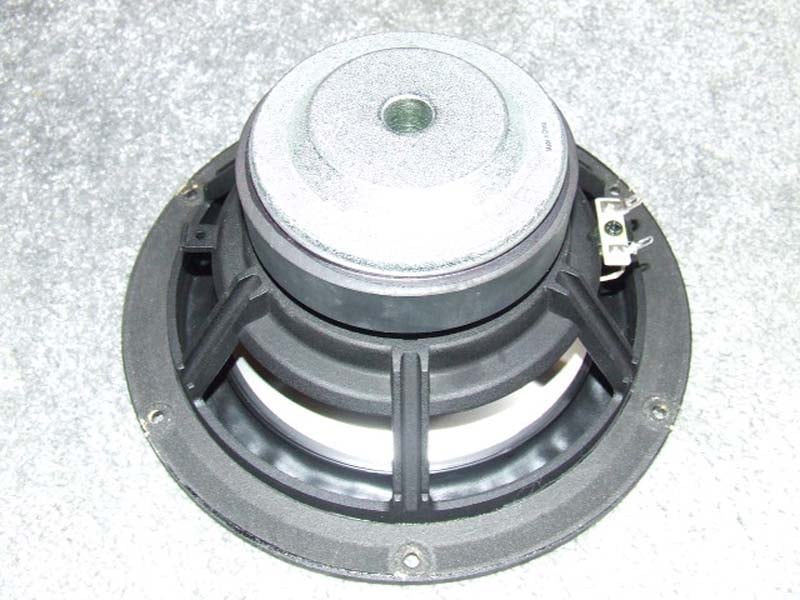

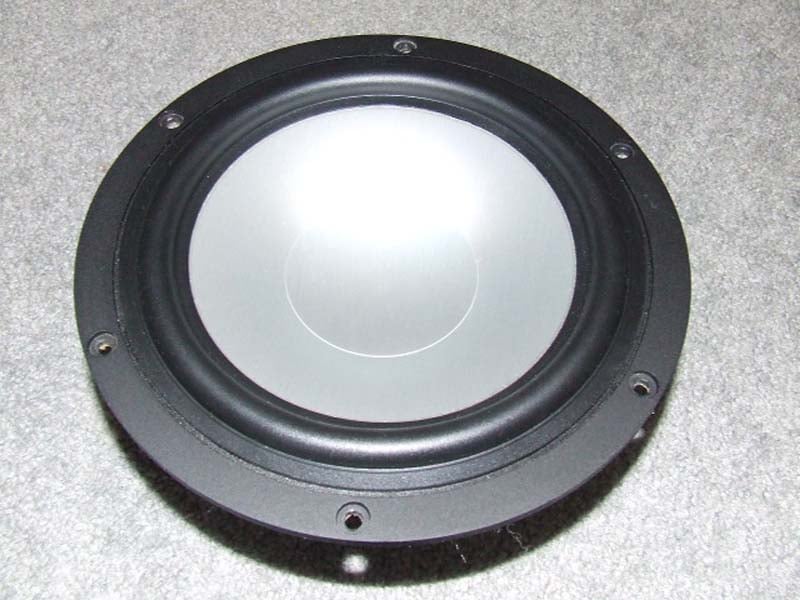
Taking out several drivers, I found the cabinets filled extensively with foam and fiber batting. There is acoustic foam adhered to the sidewalls and each chamber between internal braces is stuffed with fiber batting. The cabinets are standard ¾” HDF with an internal stiffener plate between each driver and the port. The woofers are isolated from the midranges and tweeter with a solid stiffener plate that forms two chambers, while the rest of the stiffeners have a large circular hole that allows acoustic coupling.
The RBH manufactured woofers and midranges have sturdy cast baskets. Each woofer basket supports a 4¼” diameter motor while each midrange supports a 4” diameter motor. Both of these driver types are mounted with machine screws into flanged threaded metal inserts embedded inside the cabinets. The outsourced Scanspeak tweeter utilizes a 3” motor and the assembly is mounted to the cabinet with wood screws.
The crossover is mounted to the back, just below the speaker inputs. The only thing that is clearly visible when pulling one of the woofers out is a large, tightly wound inductor coil. Thus we had to request a photo of the entire crossover from RBH Sound.
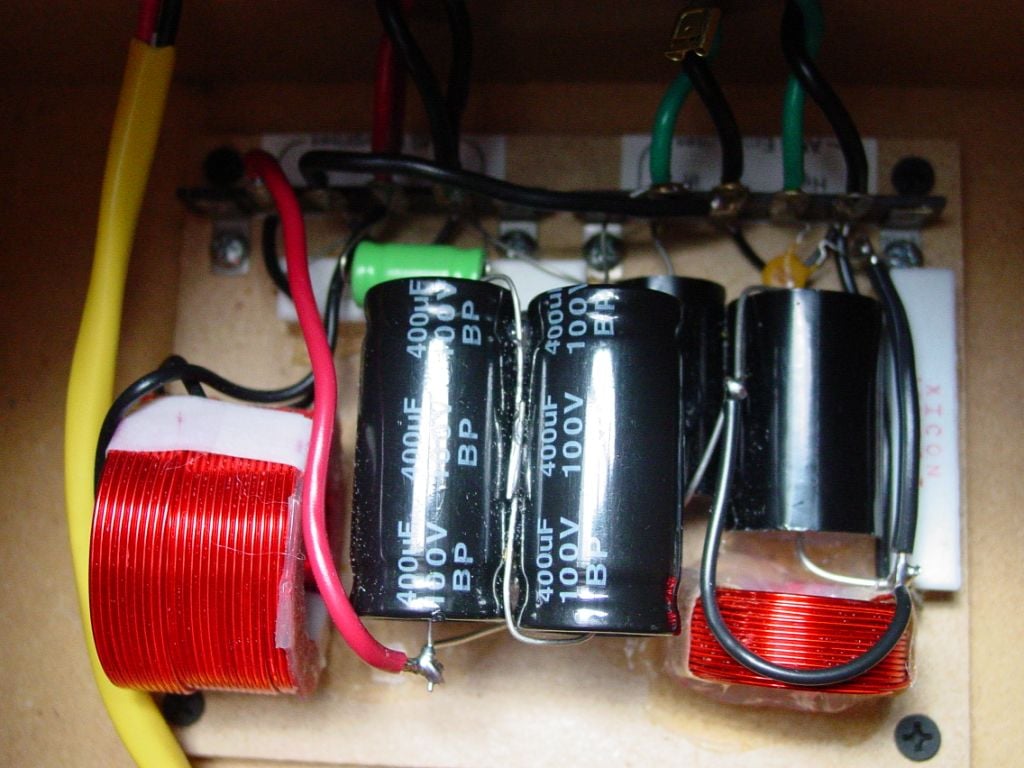

The choke on the woofer is a 6 mH low DCR and has a power rating of 500 Watts with low saturation. The electrolytic caps are used in the high pass on the mid range. Two each 400 µF 100 V caps are used in series for a net 200 µF 200 Volt rating. The poly caps for the tweeter and midrange bypass are located underneath the electrolytics and are not visible in the picture.
RBH Sound 8300-SE/R System Set-Up & Evaluation
The 8300 SE/Rs arrived in easily the most protected packaging that has been delivered to my home. The loudspeakers arrived packed in separate wooden crates, via freight carrier, that were unloaded by hand truck. The crates themselves were constructed of particleboard paneling with 1x4 framing and 2x4 support pads held together with glue and wood screws.


Unscrewing the top panel revealed a slender interior cardboard box snuggled in 2” foam panels on all sides. It takes two people to lift this interior box out, so plan ahead of time to have someone else around who can help with lifting a pair of 115 pound speakers out of large wooden crates when you take delivery. Once the interior boxes were removed, they were opened to reveal the 8300 SE/R loudspeakers and grilles fit snugly inside. The metal pedestal mounts and various attachments arrived the next day, obviously in a separate box, by standard UPS.

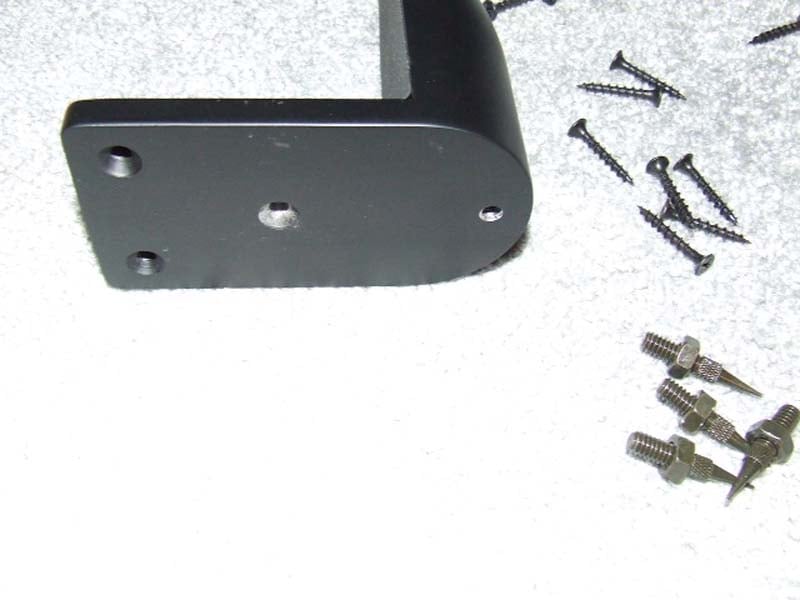
The pedestal mounts will have to be attached with the 8300s laying flat on their backs. Each foot is an L bracket with a thin layer of protective foam that wraps underneath the speakers at each corner and each foot is attached with three wood screws. The pedestal extends past the footprint of the speaker in a bullet shaped oval dome that widens the effective base to mount either the optional carpet spikes or rubber padded feet which are then screwed in towards the outer radius of the pedestal. When attaching the pedestal mounts, make sure that the wood screws are firmly secured but not over tightened as the configuration with the either spikes or feet puts the screws under tension and not securing the screws properly may lead to stripping the wood from around the threads allowing the screws to pull out and no to longer attach properly to the cabinet. This is especially true considering that most cabinets, like the 8300 SE/Rs, are made of MDF, a material formed of wood fibers glued together under heat and pressure, that has a tendency to split out around screws.
When placing the 8300 SE/Rs, take some care in setting the spikes or feet to level the speakers and provide uniform support at all four corners. While these speakers are heavy enough that it does take some effort to tip them over, the base is relatively narrow and wobbly; uneven supports will only exacerbate the possibility that they can be tipped. This is true of any tall and narrow loudspeaker, but at 115 pounds, these will crush anything underneath if they do go over, like children. That is the helpful Audioholics public safety announcement for this review; enjoy, safely.
Once the bases are attached, lug these babies into position and wire them up. The speakers have dual binding posts for bi-amping/bi-wiring and a coupling strap for mono wiring as well. Looking around back at the product label revealed that RBH also took some care in sending speakers with sequential serial numbers, 013549 and 013550, often considered by audiophiles as improving the probability of similarity manufacturing and performance.
Listening Evaluation
I evaluated the 8300 SE/R loudspeakers driven by my primary stereo audio gear. The setup consists of a PS Audio 100 Delta power amplifier with a SimAudio Celeste P-4002 preamplifier, a Wadia 12 D/A converter, and a California Audio Delta CD transport.
Firing up these babies, my immediate impression was of a thick midrange, but I do not mean that in a bad way. It is simply that these loudspeakers present a generous amount of midrange, at least more than I was used to. This does have its up and down side as well, though.
While the 8300 SE/Rs are a very detailed set of loudspeakers in an absolute sense, they did not seem quite as detailed or as forward and enveloping with the imaging as I am used to with my Kappa 600 reference speakers. This is not necessarily a fault with the speakers, but with human hearing and masking. A slight increase in output of particular sounds may lead to a slight decrease in perception of other sounds that do not have an increase in output. The change in relative magnitude can obscure certain details and ambience slightly.
Case in point of this phenomenon where personal experience comes in is with re-masters of older recordings. The original digital releases of certain records, Peter Gabriel era Genesis comes to mind, were somewhat thin in the midrange. This is perhaps in part because recording engineers who were used to equalizing for vinyl were mastering digital the same way or in some cases the recording was reissued using the vinyl LP masters. The same thing happened with some early DVD releases that looked like transfers straight from video tape. I found this lack of midrange to be increasingly noticeable on lower quality audio gear while higher quality gear tended to de-emphasize this thinness to some extent. With subsequent purchases of these albums re-mastered, I found the midrange to be much more lush, but in turn, I found a certain amount of low level detail that I was used to obscured slightly. All the detail is still there, perhaps even more, but it takes a bit of listening retraining to get accustomed to. Despite a slight perceived loss in detail, I quickly became accustomed to the fuller reproduction of the re-masters and I find something similar happening with the 8300 SE/Rs. Life is full of tradeoffs; each has their own decisions to make.
What I found with the RBH 8300 SE/R loudspeakers was a very natural sound with a lush midrange that was simultaneously laid back and yet dynamic, solid imaging, and natural timbre. The 8300 SE/Rs did present a significant amount of detail without sounding analytical or unnatural by drawing attention to the detail in an artificial way. Nothing about the sonic presentation was forced or strained in any way from the deepest bass to the highest treble with these speakers. Bass was deep with tight control and the treble was smooth and open, one might say airy in audiophile speak, with no grain or harshness audible even at elevated listening levels.
As I pondered how best to describe the sonic strengths of the 8300 SE/R loudspeakers, one word kept coming to mind: voice.
As central focus of so much music, what the 8300 SE/R speakers get right is the sound of the human voice. From there, all the sonic qualities of the rest of the instruments fall into place around that well-grounded center. I found that singing came through the 8300 SE/R loudspeakers with a high level of realism that is hard for many lesser loudspeakers to recreate. Music with a well-recorded voice track benefitted from an impressive immediacy and presence which was supported by the unobtrusive, well-rendered imaging provided by the 8300 SE/Rs, doing an excellent job supporting the illusion, putting the singer into the room with relaxed ease without putting them in your face. Other speakers are perhaps more enveloping, but they do not put the singer right there in front of you quite as well.
The particular qualities of the 8300 SE/R’s imaging also lends to a near complete decoupling of instruments; I will explain. Actual instruments making music are, of course, each their own dedicated sound source. Recording and reproduction takes the individual sounds and combines them into a composite that has to then be separated into individual sounds again by the ear and brain level auditory processing. To make the illusion believable, enough of the auditory clues present in the original performance have to be both captured and reproduced. Poor recording and/or reproduction loses some of the subtle details, mashing a certain amount of the sounds together, making them inseparable auditorially. While even the best reproduction cannot entirely eliminate this effect, the 8300 SE/Rs come very close, managing to maintain a high level of integrity to necessary subtlety that makes the instruments just sound there in a very natural way.
CD: Steven Wilson – Insurgentes When not fronting Porcupine Tree, founding front man Steven Wilson is always busy on a multitude of other projects including bands such as No-Man, Blackfield, Bass Communion, IEM, and occasionally as engineer and producer for others including Anja Garbarek and remixing classic King Crimson into 5.1 surround. One of his latest efforts, Insurgentes, is the first to bear his name and consists of material that Wilson felt did not belong on any of his other projects. The album features Wilson’s typical breadth of musical styles and while it is experimental it nevertheless retains basic song forms.
Here, as with other recordings, I found that the 8300 SE/Rs got the vocals right. Steve Wilson has what might be described as a light, delicate voice that these loudspeakers really reproduced with a natural quality. As for the rest of the sonics, the 8300 SE/Rs gave a smooth performance with no hint of harshness, at least any that was not intended in the compositions. Throughout listening to this album, the sound from top to bottom was tight and controlled with layers of instrumentation and vocals clearly pulled apart and revealed by the 8300 SE/Rs. I also found the imaging was expansive, treble was open ended, and transients were tight and quick.
The album opens with Harmony Korine. As the bass guitar shifts from low to high neck positions, the presentation by the 8300 SE/Rs came through controlled and uniform. I found the imaging to be excellent, with the speakers producing an expansive sound, detailed vocals, and clear instrumental separation between keyboards, drums and percussion, and vocals, all unstrained at volume despite the song being thick with guitars. The 8300 SE/Rs provided a tight presentation of the scratchy electronics, percussion, and bass as Abandoner opened, displaying excellent transients and clarity. The acoustic guitar was presented tautly and the transients in the percussive electronics at the bridge were excellent and remained well separated from tight bass synthesizer while a bell tree comes in from out of nowhere. As the distortion kicks in, the sound field expands yet all the other instruments remain clearly audible in massive wall of distortion while electronic sound effects flitter in and out.
The 8300 SE/RS presented openness and ambience from the electric guitars and piano during Veneno Para Las Hades. I found the drums and bass to have excellent timbre, bass transients and chords were clean and taut, and the rich, multi-layered vocal overdubs were well realized through these speakers. Imaging through the 8300 SE/Rs was such that many sounds were remarkable: the staticy synthesizer had its own presence, the splash of the occasional cymbal floated away into the air as did cymbal rolls, and the clarinet duet called out clearly over the other instruments with lush, superbly rendered timbre. During No Twilight Within the Courts of the Sun, the 8300 SE/Rs kept the drums and bass taut and flavorful with shades of timbres clearly reproduced. Listening through these speakers, the guitar had excellent presence, cymbals were opened to the sky, and all the instruments had rock solid imaging in three-dimensional space with a coherency that was maintained as the full instrumentation kicked in. I also found the vocals that were just right, guitar articulation and nuance was clear, and the bell tree sounded immediate and natural. The coherency of the driver matching was seamless as the bass guitar moved up and down the fret board with complete sonic independence, detached from all the other instrumentation, and the 8300 SE/Rs dynamics were impressive when the song fades and then kicks back in at full volume.
Throughout Get All You Deserve, the 8300 SE/Rs conveyed an ambience to the synthesized distortion, the piano had a very natural timbre with spacious ambience, and the vocals came though with distinct presence. As bells and guitar come in, all the separation and ambiance is maintained with the other instruments while a coarse, synthesized bass part was rendered with rigorous detail at the bottom. As the song continues to build intensity into a tone cluster, the presentation by the 8300 SE/Rs just became more: louder, bigger, a wall of sound in which all the instruments remained clean and well separated, dissolving into chaos of synthesizers, all presented cleanly with a detailed, transient sound quality.
The 8300 SE/Rs presented excellent timbral qualities of the piano at the beginning of Insurgentes, the single vocal part was open and airy and the hall ambiance and echo/reverb was rendered gorgeously. As the song progressed, beautifully rendered detail in the koto was backed with taut, clean, and detailed bass transients while the vocal overdubs were clear enough to count.
CD: David Sylvian: Dead Bees on a Cake David Sylvian’s Dead Bees on a Cake is provides an excellent opportunity to determine the ability of a set of loudspeakers to develop a sound field in three-dimensional space and to resolve instrumental separation and highly varied timbres in a dense soundscape. The album has an elaborate retinue of traditional rock and world music instrumentation that is used to form an elaborate tapestry of musical styles, not just from song to song but superimposed on one another within the songs as well. Elements of Rock, Jazz, Blues, Americana, Electronica, New Age, and World Music intermingle freely.
The 8300 SE/Rs pulled off all of the difficulties in reproducing Dead Bees on a Cake easily. The ease of the sound quality gives the illusion of uncoupled reproduction that each instrument is its own distinct sonic source rather than coming from a common source, as they were before they were captured in a recording. This is a difficult feat, particularly on an album as dense as this. The treble through the 8300 SE/Rs was open and smooth; there is no sonic flashiness, everything just sounds right.
Delicate interplay between Rhodes electric piano and several guitars came through the 8300 SE/Rs distinctly on I Surrender in a mixture of flavors: vibrato in the Rhodes, wah-wah guitar, and jazz guitar. Drums were taut with a solid kick of bass drum, cymbals came through open and clear, and the vocals were solid and present. As the song unfolded, swells of low strings were throaty and full, and a flute wafts lightly above everything, giving way to flugelhorn whose reproduction was natural and effortless though the 8300 SE/Rs. Instrumental layers of Midnight Sun were cleanly resolved by the 8300 SE/Rs with well separated multiple double bass parts that interplayed with the piano, acoustic, and electric guitars. Rich brass swells during the bridge with the 8300 SE/Rs rendering the trumpet and other horns clearly audible. The synthesized bass used in Thalheim was very detailed and deep while vocals and electric piano were lushly reproduced by the 8300 SE/Rs with all of the overdubbed voices well separated. The 8300 SE/Rs did a fine job pulling apart all of the layers of the arrangement, complex chords built from a shifting array of instruments and sounds, while a trumpet with very natural timbre played over the top.
The RBH 8300 SE/Rs rendered God Man with tight synthesizer transients as the song opened. Ambiance of complex chords in the marimba part were clearly resolved by these loudspeakers while deep bass came through cleanly with well separated instruments, tight transients, and with a good amount of rumble. Layered interplay of guitars, electric piano, and synthesizers were also clean, all the layers rendered with great obviousness in a detailed sound field that had presence and excellent imaging. Khrishna Blue puts the resolving capabilities of the 8300 SE/Rs on display again with excellent reproduction of percussion timbre, in particular, the tabla while providing deep bass with good transients in room rumbling swells that still revealed details of the synthesized bass timbre. Vocals were solid with significant amount of presence and the acoustic guitar came through full of warmth, with a solid presence. The detailed interplay of the various instruments was lush but always clear and well separated. As it draws on towards the conclusion, the song escalates intensity, multiple bansuri flutes wafted over the top, but all of the instrumentation stayed distinct and unstrained.
The 8300 SE/Rs carried the solid bass punch from Pollen Path with cleanly rendered and well separated layers of angry synthesizers, acoustic and electric bass, guitars, and percussion. Synthesizer transients were tight and vocals were solid, with a presence that was well centered and focused. During the bridge, the 8300 SE/Rs rendered the tuned percussion, an imaging and transient feast, with excellent timbres while guitar plunks away and synthesizers floated over the top. The transients in the tabla and other tuned percussion came through the 8300 SE/Rs crisply during All of My Mothers Names. I found the delicate bass synthesizer noodling to be clearly revealed. The RBH speakers rendered this sonic tapestry with excellent imaging and separation. As the song suddenly shifted into a demented swing, the double bass timbre was well conveyed and a very palpable electric piano presence comes out of the 8300 SE/Rs as the song closes.
CD: Art Blakey & the Jazz Messengers: Free For All Art Blakey’s 1964 Blue Note release Free For All is a hard bop masterpiece. The two track live session recording by Rudy van Gelder captures a band on fire driven incessantly by Blakey’s drumming. The Jazz Messengers long served as a proving ground for talented young musicians sheparded by Blakey’s formidable drumming. With a sextet that featured Wayne Shorter on tenor saxophone, Freddie Hubbard on trumpet, Curtis Fuller on trombone, Cedar Walton on piano, and Reggie Workman on bass, Free for All is superb recording for its time that manages to capture the sonic colors and textures of a driving performance.
Well-made older recordings are always an interesting test for audio equipment. There is quality but it is delicate. These recordings can yield remarkable sonic rewards on high quality gear, even considering the technical limitations from the time when they were produced, and can sound wonderful, but they are unforgiving with gear that is unable to carefully extract that delicacy. While they will never sound as good as the best available contemporary recordings, with the right gear driving them, they can sound far closer to quality modern recordings than one would expect. What I found listening to the 8300 SE/R loudspeakers was that they were more than capable of extracting the fragile life from this 45 year old recording: Blakey was a master at pushing young musicians beyond their limits and getting the very best performance out of them, a trait that I found the RBH 8300 SE/R loudspeakers share.
Free For All has a cosy intimacy that gives the impression of a small jazz club, just minus the audience noise and clapping. The 8300 SE/Rs did well to develop a three dimensional sound field that was focused and clear, with the rhythm section clearly in the back, piano to the left and the drums and double bass to the right, and horns up front, trombone and trumpet to the left and tenor saxophone to the right. I found the 8300 SE/Rs treble performance to be open, clear, and smooth and all the instruments sounded unforced, with warmth and natural timbre at all times conveying all of the performers’ nuances clearly no matter how busy the music would get.
Opening with the title track, the 8300 SE/Rs breathed life into this old record with an open top end and accurate conveyance of subtle acoustic clues necessary to maintain the small club illusion. Each instrument in the sextet was presented with a clear sense of space and a remarkable level of sonic separation at all levels of dynamics. The double bass came through the 8300 SE/Rs with excellent dynamics in the transients. The tenor sax and trombone solos had solidity and presence and the trumpet solo was presented by the 8300 SE/R loudspeakers with clarity and detail.
The 8300 SE/Rs provided excellent projection to the opening trumpet on Hammer Head. All the instruments were kept distinctly separated by the 8300 SE/Rs with an obvious and palpable presence during the unison theme while effectively developing an enveloping club ambiance throughout the chart. The saxophone solo was well imaged, the trumpet solo again shown through with a remarkable naturalness, and the trombone solo was detailed and rich. The 8300 SE/Rs fleshed out the meaty double bass chords opening The Core. As the other instruments jump in, the delicate club ambiance was sustained through the fury, the top end was open and delicate, particularly Blakey’s assault on the cymbals, while the winds were presented with clarity and naturalness. Throughout the chart, the 8300 SE/Rs drove forward and maintained separation of all instruments on a song that can easily become clumped into a single sound on lesser gear. The piano had excellent presence and the trumpet and trombone solos sang through the speakers. Pensativa is a relaxed contrast to an album that otherwise drives forward with a fiery tirelessness. The trumpet was in the room with all of its detail and nuance, all of the layers of percussion were distinct, the double bass was taut and full, and the piano had solidity and presence. All of the instruments were natural and warm, well separated and clear, and the recorded ambiance was enveloping.
RBH Sound 8300-SE/R Measurements and Analysis
Measurements were conducted in-room using the antiquated but accurate LMS measurement tool.

Figure 1: RBH 8300 SE/R Summed Nearfield Response
Trying to remove the room from the equation as much as possible, we conducted a summed nearfield response of the 8300 SE/Rs. The woofers and port were measured nearfield and summed at 200Hz with the 1 meter tweeter response to produce this curve. As you can see, the 8300 SE/R’s exhibit excellent frequency response linearity with a -3dB point in the low 20Hz range.

Figure 2: RBH 8300 SE/R 1 meter in-room response
Blue: on-axis; purple: 15 deg off-axis; green: 30 deg off-axis
The on/off axis response of the 8300 SE/R’s is very uniform indicating no weird cabinet diffraction issues or crossover anomalies. As you can see the midrange response of the 8300 SE/Rs is extremely linear both on/ off axis and the overall response seems smoothest 15 degrees off axis.

Figure 3: RBH 8300 SE/R Impedance/Phase response
As expected, the 8300 SE/Rs have an impedance minimum right around 20Hz which is close to their tuning frequency. These speakers dip down to 4 ohms at around 500Hz which is fine for most amplifiers, especially given the high efficiency of their design. Phase response is kept within a +30/-45 degree window which is very good. These speakers are best powered with quality amplification to truly shine and we recommend not skimping on power with these babies as they can certainly handle it.
RBH Sound 8300-SE/R Conclusion and Recommendations
 RBH Sound has been a perennial favorite among certain of the reviewers at Audioholics, and now that I have gotten my hands on a pair, I can see it is for good reason.
There are many loudspeakers vying for attention that get into stratospheric price ranges, many far more expensive than the 8300 SE/Rs. Saying that any of these expensive loudspeakers are the best, regardless of price, is highly subjective opinion. There will be at least as many opinions as there are audiophiles to argue those opinions. Which is best, who is to say, but the RBH 8300 SE/R loudspeakers certainly belong among those arguments and opinions. When accounting for the asking price with the quality of performance in comparing the 8300 SE/Rs to some of those other contenders, one comes to realize how little they will get, if anything, for the extra money.
Those of a more practical inclination or of more humble means may scoff at the idea of spending $9,700 on a pair of speakers. For most people, this is a lot of money to spend on anything, let alone loudspeakers. But, spending some time with a pair of loudspeakers like the 8300 SE/Rs is really what the audio hobby is all about.
The 8300 SE/Rs are a wonderfully lush set of loudspeakers that can breathe some life into even the thinnest recordings. That lushness does not sacrifice clarity or control resulting in a very precise and tight set of loudspeakers with a substantial depth of sound and a detailed sonic presentation that is never etched, but rather has an effortless, natural musicality. On top of that, the 8300 SE/Rs are among the few so called full range loudspeakers that can get significantly below 30 Hz, much less anywhere near 20 Hz, with bass output that is strong and well controlled.
If the RBH 8300 SE/Rs are in one’s price range, they well deserve a look. Even if one is aiming for a more costly set of loudspeakers, there is a good chance that considering these speakers might yield just as much or more sonic satisfaction with potential cost savings to boot.
As I would love to own a pair myself, but fall into that modest means category, I can wholeheartedly say… Recommended!
Read Consumer Reviews on
The Score Card
The scoring below is based on each piece of equipment doing the duty it is designed for. The numbers are weighed heavily with respect to the individual cost of each unit, thus giving a rating roughly equal to:
Performance × Price Factor/Value = Rating
Audioholics.com note: The ratings indicated below are based on subjective listening and objective testing of the product in question. The rating scale is based on performance/value ratio. If you notice better performing products in future reviews that have lower numbers in certain areas, be aware that the value factor is most likely the culprit. Other Audioholics reviewers may rate products solely based on performance, and each reviewer has his/her own system for ratings.
Audioholics Rating Scale
 — Excellent
- — Very Good
- — Good
- — Fair
- — Poor
| Metric | Rating |
|---|---|
| Build Quality | |
| Appearance | |
| Treble Extension | |
| Treble Smoothness | |
| Midrange Accuracy | |
| Bass Extension | |
| Bass Accuracy | |
| Imaging | |
| Soundstage | |
| Dynamic Range | |
| Fit and Finish | |
| Performance | |
| Value |  |
Professionally, David engineers building structures. He is also a musician and audio enthusiast. David gives his perspective about loudspeakers and complex audio topics from his mechanical engineering and HAA Certified Level I training.
View full profile Subscribe to our newsletter