


PSB Alpha Loudspeaker System Review
PSB Alpha Loudspeaker System
- Product Name: Alpha Loudspeaker System
- Manufacturer: PSB
- Performance Rating:


- Value Rating:
- Review Date: September 18, 2006 20:00
- MSRP: $ 2205
|
Specifications PSB Alpha T1 |
Specifications PSB Alpha C1 |
|
|
|
Specifications PSB Alpha B1 |
Specifications PSB Subsonic 5i |
|
|
Pros
- Excellent imaging and sound stage
- Narrow front baffle
- Good value
Cons
- Hard to remove metal grills
- Compress at high volumes
- Rear vents on C1 & B1
PSB Alpha System Build Quality
With such a vast number of speaker manufacturers it is easy to overlook any one of them.
I have
heard of PSB speakers but never had the opportunity to listen to them nor did I ever pay much attention
to their reviews.
PSB, which stands for "Paul
&
Sue Barton", is a company that
has been around since the seventies and according to Paul, before that unofficially.
Paul, like
me, was a Do-It-Yourselfer when he made his first speakers with his father.
He took the next step
when he started selling speakers to students at a nearby college.
He later officially started PSB
and did all the designs himself.
Not until recent years did Paul petition the help of David Smith
to be the company's Director of Product Development because of the large growth that PSB has
undergone.
The driving philosophy behind PSB is clearly Performance and Value. Their main goal is
to offer high performance at reasonable costs and the Alpha Series falls into the entry level "In
Room"
speaker.
Description and Inspection
 The Alpha T1 is a floor standing speaker with an MTM
(midrange-tweeter-midrange) configuration. The two 5.25 inch woofers, although they look like metal
cones, are made from a polypropylene material.
The rubber surrounds are a plus to me because foam
surrounds only last about 8 years before they dry rot, and I own speakers older than that that are
still in use. The tweeter is a metal dome with a truncated frame which allowed close proximity to the
woofers.
It has a rear port and the terminal has a 5-way binding post with an extra set of inputs
for bi-amping. It has a metal grill which tightly fits inside a frame. The finish is vinyl
laminate.
The Alpha T1 is a floor standing speaker with an MTM
(midrange-tweeter-midrange) configuration. The two 5.25 inch woofers, although they look like metal
cones, are made from a polypropylene material.
The rubber surrounds are a plus to me because foam
surrounds only last about 8 years before they dry rot, and I own speakers older than that that are
still in use. The tweeter is a metal dome with a truncated frame which allowed close proximity to the
woofers.
It has a rear port and the terminal has a 5-way binding post with an extra set of inputs
for bi-amping. It has a metal grill which tightly fits inside a frame. The finish is vinyl
laminate.
 Upon inspection the first thing I noticed were the metal grills.
When I received
the speakers one of the grills was bent slightly and it never seated right in its frame. They were
extremely hard to remove but I'm not sure it was really necessary to remove them.
Typically
I always like to remove the grills to eliminate any diffraction from the grill itself. In the case of
the T1s the grills snapped into a frame, but removing the grills still leaves the frame which is
part of the front baffle.
All of the drivers were flush-mounted to eliminate diffraction from the
driver itself but then there is the edge of the frame for the grill which causes diffraction.
The
front baffle was made up of two materials; the lower part of the front was MDF and the upper part where
the drivers were mounted was molded plastic. Although it seemed rigid, the plastic was not uniform
throughout. The rest of the cabinet was made from MDF.
Giving it the old knuckle rap test, some
parts sounded inert while others did not.
Although this cabinet didn't seem to be the most
solid design it didn't necessarily need to be.
Since the speaker only plays down to 55 Hz
they should be set up on your receiver as "Small"
speakers and have bass management applied
to them. At that setting you are most likely cutting them off at 80 Hz which somewhat reduces the
burden for the manufacturer to more amply brace and reinforce the cabinet structure.
Keep in mind
that this is the PSB entry level speaker.
I like to look at it as a bookshelf speaker with a
built in stand.
That also means that you'd better plan on having a subwoofer or two to go
with these T1s.
Upon inspection the first thing I noticed were the metal grills.
When I received
the speakers one of the grills was bent slightly and it never seated right in its frame. They were
extremely hard to remove but I'm not sure it was really necessary to remove them.
Typically
I always like to remove the grills to eliminate any diffraction from the grill itself. In the case of
the T1s the grills snapped into a frame, but removing the grills still leaves the frame which is
part of the front baffle.
All of the drivers were flush-mounted to eliminate diffraction from the
driver itself but then there is the edge of the frame for the grill which causes diffraction.
The
front baffle was made up of two materials; the lower part of the front was MDF and the upper part where
the drivers were mounted was molded plastic. Although it seemed rigid, the plastic was not uniform
throughout. The rest of the cabinet was made from MDF.
Giving it the old knuckle rap test, some
parts sounded inert while others did not.
Although this cabinet didn't seem to be the most
solid design it didn't necessarily need to be.
Since the speaker only plays down to 55 Hz
they should be set up on your receiver as "Small"
speakers and have bass management applied
to them. At that setting you are most likely cutting them off at 80 Hz which somewhat reduces the
burden for the manufacturer to more amply brace and reinforce the cabinet structure.
Keep in mind
that this is the PSB entry level speaker.
I like to look at it as a bookshelf speaker with a
built in stand.
That also means that you'd better plan on having a subwoofer or two to go
with these T1s.
 Taking a look at the inside revealed some interesting things about the design. The
woofers were magnetically shielded but the neodymium tweeter was not. I'm not sure if that
matters or not but nowadays people are going to digital displays and CRTs will soon be a thing of the
past. The 5.25 inch woofer itself was built on a stamped frame which is old technology. Almost all
modern drivers are built on a cast aluminum frame for rigidity but many of the budget designs like this
still use stamped frames as a cost savings measure. While in the DIY world a stamped frame may be
highly frowned upon, it is understandable for budget-minded products like this. Behind the drivers was
a bat of 3 ½ inch fiberglass. Speaker design practices say to leave a clear path from the woofer back
pressure to the port. This practice wasn't followed since the port is in the rear behind the
woofers. There was no absorption material on the side walls or top which would help keep the mid
frequencies from reflecting and impinging on the back of the driver cones. The bottom part of the
cabinet was completely stuffed with fiberglass with a layer of felt between the upper and lower part of
the cabinet.
I am not sure the purpose of the felt but it is not acoustically transparent (more
like translucent).
I think some of that felt should have been used on the side walls for
absorption.
There was a cross brace behind the tweeter and a shelf brace between
Taking a look at the inside revealed some interesting things about the design. The
woofers were magnetically shielded but the neodymium tweeter was not. I'm not sure if that
matters or not but nowadays people are going to digital displays and CRTs will soon be a thing of the
past. The 5.25 inch woofer itself was built on a stamped frame which is old technology. Almost all
modern drivers are built on a cast aluminum frame for rigidity but many of the budget designs like this
still use stamped frames as a cost savings measure. While in the DIY world a stamped frame may be
highly frowned upon, it is understandable for budget-minded products like this. Behind the drivers was
a bat of 3 ½ inch fiberglass. Speaker design practices say to leave a clear path from the woofer back
pressure to the port. This practice wasn't followed since the port is in the rear behind the
woofers. There was no absorption material on the side walls or top which would help keep the mid
frequencies from reflecting and impinging on the back of the driver cones. The bottom part of the
cabinet was completely stuffed with fiberglass with a layer of felt between the upper and lower part of
the cabinet.
I am not sure the purpose of the felt but it is not acoustically transparent (more
like translucent).
I think some of that felt should have been used on the side walls for
absorption.
There was a cross brace behind the tweeter and a shelf brace between
 the upper and lower parts of
the cabinet.
the upper and lower parts of
the cabinet.
I figured the crossover was somewhere on the bottom near the speaker cup. I didn't think it would be on the speaker cup itself but that's where it was, on the back. I expected something a little bit larger but I am used to seeing a lot more "meat and potatoes" so I had to keep reminding myself that these are small budget speakers in a big box, so the design of all components - from box to drivers to the crossover system have to take this in mind in order to get the best bang for the buck possible.
The C1 center channel speaker has the same drivers as the T1 and is essentially the
same speaker but in a smaller cabinet. Similarly the B1s
 are a two way version of the T1
speakers.
Both the C1 and the B1 have multiple mounting options. There are a variety of threaded
inserts for mounting brackets and two-way keyholes are also provided for hanging the speakers. To my
surprise these speakers like the T1s are rear ported.
If they are to be hung on the wall or even
close to it the rear port gets blocked. I am not sure what the thought process was here but I see this
as a design flaw.
To circumvent this issue, I recommend stuffing the ports and applying bass
management to these speakers when mounting them on or against the wall.
The loss of low end
extension by doing this won't be realized since you are crossing them over higher than their tuning
frequency while at the same time achieving a more uniform sound by reducing boundary gain
issues.
are a two way version of the T1
speakers.
Both the C1 and the B1 have multiple mounting options. There are a variety of threaded
inserts for mounting brackets and two-way keyholes are also provided for hanging the speakers. To my
surprise these speakers like the T1s are rear ported.
If they are to be hung on the wall or even
close to it the rear port gets blocked. I am not sure what the thought process was here but I see this
as a design flaw.
To circumvent this issue, I recommend stuffing the ports and applying bass
management to these speakers when mounting them on or against the wall.
The loss of low end
extension by doing this won't be realized since you are crossing them over higher than their tuning
frequency while at the same time achieving a more uniform sound by reducing boundary gain
issues.
PSB Alpha System Setup
 After completing the
HAA (Home Acoustics Alliance) training I was eager to apply the proper setup
techniques learned.
Starting with the T1 Towers I tried several locations. The first attempt
was to place them out into the room at least 3 feet from the front wall and side walls with the goal
of removing speaker boundary interference.
Although this would be an ideal position, it allowed
considerable direct early reflections in my room because the incident sound waves struck the side
wall and door directly completely missing the absorption panels on the walls.
The difference
could clearly be heard as a harsh edgy sound caused by the reflections obscuring the direct
sound.
The next position tried was just inside my floor standing speakers. I am always
challenged with placing speakers under review around my own but must leave mine for the obvious
reason of comparison. Placing the T1s inside my own reduced the harshness of reflected sound but did
not eliminate it.
After completing the
HAA (Home Acoustics Alliance) training I was eager to apply the proper setup
techniques learned.
Starting with the T1 Towers I tried several locations. The first attempt
was to place them out into the room at least 3 feet from the front wall and side walls with the goal
of removing speaker boundary interference.
Although this would be an ideal position, it allowed
considerable direct early reflections in my room because the incident sound waves struck the side
wall and door directly completely missing the absorption panels on the walls.
The difference
could clearly be heard as a harsh edgy sound caused by the reflections obscuring the direct
sound.
The next position tried was just inside my floor standing speakers. I am always
challenged with placing speakers under review around my own but must leave mine for the obvious
reason of comparison. Placing the T1s inside my own reduced the harshness of reflected sound but did
not eliminate it.
 Next I tried them on the outside of my speakers which put them closer to the absorption
panels but kept them quite far apart.
Finally I placed the T1's in front of mine and even
took it one step further.
I put an absorption panel on the floor right next to the speakers to
absorb all early reflections.
I did this because the lower mid-bass driver would have reflected
sound while the upper one would be absorbed which you can see from the picture.
I tried all of
these different positions to ensure that these speakers were heard in the best possible sound field. It
was very time consuming but in the end I wanted them to sound their best.
When owning a pair of
speakers even more care should be taken to find their best position. The lack of fatigue will be well
worth it. You'll also notice that I placed them on a piece of wood.
The T1's come
with both spikes and rubber feet but with the thickness of my carpet the spikes were not long enough to
make it to the concrete so I put on the rubber feet and placed them atop the wood.
Next I tried them on the outside of my speakers which put them closer to the absorption
panels but kept them quite far apart.
Finally I placed the T1's in front of mine and even
took it one step further.
I put an absorption panel on the floor right next to the speakers to
absorb all early reflections.
I did this because the lower mid-bass driver would have reflected
sound while the upper one would be absorbed which you can see from the picture.
I tried all of
these different positions to ensure that these speakers were heard in the best possible sound field. It
was very time consuming but in the end I wanted them to sound their best.
When owning a pair of
speakers even more care should be taken to find their best position. The lack of fatigue will be well
worth it. You'll also notice that I placed them on a piece of wood.
The T1's come
with both spikes and rubber feet but with the thickness of my carpet the spikes were not long enough to
make it to the concrete so I put on the rubber feet and placed them atop the wood.
This position had them still a little far apart and I was concerned with the affects on the sound stage and imaging but this turned out alright which I will discuss in more detail in the Listening section of this article. When I needed to listen to my own speakers I just left the pieces of wood and moved the T1s out of the way. It worked out well because of the speakers - light weight. If these were a real heavy floor standing speaker I probably would not have played around with the positioning as much. I'll chalk this up to an advantage of having a lighter speaker. Next up was the Alpha C1 center channel speaker. This one was obviously a lot easier to set up. It went in the center but how far back was the question. For music it is best to have all five speakers set up in a circle around the main listening position but that is rarely possible. That is why receivers and processors have speaker distance settings, so that the proper delays are created. I set the C1 center speaker up directly in front of my center speaker on a stand which was further back from the right and left channel speakers and it stayed in the appropriate circle. I placed it on a stand with the towel to keep it from getting scratched.
 The surround speakers were placed on a shelf in place of my existing surround speakers.
Surrounds are usually not able to be kept in a circular arrangement without having a very unusual or
circular room. For movies the sound of the surround speakers should be diffused or indirect.
For
multi-channel music the sound from these speakers should be direct but also at ear level and
approximately 110º behind the listener. It is nearly impossible to have an ideal set up for both movies
and multi-channel music using the same speakers, though some systems allow DSP modes (think THX's advanced speaker array) or bipole/dipole functions to help. Typically, though, a compromise must be made and you should
lean toward what you listen to more, movies or music. I simply pointed the B1s at 45º toward the back
wall to create a somewhat diffused sound for movies.
The surround speakers were placed on a shelf in place of my existing surround speakers.
Surrounds are usually not able to be kept in a circular arrangement without having a very unusual or
circular room. For movies the sound of the surround speakers should be diffused or indirect.
For
multi-channel music the sound from these speakers should be direct but also at ear level and
approximately 110º behind the listener. It is nearly impossible to have an ideal set up for both movies
and multi-channel music using the same speakers, though some systems allow DSP modes (think THX's advanced speaker array) or bipole/dipole functions to help. Typically, though, a compromise must be made and you should
lean toward what you listen to more, movies or music. I simply pointed the B1s at 45º toward the back
wall to create a somewhat diffused sound for movies.
 As I have recently learned and now experimented with, subwoofer placement is probably the
most important speaker placement.
I was pleased to see that the folks at PSB know this and print
it in the Owner's Manual for the subwoofer.
The manual shows that if you want maximum bass
output to place the sub in the corner of the room.
However, this placement excites all the room
modes to their maximum output which creates large peaks and nulls. So while you may hear some loud bass
at some frequencies you will hear nothing at others. It also states that with the nulls, no matter how
much you turn up the gain you won't hear frequencies in the null because it is a product of the
room and the seating position.
The manual even talks about the 180º phase switch helping in
certain situations. An important point to make here is that if the crossovers in the system are set up
properly with no overlap in frequencies, the phase switch only helps at the crossover frequency,
usually 80 Hz.
In other words a cancellation can occur between the main speakers and the
subwoofer at the crossover frequency and the phase switch will eliminate that cancellation. Without
measurement equipment you can probably hear that difference with a test tone at the crossover
frequency.
The manual goes on to show that to smooth the bass,
moving the sub along the
front wall toward the center of the room will give a moderate output but more even. To make the
response more even the manual shows moving the sub away from the front wall and into the room.
The funny thing is that the picture in the manual is very close to where my bass placement tool puts
the sub which I will show shortly.
I am not sure why the sub would ever be kept in the corner
(although I naively did it for years) for maximum bass response when getting an
even
bass
response (much more important) can be achieved and then the gain controls can be used to boost the
output.
As I have recently learned and now experimented with, subwoofer placement is probably the
most important speaker placement.
I was pleased to see that the folks at PSB know this and print
it in the Owner's Manual for the subwoofer.
The manual shows that if you want maximum bass
output to place the sub in the corner of the room.
However, this placement excites all the room
modes to their maximum output which creates large peaks and nulls. So while you may hear some loud bass
at some frequencies you will hear nothing at others. It also states that with the nulls, no matter how
much you turn up the gain you won't hear frequencies in the null because it is a product of the
room and the seating position.
The manual even talks about the 180º phase switch helping in
certain situations. An important point to make here is that if the crossovers in the system are set up
properly with no overlap in frequencies, the phase switch only helps at the crossover frequency,
usually 80 Hz.
In other words a cancellation can occur between the main speakers and the
subwoofer at the crossover frequency and the phase switch will eliminate that cancellation. Without
measurement equipment you can probably hear that difference with a test tone at the crossover
frequency.
The manual goes on to show that to smooth the bass,
moving the sub along the
front wall toward the center of the room will give a moderate output but more even. To make the
response more even the manual shows moving the sub away from the front wall and into the room.
The funny thing is that the picture in the manual is very close to where my bass placement tool puts
the sub which I will show shortly.
I am not sure why the sub would ever be kept in the corner
(although I naively did it for years) for maximum bass response when getting an
even
bass
response (much more important) can be achieved and then the gain controls can be used to boost the
output.
PSB only sent one subwoofer to begin with and I did not follow the manual's method for finding the best position so I can neither confirm nor deny that it works. The manual follows our recommendations in our "Crawling for Bass" article and says to put the sub in your seat, crawl around on the floor to find where the bass sounds best and then place the sub at that position. Instead I went straight to the sub placement tool that I received from HAA. Here is a snapshot of the result.
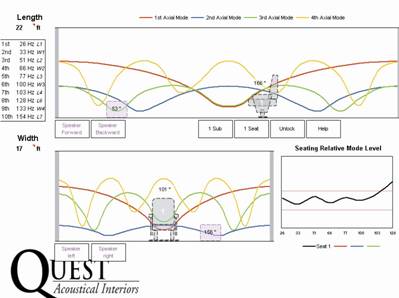
The tool shows axial modes of two dimensions relative to the seat position. Why two and not three? Well, if you think about it how many people place the sub off of the floor?! You can see in the picture the pink box represents the sub and it is 53" from the front wall and 156" from the right wall. Take special notice to the "Seating Relative Mode Level" curve; those are the peaks and nulls and that's as smooth as I could get it with one subwoofer. This position is not an aesthetic one and everyone would be tripping over it.
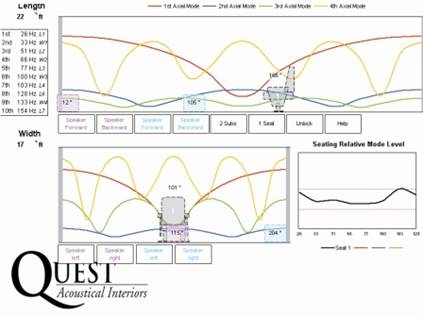
PSB eventually sent another subwoofer (they even recommend using two in the Owner's Manual). The manual states that two subs not only give an increased output but also smoothes the response better than one sub. Now look at the response for 2 subs. Remember that above 80 Hz the response doesn't matter because that is where the cutoff frequency is of the subs. You can see how much smoother the response is for 2 subwoofers and that they are now both against a wall. These positions should not change no matter what subwoofers are used, but to really tweak it, Real Time Analyzer measurements should be taken. I did not use the subwoofer crossover; instead I let my processor do the work via the subwoofer output. Finally, I set all speaker levels using a Radio Shack SPL meter and all distances accordingly.
PSB Alpha System Listening Tests
Despite some of the physical shortcomings of these speakers I was quite impressed with their sound. While you read my subjective comments please keep in mind that these are entry level speakers. I compared them to much higher end speakers and I never expected the PSBs to perform to the same level.
As always I do a two-channel audition of the main speakers prior to evaluating the entire speaker system as a whole. If the main speakers perform well with two-channel music then the other speakers will most likely follow. I listened to the T1s at first without the sub and with the processor configured for "Large" speakers just to get an idea about their bass extension. Of course I did not expect much from this test from only 5.25 inch drivers. Even though they play down to 55 Hz there was no authority; the subs were definitely a must. I listened to quite a few songs without any sub and then listened to them again with one sub. Obviously there was a lot more bass extension but it was just added bass and not as seamless as I would like. Later when I received the second sub I could definitely hear the bass even out which I would describe as a fuller bass sound which was much more seamless. My listening comments to follow are based on the final position of the speakers with good off axis absorption.
 Yes:
The Ladder
Yes:
The Ladder

Involvement is probably the most important aspect of music listening. After all, what is the point of listening to music if the listener can't get involved? Yes The Ladder is an excellent CD for these qualities. I noticed right off that the Alpha T1s were fairly involving. The beginning of this CD was so upbeat and moving that it made me want to keep listening. I noticed how smooth the midrange was from Jon Anderson's voice and also how forward it sounded. On "Be a Good Day" which had more bass I felt the cabinets to see how much vibration there was and it was very minimal. Again, those 5.25" drivers are not going to rattle too much. When I got to "Lightning Strikes" I turned up the volume and, as I got to a level comfortable for my room, the 5.25" drivers started to compress but not too much. They did not have the clarity that my reference speakers have but again these are entry level speakers and they were sounding pretty good. When I got to the song "Face to Face" the involving character seemed to diminish compared to the previous songs. It would be very interesting to see if some diffusion panels placed on the side could help change the involving character of these speakers. My guess is that it would. I never used to be a big fan of metal dome tweeters because they tended to sound harsh. Metal domes have come a long way over the years and the designers have learned to deal with their harshness (typically through resonance dampening). These tweeters did not sound harsh at low to moderate volumes.
Enya: Shepherd Moons
 Next
up in my audition was Enya's
Shepherd Moons
CD. With all of the layers of Enya's
voice in tracks like the popular
"Marble Halls"
it created a light wispy airiness that
should come out of the speakers as if they had become completely transparent.
As I listened,
the PSB T1s made her voice sound forward and open.
Next
up in my audition was Enya's
Shepherd Moons
CD. With all of the layers of Enya's
voice in tracks like the popular
"Marble Halls"
it created a light wispy airiness that
should come out of the speakers as if they had become completely transparent.
As I listened,
the PSB T1s made her voice sound forward and open.
They also portrayed the sibilance from her voice although they were not quite as airy as I am used to with my reference speakers and each word sung was not very succinct.
Detail and dynamics go hand in hand. When the playing levels of the recording are soft the same details should be heard as when the playing levels are loud. The Heart Throb track from the Flim and the BB's "Big Notes" CD does a good job of dynamics and detail. The sax sounded smooth and the keyboards sounded full. The T1s definitely had the full sound that this track exhibits. I had the volume at a moderate level and the dynamics were okay. "Funhouse" is totally synthesized but gives some awesome details with its pseudo instrument sounds. The kick drum sounded tight but the PSBs did not portray the detail that I normally hear in this track; the sounds were merged together. The highs were a little harsh and the low frequencies did not play nearly low enough though they stayed within the parameters of the system.
 "Malcolm Makes Haaj"
is all instrumental and it exemplifies
the sound stage and imaging.
It starts with a sax solo just to the right of the center and then
goes into a drum solo to the back of the stage.
After the drum solo finishes the trumpet player
starts his solo playing to the front left of the stage and finally the track finishes with a piano
solo just behind the trumpet player.
Good reproduction places these elements properly from side
to side and front to back.
The PSBs did an excellent job of placing these instruments on stage.
They had enough realistic presence that I could imagine the sax player standing on stage.
When
I turned up the volume, the T1s suffered from compression as I expected from smaller
drivers.
"Malcolm Makes Haaj"
is all instrumental and it exemplifies
the sound stage and imaging.
It starts with a sax solo just to the right of the center and then
goes into a drum solo to the back of the stage.
After the drum solo finishes the trumpet player
starts his solo playing to the front left of the stage and finally the track finishes with a piano
solo just behind the trumpet player.
Good reproduction places these elements properly from side
to side and front to back.
The PSBs did an excellent job of placing these instruments on stage.
They had enough realistic presence that I could imagine the sax player standing on stage.
When
I turned up the volume, the T1s suffered from compression as I expected from smaller
drivers.
Patrick O'Hearn's "Trust" CD is what I use for the subwoofer tests. It was sufficiently loud and with 2 subs it was very smooth but as I mentioned it just did not play low enough for my tastes. With the volume turned up I could also hear chuffing through the port. In a smaller room with room gain you probably wouldn't have the subwoofers up this high.
For some vocal tests I put on "Into the West" by Annie Lennox. Her voice sounded a little boxy and not as open as I wanted, but then I put on Suzanne Vega's "Tom's Diner." I was very surprised at this point to hear a lot of clarity here. I also got a good sense of realism as if she were in the room. I completed my two-channel audition with Steely Dan's "Two Against Nature." I liked the bass guitar performance through the PSBs and aside from the snare drums lacking some snappiness Fagan's voice was plenty forward. The overall sound was full with fairly authoritative bass.
I have a few SACDs and my favorite for auditioning is Tchaikovsky's "Overture of 1812." The resolution of this music is beyond anything else I own. The digitally recorded cannons will go beyond the testing of any subwoofer if indeed it can survive. The multi-channel recording is superb, only the recording hall's ambiance is put into the side channels. The PSB Alpha system did a fair job with this performance. With a moderate volume the softer passages were clear and fairly distinct but as the passage became louder the sound began to blur. The part with the digitally recorded cannons has the cannons firing from each side of the room to sound like two sides of the war. I could clearly hear that in the PSBs but there was no impact from those cannons. So while the upper harmonic frequencies were clear the lower harmonic frequencies were not there, eliminating the impact of this passage. The good thing was that there were no ill sounds or damage to the subwoofers. I guessed at this point that there was a high pass filter in the sub to prevent damage. I much prefer this method to the sound of the voice coil/former slamming into the magnet and I've done that quite a few times with various subwoofers which have put some out of commission.
Upon completion of my music audition, I perused through a couple movie tracks. The main things I look for in movie playing are: Could I understand the dialogue? Was the music in the movie involving? Are the low frequency effects impactful? and Is the sound panning believable (i.e. images and sound moving left to right and front to back)? One really great movie for testing an AV system is Finding Nemo . Not only is the video quality excellent, but so is the sound. The mine explosion scene has some of the most taxing effects on a subwoofer I've heard. Again, the SubSonic 5i's did not have the impact that this scene demands but there was no distortion either.


For dialogue, the C1 as a center speaker did a nice job. I could understand the dialogue clearly on most scenes though there seemed to be some times where it was a little harsh. Another movie I like to use for reviews is Lord of the Rings: Return of the King. One of the added scenes carries great dialogue and special effects. It starts off with Treebeard's voice panning from the right to the center and the Alpha's did a good job. The tonality was consistent and the volume was consistent which is exactly how it should be. The dialogue was clear and well understood in this scene. There was something missing though in the envelopment of the special effects. I think it was a combination of the low impact subs and my room.
PSB Alpha System Conclusion
It may be hard to tell from some of my comments whether I think that the PSB Alpha's are good or not, so let me clear the air and say that they are great speakers for a system price of $2205. I will say that I don't believe that these speakers are suited for a room such as mine. I have a good sized room (22.5' x 17' x 10' ) and the Alpha's just do not have the dynamics to fill the space. I found some physical shortcomings but I don't think that they really have an impact on the overall sound and performance. While the subs do not have a great low-end extension I think they would have plenty of impact in a smaller room than mine and they would perform without distortion. After quite a few hours of listening I never found the system to be fatiguing. There are a lot of pluses and this was a great performance for an entry level speaker system which would provide years of service. I suggest that if this is the budget that you are looking for that you definitely consider the PSB Alphas.
The Score Card
The scoring below is based on each piece of equipment doing the duty it is designed for. The numbers are weighed heavily with respect to the individual cost of each unit, thus giving a rating roughly equal to:
Performance × Price Factor/Value = Rating
Audioholics.com note: The ratings indicated below are based on subjective listening and objective testing of the product in question. The rating scale is based on performance/value ratio. If you notice better performing products in future reviews that have lower numbers in certain areas, be aware that the value factor is most likely the culprit. Other Audioholics reviewers may rate products solely based on performance, and each reviewer has his/her own system for ratings.
Audioholics Rating Scale
 — Excellent
- — Very Good
- — Good
- — Fair
- — Poor
| Metric | Rating |
|---|---|
| Build Quality | |
| Appearance | |
| Treble Extension | |
| Treble Smoothness | |
| Midrange Accuracy | |
| Bass Extension | |
| Bass Accuracy | |
| Imaging | |
| Soundstage | |
| Dynamic Range | |
| Performance |  |
| Value | |
Ken Stein is a contributing writer and reviewer for Audioholics and he really REALLY likes his speakers (which he should, since he spent countless hours hand-crafting them himself.) Ken is an engineer with FedEx and applies his diligent attention to detail to his speaker and electronics reviews here at Audioholics.
View full profile Subscribe to our newsletter