


Mordaunt-Short Performance 6 Series Loudspeaker System Review
- Product Name: Performance 6 Series Speaker System
- Manufacturer: Mordaunt
- Performance Rating:


- Value Rating:
- Review Date: September 28, 2005 20:00
- MSRP: $ 6500/pr
|
Features: Sensitivity: 89dB |
Drive units: 2 x 165mm (6.5") aluminum 3rd generation CPC woofer 1 x 100mm (4") aluminum 3rd generation CPC midrange 1 x 25mm (1") aluminum dome tweeter Crossover: Damped 2nd order Recommended amplifier power: 15 – 250 watts Dimensions: 9” W x 48” H x 15" D (240 x 1210 x 370mm) Weight: 66 lbs (30kg) |
Pros
- Excellent bass extension
- Clean, uncompressed highs
- Can play loud
- Beautiful, elegant design with high appeal
Cons
- Full surround setup not yet available
- Midrange could be fuller
Performance 6 Unpacking and Build Quality
It was last year at CEDIA (yes last year, 2004) that we caught our first glimpse of the Performance 6 loudspeakers from Mordaunt-Short. The reception was incredible as the rather elegant looking speakers were shown off and the new era of Mordaunt-Short was emerging in phoenix-like fashion. Rather than make excuses as to why it took us so long to get to a review, let me just say that it was well worth the wait and allow you to read on.
Unpacking and First Impressions
When the Performance 6 loudspeakers arrived via FedEx Ground I had no idea they would be as large and heavy as they proved to be. The speakers ship face down, individually boxed and surrounded at critical points (top, bottom, middle) by firm foam which is molded to the contours of the loudspeaker. A thick nylon carrying strap is placed within the box around the entire loudspeaker assembly. Via two convenient slots in the top of the box you can perform a simple two-man lift using the straps. These are the first speakers I' ve encountered that sported such a packaging system. It really worked and made sense, considering each speaker weighed in at just over 66 lbs each (much more with the packing materials).
Once I opened the boxes and removed the top protective board and foam, the speakers were shown to be wrapped in a protective cloth and gloves were even provided to aid in setting up the system without leaving visible oils or fingerprints on the polished enclosures. Spikes are available for the bottom as an option and could be screwed in- though users should take care to only tilt the loudspeaker down while on carpet or some other cushioned surface- and only on its side, never on its front or back. I quickly "spiked" the Performance 6 speakers and set them up for a closer look.
Build Quality
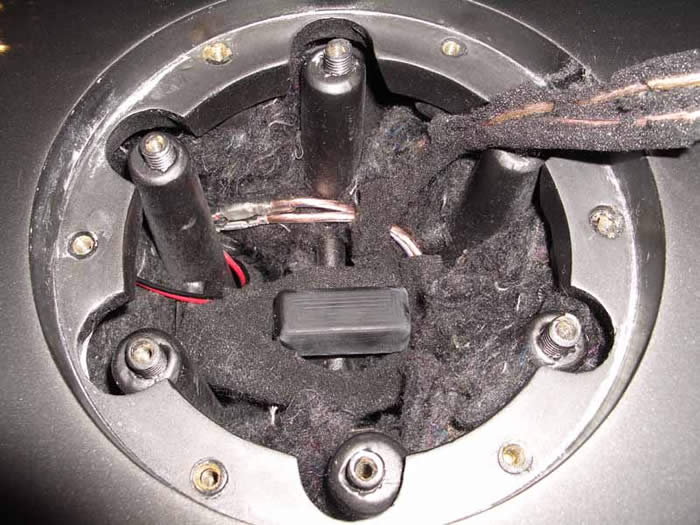
We were fortunate enough to be able to speak with Mordaunt Short designer/engineer Graeme Foy about the design and build concepts that went into the Performance 6. The Performance 6 series was born from the developmental work that went into the newly revamped 900 (Avant) series. Drive units, specifications and engineering were all done in-house at Mordaunt Short. The cabinet design was developed over a period of time as MS designers realized that they wanted something a bit different than could be constructed with traditional wood-based materials. The final monocoque polymer resin cabinet was unique in that curves and varying thicknesses could be used to virtually eliminate resonances within the structure. The cabinet itself is injection molded and the varying thicknesses within gave way to creative acoustical dampening methods. Other enhancement that came out of this style of cabinetry was the ability to literally "float" the drivers off of the front baffle and connect them directly to the rear of the cabinet. If you look at a cross section of the cabinet design you will see how the drivers are secured directly to the rear of the cabinet through a set of six anchor points. This is something that is nearly impossible with a standard MDF cabinet.
 The
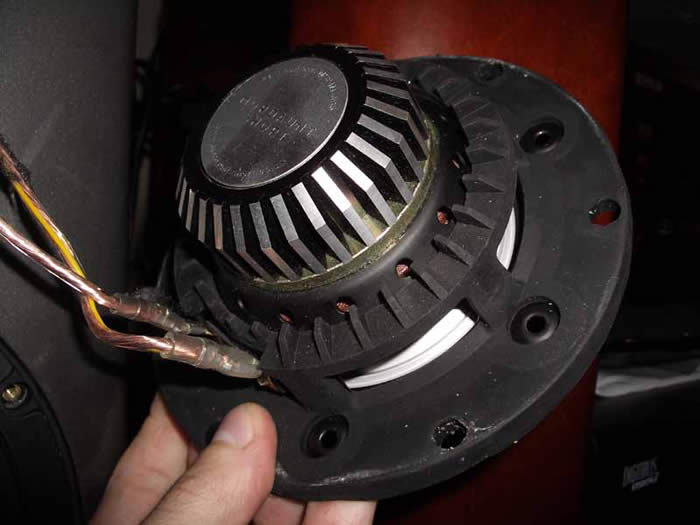
tweeter is a favorite of Graeme and the design team and was specifically developed to address phase
issues associated with traditional tweeters and speaker placement. The noticeable venting
that
exists on the rear of the aspirated tweeter
is tuned across 1.5 octaves and arranged in
a logarithmic spiral such that these slices of the frequency spectrum are intended to recombine with
the originating sound and enhance spatial imaging and overall response. It is designed to have the
advantages of adding a back fill tweeter without adding distortion.
The
tweeter is a favorite of Graeme and the design team and was specifically developed to address phase
issues associated with traditional tweeters and speaker placement. The noticeable venting
that
exists on the rear of the aspirated tweeter
is tuned across 1.5 octaves and arranged in
a logarithmic spiral such that these slices of the frequency spectrum are intended to recombine with
the originating sound and enhance spatial imaging and overall response. It is designed to have the
advantages of adding a back fill tweeter without adding distortion.
The damped 2nd order crossover was especially developed to address the unique nature of the driver complement and enclosure. It is mechanically isolated at the bottom of the loudspeaker and uses polypropylene capacitors. The goal was complete driver integration and minimal distortion. Very slick-looking 3-way nickel-plated bullet style terminals offer the option of bananas, bare cable, or spade connectors. These are possibly my favorite binding posts to-date and I'd love to see them on more loudspeakers (where practical). They can be easily turned, fit banana connectors easily and securely and lock down resolutely.
|
|
|
|
|
Notice the driver is never connected directly to the front baffle. |
The midrange driver has a molded basket and CPC driver. |
The dual woofers are magnetically shielded with a removable rubber gasket that covers the magnet structure. |
|
|
|
|
|
Notice how the voice coil attaches to the CPC. |
The tweeter passes through the entire enclosure, essentially floating in mid-air. |
The crossover is located in the bottom of the loudspeaker, solidly attached to a thick metal base. |


Setup
I wanted to ensure that the Performance 6 speakers would be given a chance to image well, so I placed them about 9' apart and sat about 10' back from the center point (forming close to an isosceles triangle). After doing some experimentation, I found that placing them about 2' from the rear wall and providing a moderate (but not drastic) toe-in provided the best overall imaging and sound. In performing these toe-in tests I moved the speakers in and out quite a bit to get the desired placement. Toeing them in too far resulted in an overly crisp sound, so play around with your particular configuration to get it just right.
 I
wired up the Mordaunt-Shorts using Velocity Speaker Interconnects from Impact Acoustics to the
nickel-plated bullet terminals on the back of each speaker. The Mordaunt-Shorts are capable of being
tri-wired or tri-amped, though I don't see the attraction in "tweaking"
a pair of
speakers at this price point-
but to each his own.
I
wired up the Mordaunt-Shorts using Velocity Speaker Interconnects from Impact Acoustics to the
nickel-plated bullet terminals on the back of each speaker. The Mordaunt-Shorts are capable of being
tri-wired or tri-amped, though I don't see the attraction in "tweaking"
a pair of
speakers at this price point-
but to each his own.
These loudspeakers have an extremely wide dispersion and you can really sit anywhere in between them and get a clean, accurate soundstage (at least more so than with many other systems I've reviewed). There was very little off-axis coloration of the sound, even at the top end. These are the type of speakers you want if you don't plan on requiring people to sit in your lap in order to share the sweet spot.
Perfomance 6 Measurements and Analysis
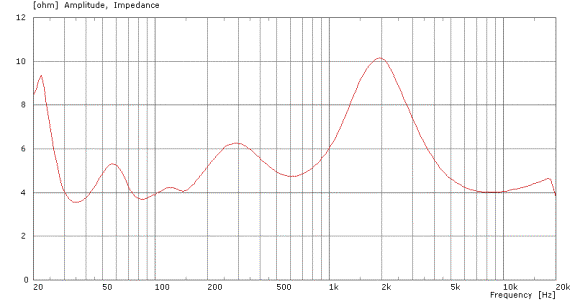
Though the Mordaunt-Short's are a relatively efficient loudspeaker (89dB 1/watt/meter). They appear to be tuned at around 35Hz as specified in their literature. Their impedance profile is reactive in midrange and the overall impedance leans more towards 4 ohms rather than 8 ohms. Thus we recommend partnering these speakers with a solid amplifier that can put out an honest 150wpc or more into 4 ohms with a reasonably low output impedance of under 150mohns for the entire audible bandwidth.
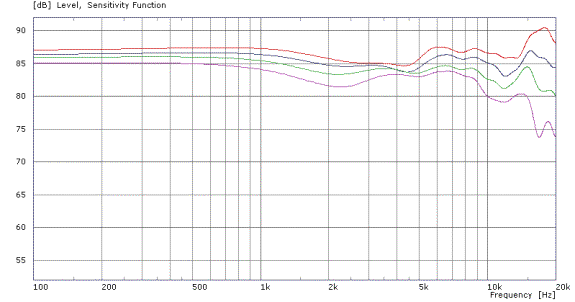
Red trace -
on axis
Blue Trace -
15 degrees off axis
Green trace -
30 degrees off axis
Purple trace -
45 degrees off axis
The tweeter level appears to be set a bit too high as indicated by the +3dB bump at 15kHz (on axis measurement). Though in our extensive listening tests, we never found this to be fatiguing or overly colored sounding. The Performance 6 speakers measured best at 15 degrees off axis, maintaining a ±2dB window from 100Hz to 20kHz. This partly explains why Clint found they sounded best with only a modest toe in. The downward trend in the 2-5kHz region, coupled with the slightly hot top end may also explain why Clint found the upper midrange to be a bit recessed sounding compared to his RBH Sound reference speakers. In any event, the family of on/off axis curves indicate excellent polar response and a very wide listening window which is what Clint experienced when putting these high performance speakers though their paces.
Performance 6 Listening Tests and Conclusion
In setting up the listening sessions I calibrated the system and set the Mordaunt-Short speakers to Large, forcing all information to be sent to the main speakers and bypassing the crossover and subwoofer. As I mentioned, in finding the best position and angle for the Performance 6 loudspeakers I tried a number of tests, but settled on having them toed in slightly more than I am accustomed to, but not such that they were facing me directly (which seemed to narrow the soundstage quite a bit.) Once I was finished I noticed a very pleasing image that was wide and robust. I would recommend listeners take their time and get these speakers perfect as the toe-in seemed to dramatically affect the listening experience.
 Blue Man Group-
The Complex (96kHz/24-bit)
Blue Man Group-
The Complex (96kHz/24-bit)
"Sing
Along", the third track on the Blue Man Group DTS disc was the first song on the album that I
felt had the detail and finesse to let the Performance 6 loudspeakers shine. The vocals were clear and
came through with every nuance, including some of the slight wavering and modulation that appears near
the end. The effect was one of having the group on a stage in front of me, several feet beyond the
speakers and slightly elevated. The low end was firm and punchy, though I think that when the
Performance 9 subwoofer is released the added low end will only make what I heard better. What I felt
important to note was how the Performance 6's 6.5"
woofers never sounded overextended or
flabby. In contrast, the low end was the perfect compliment to what I perceived to be one of the
cleaner high-frequency systems I've heard this year.". I closed
my eyes and the room-filling chorus of this song made it hard to believe that I was listening to just
two loudspeakers. There is an ever-so-short pause in the song, near the end where a sound not unlike a
cross between a chirping bird and a record scratch is left bare in the left channel... or was it mixed
into the left surround (wait a second, there is no left surround!)
The vocals by Tracey Bonham in
this song are a fantastic source by which the incredible sound of the Performance 6's vented
tweeters are left vulnerable. The tonality of her vocals are strong, yet crisp, with a top end that
would be easily compressed or distorted by lesser drivers. The Vented ATT system didn't crumble
under pressure- the results were more than impressive. This is one of my favorite songs on the
album, simply for its effective use of so many diverse elements.
 Jeff Wayne'
s Musical Version of the War of the Worlds (SACD 2.0)
Jeff Wayne'
s Musical Version of the War of the Worlds (SACD 2.0)
This SACD is a 2005 remix of the original 48-track analogue recordings and represents quite simply an
incredible milestone in recording engineering and production. There are a myriad of points along the
story line which present excellent recorded material with which to perceive a loudspeaker'
s range
and capability. Track 2 of Disc 1 features an introduction by Herbie Flowers that has all the detail of
an intimate live performance
舑
drifting from an off-center, raw, almost purposefully sloppy
plucking, to a smoother bass line centered in the immense soundstage. At the completion of the
transition, a reverberant metallic grating effect begins which, in two-channel mind you, filled the
room. It sounded like multi-channel. As this SACD also has a 5.1 mix, I had to double check to ensure I
was listening in 2.0. The imaging and soundstage on these speakers is nothing short of astonishing.
Track 4, "Forever Autumn", performed by Justin Hayward of the Moody Blues, gave me a good mix of guitar, drums, and a smooth male tenor vocal. I found that I could really drive the Performance 6 loudspeakers to high SPLs. I went as high as 95dB at the listening position (and didn't care to go further) without losing definition or having the clarity of the top-end distorted or rendered crispy. Instead, the vented tweeters and 4" midrange seemed to be able to take on a hefty load and serve it up on a silver platter for my ears to enjoy.
On Disc 2, track 5, "Brave New World", you'll get treated to another intimate musical interlude by David Essex (of Godspell fame) which heralded an honest vocal line, complete with breaths and throat noises. The impression was that the Performance 6 speakers had melted away (taking the wall behind with them) leaving only a live performance. The sound was so clean it had me trying to discern the mics and equipment used during the recording engineering process.
 Seal IV (DVD-Audio 88.2kHz/24-bit 2.0)
While not as deep and
enveloping at all times as
Jeff Wayne's Musical Version of the War of the Worlds
,
Seal's latest album features raw vocals and some exceptional guitar and synthesizer work. Track 2 "Get It Together" features some wet vocals that filled the listening room front to back.
The drums, percussion, and bass line were also punchy and firm-
even tactile, as I could feel
the kick drum in my seat as well as the floor. Seal is a fan of placing very low sweeteners into his
music, usually towards the end of at least one track.
In the case of track 3 "Waiting For You" I was treated to a nicely-rounded synth bass as well as horns and strings that positioned themselves nicely back in the sound stage. Near the end, the mix featured a less cluttered breakdown section which allowed some greatly detailed vocals, synth, and piano to come through which I felt were articulately reproduced by the Mordaunt-Short loudspeakers. Track 5 "Don't Make Me Wait" was another track I listened to in order to gauge how well Seal's vocals were carried by the Performance 6's single 4" midrange. The results were satisfactory, though it's hard to substitute (or compare against) loudspeakers with larger multiple midrange drivers.
 Peter Gabriel 3 (SACD 2.0)
Peter Gabriel has some insanely detailed
recordings.
3
is an example of an eclectic mix of some talent-laden pieces. While some may
find this album almost too far out in left field at times there are some gems contained within that
will push a system and help evaluate a loudspeaker's linearity and detail. Track 2
"No Self
Control"
features Gabriel's signature vocal style and a mix that features Phil Collins on
Drums (with a rather narrow mix) and some widely-paned percussion by Morris Pert. The Performance 6
loudspeakers seemed to take higher frequencies and virtually "throw"
them to the back of
the room on some mixes, creating an audible depth of field that put you into a present and realistic
location within the recording.
I picked through several of the busier tracks and found a gem in track 6 "And Through the Wire" which, for a two-channel mix, sent vocal reverb and backing tracks way out front, akin to what I'd expect from a multi-channel mix. The reverb decays were extremely smooth and instrumentation could be easily discerned and differentiated. A ping-ponging, percussive wood black showed just how wide the sound stage could be, seeming to extend well beyond my walls.
Track 7, the popular "Games Without Frontiers" had a very particular mix, with each instrument taking up its position across the front sound stage. Backing vocals and percussion once again filled the room(each time making me want to re-check the surrounds). The whistling present in the track seemed to come from well above the speakers, demonstrating a truly immersive three-dimensional listening experience. In all of the mixes, the Performance 6 speakers never seemed to overextend themselves. Rather, they operated in a way that maximized their range and eschewed distortion in favor of control and precision.
 The Best of R.E.M. In Time 1988-2003 (DVD-Audio 192kHz/24-bit 2.0)
R.E.M. is one of my favorite bands and hearing some of their best tracks played back at 192kHz/24-bit
was quite a treat. "The Great Beyond"
filled the room, its steady synth beat anchoring the
mix, but allowing the smooth reverb and guitars to make their rounds. An off-center drum mix kept this
track more spread out than most and the balancing synthesizers poked through when appropriate whereas
on lesser speakers they would have been lost in the mix. Track 6 "Losing My Religion"
presented a more recessed mix in terms of 3-D space, but did demonstrate a sound stage that was widely
spread out. The melodic bass line in this song came through with great definition and drive. "Orange Crush"
is an enigmatic song that has lots of excellent "pockets"
of
instrumentation within the track. On average speakers the mix will turn to "orange mush"
but on the Performance 6 each instrument was in its place and, if you closed your eyes, you could
really listen to each independent element. "The Sidewinder Sleeps Tonight"
is an upbeat
tune with some nice clear male vocals from Michael Stipe. The Mordaunt-Shorts didn't miss a thing
and if you do not like to hear every nuance in a vocal track you may want to find speakers that
don't have as much clarity.
Comparisons
Just for giggles I did some rather unscientific A-B comparisons between the Mordaunt-Short Performance 6 speakers and my reference speakers to see how they fared against a truncated line array. While the truncated line arrays had a greater amount of midrange clarity (likely due to the larger amount of driver surface area they had to deal with) the Performance 6 speakers felt as if they were a bit more revealing in the low-mids. Keep in mind that I was running the speakers at full range with no subwoofer. I enjoyed the top end and airiness of the Performance 6's tweeter, which was simply a different listening experience than my reference system.
Regarding the low end response capability of the Performance 6 loudspeakers, I queued up "Crazy" from Seal's self-titled album and fast-forwarded to past 5 minutes where he added some super-low sub sweetener hits that accentuate the bass line. The Performance 6's couldn't quite hit them but they didn't smear the remaining bottom end either- which is really what I was looking for, having familiarized myself with the frequency response of the system (that's what subwoofers are for). To put it succinctly - the recording was rendered confidently. I skipped over to track 5 "Whirlpool" and listened to Seal's vocals and acoustics guitar. The Mordaunt-Shorts sounded warm and had slightly more emphasis in the mid-bass than my reference speakers. Overall, the tracks sounded excellent, with tons of detail and plenty of presence. "Show Me" had great synth bass and a kick drum that came through like it owned the place- snappy, deep and firm.
Conclusions
This is a great looking system that is aptly named. What's more- it's the future in that a custom-designed, injected cabinet allows the speaker designers to absolutely control a greater level of nuances within the enclosure's acoustical properties. The results are truly audible and they are without a doubt impressive. I found this system to be extremely viable as a two-channel system for music- but am even more intrigued by the fact that Mordaunt-Short is adding a center channel, subwoofer and surrounds to the line in an effort to take a truly musical system and enable it to be used in a multi-channel environment. This can only take something that is great and lift it up to an even higher plateau. I, for one, can't wait!
About Mordaunt ShortMordaunt-Short has been designing and manufacturing loudspeakers for more than thirty years. Naturally, they have seen a great many changes in that time. Their company has maintained its leading position by consistently responding to - and frequently introducing - new technologies and materials.
The Score Card
The scoring below is based on each piece of equipment doing the duty it is designed for. The numbers are weighed heavily with respect to the individual cost of each unit, thus giving a rating roughly equal to:
Performance × Price Factor/Value = Rating
Audioholics.com note: The ratings indicated below are based on subjective listening and objective testing of the product in question. The rating scale is based on performance/value ratio. If you notice better performing products in future reviews that have lower numbers in certain areas, be aware that the value factor is most likely the culprit. Other Audioholics reviewers may rate products solely based on performance, and each reviewer has his/her own system for ratings.
Audioholics Rating Scale
 — Excellent
- — Very Good
- — Good
- — Fair
- — Poor
| Metric | Rating |
|---|---|
| Bass Extension | |
| Bass Accuracy | |
| Build Quality | |
| Fit and Finish | |
| Ergonomics & Usability | |
| Features | |
| Build Quality | |
| Appearance | |
| Treble Extension | |
| Treble Smoothness | |
| Midrange Accuracy | |
| Bass Extension | |
| Bass Accuracy | |
| Imaging | |
| Soundstage | |
| Dynamic Range | |
| Performance |  |
| Value | |
Clint Deboer was terminated from Audioholics for misconduct on April 4th, 2014. He no longer represents Audioholics in any fashion.
View full profile Subscribe to our newsletter