


Krix Phoenix Floorstanding Speaker Review
Krix Phoenix Floorstanding Speakers
- Product Name: Phoenix Floorstanding Speaker
- Manufacturer: Krix
- Performance Rating:


- Value Rating:
- Review Date: October 27, 2008 09:08
- MSRP: $ 1700
Frequency Range: 35Hz - 20kHz in room response
Power Handling: Maximum 150 watts RMS amplifier power into 4 ohms
Sensitivity: 90dB for 2.83 volts at 1 metre
Configuration: Point source dual 6½ inch 2 way bi-wirable / bi-ampable
Bass Driver(s): Fibre reinforced moulded polymer baskets with 2 x 165mm (6½") doped paper cones. 25mm (1") vented magnet, voice coil wound on high temperature aluminium former
Tweeter: 28mm (1") doped fabric dome. Ferro fluid cooled. Double magnet shielded
Crossover Points: 1.9kHz
Impedance: Nominally 4 ohms
Enclosure Type: Bass reflex, rear vented with internal / external flaring
Dimensions: 935mm high x 205mm wide x 320 deep
Material: 17mm MDF, heavily braced
Finish: Vinyl or lacquered timber veneer
Volume: 39 litres internal
Weight: 19kg each
Pros
- Deep bass
- Small form factor for a floorstander
- Wide soundstage/good off-axis response
Cons
- Limited dynamic range
- Bright highs
- Recessed mids at normal seated position
- Highest fidelity convergence too low for tradition seating
Krix Phoenix
 If you've been around
as long as I have, it is rare that someone mentions a major speaker manufacturer and you don't recognize their name. I'm
embarrassed to admit that this was the case with Krix. Clint had come across
the Krix Phoenix speakers and wanted to set up a review. My first reaction was,
"Sure!" My second reaction was, "Who?" Krix has been around
since in the early to mid 70's. They have both a consumer and commercial line
of speakers. You might have heard their speakers at one of the 80 cinemas they
have installations here in the US
or maybe if you have been to Germany, Korea,
Ireland, Japan, Malaysia and a
few others. All in all, they have over 2100 theaters featuring their speakers. Krix
is the largest and oldest speaker manufacturer in Australia. Their consumer line of
speakers have been slowly crossing national borders and being distributed all
over the world. The fact that I haven't heard of them probably says more about me
than their efforts. The new Phoenix
speakers are an MTM design and retail for $1700 a pair.
If you've been around
as long as I have, it is rare that someone mentions a major speaker manufacturer and you don't recognize their name. I'm
embarrassed to admit that this was the case with Krix. Clint had come across
the Krix Phoenix speakers and wanted to set up a review. My first reaction was,
"Sure!" My second reaction was, "Who?" Krix has been around
since in the early to mid 70's. They have both a consumer and commercial line
of speakers. You might have heard their speakers at one of the 80 cinemas they
have installations here in the US
or maybe if you have been to Germany, Korea,
Ireland, Japan, Malaysia and a
few others. All in all, they have over 2100 theaters featuring their speakers. Krix
is the largest and oldest speaker manufacturer in Australia. Their consumer line of
speakers have been slowly crossing national borders and being distributed all
over the world. The fact that I haven't heard of them probably says more about me
than their efforts. The new Phoenix
speakers are an MTM design and retail for $1700 a pair.
First Impressions and Build Quality
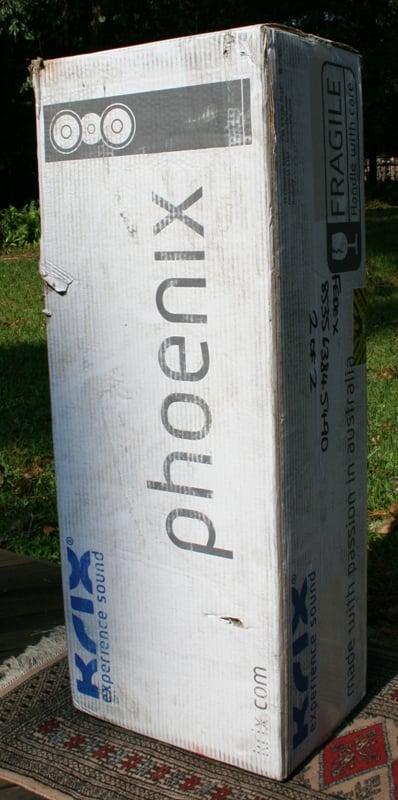 I actually received these
speakers just before leaving for CEDIA this year. I barely had time to set them
up before I left. They arrived well boxed and although the speakers were
undamaged, the same could not be said for the boxes. The speakers are
surrounded by about an inch and a half of foam on all sides and are packaged
very tightly. This will protect the speakers from most bumps and small
punctures but it might not be enough for some of the jostling I see with some
of my deliveries.
I actually received these
speakers just before leaving for CEDIA this year. I barely had time to set them
up before I left. They arrived well boxed and although the speakers were
undamaged, the same could not be said for the boxes. The speakers are
surrounded by about an inch and a half of foam on all sides and are packaged
very tightly. This will protect the speakers from most bumps and small
punctures but it might not be enough for some of the jostling I see with some
of my deliveries.
The speakers are a slight 37" tall and are veneered with real Atlantic Jarrah - a very rosewood looking timber. I'm not a wood expert but I got a kick of telling people that they were "Atlantic Jarrah" and seeing the confused looks. There is a seam around the front and back (basically, the sides, top, and bottom look like they overlap about 1/2 inch). The front panel is veneered and the back is wrapped in textured vinyl. I've seen this same sort of design on other speakers and I'm not a fan. The back doesn't bother me so much but I like the front to be seamless. The top/side transitions are flawless with no perceivable breaks. The edges and corners are a little sharp and I would have preferred a more rounded, less pointy corner look. The grain is very attractive while not standing out. The finish is very flat with minimal reflections.
 The speaker is rear ported about a third the way up the height and
arrived with a foam port plug. The directions enclosed with the speakers
suggested that you remove the port plug unless you plan on placing the speakers
near a wall. I wasn't, so I removed it. The port plug is composed of a dark
gray foam and fits snuggly without being too hard to remove. I'm generally not
a fan of port plugs because people tend to want to use them but the giant
warning from Krix to remove them in most cases made them OK for me. I actually
liked that they were thinking about how to make their speakers sound good in
non-optimal placements instead of waiting until someone called with a complaint
and telling them to shove socks in the ports. There is a small black base
already attached to the bottom of the speakers that overhangs just a bit. It is
flat black and only an inch high. It is beveled and rounded at the front with
the farthest point about an inch from the front of the speaker. The sides overlap
by about 1/4 inch and the back is nearly flush. The rear has two sets of 5-way
binding posts for bi-amping.
The speaker is rear ported about a third the way up the height and
arrived with a foam port plug. The directions enclosed with the speakers
suggested that you remove the port plug unless you plan on placing the speakers
near a wall. I wasn't, so I removed it. The port plug is composed of a dark
gray foam and fits snuggly without being too hard to remove. I'm generally not
a fan of port plugs because people tend to want to use them but the giant
warning from Krix to remove them in most cases made them OK for me. I actually
liked that they were thinking about how to make their speakers sound good in
non-optimal placements instead of waiting until someone called with a complaint
and telling them to shove socks in the ports. There is a small black base
already attached to the bottom of the speakers that overhangs just a bit. It is
flat black and only an inch high. It is beveled and rounded at the front with
the farthest point about an inch from the front of the speaker. The sides overlap
by about 1/4 inch and the back is nearly flush. The rear has two sets of 5-way
binding posts for bi-amping.
 The speaker grill is a latticed plastic design and runs about 4/5ths the
length of the front while taking up most of the width of the speaker. The grill
is definitely a little flimsy from the front but doesn't torque too easily.
Basically, you might break through the front but you won't crack the whole
frame. Just avoid playing baseball in the house and you'll be fine. There is a
Krix logo attached at the bottom of the grill. The grill posts are plastic and
have a ball at the end. They snap securely into place and I detected no
movement or vibration from the grill. I've had experience with the type of
plastic posts used and they have a tendency to break off if you aren't careful.
To me, the grill seems oversized though it does harken back to your more
traditional speaker design where the entire front was grill. People I've shown
these speakers to generally either like the looks or feel they are plain.
You'll need to decide for yourself.
The speaker grill is a latticed plastic design and runs about 4/5ths the
length of the front while taking up most of the width of the speaker. The grill
is definitely a little flimsy from the front but doesn't torque too easily.
Basically, you might break through the front but you won't crack the whole
frame. Just avoid playing baseball in the house and you'll be fine. There is a
Krix logo attached at the bottom of the grill. The grill posts are plastic and
have a ball at the end. They snap securely into place and I detected no
movement or vibration from the grill. I've had experience with the type of
plastic posts used and they have a tendency to break off if you aren't careful.
To me, the grill seems oversized though it does harken back to your more
traditional speaker design where the entire front was grill. People I've shown
these speakers to generally either like the looks or feel they are plain.
You'll need to decide for yourself.
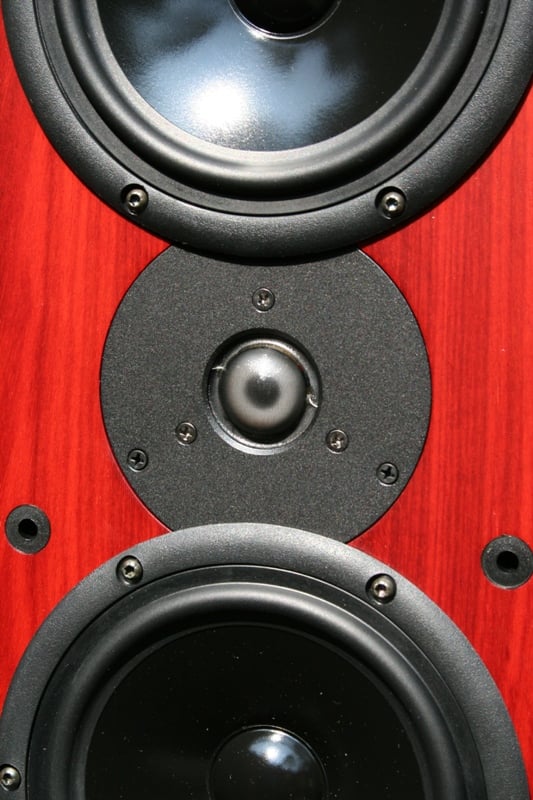
 The Phoenix speakers sport an MTM design with two
6.5 inch woofers and a 1 inch soft dome tweeter. The tweeter is set flush to
the front baffle with the woofers slightly overlapping. I generally don't like
all black drivers on the front of a speaker but these tend to work for me. The
woofers have a sheen to them and the tweeter has a dark spot in the center that
gives the illusion of an eye and appears to be a copy cat design of a Dynaudio
tweeter employed by many manufacturers these days. With the red of the veneer,
this actually looks pretty nice together. The only real problem with the design
is the height of the tweeter. Here at Audioholics (and just about everywhere
except in the engineering department of Dynaudio) we suggest placing the
tweeter at ear height. Either Australians are really short, they sit on the
ground, or the Krix Phoenix was designed to have the tweeter at chest height.
At only 27-1/2 inches off the ground they are a good 10-12 inches lower than
nearly every other floorstanding speaker I've reviewed. I'm operating under the
assumption that this was on purpose and that the speakers are voiced for this
design (and not that I'm supposed to build a stand for them which is ridiculous
for a speaker in this price range and genre it is in).
The Phoenix speakers sport an MTM design with two
6.5 inch woofers and a 1 inch soft dome tweeter. The tweeter is set flush to
the front baffle with the woofers slightly overlapping. I generally don't like
all black drivers on the front of a speaker but these tend to work for me. The
woofers have a sheen to them and the tweeter has a dark spot in the center that
gives the illusion of an eye and appears to be a copy cat design of a Dynaudio
tweeter employed by many manufacturers these days. With the red of the veneer,
this actually looks pretty nice together. The only real problem with the design
is the height of the tweeter. Here at Audioholics (and just about everywhere
except in the engineering department of Dynaudio) we suggest placing the
tweeter at ear height. Either Australians are really short, they sit on the
ground, or the Krix Phoenix was designed to have the tweeter at chest height.
At only 27-1/2 inches off the ground they are a good 10-12 inches lower than
nearly every other floorstanding speaker I've reviewed. I'm operating under the
assumption that this was on purpose and that the speakers are voiced for this
design (and not that I'm supposed to build a stand for them which is ridiculous
for a speaker in this price range and genre it is in).
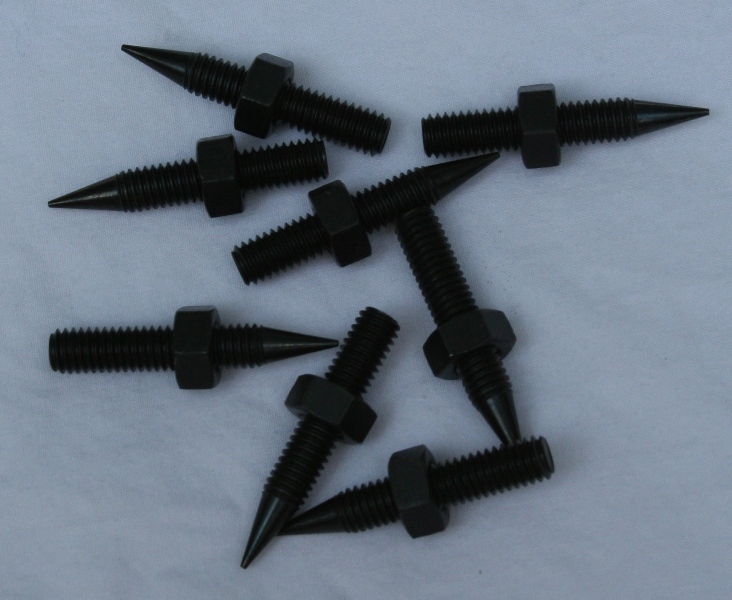 Carpet spikes are provided which
are very similar to the ones I get with many speakers. They are black, thin,
and have an adjustment nut. These spikes are EXTREMELY sharp and can be hard to
work with. With this set, the nut will screw all the way off the end and the
spike will go nearly all the way inside the base if you try hard enough. If you
can't tell, I'm not a fan of these spikes. I'm sure you could buy some
aftermarket spikes if you wanted or an outrigger setup (my preferred solution).
Remember that the base is attached so if you decide to go with outriggers it
might look a little awkward.
Carpet spikes are provided which
are very similar to the ones I get with many speakers. They are black, thin,
and have an adjustment nut. These spikes are EXTREMELY sharp and can be hard to
work with. With this set, the nut will screw all the way off the end and the
spike will go nearly all the way inside the base if you try hard enough. If you
can't tell, I'm not a fan of these spikes. I'm sure you could buy some
aftermarket spikes if you wanted or an outrigger setup (my preferred solution).
Remember that the base is attached so if you decide to go with outriggers it
might look a little awkward.
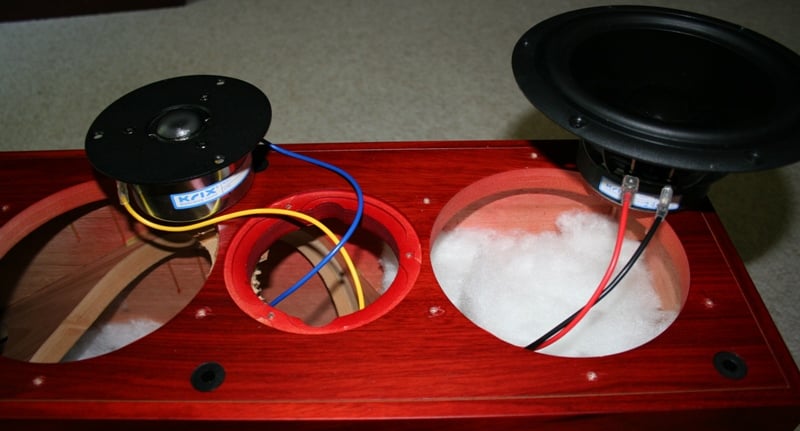
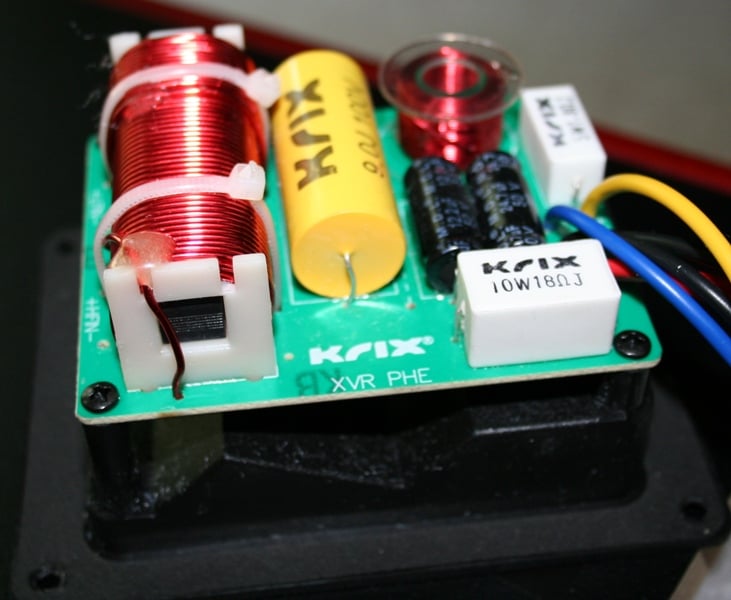
Removing the drivers, I noticed that the woofer baskets were plastic (Krix says - Fibre reinforced moulded polymer). This is actually preferable to a stamped metal basket but not as good as a cast one. The tweeter is very heavy duty and encased in its own metal enclosure. The cabinet is constructed out of 5/8 inch MDF and has two internal braces. The two braces meet on the front baffle between the tweeter and the lower woofer. They run at angles away from this point with the lower one at about 45 degrees and the upper about 30 degrees (I didn't have my protractor on me so don't hold me to that). The bottom and top areas are stuffed with polyfil and they have polyfil glued to the back. The Krix Phoenix responds well to the knock test. They are about as inert as the other speakers I've reviewed in this price range. The crossover is attached directly to the plastic binding post case and uses low gauge air core inductors, and a combination of polypropylene capacitors and electrolytics with ceramic power resistors to pad the tweeter sensitivity down to match the woofer response.
Krix Phoenix Setup and Measurements
 Attaching the spikes was an exercise in frustration, not because they
were hard to attach, but because they were nigh impossible to level. If Krix
had used a spike with a stopping point for the adjustment nut (instead of a nut
that screwed all the way off the spike) I could have had a universal starting
point. Instead I had to just eyeball it (never good enough for audio tweaker
types). There are no rubber feet so I'm not sure what you are supposed to do if
you want to place these speakers on tile or hardwood flooring. I've got carpet
so that wasn't a problem.
Attaching the spikes was an exercise in frustration, not because they
were hard to attach, but because they were nigh impossible to level. If Krix
had used a spike with a stopping point for the adjustment nut (instead of a nut
that screwed all the way off the spike) I could have had a universal starting
point. Instead I had to just eyeball it (never good enough for audio tweaker
types). There are no rubber feet so I'm not sure what you are supposed to do if
you want to place these speakers on tile or hardwood flooring. I've got carpet
so that wasn't a problem.
The first thing I did was experiment with placement. I always place review speakers a minimum of 2.5 feet from any wall so I removed the port plugs as suggested by Krix. This turned out to be a mistake. As you'll see later, the Phoenix are a very bass heavy speaker and I'm not sure how large an auditorium you'll need to place them in before you decide that you don't need the port plugs. I recommend using the port plugs regardless of placement or room size. With the speakers pointed straight out, I was getting a decent center image and wide sound stage. I next tried them pointed directly at me. This compressed the width of the soundstage significantly without an appreciable benefit to the imaging. In the end I decided on a very slight toe-in (like a couple of degrees). You'll definitely want to experiment in your own room though. Overall, the off-axis response of the Phoenix seemed very uniform which will give you a very large sweet spot and make placement very easy.
Measurements & Testing
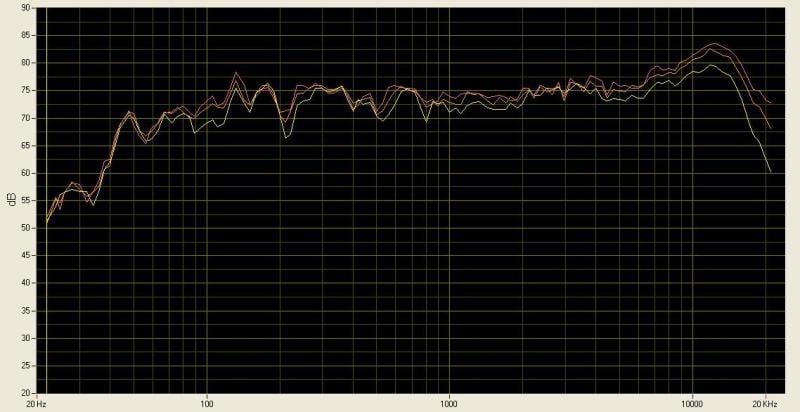
Using the Sencore SP395A FFT Audio Analyzer and a Sherbourn 2/75B amp, I measured the Phoenix's in-room on and off axis frequency response with 1/12th octave resolution with the port plugs in. Generally, what you do when you measure a speaker is look for the conversion point. This is the point where the speakers measure the best. It usually find it a hair below the tweeter. Generally, this is also very near ear height when seated. Thinking that the Phoenix's were voiced differently, I initially thought to make my measurements at ear height - just above the center of the top woofer. I quick glance told me that these measurements were so poor that I had to rethink my strategy. The high end was boosted and the midrange was dropped very low. Fiddling with the mic position for quite some time, I determined that the Krix Phoenix did indeed give me the best measurements just below the tweeter. I'm not sure what was the design goal behind this.

Phoenix 1 Meter Frequency Response (1/12th Octave) On Axis
(note - this is not a 1
watt measurement and is not intended to show efficiency)
Phoenix 1/2 Meter Frequency Response
(1/12th Octave)
Pink - On axis, Orange
- 15 degrees off axis, Yellow - 30 degrees off axis
Disregarding the graph below 200Hz (due to in-room measurement inaccuracies) the on axis frequency response looks fairly linear with the exception of about a +5dB bump above 6kHz. They do exhibit a very uniform off axis response. As you can see, the upper end is voiced very high, likely intentional since the tweeters are so low to the ground. This makes for a bright speaker, especially when pushed hard. With the port plugs out, the bass is also accentuated which subjectively makes the boosted treble not so noticeable but further emphasizes an unnaturally recessed midrange. If you want to know what the other graph looked like, just think of the old “smiley face” V curve with EQ’s.
Phoenix Impedance (port open)
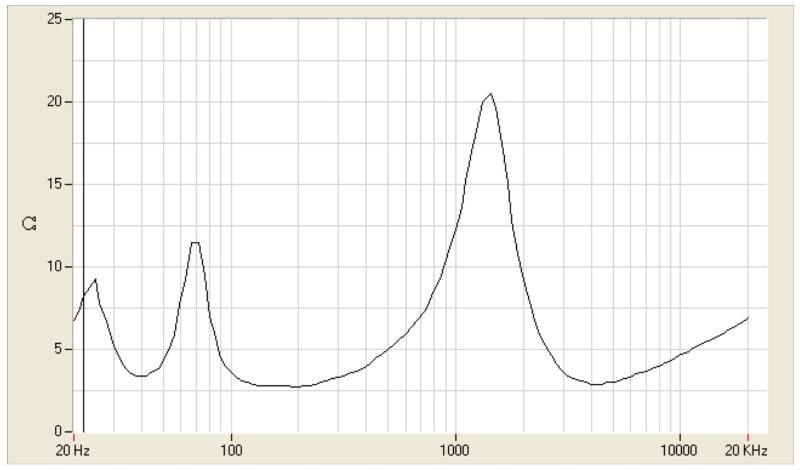
The Sencore consistently measures speakers about 1 ohm lower than they actually are. There is an impedance minima right around the 40Hz tuning frequency. The Phoenix present a fairly easy load that will work with most mid-fi receivers (even though it does dip into the 4 ohm range). Increased amplification would probably be appreciated for those with larger rooms.
Krix Phoenix Listening Evaluation and Conclusion
 The review of the Krix
speakers was done with both a Denon
AVR-2307CI powering a Rotel 1085
and the Emotiva RSP-1/RPA-1
combo. The 4 ohm Phoenix
speakers did fine with both though I preferred the extra oomph the Emotiva amp
provided. I kept the speaker grills off for all of the critical listening
tests. All tests were conducted without the aid of a sub and fed from a Denon
DVD-3910 universal player.
The review of the Krix
speakers was done with both a Denon
AVR-2307CI powering a Rotel 1085
and the Emotiva RSP-1/RPA-1
combo. The 4 ohm Phoenix
speakers did fine with both though I preferred the extra oomph the Emotiva amp
provided. I kept the speaker grills off for all of the critical listening
tests. All tests were conducted without the aid of a sub and fed from a Denon
DVD-3910 universal player.
The first thing I wanted to test was the bass response of the speakers. Using the Rives Test CD II, I noted a significant volume increase at 31.5 and 40Hz without the port plugs. Even with the port plugs, I noticed the same bass bloat (though not as bad). This may be partly caused by cabinet resonance. Generally, though, the Krix claim that the Phoenix reach down to 35Hz is probably correct. During the course of this review, I did a brief comparison between the Krix Phoenix and my reference speakers, the RBH TK-5CTs (cousins to the EMP 30T) which retail for under $1000. I'll mention the results of these comparisons in the text below.
Overall, I found that the Krix had a definite sweetspot on the volume dial. Too much volume and they tended to get bright. Too little and the midrange thinned out. They definitely got muddy in the deepest bass region much like what I'd heard with the Rives CD at 40Hz especially without the port plugs. I decided to insert the port plugs and this pretty much fixed the problem though at the expense of some extension and realism. Assume (unless I say differently) that I was listening to the Krix at the sweetspot on the volume dial.
My biggest decision was where to sit for the review. If I sat on the floor, I'd get all the fidelity that the Krix Phoenix could provide. Unfortunately, I'd also be sitting on the floor (and not on my very expensive theater seating). If I sat on the seating, I might be doing a disservice to the speakers but I'd actually be listening to them they way 99% of my readers would be. In the interest of fairness, I tried both at times. I definitely felt like the midrange was fuller and the imaging a bit better when I was seated on the ground though it didn't do anything to help tame the top end. In the end I decided to write the listening review from the couch for comfort and applicability reasons.
Michael
Buble - It's Time I'm not even sure how I
got this album but I'm sure glad I did. Resonant male vocals fronting a ton of
instruments with a very high production value… it just screams review material.
Michael's voice was well centered in the soundstage regardless of toe-in
accenting the Phoenix's
off-axis response. With the volume cranked, the Krix literally shook the couch
(even with the port plugs). Bass was rich and deep and generally well defined. Overall,
the Phoenix
presented a very warm listening experience. Occasionally, at high volumes, I'd
notice the tweeter getting bright with the trumpets but overall they sounded
very good. Placement of instruments in the soundstage and left/right separation
was a bit better with the RBHs but the overall tonality and experience with the
Krix was much better. The bass was definitely punchier and the overall
presentation was smoother with the Krix though the vocals were fuller with the
RBHs.
I'm not even sure how I
got this album but I'm sure glad I did. Resonant male vocals fronting a ton of
instruments with a very high production value… it just screams review material.
Michael's voice was well centered in the soundstage regardless of toe-in
accenting the Phoenix's
off-axis response. With the volume cranked, the Krix literally shook the couch
(even with the port plugs). Bass was rich and deep and generally well defined. Overall,
the Phoenix
presented a very warm listening experience. Occasionally, at high volumes, I'd
notice the tweeter getting bright with the trumpets but overall they sounded
very good. Placement of instruments in the soundstage and left/right separation
was a bit better with the RBHs but the overall tonality and experience with the
Krix was much better. The bass was definitely punchier and the overall
presentation was smoother with the Krix though the vocals were fuller with the
RBHs.
Lorna Hunt - All in One Day The Phoenix speakers and Lorna didn't get along
well. Without the port plugs, my room rang with bass. With the plugs in, the
bass sounded much better but Lorna's voice got very harsh especially at the
higher registers. I could definitely hear how Michael Buble's lack of high end
(except with some instruments) was practically recorded to be played on the
Krix. When I listened to Lorna's album with the port plugs out, I was so
overwhelmed with bass that I didn't notice the high end issues nearly as much.
The bass was so overpowering, though, that it sounded like it was coming from a
car at an intersection rather than from nice speakers in my home theater. With
the plugs in, the bass sounded much more natural but the problems with the
higher notes was much more noticeable.
The Phoenix speakers and Lorna didn't get along
well. Without the port plugs, my room rang with bass. With the plugs in, the
bass sounded much better but Lorna's voice got very harsh especially at the
higher registers. I could definitely hear how Michael Buble's lack of high end
(except with some instruments) was practically recorded to be played on the
Krix. When I listened to Lorna's album with the port plugs out, I was so
overwhelmed with bass that I didn't notice the high end issues nearly as much.
The bass was so overpowering, though, that it sounded like it was coming from a
car at an intersection rather than from nice speakers in my home theater. With
the plugs in, the bass sounded much more natural but the problems with the
higher notes was much more noticeable.
Bang & Olufsen Vol. XIII - The
Sound of Perfection
There is a ton of
material on this disc that is great for reviews. I focused on Track 5: Aaron
Neville - "I Bid you Goodnight." This track has a number of different
male vocalists giving the full range from bass to tenor. Here I did a serious
comparison between the RBH TKs and Krix Phoenix. Overall the Krix's presentation
tended to be very forgiving with its recessed midrange. Unfortunately, it also
"forgave" some things that were meant to be there. The bassist often
got lost in the presentation which only got worse without the port plugs, whereas
he was clearly audible on my reference speakers. The Krix high end was not as
detailed as the RBHs and the midrange was definitely more recessed. Without the
port plugs, the bass was punchier and deeper than the RBHs but the RBHs seemed
a little more articulate. With the port plugs, the Krix bass was fairly
lifelike but the extension and impact was diminished. The plugged Krix bass
drum wasn't nearly as lifelike as the RBHs which is probably due to the reduced
extension. The imaging again was a bit better with the RBHs especially with the
left/right separation however the Krix definitely had no problem centering the
vocals in the soundstage.
Conclusion
 If you are all about the bass, then the
unplugged Krix will be for you. If your listening tastes tend to favor more
acoustical or vocal type music over rock or hip hop, you may wish to consider
different options. Though they could shake my room with bass. This was unfortunately
at the expense of overall fidelity and accurate music reproduction. The
midrange of the Krix Phoenix was recessed, the highs accentuated, and the
dynamic range was limited. The imaging of these speakers was decent but not as
good as I've heard from others in this price range. While I'm not a fan of the styling
of the Krix Phoenix, they are very well constructed. The soundstage of the
speakers is very wide with respectable off-axis response. If you are really
interested in these speakers, you may want to consider low seating or building
a 12 inch stand for them as it will increase imaging and help with the
midrange.
If you are all about the bass, then the
unplugged Krix will be for you. If your listening tastes tend to favor more
acoustical or vocal type music over rock or hip hop, you may wish to consider
different options. Though they could shake my room with bass. This was unfortunately
at the expense of overall fidelity and accurate music reproduction. The
midrange of the Krix Phoenix was recessed, the highs accentuated, and the
dynamic range was limited. The imaging of these speakers was decent but not as
good as I've heard from others in this price range. While I'm not a fan of the styling
of the Krix Phoenix, they are very well constructed. The soundstage of the
speakers is very wide with respectable off-axis response. If you are really
interested in these speakers, you may want to consider low seating or building
a 12 inch stand for them as it will increase imaging and help with the
midrange.
Krix Phoenix
$1,700 / pair
Krix
14 Chapman Road
Hackham SA 5163
AustraliaT 61 8 8384 3433
About Krix
As a teenager Scott Krix was in love with
sound. Scott tinkered in the garage with kit amplifiers, and made
experimental speakers with scavenged drivers from old radios. Scott had
a dream to make Australian speakers that could compete successfully on the
world market. Scott's dream is now reality. The Krix team manufacture
high quality loudspeakers for home and commercial use. With some
2000 commercial cinema installations globally, you have possibly already
experienced Krix sound. Distributed throughout the world, Krix is at
the leading edge of loudspeaker design. Utilising the latest test
equipment, 3D modeling and computer simulated design technology, Krix's
innovative research and development team is a pioneering force in the
Australian loudspeaker industry. Whether you are looking for your first pair of
stereo speakers or your own ultimate home theatre experience, Krix will exceed
your expectations. Krix's range of loudspeakers deliver the
experience of sound.
The Score Card
The scoring below is based on each piece of equipment doing the duty it is designed for. The numbers are weighed heavily with respect to the individual cost of each unit, thus giving a rating roughly equal to:
Performance × Price Factor/Value = Rating
Audioholics.com note: The ratings indicated below are based on subjective listening and objective testing of the product in question. The rating scale is based on performance/value ratio. If you notice better performing products in future reviews that have lower numbers in certain areas, be aware that the value factor is most likely the culprit. Other Audioholics reviewers may rate products solely based on performance, and each reviewer has his/her own system for ratings.
Audioholics Rating Scale
 — Excellent
- — Very Good
- — Good
- — Fair
- — Poor
| Metric | Rating |
|---|---|
| Build Quality | |
| Appearance | |
| Treble Extension | |
| Treble Smoothness | |
| Midrange Accuracy | |
| Bass Extension | |
| Bass Accuracy | |
| Imaging | |
| Soundstage | |
| Dynamic Range | |
| Fit and Finish | |
| Performance |  |
| Value | |
As Associate Editor at Audioholics, Tom promises to the best of his ability to give each review the same amount of attention, consideration, and thoughtfulness as possible and keep his writings free from undue bias and preconceptions. Any indication, either internally or from another, that bias has entered into his review will be immediately investigated. Substantiation of mistakes or bias will be immediately corrected regardless of personal stake, feelings, or ego.
View full profile Subscribe to our newsletter