


Klipsch Icon V Speaker System Review
Klipsch VF-36 Floorstanding Speakers
- Product Name: Icon V Speaker System
- Manufacturer: Klipsch
- Performance Rating:

- Value Rating:
- Review Date: December 15, 2008 12:22
- MSRP: $ 2059.97 - 5.1 system
VF-36 Floorstanding Speakers ($949.99 pair)
Frequency
response: 36Hz - 23kHz +/- 3dB
Low
frequency extension: 33Hz
Power
handling: 150 W continuous, 600 W
peak
Sensitivity:
97.5dB
Nominal
impedance: 8 ohms compatible
Crossover
frequency: 1780 Hz
Drive
components: Shielded two-way system
utilizing three 6.5" fiber-composite lightweight cone woofers and one
1" aluminum dome tweeter mounted in a 6" square 90º X 90º XT
Tractrix® Horn
Enclosure
material: MDF (medium density
fiberboard)
Enclosure
type: Bass reflex via front flared
port
Dimensions : 45" (114.3
cm) x 8.5" (21.6 cm) x 15.75" (40 cm)
Weight:
55 lbs (24.9 kg)
Finishes: Black vinyl with furniture-grade black wood veneer top cap
VC-25 Center Channel ($279.99)
Frequency
response: 77Hz - 23kHz +/- 3dB
Low
frequency extension: 70Hz
Power
handling: 75 W continuous, 300 W peak
Sensitivity:
93.5dB
Nominal
impedance: 8 ohms compatible
Crossover
frequency: 1900Hz
Drive
components: Shielded two way system
utilizing 2 - 5.25" fiber-composite lightweight cone woofer and 1 -
1" Aluminum dome tweeter mounted in a 4.5" Square 90° X 90° XT
Tractrix horn.
Enclosure
material: MDF (medium density
fiberboard)
Enclosure
type: Sealed enclosure
Dimensions:
7" (17.8 cm) x 21.5" (54.6 cm) x 8.75" (22.2 cm)
Weight:
16 lbs (7.3 kg)
Finishes: Black vinyl with furniture-grade black wood veneer side caps
VS-14 Specifications ($329.99 pair)
Frequency
response: 99Hz - 23kHz +/- 3dB
Low
frequency extension: 92Hz
Power
handling: 50 W continuous, 200 W
peak
Sensitivity:
89dB
Nominal
impedance: 8 ohms compatible
Crossover
frequency: 2000Hz
Drive
components: Two-way system utilizing
one 4.5" fiber-composite lightweight cone woofer and two 1" aluminum
dome tweeters mounted in dual 4.5" square 90º X 90º XT Tractrix® Horns in
a WDST configuration
Enclosure
material: MDF (medium density
fiberboard)
Enclosure
type: Sealed enclosure
Dimensions:
6.75" (17.1 cm) x 15"
(38.1 cm) x 6.5" (16.5 cm)
Weight:
7.5 lbs (3.4 kg)
Finishes:
Black vinyl with furniture-grade
black wood veneer top and bottom cap
Synergy Sub-12 ($500)
Frequency
response: 24-120Hz +/-3dB
Amplifier
power: FTC Rated Power: 300 watts
continuous @ 1% THD, Dynamic Power: 650 watts
Maximum
acoustic output: 117dB @ 30Hz 1/8
space, 1m
Drive
components: 12" (30.5cm)
fiber-composite cone, down-firing woofer
Amplifier:
BASH® digital hybrid
Phase:
Switchable 0-180 degrees
Enclosure
type: Bass-reflex via rear-firing
port
Inputs:
L/R line-level RCA jacks, L/R high
level speaker binding posts
Outputs:
L/R High level speaker binding posts
(passthru)
Dimensions: 18” (45.7cm) H x
15” (38.1cm) W x 19.9” (50.5cm) D
Weight:
40 lbs. (18.2kg)
Features:
Volume, Lowpass, Phase, Auto Power
Finishes:
Black vinyl
Voltage:
110/120 VAC 60Hz
Export voltage: 220 VAC 50/60Hz
Pros
- Dynamic
- Great at moderate volume
Cons
- Fatiguing at higher volumes with music
- Midrange a bit thin
Klipsch Icon V Build Quality
Too often I find myself reviewing and recommending speakers that you can only find at a specialty shop or online. My friends, like yours, don't want to go to a specialty shop and don't like buying speakers online. Frankly, I can't blame them. I've been to specialty shops where, when they aren't trying to hard-sell you speakers, they are telling you that you need esoteric cables. Online sales of speakers are a difficult prospect for an enthusiast much less a neophyte who is just looking to get a deal. The idea of having to pay shipping back or even buy speakers sight-unseen (or unheard) is just too much for many.
Klipsch worked with Best Buy to create the Icon V series of speakers. What does that mean? I'm not entirely sure. On the upside it means that these speakers will be available to nearly everybody. The downside is that Best Buy's influence and reasons behind it are a mystery. Were their design suggestions based on aesthetics and sound or were they based on maximizing profits? Regardless, Klipsch has been a big name is speakers for years. I can't believe that they'd sacrifice sound quality no matter who they partner with.
First Impressions and Build Quality
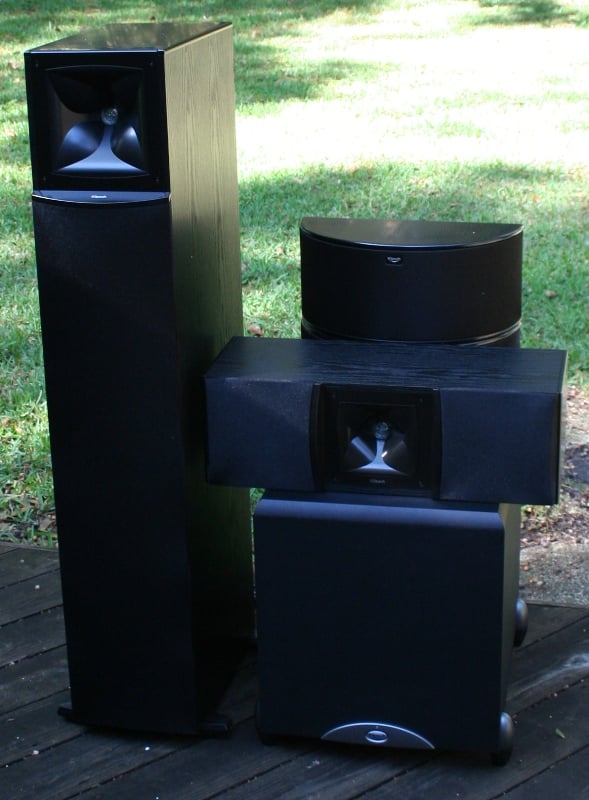 When
the speakers shipped I got a note from the shipper that I had a 500lbs shipment
on the way. I couldn't believe that a 5.1 speaker system could weigh so much.
It had to be an approximation. Well, approximate or not, I got a shipment on a palett
and a driver with a hand truck. All of the speakers were well packed with
molded foam protection all the way around and included manuals. The entire
package was wrapped in plastic and arrived undamaged. The speakers were all in
good condition with no visible marring or scratches.
When
the speakers shipped I got a note from the shipper that I had a 500lbs shipment
on the way. I couldn't believe that a 5.1 speaker system could weigh so much.
It had to be an approximation. Well, approximate or not, I got a shipment on a palett
and a driver with a hand truck. All of the speakers were well packed with
molded foam protection all the way around and included manuals. The entire
package was wrapped in plastic and arrived undamaged. The speakers were all in
good condition with no visible marring or scratches.
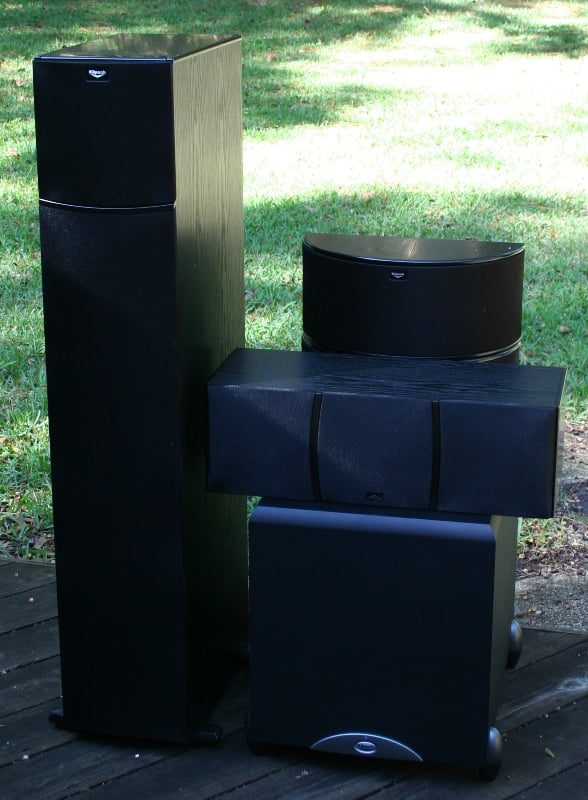
The Icon V series of speakers come in any finish you like, as long as you like black. The grills are black and for the most part do not come off without a screwdriver. Being that these are Klipsch, the only grill that removes easily is the one over the horn-loaded tweeter in the towers and center. The bulk of the speaker is wrapped in a black vinyl with a wood grain finish. The towers have a wood veneered top cap. The center has wood veneered side caps and the surrounds have wood veneered top and bottom caps. The center channel comes with a few sticky pads for placement on a shelf and the surrounds have a single keyhole bracket located just above center for wall mounting. I'd suggest some sort of additional padding on the corners to keep the speaker from making noise should they vibrate against the wall during playback. Double keyhole brackets would probably have helped with this problem. A dedicated wall bracket system could also be purchased.
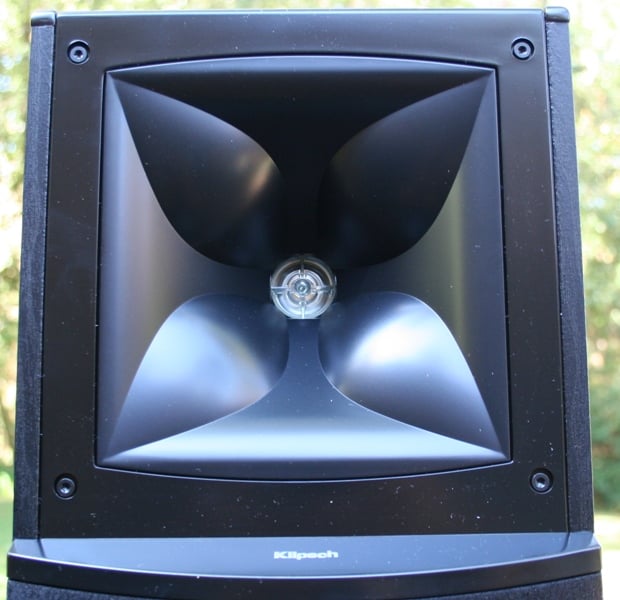 The
build quality of all the speakers seems quite high with heavier than expected
weight and generally low cabinet resonances (as based on the knock test). The
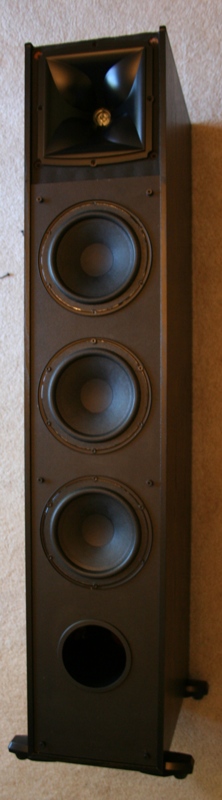
towers have a very high mounted horn-loaded tweeter with three 6.5" woofers below and a front firing port. The
center has a center mounted horn-loaded tweeter and two 5.25" woofers. The
surrounds have two horn-loaded tweeters that fire out at angles with a forward
firing 4.5" woofer. The center and the surrounds are a sealed design. The
Synergy Sub-12 (not part of the V line of speakers, though Klipsch says a sub
is on the way) has a 12" woofer and a larger rear-firing port.
The
build quality of all the speakers seems quite high with heavier than expected
weight and generally low cabinet resonances (as based on the knock test). The
towers have a very high mounted horn-loaded tweeter with three 6.5" woofers below and a front firing port. The
center has a center mounted horn-loaded tweeter and two 5.25" woofers. The
surrounds have two horn-loaded tweeters that fire out at angles with a forward
firing 4.5" woofer. The center and the surrounds are a sealed design. The
Synergy Sub-12 (not part of the V line of speakers, though Klipsch says a sub
is on the way) has a 12" woofer and a larger rear-firing port.
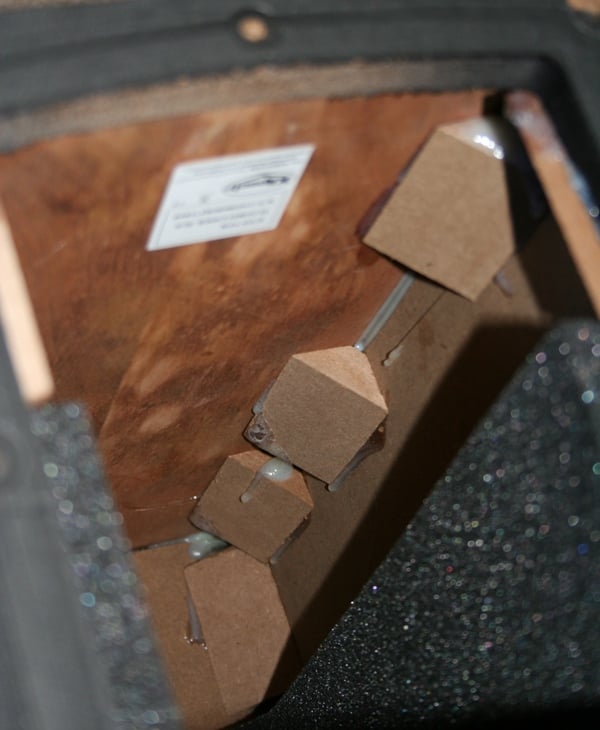
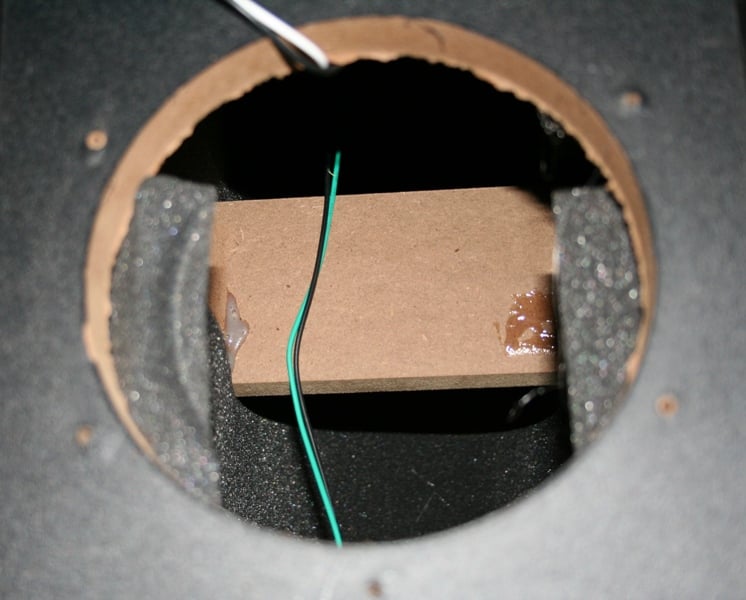
Taking apart the towers, I found they were constructed out of 3/4" MDF, had two braces (1 just below bottom woofer, one near the top one), were well braced at all corners/edges, and had about 1” to 1 ½” dense acoustical foam glued to the sides. The cabinet was very heavy and seemed quite inert for this price point. In order to get the bottom grill off I needed to remove a plastic vanity plate that surrounded the tweeter. Once removed, the bottom grill slid up and off of the screws that held it in place with the help of keyhole brackets on the back of the grill. The sides of the cabinet actually extend a bit past the front baffle. The grill is of the plastic lattice variety which gives the speaker a lot of protection from impacts and prying children's fingers. The grill over the tweeter is held down with magnets of a similar (but better executed) design as the ones utilized with the Emotiva ER series speakers. While I wouldn't mind a slightly stronger magnet, the connection was strong enough that grills weren't popping off too easily.
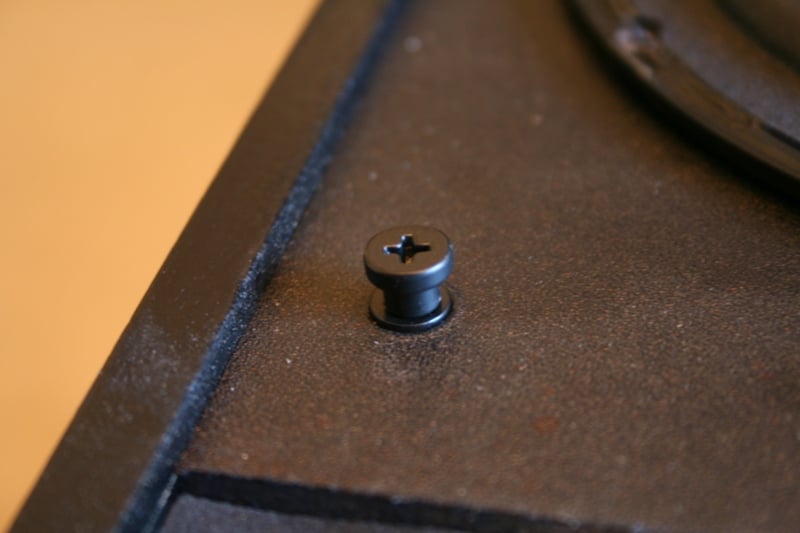
 The outriggers at the bottom of
the speaker look like they are indented into cabinet but they aren't. They are
held in place by two screws and have a round plastic foot. This seems to be an
odd choice. I expected rubber for use on hardwood floors. The feet unscrew a
little for slight adjustments. While there is no reason to think that the
speaker won't work on hardwood or tile (it certainly is heavy enough to make
good contact with the floor), rubber feet would have made this a lot easier.
Plus, rubber wouldn't have been any worse on carpet than the plastic in my
opinion. There is no provision for carpet spikes. Given the audience for these
speakers (Best Buy crowd) that doesn't seem to be much of a strike. The upside
is that the outriggers are easily replaced if you want to install other
aftermarket setups. Also, the plastic feet can be completely removed from the
provided outriggers and theoretically replaced with a rubber foot or carpet
spike.
The outriggers at the bottom of
the speaker look like they are indented into cabinet but they aren't. They are
held in place by two screws and have a round plastic foot. This seems to be an
odd choice. I expected rubber for use on hardwood floors. The feet unscrew a
little for slight adjustments. While there is no reason to think that the
speaker won't work on hardwood or tile (it certainly is heavy enough to make
good contact with the floor), rubber feet would have made this a lot easier.
Plus, rubber wouldn't have been any worse on carpet than the plastic in my
opinion. There is no provision for carpet spikes. Given the audience for these
speakers (Best Buy crowd) that doesn't seem to be much of a strike. The upside
is that the outriggers are easily replaced if you want to install other
aftermarket setups. Also, the plastic feet can be completely removed from the
provided outriggers and theoretically replaced with a rubber foot or carpet
spike.
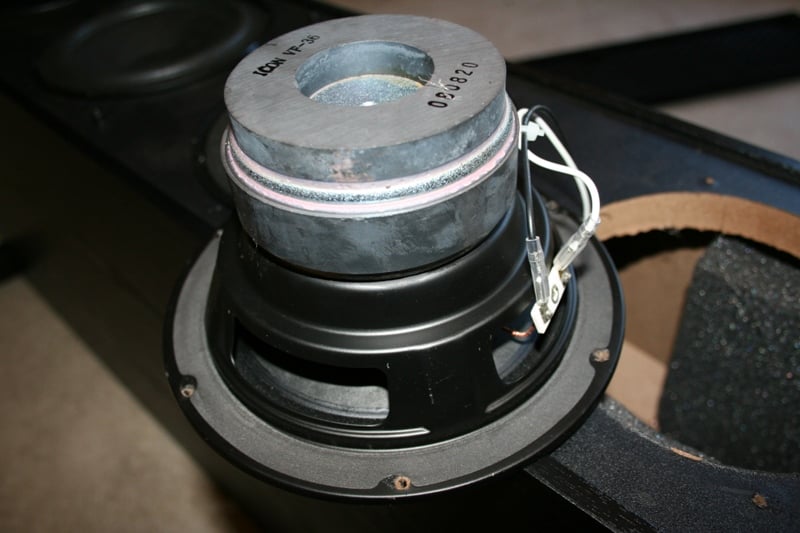
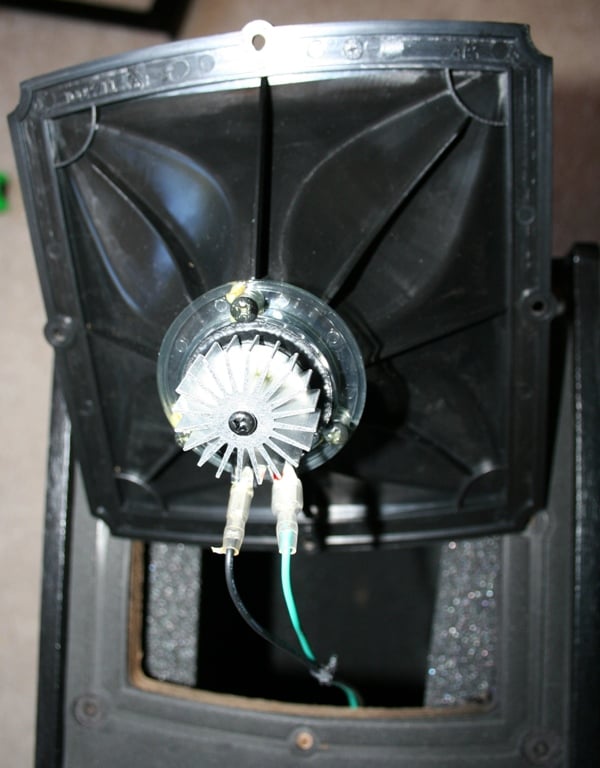
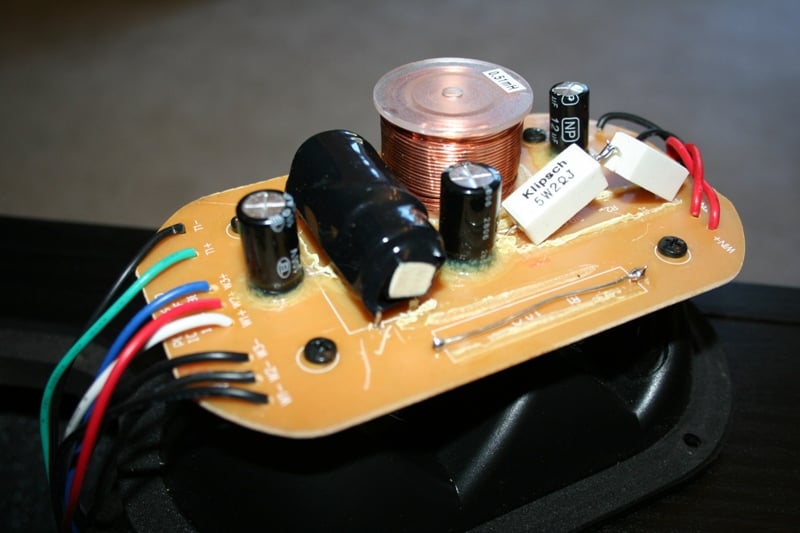
The woofers sport beefy magnet structures and are shielded. The baskets are stamped (rather than cast) which is a little disappointing at this price point. The horn-loaded tweeter has a heat sink on the back and is very lightweight. The crossover is mounted directly to the plastic dual binding post housing and has average quality parts such as iron core inductors and unfortunately all electrolytic capacitors. One wonders how much better these speakers could have sounded with premium air core inductors to minimize core saturation and low ESR polypropylene capacitors instead of the electrolytics.
Klipsch Icon V Setup and Measurements
I set up the VF-36's on either side of the Diamond Case Theater Tech TT-400 Credenza, the center inside, and the surrounds on the StudioTech Ultra-30 stands on either side of my couch. The Synergy Sub-12 took the place of the Axiom EP-500 to the right side of the right main speaker. Most of the system was powered by my Denon AVR-2307CI with SeymourAV 500 watt ICE Block 5001 monoblocks powering the mains. A Denon DVD-3910 universal player did source duties with cabling from Impact Acoustics and Blue Jeans wiring everything together. I set the mains to Large, crossover (which is global on the AVR-2307CI) to 80Hz, and the sub to LFE only.
The Klipsch mains had replaced a set of Salk SongTower QWT's and the center replaced the RBH TK-5C center channel. The first thing I noticed was that I barely had to adjust the calibration on the Denon for the new speakers. The Salks are rated at 88dB efficient while the Klipsch are rated at 97dB. I should have had to make more than the 1-1.5 dB adjustment that I ended up making. This was true for the center and surround channels as well. I was puzzled as the Klipsch speakers didn’t seem to be as efficient as indicated in the specifications.
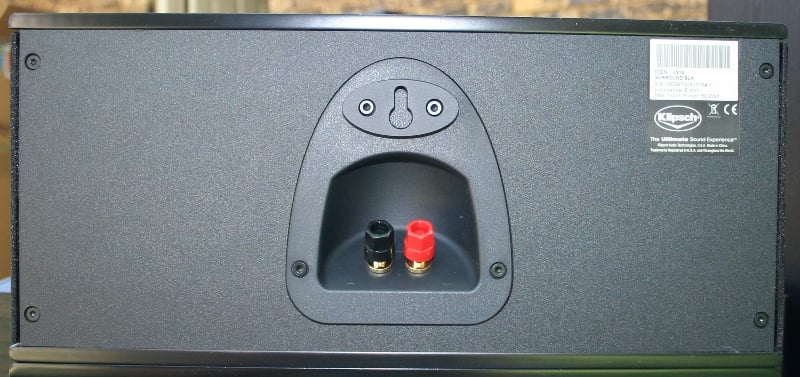 Given that the center and
surrounds are sealed, placement of these speakers was pretty easy without
having to worry about blocking a rear port. It seems as if Klipsch has designed
these to work well near boundaries. I didn't notice any bass bloat from the
in-cabinet placement of the center. The rear port on the sub indicates that you
should probably not butt it against a wall and I had it placed about two feet
away from the back wall and over a foot from the side wall. The front port on
the towers should make placement a bit more flexible in relation to walls
though I still recommend pulling them away if possible. In my setup, they were
no nearer (and generally quite a bit farther away) than 2 feet from any wall.
Given that the center and
surrounds are sealed, placement of these speakers was pretty easy without
having to worry about blocking a rear port. It seems as if Klipsch has designed
these to work well near boundaries. I didn't notice any bass bloat from the
in-cabinet placement of the center. The rear port on the sub indicates that you
should probably not butt it against a wall and I had it placed about two feet
away from the back wall and over a foot from the side wall. The front port on
the towers should make placement a bit more flexible in relation to walls
though I still recommend pulling them away if possible. In my setup, they were
no nearer (and generally quite a bit farther away) than 2 feet from any wall.
I played with toe-in of the mains quite a bit. With the mains pointed directly at me, imaging was tight though the soundstage was constricted. Highs were dynamic if a bit fatiguing. Pointed straight forward, the soundstage was wider but the center seemed a bit thin. I ended up with a very, very slight toe-in (like 2 degrees). This thickened up the center of the soundstage. Overall, these speakers seemed very easy to place and imaged well in most any orientation.
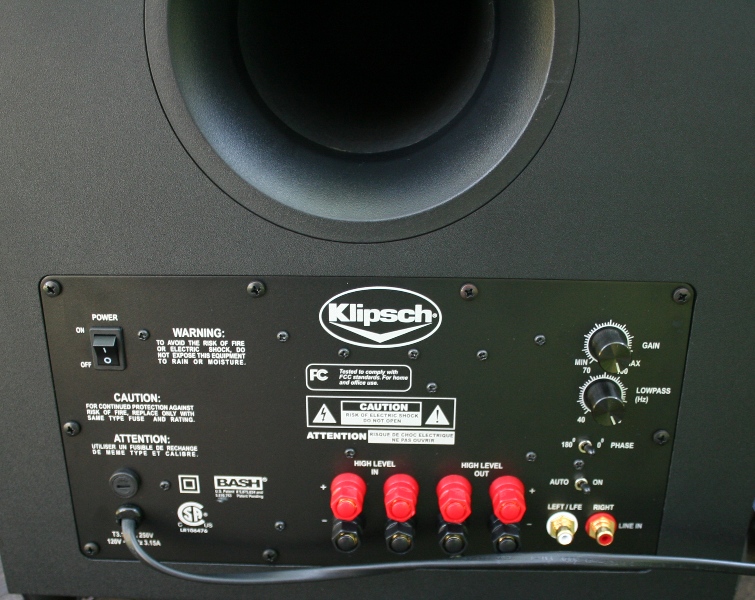 The Synergy Sub-12 is
not really part of the V series so I'll deal with it separately here. The sub
has an LED on the front that shows when the sub is active (blue) or in standby
(red). There is a switch on the back for On
or Auto. I really had a hard time
with this sub as it would go in and out of standby mode at the oddest times.
There were plenty of times when it would come out of standby when there was no
more discernable bass than moments before and would go in when it seemed it
shouldn't. I tried increasing the gain on the receiver's sub output but to no
avail. I'd suggest leaving it on all the time and manually turning it off when
you know it won't be in use for a while.
The Synergy Sub-12 is
not really part of the V series so I'll deal with it separately here. The sub
has an LED on the front that shows when the sub is active (blue) or in standby
(red). There is a switch on the back for On
or Auto. I really had a hard time
with this sub as it would go in and out of standby mode at the oddest times.
There were plenty of times when it would come out of standby when there was no
more discernable bass than moments before and would go in when it seemed it
shouldn't. I tried increasing the gain on the receiver's sub output but to no
avail. I'd suggest leaving it on all the time and manually turning it off when
you know it won't be in use for a while.
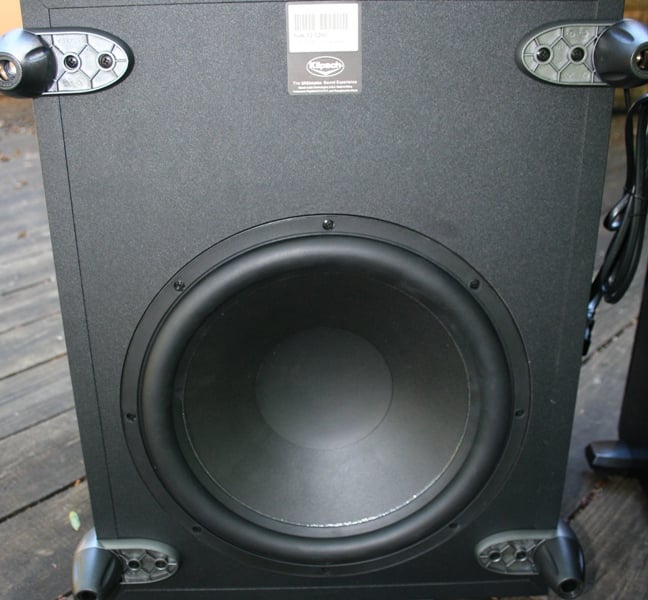 The sub itself is fine
for a $500 sub but didn't really strike me as a great all-around performer. At
first I set the mains to large and the sub to LFE+main. With some content this
was OK but for much of it the sub made the lower midrange/upper bass sound
muddy and ill-defined. In the end, I had to relegate the sub to LFE duties
only. Output was fine with the sub though I've definitely had more tactile
experiences. I hope that the Icon V series offering will be a step up from the
Synergy Sub-12.
The sub itself is fine
for a $500 sub but didn't really strike me as a great all-around performer. At
first I set the mains to large and the sub to LFE+main. With some content this
was OK but for much of it the sub made the lower midrange/upper bass sound
muddy and ill-defined. In the end, I had to relegate the sub to LFE duties
only. Output was fine with the sub though I've definitely had more tactile
experiences. I hope that the Icon V series offering will be a step up from the
Synergy Sub-12.
Measurements & Testing
For laboratory measurements I used the Sencore SP395A FFT Audio Analyzer and a Sherbourn 2/75B amp, I measured the VF-36's in-room on- and off-axis frequency response with 1/12th octave resolution. Klipsch is one of those manufacturers that never provide frequency response graphs for their speakers. That being said, I was curious as to what I would find.
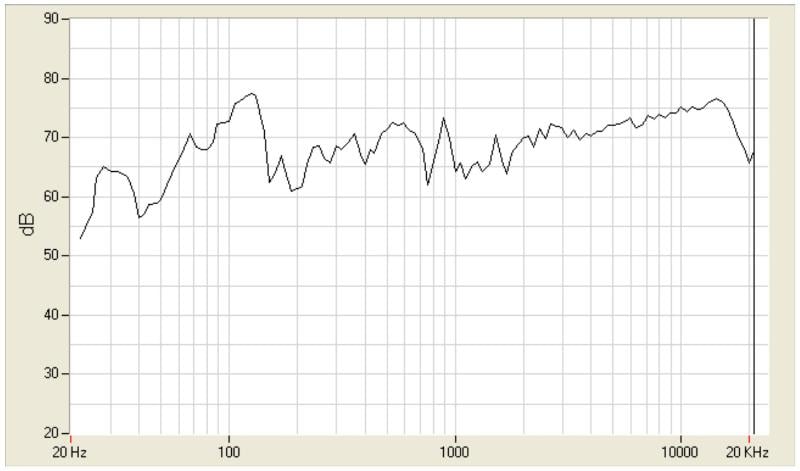
VF-36 1 Meter Frequency Response
(1/12th Octave) On Axis
Note
- this is NOT a 1 watt measurement
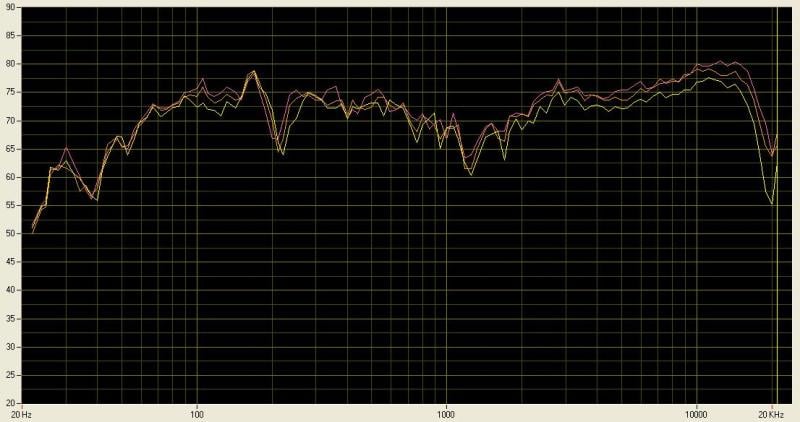
VF-36 1/2 Meter Frequency Response
(1/12th Octave)
Pink - On axis, Orange - 15 degrees off axis, Yellow - 30
degrees off axis
Overall the frequency response of the VF-36s were fairly linear aside from a slight dip in the lower midrange response which seems almost deliberate to give the speaker a more boom and sizzle sound that would lure people into a noisy showroom floor. Given the woofer alignment, some of the dip could also be attributed to driver lobing with respect to the distance of the mic. I suspect the frequency response will flatten out further towards the listening position.
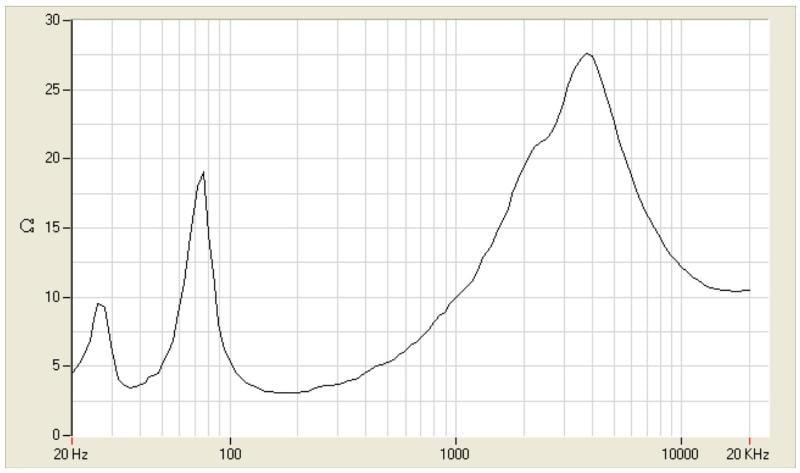
VF-36 Impedance
The Sencore consistently measures impedance one ohm low. These speakers are roughly 6 ohm which Klipsch rates at 8 ohms probably do to their above average sensitivity. They should be an easy load for virtually any decent A/V receiver to drive them. The low pass and high pass aren’t as well integrated as they could be, but it could be deliberate depending on the individual driver responses to achieve better acoustical summation.
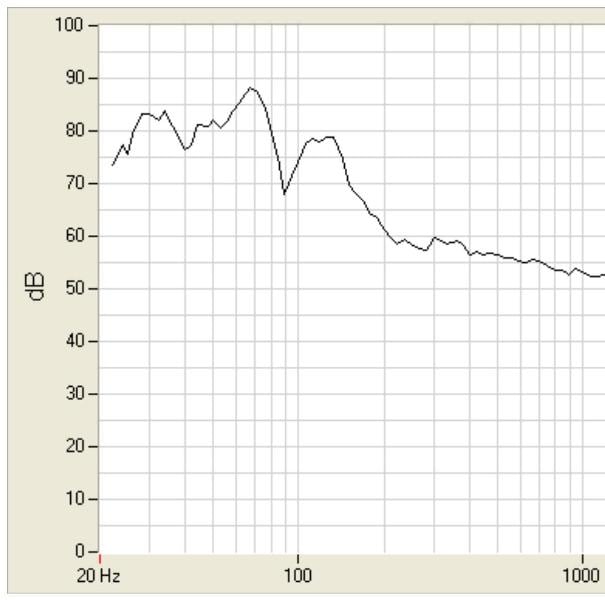
Synergy Sub-12 In-room Ground Plane Measurement
Lastly, I thought I should get some sort of idea of how the Synergy sub measured. The -3dB point seemed to be 26Hz which is close to specifications.
Klipsch Icon V Listening Tests and Conclusion
 Starting off, I wanted
to see what the VF-36's could do with bass. Grabbing my trusty Rives
Test CD II, I played a few test tones to see what they could do. Klipsch
rates the speakers down to 36Hz and that seemed about right to me. I was
hearing output at 31.5Hz but it was lower than the 40Hz tone. With some corner
loading and perhaps the right room, you could do without a sub for some music.
I felt that for most music and all movies, you'd definitely benefit from a sub.
Starting off, I wanted
to see what the VF-36's could do with bass. Grabbing my trusty Rives
Test CD II, I played a few test tones to see what they could do. Klipsch
rates the speakers down to 36Hz and that seemed about right to me. I was
hearing output at 31.5Hz but it was lower than the 40Hz tone. With some corner
loading and perhaps the right room, you could do without a sub for some music.
I felt that for most music and all movies, you'd definitely benefit from a sub.
The next thing I wanted to do was to compare the VF-36 towers to the similarly priced RBH TK-5CTs. The TK's are now being sold under the EMP EF-30T brand with pretty much identical MSRP as the VF-36s. The TKs sport dual 5 ¾” fiberglass woofers which gives the VF's an additional mid-bass driver advantage, while the TK's have a side-firing 8" woofer. The TK's drivers are 5.75" versus the VF's 6.5". Of course, the Klipsch has the horn-loaded tweeter versus the TK's 1” silk dome. The Klipsch are bigger all around though I feel about the same about the styling (the Klipsch has a slight edge in my mind over the EMP version). Overall, this is a pretty fair match up.
I listened to a number of different albums during the comparison but the defining one was Yello: the eye. With its smoky female vocals, bass runs, and lots of phase shifts, it is the perfect album for head-to-head comparisons. The Klipsch definitely had a more forward sound especially in the high end. The horn-loaded tweeters were dynamic and responsive if a bit thin at times. The TK's sounded a bit more laid back (in comparison), fuller, and had a bit more bass. Imaging was excellent in both. The Klipsch had plenty of bass but it was a hair less defined than the TK's. The largest difference (which wasn't very large and only reared its head through repeated listening tests) was in the midrange. The RBHs were fuller and sounded more well rounded overall. The Klipsch high end was very dynamic though the midrange seemed to suffer as a result. At this price point, I really believe most people would be happy with either speaker.
DVD-A: Porcupine Tree: Deadwing
and In
Absentia If you are like me,
you've heard one thing about Klipsch - they are great for rock music. Well, it
isn't like I don't have any around, so I popped in a few tracks from the DVD-A
versions of these two Porcupine Tree albums. This gave every speaker in the
system the chance to show off what it could do. The cymbals and higher notes
were well defined and lifelike. The bass was deep, if lacking that tactile
edge. The midrange sounded a little thin which made the highs seems even higher
(if that makes sense). At lower to moderate listening levels, the system
sounded very clean and enjoyable. At higher volumes, I found the tweeter to get
a bit fatiguing and harsh though it never broke up as I've heard with other
aluminum dome tweeters.
If you are like me,
you've heard one thing about Klipsch - they are great for rock music. Well, it
isn't like I don't have any around, so I popped in a few tracks from the DVD-A
versions of these two Porcupine Tree albums. This gave every speaker in the
system the chance to show off what it could do. The cymbals and higher notes
were well defined and lifelike. The bass was deep, if lacking that tactile
edge. The midrange sounded a little thin which made the highs seems even higher
(if that makes sense). At lower to moderate listening levels, the system
sounded very clean and enjoyable. At higher volumes, I found the tweeter to get
a bit fatiguing and harsh though it never broke up as I've heard with other
aluminum dome tweeters.
Xbox 360: Gears
of War 2, Rock
Band 2 When you are playing a
game like Gears of War 2 you aren't worried so much about sound quality - you
are too busy trying not to die. When I was playing the game with Clint DeBoer, Editor-in-Chief of Audioholics, I
found that I was easily able to determine where we were getting shot from by
the surrounds. With two horn-loaded tweeters, the VS-14s seemed like they would
be very localizable and underperforming but they weren't. Out of the entire
setup, the VS-14s were probably my favorite. With music they blended very well
and with point-of-source effects they let you know exactly where they were. They
provided an immersive experience all the while not forgetting they occasionally
needed to let you know where that sniper just hit you from.
When you are playing a
game like Gears of War 2 you aren't worried so much about sound quality - you
are too busy trying not to die. When I was playing the game with Clint DeBoer, Editor-in-Chief of Audioholics, I
found that I was easily able to determine where we were getting shot from by
the surrounds. With two horn-loaded tweeters, the VS-14s seemed like they would
be very localizable and underperforming but they weren't. Out of the entire
setup, the VS-14s were probably my favorite. With music they blended very well
and with point-of-source effects they let you know exactly where they were. They
provided an immersive experience all the while not forgetting they occasionally
needed to let you know where that sniper just hit you from.
Rock Band 2, on the other hand, doesn't really need surrounds as much as it does a good soundstage up front. The front three channels provide the music and lyrics while the back mostly just offers audience noise and a bit of wraparound. I was never want for hearing the music or knowing where I was in a song. The VC-25 center channel blended nicely with the mains and never made me feel like I had anything but a solid front presentation.
DVD: Spiderman
2 If the Icon V series
of speakers really shined anywhere it was with movies and games. I was
constantly amazed at the responsiveness of the speakers and how easily they
went from loud to soft. The VC-25 center channel did an adequate job with
movies though at times it seemed to fall behind the mains (especially at high
volumes). During playback of The
Incredible Hulk, this was particularly noticeable, though that may be
in part because of the mix of the movie. The surrounds really shined here as
well with their ability to dip in and out of my consciousness almost
effortlessly. Imaging between the rear speakers was excellent and pans were
clean and crisp. I've heard a lot of rear speakers in this room and the VS-14's
hold their own nicely.
If the Icon V series
of speakers really shined anywhere it was with movies and games. I was
constantly amazed at the responsiveness of the speakers and how easily they
went from loud to soft. The VC-25 center channel did an adequate job with
movies though at times it seemed to fall behind the mains (especially at high
volumes). During playback of The
Incredible Hulk, this was particularly noticeable, though that may be
in part because of the mix of the movie. The surrounds really shined here as
well with their ability to dip in and out of my consciousness almost
effortlessly. Imaging between the rear speakers was excellent and pans were
clean and crisp. I've heard a lot of rear speakers in this room and the VS-14's
hold their own nicely.
Conclusion
 For music I wasn't in love with the
Icon V series of speakers. The midrange was a little thin and the high end
fatiguing - especially at higher volumes. For movies, TV, and games, however,
the Klipsch Icon V's are a sure ticket to a great experience. Responsive and
dynamic, the group as a whole performs well. The VS-14 surrounds, in
particular, did an excellent job with both ambience and point -source effects.
The VC-25 center was adequate, if not as impressive as the rest of the speakers
in the group. The VF-36 main speakers are built like tanks. If you are
listening at low to moderate volume levels, you're going to be very happy with
the Klipsch Icon V series speakers. If you like it loud, you might want to
stick with movies and games.
For music I wasn't in love with the
Icon V series of speakers. The midrange was a little thin and the high end
fatiguing - especially at higher volumes. For movies, TV, and games, however,
the Klipsch Icon V's are a sure ticket to a great experience. Responsive and
dynamic, the group as a whole performs well. The VS-14 surrounds, in
particular, did an excellent job with both ambience and point -source effects.
The VC-25 center was adequate, if not as impressive as the rest of the speakers
in the group. The VF-36 main speakers are built like tanks. If you are
listening at low to moderate volume levels, you're going to be very happy with
the Klipsch Icon V series speakers. If you like it loud, you might want to
stick with movies and games.
Klipsch Icon V Speaker System
$2059.97
Klipsch Group, Inc.
3502
Woodview Trace, Suite 200
Indianapolis, IN 46268
Phone: 317-860-8100
Toll Free: 800-544-1482
About Klipsch
Founded in 1946 by Paul W. Klipsch,
one of America’s most celebrated audio pioneers, Klipsch® has long been a
high-end name in loudspeaker design. Today, the brand continues its success as
a leading global manufacturer of premium sound solutions for home, personal and
commercial use. From massive professional cinema speakers to tiny headphones,
Klipsch remains committed to delivering the most powerful, detailed and
emotional sound experiences. Family owned and operated, chairman Fred Klipsch
and vice chairman Judy Klipsch set the vision and strategy for the brand as
well as the entire Klipsch Group, Inc. organization.
The Score Card
The scoring below is based on each piece of equipment doing the duty it is designed for. The numbers are weighed heavily with respect to the individual cost of each unit, thus giving a rating roughly equal to:
Performance × Price Factor/Value = Rating
Audioholics.com note: The ratings indicated below are based on subjective listening and objective testing of the product in question. The rating scale is based on performance/value ratio. If you notice better performing products in future reviews that have lower numbers in certain areas, be aware that the value factor is most likely the culprit. Other Audioholics reviewers may rate products solely based on performance, and each reviewer has his/her own system for ratings.
Audioholics Rating Scale
 — Excellent
- — Very Good
- — Good
- — Fair
- — Poor
| Metric | Rating |
|---|---|
| Build Quality | |
| Appearance | |
| Treble Extension | |
| Treble Smoothness | |
| Midrange Accuracy | |
| Bass Extension | |
| Bass Accuracy | |
| Imaging | |
| Soundstage | |
| Dynamic Range | |
| Fit and Finish | |
| Performance | |
| Value | |
As Associate Editor at Audioholics, Tom promises to the best of his ability to give each review the same amount of attention, consideration, and thoughtfulness as possible and keep his writings free from undue bias and preconceptions. Any indication, either internally or from another, that bias has entered into his review will be immediately investigated. Substantiation of mistakes or bias will be immediately corrected regardless of personal stake, feelings, or ego.
View full profile Subscribe to our newsletter