


Fluance XL7F Floorstanding Loudspeaker Review
- Product Name: Fluance XL7F Floorstanding Loudspeaker
- Manufacturer: Fluance
- Performance Rating:

- Value Rating:
- Review Date: May 11, 2012 08:00
- MSRP: $ 499/pair (free shipping)
-
Tweeter: 1" Neodymium Balanced Silk Dome Ferrofluid Cooled
-
Midrange: Dual 6.5" Polymer Treated Butyl Rubber Surrounds Separate Enclosures
-
Subwoofer: Isolated Down-firing 8" Polymer Treated High Excursion with Butyl Rubber Surround
-
18 gauge internal lead wire to reduce signal degradation
-
Magnetically shielded to avoid interference with other video products
-
Floorstanding main configuration for full-range sound in any application
-
Power Handling: 80 - 200 Watts
-
Frequency Response: 45Hz - 20000Hz
-
Sensitivity: 89 dB
-
Crossover Frequency: 800/3500 Hz Phase Coherent - PCB Mounted Circuitry
-
Impedance: 4~8 Ohms
-
Cabinet: Precision Crafted MDF Internally Braced
-
Enclosure: Tuned Rear Port Bass Reflex Tower Design
-
Dimensions: 45.8 X 8.5 X 13.4 inches (H x W x D)
-
Weight: 45.2 pounds/speaker
Pros
- Nice pleasing all around sound
- Respectable craftsmanship
- Incredible value
Cons
- A bit too much upper bass emphasis
- Low impedance load can be challenging for some budget A/V receivers
Fluance XL7F Floorstanding Speaker Introduction
 Over
the last decade or so, Internet Direct speaker companies have been
popping up all over the globe. Fluance has actually been around
since 1997, but they aren’t as well known as some of their
competitors. We’ve heard good things about the brand from our
forum regulars in the past, so when Fluance approached me to review
their new flagship XL7F tower speaker system, I was eager to take
them up on the offer. The Fluance XL7F tower speaker system is a
largish 3-way tower sporting an MTM driver configuration on top with
a passive bass driver at the bottom of the cabinet. They are priced
just under that magic $1k/pair where there is already well
established stiff competition in which this lesser known Canadian
manufacturer must compete with. But WAIT a minute, I misunderstood
their website, the XL7F’s are priced at $499/pair, NOT each, and
that includes FREE shipping! At this price you don’t have too many
viable floorstanding speaker options worth considering. However, the
question remains can Fluance be a top contender based on value and
sound quality alone? Read the review to find out.
Over
the last decade or so, Internet Direct speaker companies have been
popping up all over the globe. Fluance has actually been around
since 1997, but they aren’t as well known as some of their
competitors. We’ve heard good things about the brand from our
forum regulars in the past, so when Fluance approached me to review
their new flagship XL7F tower speaker system, I was eager to take
them up on the offer. The Fluance XL7F tower speaker system is a
largish 3-way tower sporting an MTM driver configuration on top with
a passive bass driver at the bottom of the cabinet. They are priced
just under that magic $1k/pair where there is already well
established stiff competition in which this lesser known Canadian
manufacturer must compete with. But WAIT a minute, I misunderstood
their website, the XL7F’s are priced at $499/pair, NOT each, and
that includes FREE shipping! At this price you don’t have too many
viable floorstanding speaker options worth considering. However, the
question remains can Fluance be a top contender based on value and
sound quality alone? Read the review to find out.
Fluance XL7F Video Review
Fluance XL7F Floorstanding Loudspeaker Design Overview
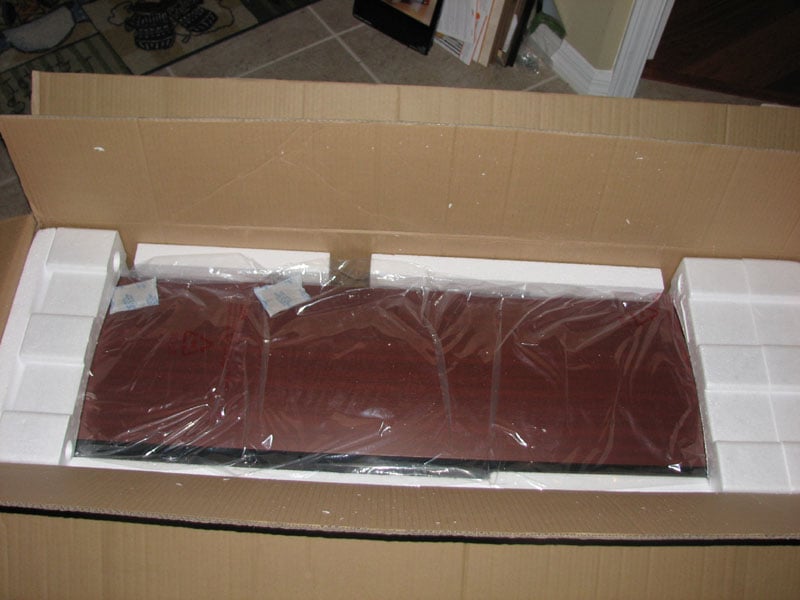
The Fluance XL7Fs were double boxed and encased in foam borders along the circumference of the cabinet ensuring they would arrive safely even if the FEDEX guys gave them a little beating in transit. The speaker was enclosed in plastic wrap, void of the typical velvet sock and Michael Jackson white gloves associated with “high end” gear. The gold plated metal floor spikes/cones were located at the bottom of the enclosure (under the foam padding). I initially missed this, so be sure to take everything out of the boxes before tossing them in the trash.
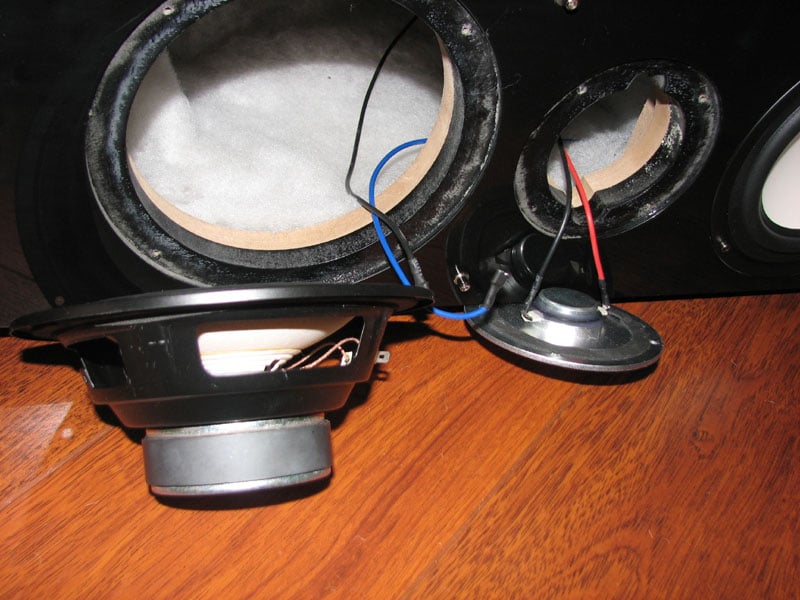
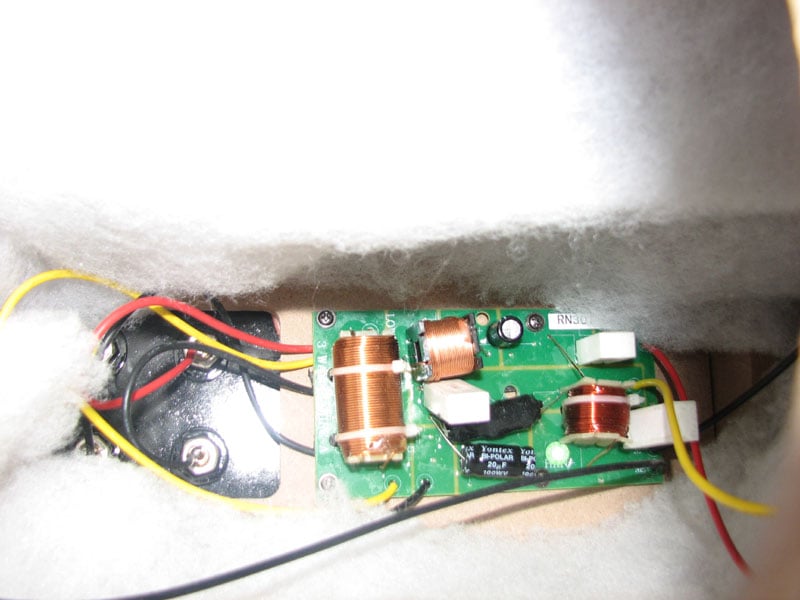
Fluance XL7F drivers (left) ; crossover (right)
The XLF7 is a 3-way tower design, standing almost 4ft tall and sporting 4 drivers. They are designed and engineered in Canada but produced overseas to keep the costs down to the consumer. The top end of the speaker features an MTM driver topology with dual 6.5” drivers and a 1” silk dome tweeter sandwiched in the middle. I initially thought the cone material of the mid drivers was aluminum, based on their whitish hue, but upon closer inspection I realized it was a treated polymer cone. Nevertheless they looked stunning especially with their butyl rubber surrounds. I removed one of the drivers to have a closer look and found a reasonably thick stamped basket (stamped baskets are typical at this price range) and a vented pole piece with piercings in the cone for further cooling (a welcomed and not-so-typical feature). The cone itself was more rigid than I’ve seen from some metal cones the competition uses. The diaphragm appears to consist of two pieces, the main cone and the inner cone affixed to the voice coil which is the one that is vented. This seemed to be quite a well thought out driver for such a modestly priced speaker system. The 1” silk dome tweeter is ferrofluid cooled and features a neodymium magnet structure. Although it’s not vented with a heatsink, it appears to be encased in an aluminum frame to help cool the magnet. Typically these tweeters don’t offer a lot of low end extension (as far as tweeters go), since they lack a rear chamber, so that is why Fluance chose to employ a higher than usual crossover point (3,500Hz). The 8” downfiring polymer treated woofer has one of the thinnest stamped baskets I’ve ever seen and actually slightly rings if you knock on it. The motor structure is also vented and the cone employs a butyl rubber surround. The cabinet is internally broken into two sections: one for the MTM portion which is in a sealed enclosure and the other for the 8” down firing woofer which has a single 3” flared port with a plastic screen to prevent anything from entering the cabinet. Trust me, if you have small children and they love stuffing their legos into obscure places, you will welcome this feature. The cabinet walls appear to be 0.6” thick, but the front baffle is doubled up to make it a whopping 1.2” thick. To achieve the contoured cabinet shape, Fluance employed multiple cuts in the panels instead of the usually preferred, but more costly, method of plaining found on more expensive designs.
The crossover is mounted to the back of the cabinet and contains a mixture of air core inductors for the midranges, steel cores for the bass drivers, ceramic resistors and electrolytic capacitors. This crossover isn’t constructed of the highest caliber parts per se, but this should be of no surprise given the budget of this design. Still, it appears to be a fairly well executed. Fluance claims to employ Butterworth filter networks which are advantageous at reducing passband ripples at the expense of more shallow roll-off rates.
The manufacturer website claims the bottom woofer is crossed over at 800Hz which I confirmed via the groundplane measurement I took of the bass driver in the measurements section of this review. It looks like a 3rd order 800Hz response acoustical plus electrical response (18dB/octave). Personally I would have liked to see this woofer crossed over at a lower frequency to reduce the overlap between it and the mids (more on this later). The mids of the MTM array exhibit a natural acoustical roll off of about 12dB/octave below 70Hz. They are crossed over to the tweeter at around 3,500Hz to reduce cone break up and off-axis beaming. You’ve got to use a pretty darn good midrange to cross over to a tweeter this high and as you will see in my listening tests, Fluance did their homework here. The tweeter appears to employ a 2nd order HPF to increase power handling and ensure better driver integration.
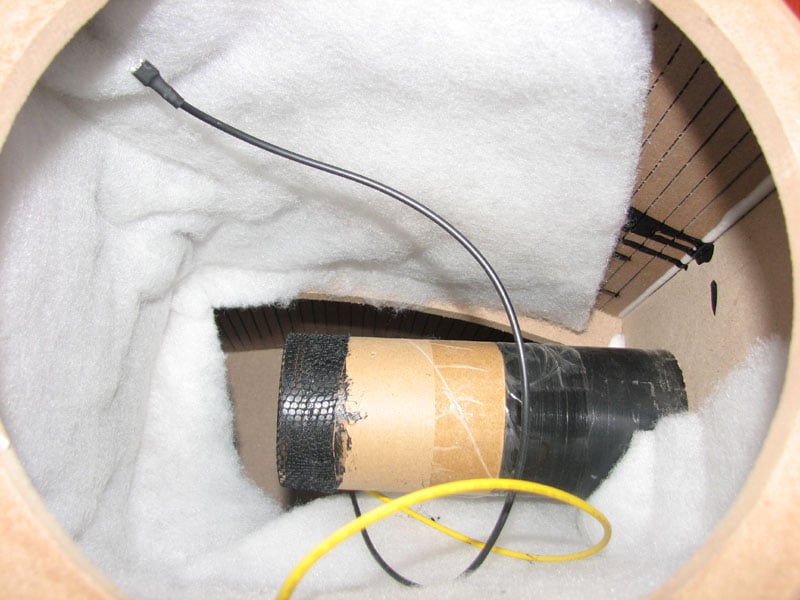
Fluance XL7F bottom cabinet enclosure
With the 8” downfiring woofer removed, I got a peek inside the cabinet. The cabinet walls are a bit thin but are contoured shaped which helps rigidity and are reinforced by braces. The port tube is constructed of cardboard and flared only on the exterior. There is an anemic amount of stuffing in the box. It wouldn’t have taken too much to throw more in there to be honest.
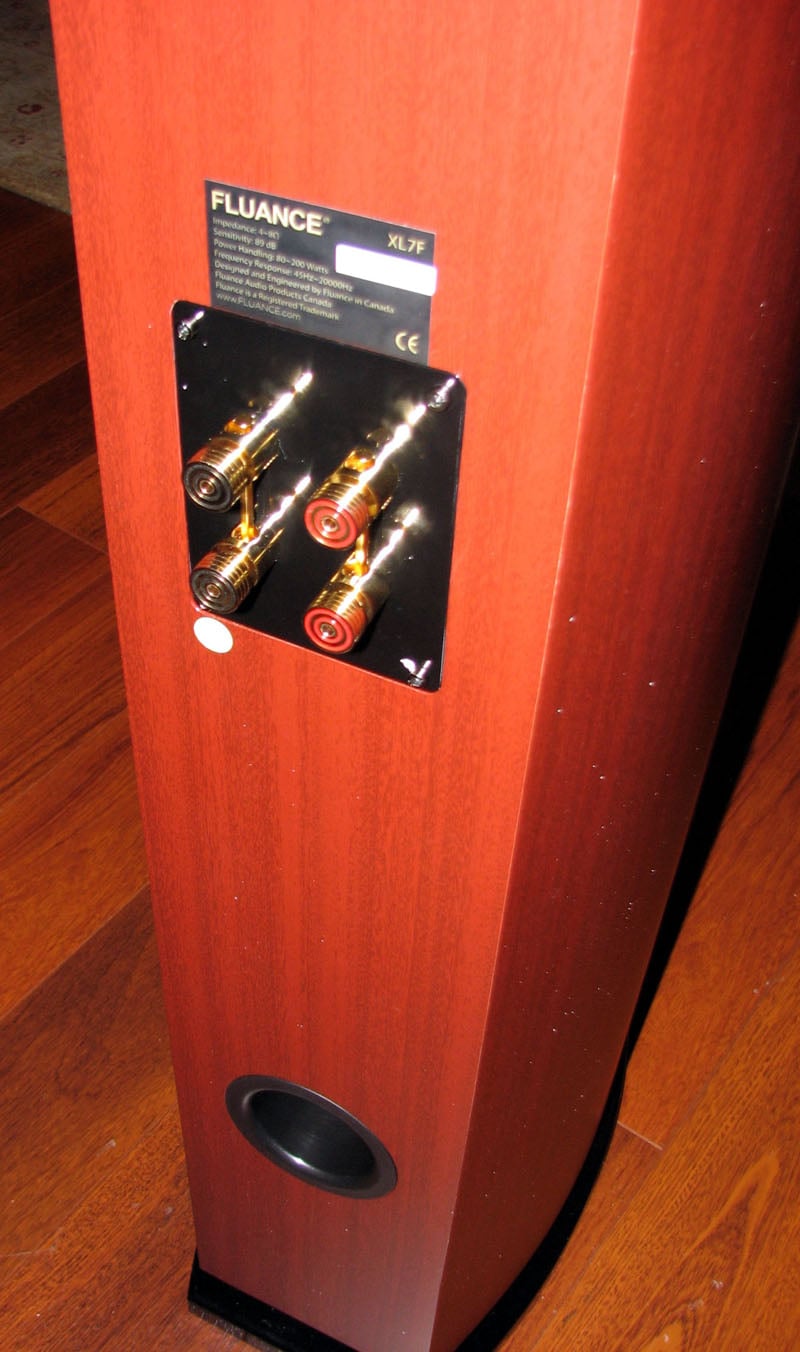
Fluance XL7F Backview
The Fluance XL7F speakers have some of the best binding posts we’ve seen and they certainly don’t typically come on a product of this price class. The connectors are gold plated, accept banana plugs, spades and even bare wire, and ship with removable gold plated pegs. The XL7F are both bi-wireable and bi-ampable which is very rare in this price class.
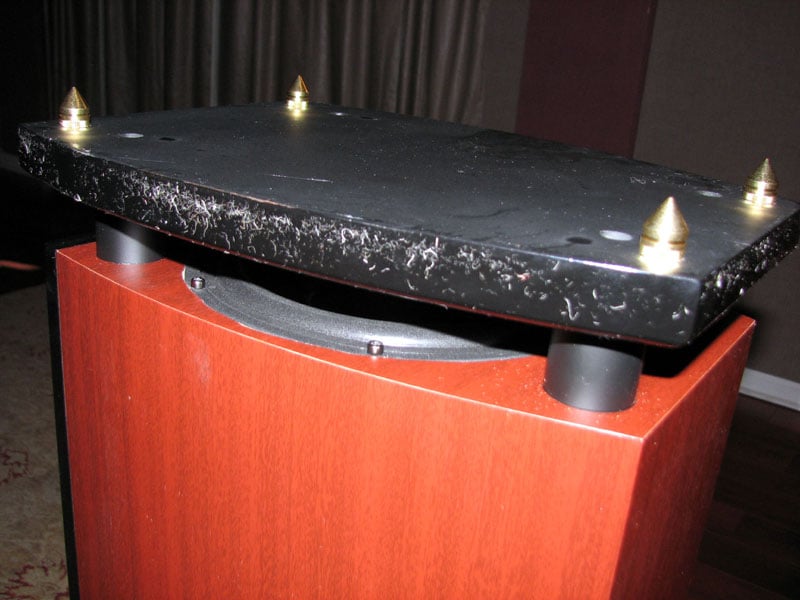
Fluance XL7F Bottom View
Turning the speaker upside down you can see the 8” downfiring woofer which fires down at the plinth. While I am a big fan of the brass cone feet that come with these speakers, I wish Fluance would have also provided the option of rubber feet for installations on hardwood flooring.
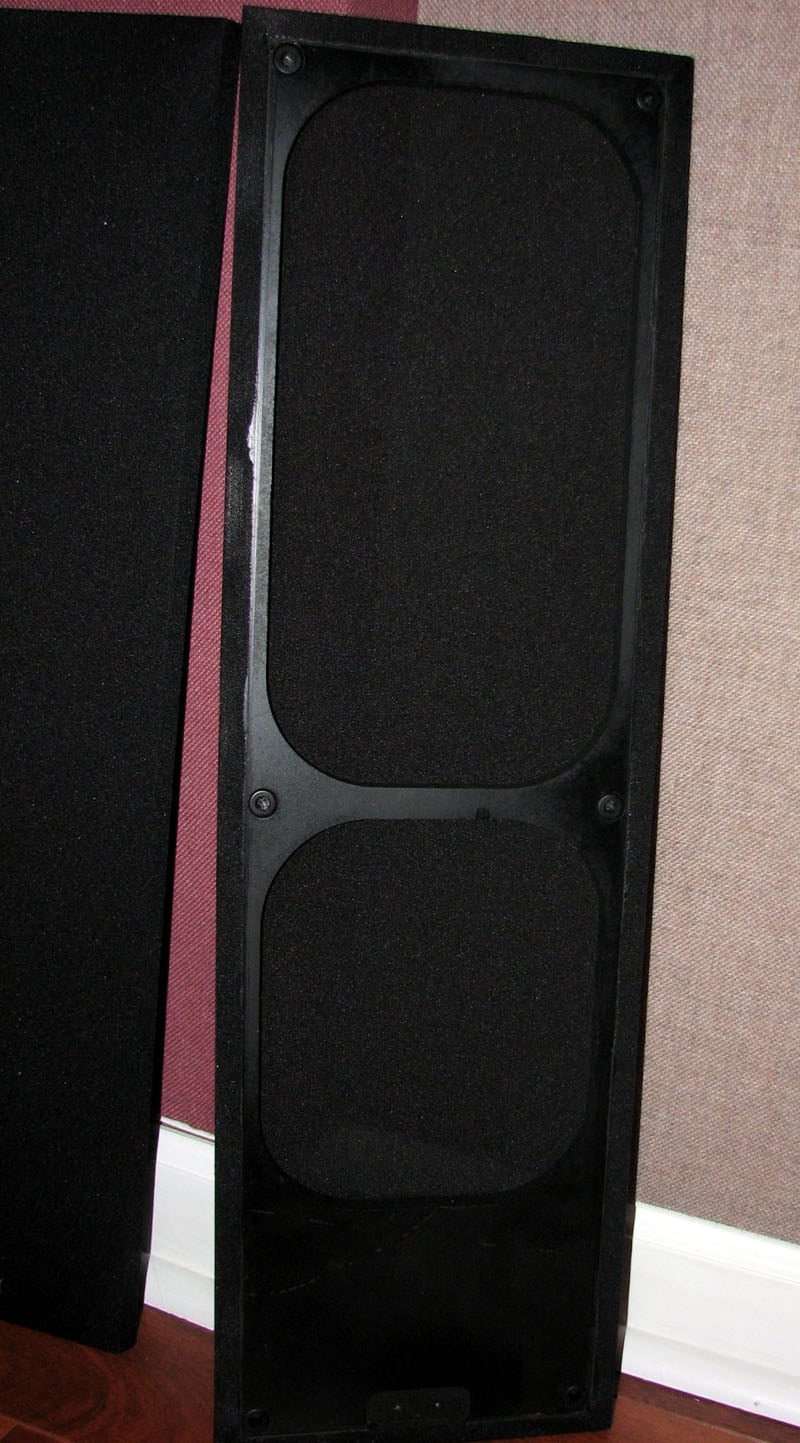
Fluance XL7F Grille Covers
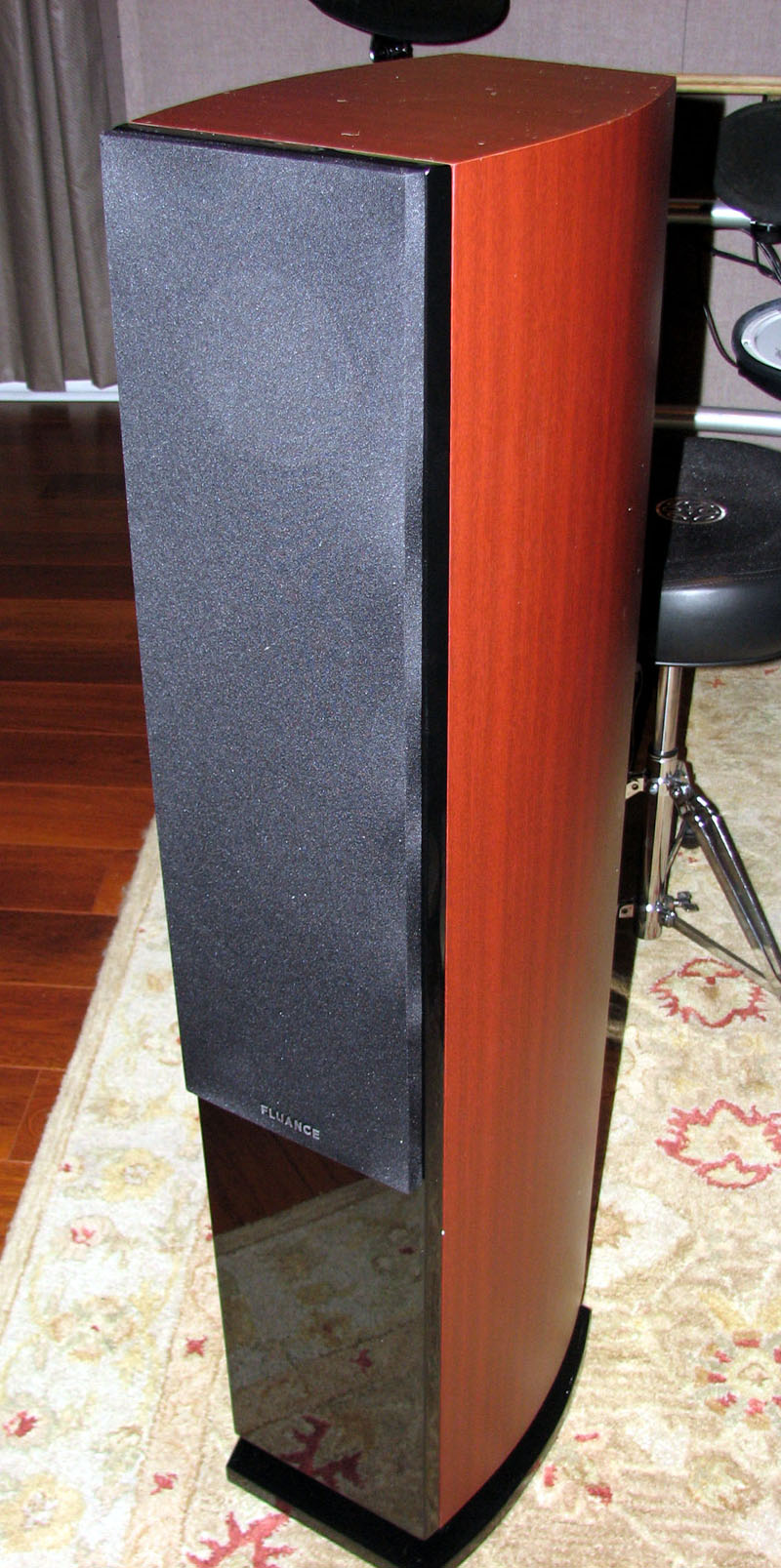
The grilles of the Fluance XL7F towers are quite impressive. Instead of the thin flimsy plastic grill covers most speakers in this price class have, the XL7F’s grilles are framed with MDF, including a horizontal support for added rigidity. You just don't expect this kind of detail or build quality which this level of product.
The XL7F’s are currently only offered in the pictured cherry finish. It’s a bit odd they don’t offer an alternative standard black finish but the front baffles are black and the cherry finish looks nice nonetheless. I don’t foresee too many potential buyers finding their only finish option to be an eyesore. All in all, I’d say the XL7F exhibits impressive build quality and components for such a rock bottom price. Now it’s time to see if the sum of the parts equates to good sound.
Set-Up
I tested the Fluance XL7F speakers in the following two scenarios:
- Audioholics Showcase Theater room - two-channel utilizing the reference gear and premier listening space in the Audioholics Showcase home
- Friends House to compare to his EMP E55Ti speakers
Listening
Scen ario #1 Audioholics Showcase Theater Room
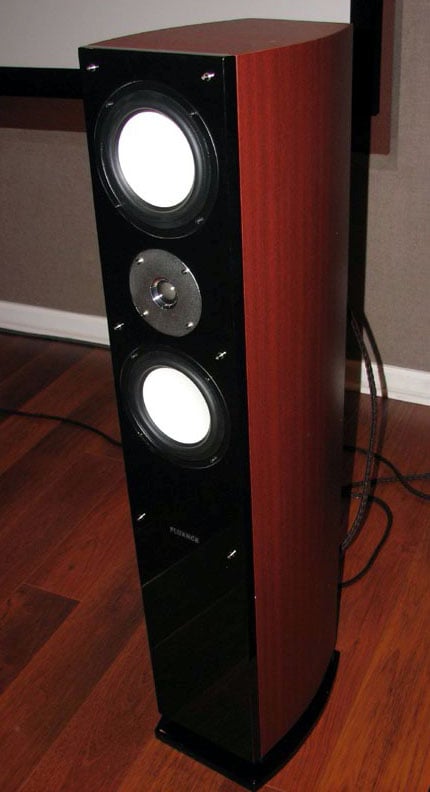
For the first listening session, I positioned the XL7F towers about 5ft from sidewalls and around 8ft from the back walls and spread apart about 10ft from each other which was about two feet shy of the distance from my primary listening position. After experimenting, I found they sounded their best with pretty aggressive toe-in since the top end of these speakers is a bit laid back and my room is both large (6,000ft^3) and acoustically treated. I used my Marantz PM-11S2 200wpc integrated stereo amplifier and the Denon DVD-A1UDCI Universal Blu-ray player as the source connected via balanced cables. All interconnects were furnished by Blue Jeans Cables (1694A Coax) and Kimber 8PR speaker cables with WBT compression banana plugs. The speakers in this case were run full-range with no bass management. For comparative purposes I also used my Denon AVP-A1HDCI A/V processor, Denon POA-A1HDCI 10 channel amplifier to run the XL7F’s in bi-amp mode. I ran the bottom 8” woofers of each XL7F tower to a single amp connected to the LFE output of my processor crossed over at 200Hz. The top portion of the XL7F’s were run as a stereo pair through bass management crossed over at 60Hz.
Listening Scenario #2: Friend's Home Fluance XL7F vs EMP E55Ti
I directly compared the Fluance XL7F and EMP E55Ti speakers side by side on a Harman/Kardon HK 3490 stereo receiver using SPK A and SPK B outputs to switch between speaker pairs. Volume was properly adjusted each time to ensure the speaker pairs were level matched during the comparison. The cables were Kimber 8PR's and the source was the Denon DVD-1920CI connected via Sonicwave toslink to the HK 3490.
Fluance XL7F Floorstanding Loudspeaker Listening Tests
Listening Scenario #1: Audioholics Showcase Theater Room
I
pulled out one the Audioholics demo CD's I use for certain
single-blind listening tests to begin my assessment of the Fluance
XL7F's using key tracks from this disc as noted below.
Dianne
Reeves - Never
too Far
Bass
emanating from this track was incredibly punchy and reasonably tight,
but a bit overbearing in the upper registers. At high listening
levels, the Fluance XL7F's maintained incredibly good composure, with
minimal signs of strain from the mids or tweeters. I’ve heard
other budget systems, and those costing considerably more, unable to
hit the high output levels I was achieving with the XL7F’s so
effortlessly. Tonally I initially felt the upper frequencies were a
bit too laid back and the vocals weren’t completely locked into my
money seat. So I experimented with toe-in. I found the XL7F’s
sounded best with a good more deal of toe-in than I’d use with most
speakers. Angling them at the listener really helped open things up
considerably. I was now getting good imaging and clear vocals even
when I shifted my head side to side. I did notice some loss of high
frequency detail when I went from seated to standing position but the
asymmetry of my room and the fact that it’s acoustically treated
tends to exaggerate this phenomenon in some speaker systems,
including my very own reference speakers.
Fourplay
- Chant
The
resonance in the kick drums was well pronounced in the Fluance XL7F
tower speakers. I use this song to test how prone a speaker is to
bottoming out. It wasn’t until I really pushed these speakers to
their limits that I heard the woofers voice coils leaving the gap.
When using my Marantz PM-11S2, it actually shutdown at these extreme
listening levels as that amp is rather sensitive to low impedance
loads which in the bass frequencies the XL7F’s present such a load.
The XL7F’s did a really good job extracting all the nuances of
this song. From the vocal overlays to the rain sticks, everything
was there.
Pat
Metheny / John Scofield - Say
the Brother's Name
I
love the reverb of Pat Metheny’s guitar in this song. A really
good speaker system will instantly transport you into a small jazz
club in NY. The Fluance XL7F’s put forth a valiant effort at
placing me there. The brushes of the high hats were a bit further
back than I’ve heard on other speakers, but the overall tone was
very pleasing. The XL7F’s did a fine job separating all of the
musical instruments. Speakers at this price point tend to mush
things together, especially when played at high output levels. This
wasn’t the case on the XL7F’s. I can’t say that for too many
tower speakers at this price point or even hovering around the
$1k/pair territory too.
Steely
Dan - Two
Against Nature
you
can’t have a serious speaker evaluation without throwing on some
Steely Dan. I really like using Two
Against Nature not
just because it’s a well recorded CD, but also because its full of
great musical content too. Donald’s voice in the title track
sounded clear and distinct and all the instrumentation was well
separated. It was a pleasure listening to this track on the Fluance
speakers.
Madonna – "Live to Tell"
Perhaps my favorite Madonna song of all time, "Live to Tell" lets you really hone in on female vocals to listen for coloration in the midrange. The Fluance speakers portrayed her voice respectably well, though perhaps not as focused as I’ve heard on higher caliber speakers. I did hear a great envelope of sound emanating from the speakers. At times I almost felt like I was listening in multi channel which was impossible considering I was using a two-channel analog integrated amplifier from Marantz to power these speakers.
Eagle – Hotel California (Live)
The
beginning of this song pegs the acoustical guitar in the right
speaker. The XL7F did a superb job of giving you that live
unamplified feeling. The clapping audience expanded around the room
(again giving me that surround sound feeling from just two speakers).
The bass was forward and tight. Despite it was a bit over
pronounced I actually preferred that sonic characteristic in this
case as it added a lot of punch to the song. I honestly couldn’t
believe I was hearing this kind of quality sound in my large theater
room from a pair of tower speakers costing less than most entry level
bookshelf alternatives.
a superb job of giving you that live
unamplified feeling. The clapping audience expanded around the room
(again giving me that surround sound feeling from just two speakers).
The bass was forward and tight. Despite it was a bit over
pronounced I actually preferred that sonic characteristic in this
case as it added a lot of punch to the song. I honestly couldn’t
believe I was hearing this kind of quality sound in my large theater
room from a pair of tower speakers costing less than most entry level
bookshelf alternatives.
CD: Santana – Supernatural
I guess by now this CD is considered an oldie by today’s standards, but it’s full on great music and offers excellent sound quality to evaluate loudspeaker performance. I started with track #3 “Put your lights on” and again noticed that the XL7F’s were putting forth a nice wide soundstage with a nice stereophonic effect between the dual acoustical guitars. Vocals were vibrant and this track just begged to be listened too on the Fluance speakers. Track #12 “Primavera” is my favorite track on the disc. I can’t help but butcher the lyrics while singing along as I never took the time to verify that their likely not singing about some tasty pasta dish. The bongos popped out nicely on the XL7F’s while the midbass was tight and perhaps a tad over pronounced which I actually enjoyed in this instance. The reeds sounded natural but perhaps a bit recessed into the background.
Listening Scenario #2 Friends House to Compare
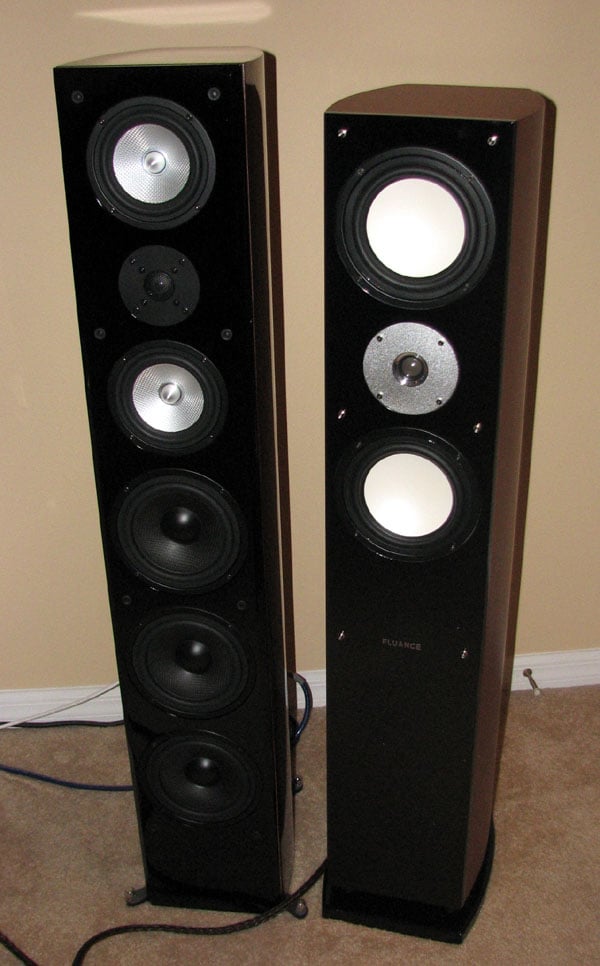 Again,
using the Audioholics demo CD, I did some brief listening comparisons
between the Fluance XL7F and EMP E55Ti (rev1) towers. The EMP’s
($795/pr) cost considerably more than the Fluance ($469/pr) but both
brands are considered to produce high value oriented products. Thus,
I wanted to get a level set of performance from the Fluance using a
budget minded tower speaker I was quite familiar with. I found the
EMP’s were about 2dB more efficient than the Fluance speakers so I
had to adjust volume level each time when switching between pairs. I
had my friend along with me so he could formulate an opinion on the
comparison too.
Again,
using the Audioholics demo CD, I did some brief listening comparisons
between the Fluance XL7F and EMP E55Ti (rev1) towers. The EMP’s
($795/pr) cost considerably more than the Fluance ($469/pr) but both
brands are considered to produce high value oriented products. Thus,
I wanted to get a level set of performance from the Fluance using a
budget minded tower speaker I was quite familiar with. I found the
EMP’s were about 2dB more efficient than the Fluance speakers so I
had to adjust volume level each time when switching between pairs. I
had my friend along with me so he could formulate an opinion on the
comparison too.
Listening to Fourplay “Chant” revealed that the Fluance XL7F’s clearly dug deeper than the EMP’s. It was almost as if a subwoofer was thrown in the mix when switching between the EMPs and the Fluance speakers. However, the EMP’s more forward character lent itself to greater clarity of the instruments. Although bass wasn’t as nearly pronounced on the EMP’s, what it did produce was tighter.
As we listened to more jazz-oriented music such as Pat Metheny, we both clearly preferred the sonic attributes of the EMP speakers. The Fluance threw off a slightly wider soundstage but the EMP’s had a much larger vertical presence to them. But, when jumping to Steely Dan, we both started really appreciating the bass extension of the Fluance. In this scenario, each time we switched over to the EMP’s we felt something was missing. Normally my friend listens to the EMPs with his matching ES10i sub (a must with these speakers in my opinion). The subwoofer was clearly missed on the EMPs when we directly compared these two speakers with no subwoofer present. Both speakers sounded quite good in their own right and considering the Fluance were about $300 cheaper than the EMPs and had better bass extension, I could see folks not willing to invest more money in a powered subwoofer preferring these speakers. However, for those running a sub, and more oriented towards accurate reproduction of vocals and acoustical instruments, the EMPs were the clear winner. The fact I was even comparing the Fluance speaker to a more expensive alternative - and finding things I liked about them better - was a testament to my initial assessment of how good the Fluance speakers were for their modest asking price.
Fluance XL7F Floorstanding Loudspeaker Measurements and Analysis
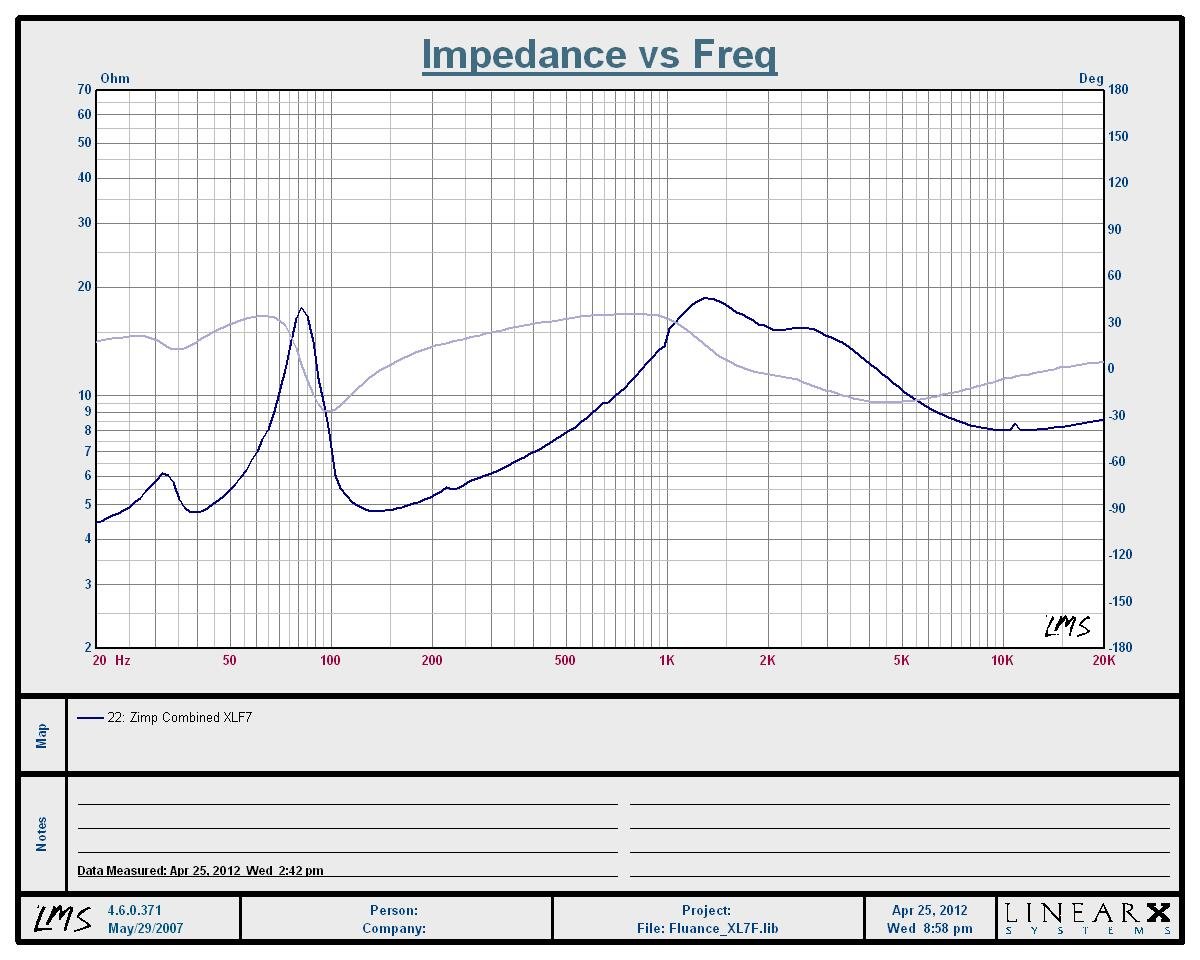
Impedance / Phase Measurements of the Fluance XL7F
The Fluance XL7F speakers appear to be tuned at around 40Hz, but the saddle points are quite asymmetric. This indicates two things: the system is tuned a bit lower than the driver's resonance frequency and smallish box volume would benefit from, and the midrange drivers running without a HPF essentially lower the impedance of the 32Hz saddle point. I measured the impedance of the MTM and bottom woofer separately and, when combined their parallel equivalent, you get (20 ohms and 9 ohms, respectively) equals 6 ohms. I understand why Fluance did this as they were relying on the real usable bass extension the dual 6.5” woofers provide down to the 50Hz range to supplement the bottom 8” woofer but I caution anyone pairing these speakers with a modestly powered A/V receiver. The impedance dip to 4.5 ohms at 20Hz and 45 degree phase shift from 100Hz to 200Hz can trip the protection circuits in some receivers at high listening levels. I found this to be the case when powering these speakers on my Marantz PM-11S2 integrated amp at very LOUD listening levels. The manufacturer rates these speakers as “4 to 8 ohms” but I’d say calling them 6 ohm speakers would be generous.
Calibrating my measurement system so that it sent out 1 watt into a 6 ohm load (2.44Vrms), I measured system sensitivity and found the XL7F's measured around 89dB 1 watt/meter which is what Fluance claims for this product though they don’t declare at what power level since their impedance spec is rather vague.
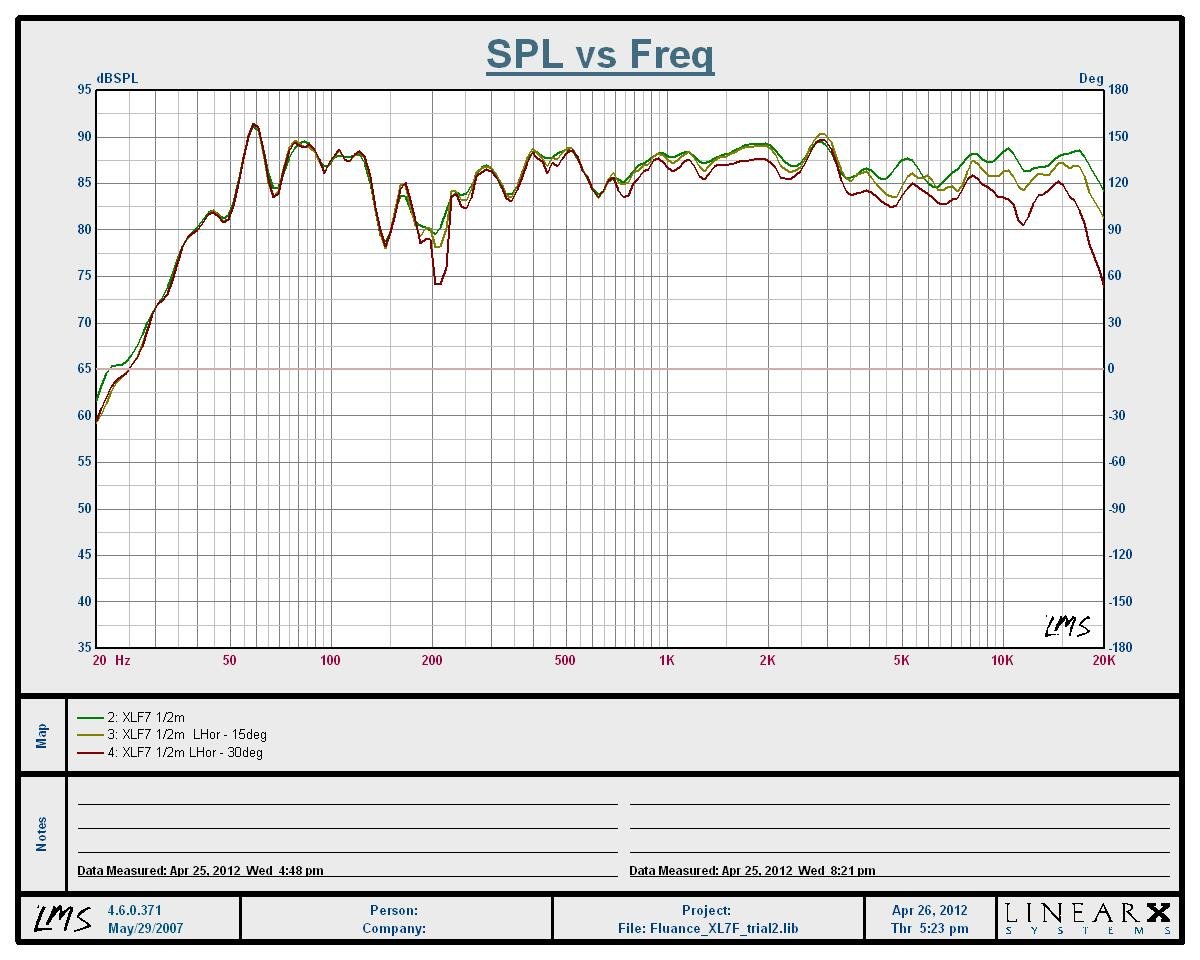
Fluance
XL7F In-room 1/2 meter SPL vs Frequency Response (1/12th
octave smoothed)
green
trace: on-axis; yellow trace: 15 deg off-axis; red trace: 30 deg
off-axis
I measured Fluance XL7F loudspeaker with grilles off. The speaker produced generally excellent on/off axis horizontal response +-3dB from 200Hz to 20kHz on-axis with a gradual tapering off above 2kHz off-axis. I measured both speakers and found they measured similarly indicating good quality control between the samples.
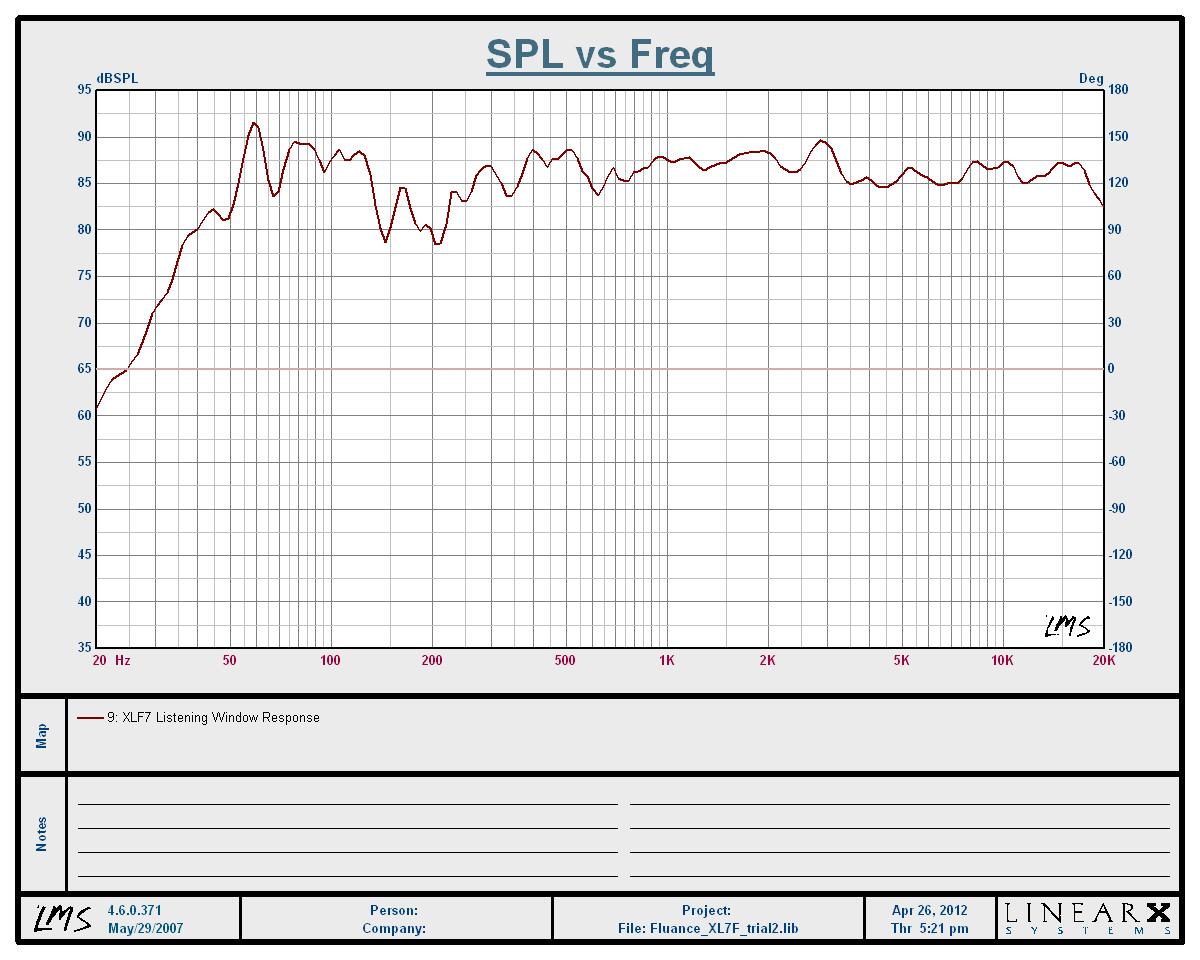
Fluance XL7F In-room 1/2 meter Listening Window Response (1/12th octave smoothed)
I
took a total of 7 measurements (on-axis +-15 deg & +-30 deg
horizontal and +-15 deg vertical) and averaged the response to more
accurately represent what the listener will actually hear. As you can
see, the speaker’s linearity is quite excellent.
I
did find a peculiar suckout 15 deg up the vertical axis from the
tweeter between 1.2kHz and 5kHz, indicating that perhaps more work
could have been done in the crossover to optimize the response. Though, the dip was somewhat over exaggerated by the close proximity of the measuring mic and typical for what we see measuring multi-driver speakers like this.
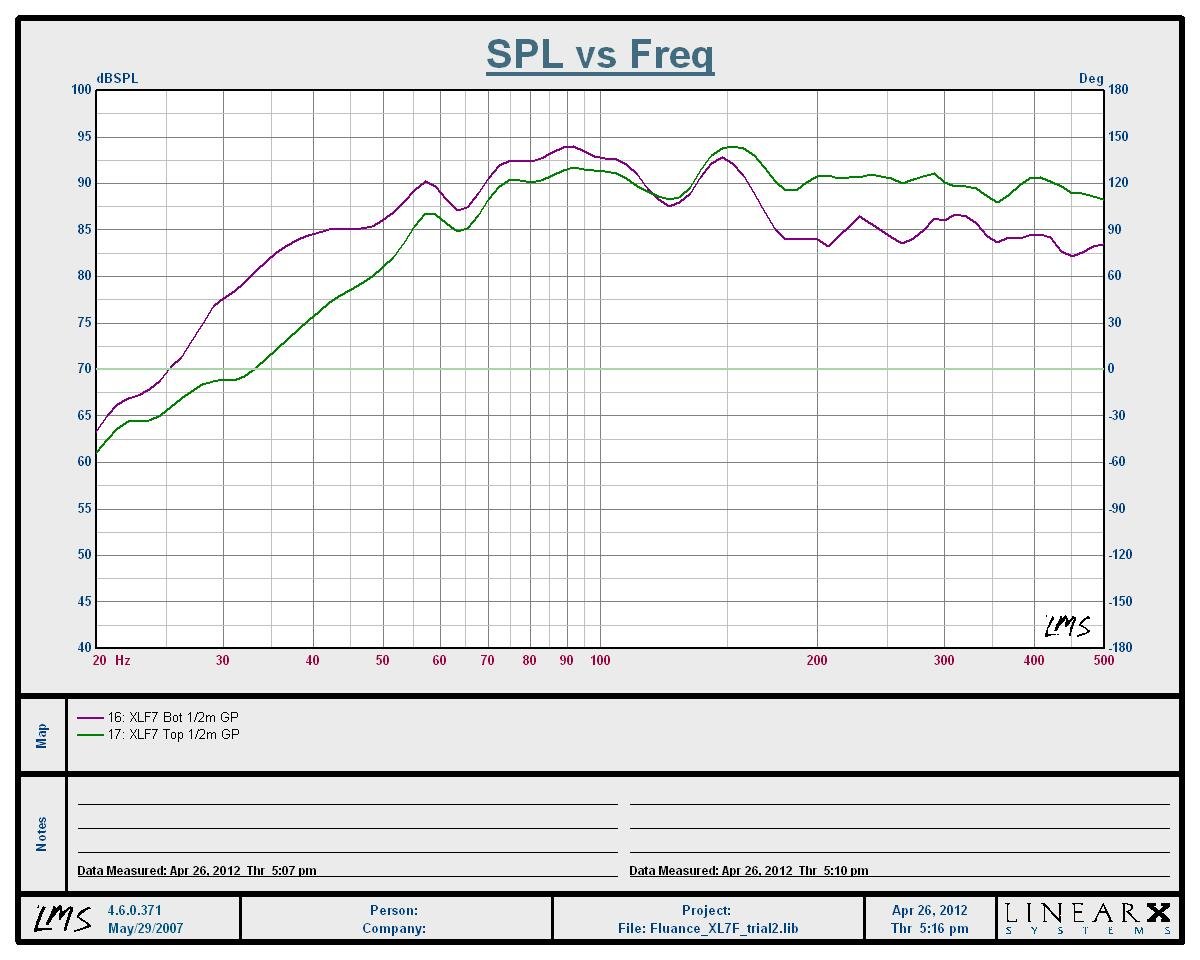
Fluance
XL7F Bass Response (1/12th
Octave Smoothed)
Green
trace: MTM ½ meter ; purple trace: bottom woofer ½ meter
groundplane
I was curious to get a better look at bass response of the XL7F’s so I measured the MTM separately from the bottom woofer. The MTM was measured at tweeter height ½ meter and the bottom woofer was measured groundplane ½ meter between the woofer and port. I level matched the outputs of both as closely as possible to get an idea of how much bass extension the bottom woofer adds. As you can see below 50Hz the bottom woofer really adds significant bass extension to the system (+10dB or so at 40Hz). I did find the crossover frequency of the bottom woofer set too high (around 800Hz). This caused too much combined upper bass energy which at times I felt made the speaker sound a bit boomy. I personally would have liked to see the bottom woofer crossed over at 200Hz and can only figure Fluance chose a higher crossover frequency for cost purposes since it allowed them to use a smaller value filter choke.
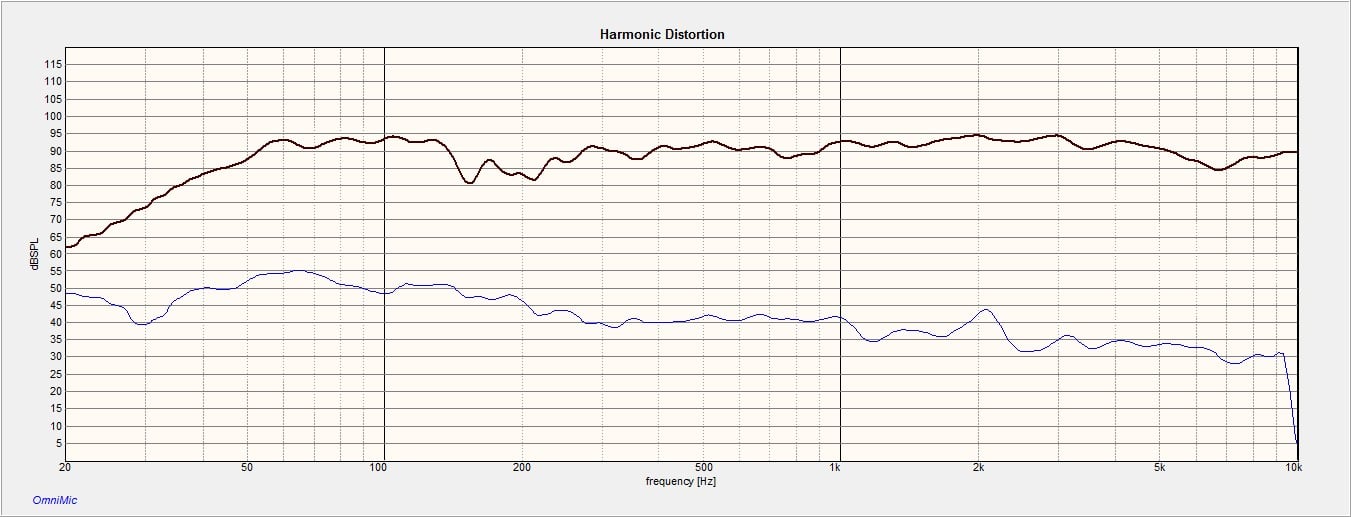
Fluance XL7F In-Room THD Distortion Measurement (1/2 meter)
Using the OmniMic system from Dayton Audio, I positioned the mic about ½ meter away from the XL7F’s tweeter to do a frequency vs distortion sweep. This is a similar test to how the NRC does distortion. In my opinion this doesn’t come close to giving you the whole picture on actual audible distortion since it’s a single tone sweep and doesn’t account for modulation distortion if for example a midrange driver is running fullrange without a HPF (like this speaker). This measurement does tell you of any obvious flaws or problems with the speaker system. I drove the XL7F’s at fairly high output (more than my ears could take for any duration of time) and they produced nice clean results as you can see above. If you want to convert the THD to physical #’s you can subtract the SPL sweep (black) from the distortion sweep (blue) at corresponding frequencies and convert the numerical # to a percentage as follows:
| dB Below Test Tone | % Distortion |
| -5 dB | 56.2% |
| -10 dB | 31.6% |
| -15 dB | 17.8% |
| -20 dB | 10.0% |
| -25 dB | 5.62% |
| -30 dB | 3.16% |
| -35 dB | 1.78% |
| -40 dB | 1.00% |
| -45 dB | .562% |
| -50 dB | .316% |
| -55 dB | .178% |
| -60 dB | .100% |
| -65 dB | .056% |
| -70 dB | .032% |
| -75 dB | .018% |
| -80 dB | .01% |
For example at 1kHz, the XL7F SPL was roughly 95dB while the THD level was 45dB. 95dB – 45dB = 50dB or 0.316% THD.
The Downside
 Like
any budget-minded speaker, compromises must always exist in order to
hit a certain price point. The Fluance XL7F tower speaker system is
far from being perfect, but it does so many things so right at this
price that it’s hard to be too critical of them. From a design
standpoint, I would have liked to see Fluance cross the bottom woofer
over at a much lower frequency (200Hz instead of the current 800Hz
configuration). I believe this would have reduced the somewhat
bloated bass response I was hearing with some music. As an
experiment, I switched over to my Denon rig and bass managed the XL7F
system, biamping and running the bottom woofer crossed over at 200Hz
and the MTM at 50Hz. This did a great job at reducing the overly
energetic upper bass response and also seemed to improve midrange
definition and clarity. The only other real gripe I have with these
speakers isn’t related to the speakers at all, but the company
itself. Fluance appears to have a little bit of an identity crisis.
They are generally not a well known company and visiting their
website reveals a rather disconnected product line offering. They
currently don’t have matching center and surround speakers for the
XL7F towers, but informed me they are in the works. At the prices
they are offering their products for, I hope this review gets them
their much deserved attention and they also take the time to
consolidate their product line and tweak their website accordingly.
In my opnion, Fluance needs a "look" and a brand. Right now
they come across as a smorgasbord of mismatched products that don't
share any sort of design philosophy or company identity.
Like
any budget-minded speaker, compromises must always exist in order to
hit a certain price point. The Fluance XL7F tower speaker system is
far from being perfect, but it does so many things so right at this
price that it’s hard to be too critical of them. From a design
standpoint, I would have liked to see Fluance cross the bottom woofer
over at a much lower frequency (200Hz instead of the current 800Hz
configuration). I believe this would have reduced the somewhat
bloated bass response I was hearing with some music. As an
experiment, I switched over to my Denon rig and bass managed the XL7F
system, biamping and running the bottom woofer crossed over at 200Hz
and the MTM at 50Hz. This did a great job at reducing the overly
energetic upper bass response and also seemed to improve midrange
definition and clarity. The only other real gripe I have with these
speakers isn’t related to the speakers at all, but the company
itself. Fluance appears to have a little bit of an identity crisis.
They are generally not a well known company and visiting their
website reveals a rather disconnected product line offering. They
currently don’t have matching center and surround speakers for the
XL7F towers, but informed me they are in the works. At the prices
they are offering their products for, I hope this review gets them
their much deserved attention and they also take the time to
consolidate their product line and tweak their website accordingly.
In my opnion, Fluance needs a "look" and a brand. Right now
they come across as a smorgasbord of mismatched products that don't
share any sort of design philosophy or company identity.
 Recommendations
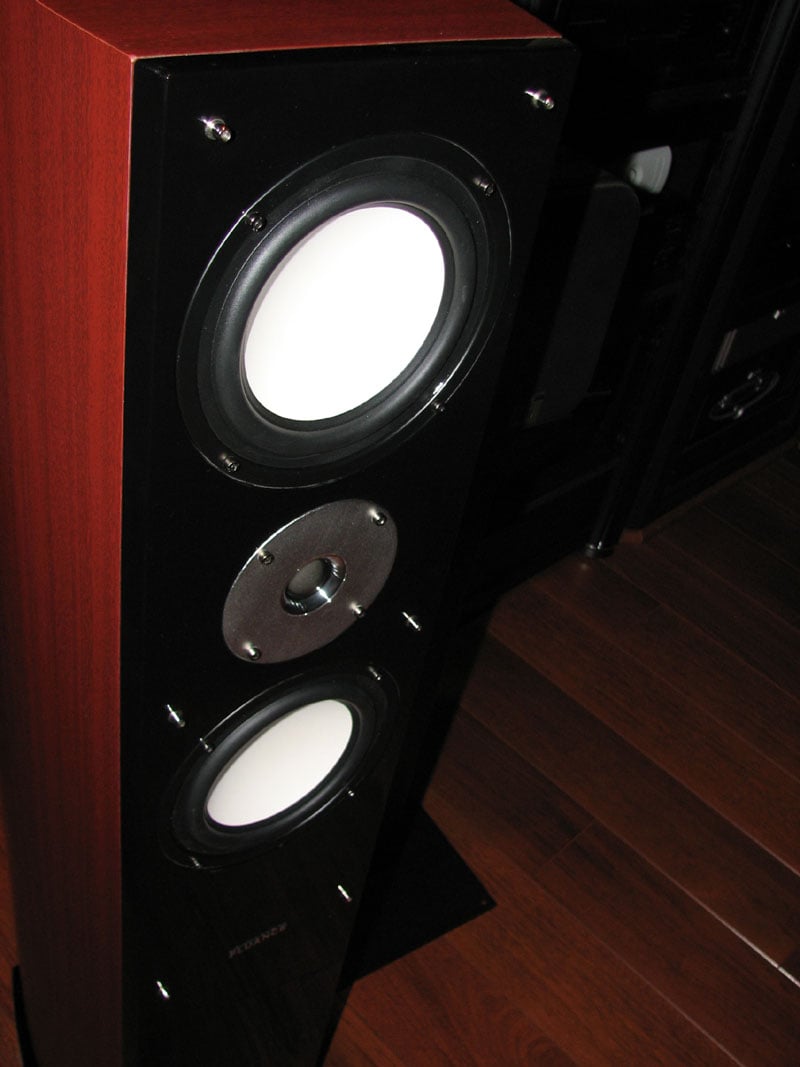
I must confess, I spent very little time listening to the Fluance XL7F speakers with the grilles on. The shiny drivers radiating off the front baffle are just too beautiful to look at. Unless you have small children or pets, I recommend you also run these speakers "in the nude" and stow away the grilles. For those finding these speakers too bass heavy, I suggest you set them up as “small” crossing them over between 60 to 80Hz to a dedicated subwoofer. This should also help to improve bass response while also increasing system dynamic range by taking the bass load off the unfettered midrange drivers. Also since these speakers dip down to the 4 ohm area in the bass region, bass managing them will also take considerable strain off your A/V receiver. If you plan on running them full-range, make sure you experiment with placement as their pronounced bass upper bass response will make them a little more placement finicky than some speakers. The XL7F’s sound their best when toed in so that the tweeters are pointing at the listening area. Don’t be afraid to feed them good quality power. A dedicated amp would really make these speakers shine and bi-amping is certainly an option to consider. In fact, for those not running a dedicated sub in their systems, you may wish to experiment with biamping these by running the 8” bottom firing woofers through your A/V receiver's LFE output to an external amp. This would essentially treat them as dedicated subwoofers. I’d imagine this could produce satisfying results in small to medium size rooms.
Conclusion
In
tough economic times, it’s always refreshing to find bargains to
help fellow budget-minded Audioholics reach their goals of sonic
nirvana. While the Fluance XL7F’s don’t represent the pinnacle
of loudspeaker technology compared to some price-no-object systems,
they get about as close to that goal as any sub $500/pair towers I’ve
listened too. They are, in my opinion, one of the best values in
floorstanding speakers I’ve seen in many years. The XL7F’s offer
near full-range sound with respectably good fidelity and cosmetics.
They will play plenty loud even in fairly large rooms without ever
sounding fatiguing or strained. The fact that these speakers could
be bi-amped is not only rare at this price point but offers some
great alternative setup options. If you’re looking for a
floorstanding speaker that will give you plenty of bass and good
sound on the cheap, give these babies a try. Free shipping and a
lifetime warranty is just gravy for this already tasty deal. Highly
Recommended!
Fluance
XL7F Scorecard
MSRP:
$469/pair (includes shipping)
Fluance
1.888.61.SOUND (1.888.617.6863)
The Score Card
The scoring below is based on each piece of equipment doing the duty it is designed for. The numbers are weighed heavily with respect to the individual cost of each unit, thus giving a rating roughly equal to:
Performance × Price Factor/Value = Rating
Audioholics.com note: The ratings indicated below are based on subjective listening and objective testing of the product in question. The rating scale is based on performance/value ratio. If you notice better performing products in future reviews that have lower numbers in certain areas, be aware that the value factor is most likely the culprit. Other Audioholics reviewers may rate products solely based on performance, and each reviewer has his/her own system for ratings.
Audioholics Rating Scale
 — Excellent
- — Very Good
- — Good
- — Fair
- — Poor
| Metric | Rating |
|---|---|
| Build Quality | |
| Appearance | |
| Treble Extension | |
| Treble Smoothness | |
| Midrange Accuracy | |
| Bass Extension | |
| Bass Accuracy | |
| Dynamic Range | |
| Performance | |
| Value | |
Gene manages this organization, establishes relations with manufacturers and keeps Audioholics a well oiled machine. His goal is to educate about home theater and develop more standards in the industry to eliminate consumer confusion clouded by industry snake oil.
View full profile Subscribe to our newsletter