


Elemental Designs A6-6T6 Floorstanding Speaker Review
Elemental Designs A6-6T6
- Product Name: A6-6T6
- Manufacturer: Elemental Designs
- Performance Rating:


- Value Rating:
- Review Date: November 18, 2008 08:37
- MSRP: $ 500/pair
Max Power Handling: 250W
Minimum Power Input: 30W
Nominal System Resistance: 6Ω
Tweeter Size: 1.3"
Tweeter Type: Silk
Tweeter Model: O-635
Crossover Model: ER-6.4X
Midrange Size: 162mm
Midrange Material: Poly
Number of Midrange Drivers: 3
Cabinet Type: Dual Chamber Vented
Weight: 55lb
Frequency Response: 40-22KHz +/- 3dB
System Sensitivity: 90.3dB
Dimensions: 40" x 11" x 12"
Pros
- Price
- Imaging
- Soundstage
Cons
- Form factor may lead you to believe it has more bass than it does
- Non optimized crossover design causes frequency response dip in critical midrange area
A6-6T6 Build Quality
 Part of me gets
irritated at "major" speaker manufacturers. Most of the time it is
all but impossible to get a review sample. It's like they don't want their
speakers to be reviewed. Reviews don't cost anything - other than shipping.
Reviews generate interest. The only thing you have to fear is a bad review but
you shouldn't have to worry about that if you make good speakers, right?
Really, though, it isn't their fault. The fact is that there are so many
gatekeepers (read: marketing people) whose job it seems to be to keep you away
from the larger speaker manufacturers. Getting a review sample seems to be as
much a function of luck as anything else. With ID (Internet Direct) speakers,
the companies are smaller, the staff more accessible, and, generally, they are
dying for someone to review their speakers. Generally.
Part of me gets
irritated at "major" speaker manufacturers. Most of the time it is
all but impossible to get a review sample. It's like they don't want their
speakers to be reviewed. Reviews don't cost anything - other than shipping.
Reviews generate interest. The only thing you have to fear is a bad review but
you shouldn't have to worry about that if you make good speakers, right?
Really, though, it isn't their fault. The fact is that there are so many
gatekeepers (read: marketing people) whose job it seems to be to keep you away
from the larger speaker manufacturers. Getting a review sample seems to be as
much a function of luck as anything else. With ID (Internet Direct) speakers,
the companies are smaller, the staff more accessible, and, generally, they are
dying for someone to review their speakers. Generally.
Elemental Designs (eD for short - wow, so many puns, so little time) has actually been around for a little while. They went from being only a name in 2002 to shipping products for home and car audio today. I first heard of their subs about a year or so ago when someone was talking about their new ID subwoofer behemoth. "Great," I thought, "that's all the world needs is another ID company pushing huge subs on unsuspecting people." I quickly filed eD away as a company I was never going to have to worry about.
Fast forward a year or so and I get a message saying that we should take another look at eD. Not only do they sell subs, but also speakers. I've got a smallish room so I've pretty much ruled out any of their subs and I'm skeptical about any speakers they may be selling. No, no, my contact tells me. He's been to the factory and claims that the speakers are actually good. Fine, I'll look. I was surprised to find that the speakers were not only reasonably sized, but also very reasonably priced. Their "flagship" towers (they only have one set of tower speakers so by definition they are flagship) only cost $500 a pair. This sounds like either crazy Internet pricing or white van material. If these speakers turn out to be the real deal, this could light the Internet on fire. Always up for a good bonfire, I decided to push some things around in my schedule to fit in a review.
First Impressions and Build Quality
 I've
seen speakers packaged in any number of ways - everything from single boxed, no
markings, minimal protection to highly labeled box, double and triple boxed,
with enough protection to survive a fall off the back of a UPS truck on the highway. The eD A6-6T6 speakers
were a mix. The box was highly marked so you knew where the speakers came from.
The speakers were single boxed but wrapped in plastic and (inexplicably) white
tissue paper. There were styrofoam end and side protection but it was pretty
thin. There were foam inserts between the plinth and the bottom of the speaker
(not sure the purpose of this one). The neatest aspect of the packaging was
that there were two pieces of particle board with foam on one side with ropes
run through them that are wrapped around the speaker. These are for easy
removal from the box. This worked fairly well and was a pretty neat idea.
I've
seen speakers packaged in any number of ways - everything from single boxed, no
markings, minimal protection to highly labeled box, double and triple boxed,
with enough protection to survive a fall off the back of a UPS truck on the highway. The eD A6-6T6 speakers
were a mix. The box was highly marked so you knew where the speakers came from.
The speakers were single boxed but wrapped in plastic and (inexplicably) white
tissue paper. There were styrofoam end and side protection but it was pretty
thin. There were foam inserts between the plinth and the bottom of the speaker
(not sure the purpose of this one). The neatest aspect of the packaging was
that there were two pieces of particle board with foam on one side with ropes
run through them that are wrapped around the speaker. These are for easy
removal from the box. This worked fairly well and was a pretty neat idea.
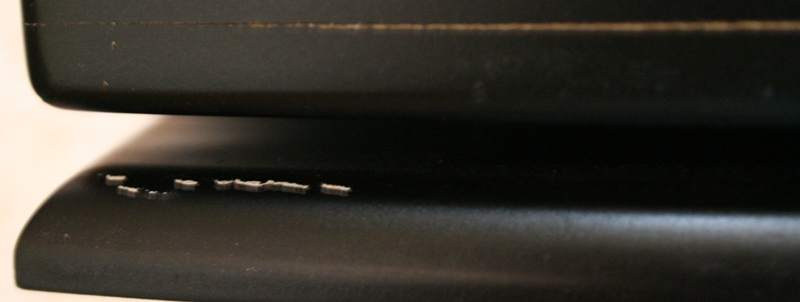 The only problem I had with the
packaging was that the foam was a little thin and weak. When I removed the
speakers, I was pretty much left with foam bits. One of the speakers also had a
bit of damage on the bottom with some scratches on the plinth. Just above that,
where the bottom of the speaker attaches to the sides looked like there was
some splitting (I noticed a bit of this on the top too). As far as I could
tell, it was just a crack and didn't seem to be separated. If I was purchasing
the speakers, I'd have it replaced but for the purposes of this review, I
didn't think the damage would affect the performance. Later on, I measured both
speakers and they did, in fact, measure the same.
The only problem I had with the
packaging was that the foam was a little thin and weak. When I removed the
speakers, I was pretty much left with foam bits. One of the speakers also had a
bit of damage on the bottom with some scratches on the plinth. Just above that,
where the bottom of the speaker attaches to the sides looked like there was
some splitting (I noticed a bit of this on the top too). As far as I could
tell, it was just a crack and didn't seem to be separated. If I was purchasing
the speakers, I'd have it replaced but for the purposes of this review, I
didn't think the damage would affect the performance. Later on, I measured both
speakers and they did, in fact, measure the same.
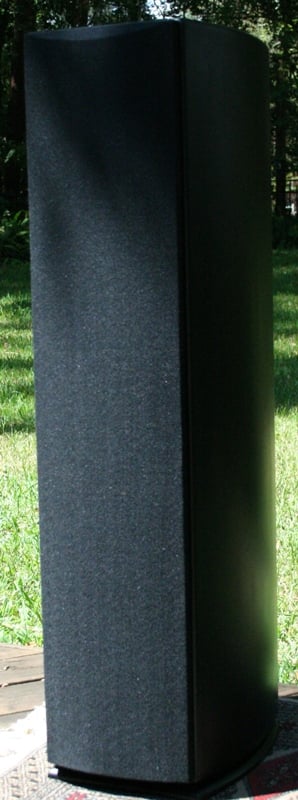
 The
finish on the speakers is a flat black that feels slightly textured to the
touch but looks smooth. eD has opted to paint their speakers rather than vinyl
wrap them. All the edges and corners are nicely rounded. The front of the
speaker sports a full length grill with no additional adornments. If you want
to know who made your speakers, you'll have to turn it around. A logo somewhere
on the front would be a nice addition (even if it was under the grill). The
grill is made of MDF and is very sturdy though the fabric itself is run over a
fine wire mesh that is strong enough to keep it bowed but not so strong that
you should push against it when mounting the grill. The grill is held on by six
plastic posts that are thick enough that I wasn't worried about them breaking
off. The grill seemed to be snug enough though it did come off a little too
easily. Over time, it seemed like it might get even looser with frequent
removing..
The
finish on the speakers is a flat black that feels slightly textured to the
touch but looks smooth. eD has opted to paint their speakers rather than vinyl
wrap them. All the edges and corners are nicely rounded. The front of the
speaker sports a full length grill with no additional adornments. If you want
to know who made your speakers, you'll have to turn it around. A logo somewhere
on the front would be a nice addition (even if it was under the grill). The
grill is made of MDF and is very sturdy though the fabric itself is run over a
fine wire mesh that is strong enough to keep it bowed but not so strong that
you should push against it when mounting the grill. The grill is held on by six
plastic posts that are thick enough that I wasn't worried about them breaking
off. The grill seemed to be snug enough though it did come off a little too
easily. Over time, it seemed like it might get even looser with frequent
removing..
There is a front port near the bottom and a second on the back just between the tweeter and the topmost woofer. The front port is covered by the same wire mesh/fabric mix used on the grill. The back port doesn't have this. The front baffle is raised and there is a 1.3" tweeter and three 6.25" woofers flush mounted. All the drivers are black as is the speaker. If you are looking for speakers to disappear in a dark room, you could do worse than the A6-6T6. If you are looking for a good looking speaker, you could do a lot better. Then again, at $500 a pair, there really isn't all the much to complain about.
 The plinth arrived already
attached. Since the plinth is the same size as the speaker, I'm not really sure
why it is there except for aesthetic reasons. Personally, I'd prefer a
removable plinth (I suppose it is removable since you can see the screws though
I wouldn't without talking with eD first) or none at all. There are metal
threaded inserts for the provided carpet spikes. There are no provisions for
wood or tile flooring. The spikes are of the "jester hat" variety
with a small ball on the end. They focus
enough pressure to push through to the
bottom of your carpet but they won't pierce through it. They would work well on
those little metal discs that are sometimes used by people when wanting to use
spikes on hardwood floors. The speakers aren't extremely heavy (55lbs) so if
you're careful, you might be able to use them directly on hardwood or a tile
floor, though I wouldn’t recommend it. As a carpet spike they aren't as
effective as the sharp ones. I did like the overall design, however, as they
were easy to install and had a uniform starting point. They didn't have an
adjustment nut so any adjustments you make have no way of being locked into
place.
The plinth arrived already
attached. Since the plinth is the same size as the speaker, I'm not really sure
why it is there except for aesthetic reasons. Personally, I'd prefer a
removable plinth (I suppose it is removable since you can see the screws though
I wouldn't without talking with eD first) or none at all. There are metal
threaded inserts for the provided carpet spikes. There are no provisions for
wood or tile flooring. The spikes are of the "jester hat" variety
with a small ball on the end. They focus
enough pressure to push through to the
bottom of your carpet but they won't pierce through it. They would work well on
those little metal discs that are sometimes used by people when wanting to use
spikes on hardwood floors. The speakers aren't extremely heavy (55lbs) so if
you're careful, you might be able to use them directly on hardwood or a tile
floor, though I wouldn’t recommend it. As a carpet spike they aren't as
effective as the sharp ones. I did like the overall design, however, as they
were easy to install and had a uniform starting point. They didn't have an
adjustment nut so any adjustments you make have no way of being locked into
place.
A6-6T6 Build Quality (cont.) and Measurements
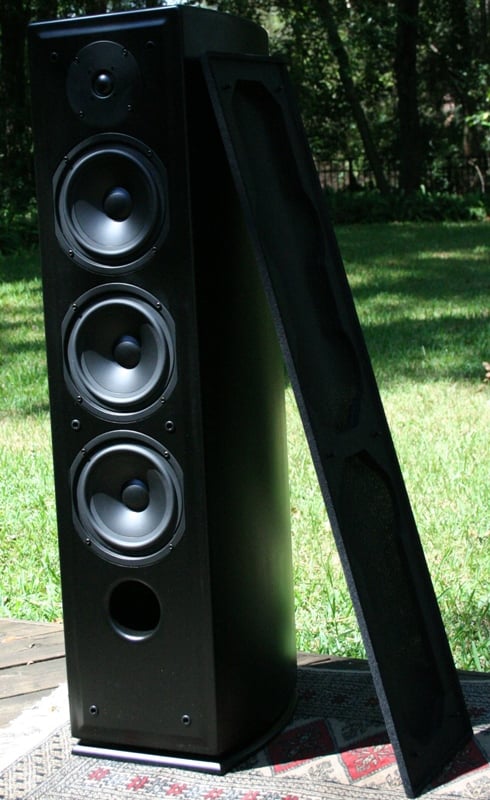 The
speakers are 40" high with the tweeter about 36.5" off the ground
(just a hair above my seated ear level). The sides are rounded which gives the
speakers sort of a bloated look (that sounds worse than I mean it). I've had
experience with a lot of different speaker designs and one thing I've found
with the ones with the rounded sides is they tend to be less sturdy. With the
carpet spikes that don't penetrate the carpet, my medium pile carpet, and
rounded sides of the speaker, I ended up with a speaker that wasn't as steady
as I'd have liked. I never got the impression that it would tip over, though,
so unless you have really active kids or a Great Dane, you should be alright.
The
speakers are 40" high with the tweeter about 36.5" off the ground
(just a hair above my seated ear level). The sides are rounded which gives the
speakers sort of a bloated look (that sounds worse than I mean it). I've had
experience with a lot of different speaker designs and one thing I've found
with the ones with the rounded sides is they tend to be less sturdy. With the
carpet spikes that don't penetrate the carpet, my medium pile carpet, and
rounded sides of the speaker, I ended up with a speaker that wasn't as steady
as I'd have liked. I never got the impression that it would tip over, though,
so unless you have really active kids or a Great Dane, you should be alright.
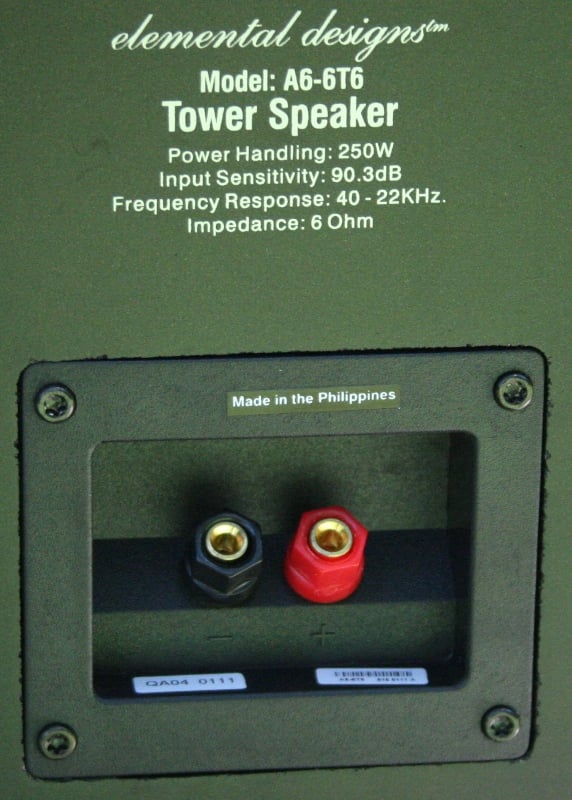 The
back of the speakers sport a single set of five way binding posts in a plastic
housing. This is pretty standard stuff including the binding posts which are of
the gold plated post but plastic top variety. You'll recognize these as similar
to the ones that are included on the back of most A/V receivers. At this price
point, 5-way binding posts are most likely a cut above the competition which
probably sport the spring type. At least you can use banana plugs with them. I
also commend eD for restraining from putting dual binding posts on the back for
bi-wiring. This would have been a ridiculous addition that would have added
unnecessary cost to a budget speaker.
The
back of the speakers sport a single set of five way binding posts in a plastic
housing. This is pretty standard stuff including the binding posts which are of
the gold plated post but plastic top variety. You'll recognize these as similar
to the ones that are included on the back of most A/V receivers. At this price
point, 5-way binding posts are most likely a cut above the competition which
probably sport the spring type. At least you can use banana plugs with them. I
also commend eD for restraining from putting dual binding posts on the back for
bi-wiring. This would have been a ridiculous addition that would have added
unnecessary cost to a budget speaker.
 Opening the speakers, I noticed a
few things. First, the two ports vent two different chambers of the speaker.
The first chamber (from the top) includes the tweeter and first woofer. The
second chamber has the bottom two woofers and the rest of the speaker length.
The edges all have additional bracing. Each chamber has one other brace running
horizontal. Since the top chamber is smaller, this makes that one much more
inert than the bottom. This is borne out by the "knock" test which
showed the bottom chamber ringing much more.
Opening the speakers, I noticed a
few things. First, the two ports vent two different chambers of the speaker.
The first chamber (from the top) includes the tweeter and first woofer. The
second chamber has the bottom two woofers and the rest of the speaker length.
The edges all have additional bracing. Each chamber has one other brace running
horizontal. Since the top chamber is smaller, this makes that one much more
inert than the bottom. This is borne out by the "knock" test which
showed the bottom chamber ringing much more.
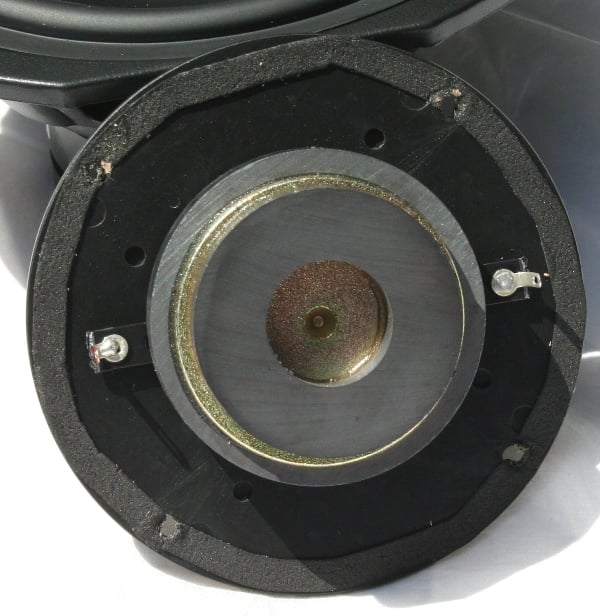
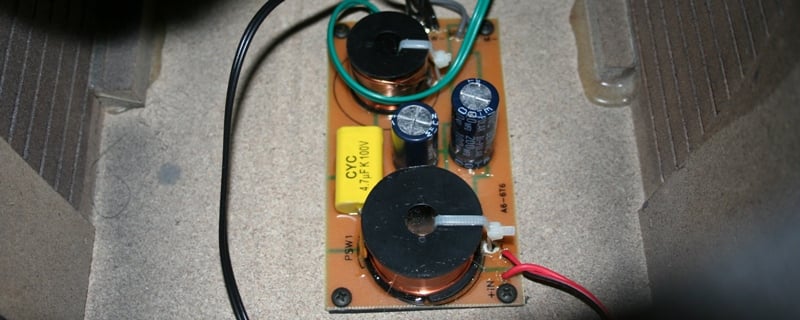
The woofers employ stamped baskets and small magnets. I was particularly surprised at how light these drivers were. The tweeter has an open back (something I haven't seen for a while) instead of a metal or plastic enclosure. Behind the drivers around the sides and back is a single piece of polyfil. The crossover contains two air core inductors, one for the high pass section and the other for the low pass section. Though they aren’t orthogonally oriented to reduce crosstalk effects, they are spaced far enough apart to minimize any audible effects. A polyester bypass capacitor is used in conjunction with two electrolytics for the HPF section of the speaker system.
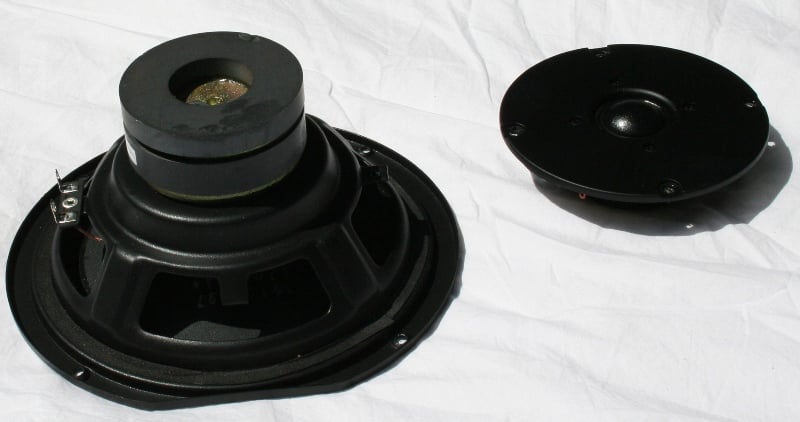
Though the eD website claims the drivers are video shielded and even show the metal can usually employed for this application, there was no steel can encasing the motor. This should still provide adequate shielding if not placed directly on a CRT type TV’s. Glancing over the website, most of the information is accurate about the speakers design (including the technical drawings) though the claim that the widened base increases stability is dubious at best. If it is wider than the body, it is millimeters wider. If they really want to increase stability, they are going to have to substantially expand the base. Also, the drawing of the spikes in no way resembles what I received. In their defense, the picture of the base in the gallery clearly shows how wide the base is and the actual spikes you'll be receiving.
Set-Up
 Inserting the spikes took a
matter of moments. As I mentioned, the balls on the tips allowed the spikes to
enter the carpet but not pierce it which meant that no fine adjustment was
necessary. Using a few of my favorite test discs, I played around with
placement. Imaging was significantly better with the speakers pointed directly
at me but highs were tamed when they were pointed straight out (putting me
off-axis). I compromised by toeing them in slightly. I placed the speakers no
closer than 2.5 feet from any wall to reduce any bass boosting affects that
close boundaries might provide.
Inserting the spikes took a
matter of moments. As I mentioned, the balls on the tips allowed the spikes to
enter the carpet but not pierce it which meant that no fine adjustment was
necessary. Using a few of my favorite test discs, I played around with
placement. Imaging was significantly better with the speakers pointed directly
at me but highs were tamed when they were pointed straight out (putting me
off-axis). I compromised by toeing them in slightly. I placed the speakers no
closer than 2.5 feet from any wall to reduce any bass boosting affects that
close boundaries might provide.
Measurements & Testing
For laboratory measurements I used the Sencore SP395A FFT Audio Analyzer and a Sherbourn 2/75B amp, I measured the A6-6T6's in room on and off-axis frequency response with 1/12th octave resolution. Like most speaker manufacturers, eD lists the frequency response of their speakers on their site. Also like most speaker manufacturers, their graph resembles mine in a "had the same father but different moms" sort of way.
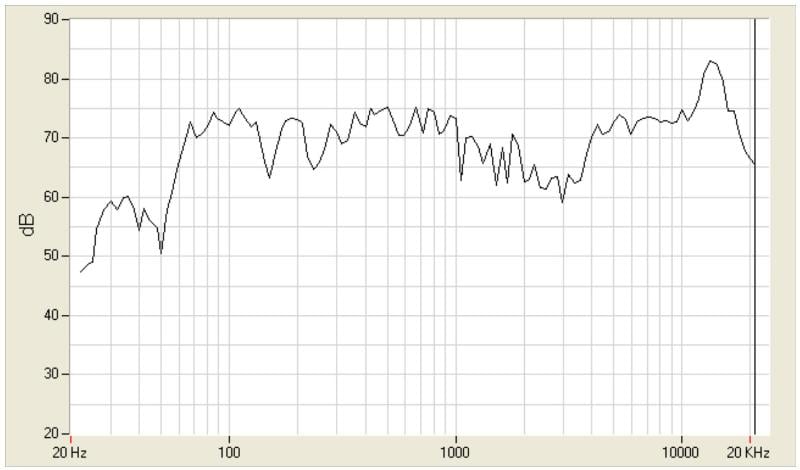
A6-6T6 1 watt/1 Meter Frequency Response (1/12th Octave) On Axis
The 15kHz peak we see in the frequency response is caused in part by the diaphragm ringing. This is an issue with the geometry of the tweeter. It can likely be mitigated or eliminated by choosing a different diagraph radius and/or material. The manufacturer would be wiser to select a smaller dome tweeter of proper design as its more challenging to make larger dome tweeters retain linearity to the frequency extremes of human hearing.

A6-6T6
1/2 Meter Frequency Response (1/12th Octave)
Pink - On axis, Orange - 15 degrees off axis, Yellow - 30
degrees off axis

A6-6T6 Impedance
The Sencore consistently measures impedance one ohm low. From a close examination of the above impedance magnitude, it is clear the A6-6T6 low passes the woofer at 2000hz, while the tweeter is crossover over considerably higher, closer to 6000 Hz. This may be for a number of reasons, but the resultant frequency response both on and off axis clearly shows a significant droop in the overall output between 1000 and 4000 Hz. The problem with errors in this part of the frequency range is that human hearing is particularly acute in this region, and not terribly forgiving of mistakes.
The octaves on either side of 2000hz result in the greatest contribution to intelligibility more than any other two octaves in the audible range. As Paul Klipsch was known to say, “We live in the midrange”. A better crossover design would likely have minimized if not eliminated this problem entirely.
A6-6T6 Listening Tests and Conclusion
At first, I was confused by the A6-6T6s. eD claimed a frequency response down to 40Hz and I was hearing nothing near that. After checking my own measurements (and more importantly eD's), I discovered that this wasn't a +/-3dB point but a "lowest frequency it can play" point. Their own graphs show it rolling off much higher (closer to 60Hz). This jelled really well with what I was hearing through my listening tests and with the Rives Test CD II. As can be seen from the Impedance magnitude curve, the low point between the low frequency peaks is at approximately 55 hz. This point indicates the Box tuning frequency. Since the cabinet is vented, it should fall off 24 db per octave below the box tuning and with a ½ octave between 55 and 40 hz, the output should be down about 12db at this point. Bass 12db down will no longer offer a substantial contribution to the overall output.
While I did all my tests without the benefit of a sub, understand that you're going to need one if you're big on bass. While the A6-6T6's uses 3 small woofers, they will not provide the bass you'll need for action movies or to justify forgoing the purchase of a dedicated subwoofer. Their response is more like a bookshelf speaker rather than a full range tower speaker. Now, understand, at this price point, you can get worse bass response (especially when you consider the price of speaker stands). Just because the A6-6T6s are floorstanding loudspeakers doesn't necessarily mean they have to be full range. Instead, I choose to think of them as a bookshelf speaker with an attached stand.
Overall imaging for the A6's was excellent - much better than I expected. With the speakers pointed directly at me, I was really impressed. Unfortunately, the speakers are a bit bright and I couldn't really tolerate this orientation for very long. This correlates well with the measurements showing the tweeter level being higher than the midrange level of the speaker. The off axis response of the speakers was good enough that you could point them directly out and still get very good imaging. I ended up toeing them in slightly just to try and tighten them up a bit (I'm not convinced it worked - you'll want to experiment for yourself). I did the majority of the listening tests with the Emotiva RSP-1
/RPA-1 combo which had absolutely no problems driving the A6's. A 6-ohm load isn't all that hard for most amps so you should have no problem marrying these speakers to almost any receiver on the market.Morecheeba
- Big Calm Morcheeba has a calm,
laidback sound that I thought would work well with the A6-6T6's (yes, I threw
them a soft pitch just this once). I was well rewarded. Vocals were well
presented in the soundstage and instruments had great separation. The
soundstage was very wide and encompassing. The overall presentation was very
warm with only a hint of brightness here and there. I definitely enjoyed my
time with the A6's and Morcheeba. Since this was such a gimme, I won't spend
too much time here.
Morcheeba has a calm,
laidback sound that I thought would work well with the A6-6T6's (yes, I threw
them a soft pitch just this once). I was well rewarded. Vocals were well
presented in the soundstage and instruments had great separation. The
soundstage was very wide and encompassing. The overall presentation was very
warm with only a hint of brightness here and there. I definitely enjoyed my
time with the A6's and Morcheeba. Since this was such a gimme, I won't spend
too much time here.
Rusted
Root - When I Woke I winced as I decided
on this album. This is the type of album that isn't kind to speakers. Tons of
percussion, a good mix of male and female vocals, and more cymbals than you can
throw a stick at. While sitting off axis to the speakers (from their toe in) I
was not really subjected to the worst of the possible brightness. What I did
find, however, was that some of the cymbals and highest notes did not reflect
the deepest and most lifelike of presentations. The top end basically sounded a
little thin and strained. Don't read too much into this. Remember, these are
$500 speakers. At this price point, you've got to expect some compromises.
Still, it makes you wonder what they could have done by leaving out the bottom
two woofers and instead spending more on better drivers.
I winced as I decided
on this album. This is the type of album that isn't kind to speakers. Tons of
percussion, a good mix of male and female vocals, and more cymbals than you can
throw a stick at. While sitting off axis to the speakers (from their toe in) I
was not really subjected to the worst of the possible brightness. What I did
find, however, was that some of the cymbals and highest notes did not reflect
the deepest and most lifelike of presentations. The top end basically sounded a
little thin and strained. Don't read too much into this. Remember, these are
$500 speakers. At this price point, you've got to expect some compromises.
Still, it makes you wonder what they could have done by leaving out the bottom
two woofers and instead spending more on better drivers.
Track 6: "Beautiful People" is a very demanding and deep song. There is just so much information there. The A6's did a decent job of revealing the depth of this particular track. Separation of the vocalists was very good and imaging, as I've mentioned, was excellent. The song is a bit fatiguing at times and the upper end of the A6's didn't help this much. Most of the presentation was laid back, in general, and sort of recessed into the soundstage. Morcheeba, in comparison, was much more forward and present. The rain effects at the end of this track in particular were a little thin. This album would definitely benefit from the addition of a sub.
Michael
Buble - It's Time This album has a lot
of great review material though it does suffer a bit from the
"loudness" fever that most of the artists of today seem to be
afflicted with. It is at least 5-10dB louder than both of the other albums I
used during this review. Fortunately, it doesn't seem plagued with too many
compression artifacts. Again, I was impressed by the A6's performance. For
$500, you are getting quite a bit of speaker. The sound was big, Michael's
voice was very present, and I couldn't help but tap my foot as I listened. Even
at lower volumes, the A6's performed well though the midrange did seem to thin
out faster than the bass and treble. The bass guitar sounded great and plucky.
Drums sounded natural. Even the upper end sounded good on this album.
This album has a lot
of great review material though it does suffer a bit from the
"loudness" fever that most of the artists of today seem to be
afflicted with. It is at least 5-10dB louder than both of the other albums I
used during this review. Fortunately, it doesn't seem plagued with too many
compression artifacts. Again, I was impressed by the A6's performance. For
$500, you are getting quite a bit of speaker. The sound was big, Michael's
voice was very present, and I couldn't help but tap my foot as I listened. Even
at lower volumes, the A6's performed well though the midrange did seem to thin
out faster than the bass and treble. The bass guitar sounded great and plucky.
Drums sounded natural. Even the upper end sounded good on this album.
Conclusion
I definitely don't want anyone walking away from this review thinking that I didn't like the Elemental Designs A6-6T6 speakers - I certainly did. At this price point, there is only so much you can do and eD has moved that bar quite high. Sure, I can point out flaws (and I did) but that's just so you know where their limitations are. I defy you to find a speaker that outperforms the A6's overall at this price point. You certainly won't find a floorstander. The imaging of the A6's is really their strong point. I'm tempted to make grandiose claims about the imaging but I won't. If you're on a budget and or perhaps looking for your first pair of speakers, you could do a lot worse than the A6-6T6s. Honestly, I'm not sure how much better you could do.
Elemental Designs A6-6T6
$500
Elemental Designs
1618 N. 15th Ave. E.
Newton, IA 50208
The Score Card
The scoring below is based on each piece of equipment doing the duty it is designed for. The numbers are weighed heavily with respect to the individual cost of each unit, thus giving a rating roughly equal to:
Performance × Price Factor/Value = Rating
Audioholics.com note: The ratings indicated below are based on subjective listening and objective testing of the product in question. The rating scale is based on performance/value ratio. If you notice better performing products in future reviews that have lower numbers in certain areas, be aware that the value factor is most likely the culprit. Other Audioholics reviewers may rate products solely based on performance, and each reviewer has his/her own system for ratings.
Audioholics Rating Scale
 — Excellent
- — Very Good
- — Good
- — Fair
- — Poor
| Metric | Rating |
|---|---|
| Build Quality | |
| Appearance | |
| Treble Extension | |
| Treble Smoothness | |
| Midrange Accuracy | |
| Bass Extension | |
| Bass Accuracy | |
| Imaging | |
| Soundstage | |
| Dynamic Range | |
| Fit and Finish | |
| Performance |  |
| Value | |
As Associate Editor at Audioholics, Tom promises to the best of his ability to give each review the same amount of attention, consideration, and thoughtfulness as possible and keep his writings free from undue bias and preconceptions. Any indication, either internally or from another, that bias has entered into his review will be immediately investigated. Substantiation of mistakes or bias will be immediately corrected regardless of personal stake, feelings, or ego.
View full profile Subscribe to our newsletter
