


DALI LEKTOR 8 Floorstanding Speaker Review
DALI LEKTOR 8 Floorstanding Speakers
- Product Name: LEKTOR 8
- Manufacturer: DALI
- Performance Rating:

- Value Rating:
- Review Date: February 18, 2009 11:55
- MSRP: $ 1800/pair
|
Frequency range+/- 3dB [Hz]: |
38.5Hz - 27kHz |
|
Sensitivity (2,83 V/1 m) [dB]: |
89.5Hz |
|
Nominal impedance[ohms]: |
6 |
|
Maximum SPL[dB]: |
112dB |
|
Recommended amplifier power [Watts]: |
40 - 180 |
|
Crossover frequencies: |
600 / 3500 |
|
Crossover principles: |
3-way |
|
High frequency driver: |
Soft textile dome |
|
Enclosure type: |
Bass reflex |
|
Bass reflex tuning frequency [Hz]: |
36 |
|
Connection input(s): |
Single wire |
|
Magnetic shielding: |
Semi magnetic shielded |
|
Loudspeaker dimensions including base and grille: |
251 X 1059 X 370 |
|
Loudspeaker weight including base and grille [kg]: |
24.2 |
|
Accessories included: |
Manual |
Pros
- Looks
- Plenty of bass
- Wide soundstage
- Great for larger rooms
- Excellent off axis response
Cons
- Bass can be overdone at times
- No real option for non-carpeted floors
- Imaging could be tighter
DALI LECTOR 8 Build Quality
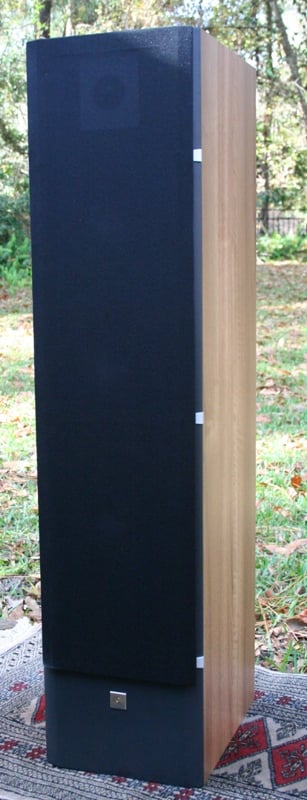 DALI may not exactly be a
household name in speakers - at least not in America - but they should. My first
experience with DALI's were at the Audioholics
bookshelf shootout. At an $1800 price point for a pair of bookshelves in
the MENTOR
1's, I felt sure I'd never see a pair of DALI's in for review. The next
time I ran into DALI was at CEDIA 2008. They had a similarly priced pair of
floorstanders just released. Believe me when I say I couldn't wait to get a
pair in for review. Two of my companions couldn't stop talking about how good
they sounded on the show floor. Me? I tend to reserve judgment. Well, it's
judgment time and as always I promise to be tough but fair.
DALI may not exactly be a
household name in speakers - at least not in America - but they should. My first
experience with DALI's were at the Audioholics
bookshelf shootout. At an $1800 price point for a pair of bookshelves in
the MENTOR
1's, I felt sure I'd never see a pair of DALI's in for review. The next
time I ran into DALI was at CEDIA 2008. They had a similarly priced pair of
floorstanders just released. Believe me when I say I couldn't wait to get a
pair in for review. Two of my companions couldn't stop talking about how good
they sounded on the show floor. Me? I tend to reserve judgment. Well, it's
judgment time and as always I promise to be tough but fair.
First Impressions and Build Quality
To be honest, before I even opened the box I was a bit biased against the look of the LEKTORs. Why? At $1800 a pair, I couldn't believe they would even consider a vinyl wrap. At this price point, I expect much more.
Boy, was I wrong.
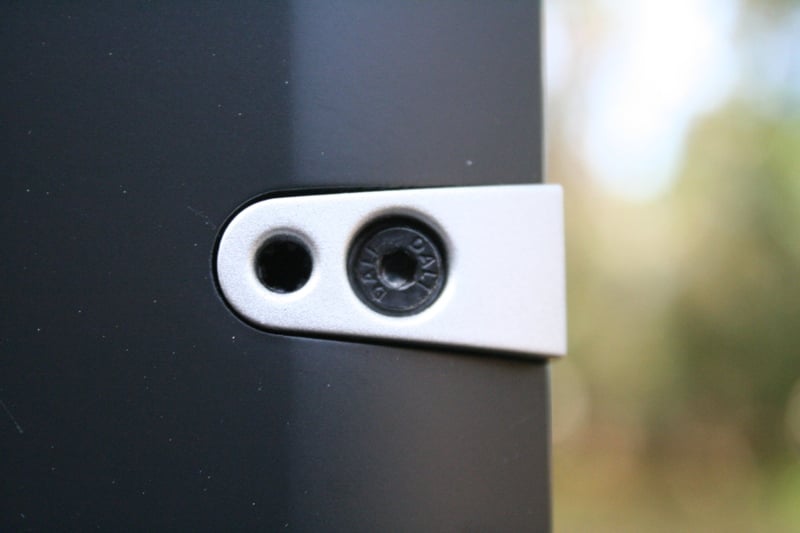 I've seen a lot of vinyl wraps in my day and I can say without
reservation that this is the best. The review pair of LEKTORs was in the light
walnut finish rather than the all black option. As much as I like a speaker
that "disappears" into a room, I find that black, in general, is
harder to keep clean and generally bores me. The woodgrain finishes tend to not
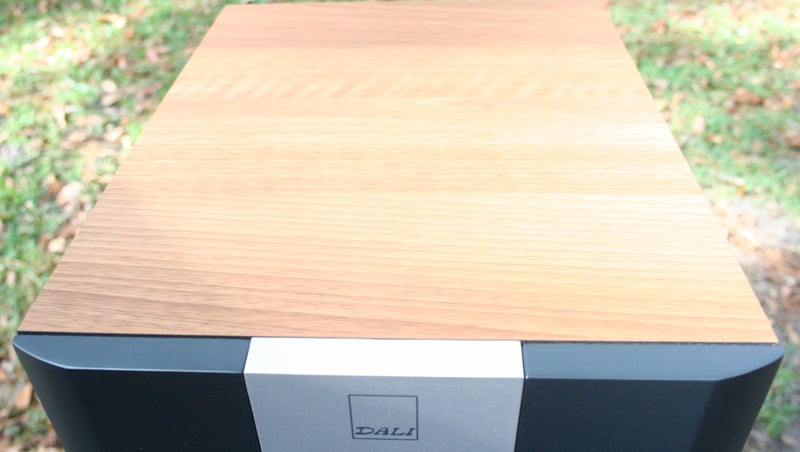
show off dust as much and definitely make more of a statement. The LEKTOR 8's
are one of the better looking speakers I've had in my room - at least from the
front. The black front baffle is nicely rounded and is matte enough to absorb
most light. The grill is a little oddly shaped until you realize that it can be
reversed so to cover or reveal the tweeter. For those that believe that grills
make an audible difference… well, they probably still think it makes an audible
difference when covering the woofers. DALI was smart enough to put their logo
on both the top (near the tweeter) and bottom (small chrome plate) so that no
matter your grill preference, you'll know who made your speakers. What you
don't know is that the DALI and LEKTOR logos are everywhere - even in places
you can't see them: Back of the woofers/tweeter, under the metal plate around
the tweeter, even on the screws!
I've seen a lot of vinyl wraps in my day and I can say without
reservation that this is the best. The review pair of LEKTORs was in the light
walnut finish rather than the all black option. As much as I like a speaker
that "disappears" into a room, I find that black, in general, is
harder to keep clean and generally bores me. The woodgrain finishes tend to not
show off dust as much and definitely make more of a statement. The LEKTOR 8's
are one of the better looking speakers I've had in my room - at least from the
front. The black front baffle is nicely rounded and is matte enough to absorb
most light. The grill is a little oddly shaped until you realize that it can be
reversed so to cover or reveal the tweeter. For those that believe that grills
make an audible difference… well, they probably still think it makes an audible
difference when covering the woofers. DALI was smart enough to put their logo
on both the top (near the tweeter) and bottom (small chrome plate) so that no
matter your grill preference, you'll know who made your speakers. What you
don't know is that the DALI and LEKTOR logos are everywhere - even in places
you can't see them: Back of the woofers/tweeter, under the metal plate around
the tweeter, even on the screws!
The fit and finish around the front and sides is nearly impeccable. The corners of the main cabinet are a bit sharp but the front corners are covered with the black front baffle so it isn't an issue. There is a small gap between the front baffle and the main cabinet but it would take very little convincing to make me believe this was an intentional design choice and not some sort of fit and finish issue. The metal accents on the front aren't heavy handed and give the speaker the contemporary but not gaudy look I'd expect of a Danish speaker manufacturer. The metal side pegs double as holders for the binding posts. When I was trying to dissemble the speakers, I discovered that they really don't seem to serve any purpose other than that.
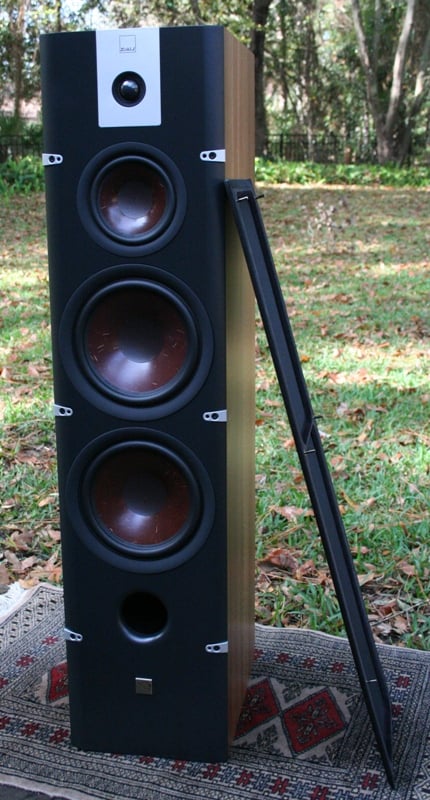 The real standouts in the
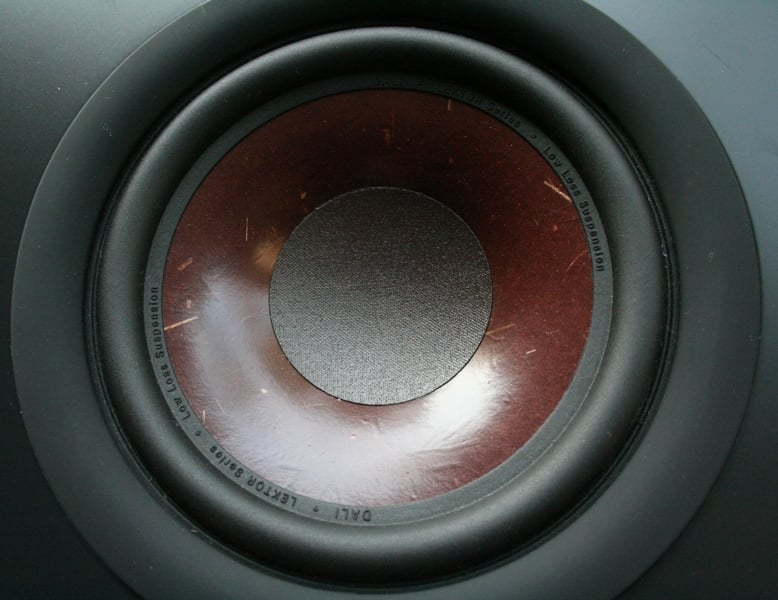
looks department are the woofers. The LEKTOR 8's sport two 8" woofers and
a 5" midrange. They are also the color of old bricks or dried blood (your
pick). This is the first time I've seen deep red woofers in a speaker -
especially one made to be seen in the home. At first, I was a bit put off by
the color - red just seemed weird to me. But the longer I've lived with them
the more I've appreciated them. The coated paper with wood fiber reinforcement
material isn't as reflective as your aluminum or some of the other woofer designs
I've seen in the past so they tend to blend better. They certainly are
different which, if nothing else, will get people's attention. Still, in a
darkened room with the lights low and the grills off, they don't stand out as
much as I'd like. Now, understand, this is purely an aesthetic opinion and has
nothing to do with performance.
The real standouts in the
looks department are the woofers. The LEKTOR 8's sport two 8" woofers and
a 5" midrange. They are also the color of old bricks or dried blood (your
pick). This is the first time I've seen deep red woofers in a speaker -
especially one made to be seen in the home. At first, I was a bit put off by
the color - red just seemed weird to me. But the longer I've lived with them
the more I've appreciated them. The coated paper with wood fiber reinforcement
material isn't as reflective as your aluminum or some of the other woofer designs
I've seen in the past so they tend to blend better. They certainly are
different which, if nothing else, will get people's attention. Still, in a
darkened room with the lights low and the grills off, they don't stand out as
much as I'd like. Now, understand, this is purely an aesthetic opinion and has
nothing to do with performance.
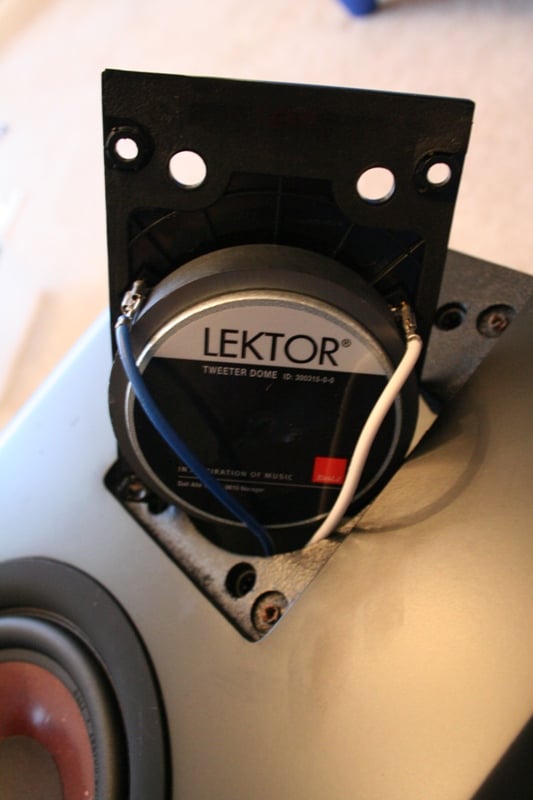
The 28mm (1.1 inch) tweeter is soft domed and black. The metal surround plate goes a long way toward making this stand out. The speaker grill is a bit flimsy for my taste and I was often concerned about breaking it during removal. The chrome posts, however, held snugly and there was never any fear of accidental removal. The problem was that the grill was very thin and the posts held it very firmly making for some tense moments. The thin frame was by design according to DALI to reduce reflections and diffraction from the frame.
 My only real aesthetic concern is with the back of the speaker. While
the front and sides are nearly impeccable, the back looks much more like those
speakers you remember your parents buying from Sears 30 years ago. The raised
outer lip, the less than perfect vinyl wrap meetings… it just isn't on the same
level as the rest of the speaker. That being said, it's in the back. Who
really cares? I certainly wouldn't.
My only real aesthetic concern is with the back of the speaker. While
the front and sides are nearly impeccable, the back looks much more like those
speakers you remember your parents buying from Sears 30 years ago. The raised
outer lip, the less than perfect vinyl wrap meetings… it just isn't on the same
level as the rest of the speaker. That being said, it's in the back. Who
really cares? I certainly wouldn't.
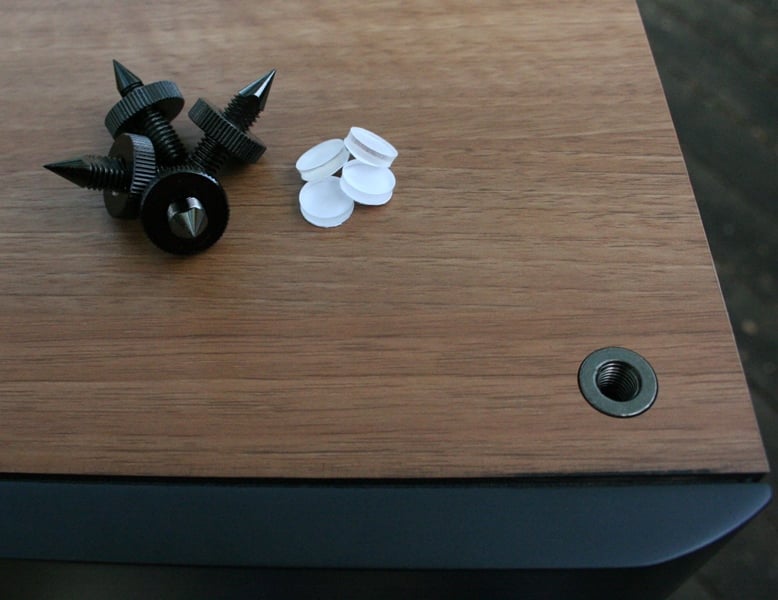 There are two ports on the speaker, one in the front near the bottom and
one about midway up the height in the back. The bottom of the cabinet sports
threaded inserts for carpet spikes (provided by DALI). The spikes have a HUGE
tightening nut which makes leveling these speakers considerably easier than
just about any non-outrigger equipped speaker I've reviewed. Unfortunately, the
only provisions for non-carpeted floors are little sticky rubber rounds that I
doubt would last a single move. If you are going to go this route, be
absolutely certain of your speaker placement before you install them as they
are sure to come loose with any adjustments. I'd get a small square of carpet
or maybe a thick towel to set them on at first until you are sure of the
orientation, location, and toe-in before installing the rubber pads. After
that, I'd leave them where they were or consider some sturdier aftermarket
feet.
There are two ports on the speaker, one in the front near the bottom and
one about midway up the height in the back. The bottom of the cabinet sports
threaded inserts for carpet spikes (provided by DALI). The spikes have a HUGE
tightening nut which makes leveling these speakers considerably easier than
just about any non-outrigger equipped speaker I've reviewed. Unfortunately, the
only provisions for non-carpeted floors are little sticky rubber rounds that I
doubt would last a single move. If you are going to go this route, be
absolutely certain of your speaker placement before you install them as they
are sure to come loose with any adjustments. I'd get a small square of carpet
or maybe a thick towel to set them on at first until you are sure of the
orientation, location, and toe-in before installing the rubber pads. After
that, I'd leave them where they were or consider some sturdier aftermarket
feet.
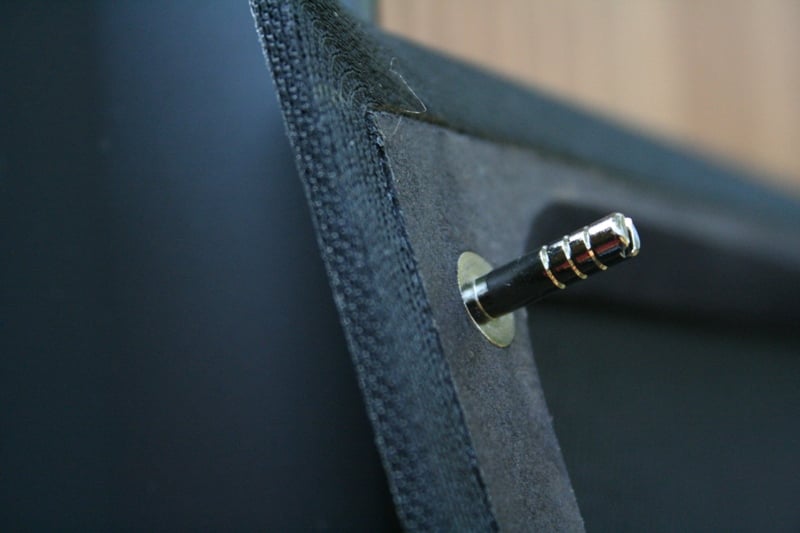
The binding posts in the back were different than any I've experienced before. At first I was convinced that they were five-way binding posts in look only. While most five-way have a plastic cap on top that is removable for use with banana plugs, it didn't look like the DALI's did. I would have sworn on a stack that the center post was solid with red or black paint on the top. When DALI informed me that there was in fact a plastic cap on top, I went back and checked. With some difficulty, I found out (much to my chagrin) that they were right. The cap is actually under the binding post nut (a bit of a divergence from the norm) which has to be completely removed to gain access. Even then, the tolerances are so tight on the plastic cap that it looks like paint. This presents a very clean look even if it did flummox me for a bit.
 This is the point where I
share the pictures of the disassembled DALIs and I talk about the crossover,
driver, and cabinet design. The LEKTORs were the first speaker since the SVS SBS-01's (one of my
earliest speaker reviews with Audioholics) that I couldn't get apart. I
certainly wasn't going to take a prybar to them or anything. I did a knock test
and the top definitely seemed more inert than the bottom which was a bit more
echoey. They are definitely heavy, so unless they've lined the bottom with
lead, they do have quite a bit of MDF at work here. When I couldn't get them
apart I requested some pictures from DALI. Unfortunately, they didn't seem
inclined to take actual pictures and instead send a few technical drawings.
That wasn't going to do so I decided to just give up…
This is the point where I
share the pictures of the disassembled DALIs and I talk about the crossover,
driver, and cabinet design. The LEKTORs were the first speaker since the SVS SBS-01's (one of my
earliest speaker reviews with Audioholics) that I couldn't get apart. I
certainly wasn't going to take a prybar to them or anything. I did a knock test
and the top definitely seemed more inert than the bottom which was a bit more
echoey. They are definitely heavy, so unless they've lined the bottom with
lead, they do have quite a bit of MDF at work here. When I couldn't get them
apart I requested some pictures from DALI. Unfortunately, they didn't seem
inclined to take actual pictures and instead send a few technical drawings.
That wasn't going to do so I decided to just give up…
Wait a minute…
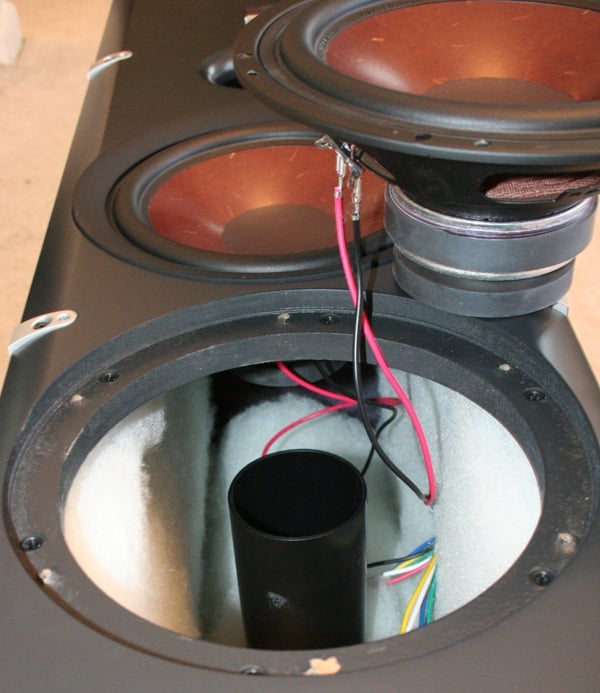 From the technical drawings,
I figured out how to disassemble (no disassemble #5) the speakers. Score one
for me. The front baffle is thicker than the other walls (according to the
documents they sent) and I measured it to be an inch thick! MDF construction
all the way around with the tweeter and 5" midrange in an enclosed box.
The two 8" drivers have the rest of the cabinet (including the space
behind the tweeter/mid box) along with the two ports. The ports are flared on
the exterior but not the interior. A layer of polyfil is glued/stapled to the
inside of the larger cabinet and pretty much fills up the tweeter/mid box. The
tweeter sports a very large magnet and is mounted to a well braced plastic
plate. There is a single brace just below the bottom woofer and above the front
port. This explains the more hollow sound at the bottom of the cabinet which
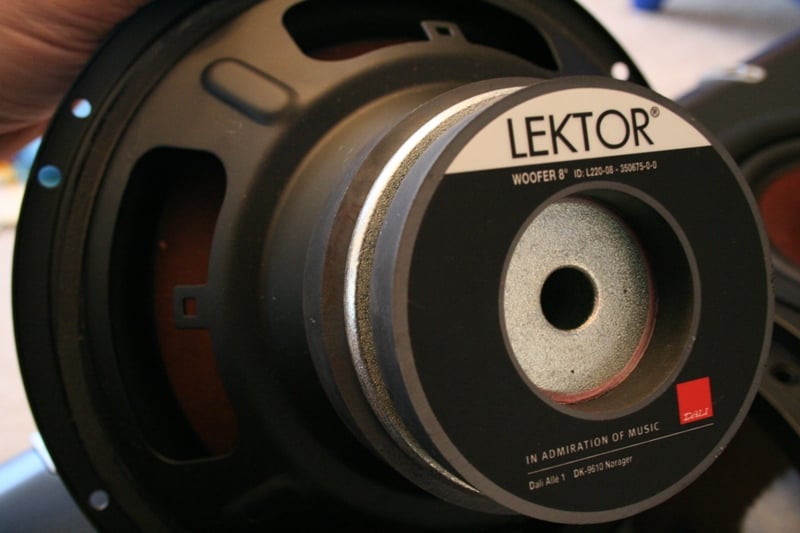
could use some more bracing. The woofers sport stamped metal baskets (I was hoping
for cast) and fairly large magnet structures. The specs say the drivers are
semi-magnetically shielded which I supposed means you can place them semi-close
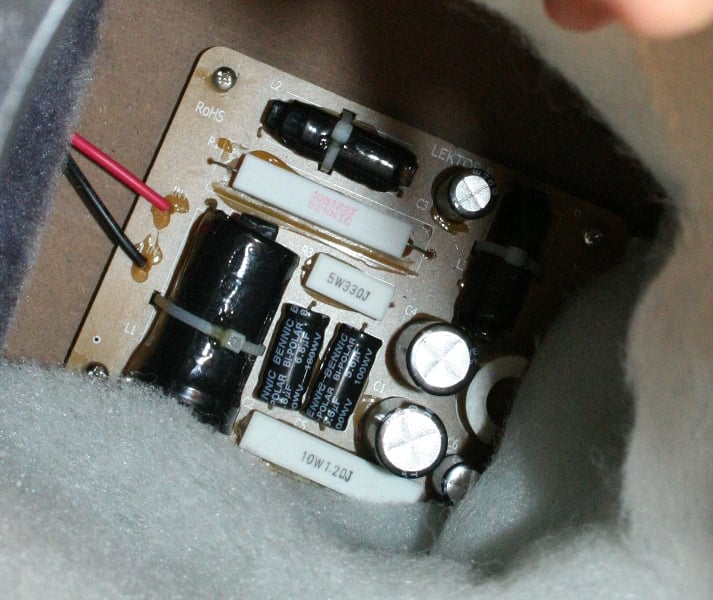
to your computer or CRT. The
crossover component parts were a bit of a disappointment (aside from the
ceramic resistors) as DALI employed iron core inductors instead of air cores,
and electrolytic capacitors with no poly bypass capacitors. I couldn’t help to wonder how much better
these speakers could have been with some higher quality component usage in the
crossover.
From the technical drawings,
I figured out how to disassemble (no disassemble #5) the speakers. Score one
for me. The front baffle is thicker than the other walls (according to the
documents they sent) and I measured it to be an inch thick! MDF construction
all the way around with the tweeter and 5" midrange in an enclosed box.
The two 8" drivers have the rest of the cabinet (including the space
behind the tweeter/mid box) along with the two ports. The ports are flared on
the exterior but not the interior. A layer of polyfil is glued/stapled to the
inside of the larger cabinet and pretty much fills up the tweeter/mid box. The
tweeter sports a very large magnet and is mounted to a well braced plastic
plate. There is a single brace just below the bottom woofer and above the front
port. This explains the more hollow sound at the bottom of the cabinet which
could use some more bracing. The woofers sport stamped metal baskets (I was hoping
for cast) and fairly large magnet structures. The specs say the drivers are
semi-magnetically shielded which I supposed means you can place them semi-close
to your computer or CRT. The
crossover component parts were a bit of a disappointment (aside from the
ceramic resistors) as DALI employed iron core inductors instead of air cores,
and electrolytic capacitors with no poly bypass capacitors. I couldn’t help to wonder how much better
these speakers could have been with some higher quality component usage in the
crossover.
LEKTOR Setup and Measurements
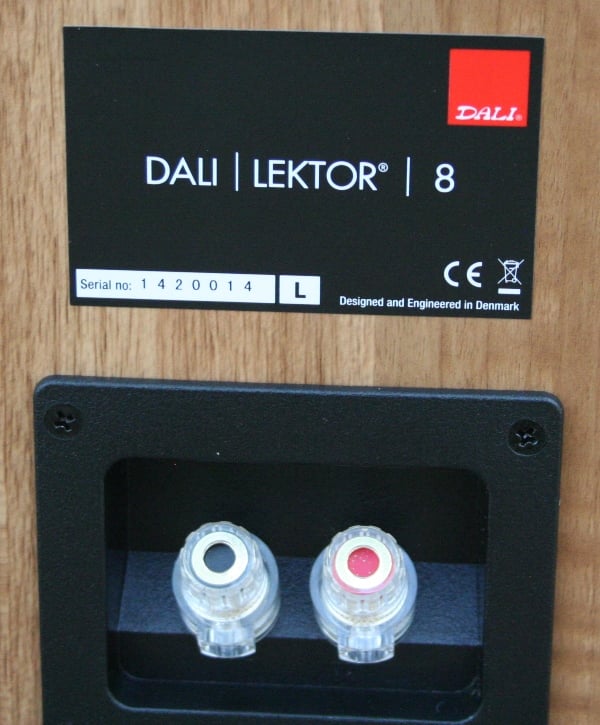 When the speakers arrived I noticed that the
boxes were labeled L and R. This usually indicates a Left and Right speaker and
it is something I've experienced before. Many speakers with side firing or
offset tweeters will specify a side. The problem is that the DALI LEKTOR 8's
don't have any sort of physical requirement that would suggest such a
distinction is necessary or warranted. So I did something that I usually would
never do - I contacted the manufacturer. As a rule, I try to keep my reviews as
bias-free as possible. This means I don't read other reviews (or user
comments), I don't talk to marketing reps, and I spend as little time as
possible in contact with the manufacturers. I know other reviewers like to brag
about how they talked to the cabinet designer or crossover builder but to me
that just adds bias. It is like going into a listening test and having someone
tell you what you are about to hear (remember all that backwards masking stuff
where you couldn't hear the satanic messages until they told you what you were
supposed to hear?). Of course you
hear what they point out - that's simple psychology. But when I have questions
that I can't answer, sometimes contacting the manufacturer is the only option. My
solution was to do my listening tests, comparisons, and measurements before
contacting DALI. In the end, my precautions were unnecessary as DALI answered
my questions simply and succinctly without trying to sway my review.
When the speakers arrived I noticed that the
boxes were labeled L and R. This usually indicates a Left and Right speaker and
it is something I've experienced before. Many speakers with side firing or
offset tweeters will specify a side. The problem is that the DALI LEKTOR 8's
don't have any sort of physical requirement that would suggest such a
distinction is necessary or warranted. So I did something that I usually would
never do - I contacted the manufacturer. As a rule, I try to keep my reviews as
bias-free as possible. This means I don't read other reviews (or user
comments), I don't talk to marketing reps, and I spend as little time as
possible in contact with the manufacturers. I know other reviewers like to brag
about how they talked to the cabinet designer or crossover builder but to me
that just adds bias. It is like going into a listening test and having someone
tell you what you are about to hear (remember all that backwards masking stuff
where you couldn't hear the satanic messages until they told you what you were
supposed to hear?). Of course you
hear what they point out - that's simple psychology. But when I have questions
that I can't answer, sometimes contacting the manufacturer is the only option. My
solution was to do my listening tests, comparisons, and measurements before
contacting DALI. In the end, my precautions were unnecessary as DALI answered
my questions simply and succinctly without trying to sway my review.
From DALI - Each DALI speaker (no samples) is tested in an isolation chamber on 14 separate parameters, including polarity, frequency, SPL, "rub & buzz", impedance, etc. Pairs of speakers are tested together, with the output curves matched to a standard, and to each other. Each speaker must fall within close tolerances of each other and the test standard. Any speaker failing this performance test is reworked. If it fails a second time, the cabinet is crushed and discarded. So, the L&R indicates a "matched pair" in terms of testing, on a broad array of variables. If the consumer inverts the speakers, it will have no effect upon sonic performance. The L&R simply shows they were built and tested together. In some cases, DALI has produced asymmetrical designs, which must be positioned as indicated (drivers are mounted off-center). In those cases, L&R positioning is critical. In the case of LEKTOR 8, the speakers are symmetrical and indifferent to L&R placement.
Exactly as I thought. It is nice to know that the speakers are tested together and that QC is tight (at least, that's what they claim and we have every reason so far to believe them). If they are going to "skimp" on veneers (I use the term lightly as the finish on the LEKTOR's is excellent), than I expect them to bring their 'A' game in other departments.
Placement with the DALI LEKTOR 8's was fairly straightforward. The LEKTOR's have a very wide soundstage and their sweet spot was fairly huge (more on this in the listening tests below). This makes the DALI's very placement forgiving which actually makes for a very fine-tunable listening experience. As you can see below from the measurements, on axis the DALI's have a bit more high-end energy while off axis they measure a bit flatter. According to DALI this is by design as the speakers are meant to be listened to off-axis with placement parallel to the front wall. However, if you prefer one sound over the other, all you need do is adjust the positioning. I ended up with a slight toe-in as I felt it solidified the center imaging a bit. Pointing the speaker directly at me was a bit fatiguing but not overly so. I know there are many out there that would still like that orientation. Especially since the large soundstage didn't seem to diminish much in that orientation like other speakers.
 The large adjustment nuts on the carpet
spikes made leveling the speakers easier than other spikes I've used, though of
course not as easy as an outrigger setup. The spikes were a little short,
however, and I had to have them only barely in the threaded inserts to have
enough room for the spike to penetrate my medium pile carpet. A longer spike
would have helped this. For this review, the DALI LEKTOR 8's were powered
either by a Denon
AVR-2307CI or by the Emotiva RSP-1/RPA-1 combo. All
critical listening tests were done with the Emotiva combo. Analogue cabling was
Blue Jeans with digital supplied by Impact Acoustics.
The Denon
DVD-3910 provided source material for the critical listening tests.
The large adjustment nuts on the carpet
spikes made leveling the speakers easier than other spikes I've used, though of
course not as easy as an outrigger setup. The spikes were a little short,
however, and I had to have them only barely in the threaded inserts to have
enough room for the spike to penetrate my medium pile carpet. A longer spike
would have helped this. For this review, the DALI LEKTOR 8's were powered
either by a Denon
AVR-2307CI or by the Emotiva RSP-1/RPA-1 combo. All
critical listening tests were done with the Emotiva combo. Analogue cabling was
Blue Jeans with digital supplied by Impact Acoustics.
The Denon
DVD-3910 provided source material for the critical listening tests.
Measurements & Testing
For laboratory measurements I used the Sencore SP395A FFT Audio Analyzer and a Sherbourn 2/75B amp, I measured the DALI LEKTOR 8's in-room on- and off-axis frequency response with 1/12th octave resolution
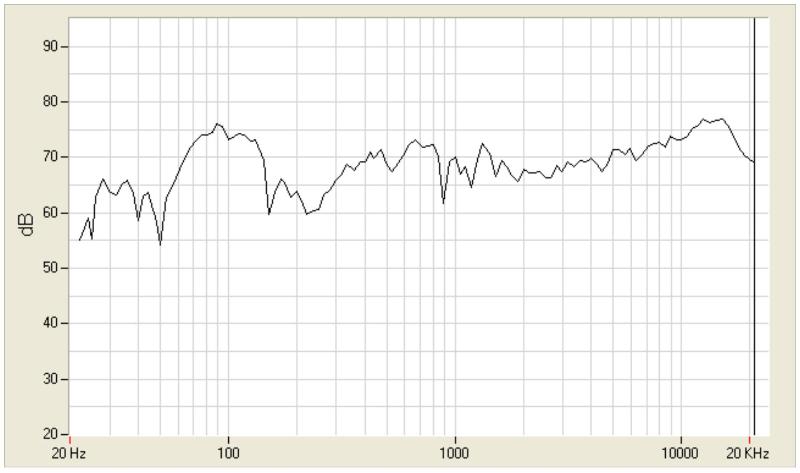
DALI LEKTOR 8 1 Meter Frequency
Response (1/12th Octave) On Axis
Note
- this is NOT a 1 watt measurement
Our measurements indicate the LEKTOR 8’s tweeter response is set a tad too high as indicated by the rising frequency response at the tweeter crossover point. We noticed the same phenomenon when we tested the MENTOR 1’s but DALI explained this is deliberately done for a more uniform off axis power response. We suggest little to no toe-in to prevent listening fatigue.
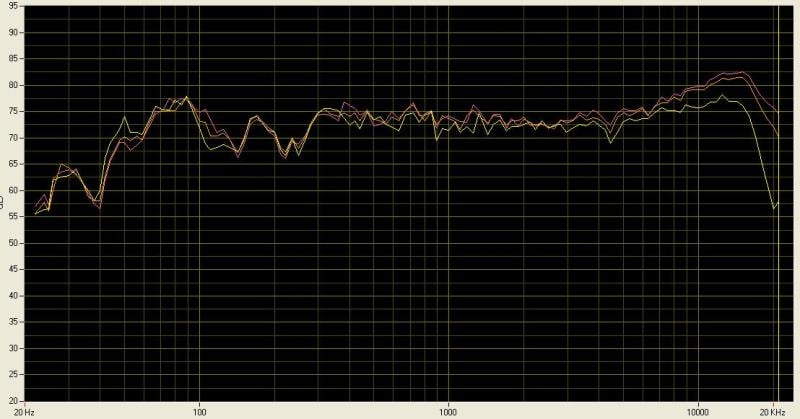
DALI LEKTOR 8 1/2 Meter Frequency
Response (1/12th Octave)
Pink - On axis, Orange - 15 degrees off axis, Yellow - 30
degrees off axis
The LEKTOR 8’s frequency response looks best around 30 degrees off axis exhibiting a very linear response throughout the entire frequency spectrum. Its quite unusual for a speaker to have such a flat response this far off axis but it seems to serve the system well for those that like very articulate if not a lively top end response.
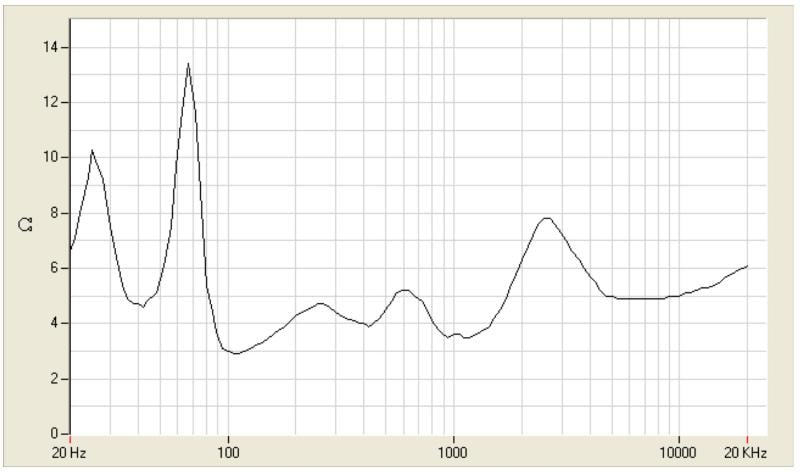
DALI LEKTOR 8 Impedance
The Sencore consistently measures impedance one ohm low. The impedance measurement indicates a tuning frequency around 40Hz as specified by DALI. Given the moderately high efficiency rating and fairly benign impedance profile, this speaker shouldn’t be too difficult for any decent multi-channel receiver to drive.
LEKTOR 8 Listening and Conclusion
Starting off, I wanted to see how the LEKTOR 8's handled bass. Grabbing my trusty Rives Test CD II, I played a few test tones to see what they could do. As expected, they provided sufficiently low bass in copious amounts. The specs of the LEKTORs claim a -3dB point of 38.5Hz and I believe this is right on. The 40Hz tone came though much clearer and with more force than the 31.5Hz. At the lower tones, some port/driver noise could be discerned but only at higher volumes. Even the least sound other than the low tone would have masked it.
My next step was to do my usual comparison. I will say that I was tempted to compare them to the Salk SongTower QWTs but refrained. The planned floorstanding speaker shootout is just around the corner and I didn't want to do that comparison so close to the date. Instead, I did what I normally do, compared the DALIs to the RBH TK-5CTs. The TK-5CTs (cousins of the EMP EF30t speakers) have been and probably always will be my reference budget floorstanding speakers. At an MSRP of just over half the asking price of the DALIs, the comparison should be fairly quick.
It wasn't.
 Sometimes I have a hard
time with comparisons because the two speakers sound so similar that it takes a
while to pick out the subtle differences. Not this time. The DALIs and the TKs
were night and day. The problem was I couldn't decide if the differences
indicated a quality difference or if they were just… different. The TKs had a more delicate touch to the presentation of
the music (something that I'm not used to saying about them) while the DALIs
were much more forceful in their presentation. I've never thought of the TKs as
a small speaker (of course, they are compared to many floorstanders - DALIs
included) but the DALIs made them sound tiny.
Sometimes I have a hard
time with comparisons because the two speakers sound so similar that it takes a
while to pick out the subtle differences. Not this time. The DALIs and the TKs
were night and day. The problem was I couldn't decide if the differences
indicated a quality difference or if they were just… different. The TKs had a more delicate touch to the presentation of
the music (something that I'm not used to saying about them) while the DALIs
were much more forceful in their presentation. I've never thought of the TKs as
a small speaker (of course, they are compared to many floorstanders - DALIs
included) but the DALIs made them sound tiny.
The problem (if you can call it that) is that neither of speakers sounded bad - just different. The DALIs were in your face. They are big and bassy and demanded to be heard. The soundstage was huge and the imaging was fairly solid. The TKs were lighter, more laid back, and generally sounded more articulate. The highs seemed a bit better defined though I suspect this was due more to the lack of bass in comparison with the DALIs. The DALIs definitely sounded bigger and fuller than the TKs - something that I would expect from a speaker 2x's the price. Overall, the comparison seemed to reveal that the DALIs and the TKs were excellent examples of speakers at their price point. It was sort of like comparing a Honda and an Acura. They are both excellent cars at their price point. No way to ding either one.
CD: Bang
& Olufsen Vol. XIII – The Sound of Perfection
I used this CD during the comparison with
the TKs. It has a lot of different styles of music and a good mix of male and
female vocals. While some of the recordings aren't really of the highest
fidelity, they all offer something to listen for. I had a bit of a problem with
this album as the amount of bass seemed to overtake everything else. When I
forced myself to pay attention, however, all the higher end information was
definitely there. The bass was just quite a bit stronger than I was used to but
also punchy and tight without being overbearing. Kick drums and bass guitars
had a lifelike quality with no real hint of reverb. At lower volumes, the bass
really disappeared (which to some extent is to be expected) and the soundstage
became quite a bit more flat and recessed. The central image was still well
defined, however, and the soundstage still retained its width (inexplicably). Overall
the presentation was very forward and wide. The vocals were well anchored in
the center of the soundstage.
CD: Rusted
Root – When I Woke I've often used this album during reviews because of the mix of male and
female vocals, fast and slow tempo, and gratuitous use of percussion
instruments. There really are very few albums that can put a pair of speakers
through their paces like When I Woke. Each
of the percussive instruments was well defined and left and right separation
was excellent. Again, I couldn't help but notice the wide soundstage. Compared
to other speakers, I felt the LEKTORs were excellent at enveloping you with the
music. I'm sure their off-axis response was part of this. Imaging was good if
not as rock solid as I've heard in the past. The central image (mostly
consisting of the vocalist) was very good but not as three dimensional as
competitors at this price point.
I've often used this album during reviews because of the mix of male and
female vocals, fast and slow tempo, and gratuitous use of percussion
instruments. There really are very few albums that can put a pair of speakers
through their paces like When I Woke. Each
of the percussive instruments was well defined and left and right separation
was excellent. Again, I couldn't help but notice the wide soundstage. Compared
to other speakers, I felt the LEKTORs were excellent at enveloping you with the
music. I'm sure their off-axis response was part of this. Imaging was good if
not as rock solid as I've heard in the past. The central image (mostly
consisting of the vocalist) was very good but not as three dimensional as
competitors at this price point.
CD: Yello
– the eye Focusing in on the imaging aspect, I couldn't help but grab Yello the eye. I immediately noticed the width
of the soundstage (again) but also the left and right separation. Sounds and
effects bounced between the main speakers effortlessly and to great effect. Female
vocals were rich and lush without being overdone. Left and right pans were well
realized and the LEKTORs did an excellent job of energizing the space. The
central image was definitely present but not very defined. The wide soundstage
made it seem like the image took up entire front of the room (between the
speakers). Other speaker offerings seemed to do better with locating it a one
point between the speakers. I believe in a larger room (I sit about 9 feet from
each of the speakers), this might tighten up a bit. The midrange in general
seemed full and well balanced with the high end. Bass heavy passages (of which
there are a few in this eletronica album) were a bit overdone though not in an
unpleasant way. There was enough tactile bass to let you know it was there but
not so much that it was distracting. The highs were well done if not quite as
extended as I've heard in the past.
Focusing in on the imaging aspect, I couldn't help but grab Yello the eye. I immediately noticed the width
of the soundstage (again) but also the left and right separation. Sounds and
effects bounced between the main speakers effortlessly and to great effect. Female
vocals were rich and lush without being overdone. Left and right pans were well
realized and the LEKTORs did an excellent job of energizing the space. The
central image was definitely present but not very defined. The wide soundstage
made it seem like the image took up entire front of the room (between the
speakers). Other speaker offerings seemed to do better with locating it a one
point between the speakers. I believe in a larger room (I sit about 9 feet from
each of the speakers), this might tighten up a bit. The midrange in general
seemed full and well balanced with the high end. Bass heavy passages (of which
there are a few in this eletronica album) were a bit overdone though not in an
unpleasant way. There was enough tactile bass to let you know it was there but
not so much that it was distracting. The highs were well done if not quite as
extended as I've heard in the past.
CD: Sonic
Youth - Sister
After a while you get tired of hearing the same test albums over and
over again. Rather than trying out a new album, I decided to delve into the
stuff I hadn't heard in years. Out comes Sonic Youth's Sister. Not the most accessible album by any means, Sonic Youth
recorded this album years ago forgoing the newly emerging digital technology
(that's how old it is) and recorded it all on tubes. I know, how very esoteric
of them. Still, it gives the album a very unique sound and the LEKTORs
represented it well. This album is not overly bassy and I found I enjoyed the DALIs
a bit more with this offering than some of the newer albums I had used for
testing. The guitar was grungy and gritty, the high-hat tight and controlled,
the vocals well presented and clear. Some of the softer tracks were ethereal
and airy. All in all, this was a great album for the DALIs and I enjoyed
revisiting this classic.
Conclusion
 The DALI LEKTOR 8's are an excellent
speaker. They are a bit bassy for my taste but they aren't overly so. The highs
are very well articulated and clear with a smooth as silk midrange. The
aesthetics of the Lecktor 8's is impeccable and the walnut finish is simply
stunning. The LEKTORs would be right at home in a medium to large room and
present a very easy load to amplifiers. The excellent off axis response makes
placement a breeze. The real strength of these speakers is the soundstage.
Wider than your room (or so it seems), the DALI Lekors wrap the music around
you even in a two channel setup. For the price, the DALI's definitely represent
a top tier offering. When you pay the asking price of the LEKTORs, you expect a
level of performance. The DALI's give you that, plus some!
The DALI LEKTOR 8's are an excellent
speaker. They are a bit bassy for my taste but they aren't overly so. The highs
are very well articulated and clear with a smooth as silk midrange. The
aesthetics of the Lecktor 8's is impeccable and the walnut finish is simply
stunning. The LEKTORs would be right at home in a medium to large room and
present a very easy load to amplifiers. The excellent off axis response makes
placement a breeze. The real strength of these speakers is the soundstage.
Wider than your room (or so it seems), the DALI Lekors wrap the music around
you even in a two channel setup. For the price, the DALI's definitely represent
a top tier offering. When you pay the asking price of the LEKTORs, you expect a
level of performance. The DALI's give you that, plus some!
DALI LEKTOR 8 Floorstanding Speakers
$1800/pair
DALI USA
2150 West 6th Ave.
Unit N
Broomfield, CO 80020
303-464-7000
About DALI USA
At DALI, we are driven by a raw passion for music and its honest
reproduction in the domestic environment. The development and refinement of new
technologies to increase the realism of the home entertainment experience is
the main objective in our quest to create what we believe to be the best
loudspeakers in the world!
The Score Card
The scoring below is based on each piece of equipment doing the duty it is designed for. The numbers are weighed heavily with respect to the individual cost of each unit, thus giving a rating roughly equal to:
Performance × Price Factor/Value = Rating
Audioholics.com note: The ratings indicated below are based on subjective listening and objective testing of the product in question. The rating scale is based on performance/value ratio. If you notice better performing products in future reviews that have lower numbers in certain areas, be aware that the value factor is most likely the culprit. Other Audioholics reviewers may rate products solely based on performance, and each reviewer has his/her own system for ratings.
Audioholics Rating Scale
 — Excellent
- — Very Good
- — Good
- — Fair
- — Poor
| Metric | Rating |
|---|---|
| Build Quality | |
| Appearance | |
| Treble Extension | |
| Treble Smoothness | |
| Midrange Accuracy | |
| Bass Extension | |
| Bass Accuracy | |
| Imaging | |
| Soundstage | |
| Dynamic Range | |
| Fit and Finish | |
| Performance | |
| Value | |
As Associate Editor at Audioholics, Tom promises to the best of his ability to give each review the same amount of attention, consideration, and thoughtfulness as possible and keep his writings free from undue bias and preconceptions. Any indication, either internally or from another, that bias has entered into his review will be immediately investigated. Substantiation of mistakes or bias will be immediately corrected regardless of personal stake, feelings, or ego.
View full profile Subscribe to our newsletter