


Axiom Audio Epic 80-600 System Review
- Product Name: Epic 80-600
- Manufacturer: Axiom Audio
- Performance Rating:

- Value Rating:
- Review Date: July 26, 2005 19:00
- MSRP: $ 3681 (5.1) $4858 (7.1) Additional EP-600: 1662.50, Additional VP150: $366
M80ti tower speakers
Enclosure: Triple Vortex / Reflex
Max Amp Power: 400W
Min Amp Power: 10W
Freq Response +/-3db: 34 - 22kHz
Freq Response +3dB- 9dB: 25 - 22kHz
Impedance: 4-ohms
SPL (in-room 1w/1m): 95 dB
SPL (anechoic 1w/1m): 91 dB
Crossover: 160Hz & 2.3kHz
Tweeter: Dual 1"
Mid-bass: Dual 5.25"
Woofer: Dual 6.5"
Dimensions: 39.5" x 9.25" x 17" (1003mm x 235mm x 432mm)
Weight: 55 lbs (25 kg)
QS-8 Surround Speakers
Enclosure: Acoustic Suspension
Max Amp Power: 400W
Min Amp Power: 10W
Freq Response +/-3db: 95 - 22kHz
Freq Response +3dB- 9dB: 65 - 22kHz
Impedance: 6-ohms
SPL (in-room 1w/1m): 95 dB
SPL (anechoic 1w/1m): 91 dB
Crossover: 2.5kHz
Tweeter: Dual 1"
Mid-bass: Dual 5.25"
Dimensions: 8.25" x 11" x 6" (210mm x 279mm x 152mm)
Weight: 13 lbs (4 kg)
VP-150 Center Speaker
Enclosure: Acoustic Suspension
Max Amp Power: 400W
Min Amp Power: 10W
Freq Response +/-3db: 85 - 22kHz
Freq Response +3dB- 9dB: 50 - 22kHz
Impedance: 6-ohms
SPL (in-room 1w/1m): 95 dB
SPL (anechoic 1w/1m): 91 dB
Crossover: 2.7kHz
Tweeter: Dual 1"
Mid-bass: Triple 5.25"
Dimensions: 7.5" x 27.5" x 7.5" (191mm x 699mm x 191mm)
Weight: 20 lbs (9 kg)
EP-600 Subwoofer
Enclosure: Vortex/Reflex
Max Amp Power: 600W
Crossover Adjust: 40-100Hz
Phase: 0 & 180 degrees
Woofer: 12"
Features: DSP Controlled, Line in/out, High level inputs, Room trim, Dynamic power supply, Boost control
Anechoic Response +/-1.5db: 19 - 100Hz
Anechoic Response +/-3db: 17 - 100Hz
In-Room Response +3dB- 9dB: 15 - 100Hz
Max SPL Anechoic: 111 dB
Max SPL In-Room: 122 dB
Dimensions: 45.5" x 15" x 17" (1156mm x 381mm x 432mm)
Weight: 100 lbs (45 kg)
Pros
- Excellent system synergy
- Fantastic performance at original prices
- Easy to integrate
- Available in many finishes
- Excellent customer service and support
- Plenty of WOW effect!
Cons
- Grill covers are a bit flimsy
- Center channel has a tough time keeping up with main channel speakers
- Subwoofer should have more internal bracing
- Prices have gone up dramatically since the original publication of this review
Axiom Epic 80-600 Overview
 The single most gratifying word a custom
installer or Home Theater aficionado can hear after installing a system or giving a multi-channel
demonstration is the word "WOW". This indicates a positive emotional response. Think about it for a
moment. Without using an expletive, what word would you use when you see a beautiful car or person with
whom you are attracted? WOW!
The single most gratifying word a custom
installer or Home Theater aficionado can hear after installing a system or giving a multi-channel
demonstration is the word "WOW". This indicates a positive emotional response. Think about it for a
moment. Without using an expletive, what word would you use when you see a beautiful car or person with
whom you are attracted? WOW!
I became interested in trying to assemble a loudspeaker system that would provoke this "WOW", but not break the bank. Trying to find a loudspeaker system that can actually provide "WOW" is easier said than done. The system must meet the following four requirements to be considered.
- First, the loudspeaker system needs to be dynamic. Dynamic is defined as the ability to reproduce soft subtle sounds like whispers or footsteps one minute and large high impact sounds like explosions the next minute without sounding compressed or strained.
- Second, the speaker system needs to be revealing. It must be able to reproduce small details like footsteps, clothing rustle, or the sound of leather creaking with clarity (perception of Foley effects are a great way to measure this). Laid back or rolled off speakers tend to mask these sounds.
- The third important factor that is most often overlooked when assembling a multi-channel loudspeaker system is system synergy. All of the loudspeakers in the system should have a very close sonic signature. This is very important for multi-channel music like DVD-A and SACD, as well as for multi-channel movie tracks. Sound effects that move from speaker to speaker (pans) should sound balanced and equal.
- Lastly, the loudspeaker system needs to be able to play at high SPL levels with no audible distortion while not inducing listening fatigue at these levels.
Axiom Audio is a loudspeaker company located in the heartland of Canada. They have been building and designing loudspeakers for over twenty years. Axiom Audio is part of the growing wave of "consumer-direct" companies. The idea of buying direct from the manufacturer has advantages. Most notably, the price-to-performance ratio is increased substantially through elimination of a dealer network and reduced costs.
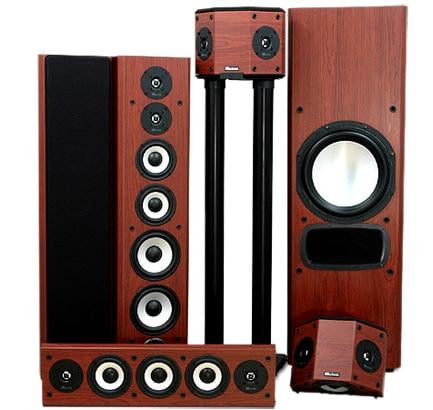
Getting more speaker for the dollar or bang-for-the-buck, along with all the positive comments that I have read about Axiom Audio speakers over the last several months, prompted me to order a complete system for evaluation and review. After a couple of phone calls to Axiom Audio advising them of my room size of 4000 cubic feet and my desire to build a system that would provide "WOW", I ordered the following speaker system in Boston Cherry finish with black grills:
- Two M80ti tower speakers-front left and right
- Two M80ti tower speakers-alternate surrounds (7.1 system)
- One VP-150 center speaker for the 5.1 system (Two) to be used in the 7.1 system
- Two QS-8 used for surrounds 5.1 system and EX channels in the 7.1 system
- Two EP-600 subwoofers placed 1/3 in from sidewall
Other standard finish choices include Black, Beech and Light Maple.


Over 24 Custom Matte and Highgloss Finishes and 6 grill cloths are also available at an extra charge of $95-$350 USD per model; to a maximum of $275-$1000 USD per system in the same finish.
Axiom Epic 80-600 VP150 and M80ti
The VP-150 center channel speaker is a very interesting design. The speaker configuration with the tweeters placed at the ends of the enclosure is one that I have not seen produced in the many years I have been installing speaker systems. The reasoning behind this design is said to improve dispersion and off axis response on the left and right side. It is also said to provide a broader soundstage and wider array for more seated listening positions. It is a sealed design for easy placement and integration into custom A/V cabinetry.
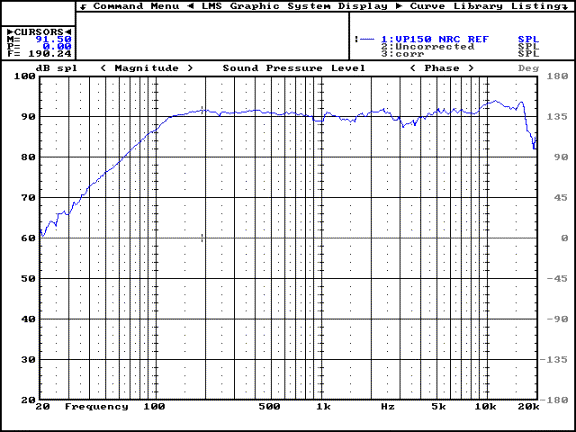
The VP-150 has a pretty flat frequency response. There is a slight hump between 12kHz -17kHz. Also note the effective low frequency cutoff of about 80Hz.
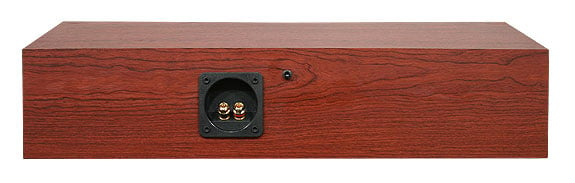 Around
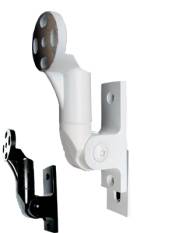
the back of the VP-150 you will find very high quality five-way gold plated binding posts and the mount
hole for the optional wall bracket as shown below. A look inside the VP-150 revealed very good speaker
components and build quality. The enclosure is constructed from 3/4" MDF and is lined with polyfill. 18
AWG high strand count copper wire is used from the crossover to the speaker spade connections. The
speaker's woofer component is of high quality aluminum and the midrange speakers have steel baskets,
large motor structures, and shielded bucking magnets.
Around
the back of the VP-150 you will find very high quality five-way gold plated binding posts and the mount
hole for the optional wall bracket as shown below. A look inside the VP-150 revealed very good speaker
components and build quality. The enclosure is constructed from 3/4" MDF and is lined with polyfill. 18
AWG high strand count copper wire is used from the crossover to the speaker spade connections. The
speaker's woofer component is of high quality aluminum and the midrange speakers have steel baskets,
large motor structures, and shielded bucking magnets.
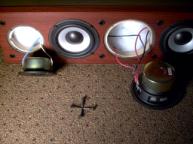 The tweeters used in the VP-150 are composed of a high power handling
titanium dome.
As shown below all drivers are recessed in the front baffle to improve imaging and
reduce diffraction. This is a nice touch for a speaker in this price class. Many speakers costing much
more take the easy and more cost effective route and flush mount driver components.
The tweeters used in the VP-150 are composed of a high power handling
titanium dome.
As shown below all drivers are recessed in the front baffle to improve imaging and
reduce diffraction. This is a nice touch for a speaker in this price class. Many speakers costing much
more take the easy and more cost effective route and flush mount driver components.
The VP-150 has excellent fit and finish at this price point. The vinyl Boston Cherry looks like real wood and no visible seams were detected. The grill that covers the front baffle looks OK but I think this is one area that could be improved upon. Although the grill did its job just fine, its construction was a bit on the flimsy side.
M80ti Floorstanding Speakers
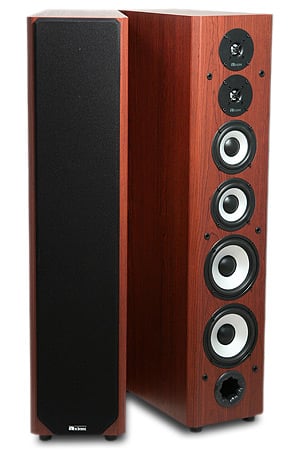 The M80ti floorstanding speaker has another
interesting design. As far as I know, the design is not replicated in any current loudspeaker currently
on the market. The Axiom M80ti has dual tweeters mounted in tandem on the top of the front baffle,
below that there are dual midrange drivers and dual woofers.
The M80ti floorstanding speaker has another
interesting design. As far as I know, the design is not replicated in any current loudspeaker currently
on the market. The Axiom M80ti has dual tweeters mounted in tandem on the top of the front baffle,
below that there are dual midrange drivers and dual woofers.
The drivers used in the M80ti are the same type used in the VP-150 with the exception of displacement. This insures very similar sonic signatures for seamless transitions between the center speaker and front main speakers.
All drivers used in the Axiom M80ti are active and they are all recessed into the front baffle. Many loudspeaker manufacturers use multiple drivers in their designs in an active/passive-radiator configuration. All of the drivers in the M80ti 舗 s are active. The first of three ports is mounted on the very bottom of the front baffle.
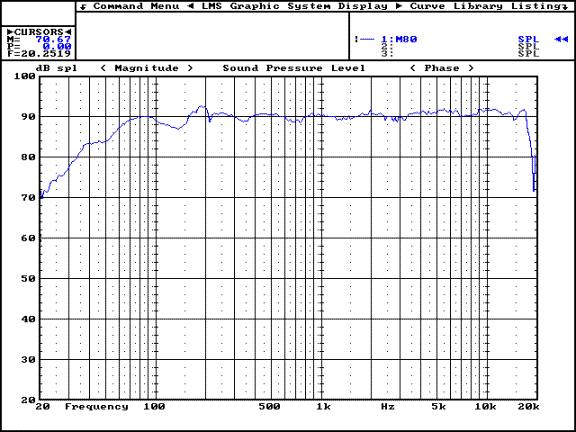
 As you can see from the above 1 meter frequency response, the M80ti measured
very well and has a relatively flat anechoic response. The M80ti has an effective low frequency
response of about 40-45Hz which is somewhat masked in the measurement since anechoic chambers bass
response below 85Hz begin to taper off.
As you can see from the above 1 meter frequency response, the M80ti measured
very well and has a relatively flat anechoic response. The M80ti has an effective low frequency
response of about 40-45Hz which is somewhat masked in the measurement since anechoic chambers bass
response below 85Hz begin to taper off.
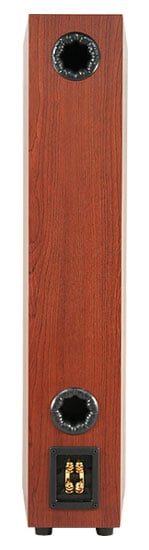
A peek around the back of the Axiom M80ti revealed that these speakers can be bi-amped, due to the incorporation of dual 5-way binding posts. These speakers are also bi-wireable, however, in my opinion this method of termination will yield no appreciable gain in performance. Unless you have a very long run of speaker wire and you want to double up the gauge of wire to compensate for the long distance, there is no audible benefit. The remaining two ports are located on the top and bottom of the enclosure as shown in the photo.
On the bottom of the enclosure you will find threaded inserts for the installation of either spiked or rubber feet. High quality parts are supplied with the speaker along with a wrench to install them.
A look inside the Axiom M80ti revealed that this speaker is built to a very high standard not usually found in speakers at this price. The photo below shows the Axiom M80ti lying on its side with the woofer, midrange, and tweeter removed. The enclosure is constructed using 3/4" MDF.
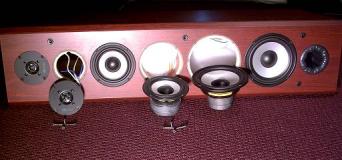
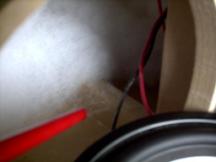
The first thing I noted inside the M80ti's enclosure was the very robust shelf bracing, one located just below the mid subwoofer and one located just below the bottom tweeter. These are used to control cabinet resonance. The speaker enclosures were also packed with polyfill.
The Axiom M80ti speakers are built with separate chambers to house the dual midranges. This construction technique is most often found on very expensive loudspeakers.

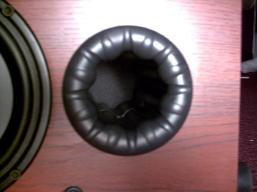
The Vortex vent ports used on the Axiom M80ti are designed to reduce port noise. Look closely at the photo and you can see the attached vent sock, this helps reduce noise even more and prevents the polyfill from blocking the port.
The fit and finish on the M80ti was superb. The speaker is elegant and takes up very little space due to its relatively small footprint of 9.25 x 17 inches (and 40" tall). The grills attach to the front baffle solidly, but again I would have liked to have seen a sturdier grill. That gripe aside, I must say that I was blown away by the attention to detail and the excellent build quality and overall engineering of the Axiom M80ti. The construction techniques used in this speaker are usually found in speakers at much higher price points.
Axiom Epic 80-600 QS8 and EP600
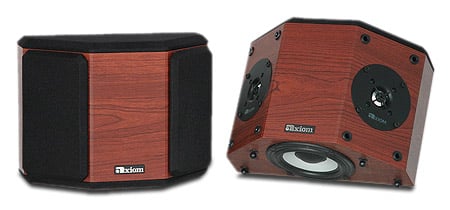 The Axiom QS8
surround speaker is yet another unique design. It incorporates dual tweeters mounted on a trapezoid
front baffle. The tweeters are wired in phase. The QS8 also has dual midranges, one mounted on top and
one on the bottom that are wired in phase. This unique driver configuration produces two effects: it
makes the speaker have a very wide dispersion area and it creates a very diffuse
soundstage.
The Axiom QS8
surround speaker is yet another unique design. It incorporates dual tweeters mounted on a trapezoid
front baffle. The tweeters are wired in phase. The QS8 also has dual midranges, one mounted on top and
one on the bottom that are wired in phase. This unique driver configuration produces two effects: it
makes the speaker have a very wide dispersion area and it creates a very diffuse
soundstage.
Looking around the back of the QS8 you will find 5-way gold plated binding posts, quick connect slide brackets, and a threaded insert for the optional swivel mount.
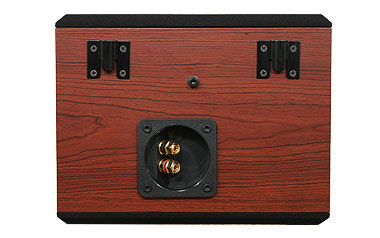
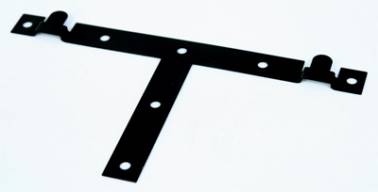
The QS8 allows for several different mounting configurations. Wall mounting can be accomplished using the supplied T bracket.
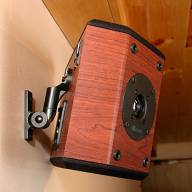
If you cannot flush mount the QS8 with the T bracket you can use the optional swivel mount.
 The QS8 is very installation flexible. If you don't have a wall to mount them,
installation can be accomplished using the optional floor stands. The floor stands are black powder
coated, measure 38 x 10.5 x11 inches, and have an integrated cable management system.
The QS8 is very installation flexible. If you don't have a wall to mount them,
installation can be accomplished using the optional floor stands. The floor stands are black powder
coated, measure 38 x 10.5 x11 inches, and have an integrated cable management system.
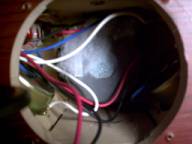
Removing the top midrange revealed the inner workings of the QS8. The enclosure is a sealed-design cabinet constructed with 3/4 inch MDF. The photo shows the bottom midrange, dual tweeters, and in the upper left hand corner you can see part of the crossover. The enclosure was filled to capacity with polyfill.
Driver components used in the QS8 are the same type as used in the VP-150 and M80ti to ensure similar sonic characteristics.
Monster Sub: EP600 Subsonic Subwoofer
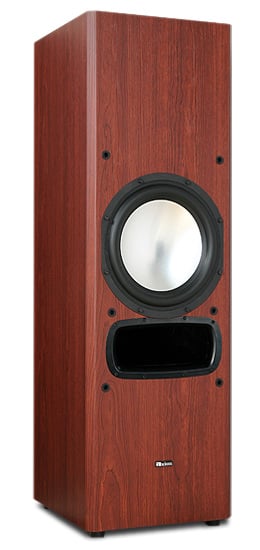 And then there is this
to say: the Axiom EP-600 differentiates itself from the norm. This is an understatement. This subwoofer
walks among the giants, weighing in at 100 lbs and standing 46 inches tall. It truly is intimidating.
The 12-inch aluminum woofer is mounted in the center of the front baffle: below that you will find the
vortex port and the small rectangular Axiom badge.
And then there is this
to say: the Axiom EP-600 differentiates itself from the norm. This is an understatement. This subwoofer
walks among the giants, weighing in at 100 lbs and standing 46 inches tall. It truly is intimidating.
The 12-inch aluminum woofer is mounted in the center of the front baffle: below that you will find the
vortex port and the small rectangular Axiom badge.
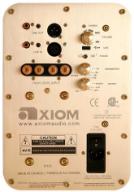
The Axiom EP-600 truly does have an absolutely gorgeous backside. The plate amplifier is a site to behold; resembling fine Swiss watchmaking or something you would find in one of the shops on Rodeo Drive. This amplifier has every conceivable input and output that you would ever need and then some!
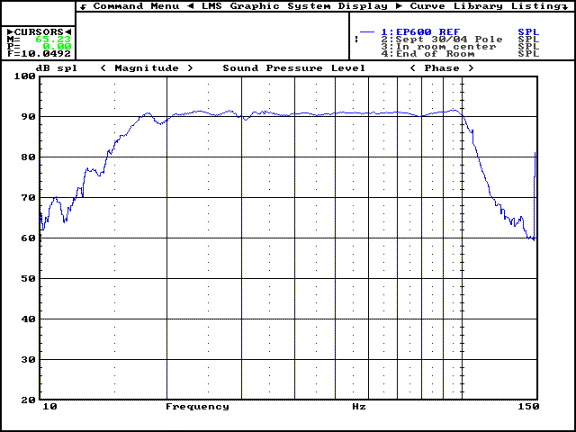
What more do we need to say - one look at the frequency response of the EP-600 and you can see that this is a very capable subwoofer. Look at how flat the response is between 20Hz and 100Hz. Also note the low-end extension to about 15Hz.
Note the USB port below the power button. This will be utilized for future software upgrades, accessories, or changes. The small silver Phillips head screw between the balanced input and output is a ground-lift screw just in case you have ground loop issues. Removing this screw will lift the ground.
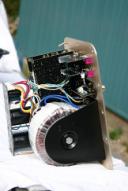
Looking at the internal view of the amplifier you can notice the huge toroidal power supply and the large filter capacitors.
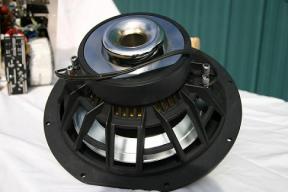
The woofer used in the Axiom EP-600 is a 12-inch long excursion heavy-duty dual three-inch voice coil driver.
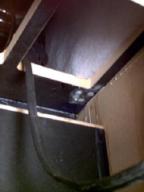 Removing the very large and very heavy plate amp to get a look inside the enclosure, I
found that the EP-600 was constructed with 3/4 MDF. This photo was taken from where the plate amplifier
normally is installed and shows
the internal makeup of the EP-600.
Removing the very large and very heavy plate amp to get a look inside the enclosure, I
found that the EP-600 was constructed with 3/4 MDF. This photo was taken from where the plate amplifier
normally is installed and shows
the internal makeup of the EP-600.
The black square object in the lower left hand corner is the backside of the vortex port. Directly above the port is the shelf brace. In the top left corner you can see part of the magnet of the subwoofer. Note the use of thick polyfill on the sides of the enclosure and the 12-gauge high strand count speaker wire.
The EP-600 had very good overall fit, finish, and construction, although the use of one more shelf brace in the upper section of the enclosure would have made it even better. The grill that covers the woofer is functional but a little better construction would have been appreciated. Given the driver and amplifier quality, these are minor issues in the overall quality of the subwoofer.
Axiom Epic 80-600 Set-Up
In setting up the Axiom speakers in my dedicated Home Theater room (19 x 25 x 9), I wanted to try several different configurations for evaluation. The 5.1 system setup included the Axiom M80ti front right and left placed 12 feet apart and about 18 inches away from the front wall.
The M80ti's sound too directional with more than a slight amount of toe-in. I think this may be due to the use of dual tweeters. I suggest you keep the toe-in to a maximum of 3-5 degrees unless the speakers are spaced very far apart. The VP-150 center channel was placed horizontally on a 24-inch stand and aligned with the M80ti speakers. The two (yes, two) EP-600 subwoofers were placed on the front wall directly next to the M80ti speakers.
The QS-8s were installed on the side walls approximately 12 inches back from the null of the listening position and 18 inches above the seated ear level. This type of installation is typical for many living room home theaters.
For this evaluation I used the Yamaha RX-V2500 receiver in conjunction with the Aragon 2002 amplifier augmenting the front right and left M80ti speakers. All Axiom speakers are relatively efficient representing an easy load to drive but they all have a lower impedance value of 4- to 6-ohms.
This was the reason for the use of an external power amp. I set all speakers to Small and set the crossover to 80Hz for the M80ti front speakers, the VP-150 center speaker, and the QS-8 surround speakers. I then selected By-Pass on the EP-600 to prevent crossover cascading and selected the Flat boost setting.
I know many of you are thinking why set a front main speaker that has an effective cutoff of 35Hz to small 80Hz? There are many good reasons for this and these articles will help you understand why this is important:
The marriage between the subwoofer and tower speakers
Setting the subwoofer LFE crossover for the best performance
Base management basics-settings made simple
The short answer is that the Yamaha RX-V2500 has a global crossover. If you examine the LMS frequency response on the above curves for the VP-150 you will see that at 80Hz it is minus 4db and then rolls off sharply below 80Hz. Changing the crossover point to 90Hz made the system sound too dry and hollow. The 60Hz crossover setting was too far below the effective crossover point of the VP-150 and QS-8s.
If you are using a receiver or preamp with (good quality) independent crossover settings, then I recommend 60Hz for the M80ti front mains, 80 or 90Hz for the VP-150 center channel and 80-90Hz for the QS-8s for multi-channel movie soundtracks.
The other reason for Small and 80Hz is it places less strain on my amplifiers and speakers because they don't have to reproduce low frequencies. The EP-600s are optimized for reproducing low frequencies up to about 120Hz. If you don't have a good subwoofer then this setting may not work for you. When I switch to DVD-A/SACD or CD, all of the speakers in the system receive full-range frequency because the crossover is bypassed.
Listening Tests & Evaluation
Evaluating loudspeaker performance is subjective by nature. The reviewer's interpretation of the outcome may not reflect what other individual evaluations conclude. I have said in the past that my ears are far from golden, but I do think they are well tuned enough to appreciate good sound when they hear it.
 To start the listening evaluation, I wanted to try Redbook
CD.
I selected Pure Direct on the Yamaha RX-V2500. This bypasses all DSP processing and
crossover settings sending full range to the front right and left M80tis.
To start the listening evaluation, I wanted to try Redbook
CD.
I selected Pure Direct on the Yamaha RX-V2500. This bypasses all DSP processing and
crossover settings sending full range to the front right and left M80tis.
The first CD I loaded was LeAnn Rimes
You Light Up My Life
track 11
"Amazing Grace". This recording is far from reference, but I wanted to hear female vocals on the M80tis
from start to finish. LeAnn
舗
s youthful voice filled the room with air and grace. This recording
on many loudspeakers will sound shouty, beamy, shrill, and ring like crazy. The Axiom M80tis did a
fantastic job; the midrange was very sweet, powerful and effortless. The upper frequencies were a
little forward but not overly bright or tinny.
The soundstage was enormous and deep.
Moving
from the center or the sweet spot about 2 feet to the right or left into my other listening positions
the Axiom M80tis sounded almost as good as being in the center.
 Up next, I wanted to try something with a lot of energy. Royal Crown Revue,
Mugzy's
Move
was just the ticket. For those of you that don't own this CD, get it! It's not a reference
recording but the retro big band swing sound is amazing.
Up next, I wanted to try something with a lot of energy. Royal Crown Revue,
Mugzy's
Move
was just the ticket. For those of you that don't own this CD, get it! It's not a reference
recording but the retro big band swing sound is amazing.
Selecting track 1, "Hey Pachuco", I sat back and began listening as the M80tis began to play the combination of the vocals, hard-hitting drums, tenor sax, and baritone saxophone. The first thing I noticed was that the M80tis had incredible dynamics. The sax and the trumpet sounded astonishingly fast and the drum solo had my head boppin' and my foot stompin'.
I next selected Track 3, "Mugzy's Move". The Axioms sounded big and bold. The bass was tight and fast. It was almost incomprehensible the amount of bass radiating from the small diameter woofers. The midrange had a fundamental rightness, never sounding over-exaggerated, compressed or dry. It consistently sounded lush and full.
The tweeters sounded cheery and sparkly; not overly bright or neutral. These speakers have an aggressive attitude that is addicting. They love to be played loud, but also do well playing at low levels.. The M80tis are very revealing speakers; everything that is on the recording will be heard. Any weaknesses of your system will be revealed.
I loved the sound of the M80tis and could not find any fault with the sound of these speakers. Their effortless dynamics and revealing nature had me stretching my 1-hour Redbook 2-channel evaluation into a 3-hour sensation. These speakers have wow and then some WOW!
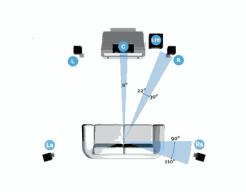 Many people don't have the room required for complete 7.1 systems.
With this in mind, I wanted to evaluate the Axiom system in a 5.1 configuration consisting of M80ti
front right and left, VP-150 center, QS-8 surrounds and two EP-600 subwoofers.
Many people don't have the room required for complete 7.1 systems.
With this in mind, I wanted to evaluate the Axiom system in a 5.1 configuration consisting of M80ti
front right and left, VP-150 center, QS-8 surrounds and two EP-600 subwoofers.
One of the most important attributes to look for when assembling a loudspeaker system is balance. System balance is dictated by the speakers' overall sonic signatures in relationship to each other and to the listening position as well as room acoustics.
Placement and room acoustical properties can change but we have no control over the sonic characteristics of the loudspeakers. Therefore, we need to make sure we select a system that sounds balanced.
 A great DVD for evaluation system balance is Antz. This disc is
chock full of foley effects, fast and hard pans, loads of LFE, and a top-notch music score. Animation
is excellent source material since everything is virtually pristine
舑
having, by necessity, to be
created from scratch. There is a scene when the princess emerges out of the grass, where the rustling
of the grass blades and the pitter-patter of the ants as they walk across the tablecloth were easily
discernable. Little scenes like this abound and allow you the opportunity to check the fidelity and
clarity of your speakers.
A great DVD for evaluation system balance is Antz. This disc is
chock full of foley effects, fast and hard pans, loads of LFE, and a top-notch music score. Animation
is excellent source material since everything is virtually pristine
舑
having, by necessity, to be
created from scratch. There is a scene when the princess emerges out of the grass, where the rustling
of the grass blades and the pitter-patter of the ants as they walk across the tablecloth were easily
discernable. Little scenes like this abound and allow you the opportunity to check the fidelity and
clarity of your speakers.
In another scene, as the wasps fly over, there is a hard pan from left front, center, right front, right surround, and left surround. I replayed this effect many times. This effect sounded very smooth, seamless, and balanced; there was no discernable tonal difference. Be aware that even with properly balanced speakers, a room with poor acoustical properties may yield tonal mismatches across the front soundstage. If this occurs in your room look to see how you can either better arrange the room or apply some absorption materials to aid in correcting this problem.
The QS-8 surrounds sounded robust and spacious. Channel separation was excellent. As demonstrated in the scene when the wasps were hovering overhead, their wings are fluttering, background music is playing, and dialog is occurring in the center channel. The VP-150 sounded smooth, rich, and natural, though at times also slightly recessed.
After verifying my channel levels I came to the conclusion that this was most likely attributed to the size of my room, wide spacing between the front speakers, and the high dynamic capabilities of the M80ti front speakers. I will explain more on this later. The pans from left to right and front to rear sounded absolutely amazing. The EP-600s belted out huge amounts of tight lightning fast-undistorted LFE.
The music score accompanying all the effects sounded absolutely beautiful. During the several replays, the balance and effortless dynamic capabilities of the Axiom system were remarkable. There was no tonal shift between the speakers and, in my room, every speaker sounded nearly identical. For the individual that has sidewalls on either side of the listening position, and does not have the room to accommodate a full range rear surround or EX speakers this would be the system to consider. The Axiom speakers' performance set up in this configuration was stellar to say the least.
Axiom Epic 80-600 Listening Tests cont.
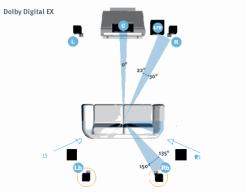 The next setup I wanted to try was a full-blown 7.1 system with a twist:
M80ti front right and
left speakers, two VP-150 center channel speakers, one above the screen and one below the screen, two
EP-600 subwoofers, and M80ti tower speakers used as rear surrounds, placed 6 feet behind the listening
position in line with the front M80ti speakers toed in about 12 degrees.
I moved the
QS-8 surrounds from the sidewall to the back wall and spaced them 8 feet apart and about 18" above the
seated ear level.
The next setup I wanted to try was a full-blown 7.1 system with a twist:
M80ti front right and
left speakers, two VP-150 center channel speakers, one above the screen and one below the screen, two
EP-600 subwoofers, and M80ti tower speakers used as rear surrounds, placed 6 feet behind the listening
position in line with the front M80ti speakers toed in about 12 degrees.
I moved the
QS-8 surrounds from the sidewall to the back wall and spaced them 8 feet apart and about 18" above the
seated ear level.
Thinking about how to set up dual center channels I used a Y-splitter at the RX-V2500's center channel pre-out and connected it to an additional Aragon 2002 amplifier. I now had the Yamaha RX-V2500's amplifier powering the M80ti rear surrounds and the QS-8 EX channels. One Aragon 2002 was powering the M80ti front speakers and another Aragon 2002 amp powered the dual center channels using the pre-out's on the RX-V2500.
7.1 Listening Test - The Incredibles
 After completing a
channel level test and adjustment, I selected a DVD to test the Axiom System's dynamic
capabilities in this configuration. An excellent DVD,
The Incredibles, features excellent
material in Chapter 23 "100 Miles Dash" and Chapter 24 "Reunited."
After completing a
channel level test and adjustment, I selected a DVD to test the Axiom System's dynamic
capabilities in this configuration. An excellent DVD,
The Incredibles, features excellent
material in Chapter 23 "100 Miles Dash" and Chapter 24 "Reunited."
Playing these chapters with the RX-V2500 set to Dolby Digital EX through the Axiom system made me feel as though I was on one of those 3-D rides at an amusement park. The sound I experienced with the Axioms set up in this configuration had me thrilled with seamless head-ducking pans from left to right and front to back.
Dialogue with the dual center speakers was robust, uncompressed, and very natural sounding. The rear sound stage was enormous and the LFE produced from the twin EP-600s was jaw dropping. Set up in this configuration, the Axiom speakers obtained a level of dynamics that many could only dream about.
The system blended perfectly and I had little doubt that I had just configured the system with excellent synergy. The use of dual center channels was the perfect match for the very aggressive, very dynamic M80ti front speakers.
The use of the M80tis for the surrounds and the placement of the QS-8 on the back wall in an EX configuration made the rear sound stage sound like it went on forever. To say that I was impressed with the way this system sounded in this configuration is an understatement. I simply cannot believe that this level of performance is obtainable at this price. If you have the room and the budget to accommodate the set up as described above, I encourage you to consider it; you will not regret it for a second.
Multi-channel Music Evaluation: Brazilllian Bossa
 The final
part of the evaluation is multi-channel music. I am really hooked on DVD-Audio multi-channel music.
This is one of the reasons I wanted to review this system with full range rear surrounds. The
Brazilian Bossa
DVD-Audio disc is great material for casual listening and is well
recorded.
The final
part of the evaluation is multi-channel music. I am really hooked on DVD-Audio multi-channel music.
This is one of the reasons I wanted to review this system with full range rear surrounds. The
Brazilian Bossa
DVD-Audio disc is great material for casual listening and is well
recorded.
Starting with track 1 "Batida Diferente" and selecting the multi-channel input on the Yamaha RX-V2500, I began listening. As flutes began to play on this track it exhibited lots of air and life. It was perfectly centered and the soundstage was enormous and deep. The piano sounded very fluid but I did note a slight amount of ringing in the center. The horns sounded awesome as they filled in the rear surrounds. I would characterize what I heard from the Axiom system as big, bold, aggressive, revealing, and slightly forward of neutral in its presentation.
Up next was track 7, "Corcovado". This track starts with an unknown female vocalist. She has the kind of seductive voice that almost makes you feel guilty you are listening to her. I wish I knew who the artist was but I can find no information on her. As she began to sing it was readily apparent that the Axiom Audio system was up to the task of conveying her voice; the midrange had an almost liquid sound. Closing my eyes, I felt as though she was performing right in front of me. Electric and acoustical guitar filled the front right and left speakers. Piano and percussion instruments were present in the rear surrounds. All of the speakers blended perfectly, none dominating one or the other. The entire track sounded effortless and balanced.
Phillip Glass Koyaanisqatsi
The next DVD-audio disc I selected was Phillip Glass, Koyaanisqatsi. This is a virtual torture test for loudspeakers and subwoofers.
I selected this DVD for evaluation because it is very easy to detect weaknesses in a surround system. The track starts out with the pipe organ playing very long low notes. Many subwoofers will fall flat when trying to reproduce these notes. The EP-600 had no such trouble.
The notes had great depth, clarity and articulation. There was no overhang between the notes and the EP-600 reproduced them loud and distortion-free. I turned the volume up a bit on the RX-V2500 and had the whole room shaking. 20 seconds or so into the track, a male voice begins chanting Koyaanisqatsi in all speakers, followed by very long violin strums that float over your head from front to back.
The nature of the recording makes it very easy to detect tonal shifts and system imbalance. The use of the dual center speakers up front and the M80tis as rear surrounds really paid off. I was unable to note any audible difference between the speakers. It literally sounded like an umbrella of matching speakers placed above and around me. The interaction between the EP-600 subwoofer and the rest of the speakers was outstanding.
Axiom really has done their homework with the EP-600 subwoofer. It is very musical and is able to reproduce low frequencies at very high SPL levels. One of the EP-600 subwoofers would have easily been enough to fill my room when calibrated to reference level. Two was just icing on the cake.
The gain knob on the plate amplifier was barely off the zero mark. Two of the EP-600s in my room was like having the power of Mother Nature right at my fingertips. My advice if you do use two of the EP-600 subwoofers: bolt your house down to its foundation because, Mister, you are going for a ride!
Axiom Epic 80-600 Conclusion
The Axiom speaker systems I reviewed were absolutely unbelievable. The speaker's good build quality, high performance, and excellent customer support and service offered by Axiom make these an easy recommendation. These speakers are without a doubt among the finest speakers built in Canada at this price. They set a new benchmark for performance at this price and about the only thing left to say is "WOW!"
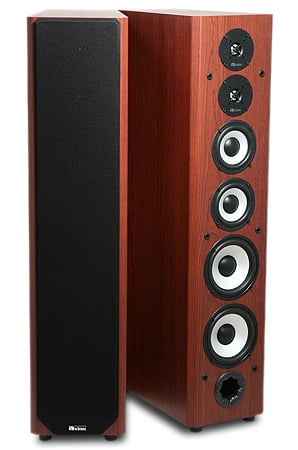
Axiom Audio M80ti Speakers
The Axiom M80ti speakers were the stars of the show. Their effortless dynamic capability, almost liquid midrange, tight and deep bass, and their uncanny ability to disappear, had me shaking my head in disbelief. Was I really listening to a speaker of such small stature and price?
EP-600 Subwoofer
The Axiom EP-600 subwoofer is a monster. It is very musical, can play lower than we can hear, and when called upon can wreck the house with gut-wrenching high SPL. Let's not forget the gorgeous plate amplifier; it is a true audiophile subwoofer with impressive slam. The Axiom EP-600 does require some experimentation for placement.
It is a very large subwoofer, I would have liked to have seen the use of more internal bracing, and a nicer grill would have been appreciated; however, the value of this subwoofer is in its performance. In that category, it is truly an awesome subwoofer.
VP-150 Center Channel
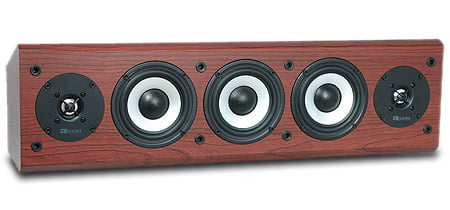 The VP-150 center channel sounded very natural: male and female voices were unrestrained and blended perfectly with the rest of the speakers in the system. The minor gripe I have is the ability of the VP-150 center speaker to keep up with the M80ti tower speakers. Off axis performance was a bit recessed sounding in the vocals, so you will want to avoid placing seats too far to the left/right of the center position. In addition, their effective crossover point of 80Hz made it a little difficult to select the best crossover setting for the system. The grill cover was a little on the flimsy side, but considering the price of the VP-150, I can certainly cut it some slack. I recommend that two of the VP-150's be used with the M80tis in large rooms that intend to use front projection systems or very large displays.
QS-8 Surround Speakers
I was shocked at the level of performance that I was able to obtain with the QS-8 speakers. These little speakers sound a lot bigger than they are. Using them as the surrounds placed on the sidewalls, they were impressive. Their sound was big and open. They are equally impressive when used as an EX speaker and they blend perfectly with the rest of the system. The QS-8 can be mounted in just about every conceivable configuration. Because of their small size, they are very unobtrusive when installed.
The Score Card
The scoring below is based on each piece of equipment doing the duty it is designed for. The numbers are weighed heavily with respect to the individual cost of each unit, thus giving a rating roughly equal to:
Performance × Price Factor/Value = Rating
Audioholics.com note: The ratings indicated below are based on subjective listening and objective testing of the product in question. The rating scale is based on performance/value ratio. If you notice better performing products in future reviews that have lower numbers in certain areas, be aware that the value factor is most likely the culprit. Other Audioholics reviewers may rate products solely based on performance, and each reviewer has his/her own system for ratings.
Audioholics Rating Scale
 — Excellent
- — Very Good
- — Good
- — Fair
- — Poor
| Metric | Rating |
|---|---|
| Build Quality | |
| Appearance | |
| Treble Extension | |
| Treble Smoothness | |
| Midrange Accuracy | |
| Bass Extension | |
| Bass Accuracy | |
| Imaging | |
| Soundstage | |
| Dynamic Range | |
| Fit and Finish | |
| Performance | |
| Value | |
 Subscribe to our newsletter