


2010 Audioholics $1k Floorstanding Loudspeaker Faceoff
- Product Name: 2010 Audioholics $1k Speaker Floorstanding Faceoff
- Manufacturer: Klipsch, JBL, Axiom Audio and EMP
- Performance Rating:

- Value Rating:
- Review Date: May 27, 2010 11:50
2010 $1k Floorstanding Loudspeaker Faceoff Test Methodology
 Since the days when I founded Audioholics.com in
1999, we've conducted annual speaker Faceoffs. These Faceoffs ranged from bookshelf to
floorstanding speakers of various designs and budgets. Over the years we managed to beef up the
brand variety while also increase the panel of listeners and refine our testing
process. Last year we conducted our
first blind listening test headed up
by Tom Andry. The results were both
enlightening and intriguing to say the least.
Since the days when I founded Audioholics.com in
1999, we've conducted annual speaker Faceoffs. These Faceoffs ranged from bookshelf to
floorstanding speakers of various designs and budgets. Over the years we managed to beef up the
brand variety while also increase the panel of listeners and refine our testing
process. Last year we conducted our
first blind listening test headed up
by Tom Andry. The results were both
enlightening and intriguing to say the least.
I wanted to continue in this tradition by hosting a blind Faceoff at the Audioholics Showcase Home premier theater room. Because of the enormous amount of time and resources it takes to conduct a blind comparison such as this, I limited it to four speaker pairs, each with a maximum price of $1k/pair.
The Contenders
- Axiom Audio M60v3 $990/pair
- EMP E55ti $795/pair
- JBL ES80 $999/pair
-
Klipsch
RF-62 $880/pair
With the exception of the relative newcomer EMP, all of the other speakers in this comparison are some of the biggest names in the industry and also most accessible to consumers both online and/or in brick and mortar stores. It was important that our selection included easily accessible speakers, as some of the smaller brands tend to be hard for consumers to locate on their own to conduct a proper demo.
Test Methodology
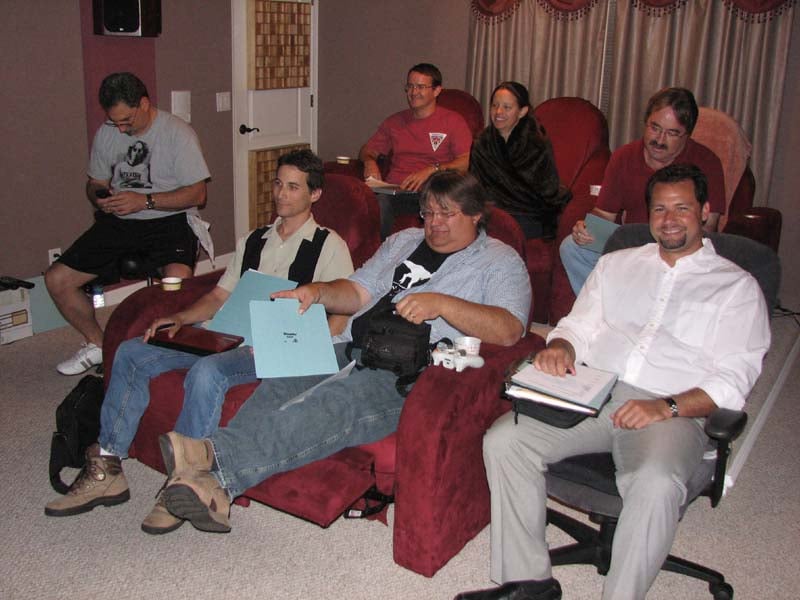 After selecting the speakers, I assembled a panel of
listeners which included two trained listeners and four casual listeners. One of the casual listeners was a female with
proclaimed excellent hearing whom also had no knowledge of any of the brands
under test. The local Florida Klipsch
rep also showed up for our Faceoff and sat through a few trials with us. I was happy to capture his experiences while
listening to the Klipschs faced off against the Axioms and the JBLs. I noted
some of his impressions in the comments section of this report.
After selecting the speakers, I assembled a panel of
listeners which included two trained listeners and four casual listeners. One of the casual listeners was a female with
proclaimed excellent hearing whom also had no knowledge of any of the brands
under test. The local Florida Klipsch
rep also showed up for our Faceoff and sat through a few trials with us. I was happy to capture his experiences while
listening to the Klipschs faced off against the Axioms and the JBLs. I noted
some of his impressions in the comments section of this report.
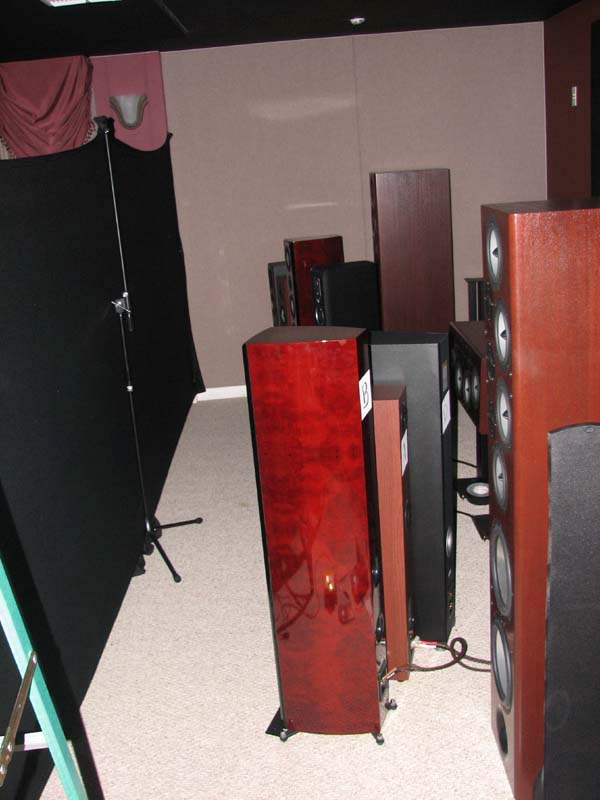
The entire front of the room was draped in speaker cloth furnished by RBH Sound with no backlighting behind the cloth so none of the listeners were able to determine what speakers were under test at any given time. Speaker pairs were tested, two at a time, staggered in the following pattern to ensure equidistant spacing of the pairs:
AB AB
The grille covers were removed from each speaker to minimize any additional losses. The speakers were placed about one foot behind the grille cloth where positions for two pairs at a time were marked off on the floor to ensure consistent lateral spacing between left and right speakers of each pair. If speaker A was placed towards the left wall for one trial, its position was reversed for the next comparison and so on.
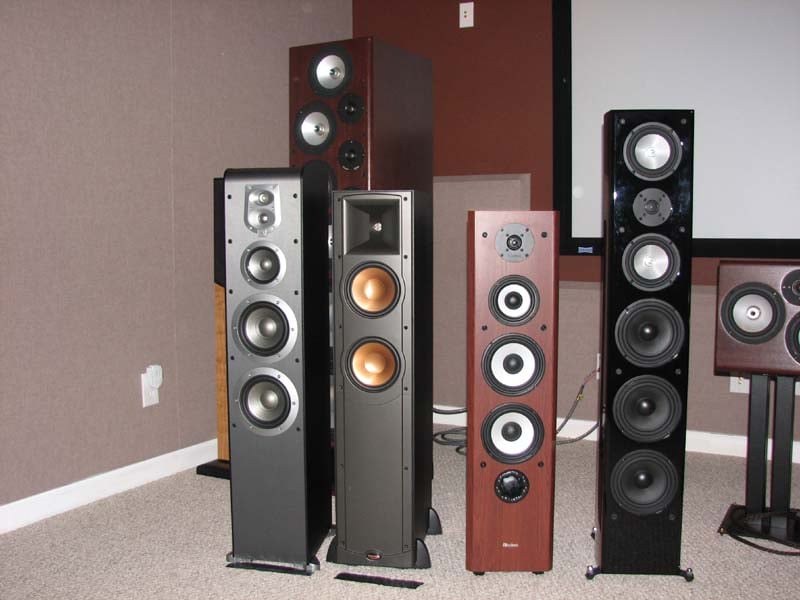
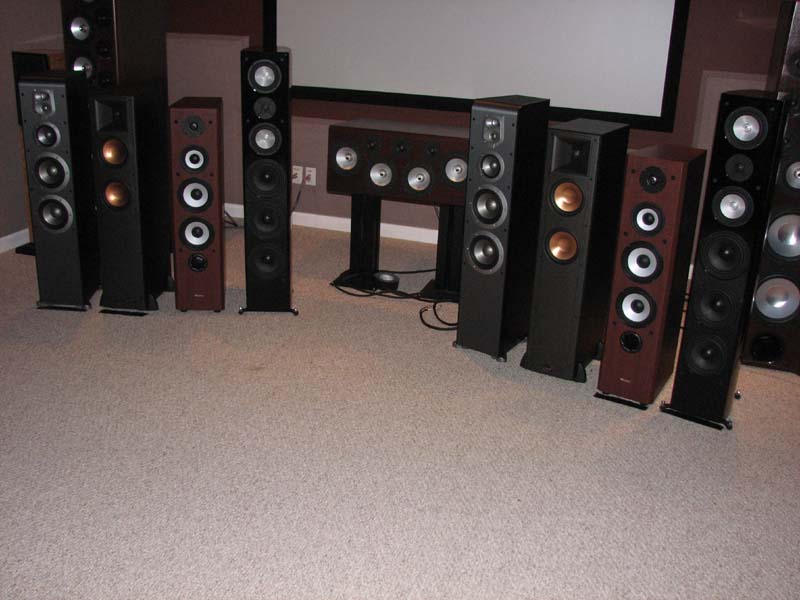
Pictured from left to right (JBL ES80, Klipsch RF-62, Axiom M60v2, EMP E55ti)
Three songs were selected for the blind test which included:
- SACD: Patricia Barber "Company"
- CD: Dianne Reeves "Never too far"
-
CD:
Usher CD Sampler "Don Juan"
Each song was played in its entirety with 20-30 second sampling between the speaker pairs under test. After switching between pairs more than two consecutive times, I called out the speaker under test as "A, B, C, or D" to ensure the listeners knew what they were listening to at any given time.
Each listener was asked to pick a designated seat to be used for all of their listening tests. The listeners were instructed NOT to discuss what they wrote or how they felt about each speaker until the end of the day when all of the listening tests were completed. Each listening session lasted about 15 minutes. At the end of the session, the listeners were instructed to leave the room to consume mass quantities of food and drinks while I set up the next test. Even during our sighted tests, the listeners were never allowed an up-close look at the speakers to reduce aesthetic biases, and I still identified them by their letter designation instead of name brand. We entertained NO discussions about aesthetics of any of the speakers it order to reduce any listener bias based on appearance alone during the sighed listening tests.
I personally did NOT participate as a listener in this Faceoff nor did I interject any of my opinions or biases towards each speaker to our listening panel before, or during any of the listening tests. But, I did provide my listening experiences for all of these speakers within this report since I spent several weeks with most of them listening and analyzing prior to conducting this comparison. It's important to note that I was likely most critical in my comments about the Axioms and EMPs since I spent the greatest amount of time listening to them compared to the other speakers in this Faceoff.
The tests were paired
as follows: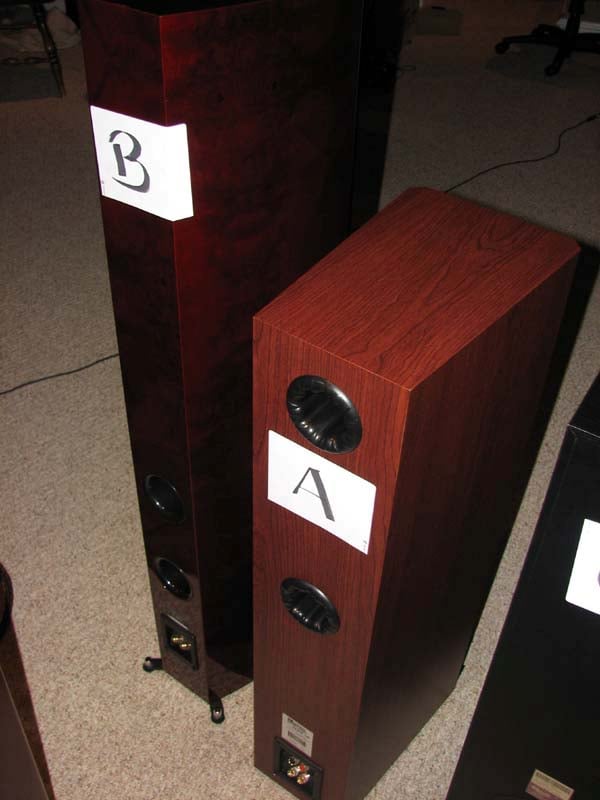
- AB
- CD
- AC
- BD
- AD
- BC
Where:
A = Axiom M60v3
B = EMP
E55ti
C = Klipsch
RF-62
D = JBL
ES80
Audioholics Speaker Test Form
Participant Name: __________________________________
Date: May 7th, 2010
Seat Location (circle one): FR, FL, BR, BC, BL, Dog
Comparison# (circle one): AB & CD; AC & BD; AD & BC
Rating Scale
1 - poor
2 - fair
3 - Good
4 - Very
Good
5 -
Excellent
|
|
Speaker A |
Speaker B |
Speaker C |
Speaker D |
|
Highs |
|
|
|
|
|
Midrange |
|
|
|
|
|
Bass |
|
|
|
|
|
Soundstage |
|
|
|
|
|
Imaging |
|
|
|
|
|
Dynamic Range |
|
|
|
|
|
Overall Rating |
|
|
|
|
|
Would you Own (Y/N) |
|
|
|
|
Describe in detail what you like and
dislike about each of the speakers:
Speaker A:
Speaker B:
Speaker C
Speaker D:
Test Equipment & Calibration
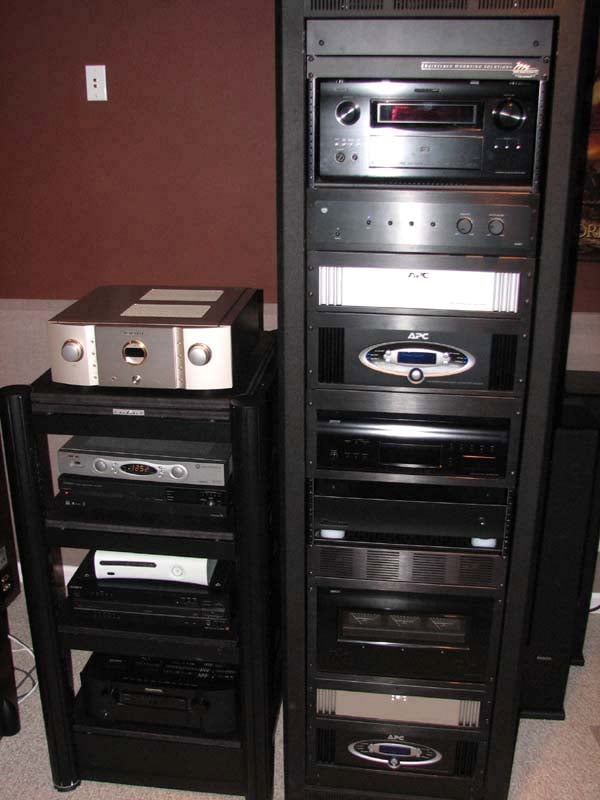 I utilized my Denon AVP-A1HDCI Zone 2 and Zone 3
outputs connected to my Axiom A1400-8 multi channel power amplifier. The sources included the Denon DVD-A1UDCI for
two-channel SACD playback and the Yamaha MCX-2000 for two-channel PCM
playback. All interconnects were Bluejeans
1694A coax and the speaker cables were 20ft lengths of 8PR furnished by Kimber
Kable.
I utilized my Denon AVP-A1HDCI Zone 2 and Zone 3
outputs connected to my Axiom A1400-8 multi channel power amplifier. The sources included the Denon DVD-A1UDCI for
two-channel SACD playback and the Yamaha MCX-2000 for two-channel PCM
playback. All interconnects were Bluejeans
1694A coax and the speaker cables were 20ft lengths of 8PR furnished by Kimber
Kable.
I used the Sencore SP495 to generate wideband pink noise and used C-wt to calibrate each speaker to 75dB SPL at the primary listening position which happened to be center front row. Level matching speakers isn't a trivial matter. I found that simply using internal test tones found in A/V receivers / processors isn’t sufficient since they aren’t wideband making the bassier speaker seem less efficient than the speaker with less bass. In fact, I found that when using the internal test tones of my processor, I had to set the bassier speakers 3dB louder than the less bassy speakers which sounded very different in level when doing my own listening comparisons. Thus I switched to using wideband pink noise signals to level match and achieved much more balanced results. Sonically, all the speakers seemed level matched both to myself and the panel of listeners during the testing.
I pinged Dr. Sean Olive and Dr. Floyde Toole from Harman on this very topic and here is what they had to say:
Editorial Note on Level Matching and Listening Position
We use wideband pink noise measured at the listening seat and adjust to B-weighting. More recently we started using a software-based CRC loudness meter that follows the ITU_R 1770 loudness standard for matching loudness of programs.
The combination of wideband noise and B-weighting should give a better loudness match for speakers with larger bass differences. The CRC loudness meter uses a modified B-weighting that extends the low frequency HP filter even further down.
My meters don't have B-wt capability but I found C-wt was close enough. I also pulled measurements of each speaker at the primary listening position to get a better sonic picture on what was going on. In further discussions with Dr. Olive/ and Dr. Toole, they made me well aware of the fact that listening position can have even more impact on preference than the actual speaker itself. Readers interested in this subject are should reference the white paper submitted to AES by Sean Olive.
Realizing that only two seats were optimal for two channel listening and the other four listeners weren't getting the full sonic picture of the speakers they were listening too. I didn’t really have a solution for this that wouldn't require multiple days of testing which we simply didn’t have. Harman conducts their blind tests in mono as do many other loudspeaker companies. I personally feel this leaves out critical information on how the loudspeakers interact with each other and setup soundstage and imaging characteristics which also leads to very dry listening sessions. But, I can understand why they test in mono since it reduces another source of variability in listening tests. Dr. Toole suggests if a speaker wins a blind test in mono, it will almost always win in stereo as well. Further study on this topic should be explored which is beyond the scope of this article.
Test Biases
No test is without bias, even those that claim to be scientifically controlled and double blind. In fact, most companies whom claim to do double blind tests are in fact only doing single blind testing since the actual tester is aware of the equipment under test. Our testing isn’t exempt from this either and I did my best to tabulate all of the biases below.
- Tester (me) was aware of all loudspeakers under test at all times
- Tester (me) analyzed results unblind knowing what data corresponded to each speaker
- Some of the listeners were aware of the brand of speakers under test
- Pre-selected music that listeners may be unaware of as a personal reference for judging sound quality
- The listeners were aware that designations for Speaker A, B, C, D never changed
- The grille cloth used to cover the speakers significantly attenuated high frequency response of the speakers under test
- 4 of the 6 listeners were not located in the stereo sweet spot
- Towards the end of the day, listeners experienced confusion and sensory overload from too much testing
- Only a limited number of test
trials (6 blind) were conducted
over a single day period which resulted in reduced statistical sampling
accuracy
The point about the grille cloth losses is perhaps the most significant. I was able to identify when the grille cloth was up or down using pink noise testing while I was blindfolded. This concerned me but at the time I had no better way of obscuring the speakers under test for the listeners. I measured one of the speakers (Axiom M60v2) with and without the grille covering to better understand the losses.
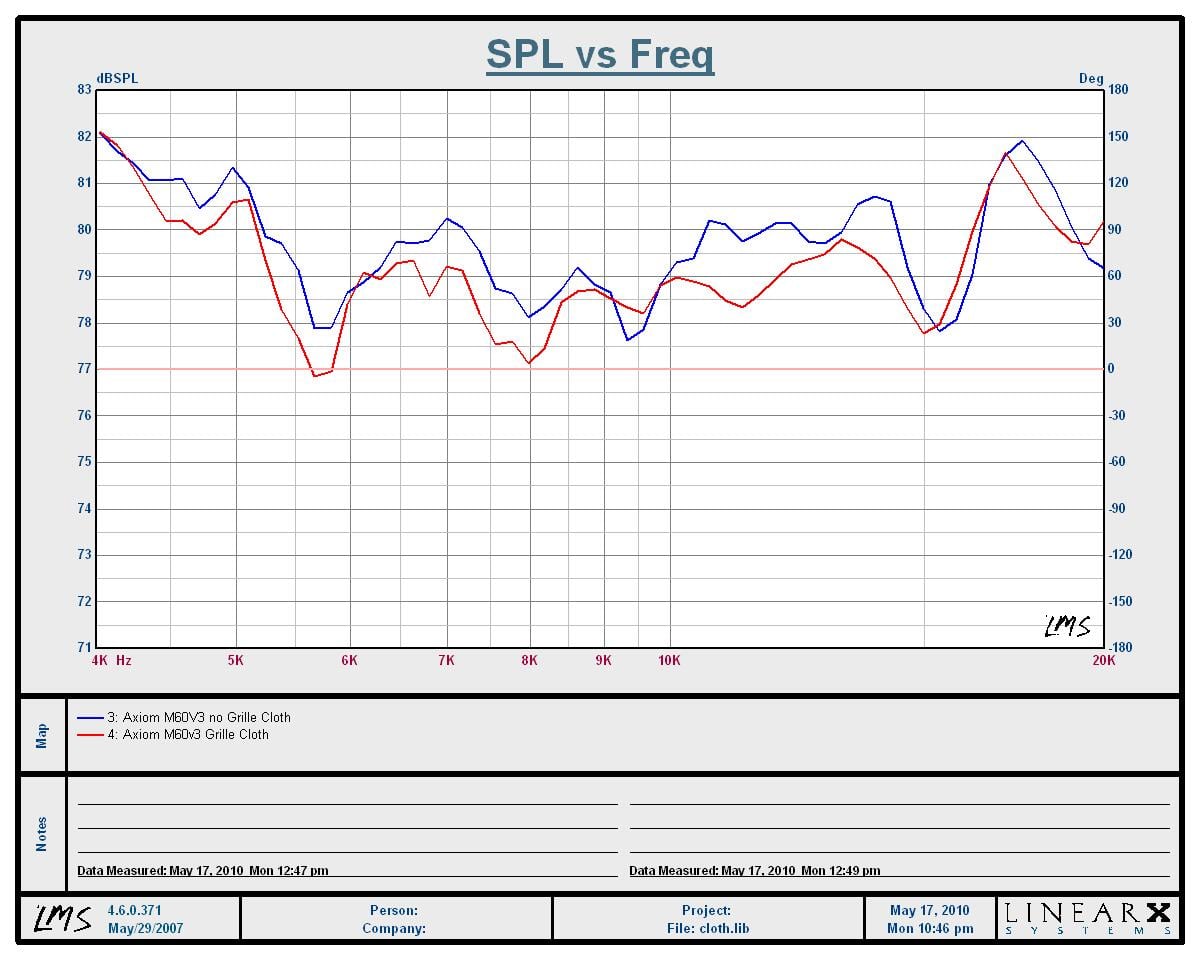
Axiom M60v3 Frequency
Response Comparison
Blue trace - no grille cloth
Red trace - grille cloth
Using LMS, I measured the Axiom M60v3 with and without the grill cloth covering the speaker and plotted the results for comparison. As you can see the losses with the grille cloth in place in the 6-7kHz and above 10kHz were pretty substantial (about 2dB).
I did my best to ensure the cloth was as taut as possible but in hindsight it was placed about 1 foot in front of the speakers under test which may have caused it to act as an absorber of direct and reflected sound.
At first glance I wanted to chastise RBH Sound for using such lossy grille cloth until we both confirmed with measurements that once the cloth was stretched onto a grille cover and placed in close proximity to the speaker, the losses were less substantial (about 1dB) as shown below.
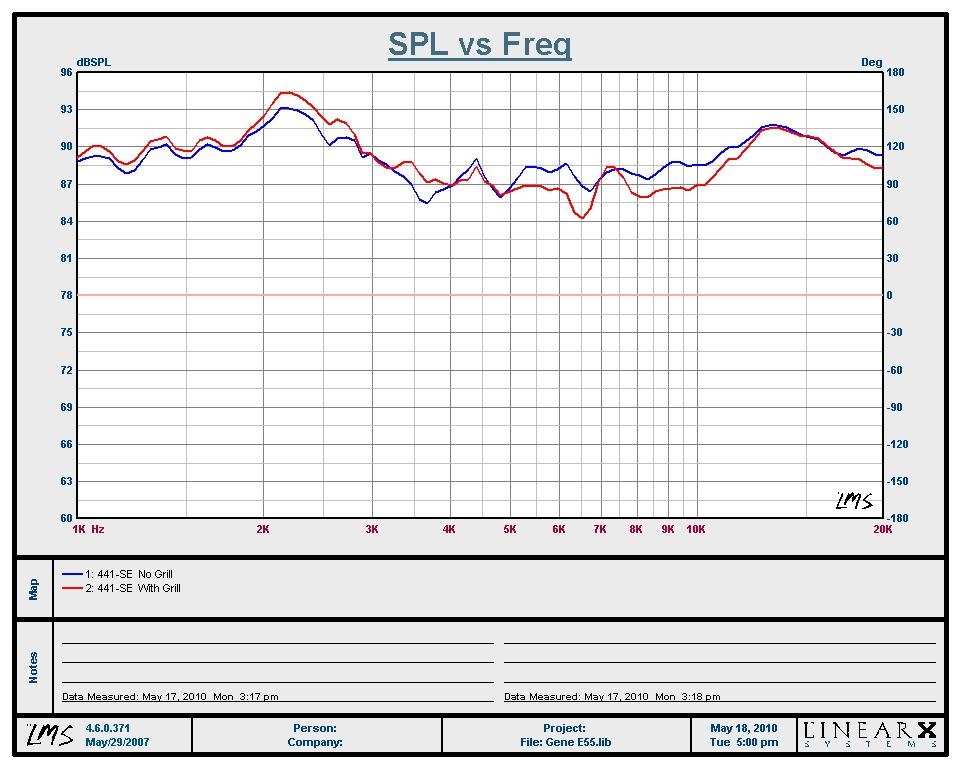
RBH Sound 441-SE
Frequency Response
Blue trace - no grille cover/cloth
Red trace - grille cover/cloth
This does however give me pause about ever draping grille cloth for conducting a blind test. I also hypothesize that these losses will lead the listeners to prefer the brighter speakers over the more tonally neutral speakers as a result.
Methods for Improving Speaker Testing
Although
this speaker comparison produced interesting results, I believe we all learned
a lot from this process regarding how to improve our testing methodology for
producing more consistent testing results.
I have listed my observations below in efforts to improve our
methodology for our next annual Faceoff.
Find Less Lossy Grille Cloth
Covering
I believe
one of the largest biasing factors in this test was the extremely lossy grille
cloth we utilized to cover the speakers which seemed to shift the listener
preference to the brighter speakers.
Since it's virtually impossible to stretch the cloth more taut, we
either need to blindfold our listeners or find less lossy material to use in
future comparisons. Ian Colquhoun from Axiom Audio commented that perhaps the grille cloth we used for our testing was only acoustically transparent when stretched over a grille cover. Axiom uses specific cloth that is less lossy for these type of tests and will be happy to supply us samples for our next blind faceoff comparison testing.
Use Better Randomization of Testing
Rather than
assigning each speaker a letter designation, I will follow in Tom Andry's foot
steps where he only assigned an "A" and "B" designation for
the speakers and simply kept track which was which during the testing to always
keep the listeners guessing.
A B
Klipsch JBL
JBL EMP
EMP Axiom
Axiom Klipsch
JBL Axiom
Klipsch EMP
I believe
towards the end of the tests, people already had preconceived ideas of what
each speaker would sound like based on simply calling out its letter
designation. Some of the listeners
reported it was too confusing remembering four letter designations when taking
notes.
Reduce Number of Listeners per
Session and Increase Number of Listening Sessions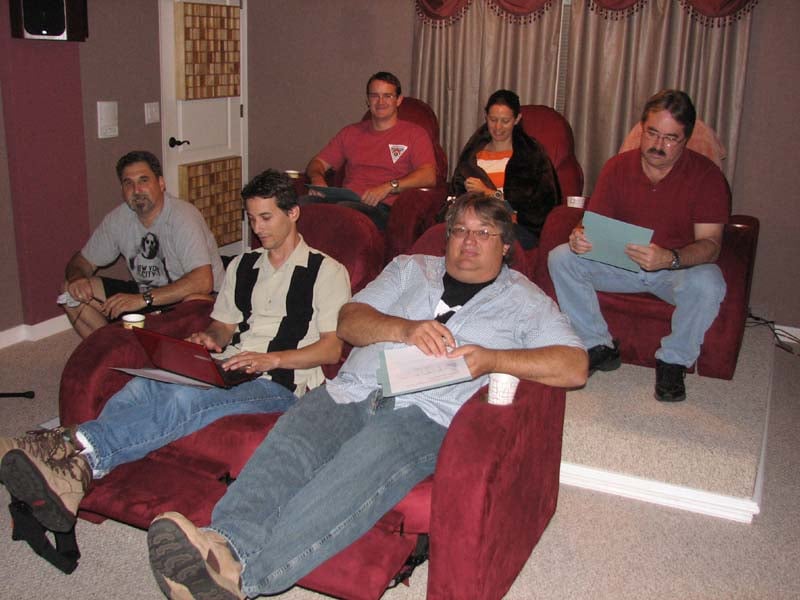 For two-channel listening, it makes little sense to
sit any particular listener off axis from the stereo sweet spot. I believe we partly confirmed the research
Dr. Sean Olive conducted regarding listening position can have a more dramatic
impact on listener preference than the actual audible differences in the
loudspeakers themselves. Our data showed
that people sitting in the back row preferred the speakers with the most bass
and high frequency bias. Their
preferences also seemed to have the most variability in ratings from test to
test. It's inconclusive however if these
preferences were influenced by them also being the least experienced listeners
or simply changing their opinion of the speaker under test when compared to a
different speaker each time. More study
is needed to make an accurate correlation. Perhaps in our next round of testing we will trick the listeners into comparing the same speaker during our A/B testing as a control to determine the variability in their preferences.
For two-channel listening, it makes little sense to
sit any particular listener off axis from the stereo sweet spot. I believe we partly confirmed the research
Dr. Sean Olive conducted regarding listening position can have a more dramatic
impact on listener preference than the actual audible differences in the
loudspeakers themselves. Our data showed
that people sitting in the back row preferred the speakers with the most bass
and high frequency bias. Their
preferences also seemed to have the most variability in ratings from test to
test. It's inconclusive however if these
preferences were influenced by them also being the least experienced listeners
or simply changing their opinion of the speaker under test when compared to a
different speaker each time. More study
is needed to make an accurate correlation. Perhaps in our next round of testing we will trick the listeners into comparing the same speaker during our A/B testing as a control to determine the variability in their preferences.
One thing that’s important to realize is in order to have reasonably accurate results a greater number of tests and sampling of listeners is needed in order to produce significantly meaningful results (>95% confidence). Unfortunately it is often costly and impractical to conduct blind tests in this fashion like it's typically done in the medical field. Sorry we are just an A/V publication, NOT a pharmaceutical company with billions of dollars in financial backing. This doesn't, however, mean we can't improve our methodology by restricting our listening sessions to the best seats in the room and spanning the test out for multiple days to include more listeners. If there are any volunteers to host such tests, drop me an email :)
Use the Most appropriate Listening
Venue
An
important factor to how a loudspeaker performs is the type and size of the room
it is placed in. My primary theater room
is quite large (almost 6,000ft^3). It's
also acoustically treated with an asymmetrical right sidewall. Small speakers have a hard time producing
high SPLs in this room as they tend to get drowned out in such a large
listening venue. I suspect if we used my
Family room which is much more lively thanks to its wood floors, glass door and
high ceilings, listener preferences would have been much different, perhaps
favoring the more laid back speakers in the high frequencies. It would have be interesting to conduct these
listening tests in two different rooms to determine how those results change
based solely on room acoustics. Future
comparisons may be conducted in two different listening venues to determine how
much the room influences listener preference.
Better train inexperienced listeners
The
variability both in comments and ratings was highest among the least
experienced listeners. I was a bit
surprised by all of the negative comments for all of the speakers. Perhaps I didn't do a good job explaining to
the listeners what to listen for and to put more focus on the positive
attributes they were hearing.
I also observed that the trained listeners exhibited preference towards the more tonally neutral speakers while the untrained listeners appeared to have higher preferences for the speakers with the most bass and treble. Perhaps it would be beneficial to better prepare the inexperienced listeners on what to listen for when evaluating loudspeaker performance. On the flip side it does provide insightful data to see what untrained listeners prefer when walking into a showroom floor trying to select the best sounding speaker.
A Note About Listening Tests
When choosing a loudspeaker it's important to first decide on what purpose it will serve to you as well as what type of room you will be listening to it in - and at what SPL levels. All of the blind test results in the world won't determine how a particular loudspeaker will sound in your listening environment reproducing the music you like to listen too. It's also important to NOT judge a loudspeaker's performance solely on one or two short listening sessions. Casual buyers tend to gravitate towards the most colored sounding speaker on a busy showroom floor only to find weeks later they suffer from buyer's remorse caused by listening fatigue. When judging a loudspeaker performance in your own home, ask yourself "does this sound like an actual reproduction or just a colored representation?"
Axiom Audio M60 v3 Floorstanding Loudspeakers
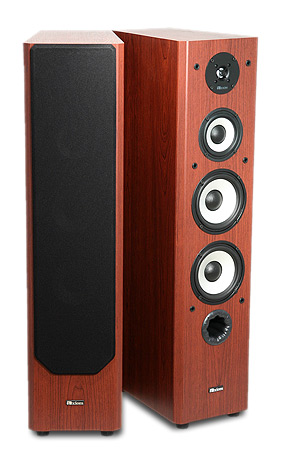 Axiom M60 v3 Product Specifications
The Axiom M60s have been around for quite some time. Over the years the company has continually refined its performance which we can partly validate with their latest v2 edition that no longer employs electrolytic caps in series with the tweeter. Instead, they've been replaced with less lossy poly ones. Axiom has also refined the tweeter performance in their latest series and eventually plans on adding magnetic grilles and completely aluminized cones so all of the mid and bass drivers will appear completely silver. The review samples sent to us were actually early V3 versions without the magnetic grilles or silver cones. Axiom told us the performance of these speakers is identical to their latest V3 offering however.
The M60 v3 employs 4 drivers with a 1" titanium tweeter, 5.25" midrange and two 6.5" woofers. They are triple vortex ported (2 rear / 1 front) with a claimed extension down to 37 Hz (-3dB). The tweeter has a 2kHz 12dB/octave HP filter while the midrange has no crossover at all relying on the natural acoustical rolloff of the driver (12dB/octave) and small sealed enclosure to provide more bass output above the tuning frequency of the ports. Unfortunately since the midrange has no HP filter, we noticed at high volume levels, the little driver was stressed though we never heard it actually bottom out which was a testament to their driver design. It's important to note that anyone wishing to use these speakers in a large room with a huge appetite for high SPL levels should consider high power amplification over a receiver to power them as these speakers can handle it. Luckily I was using the Axiom A1400-8 power amp which has enough current drive to push a train, but I wonder how many potential buyers would be using such a beast for a sub $1000 speaker system.
Overall, I found the Axiom M60 v3's to have a warm and pleasing sound with excellent bass extension second only to the Klipsch RF-62 in the bass extension but not necessarily in accuracy. Depending on program material, I found the midrange was a bit recessed and chesty sounding on male vocals with notable break up at high sustained output levels, but the highs were quite detailed producing a very pleasing fullrange sound. It was a sure bet to me that these speakers would do well in the listening comparison among our panel of listeners.
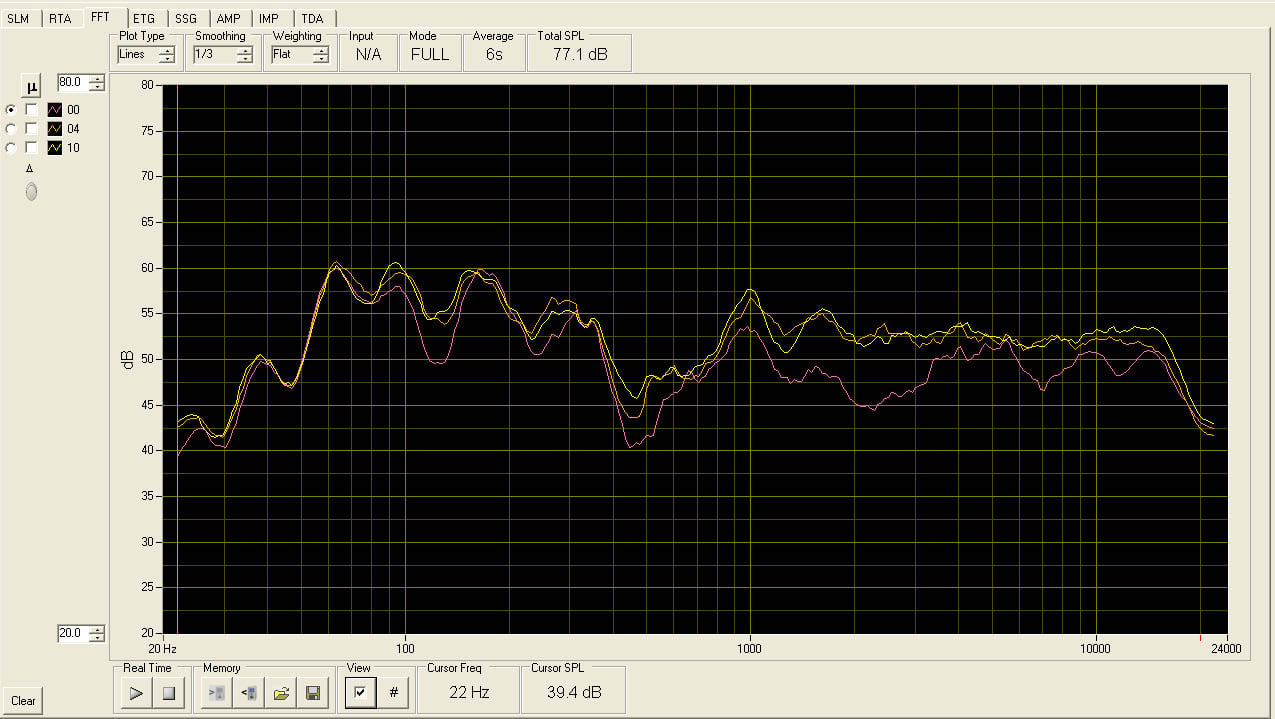
Axiom M60v2 In-Room Frequency Response at Primary Listening Position
I measured
the M60 v3's for all three test trials. The
dip at 400-500Hz is caused by floor bounce which is a measurement anomaly. The dip in the red trace across the entire
frequency spectrum was because I forgot to turn on both channels when pulling
that measurement like I did with all of the other measurements.
Axiom M60v2 Listener Comments for Blind Tests
With Axiom directly compared to EMP
Comments from trained listeners:
- Good overall sound but [they] don't blend as well leaving a somewhat compressed sound.
- Compressed and recessed midrange,
deeper bass but not very accurate, lacking snap or kick to the bass. Too much
sibilance in female vocals
Comments from other listeners: - Three listeners felt the sound was very balanced.
- One listener specifically felt the
soundstage was larger and more like a live performance but felt they were
average sounding speakers with boomy bass.
With Axiom directly compared to JBL
Comments from trained listeners:
- Clean, well-blended sound, natural vocal quality but more compressed.
- Pleasing natural sound but floppy bass.
Comments from other listeners:
- Crisper bass and more 3D sounding.
- Natural and dynamic sound.
- Mushy bass, vocals recessed, detailed instrumentals.
- Highs were smoother than the other speaker.
With Axiom compared to Klipsch
Comments from trained listeners:
- Bright natural tone, pleasant vocals, good full range sound.
- Recessed mids, loose bass.
Comments from other listeners:
- Very accurate vocals, favorite speaker of the two.
- Natural sound but bass not as tight as the other speaker.
- Highs not as defined as other speaker and sound is slightly recessed.
- Average performance, not something I would buy.
- Klipsch Rep: No sense of imaging in my seat as I was sitting too far off axis.
EMPtek E55ti Floorstanding Loudspeakers
EMPtek E55ti Specifications Page
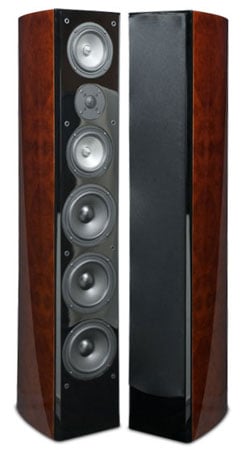 While EMP is a relative newcomer for an
online speaker company, the same people
that design the highly esteemed RBH Sound products are responsible for the
EMP. Rest assured there is trickle down
technology shared and benefited to EMP from RBH Sound. The E55ti was the largest and least expensive
speakers in this comparison. Standing a
tad over 4 feet tall, it also had the most drivers (6 total) including three
6-1/2" bass drivers, two 5-1/4" midrange drivers and a 1" silk
dome tweeter. The top half of the
E55ti's have an MTM driver arrangement which helps to control vertical
dispersion while also providing a lot of dynamic range since multiple drivers are
dedicated for the midrange frequencies.
The soundstage thrown off by these speakers is truly impressive and has
to be heard to be believed. The E55ti
was the second most efficient speaker in this comparison and employed 120Hz and
3kHz crossover frequencies making it a true three-way design.
While EMP is a relative newcomer for an
online speaker company, the same people
that design the highly esteemed RBH Sound products are responsible for the
EMP. Rest assured there is trickle down
technology shared and benefited to EMP from RBH Sound. The E55ti was the largest and least expensive
speakers in this comparison. Standing a
tad over 4 feet tall, it also had the most drivers (6 total) including three
6-1/2" bass drivers, two 5-1/4" midrange drivers and a 1" silk
dome tweeter. The top half of the
E55ti's have an MTM driver arrangement which helps to control vertical
dispersion while also providing a lot of dynamic range since multiple drivers are
dedicated for the midrange frequencies.
The soundstage thrown off by these speakers is truly impressive and has
to be heard to be believed. The E55ti
was the second most efficient speaker in this comparison and employed 120Hz and
3kHz crossover frequencies making it a true three-way design.
Despite the
fact that the E55ti has three bass drivers, it doesn't seem to play as low as
some of the other products in this comparison (namely the Klipsch and
Axioms). EMP chose maximum output over
extension which came in spades when I tested them in my 6,000 ft^3 room at ear
bleeding levels and wasn't able to bottom any of the drivers or cause audible
distress in the critical midrange frequencies like I heard with some of the
other speakers in this comparison. They
are also a super easy load for any amplifier to drive as the impedance doesn't
drop below 8 ohms at low frequencies.
Although these speakers aren't bass anemic, I feel they are best used in
conjunction with a subwoofer. This had me a bit concerned in this comparison
since we were running all speakers full range without the use of a powered
sub. I bugged EMP enough to have them
make a running change to the bass drivers which they claim will lower the
resonance frequency of the driver by 10Hz to produce stronger output at its
tuning frequency (50Hz) and more usable low end extension. Expect a formal review of these speakers when
the driver updates become available.
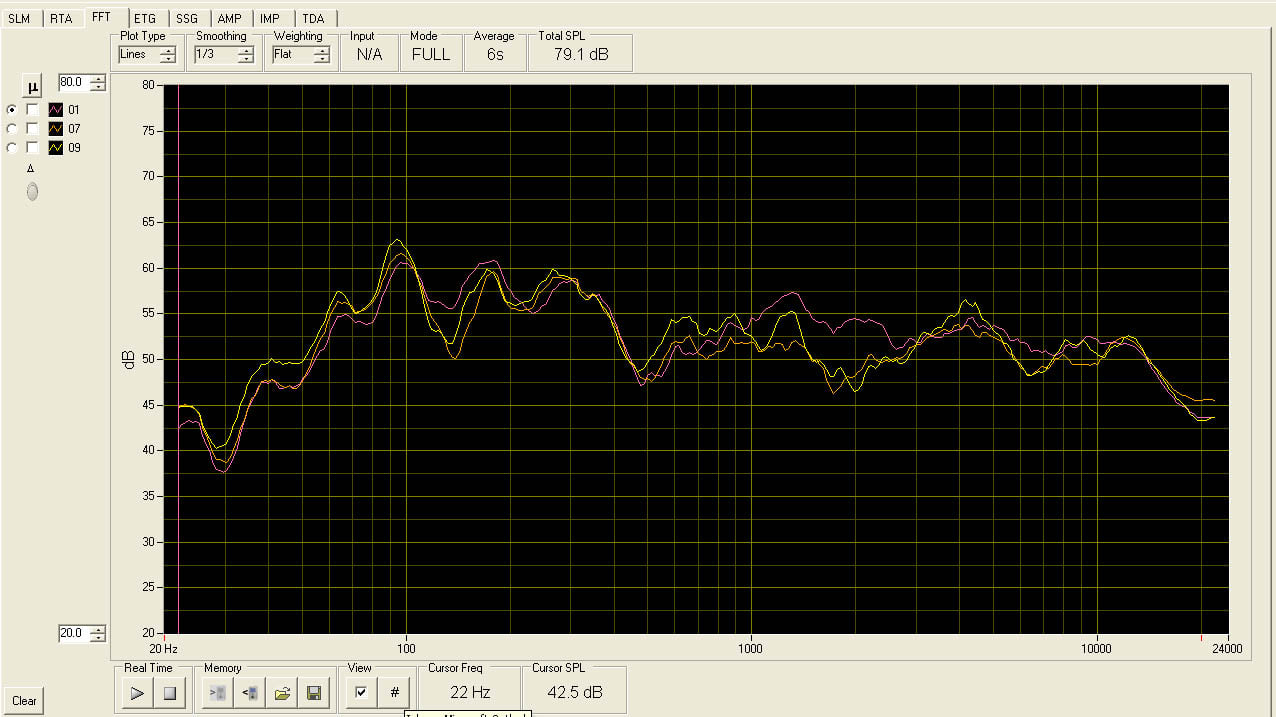
EMP E55ti In-Room Frequency Response at Primary Listening Position
I measured the E55ti's for all three test trials. The dip at 400-500Hz is caused by floor bounce which is a measurement anomaly. The variations between the three measurements were due to positional differences whether they were located in the marked area closest to the left wall or further.
EMP E55ti Listener Comments for Blind Tests
With EMP directly compared to Axiom
Comments from trained listeners:
- Very natural life-like sound with pristine midrange and smooth top end.
- Fuller sound, more natural and pleasing blend of frequencies than [the] other speaker.
Comments from other listeners:
- Lacked details in highs with average imaging and soundstage.
- Female vocals were deeper but other speaker had more impressive soundstage
- Great vocal clarity but bass was boomy.
- Bass was tighter and drum solo sounded more life-like and real than the other speaker but overall sound was somewhat mushy.
With EMP directly compared to JBL
Comments from trained listeners:
- Natural midrange, tight bass though not very deep, clean sound.
- Very similar tonal balance with tighter bass than the other speaker.
Comments from other listeners:
- Better vocals and imaging than other speaker.
- Good imaging and midrange.
- Midrange is nice, guitar strum very clear though bass is a little messy.
With EMP compared to Klipsch
Comments from trained listeners:
- Clear highs, natural sound, tight punchy bass.
- Forward sounding and bass not as deep as the other speaker.
Comments from other listeners:
- Lacking in highs, imaging and soundstage not as good as other speaker
- Nice midrange, messy bass.
- Crisp bass but overall sound less impressive than other speaker.
JBL ES80 Floorstanding Loudspeaker
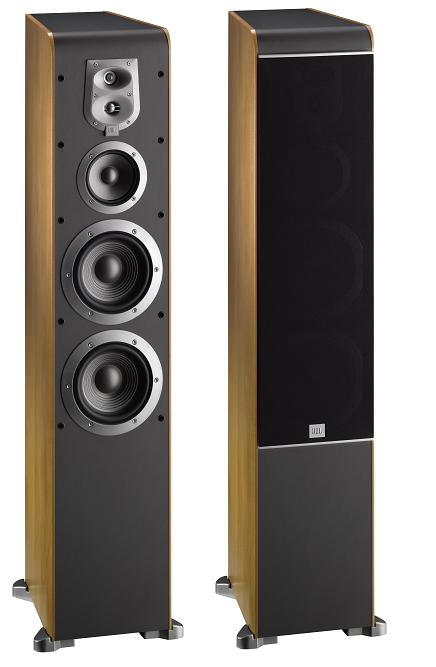 The JBL ES80 is a 4-way loudspeaker with dual 6"
woofers, one 4" midrange and one 3/4" titanium dome tweeter and one
3/4" ring radiator super tweeter.
The crossover points are 700Hz, 3.6kHz and 12kHz. The reported sensitivity is 91dB which
theoretically is about 3dB more sensitive than the EMP E55ti towers, yet I
measured similar sensitivity of both speakers.
The frequency response is rated from 45Hz to 40kHz (-3dB). These speakers have a nice clean look to
them, but I must admit that upon first glance I didn't expect much . This was
because I felt the midrange and tweeter drivers appeared to be very cheaply
designed. I was really blown away when I
hooked them up and was rewarded with tonally neutral sound. The bass was tight and well-extended and the
midrange was pronounced, though a bit dark and analytical sounding. The highs were detailed and not
fatiguing. I had high hopes for these
speakers in the blind test as I felt they were one of the most accurate
sounding among the four in this comparison.
The JBL ES80 is a 4-way loudspeaker with dual 6"
woofers, one 4" midrange and one 3/4" titanium dome tweeter and one
3/4" ring radiator super tweeter.
The crossover points are 700Hz, 3.6kHz and 12kHz. The reported sensitivity is 91dB which
theoretically is about 3dB more sensitive than the EMP E55ti towers, yet I
measured similar sensitivity of both speakers.
The frequency response is rated from 45Hz to 40kHz (-3dB). These speakers have a nice clean look to
them, but I must admit that upon first glance I didn't expect much . This was
because I felt the midrange and tweeter drivers appeared to be very cheaply
designed. I was really blown away when I
hooked them up and was rewarded with tonally neutral sound. The bass was tight and well-extended and the
midrange was pronounced, though a bit dark and analytical sounding. The highs were detailed and not
fatiguing. I had high hopes for these
speakers in the blind test as I felt they were one of the most accurate
sounding among the four in this comparison.
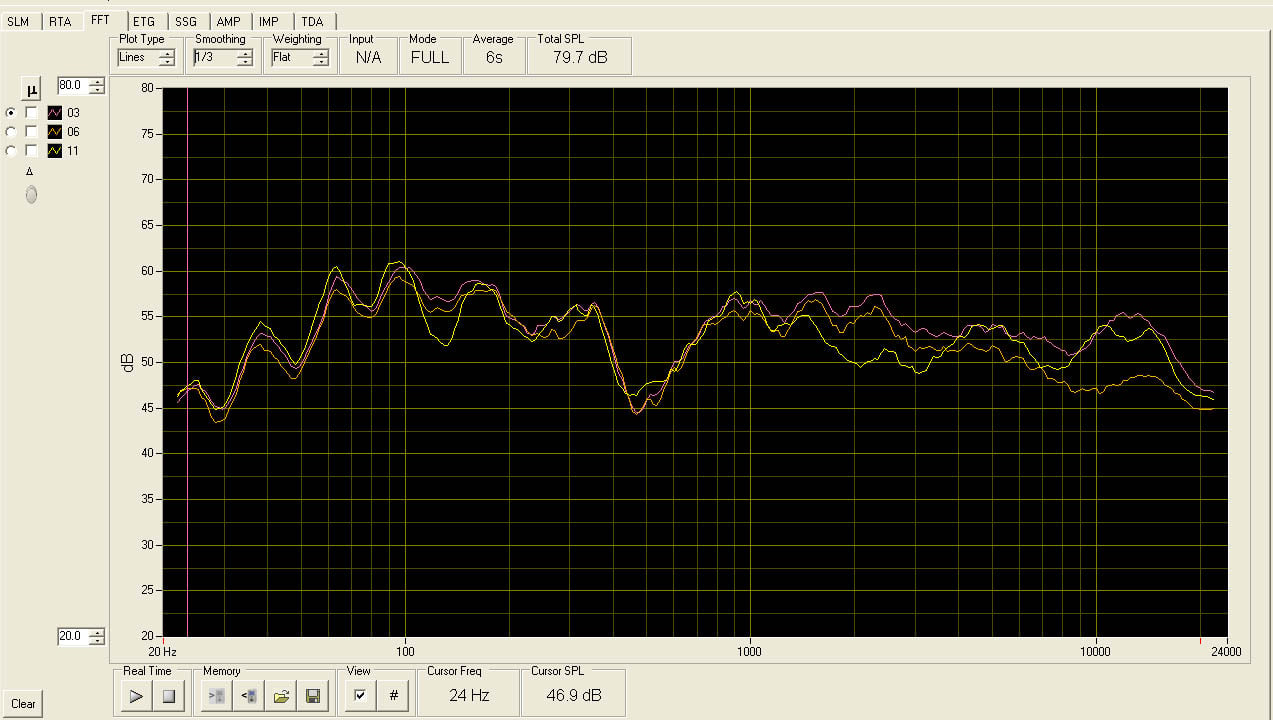
JBL ES80 In-Room Frequency Response at Primary Listening Position
I measured the ES80's for all three test trials. The dip at 400-500Hz is caused by floor bounce which is a measurement anomaly. The variations between the three measurements were a due to positional differences whether they were located in the marked area closest to the left wall or further.
JBL ES80 Listener Comments for Blind Tests
When JBL directly compared to Axiom
Comments from trained listeners:
- Boxy midrange (female vocals).
- Somewhat thin and forward sounding and bright at times but good bass extension.
Comments from other listeners:
- Veiled highs, bass heavy, forward sounding and narrow soundstage.
- Poor imaging but punchy bass.
- Nice range of sound and well balanced from left to right.
- Harsh highs, excessive bass, average
mids.
When JBL directly compared to EMP
Comments from trained listeners:
- Not much texture in midrange, bass is deep but not as tight as the other speaker
- Similar sound to speaker C (Author's note: this was the Klipsch), don't care for the sound
Comments from other listeners:
- Bass heavy, lacks clear highs.
- Not as impressive as other speaker in all aspects.
- Lots of bass, full sound overall but lacks crispness of other speaker.
- Seemed to sound more balanced
overall than the other speaker.
When JBL compared to
Klipsch
Comments from trained listeners:
- Bass seems loose, midrange clear but recessed, overall boxy sounding.
- Crisp clean sound with smooth frequency response but a bit thin and would be better with a sub.
Comments from other listeners:
- Very good imaging but lacks soundstage.
- Less impressive than other speaker.
- Veiled highs but overall good sound.
- Music sounded pulled away compared to other speaker.
- Klipsch Rep: deeper soundstage than
other speaker.
Klipsch RF-62 Floorstanding Loudspeaker
Klipsch RF-62 Specifications Page
T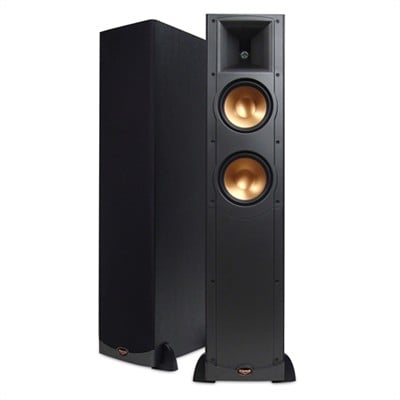 he Klipsch
RF-62 is a two-way design sporting dual 6-1/2" woofers and a 1"
titanium compression horn crossed over at 1.8kHz. It was the only speaker in this comparison
that was horn-loaded. The woofers were spaced too far apart causing measurable
comb filtering. I could only conclude
this was done for marketing purposes to increase aesthetic appeal as opposed to
any valid engineering reason to do so. The
reported efficiency was 97dB at 2.83V/meter but in reality it was only about 4
dB more efficient than the EMP E55ti which was rated at 88dB. Because the Klipsch had so much bass (published
38Hz -3dB) and treble, it was the most challenging speaker to level match them
with the other speakers in this comparison.
In fact, if I were to relate the comparison of all the speakers in terms
of burgers, the EMP and JBL would be Angus hamburgers with lettuce and tomato
while the Axioms would add cheese and the Klipsch would make it a double with
extra cheese and pink sauce. You've got
four distinct options to choose from here depending on how you like to flavor
your burger. The RF-62s have impressive bass extension, almost as if there is a
subwoofer playing in the room. They can
play at ungodly loud levels with little amplifier power - but be warned: they
are not tonally neutral, so purists may look elsewhere while disco and heavy
metal fans need to look no further to find sonic nirvana. After hearing them, I suspected they would
fare well among the more casual listeners in our panel. It's no surprise to me why Klipsch speakers
are so popular.
he Klipsch
RF-62 is a two-way design sporting dual 6-1/2" woofers and a 1"
titanium compression horn crossed over at 1.8kHz. It was the only speaker in this comparison
that was horn-loaded. The woofers were spaced too far apart causing measurable
comb filtering. I could only conclude
this was done for marketing purposes to increase aesthetic appeal as opposed to
any valid engineering reason to do so. The
reported efficiency was 97dB at 2.83V/meter but in reality it was only about 4
dB more efficient than the EMP E55ti which was rated at 88dB. Because the Klipsch had so much bass (published
38Hz -3dB) and treble, it was the most challenging speaker to level match them
with the other speakers in this comparison.
In fact, if I were to relate the comparison of all the speakers in terms
of burgers, the EMP and JBL would be Angus hamburgers with lettuce and tomato
while the Axioms would add cheese and the Klipsch would make it a double with
extra cheese and pink sauce. You've got
four distinct options to choose from here depending on how you like to flavor
your burger. The RF-62s have impressive bass extension, almost as if there is a
subwoofer playing in the room. They can
play at ungodly loud levels with little amplifier power - but be warned: they
are not tonally neutral, so purists may look elsewhere while disco and heavy
metal fans need to look no further to find sonic nirvana. After hearing them, I suspected they would
fare well among the more casual listeners in our panel. It's no surprise to me why Klipsch speakers
are so popular.
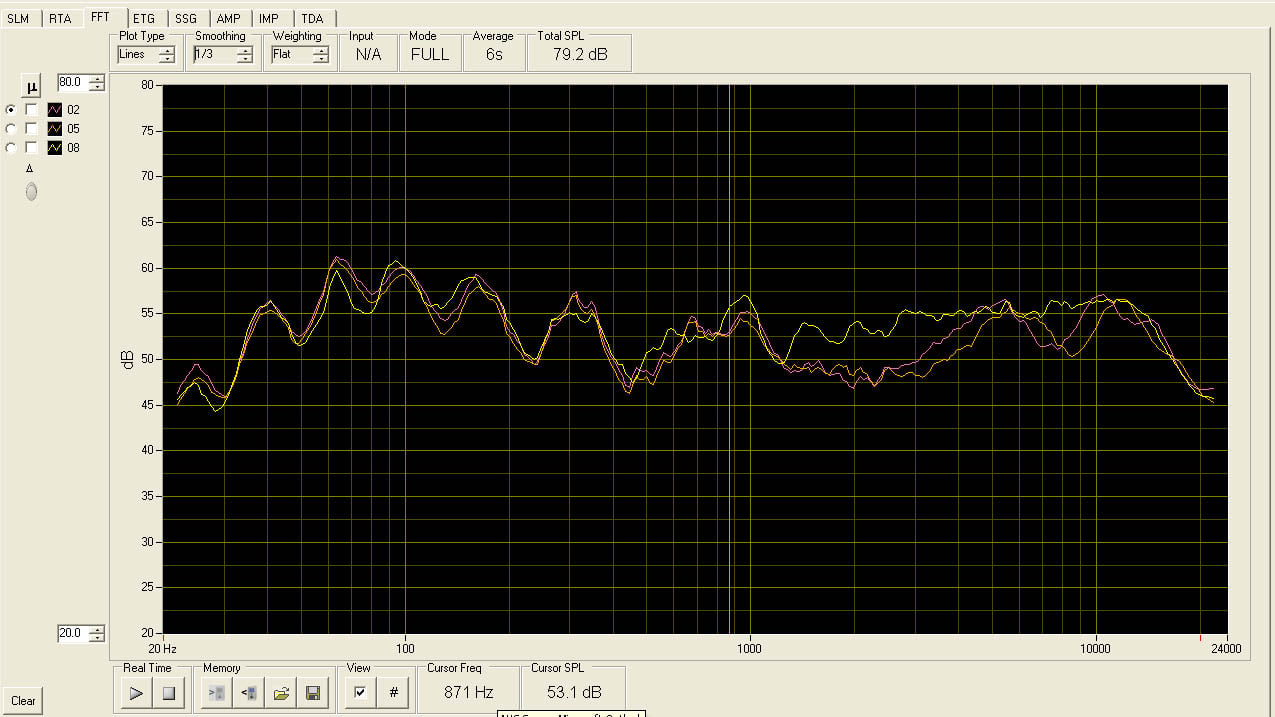
Klipsch RF-62 In-Room Frequency Response at Primary Listening Position
I measured the RF-62s for all three test trials. The dip at 400-500Hz is caused by floor bounce which is a measurement anomaly. It is interesting to note the high frequency output of the Klipsch was higher than all of the other speakers in this comparison and a whopping 3-4dB hotter than the EMPs. The variations between the three measurements were a due to positional differences whether they were located in the marked area closest to the left wall or further.
Klipsch RF-62 Listener Comments for Blind Tests
When Klipsch directly compared to Axiom
Comments from trained listeners:
- Compressed and boxy sound, bass heavy with somewhat brash vocals.
- Bright highs, compressed mids, but bass a tad more accurate than other speaker.
Comments from other listeners:
- Soundstage was wider and more open than the other speaker with better highs and mids.
- Crisp bass, more forward "projected" sound but sound seemed louder in the right speaker.
- Deep rich bass with excellent imaging and soundstage.
- Better bass control than other speaker, trumpet sounds more prominent.
- Klipsch rep: great dynamic range and
image balanced.
When Klipsch directly compared to EMP
Comments from trained listeners:
- Boomy bass with no punch in kick drums, clear highs but compressed sounding.
- Compressed and distorting sounding, bass heavy and poor midrange.
Comments from other listeners:
- Bass heavy but had more pleasing highs than other speaker. Female vocals more life-like.
- Crisp highs not drowned like other speaker, forward projected sound.
- Excellent vocals and range of sound, good imaging.
- Tad too bright, but tight bass and
open sound.
When Klipsch compared
to JBL
Comments from trained listeners:
- One dimensional sounding, compressed midrange, overemphasized highs, low end sounded more natural than other speaker.
- Boomy muffled bass, best suited for use with no subwoofer. Poor crossover frequency.
Comments from other listeners:
- Very good mids/highs , much wider soundstage than other speaker but bass extension could be better.
- Lots of deep bass, music sounded projected and surrounded me.
- Excellent imaging and depth of sound.
- Very nice balanced sound.
Blind Scorecard Test Results
I tabulated all of the scorecard results in excel which was a painfully long process but all worth it in the name of science. I took the average rating for each category (aka. highs, mids, lows, etc) and plotted the results for each speaker.
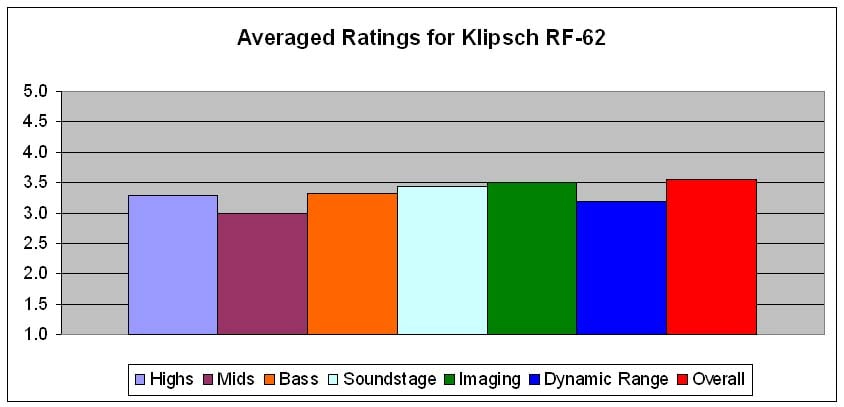
Klipsch RF-62 Blind Scorecard Results
Overall the Klipsch scored the highest overall rating by a small margin. When the Klipsch was directly compared against the Axioms, its midrange rating decreased most significantly but the Klipsch also had its highest bass rating in return. The JBL diminished the Klipsch soundstage rating the most while the EMP boosted its imaging rating to its highest level.
Axiom M60v3 Blind
Scorecard Results
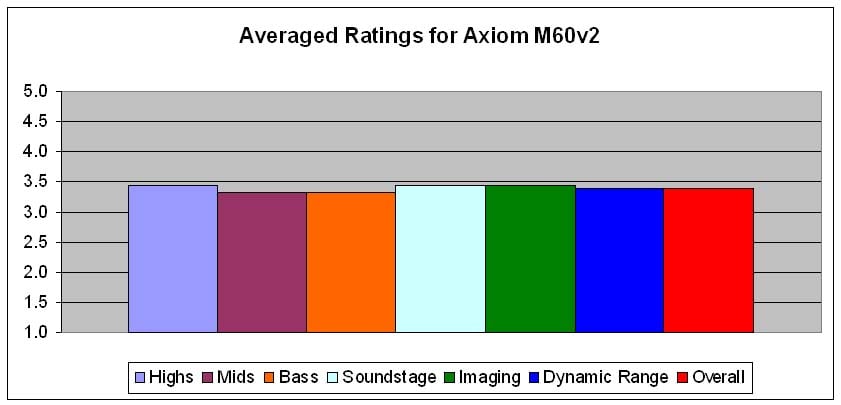
The Axiom M60v3 overall results were marginally lower than the Klipsch. When the JBL was directly compared to the Axiom, it decreased the Axiom's high and soundstage ratings the most. The EMP's significantly reduced the Axiom's midrange performance rating but also gave the Axiom's their strongest bass rating when directly compared. The EMP also diminished the Axiom's dynamic range and imaging rating the most, though only by a small margin. Incidentally the Axioms ranked highest when directly compared against the Klipsch.
EMP E55ti Blind Scorecard Results
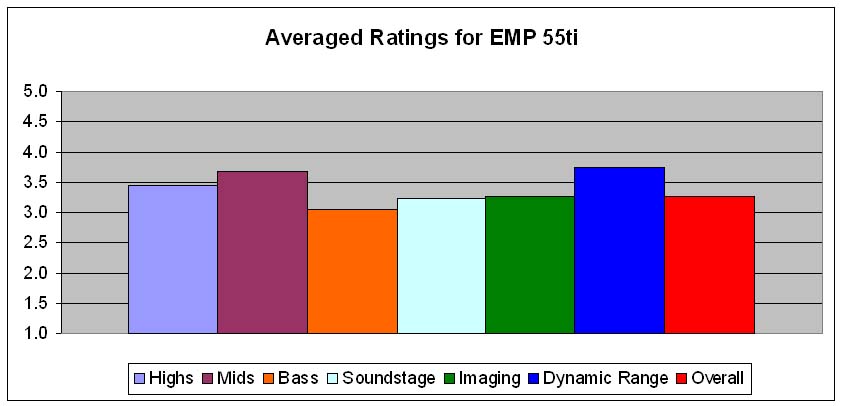
The EMP E55ti's overall score ranked 3rd place but its scoring on midrange and dynamics were higher than every other speaker in this comparison. The Klipsch significantly reduced the EMP highs, bass and imaging rankings when the two speakers were directly compared. The EMPs highest dynamic ranking was when it was directly compared to the Axioms.
JBL ES80 Blind Scorecard Results
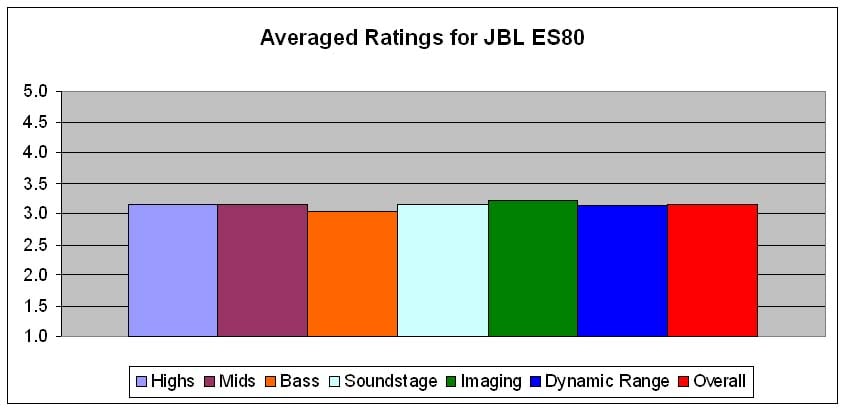
The JBL ES80 didn't fare as well as I anticipated but they still held their own as an all around good performer only marginally lower ranked than even the top ranked Klipsch. The EMPs dropped the highs and dynamic range ratings most significantly for the JBLs which is surprising as I banked on the Klipsch doing this. Instead the Klipsch had the biggest negative impact on bass performance of the JBLs when they were directly compared. The Axioms boosted the soundstage most significantly when they were directly compared. The EMPs overall had the largest impact on dropping the ranking of the JBLs when they were directly compared.
Yes Answers to "Would you own these speakers?"
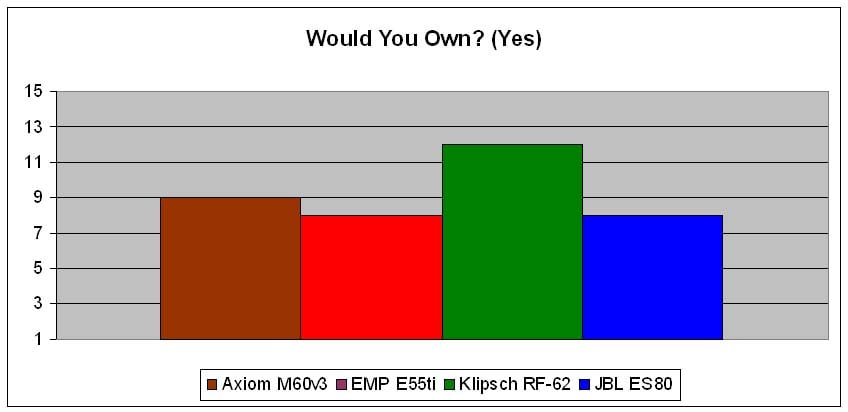
The maximum number of "Yes" votes any speaker could earn would be 18 (6 listeners, 3 trails each). The Klipsch RF-62 got the highest "Yes" rating (12 votes) to the question "would you own these speakers?" The Axioms scored the second highest with 9 votes while the EMPs and JBLs tied for 3rd place with 8 votes.
Sighted Test Results
 Towards the
end of the day, we ran some sighted tests with the grille cloth removed. Time was limited, so we were unable to run
all the test suites unsighted. Some
short A/B comparisons were made but the general consensus was everyone wanted
to spend more time listening to each speaker to form a more concise
opinion. Thus we spent about 5-10
minutes listening to each speaker and let them stand on their own merits.
Towards the
end of the day, we ran some sighted tests with the grille cloth removed. Time was limited, so we were unable to run
all the test suites unsighted. Some
short A/B comparisons were made but the general consensus was everyone wanted
to spend more time listening to each speaker to form a more concise
opinion. Thus we spent about 5-10
minutes listening to each speaker and let them stand on their own merits.
Axiom M60v3 Sighted Listener Comments
- Very deep but boomy bass, compressed sound, especially in the midrange.
- Speaker lacked definition in the midrange, bass was boomy/muddy.
- Bass didn’t sound too clean, but highs were very nice and detailed.
- Mids seemed to be missing detail.
EMP E55ti Sighted Listener Comments
- Bright natural sound, vibrant highs, great tonal separation punchy, but light on bass. Good jazz speaker.
- Good midrange but needs better highs. Excellent midbass that came alive during drum solos.
- Drums sound lifelike, clean and crisp sound
- Sounds like a live performance
- Great dynamics
JBL ES80 Sighted Listening Comments
- Fairly well balanced sound throughout tonal range. Solid bass. Good rock and roll speaker.
- Horns sounded less natural than I heard on other speakers.
- Nice mids, horns very clear, equal balanced sound from left to right.
- Very good bass with drums but sometimes sounded boomy.
Klipsch RF-62 Sighted Listening Comments
- Very weak mids and highs are very brash. This speaker is heavily bass biased.
- Excessive highs. Singer had too much lisp in her voice. Midrange was very lacking.
- Voice has harsher edge than I heard on this speaker before. The bass was clean and deep.
- Sound was great but a bit too bright.
Sighted Scorecard Test Results
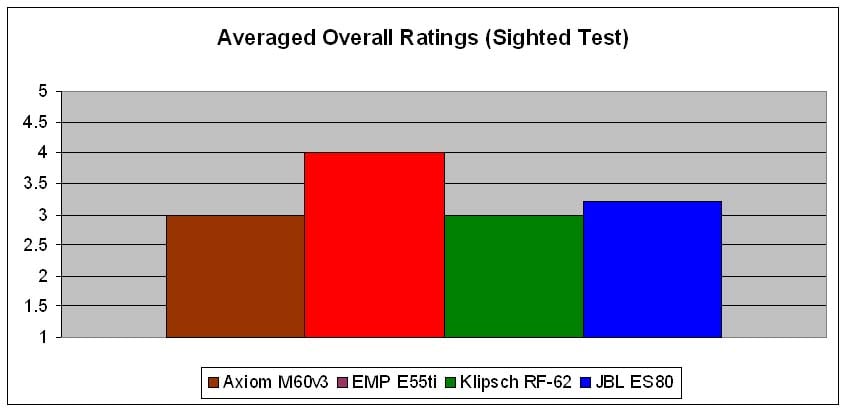
Since time was limited, I only asked each listener to offer a final overall ranking for each speaker while listening to them without the grille cloth coverings. The speakers were level matched exactly how they were done in the blind testing. One of our trained listeners was unavailable for the sighted tests which would have likely boosted the EMP and JBL ratings since he scored those highest among the four speakers during the blind tests. The results were averaged are tabulated below.
Overall Ratings for Sighted Tests
In this round of testing, the EMP E55ti's appeared to come out on top while the Klipsch RF-62's and Axiom M60v3's ratings dropped most dramatically. I believe the most significant reason for preference changes in the sighted testing had to do with restoring the tonal balance of all of the speakers once the lossy grille cover was removed. Aesthetics may have also played a factor though nobody commented on the appearance of any of the speakers in the comparison since they were sitting so far away and focused more on what they were hearing while note taking.
Pinnacle BD 1000 Honorable Mention
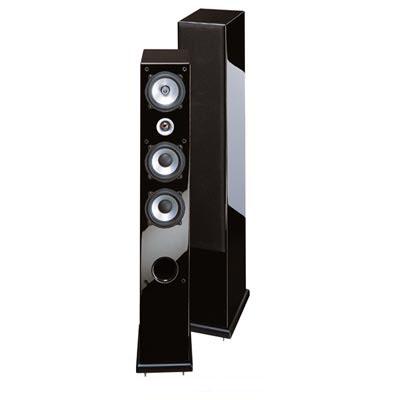 Pinnacle BD 1000 Specifications Page
About a week prior to this faceoff, I contacted Pinnacle Loudspeakers as a fall back in case the JBL's didn't come through. The JBL products did arrive as did the Pinnacles but on the day of our event when we were already knee deep in our listening tests. We put them aside and pressed on.
The Pinnacle BD 1000's retail for $1300/pair and are a 3-way 4 driver tower speaker consisting of a 1" silk dome tweeter, two 5 1/4" woofers and one 5 1/4" phase plug midrange. Their claimed frequency response is 34Hz to 20kHz +-3dB with 200Hz and 5kHz crossover points. Their rated sensitivity is 88dB @ 1 watt/meter with an nominal 8 ohm impedance. I must admit my first impression was "there is no way these little speakers could be competitive with the other four under test". At the end of the day, our listeners were itching to hear them nonetheless. We unboxed them and setup some brief sighted listening tests. Everyone, myself included, was impressed by their performance. The bass was deep and well extended, the mids were articulate and the highs were crisp and energetic. These speakers portrayed a sound that bellied their diminutive size. Although we didn't critically listen and compare these speakers to the others in this Faceoff, I believe they would have done very well. I requested that Pinnacle allow me to hold on to these samples longer so I could write up a formal review.
Methods for Improving Speaker Testing
Although
this speaker comparison produced interesting results, I believe we all learned
a lot from this process regarding how to improve our testing methodology for
producing more consistent testing results.
I have listed my observations below in efforts to improve our
methodology for our next annual Faceoff.
Find Less Lossy Grille Cloth
Covering
I believe
one of the largest biasing factors in this test was the extremely lossy grille
cloth we utilized to cover the speakers which seemed to shift the listener
preference to the brighter speakers.
Since it's virtually impossible to stretch the cloth more taut, we
either need to blindfold our listeners or find less lossy material to use in
future comparisons.
Use Better Randomization of Testing
Rather than
assigning each speaker a letter designation, I will follow in Tom Andry's foot
steps where he only assigned an "A" and "B" designation for
the speakers and simply kept track which was which during the testing to always
keep the listeners guessing.
A B
Klipsch JBL
JBL EMP
EMP Axiom
Axiom Klipsch
JBL Axiom
Klipsch EMP
I believe
towards the end of the tests, people already had preconceived ideas of what
each speaker would sound like based on simply calling out its letter
designation. Some of the listeners
reported it was too confusing remembering four letter designations when taking
notes.
Reduce Number of Listeners per Session and Increase Number of Listening Sessions
For two-channel listening, it makes little sense to sit any particular listener off axis from the stereo sweet spot. I believe we partly confirmed the research Dr. Sean Olive conducted regarding listening position can have a more dramatic impact on listener preference than the actual audible differences in the loudspeakers themselves. Our data showed that people sitting in the back row preferred the speakers with the most bass and high frequency bias. Their preferences also seemed to have the most variability in ratings from test to test. It's inconclusive however if these preferences were influenced by them also being the least experienced listeners or simply changing their opinion of the speaker under test when compared to a different speaker each time. More study is needed to make an accurate correlation.
One thing that’s important to realize is in order to have reasonably accurate results a greater number of tests and sampling of listeners is needed in order to produce significantly meaningful results (>95% confidence). Unfortunately it is often costly and impractical to conduct blind tests in this fashion like it's typically done in the medical field. Sorry we are just an A/V publication, NOT a pharmaceutical company with billions of dollars in financial backing. This doesn't, however, mean we can't improve our methodology by restricting our listening sessions to the best seats in the room and spanning the test out for multiple days to include more listeners. If there are any volunteers to host such tests, drop me an email :)
Use the Most appropriate Listening
Venue
An
important factor to how a loudspeaker performs is the type and size of the room
it is placed in. My primary theater room
is quite large (almost 6,000ft^3). It's
also acoustically treated with an asymmetrical right sidewall. Small speakers have a hard time producing
high SPLs in this room as they tend to get drowned out in such a large
listening venue. I suspect if we used my
Family room which is much more lively thanks to its wood floors, glass door and
high ceilings, listener preferences would have been much different, perhaps
favoring the more laid back speakers in the high frequencies. It would have be interesting to conduct these
listening tests in two different rooms to determine how those results change
based solely on room acoustics. Future
comparisons may be conducted in two different listening venues to determine how
much the room influences listener preference.
Better train inexperienced listeners
The
variability both in comments and ratings was highest among the least
experienced listeners. I was a bit
surprised by all of the negative comments for all of the speakers. Perhaps I didn't do a good job explaining to
the listeners what to listen for and to put more focus on the positive
attributes they were hearing.
I also observed that the trained listeners exhibited preference towards the more tonally neutral speakers while the untrained listeners appeared to have higher preferences for the speakers with the most bass and treble. Perhaps it would be beneficial to better prepare the inexperienced listeners on what to listen for when evaluating loudspeaker performance. On the flip side it does provide insightful data to see what untrained listeners prefer when walking into a showroom floor trying to select the best sounding speaker.
A Note About Listening Tests
When
choosing a loudspeaker it's important to first decide on what purpose it will
serve to you as well as what type of room you will be listening to it in - and
at what SPL levels. All of the blind
test results in the world won't determine how a particular loudspeaker will
sound in your listening environment reproducing the music you like to listen
too. It's also important to NOT judge a
loudspeaker's performance solely on one or two short listening sessions. Casual buyers tend to gravitate towards the
most colored sounding speaker on a busy showroom floor only to find weeks later
they suffer from buyer's remorse caused by listening fatigue. When judging a loudspeaker performance in
your own home, ask yourself "does this sound like an actual reproduction
or just a colored representation?"
Conclusion
 Once again
our annual speaker Faceoff proved to be both fun and enlightening. We learned about how biases (even those
unintentional ones) played a more influential role in loudspeaker preference
than the actual audible differences in the loudspeakers themselves. This leads to the realization that while the
human ear may be a great comparator its not so great as an absolute
reference. We discovered that each
speaker in this comparison had their own individual strengths and
weaknesses. It is a combination of how
those traits interact in a particular room playing a particular type of music,
and how they influence each individual's listening preferences in determining
the best-suited speakers for their needs.
In the end, all four of these speakers were winners as they managed to
provide respectably good audio at such modest price levels in a large and
demanding listening space. Good food and
drink, good friends, and good sound is an annual recipe for fun we plan on
continuing and refining each year. Next
time, however, I will leave the reporting, testing, and writing to someone else
and just sit back and enjoy the sound.
Once again
our annual speaker Faceoff proved to be both fun and enlightening. We learned about how biases (even those
unintentional ones) played a more influential role in loudspeaker preference
than the actual audible differences in the loudspeakers themselves. This leads to the realization that while the
human ear may be a great comparator its not so great as an absolute
reference. We discovered that each
speaker in this comparison had their own individual strengths and
weaknesses. It is a combination of how
those traits interact in a particular room playing a particular type of music,
and how they influence each individual's listening preferences in determining
the best-suited speakers for their needs.
In the end, all four of these speakers were winners as they managed to
provide respectably good audio at such modest price levels in a large and
demanding listening space. Good food and
drink, good friends, and good sound is an annual recipe for fun we plan on
continuing and refining each year. Next
time, however, I will leave the reporting, testing, and writing to someone else
and just sit back and enjoy the sound.
Acknowledgements
I'd like to extend a special thanks to my wife for providing us with awesome food (the Pork Chop Marsala was to die for!) and beverages. The attending participants and their help packing up the speakers at the end of our tests was most appreciative.
I would especially like to thank the following manufacturers who provided loudspeaker samples that made this Faceoff possible:
- Axiom Audio
- EMP
- JBL (sent next day air!)
- Audioholics E-Store (Klipsch samples)
- Pinnacle Loudspeakers
It's important to note that many manufacturers shun these type of comparisons in fear their products will not perform well. It speaks volumes for the manufacturers confidence in their products that provide us samples each year to allow us to run such comparisons.
Gene manages this organization, establishes relations with manufacturers and keeps Audioholics a well oiled machine. His goal is to educate about home theater and develop more standards in the industry to eliminate consumer confusion clouded by industry snake oil.
View full profile Subscribe to our newsletter