


Von Schweikert Audio VR-1 Speaker Review
- Product Name: Von Schweikert Audio VR-1
- Manufacturer: Von Schweikert Audio
- Performance Rating:

- Value Rating:
- Review Date: January 11, 2004 19:00
- MSRP: $ 1000
Frequency Response: 40Hz to 25kHz (- 3dB point in room)
Sensitivity: 89 dB (1 Watt / 1 Meter)
Recommended Power: 20-100 Watts
Drive Units: Single 1" composite silk dome VSA tweeter. Single 6.5 resin impregnated mica/cellulose composite, cast frame, shielded woofer
Crossover Frequency: Phase-consistent Global Axis Integration Network with stacked First Order circuits configured to enable 4th order acoustic slopes for minimum cross-talk distortion and reduced lobing.
System Impedance: 8 Ohm
Cabinet Finish: genuine hardwood finishes
VR-1 Packaging and Build Quality
The following review is for Von Schweikert Audio's VR-1 Reference Studio Monitors. Two pairs of VR-1 speakers were thoroughly listened to and evaluated in bookshelf, and surround applications for approximately four months on a variety of different reference systems, each with unique room acoustics. Some of the technical information was provided by the manufacturer and additional information can be found on their site at www.VonSchweikert.com . Performance measurements were conducted by Audioholics using Sencore and LMS test equipment.
Brief Background
Albert Von Schweikert followed his passion for music and instruments by founding Von Schweikert Audio. His dissatisfaction in the lack of realism found in many contemporary speaker designs led him on a long quest to create a great speaker, at a reasonable price. From the packaging, to the build quality, it's clear to see that Albert Von Schweikert takes pride in his product, and rightfully so.
First Impressions
All speakers were doubled boxed and packaged very well. Once inside the second box, we found a plastic wrap around a black velvet wrap which encased each speaker. The black velvet wrapper was embroidered with Von Schweikert Audio USA logo and knotted on top with a tight rope. At first, I questioned such elaborate packaging, but after pondering on it, I recognized that it's all part of the attention to detail that we've found throughout Von Schweikert's speaker line. To me it also showed that Albert Von Schweikert really cared about how he presented his name while recognizing the importance of a first impression. The velvet bagging also came in handy when we traveled to different locations and implemented the speakers on different reference systems as it made them easier to carry around while also protecting the beautiful finish.

VR-1 Build Quality and Finish
I have to say that Von Schweikert Audio VR-1's, VR-2's, LCR-15 and VR-S/1 sub had remarkable wood veneer finishes. The speakers we reviewed were finished off in a beautiful African Hazelwood veneer. The only other wood tone that I've found to match their beauty was in my Carver and Guitar Factor guitars. Albert told us that they even go out of their way to pay extra for the veneers to assure that the grain structure match for each pair. Von Schweikert offered several different finishes, including Maple, Red Cherry and Black, but what's interesting is that they do not charge extra for any selection. The other redeeming quality we recognized about the speakers was that the bottom and back of the cabinets were also finished with matching veneer. The finishes assured that not only did we receive a quality looking product, but the speakers would likely breeze through the Wife Acceptance Factor (WAF) .
 African
Hazelwood
|
 Maple
|
 Red Cherry
|
 Black
|

Build Quality - Edges
But Von Schweikert didn't stop at just the veneer finish. In
addition to finishing the entire enclosure, the speakers also came with
chamfered edges around the front perimeter, forming a compound angle in
the corners. Once again, even the bottom-front of the speakers were
finished with this chamfer, indicating that this company paid attention
to detail and craftsmanship. Additionally, both the woofer and tweeters
were fully recessed into the cabinets given a more uniform look while
also minimizing the potential of unwanted refraction.
The VR-1 Reference Studio Monitors sported a robust pair of binding post. The binding posts were fitted with 6-mm spade lugs and are silver plated. These robust binding post seemed to be well suited and kept in line with the buildquality that we noticed about the Von Schweikert Audio speakers.
The VR-1 Drivers
VR-1 Mid Woofer
Driver
Von Schweikert incorporated what they call a VSA Low Distortion Motor
system
including a 6.5" resin impregnated mica/cellulose composite cone, cast metal frame (unusual in
this price class), high temperature voice coil, and large shielded magnet. The build quality of this
driver aroused our expectations of this speaker, which was quickly satisfied once we listened to their
stellar performance. Most speakers in this price range offer a lesser quality driver basket motor
structure such as stamped metal or plastic molding. A cast basket had advantages in terms of strength,
reduced resonance, and non magnetic properties that ensured the potential of the magnet was not
compromised.
VR-1 Tweeter
Recognizing that high frequency distortion can be a problem in speaker designs, Von
Schweikert states that they put great emphasis on the tweeter. Their secret they claim, was to develop
a new type of dome material, a space age composite that is significantly less prone to ringing within
the audio band. In addition to the tweeter had a very powerful motor structure that can control the
motion of the dome at extremely high volume levels. By lengthening the voice coil and doubling the
depth of the magnet, they tell us they were able to increase the power handling of the motor thereby
reducing distortion while also allowing the tweeter to play lower in frequency than many conventional
designs to ensure more uniform blending with the mid bass driver. The tweeter employed a composite
diaphragm made with linen fabric and laminated with four coatings of synthetic rubber/plastic resin
compound. Their proprietary dome material is a hybrid of both hard and soft dome designs, providing the
frequency response accuracy of hard domes with the smoothness of soft domes. To combat mechanical
distortion at high volume levels, the dome's suspension is controlled by the addition of Ferrofluid
cooling liquid in the magnetic gap (very common and cost effective measure in quality high frequency
drivers), acting as a lubricant as well as drawing heat away from the voice coil to aid in power
handling. This tweeter can be found in the VR-1 Reference Studio Monitors, VR-2 and their matching
center channel LCR-15.
VR-1 Measurements and Analysis
We spent over four months carefully listening to the VR-1 bookshelf's in a variety of different systems and rooms. They included Reference System 1 , Reference System 2 , and several "bedroom systems." This helped us better understand the performance of these bookshelf speakers in a variety of room acoustics and with a variety of different receivers and amplifiers. We also listened to a host of audio tracks from DVD movies, CD's, SACD's and DVD-Audio formats. And lastly, we measured near field performance of the VR-1's with our Sencore equipment , as well as plotted an electrical phase and impedance curve using LMS. The speaker was placed in the middle of the listening room and measured 1 meter away (near field response). Bass extension was enhanced when the speaker was placed more closely to a corner/side wall. But measuring a speaker at this location is not an accurate way to do a near field response.
In application when mating with the matching subwoofer, our goal was achieve the flattest frequency response from the upper bass to the top end. However, some listeners may prefer closer placement to the walls for more bass reinforcement in applications where no subwoofer is present.
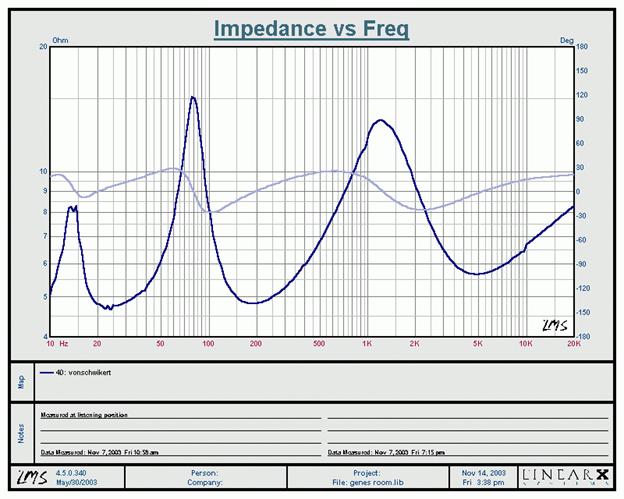
Performance Curves of VR-1
Dark Blue - Impedance Curve: Min impedance is about 4.75 ohms between 150-200 Hz, with a peak of 15 ohms at 70 Hz (around the bass limits of the speaker). Due to the relatively small port and low tuning frequency of around 30 HZ , there is really no usable/audible contribution from the port. Instead, the port acts to limit driver excursion at very low frequencies and increase dynamic range of the speaker. The rising impedance of the speaker starting at around 7kHz exhibits inductive loading.
Light Blue - Electrical Phase Plot: The VR-1 bookshelf speakers have good phase response as indicated by ± 30 degree window it maintains within the entire audio spectrum above 70 Hz. In addition the moderately high sensitivity (89dB SPL @1 watt/meter) and lowest impedance dip of 4.75 ohms indicates pretty much any decent solid state amp should be able to drive these speakers without incident. However, we suspect an amplifier with the lowest possible output impedance would be beneficial due to the reactive nature of the impedance curve to minimize any possible frequency variations.

VR-1 Near Field Frequency Response
|
|
|
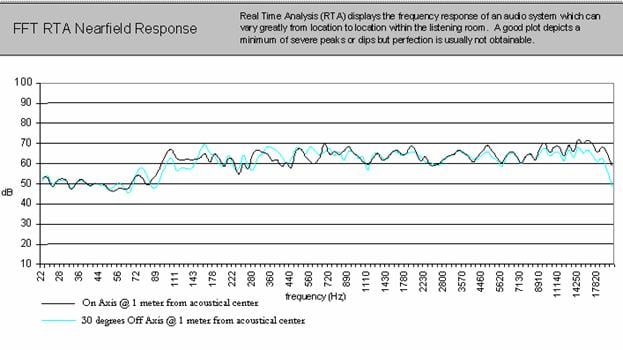
The VR-1 bookshelf's (or Reference Studio Monitors as the Manufacturer classifies them) were placed on 30" stands at least 6 feet away from all walls in a well damped room with carpeted floors and flat ceilings. The on axis response (black) indicated a slight emphasis on high frequencies above 10 kHz. The 30 degree off axis response (cyan) helped to smooth the overall response of the speaker indicating that this speaker may perform better with minimal toe in, especially in lively rooms. |
VR-1 Conclusion
VR-1
Reference Studio Monitors Simbilance
The
identical Von Schweikert designed tweeter was implemented
in the VR-1's, VR-2's and LCR-15, thus assuring a
seamless soundstage from each channel. The very first
thing we listened to in these speakers (or any for
that matter), was the simbilance of the tweeter. We
auditioned the speakers with countless familiar tracks
to determine how the tweeter reproduced vocals and
instruments. After four months, our first impression
proved to be the same as our last. The tweeters found
in these speakers surpassed our expectations. They
were never lispy or harsh and reproduced high frequencies
very accurately and transparently. In fact to our
amazement, the tweeter performed similarly as a Vifa
silk dome tweeter we are familiar with in many other
products, but with perhaps even a bit more detail.
VR-1
Reference Studio Monitors as Bookshelf's - No Subwoofer
The VR-1's
may be the perfect speaker for a bookshelf, especially
in smaller home theater rooms, for several reasons.
Size, beauty (especially in African Hazelwood), and
performance. These speakers provided accurate, tight
bass to around 70-Hz, with some audible lower frequencies.
The mid-range and high frequency was full and lively,
and the speakers were easy to drive, thereby making
them ideal for smaller amplifier applications such
as a midfi integrated amp or receiver. However, don't
be afraid to drive these babies with top notch electronics
as they will likely squeeze out all of the potential
and happily welcome more power.
VR-1
Reference Studio Monitors as Bookshelf's - With the
VRS-1 Subwoofer
Coupling
the VR-1's with the Von Schweikert VR-S/1 subwoofer
proved to be equally as pleasing as the sub added
dynamics and tight low frequency bass extension in
a region where the VR-1's were unable to deliver.
Once again, this petite subwoofer was perfect for
a small home theater room application where cabinet
size may be more important along with beauty, price
and performance.
|
|
VR-S/1 Subwoofer - Review Pending • 10" Extreme Duty Driver • 300-Watt continuous power amplifier • Compact Size - 11"W x 16"D x 13"H (includes heat sink and spikes) |

VR-1 Reference Studio Monitors as Main Surrounds and Back Surrounds
We also audition the VR-1's as surrounds on Reference System 1, which allowed us an opportunity to gain an in depth understanding on their performance. As much of the information from surrounds is mid to high frequencies, especially for those who chose "small" for the default settings, the VR-1's were well equipped for the task. The build quality of the tweeter and mid-range imparted itself on the performance in which the VR-1's reproduced accurate, clear surround information as both main surround (Dolby Digital 5.1) and back surround (Dolby Digital 7.1-EX) applications.
Conclusion
The build quality of the Von Schweikert Audio VR-1 Reference Studio Monitors were well noted and commendable. The VR-1's incorporated quality drivers and electronics coupled with beautiful veneers and craftsmanship. These speakers provided notable performance as bookshelf speakers, and surrounds, thereby making them a great choice for bookshelf speakers which can be used as surrounds or mains (coupled with a subwoofer). Perhaps the most memorable qualities of these speakers are their warm and intimate tonal balance, and superbly airy, but not sibilant highs. They have a very natural sound quality to them that befits their level of craftsmanship and should certainly be on your audition list if a high quality bookshelf speaker is what you are looking for.
The Score Card
The scoring below is based on each piece of equipment doing the duty it is designed for. The numbers are weighed heavily with respect to the individual cost of each unit, thus giving a rating roughly equal to:
Performance × Price Factor/Value = Rating
Audioholics.com note: The ratings indicated below are based on subjective listening and objective testing of the product in question. The rating scale is based on performance/value ratio. If you notice better performing products in future reviews that have lower numbers in certain areas, be aware that the value factor is most likely the culprit. Other Audioholics reviewers may rate products solely based on performance, and each reviewer has his/her own system for ratings.
Audioholics Rating Scale
 — Excellent
- — Very Good
- — Good
- — Fair
- — Poor
| Metric | Rating |
|---|---|
| Build Quality | |
| Appearance | |
| Treble Extension | |
| Treble Smoothness | |
| Midrange Accuracy | |
| Bass Extension | |
| Bass Accuracy | |
| Imaging | |
| Soundstage | |
| Dynamic Range | |
| Performance | |
| Value | |
 Subscribe to our newsletter