


Usher Audio Be-718 Tiny Dancer Speaker Review
- Product Name: Usher Audio Be-718 Tiny Dancer Speaker
- Manufacturer: Usher Audio USA
- Performance Rating:


- Value Rating:
- Review Date: December 02, 2007 19:00
- MSRP: $ 2795/pr
System Type 2-Way
Tweeter 1.25-inch
Be Beryllium (9980-20BEA)
Midbass 7-inch
Paper Cone (8948A)
Sensitivity 87
dB @ 1 watt / 1m
Nominal impedance 8
ohms
Frequency
response (-3 dB) 42 Hz ~ 35 kHz
Power handling 80
watts
Crossover
frequencies 2.06 kHz
Weight 37.9
lbs each
Dimensions (w x d x h) 10.2"
x 16.9" x 15.2"
Shipping weight 82
lbs
Pros
- Surprising bass extension
- Warm midrange
- Not afraid of a little extra power
Cons
- Can make some challenging audio passages harsh sounding
- Binding posts can be a bit tricky
Be-718 Build Quality
Okay, I admit it; my first impression of the Tiny Dancers was slightly altered because of a simple mistake in my part. As it happens, that alteration was in the positive for these diminutive yet substantial speakers. I had set my receiver to 2 channel stereo mode, which happens to add subwoofer out to the signal, which obviously colored my first impression because of this nearly miraculous bass that these little dynamo’s were producing. A couple evenings later I began to suspect that this type of low frequency response was a bit too substantial, I dug into my B&K receivers menu to realize I was indeed using “2 channel stereo” mode, instead of “LtRt” mode, which is in fact exactly what it implies, pushing all power strictly to the 2 speakers in those positions. Do you want to know what the most impressive part about these speakers is, now that I’ve discovered my own mistake? They don’t (necessarily) need a sub to impart a realistic amount of low frequency effects into a stereo presentation. As a matter of fact, as I write this passage, I have a the Blue Man Group blasting directly beneath me on the floor below. While I am testing the system at THX Reference Level to see how they handle a lot of power over a long period of time (call it the ‘stress test’ if you will), I wouldn’t expect to feel as much of the song now most famous for being the Pentium 4 theme song to be so resonant as it vibrates through the legs of my chair, each note unobscured by the fine American craftsmanship of my 51 year old Midwestern house’s construction. The resilient intonations of their ‘tubulum’ and ‘drumbone’ instruments resonating through every chamber and crevice of this well established old home. Needless to say, the original builder had never thought such an acoustic assault to be possible, but not only is the house holding up, so are these remarkable little speakers. Is that to say that they are without fault acoustically? Well, they obviously handle a lot of power with aplomb, and I’d go so far as to say the power handling capability as rated by the manufacturer is very conservative. Passages with a sense of depth are deftly grasped by these not insubstantial instruments.
Build Quality
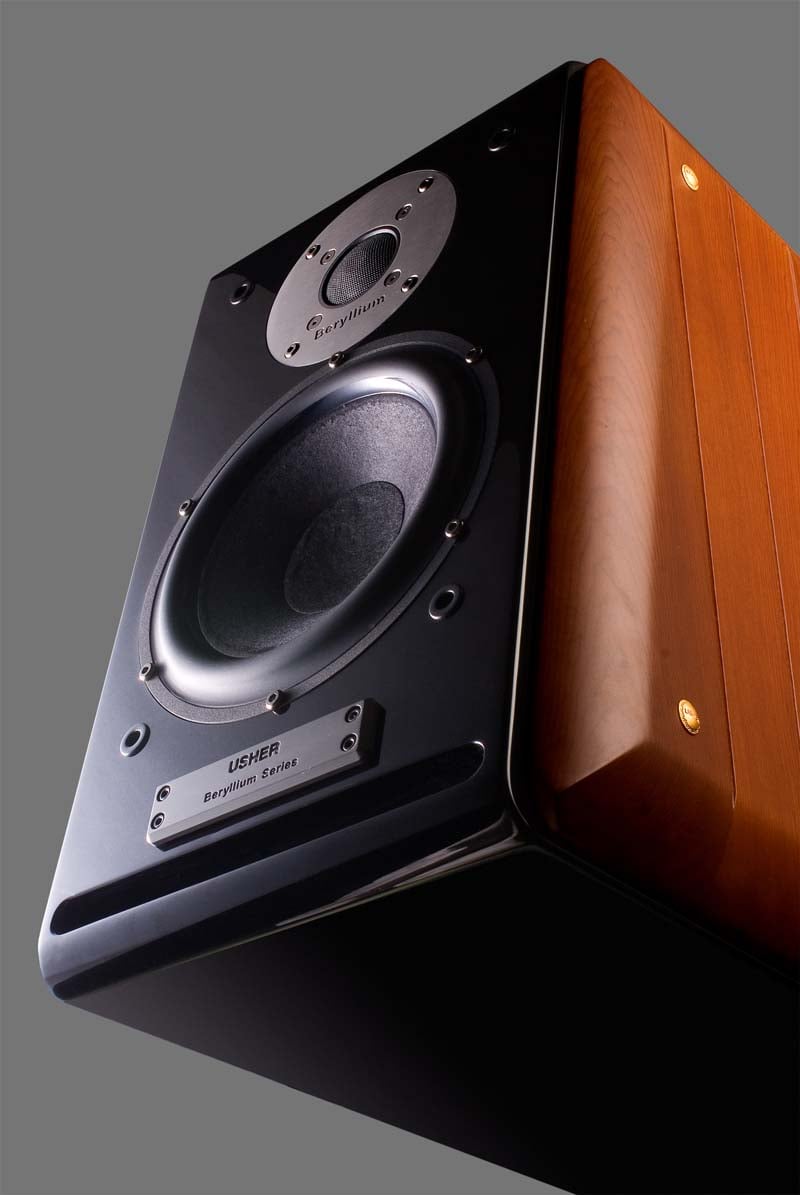
Imitation, so the saying goes, is the sincerest form of flattery. That being said, these speakers don’t necessarily fall into the category of unflattering ne’er-do-well trading on a more familiar name. While the Be-718’s from well established (if not well known) manufacturer Usher (no relation) are nothing short of breathtaking to behold, the design is far from fresh. Having been in consumer electronics sales for many years, there have been a few standout brands for not only visual quality, but construction and audio fidelity as well. One of those brands is Italian made Sonus Faber, with visionary designer and founder Franco Serblin steering the high end manufacturer in new and exciting directions. Sonus Faber is without a doubt the brand that has most affected me as a listener and consumer of music and it is this fine pedigree that I use to compare the Tiny Dancer’s against. Those of you familiar with the former’s name and reputation will know that this is high praise, but it is not without reason. First and foremost, when unboxing the Usher’s, and removing the almost silky smooth jersey material they are wrapped in, the look was unmistakably a tribute to the Sonus Faber Concertino, from the brass buttons on the exquisite wood sides, to the name of the speakers embossed into a plaque on the front panel, the look is one of distinguished elegance, but not truly original. The weight and construction quality feel similar, though the materials prove to be more approachable than the rare woods and impossibly expensive finishes of the Concertino’s, without ever feeling under-built or cheap. Granted the speaker/tweeter and port layout is distinctly Usher, and the performance of these speakers is unique from that of their Italian stable mate. That’s not a bad thing as you will see in the depths of this review though, as the flattery does extend to some degree into the listening experience.
The
Woofer
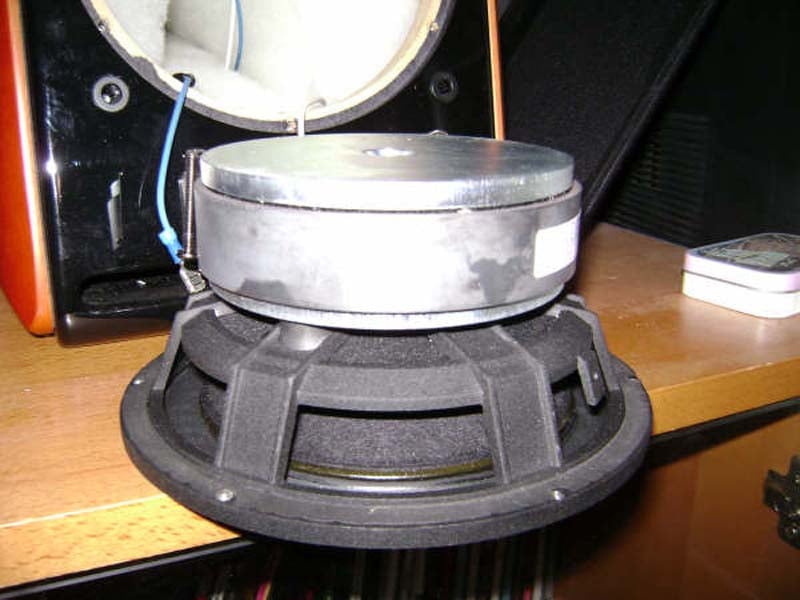
In removing the drivers to examine them in greater detail, it was made perfectly clear that these Tiny Dancers are not to be taken lightly. From the massive magnet and cast basket construction of the woofer to the uniquely capable beryllium tweeters, this is an acoustic package out to impress.
Looking every bit the part of a natural pulp paper cone again strikingly similar to the above mentioned Concertino’s, the 7” cone’s light weight and sublime rubber surround made for spectacular transient response in the low and midrange frequencies. The cast basket and extremely large magnet mean these speakers are not particularly efficient, but when fed with adequate clean power, you are rewarded appropriately. One thing that I did find rather surprising in my examination of the driver was the conspicuous absence of a bucking magnet to shield these speakers against magnetic interference on CRT televisions. Call me old school, but my stereo listening room has my older tube TV in it because it’s strictly for 2 channel audio, and I don’t watch videos in there at all. Once I replaced the woofers and began positioning the speakers, it was obvious that I needed to widen my speaker placement by an additional 8 inches per speaker to counter the magnetic interference my TV was suffering.
The
Tweeter
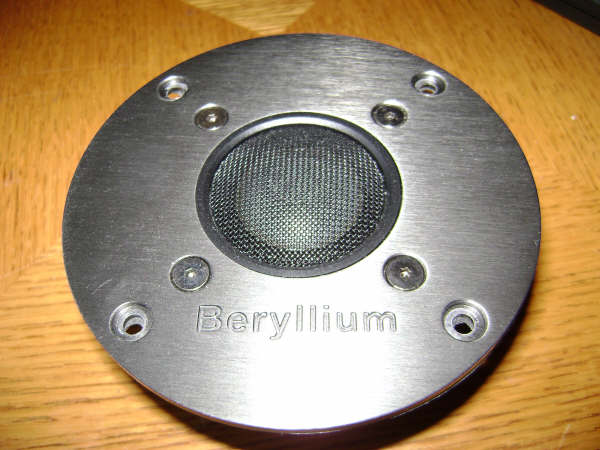
Truly where the Be-718’s begin to shine and stand out from underneath the specter of being considered an imitator. The unique way in which the Beryllium is applied to the dome and the massive size of the magnet for the tweeter makes me think that if I put it in a tube with a trigger I could sonically dismantle an Abrams tank at a thousand paces. This is a big tweeter and boy oh boy can it really belt out some sound! Once properly placed in my room (wider than usual because of the lack of magnetic shielding) and simply running some test cd’s and frequency sweeps through the system, I seemed to be hearing frequencies higher up the spectrum than I recall hearing before. I am sure it’s more perception than reality, but it seems that particular tones I thought I’d lost the ability to hear were clear and present with these speakers, and it is the fault of my previous speakers that I’d been missing these transient notes at the crossover point between the woofer and tweeter. What a pleasant and yet disappointing revelation that is, and all this time I thought my current speakers were some of the most dynamic I had ever owned, but this Beryllium tweeter proved me wrong.
The
Crossover
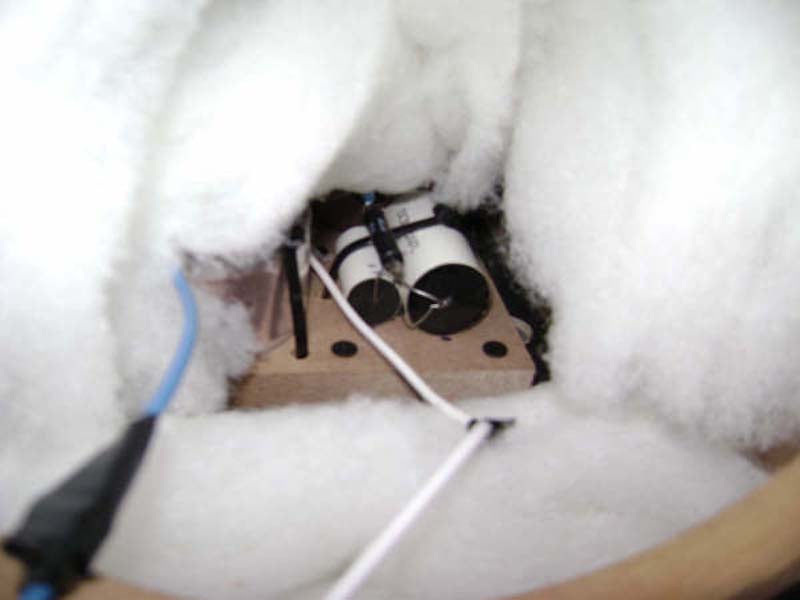
Accessing the crossover was no simple task as it was fixed to the inside of the cabinet so getting a clean shot for this article was not in the cards, but needless to say this crossover network is well thought out and even better tuned. As stated directly on the Usher website “Dr. Joseph D'Appolito, Usher's long-serving technical consultant, provides crossover tuning here in the 'States. Crossover parts and JPS Labs internal wiring are made in the USA. Design wizard Danny Richie, of Texas based GR-Research, boosts the stock crossover's performance to unprecedented levels by selecting premium crossover parts, altering parts values, re-tuning baffle step compensation and smoothing out the speaker's vertical off axis response.” That retuned crossover features all new/upgraded parts as follows: {Erse high-purity oxygen free copper air-core inductors; Mills resistors; Sonicaps; Erse poly caps; and Gen.2 Sonicaps}.
What does all this mean to you and me? How about a smoother performance for most music styles than I’ve ever experienced. It is absolutely remarkable how the crossover almost never belies the crossover point audibly, a true testament to Dr. D’Appolito’s continued and unrivalled brilliance in the world of acoustics.
The
Backside
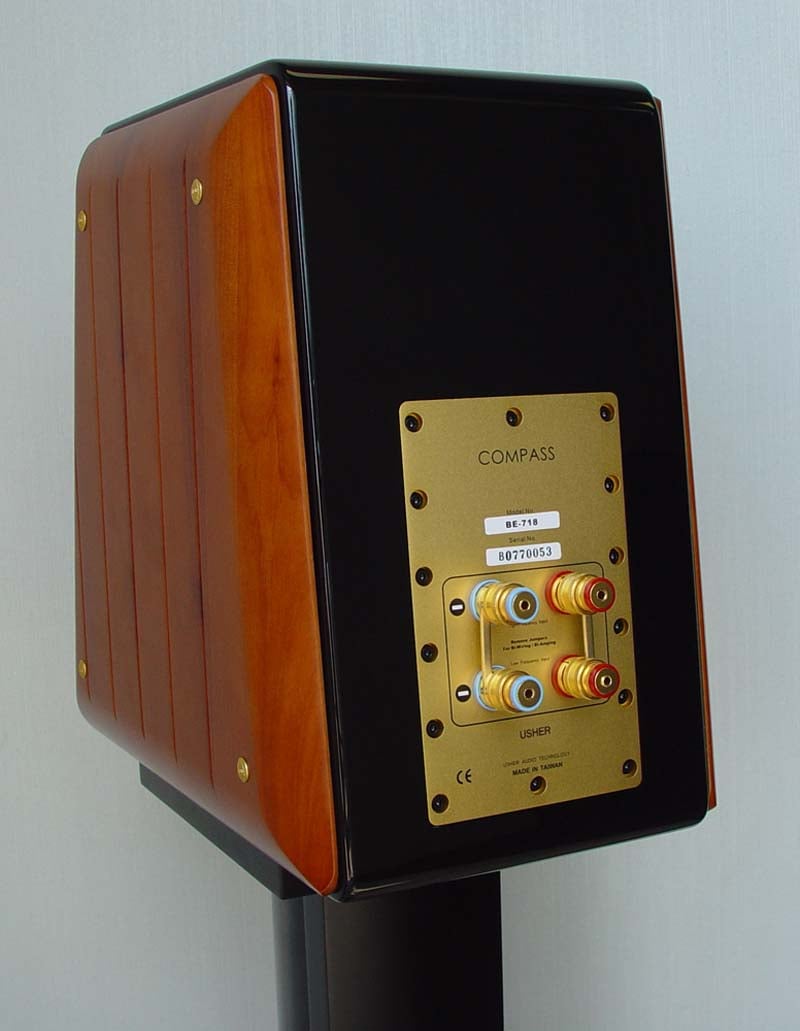
The Be-718’s have a full featured, and some may even say intimidating back panel. The dual 5-way binding posts and optional jumpers make it easy to connect as either a single wire or bi-wire connection. The binding posts are very heavily knurled with a coarse nut that attaches directly to bare speaker wire, and a finer threaded nut behind that which locks the larger one into place. The difficulty I came across is that my Audioquest wire is 4 solid copper conductors rather than dozens of finer strands, and I never felt that the binding posts had clamped onto my wire like they should have, which meant I never felt certain that my speaker cables were firmly locked in place. This was fleshed out one night when one of my speaker wires simply fell out of the binding post. A simple fix, and a recommendation for anyone with solid core wire, would be to attach banana connectors to your cable and simply insert them into the end of the binding post instead.
Being that my wire is 4 strands, it allows me to single bi-wire the speakers fairly effortlessly and the surprising thing is that the difference between straight wiring and single bi-wire was less significant than I expected. Once properly setup I began listening to several passages wired both ways, and the most notable difference was a minute sense of increased depth of the soundstage. I attribute this in large portion to the cabinet and crossover designs. With a cabinet designed to negate standing waves, and a brilliantly engineered crossover, the benefits of single bi-wiring these speakers is subtle at best.
Be-718 Setup and Listening Tests
Setting these speakers on my height adjustable stands I put the center of the woofers at 28 inches high which when accounting for the slight angle the front panel is placed at, opened the soundstage up significantly over the 30 inches I had originally set them up at that made them sound like they were almost talking above my head so to speak. This height also meant that the tweeter was more accurately placed in relation to my listening position, further expanding the soundstage. I placed the speakers 4.5 feet out from the front wall, 4 feet from the left and 5 feet from the right outside walls of the room, which was about 16-18 inches wider than I normally would for ideal placement in my small room. The reason being my display in that room is an old 36 inch Sony XBR CRT TV, and it’s mighty sensitive to magnetic interference so I spanned the speakers out far enough to prevent any problems.
Once placement in the room had been determined I began with the speakers parallel to each other and listened to several reference passages from some of the artists below to get an idea of the ideal position for both soundstage depth and tonal accuracy. Working in 2-3 degree increments, I found the ideal toe in for the speakers to be between 9 and 11 degrees from parallel. Once that magic range had been reached, I was taken aback by the sheer volume of space that the speakers gave to most of my favorite recordings. They opened up some of my music as if the artists had just been released from singing behind a curtain, with greater attention to detail than any bookshelf I’ve yet tried. The picture isn’t all rosy and pure however, as you will read in the listening tests below. They can make brassy vocals and some large ensemble band passages sound harsh and unpleasant, but that is more the exception than the rule.
Listening Tests
Fleming
and John – The Way We Are
Let it be known that I find there to be something eternally gratifying in love being expressed through music. The married couple of Fleming McWilliams and John Mark Painter aren’t afraid to air their affection and trepidation in ways that are uniquely musical and heartfelt without being kitschy or obvious. Their stripped down style gets at the very heart of the matter with brilliant guitar work and unique supporting instruments such as a rain stick occasionally added by Fleming, they approach music with a unique ear for expressing emotion through music.
Track # 11, Rain All Day - is a very simple arrangement with Fleming lilting ethereally as if in a distant place with a hollow sound to her vocals right from the start of the track, this early introduction to the song pointed out the incredible way the speakers were able to deliver depth and presence to something that other speakers almost treat as gossamer and too delicate to truly represent fully. This initial fawning sensation was quickly tempered however when her vocals, already brassy and some may say unrefined, came across as being more harsh, even grating, than I had ever experienced before, including the two times I’ve seen them live. I would attribute this to the fact that her voice comes at a range that puts it squarely between where the tweeter crosses down to the main driver, taxing both of them equally, and never giving sway to either in order to soften the presentation. Track # 9 – Ugly Girl – Which was co-written by Ben Folds, gives the speakers much less of a vocal conundrum to try and work out, and as a result I was once again taken into the incredible depth of imaging with Fleming nearly dead center, and the distinctly affected guitar of John deeper in the soundstage without being distinctly to one side or the other.
Blue
Man Group – Audio (DVD-Audio)
With the now immortalized “Drumbone” better known as “The Pentium 4 Song” now thoroughly imprinted on the psyche of every music lover and computer user around, these unique creations of performance art and music are ingrained in our popular culture through the creation of one of a kind instruments made of PVC pipe and piano’s turned on end. The percussive assault their music can offer is a true challenge to any bookshelf that wants to reproduce deep bass without running out of breath.
Track # 10 – Drumbone – Using the instrument that gives the song its name, a series of pipes ranging from 4” down to about 2” with sliding appendages used to affect the tone, nearly the entire song is played using only this one instrument which requires all three “men” to operate. It truly isn’t a test of imaging, but the quality with which it is recorded and the frequencies that the instrument can produce make a unique test bed for any speaker, and the Tiny Dancer’s were up to the challenge. As mentioned above, I originally had setup my receiver to include the subwoofer in 2 channel reproduction, and my impression of the speakers was one of jaw dropping depth and remarkable recovery time between notes until I noticed a paper I had dropped was rattling in front of the port of my sub, which gave me the pause necessary to readjust the system and listen to the song again. I came away even more impressed if that’s possible, due to the fact that while I didn’t have that sternum vibration produced by the subwoofer, I instead had spine tingles as the instrument seemed to become more musical and less magical. Individual strikes of the Drumbone with drumsticks became a report of their own, and the way the sound was pushed ever so gently outward without being “in your face” brought a smile to my face. I also used this as my break-in song to flex the woofer for about 8 hours and truly let the surrounds settle in. I did this at THX reference level (0db on my receiver) while out running errands, and in the time it took to me to return there was an audible improvement in their ability to produce the more impressively low tones of these unique percussionists.
Jack
Johnson – In Between Dreams and Brushfire Fairytales
“Hi, I’m Jack Johnson, and I like to keep things real mellow” as a friend of mine recently remarked in a mocking tone while we were driving and listening to this album in my car. His idea of mellow by comparison is Ween, so we are on two different planets in that regard. It did bring to my attention however, the fact that Jack Johnson is my choice when I just want to imagine myself under clear blue skies with a light salty breeze blowing across my sand encrusted toes while sipping daiquiri’s from a refrigerated cement mixer. That being said, I took the time to “mellow” and truly examine the artistry of this Hawaiian surf rock master.
Track # 12 – Belle - from In Between Dreams: It’s almost an interlude rather than a song, and quite simply JJ and his Guitar well mic’d and dead center stage. As near as my middle school language lessons can tell me it’s simply “Hey Beautiful” in a variety of the “romance languages”. It is however extremely expressive and the acoustic guitar has resonant tones that these speakers are more capable than most at being able to reproduce. There are other speakers that have made a greater impression on me in this short song, but at less than half the price, the difference is far from dramatic. Track # 6 – Sitting, Waiting, Wishing – from In Between Dreams: For some reason, his voice came across in more of a baritone in this track than I had remembered hearing him before. Is this a function of the speakers, the recording, my room? I can’t honestly say, but what I can say is the short and sharp percussive stabs on the simple drum kit firmly staged behind Jack in this passage have felt more muted and less a part of the ensemble than with the Tiny Dancer’s. Each strike of the drum elicited a fresh sizzle from the snares which faded in time to let the next beat sound distinctly separate from the former. Other speakers have made the drums feel like a tacked on addition rather than an instrument that’s a true part of the song. Track # 2 – Middle Man – from Brushfire Fairytales: The hollow rim shot of the percussion in this song which seems almost to emanate from everywhere and yet still has a presence in the soundstage while the simple arrangement gives crystal clarity to his voice which seems just slightly left of the center of the soundstage. I truly felt as if I was being transported into the environment of the studio with this track, and the depth of that illusion was most certainly the result of the combination of cabinet, crossover, and creativity that has made these small speakers a welcome, if temporary, addition to my listening environment.
Be-718 Conclusion
 If you are on the
market for a dynamic pair of compact speakers with a high Spouse Acceptance
Factor (SAF), dynamic audio performance on par with speakers twice their price,
and an ability to create a sound image nearly on par with full sized speakers,
than I urge you to consider these speakers seriously. They are
not perfect mind you, as they do tend toward harshness in challenging
audio passages that straddle the crossover point possibly making some female
vocalists sound almost over mic’d or poorly mixed. That sensation was mostly fleeting however as
only certain passages exhibited this behavior, and only for brief durations. On the upside, they are gorgeous, with the
piano gloss center section and beautiful wood side panels, and would be right
at home in a medium sized den with a tube amplifier softening that hard edge
while sipping a 20 year old brandy.
While I am a single man, every one of my lady friends remarked at the
wonderful addition the speakers made in my warmly colored listening room, and
with my full towers tucked in the back corners of the room during the review,
an immediate comparison was made that earned the Be-718’s the enviable nickname
“Mighty Mites” because of their significantly smaller size and equal or
superior performance to my reference speakers.
The only additional investment I would recommend is a subwoofer that can
extend down below 35Hz, just to bolster the substantial but not earth
shattering bass response. The one other
issue I would like to draw attention to, and it’s a minor one, Piano
Gloss Black shows very quickly how often you dust in your listening room! I am an obsessive swiffer’er and if I was out
for a day or two, it appeared as though the top of the speakers was a vaguely
grayish and dull shade of black instead of the rich deep gloss I had known
prior. While it’s not a nit I’d normally
pick, I had to find something else to say to bring balance to the
overwhelmingly positive experience I’ve had with these miniscule
minueters!
If you are on the
market for a dynamic pair of compact speakers with a high Spouse Acceptance
Factor (SAF), dynamic audio performance on par with speakers twice their price,
and an ability to create a sound image nearly on par with full sized speakers,
than I urge you to consider these speakers seriously. They are
not perfect mind you, as they do tend toward harshness in challenging
audio passages that straddle the crossover point possibly making some female
vocalists sound almost over mic’d or poorly mixed. That sensation was mostly fleeting however as
only certain passages exhibited this behavior, and only for brief durations. On the upside, they are gorgeous, with the
piano gloss center section and beautiful wood side panels, and would be right
at home in a medium sized den with a tube amplifier softening that hard edge
while sipping a 20 year old brandy.
While I am a single man, every one of my lady friends remarked at the
wonderful addition the speakers made in my warmly colored listening room, and
with my full towers tucked in the back corners of the room during the review,
an immediate comparison was made that earned the Be-718’s the enviable nickname
“Mighty Mites” because of their significantly smaller size and equal or
superior performance to my reference speakers.
The only additional investment I would recommend is a subwoofer that can
extend down below 35Hz, just to bolster the substantial but not earth
shattering bass response. The one other
issue I would like to draw attention to, and it’s a minor one, Piano
Gloss Black shows very quickly how often you dust in your listening room! I am an obsessive swiffer’er and if I was out
for a day or two, it appeared as though the top of the speakers was a vaguely
grayish and dull shade of black instead of the rich deep gloss I had known
prior. While it’s not a nit I’d normally
pick, I had to find something else to say to bring balance to the
overwhelmingly positive experience I’ve had with these miniscule
minueters!
The Be-718 Tiny Dancer’s are not without peer, as there are other bookshelves, not the least of which is the aforementioned Concertino’s, and even some floor standing speakers that perform admirably at or near this price point, but the combination of sturdy construction, excellent engineering, innovative tweeter design and implementation, and performance per dollar spent put these substantial sound boxes into the “if this is your price range, put these on your short list of speakers to audition” checkbox. It was truly my pleasure to review these speakers and I hope that in some small way I’ve helped you if you’re in the market for a highly capable pair of speakers with décor friendly appeal, and musicality nearly beyond reproach.
Usher Audio
Usher Audio BE-718 Bookshelf Speaker System $2,795/pair
http://www.usheraudiousa.com/
Phone: 214.638.3500 or 214.704.6082
Fax: 214.722.0325
E-mail: info@musikmatters.com
Address: 1303 Motor Street,
Dallas, Texas 75207
The Score Card
The scoring below is based on each piece of equipment doing the duty it is designed for. The numbers are weighed heavily with respect to the individual cost of each unit, thus giving a rating roughly equal to:
Performance × Price Factor/Value = Rating
Audioholics.com note: The ratings indicated below are based on subjective listening and objective testing of the product in question. The rating scale is based on performance/value ratio. If you notice better performing products in future reviews that have lower numbers in certain areas, be aware that the value factor is most likely the culprit. Other Audioholics reviewers may rate products solely based on performance, and each reviewer has his/her own system for ratings.
Audioholics Rating Scale
 — Excellent
- — Very Good
- — Good
- — Fair
- — Poor
| Metric | Rating |
|---|---|
| Build Quality | |
| Appearance | |
| Treble Extension | |
| Treble Smoothness | |
| Midrange Accuracy | |
| Bass Extension | |
| Bass Accuracy | |
| Dynamic Range | |
| Performance |  |
| Value | |
Tony is our resident expert for lifestyle and wireless products including soundbars. He does most of the reviews for wireless and streaming loudspeakers and often compares soundbars in round ups and helps us cover the trade shows.
View full profile Subscribe to our newsletter