


Triad Gold MiniMonitor Loudspeaker Review
triadgoldmini1
- Product Name: Gold MiniMonitor Loudspeaker
- Manufacturer: Triad Speakers, inc.
- Performance Rating:

- Value Rating:
- Review Date: December 12, 2004 19:00
- MSRP: $ 3,400 per pair black ($4,000 per pair in premium veneers)
|
Drive Units: |
Cabinet Dimensions: Triad
Finishes |
Pros
- Superb Imaging
- Excellent WAF based on size
- Outstanding build quality cabinets
- Choice selection of drivers
- Small size with big sound
- Seamless performance with Triad InRoom Gold PowerSub
- Dynamic soundstage
- 10 year warranty
Cons
- Front grills are fragile
- Basic box shape
- On the Expensive Side
- Require going through dealer and rep to purchase
Triad Minimonitors Company Information and Cabinet Design
Triad Speakers is located in Portland, Oregon, home of some of the best microbrewery beers in the US. Nestled between the numerous quality breweries, tucked away very close to downtown Portland
is the home of a speaker manufacturer who applies craftsmanship and
exceptional build quality to every speaker they make. Perhaps one of
Triad’s most redeeming qualifications is that they do not covet their
drivers with implied origins but instead proudly list the actual
manufacturers and model numbers. Their educated selections of quality
midranges, woofers and tweeters range from companies such as Scan
Speak, Seas and Peerless just to mention a few. Triad integrates
theses drivers into a crafted, tightly fabricated well braced cabinet for ample rigidity and optimum performance with numerous finishes including a special color match option.
|
|
|


Acoustic Suspension Cabinet Design
Triad boasts an acoustic suspension design which upon quick examination we found most intriguing. I have to say that the Triad InRoom Gold MiniMonitors remain as one of the few speakers that I actually felt guilty about dissecting. As I carefully began the process of removing the mounting screws from the mid-range and tweeter I could hear the faint sound of the gasket seal de-bonding from the driver/cabinet. Triad employed careful techniques to reduce any potential air leaks behind the drivers by forming a tight face seal. I also noticed that the mounting screws had a higher than average torque and once removed I discovered that the rim of the driver was actually being used to compress the gasket. Creating such a compressive force in an MDF cabinet requires using metal inserts and machine screws. Triad was sure to implement this costly but beneficial method in their acoustically suspended cabinet in order to ensure sufficient loading on the gasket.
Triad Cabinet Construction


The InRoom Gold MiniMonitor drivers and dampening material were enclosed in a well braced 1 ¼" thick MDF cabinet that was skillfully manufactured on precision CNC machines and hand assembled. Once inside the cabinet I found internal bracing strategically placed in a complex array intertwined with two different dampening materials. The bottom of the cabinet and other strategic internal locations was home to a red, semi-rigid clay filled rubber. This rather costly acoustically dead material is known for its ability to significantly reduce cabinet resonance. To the casual listener, the benefit from this material may go unnoticed, but for the true audiophile seeking detail and nuances in their speakers, Triad implemented this enhancement. The second dampening material included white open cell foam packed throughout the cabinet. This open cell foam is used for both its acoustical and mechanical properties. Acoustically, it dampens reflections in the mid frequencies from hitting the cabinet sides, bouncing back and impinging on the rear of the speaker cone which can cause IMD . Mechanically, the material is more stable than poly-filled and will not settle or change shape over time thereby ensuring consistent performance over the life of the speaker.
The floating grill cloth grill was thin and
unobtrusive to the cabinet, but it was not meant to be removed often.
I found the framing of
the grill to be too thin and once I removed from the cabinet I became cautious on how I handled this
fragile assembly.
My guess is that the only people who actually remove grills from speakers are
those like me who conduct reviews.
So if you're not overly inquisitive and feel you don't need
to know what's behind the grill it shouldn't become a problem.
Drivers


It amazed me to fund such a stiff midrange/bass driver in an acoustically sealed cabinet as my intuition tells me that it would make the speaker extremely inefficient thereby requiring more power to drive them. My audition and subsequent measurements discussed later in this review proved that this was really not the case with the Triad InRoom Gold MiniMonitors. Triad's drivers of choice included the Seas 27-mm high definition pre-coated fabric dome 27TDFC tweeter and a Scan-Speak OEM supplied Revelator Mid/Woofer. The internal wiring was comprised of 14 AWG twisted pairs that were soldered to their appropriate driver similar to what we found in our review of the Canton Karat Reference 2DC Tower Loudspeakers.
Triad InRoom Gold MiniMonitor Setup
We began our audition of the Triad Gold MiniMonitors on an Onkyo TX-SR502 receiver. We then integrated them into Reference System 2 with our Parasound Halo A21 two channel Amplifier, Parasound Halo C 1 A/V Processor and Denon DVD-2900 Universal Player. On both systems, we auditioned the MiniMonitors with the front speakers set to "large" without the Triad InRoom Gold PowerSub and "small" with the PowerSub to compare the resulting performance.
Bookshelf - No PowerSub
I initially ran the Triads on the Onkyo receiver without the PowerSub and set to "large." At first, I had to verify that the PowerSub was actually turned off as the mid-bass performance seemed well above average for such a compact speaker. It became obvious that they were capable of providing invigorating, punchy tight bass well beyond other bookshelf speakers I have auditioned of similar size and shape. I was stunned with their performance on the modest Onkyo receiver but they truly had their shining moment when integrated in Reference System 2 on the Parasound Halo A21 amplifier and Parasound Halo C1 processor. I enjoyed several weeks entrenched in the delight of the MiniMonitors while I perused through most of my favorite CDs ranging from classic rock, new age, jazz and classical. Though it only took me a few CD titles to consider that the Gold MiniMonitors were an exceptional performing speaker.
Perhaps what I found most appealing about the Gold MiniMonitors was their bass response. With little power, they were able to produce ultra tight, radiant mid-bass down to what seemed to be 70 to 90 Hz. The mid-range met with equal splendor as guitars and bass were reproduced with intent and accuracy. The Triads had the edge over other high end bookshelf speakers I've auditioned when it comes to bass extension and slam. After listening to the Triad Minis in several different theater rooms I found the Seas tweeter implemented in the Triad design performed commendably. Vocals and cymbals resonated with brilliance while the deep mids and bass balanced the overall performance. After exhausting my CD library and test tracks, I decided to go through them all over again, but this time I added the Triad InRoom Gold PowerSub.
Triad InRoom PowerSub Review


Adding Triad's InRoom Gold PowerSub completed the sound stage of the MinMonitors
as it provided the remaining
bass that the bookshelf speakers
alone could not produce.
The
Triad InRoom Gold PowerSub implements
a
15" woofer
and
a
250 watt
amplifier in
large square cabinet.
Reverting to the "small" setting for the front
channel
and blending the PowerSub with
a
cutoff frequency of 80-Hz balanced everything out
and created
the
ambiance of
a
much
larger speaker system.
Once I
adjusted the PowerSub volume using my Sound-level Meter, I focused on
setting the phase correctly for the environment of
my
audition.
Triad made this job
much easier by including
avariable phase
adjustment on
the back of the sub.
I connected the PowerSub
two ways, the first being the
"Theater Input"
and the second being the "Left
and Right" inputs.
Left
&
right
channel inputs have volume controls for deep frequency extension,
and the mono "Theater Input" has
a
fixed gain
configured for highest output from 40 to 80 Hz.
If you
plan on using the speaker system for music
and movies, than the "Left
and Right" inputs may be the preferred choice.
Editorial Note
According to Triad, using the LEFT and RIGHT inputs, the response is EQ'ed almost flat to 20 Hz while the THEATER input is down 3 dB @ 35 Hz, and is not usually recommended.
It would have been nice if Triad had included speaker level inputs to appease the 2-channel audiophites who do not prefer or have line level input connectability. If I were to purchase these speakers as a part of a 2-channel analog stereo system I would likely have used the speaker level connections and PowerSubs internal crossover for my configuration.
My only adverse comment about the PowerSub is its overall size when utilized with the MiniMonitors. My feeling is that most people looking to purchase bookshelf speakers are doing it because of the Wife Acceptance Factor or a lack of room for floor standing tower speakers. That being the case, it's hard to justify the presence of a large cabinet PowerSub. But based on the soundstage created by the MiniMonitors and Gold Sub, it may be worth the sacrifice of aesthetics and real-estate in order to achieve sonic Nirvana.
Triad Mini Monitors Conclusion
The Triad Gold MiniMonitors and Gold PowerSub may have what some consider a simplistic exterior, but their complex interior and stunning performance make them an Olympic Contender in the bookshelf and PowerSub combination speaker market. Triad's philosophy for the Gold MiniMonitors and their other line of speakers is to focus on build quality, performance and craftsmanship of their products without hyping them with flashy aesthetics. This philosophy is the reason why Triad is so successful with dealers and custom installers who have customers that are looking to make a statement about the performance of their system, not necessarily aesthetic appeal.
When analyzing the speaker into the sum of its parts as we have done in this review, it helps to appreciate the MSRP of the Gold MiniMonitors at $3,400 per pair (in black) and the Gold PowerSub at $1,500 (in black). Triad's Bill-Of-Materials and Manufacturing Costs for these products help to justify their price especially when considering the stellar performance they produce. Keep in mind that several other speaker manufacturers utilize similar drivers such as the Scan Speak Revelator mid/woofer and Seas Tweeter in their designs however those companies also have a higher priced and not necessarily better performing products than Triad.
Triad has over 350 dealers throughout the US, but their website does not provide phone numbers or addresses. Their reasoning is that they want interested customers to contact via email a local Factory Representative. After initial consultation about the Triad products, the Factory Rep then directs a potential customer to an appropriate Dealer in their area where they can audition the products of interest. It is also important to note that Triad has multiple versions of all their products, including an InCeiling and an InWall version of the Gold MiniMonitor, for different applications. So you can enjoy their great sound regardless of physical room or installation constraints.
In some cases, the Dealer may not have the exact model in stock that the customer is looking for. In this instance, Triad can send the Dealer a product they have in stock for demonstration purposes. As with most custom speaker manufacturers, products are not always waiting on the shelf ready to be drop shipped upon order. Triad stocks no inventory of finished goods, and all products are made custom, in batch sizes of one. Standard orders ship to the dealer within three days. This creates a longer turnaround time for your speakers than going the typical commercial route however the advantage of purchasing an outstanding performance product such as these in a premium veneer or custom color that matches your furnishings should outweigh the wait time. Anticipation will only make you more appreciative of the final product once it arrives. While Triad's speakers may be a bit challenging to find initially, they are worth the research and effort to locate, audition and purchase if they are right for you.
Triad Speakers,
Inc.
www.triadspeakers.com
15835 NE Cameron Blvd.
Portland
,
Oregon
97230
(503) 256-2600 - Main Phone
(800) 666-6316 - Toll Free
(503) 256-5966 - Fax
Triad Gold MiniMonitor Measurements
Frequency Response
Curves
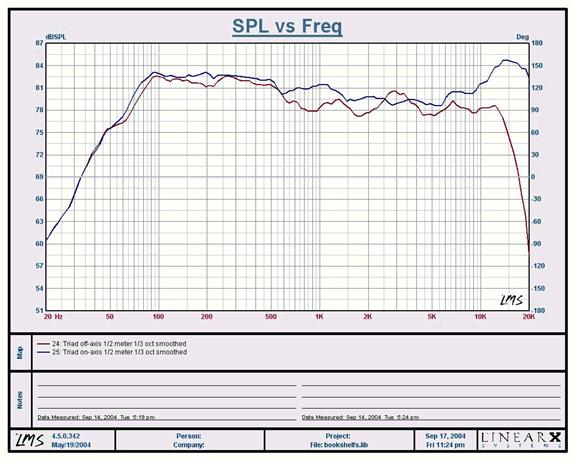
The Triads measured frequency response was fairly
smooth with a 1dB dip from 1kHz to 8kHz and an emphasis in high frequency response of 3dB from 10kHz to
about 20kHz.
Off axis frequency response was very smooth in the midrange.
We found the most
pleasing sound of these speakers was with a slight toe-in of about 15-20
degrees.
Impedance/Phase
Curves
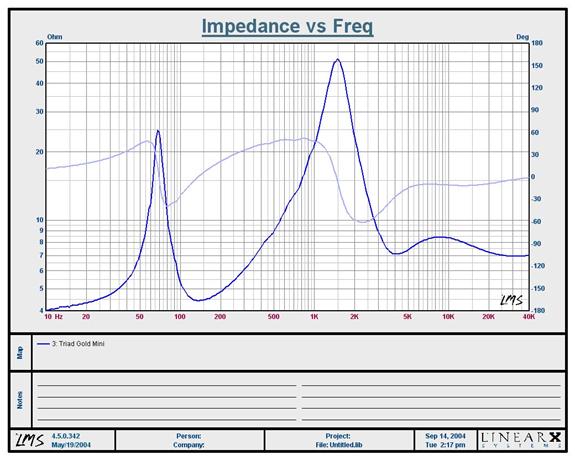
Given the moderately low efficiency of these
speakers (86dB @ 1wattmeter) and their 4 ohm impedance, we recommend powering them with a least a
100wpc amplifier in small to medium sized rooms.
The impedance curves indicate the usable bass
extension of these speakers based on the first impedance peak is about 55-60Hz.
Phase is kept
within a +45 to -60degree window which can be a bit more of a demand on a lesser designed
amplifier.
The Score Card
The scoring below is based on each piece of equipment doing the duty it is designed for. The numbers are weighed heavily with respect to the individual cost of each unit, thus giving a rating roughly equal to:
Performance × Price Factor/Value = Rating
Audioholics.com note: The ratings indicated below are based on subjective listening and objective testing of the product in question. The rating scale is based on performance/value ratio. If you notice better performing products in future reviews that have lower numbers in certain areas, be aware that the value factor is most likely the culprit. Other Audioholics reviewers may rate products solely based on performance, and each reviewer has his/her own system for ratings.
Audioholics Rating Scale
 — Excellent
- — Very Good
- — Good
- — Fair
- — Poor
| Metric | Rating |
|---|---|
| Performance | |
| Value | |
 Subscribe to our newsletter