


Thiel SCS4 Bookshelf Speaker Review
- Product Name: Thiel SCS4 Bookshelf Speaker
- Manufacturer: Thiel Loudspeakers
- Performance Rating:


- Value Rating:
- Review Date: January 28, 2009 15:45
- MSRP: $ 1980/pair
Frequency range: +/- 3 dB
47 Hz - 20 kHz
Sensitivity: (2.83V/1m) 87 dB
Nominal impedance: 4 ohms
Recommended amp power: 30– 200 watts
Crossover frequency: 2.5 kHz
Tweeter driver : 1” Aluminum Dome
Low frequency driver(s): 6
½” Aluminum/Polystyrene
Enclosure type: Vented
Connection input(s): Single Terminal
Pair
Recommended placement: Stand, shelf, on wall
Dimensions:
(H x W x D) 17.6”
H x 8.4” W x 10.8” D
Weight: 25
lbs/each
Finish: Black
Pros
- Good Sound Quality with very good midrange performance
- Can be oriented either horizontally or vertically without affecting dispersion or frequency response
- Very good bass extension for a small speaker
- Very smooth off axis response
- Minimum floor space necessary when used with stands
- Easy to move due to small size and weight
Cons
- Relatively low sensitivity (inherent in small box speakers)
- Must be elevated for best performance
- Can bottom out if overdriven
- Grille very difficult to remove
- Best performance slightly off center axis
Introduction
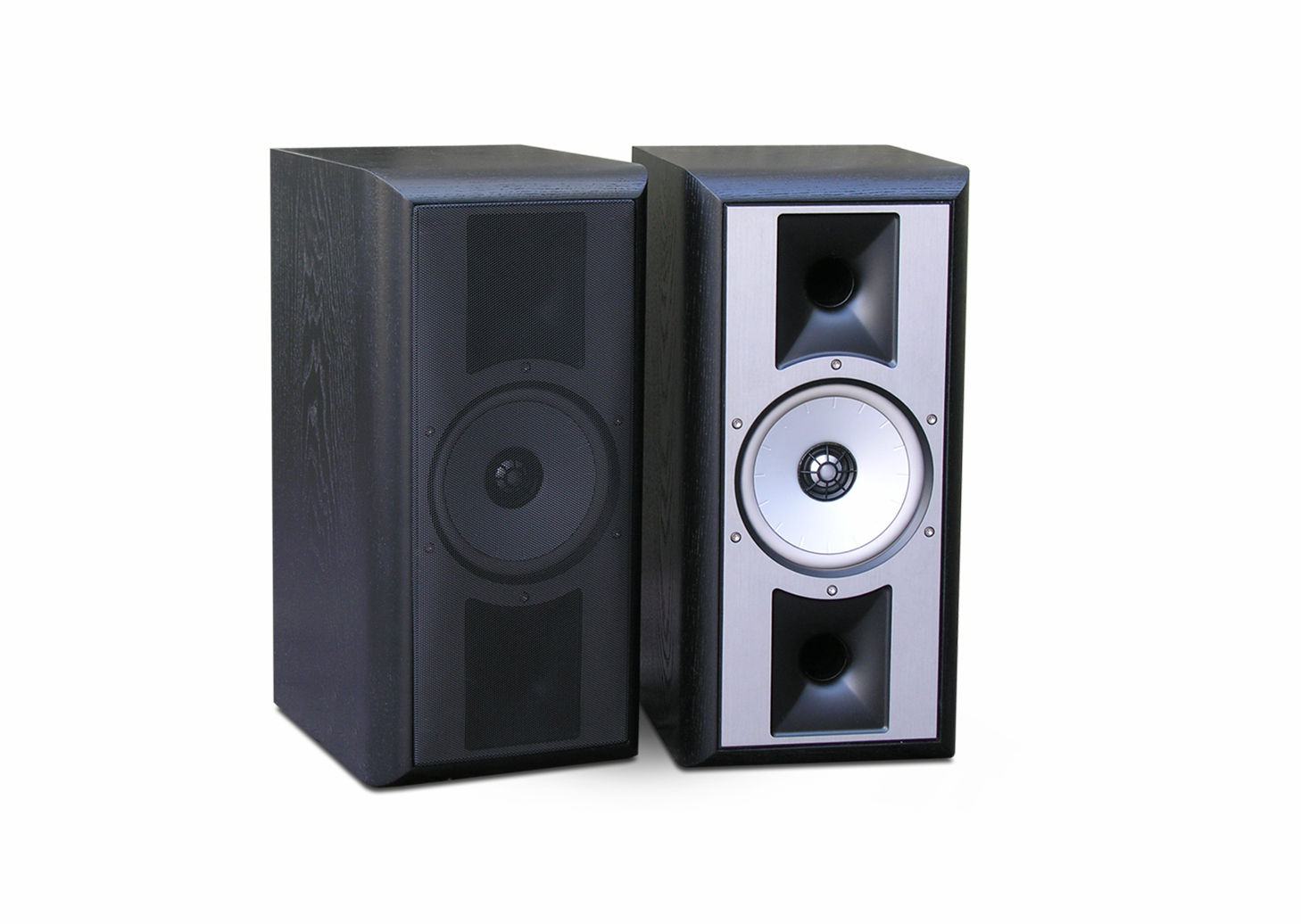 Anxious to
see when these speakers would arrive, I logged into the UPS
tracking website to find that I would be getting two packages, totaling 29
lbs. Imagine my surprise when only one
of the two packages (marked 2 of 2) was delivered! Apparently someone at UPS
thought I wanted one delivered and one left at the shipping hub! Given the
weight of the first package, I expected both speakers to be packed in there and
the second package to contain the speaker stands I requested for the
review. When UPS
brought the second package, I opened it
revealing a single 25 lb speaker. (One speaker per box, no stands.) If you do the math, I am not sure how we ship
two 25 lb speakers and get to a 29 lbs total weight, but then again, I would
probably crash if asked to drive a big brown van, so who am I to complain?
Anxious to
see when these speakers would arrive, I logged into the UPS
tracking website to find that I would be getting two packages, totaling 29
lbs. Imagine my surprise when only one
of the two packages (marked 2 of 2) was delivered! Apparently someone at UPS
thought I wanted one delivered and one left at the shipping hub! Given the
weight of the first package, I expected both speakers to be packed in there and
the second package to contain the speaker stands I requested for the
review. When UPS
brought the second package, I opened it
revealing a single 25 lb speaker. (One speaker per box, no stands.) If you do the math, I am not sure how we ship
two 25 lb speakers and get to a 29 lbs total weight, but then again, I would
probably crash if asked to drive a big brown van, so who am I to complain?
The Thiel SCS4 is too small to be a floor standing speaker, and although on the large size for a bookshelf speaker, it will fit on all but the very smallest bookshelves. It will also fit easily on a typical speaker stand, but my first listening was done with the speaker on the floor. This is not the preferred location for this speaker, and Thiel clearly states this in their manual. When my son came into my listening room hearing the speaker for the first time, he immediately proclaimed, “Wow, that has way too much mid-bass!” (Adam is the Golden Ear in the family). Even elevated, this speaker has a bit too much mid-bass for my liking, and placing it on the floor exacerbates this issue. If we examine the impedance magnitude curve of this speaker, and place this information over the frequency response, it is clear that the output of the speaker is highest where the power demand is highest, and the impedance magnitude is lowest. In my opinion this speaker will sound more natural when driven with a tube amp than with a transistor amp because of the higher output impedance of the tube amplifier compared to a transistor amp. “Fattening” the low frequency output in this region is an easy way for dramatic affect to be added to movie soundtracks, and is sometimes done by manufacturers to create ”the wow effect” in the untrained ears of potential end users. I do not believe that was Mr. Thiel's intent. After speaking to him by phone, I believe he is motivated to make the best most neutral speaker he can, as he is by himself the engineering department, and wants most of all to make something he himself would buy.
Coaxial Driver Pros and Cons
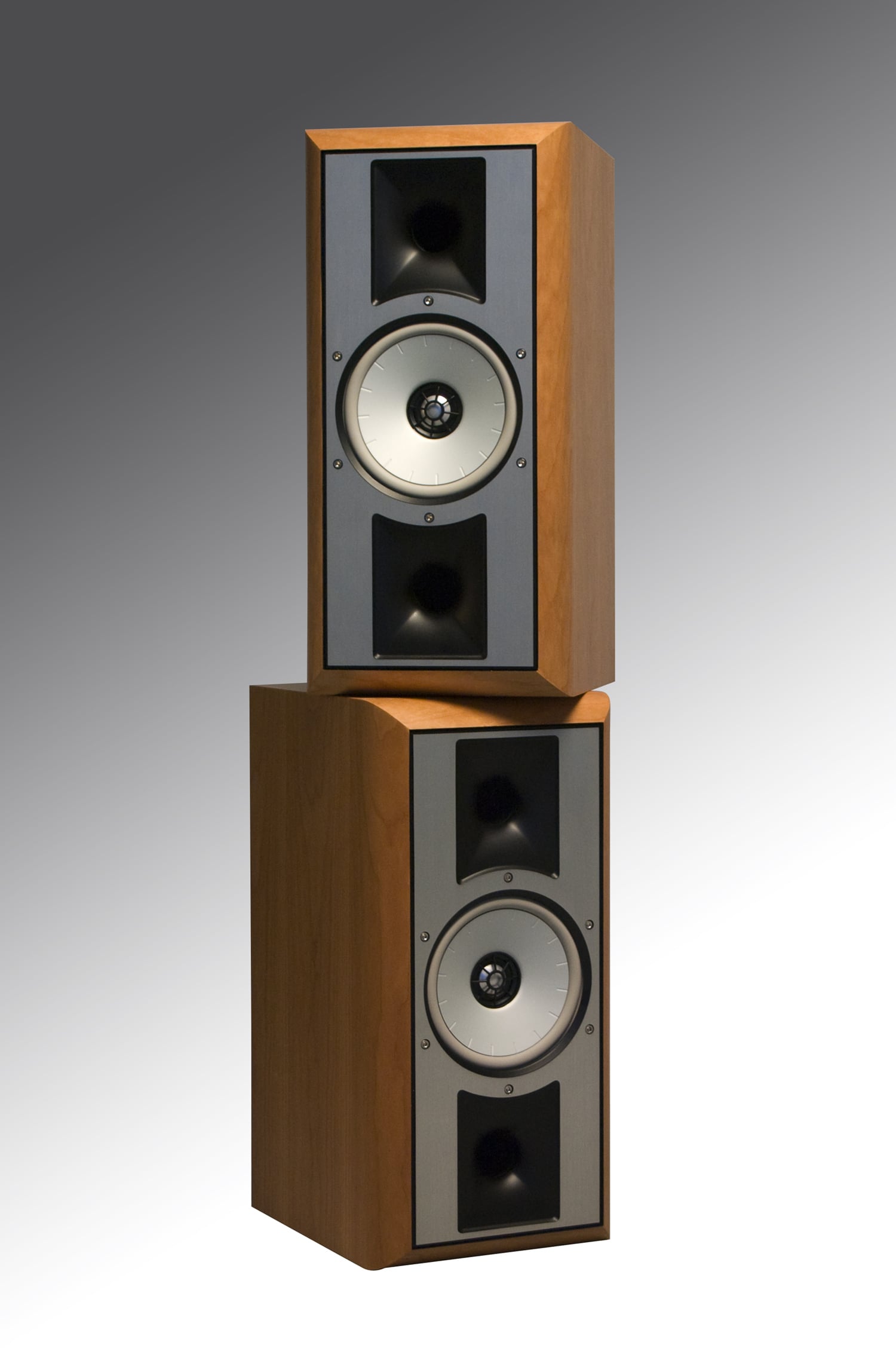 What I did
find disappointing about this speaker was that the on axis frequency response
was not very flat for a speaker of this size.
I do not recommend this speaker be toed in to put the listener on
a direct axis with the system. The
frequency response slightly off axis looked smoother than does the on axis
response. This is one of the disadvantages
of using a coaxial tweeter. The
advantages of the coaxial tweeter mounting (used in the SCS4)
are that you will get the same sound dispersion pattern whether the enclosure
is oriented with the long dimension of the box horizontal or vertical. It also offers extremely smooth off axis
response and phase linearity, especially in the crossover region. (Since much
of the sound reaching us is reflected, some in the business argue the overall
power radiated at all angles better represents what we hear in a live room than
an anechoic axial frequency response does.)
Phase linearity is very important to Thiel, and he makes it a priority
in his designs. I personally have spent
much time working in the “Pro-Audio” end of the business, where 97db for 1watt
@ 1 meter is commonplace, and DJ's with 3000 watt amplifiers run into constant
clipping is a daily occurrence. (The DJ
market could care less about subtleties, they want as much raw output as they
can get). In part because of my recent
history with the Pro Audio business, this speaker is one I would describe as
delicate. It was able to reveal musical
subtleties that I would never hear when listening to the monstrously sized DJ
gear that frequently occupies my lab.
Despite its small size and coaxial design, I found the room location of
this speaker surprisingly easy to localize, and believe that it is best used as
the mains in a medium to small room, especially when assisted by at least two
other channels for ambiance. If you want
a high volume of deep bass, (read really loud music) you have no choice but to
add a subwoofer. If on the other hand,
you rarely play it above modest levels, the extension of the Thiels is more
than enough for any but the biggest rooms or most ardent bass aficionados. A distinct advantage of putting a small
driver in a box of modest size is that one can achieve a very low cutoff
frequency. Thiels specifications for
this model claim a cutoff frequency of 47
Hz, and my laboratory measurements bear this out. The disadvantage of the small driver approach
is that the sensitivity of the system is low, and the absolute maximum output
will also be very low at the lowest frequencies meaning the dynamic range of
the system is modest. That said, considering its size, the low end is surprisingly
good.
What I did
find disappointing about this speaker was that the on axis frequency response
was not very flat for a speaker of this size.
I do not recommend this speaker be toed in to put the listener on
a direct axis with the system. The
frequency response slightly off axis looked smoother than does the on axis
response. This is one of the disadvantages
of using a coaxial tweeter. The
advantages of the coaxial tweeter mounting (used in the SCS4)
are that you will get the same sound dispersion pattern whether the enclosure
is oriented with the long dimension of the box horizontal or vertical. It also offers extremely smooth off axis
response and phase linearity, especially in the crossover region. (Since much
of the sound reaching us is reflected, some in the business argue the overall
power radiated at all angles better represents what we hear in a live room than
an anechoic axial frequency response does.)
Phase linearity is very important to Thiel, and he makes it a priority
in his designs. I personally have spent
much time working in the “Pro-Audio” end of the business, where 97db for 1watt
@ 1 meter is commonplace, and DJ's with 3000 watt amplifiers run into constant
clipping is a daily occurrence. (The DJ
market could care less about subtleties, they want as much raw output as they
can get). In part because of my recent
history with the Pro Audio business, this speaker is one I would describe as
delicate. It was able to reveal musical
subtleties that I would never hear when listening to the monstrously sized DJ
gear that frequently occupies my lab.
Despite its small size and coaxial design, I found the room location of
this speaker surprisingly easy to localize, and believe that it is best used as
the mains in a medium to small room, especially when assisted by at least two
other channels for ambiance. If you want
a high volume of deep bass, (read really loud music) you have no choice but to
add a subwoofer. If on the other hand,
you rarely play it above modest levels, the extension of the Thiels is more
than enough for any but the biggest rooms or most ardent bass aficionados. A distinct advantage of putting a small
driver in a box of modest size is that one can achieve a very low cutoff
frequency. Thiels specifications for
this model claim a cutoff frequency of 47
Hz, and my laboratory measurements bear this out. The disadvantage of the small driver approach
is that the sensitivity of the system is low, and the absolute maximum output
will also be very low at the lowest frequencies meaning the dynamic range of
the system is modest. That said, considering its size, the low end is surprisingly
good.
Design Overview
 The build
quality of the Thiels is excellent. As
you remove them from the over sized shipping cartons, complete with very thick
shock absorbing custom made packaging foam
you will notice the protective black sock which completely covers the
cabinet, and the plastic guard to protect the wood cabinet from being marred by
unintentional movement of the metal grille.
No one was counting pennies when the packaging was designed, and you
would expect no less from a product of this cost and quality.
The build
quality of the Thiels is excellent. As
you remove them from the over sized shipping cartons, complete with very thick
shock absorbing custom made packaging foam
you will notice the protective black sock which completely covers the
cabinet, and the plastic guard to protect the wood cabinet from being marred by
unintentional movement of the metal grille.
No one was counting pennies when the packaging was designed, and you
would expect no less from a product of this cost and quality.
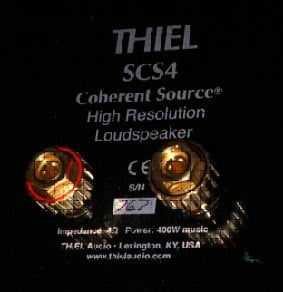
Over sized gold plated “5-way” terminals are used on the rear of the cabinet. Screwing the speaker wire ends or terminations in place is easy and the ridiculous standard ¾ inch center to center binding post distance (NOT used here) for banana plugs is thankfully discarded. This means men with normal size hands and fingers can actually screw the terminals down without having to scrape the skin of our fingers off on the terminals.
The cabinet is well built, and liberally braced. Knocking on the panels reveals a very high frequency of resonance of the cabinet panels, not one to be easily excited by the woofer, and not likely to radiate much in the way of its own sound. The front baffle is actually made from a single piece of cast aluminum. As Jim Thiel explained, this material is not only used for a beautiful appearance, but primarily because of the very high strength and lack of mechanical compression aluminum exhibits. The coaxial driver itself is rear mounted, and the front panel details allow Thiel to minimize the baffle diffraction by a careful and judicious attention to the driver box interface. By careful attention to the geometry, Thiel claims to minimize the diffraction effects of the box. (Off axis measurement at 90 degrees seems to bear him out).
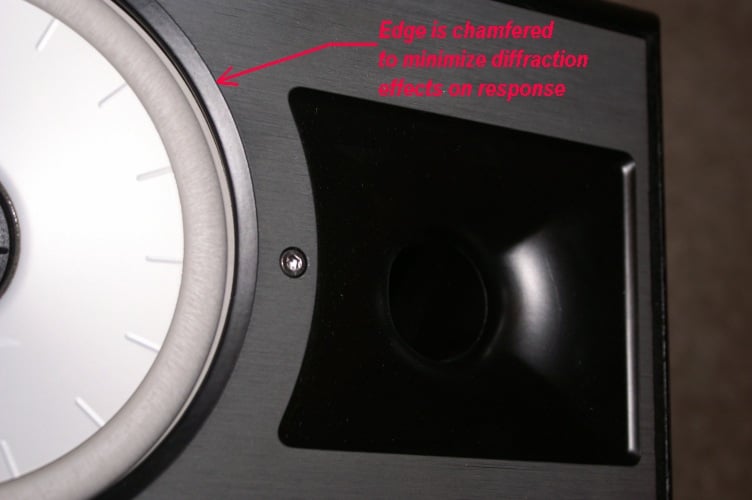 The two ports, one each above and below the coax driver, are
also cast into the aluminum panel. The
air inlet inside of the box is constructed with a flared plastic tube which
glues onto the straight end of the cast aluminum port hole.(flaring reduces
port turbulence at high outputs and therefore lessens distortion)
The two ports, one each above and below the coax driver, are
also cast into the aluminum panel. The
air inlet inside of the box is constructed with a flared plastic tube which
glues onto the straight end of the cast aluminum port hole.(flaring reduces
port turbulence at high outputs and therefore lessens distortion)
The crossover was a surprise after being told the aim was a first order network in the transition band (first octave on either side of the crossover point). By my part count, this looks like a fourth order network with at least one Zobel network (Impedance compensation). The crossover network uses exclusively air core inductors. The capacitors were either Electrolytics or Film (polyester perhaps)?
Where Electrolytics were used, they were placed in parallel which results in less series inductance and resistance, so their negative effects are minimized. Unfortunately, the resistors are all glued right down on the PCB, minimizing their ability to dissipate heat. This is a minor issue with low power speakers like the Thiel SCS4. To minimize the weakening of the speaker box, the thru-hole and backplate panel are made as small as possible in order to keep the box strength at a maximum. The plastic plate appears to be just large enough to mount the crossover board. By minimizing the through hole size, we minimize the loss of cabinet strength created by the hole.
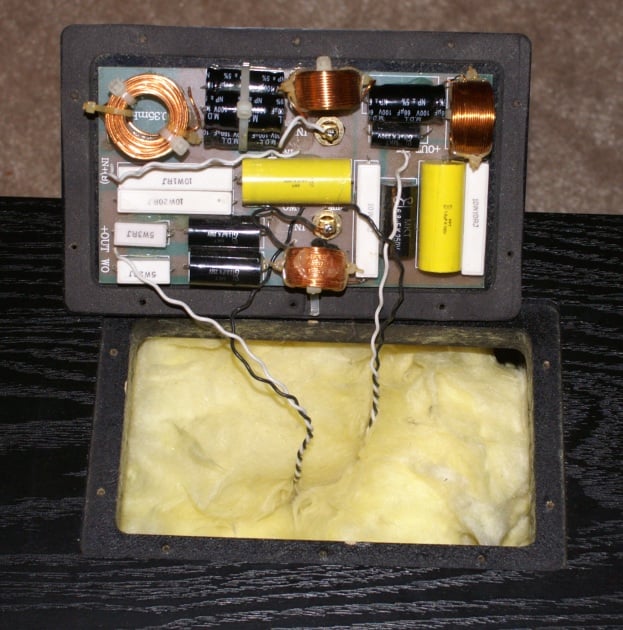 I was delighted to see that Jim Theil, like myself, is a fan
of fiberglass insulation. We have both
measured polyester fiber fill treatments, typically used by other manufacturers
and agree that polyester fiber fill does little to nothing to minimize
reflections inside a speaker box. The
right amount of fiberglass was used here, and it was located in the right
place. It was not lost on me that the
fiberglass was skewered in place and held there with solid core copper
wire. Audioholics readers who recall
Thiels interview and discussion with Gene DellaSala
about wires likely remember Thiel prefers solid core over stranded copper for
wiring. Perhaps it has less to do with
skin effect or material density than it does as being a tool to hold the
fiberglass behind the speaker (where it does the most good) and away from the ports (where it will do the most harm). Stranded wire might not hold the fiberglass
in place as does the very stiff solid core copper crossover to speaker wires.
I was delighted to see that Jim Theil, like myself, is a fan
of fiberglass insulation. We have both
measured polyester fiber fill treatments, typically used by other manufacturers
and agree that polyester fiber fill does little to nothing to minimize
reflections inside a speaker box. The
right amount of fiberglass was used here, and it was located in the right
place. It was not lost on me that the
fiberglass was skewered in place and held there with solid core copper
wire. Audioholics readers who recall
Thiels interview and discussion with Gene DellaSala
about wires likely remember Thiel prefers solid core over stranded copper for
wiring. Perhaps it has less to do with
skin effect or material density than it does as being a tool to hold the
fiberglass behind the speaker (where it does the most good) and away from the ports (where it will do the most harm). Stranded wire might not hold the fiberglass
in place as does the very stiff solid core copper crossover to speaker wires.
My least favorite part of this speaker is the grille. It is nearly impossible to remove without causing some kind of damage to the cabinet or your fingernails. The grille desperately needs a small cloth tab at the bottom or top, so when pulled on, you can overcome the magnetic force that holds the grille to the speaker box. The grille appears somewhat flimsy, and frankly I was surprised that it did not vibrate and rattle during loud passages. It is made from a thin gauge metal, is long, and has an unsupported center causing me some concern.
Overhung vs Underhung Voice Coils
The speaker
itself is a two way, with a 6.5 inch woofer, and a 1 inch coaxially mounted
tweeter. The speaker cone is not
entirely aluminum, but rather an aluminum skin over a polystyrene (plastic)
material. The combination is both light
and strong. This is a difficult thing to
achieve with the shallow woofer cone like the one Thiel uses on the SCS4. The
use of a deep cone, the usual approach to achieve high strength with low mass,
would adversely affect the off axis response of the coaxially mounted tweeter,
hence the unusual but effective approach.
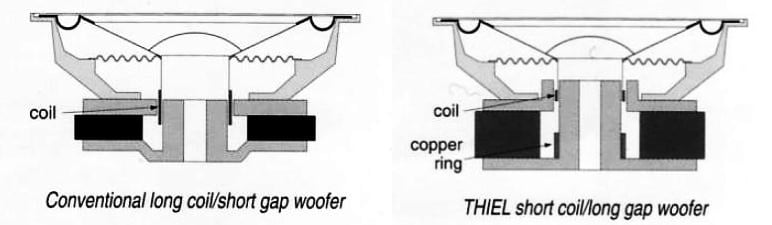
The low frequency driver (woofer) uses a non conventional motor. In most woofers, the voice coil is longer
than the magnetic gap is high. This is
known as an overhung voice coil, and is used by far and away most woofers. The
advantages of the overhung approach include material efficiency and subsequently
cost. The disadvantages include higher
distortion and lower power handling (possibly not definitely). Thiel uses an underhung voice coil, which
means the voice coil is shorter than the magnetic gap is high. It also means the voice coil is always
completely immersed in the magnetic field – (read less distortion). To further reduce distortion, Thiel uses a
copper shorting ring in the motor, to reduce magnetic flux modulation, and
voice coil inductance changes with position, two other sources of distortion
particularly problematic in woofers.
 Another
advantage to under-hung voice coils is less frequency response variation of the
woofer with high drive levels. A
disadvantage to this approach (besides cost) is that if overdriven, the speaker
WILL BOTTOM or worse, break. Thiel recommends no more than 200 watts to drive
this speaker. I would
adhere to that without fail. Minimizing
the maximum voltage across the woofer will eliminate the bottoming that will
occur with higher than recommended power at low frequency.
Another
advantage to under-hung voice coils is less frequency response variation of the
woofer with high drive levels. A
disadvantage to this approach (besides cost) is that if overdriven, the speaker
WILL BOTTOM or worse, break. Thiel recommends no more than 200 watts to drive
this speaker. I would
adhere to that without fail. Minimizing
the maximum voltage across the woofer will eliminate the bottoming that will
occur with higher than recommended power at low frequency.
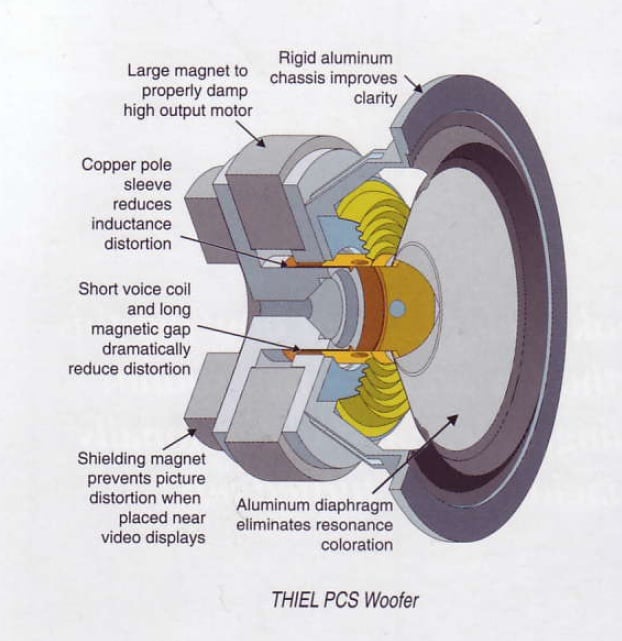 While Thiel
uses aluminum for the tweeter diaphragm (dome) he does not (thankfully) use it
for the surround(edge). While aluminum
has its advantages, it also has some negatives as well. If you are a fan of aluminum you know who you
are. Those of us who are not, recognize that
while it may work for the dome (which should be hard) it can be a disaster when
used as the surround edge, which is supposed to be compliant. This latter approach is often found in
compression drivers (for horn speakers).
While Thiel
uses aluminum for the tweeter diaphragm (dome) he does not (thankfully) use it
for the surround(edge). While aluminum
has its advantages, it also has some negatives as well. If you are a fan of aluminum you know who you
are. Those of us who are not, recognize that
while it may work for the dome (which should be hard) it can be a disaster when
used as the surround edge, which is supposed to be compliant. This latter approach is often found in
compression drivers (for horn speakers).
A distinct advantage of putting a small driver in a box of modest size is that one can achieve a very low cutoff frequency. Thiels specifications for this model claim a cutoff frequency of 47 Hz, and my measurements bear out 45 Hz. The disadvantage of the small driver approach is that the sensitivity of the system is low, and the absolute maximum output will also be very low at the lowest frequencies meaning the dynamic range of the system is modest. That said, considering its size, the low end is surprisingly good for a speaker of such small size.
The Coax Driver – For those of you with a greater curiosity about the internal details, I will have to defer my opinion to the vendor. My sample did not include license to take it apart, but Thiel was good enough to provide a sectioned drawing detailing the inner workings of the driver.
Please note the driver itself includes a metal shielding can found in better designed drivers shielded for video applications. That back-can is not shown in the above diagram.
Thiel SCS4 Listening Tests
I find that
when doing critical listening I like to use the same recordings over and over
again. In this way I can make quick
judgments as my music has a lot of memory to be compared against. I tend to place all of my impressions in the
light of what I am measuring in the laboratory.
My listening impressions of the Thiels were supported by what I saw from
objective measurements. The only real
surprises were the amount of bass that these relatively small boxes were
capable of making. What I kept coming
back to in my impressions was the accuracy of voices. This is where the 6.5 inch woofer and a 1
inch tweeter really shine. The other
item I had to note was the ability of the  Thiel to reveal subtle musical
details. Some of these very old
recordings sounded new for the first
time in 25 years.
Thiel to reveal subtle musical
details. Some of these very old
recordings sounded new for the first
time in 25 years.
DVD – Batman Dark
Knight - My first listening in my home was
with the Batman DVD,
“The Dark Knight.” My
impression was that the speaker was considerably larger than its physical
size. It had output sufficient to fill
my living room, and just enough to completely annoy my neighbors as well. The only time I sensed the system was a bit
strained was during VERY low frequency passages of high output. Those dramatic scenes in the movie, where
vehicles and buildings that just blow up and now are falling back to
Earth.
For those
of you less than 30, I suppose my music selections are mostly proof of my
age. In addition to the Video, I 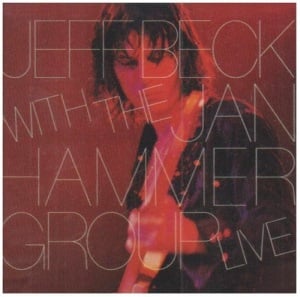 played
several music CD's on the SCS4s.
played
several music CD's on the SCS4s.
CD - Jeff Beck with the Jan Hammer Group Live – I was privileged to be in the
audience the night this recording of “Freeway Jam” was made. I remember the way it sounded, and most of
the audience was standing on our chairs during this song. The way Jan Hammer plays the organ is nothing
shy of amazing and Jeff Beck is no slouch on guitar. An older recording, but
for its day is quite good. Excellent
reproduction of guitar and organ by the SCS4. Drums and bass were a little shy relative to
the 115db I can remember inside the 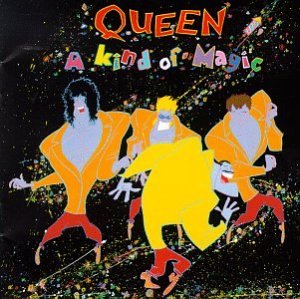 Philadelphia Spectrum.
CD - Queen – A kind of Magic. I saw Queen live only 9 times. They are rock royalty, and this album was recorded near the height of their popularity. I like to listen to “Who wants to live forever” as it has both delicate orchestral passages as well as thunderous low end to test a loudspeakers output capabilities. Use of a subwoofer with this recording would really take the strain off the small SCS4 speakers. Again, the Thiel was quite good with mid-range, especially voices, but the low end was not able to keep up at the loudest levels. The chorus of voices was very clear on the SCS4, especially on the track "friends will be friends".

CD - Jethro Tull – War Child. I saw Jethro Tull live in Philadelphia PA, when this album first came out. (Yes, I am that old..) I can remember him dancing across the stage for the song “Bungle in the Jungle”. When he finished, a HUGE flash went off behind Ian Anderson blinding myself and my friend, completely and blowing my mind. Still one of my favorite tunes, and a standby I use for critical listening. This recording does not have a lot of low end, and so I was able to play it without being able to hear any strain or perceptible distortion. All in all, a very good performance by the Thiel.
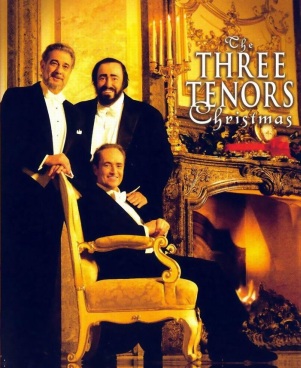
DVD - The Three Tenors Christmas - Plácido Domingo, José Carreras and Luciano Pavarotti get together to reprise their historic concerts of the early 1990's to sing some Christmas music. I am not a big fan of Christmas music, but this recording is an exception. I was most impressed with the SCS4s hearing this recording. That these artists are world class should go without saying. Listening to the DVD was an absolute pleasure. The vocal reproduction was extraordinary! Kudos to Jim Thiel. The SCS4 performs best with mixed vocal and orchestral material in my opinion. The voices of the “three tenors” sounded very natural on the SCS4. There were times during the performance when it felt like I had that much envied front row center seat.
Thiel SCS4 Measurements and Analysis
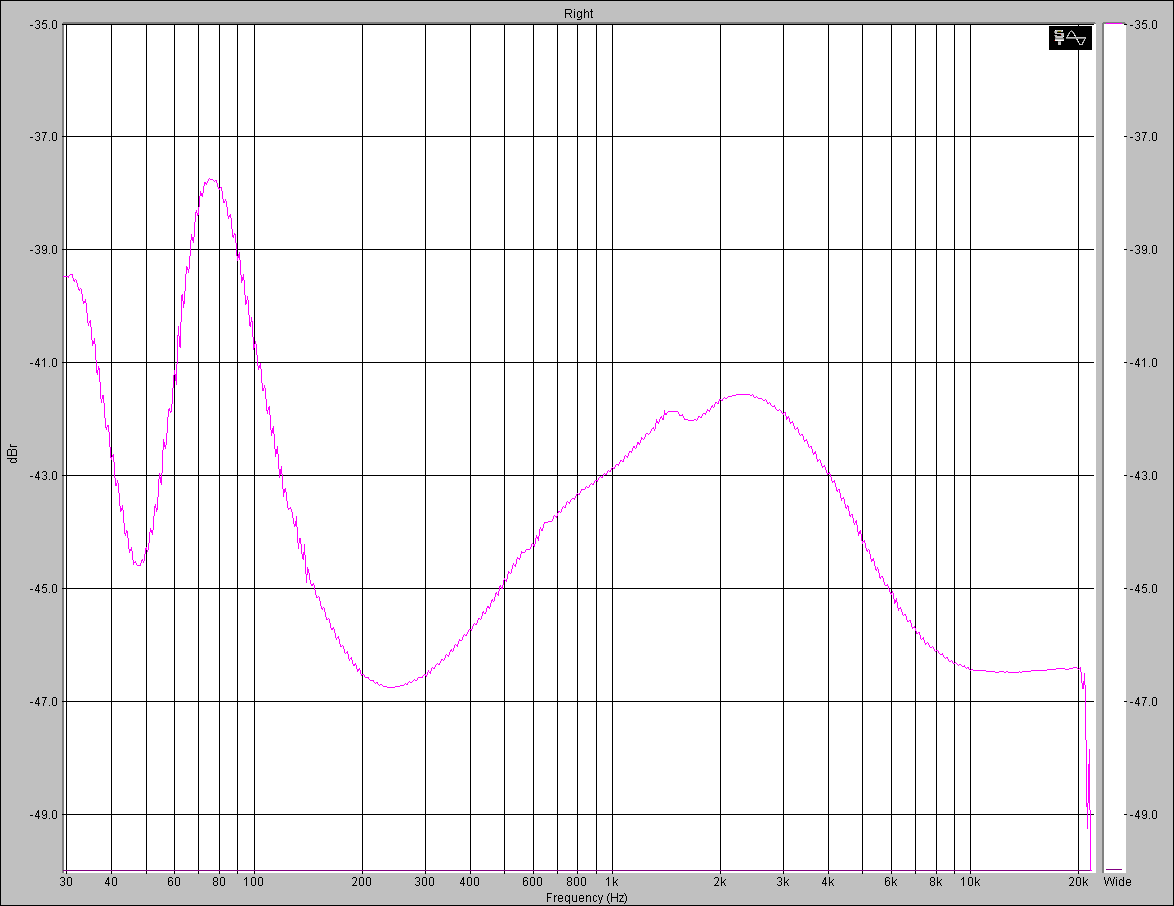
Impedance Magnitude Measurement of the SCS4 (40 db Graph)
System impedance drops to about 3 ohms in perhaps the worst place it can, the region between 200 and 300 Hz. The reason this is worrisome is because this is the range of frequencies where the greatest long term power demanded in the musical spectrum is often found. Direct measurement of the system DCR shows a VC impedance of less than 3 ohms. (I measured 2.8 ohms on my sample).
The blip in the curve at about 1.6 kHz may be the result of the resonant frequency of the tweeter interacting with the crossover. It might also be a poorly controlled resonance in the woofer cone. This is the same place where the midrange THD grows to be highest during a single frequency sine sweep. (It makes sense because this is often the low frequency limit for the tweeter, where the voice coil will have to move the farthest, putting the greatest strain on the motor of the tweeter. According to Thiel, the actual crossover frequency of the system is 2500 Hz. If that is the case, then this seems to be a resonance not ideally controlled.
The tweeter impedance remains very flat at the highest frequencies. This is either the result of network compensation (the crossover) or a shorting ring (copper usually) on the tweeter motor. The extension of the tweeter on axis is good out to 20 kHz as advertised.
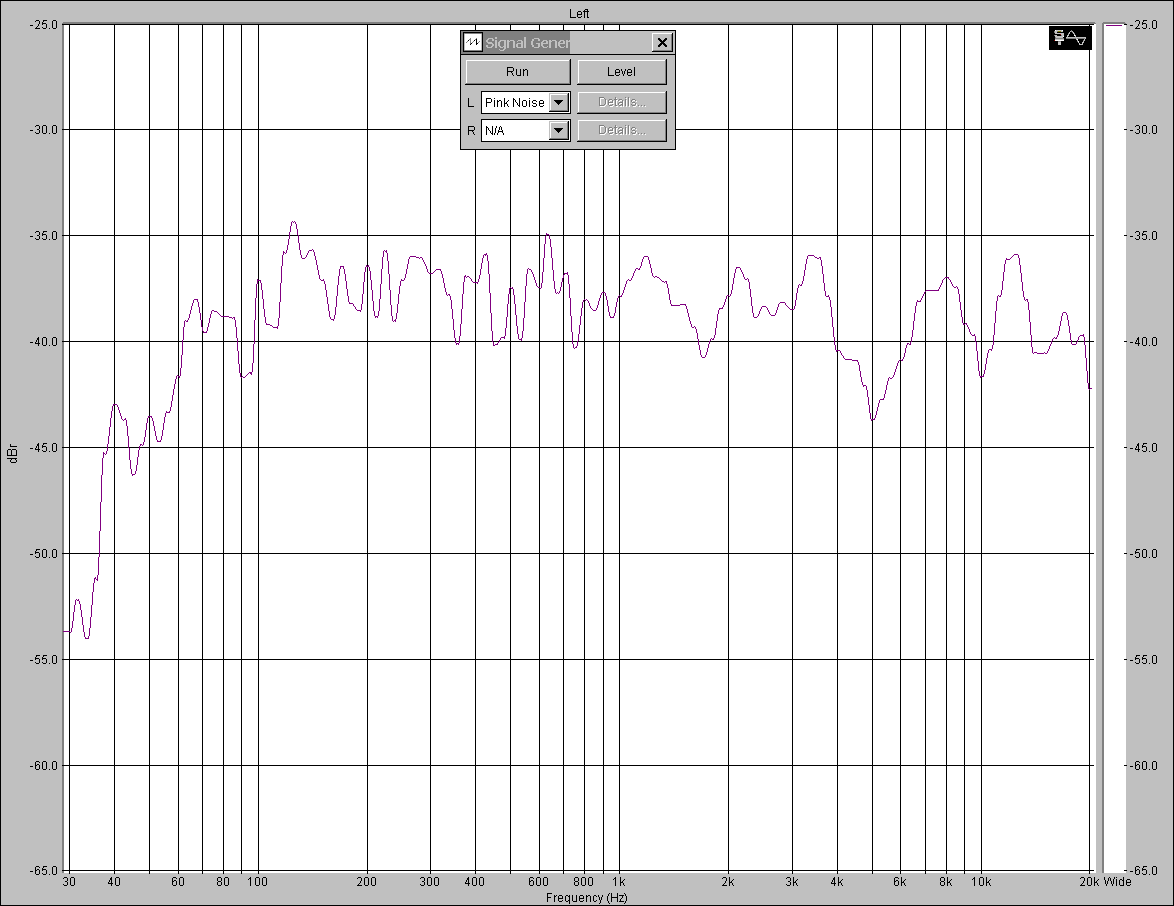
In Room
Frequency Response
(with
1/24th octave resolution - 40 db Graph)
As you may be able to tell from the curve above, this is a live room measurement. For those of you who do not make a living with measurement microphones, you are likely wondering either why I might try to do this without an anechoic (echo free) chamber. Besides the million dollar price tag, to build one which is good down to very low frequencies requires a huge amount of space. That said, those of us who do (make their living with a measurement mike) can often look at these curves and see which aberrations are due to the room, and which are due to the speaker. (I call it reading through the room). As a rule of thumb, I take measurements in live rooms near-field on the ground plane (the floor) which works best for subwoofers or to see the low frequency performance of a speaker alone. I have found there is often too much error in this method to use it for full range measurements. The other technique is to place the speaker midway between the floor and ceiling and the mike at a distance around three times the size of the loudspeaker unit. In this case the curve above is taken at 3 times the driver diameter or in the case of a small 6.5 inch coax, 16.5 inches away. (A compromise between sources of measurement error). This is how the SCS4 was measured. If you are asking yourself "why is Paul telling me this?" it is because in a different laboratory, we may see a slightly different curve, and I am mindful not to ascribe ALL of the numerous peaks and dips in the curve above to the speaker alone. Taking a curve of the mate (other in the pair) of this speaker at a larger distance in another laboratory, I did not measure the large hole at 5 kHz. That said, 5 kHz is not the frequency range where rooms typically misbehave.
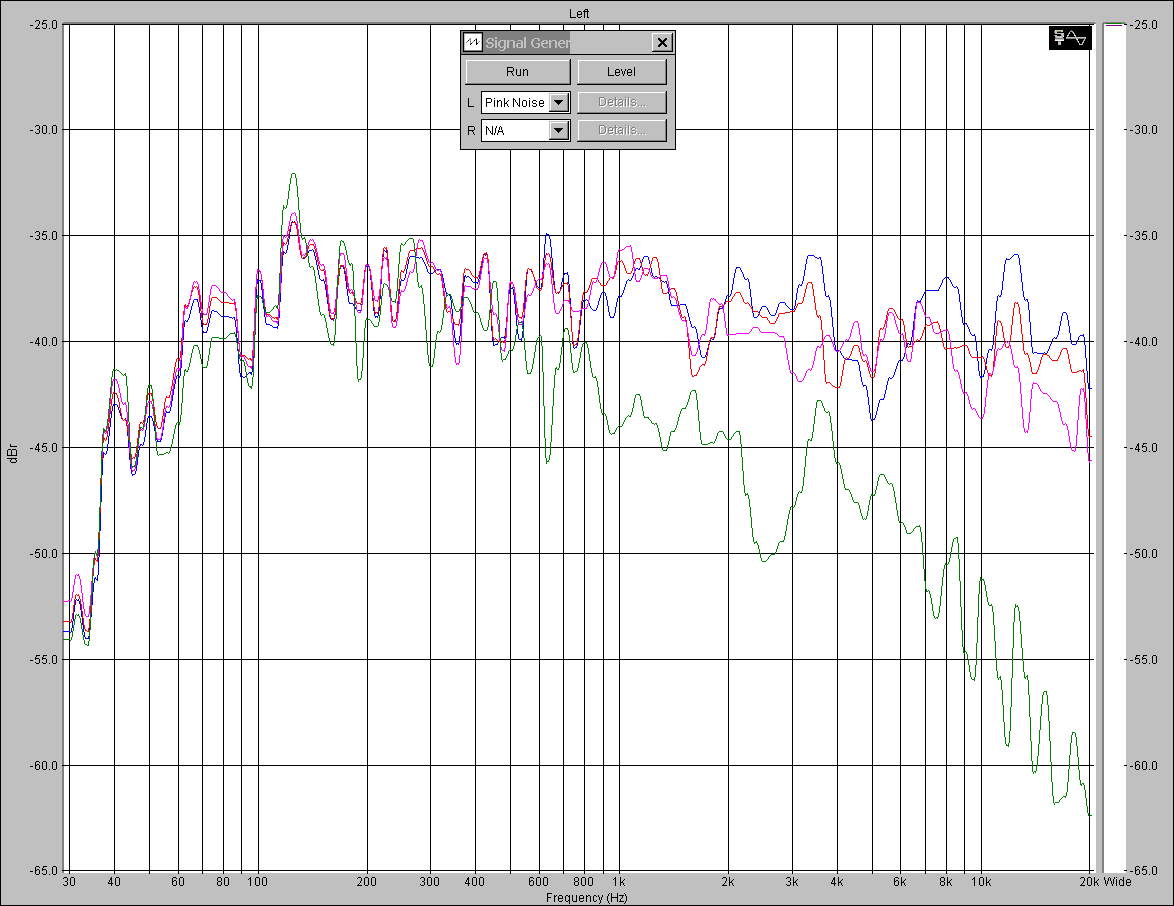
Frequency
response at 0, 15, 45 and 90 degrees (40 db graph)
Blue –
on axis, Red – 15 deg, Pink – 45 deg,
Green – 90 degrees
As you can see, the off axis response is smooth and rolls off in a predictable and well behaved way. At any angle within 45 degrees, there is a small loss only and it is confined to frequencies above 2k Hz, the range of the tweeter. The severe loss at 90 degrees is to a great extent a result of the shadowing of the tweeter by the woofer cone.
Distortion Measurements
For the distortion measurement, I used a signal generator (Spectra RTA) to run a slow 20 second sweep from 20 to 22 kHz. The distortion meter was also running, and was displayed in % THD. What I was looking for was a range over which the distortion would spike. It was already clear from listening, what I would find, and the numbers bear it out.
| Power Used | Below 50 Hz | 50 - 100 Hz | 100 - 1kHz | 1.6 kHz |
| 2 Watts | 2.7% | 1% | 0.3% | 1.5% |
| 20 Watts | >5% | 5% | 0.5% | 3% |
| 30 Watts | >15% | 7% | 1.5% | 5.5% |
THD DISTORTION MEASUREMENTS OF THIEL SCS4
As the excursion of the small woofer peaked, so did the distortion. Once the excursion was minimized, THD fell considerably. At the blip in the Impedance curve, right around 1.6 kHz where the response dipped (see curve), there was a noticeable rise in the distortion; tolerable, but still noticeable. The voltage for the first sweep was set at 2.83 volts (This is by the way, 1 watt into an 8 ohm speaker but is actually 2 watts into a 4 ohm speaker load, because Power = V squared/Ohms). When manufacturers use 2.83 volts to specify sensitivity to a 4 ohm speaker, instead of 2.0 volts, I tend to believe they are trying to get one over on the consumer, by inflating the sensitivity figure by 3 db, or 100%. Thiel specifies 87 db for 2.83 Volts RMS for the SCS4, which means its 1 watt sensitivity is actually 84 db! After the 2 watt sweep was run, the voltage was then increased to 9 volts, or 20 watts into 4 ohms. The signal power was then raised to 11 volts (30 watts), and the test is repeated for a final time. It was thought by me a sweep of any more than 30 watts RMS would result in a tweeter failure.
Thiel SCS4 Conclusion
The Thiel SCS4 speaker system has certainly met my expectations for performance, and the amount of low end exceeded it. The SCS4 is a well thought out and well made effort. It can be improved no doubt, but at what cost? The materials and workmanship are both first class, save for a grille whose attachment gives me pause, and some very very small screws which look far too small to securely hold the crossover and plastic backplate in place on the rear panel. The front baffle and speaker are cosmetically a thing of beauty, and the overall construction is excellent. The crossover design also gives me some pause, especially when it does not seem to be eliminating the response of the tweeter near resonance. The impedance magnitude in the 200 – 300 Hz range might also be of concern if the amplifier used does not like impedances below 3 ohms. The average user will find this small speaker suitable for all but the largest rooms, and biggest amplifiers.
If you have limited space, and the wife will not let you buy that floor standing speaker you really want, the Thiel can provide you with years of excellent sound. You could definitely do worse. For higher SPL output, just lows or full range, addition of a subwoofer to your system is a necessity.
Thiel Loudspeakers SCS4
http://www.thielaudio.com
MSRP: $990/each
1026
Nandino Blvd.
Lexington, Kentucky 40501
Phone: (859) 254-9427
FAX: (859) 254-0075
About Thiel Loudspeakers
THIEL Audio Products Company of Lexington, Kentucky
is a privately-held, engineering
driven organization that performs research, design, and manufacturing of
loudspeakers for the highest quality music and video sound reproduction in the
home.
The Score Card
The scoring below is based on each piece of equipment doing the duty it is designed for. The numbers are weighed heavily with respect to the individual cost of each unit, thus giving a rating roughly equal to:
Performance × Price Factor/Value = Rating
Audioholics.com note: The ratings indicated below are based on subjective listening and objective testing of the product in question. The rating scale is based on performance/value ratio. If you notice better performing products in future reviews that have lower numbers in certain areas, be aware that the value factor is most likely the culprit. Other Audioholics reviewers may rate products solely based on performance, and each reviewer has his/her own system for ratings.
Audioholics Rating Scale
 — Excellent
- — Very Good
- — Good
- — Fair
- — Poor
| Metric | Rating |
|---|---|
| Build Quality | |
| Appearance | |
| Treble Extension | |
| Treble Smoothness | |
| Midrange Accuracy | |
| Bass Extension | |
| Bass Accuracy | |
| Dynamic Range | |
| Performance |  |
| Value | |
 Subscribe to our newsletter