


Status Acoustics Decimo Review
Status Acoustics Decimo
- Product Name: Decimo
- Manufacturer: Status Acoustics
- Performance Rating:

- Value Rating:
- Review Date: October 02, 2000 19:00
- MSRP: $ 2899/pair
Drive Units: One 28mm (1.1") Fabric-Dome Tweeter, One 165mm (6.5") Metal-cone Mid-woofer
Frequency Response: 45Hz - 20kHz (+/- 3dB)
Sensitivity: 88dB (1 Watt/1 Meter)
Recommended Power: 20-170 Watts
System Impedance: 8 Ohm
Crossover Frequencies: 2500Hz
Wiring Capability: Bi-amp/wireable
Dimensions: 210mm W x 381mm H x 267mm D (8.25" W x 15" H x 10.5" D)
Weight (stand not included): 12kg (26 Lbs.)
Pros
- Superb imaging (speakers disappear in room)
- Very detailed top end
- Unparalleled cabinet construction
Cons
- Expensive
- Limited bass output
Decimo Technology Overview
 Speaker companies are a dime a dozen these days in a market flooded with gimmicky
products that claim improved fidelity by having you, the consumer, loading sand in your cabinets or
removing tweeter grills. In the audio industry today, It is a rarity to find a company that doesn't give
into these tactics to market a substandard product. It is a refreshing experience however, when a pair of
speakers are delivered to your door in an ordinary cardboard box, rather than having outrageous technical
hyperbole silk-screened all over them (that when hooked to a good processor and amp, absolutely blow your
mind to the point of returning them would be a crime). Enter the Status Acoustics Decimo's. These little
giants are a product from the high-end division of a company in Layton, Utah named RBHsound. The Status
line represents their finest offering of speakers, which are custom built and tailored for the most
discriminating listeners.
Speaker companies are a dime a dozen these days in a market flooded with gimmicky
products that claim improved fidelity by having you, the consumer, loading sand in your cabinets or
removing tweeter grills. In the audio industry today, It is a rarity to find a company that doesn't give
into these tactics to market a substandard product. It is a refreshing experience however, when a pair of
speakers are delivered to your door in an ordinary cardboard box, rather than having outrageous technical
hyperbole silk-screened all over them (that when hooked to a good processor and amp, absolutely blow your
mind to the point of returning them would be a crime). Enter the Status Acoustics Decimo's. These little
giants are a product from the high-end division of a company in Layton, Utah named RBHsound. The Status
line represents their finest offering of speakers, which are custom built and tailored for the most
discriminating listeners.
 Are They Speakers or Nice Pieces of
Furniture?
Upon unboxing these speakers, I knew from a first glance that I was dealing with a world
class product. Status Acoustics spared no expense at paying attention to detail and quality of
workmanship when engineering this amazing product. I have never seen cabinets like these before. They are
not made from typical MDF or any wood byproduct for that matter. Instead, Status chose to employ a much
more costly, rigid and inert multi-fiber composite material enclosure. Using composite material prevents
unwanted acoustic energy storage, greatly reducing any chances of audible cabinet coloration. The
internal construction of these speakers is quite impressive. They have both vertical and horizontal
cylindrical bracing beams and doubled up baffles (3/4" thick each totaling 1 1/2" thick on top and bottom
of cabinets as well as the bottom areas on the sides). Not only are these cabinets superior to
conventional MDF cabinets from an mechanical standpoint, but they are just about the most aesthetically
pleasing I have ever come across! They appear to be more like a piece of furniture than a speaker. In
fact, Status Acoustics marketing department would be wise if they came up with a nifty slogan
like:
"We don't make speakers, we make furniture that sounds good"
or something to that
effect. The Aluminum brushed port and backplate mount for the connectors gave a nice touch of class well
deserved and befitting for a product of this caliber. The overall workmanship and appearance of these
speakers left little to desire or criticize. OK, I've drooled over these speakers appearance long enough
now. It's time to get to the most critical part of this review; the listening experience. After all, one
does not buy a speaker based solely on its looks (at least I hope not). I put together a few rules (in
bullets) that I feel help to define important factors in good loudspeaker design.
Are They Speakers or Nice Pieces of
Furniture?
Upon unboxing these speakers, I knew from a first glance that I was dealing with a world
class product. Status Acoustics spared no expense at paying attention to detail and quality of
workmanship when engineering this amazing product. I have never seen cabinets like these before. They are
not made from typical MDF or any wood byproduct for that matter. Instead, Status chose to employ a much
more costly, rigid and inert multi-fiber composite material enclosure. Using composite material prevents
unwanted acoustic energy storage, greatly reducing any chances of audible cabinet coloration. The
internal construction of these speakers is quite impressive. They have both vertical and horizontal
cylindrical bracing beams and doubled up baffles (3/4" thick each totaling 1 1/2" thick on top and bottom
of cabinets as well as the bottom areas on the sides). Not only are these cabinets superior to
conventional MDF cabinets from an mechanical standpoint, but they are just about the most aesthetically
pleasing I have ever come across! They appear to be more like a piece of furniture than a speaker. In
fact, Status Acoustics marketing department would be wise if they came up with a nifty slogan
like:
"We don't make speakers, we make furniture that sounds good"
or something to that
effect. The Aluminum brushed port and backplate mount for the connectors gave a nice touch of class well
deserved and befitting for a product of this caliber. The overall workmanship and appearance of these
speakers left little to desire or criticize. OK, I've drooled over these speakers appearance long enough
now. It's time to get to the most critical part of this review; the listening experience. After all, one
does not buy a speaker based solely on its looks (at least I hope not). I put together a few rules (in
bullets) that I feel help to define important factors in good loudspeaker design.
- A properly designed loudspeaker system provides a reasonably flat frequency response within the audible bandwidth from 20Hz to 20KHz.
 If the speaker is physically
limited with respect to enclosure volume or driver radiating surface area, one would at least hope what
the speaker does produce in the bass region is linear enough to blend well with a musical subwoofer,
covering the full audible spectrum without introducing any unwanted coloration's. In this regard the
Decimo's do not disappoint. These 2 way loudspeakers consisting of one 6 1/2" midrange/woofer and one 1"
tweeter, with a mere footprint of 15" H x 10 1/2" D x 8 1/4" W, sound much larger than they appear. While
they will not shake your room with deep bass extension, what they do produce in the bass region is
extremely tight, accurate, and linear. The Decimo's bass extension is truly impressive for a speaker of
its size. They do more than a fair job of producing bass frequencies in the upper 40 Hz range, which is
low enough to seamlessly blend with a musical sub. Where these speakers truly shine is their tonal
quality from 40Hz and up. The midrange is extremely articulate and uniform throughout the voice band
(200Hz to 4KHz).
I attribute the Decimo's superb midrange tonality and
articulation to the following:
If the speaker is physically
limited with respect to enclosure volume or driver radiating surface area, one would at least hope what
the speaker does produce in the bass region is linear enough to blend well with a musical subwoofer,
covering the full audible spectrum without introducing any unwanted coloration's. In this regard the
Decimo's do not disappoint. These 2 way loudspeakers consisting of one 6 1/2" midrange/woofer and one 1"
tweeter, with a mere footprint of 15" H x 10 1/2" D x 8 1/4" W, sound much larger than they appear. While
they will not shake your room with deep bass extension, what they do produce in the bass region is
extremely tight, accurate, and linear. The Decimo's bass extension is truly impressive for a speaker of
its size. They do more than a fair job of producing bass frequencies in the upper 40 Hz range, which is
low enough to seamlessly blend with a musical sub. Where these speakers truly shine is their tonal
quality from 40Hz and up. The midrange is extremely articulate and uniform throughout the voice band
(200Hz to 4KHz).
I attribute the Decimo's superb midrange tonality and
articulation to the following:
Status Acoustics Aluminum midrange driver with cast basket

- * Hi quality aluminum cone midrange driver with phase plug . Using aluminum for the cone provides significant audible benefits because of the superior stiffness to weight ratio over conventional paper or plastic cones. As a result, the driver acts more like an ideal piston thus reducing tendencies of break up distortion and dynamic compression due to cone flexing. The phase plug essentially eliminates the need for a dust cap, which in turn, reduces cone mass, permitting extended frequency response. It allows more airflow through the motor structure, which improves cooling and thus increases power handling. A Phase plug also helps to reduce on-axis beaming by dispersing higher frequencies that the cone is producing.
Note : Beware, many loudspeaker manufacturers use a quasi phase plug which looks like a phase plug for marketing purposes, but does not physically separate from the cone of the driver. These "so called" phase plugs can do more harm than good as they provide an inconsistent surface area and they also increase mass of the cone yielding poorer frequency response and linearity.
- High quality cabinetry . The build quality of the Decimo's is second to none. They are extremely inert, thanks to the dense material they are constructed from and the extensive amount of internal bracing and baffling. 3/4" thick composite set in resin. A rigid and inert cabinet such as the Decimo, permits maximum energy delivery of the drivers to be converted to sound resulting in a more detailed, and accurate tonality and increased dynamics.
Note : Beware, some loudspeaker companies include tiny compartments on the bottom of the cabinet where the user can add sand to supposedly make the cabinet more rigid. This is another marketing technique thrown at the consumer to make them believe they are custom tailoring their own sound, when in fact, in most cases, these cabinets are poorly constructed with no internal bracing and thus a few ounces of sand will make little or no audible difference. Bottom line, a properly constructed cabinet is a must!
- Magnificent Scan Speak 9500 tweeter . This tweeter is one of the best on the market with respect to frequency response (on and off axis), and power handling. The Scan Speak tweeter plays low enough to integrate extremely well with the midrange driver resulting in a seamless interaction between the two. Regardless of how loud I cranked the Decimo's, the treble never sounded compressed or fatiguing such as lesser designs tend to. Quite frankly, I have never heard any loudspeaker convey such clean, uncompressed, detailed highs regardless of price.
-
 High Quality
crossovers
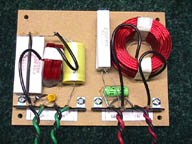
. Status uses nothing but the best inductors, high tolerance resistors and film caps in
their crossovers. Their crossovers are designed to insure optimal performance of each driver within its
audible bandwidth, guaranteeing proper phase and frequency response of the speaker system.
Decimo
Cross-Over
(Note the custom built Air Core Inductors, Film Caps, and Ceramic Resistors)
Note
:
Beware, many loudspeaker companies
use cheap electrolytic capacitors in series with the mid and tweeter drivers. Electrolytic capacitors
are not very linear at high frequencies and thus should never be utilized in series for these crossover
sections.
High Quality
crossovers
. Status uses nothing but the best inductors, high tolerance resistors and film caps in
their crossovers. Their crossovers are designed to insure optimal performance of each driver within its
audible bandwidth, guaranteeing proper phase and frequency response of the speaker system.
Decimo
Cross-Over
(Note the custom built Air Core Inductors, Film Caps, and Ceramic Resistors)
Note
:
Beware, many loudspeaker companies
use cheap electrolytic capacitors in series with the mid and tweeter drivers. Electrolytic capacitors
are not very linear at high frequencies and thus should never be utilized in series for these crossover
sections.
- A speaker should have reasonably flat frequency response 30 degrees off axis. Let's face it. Think about where you sit in relation to your loudspeakers. Not everyone has the luxury of sitting center stage between the two speakers at equidistant points from each other. If a speaker has good off axis response, this will minimize the dependency of a "sweet spot" and thus the speaker system will image well regardless of where you orient yourself in the listening room. Having good off axis response really helps widen the soundstage and to reduce the boxy sound typical of many speakers with poor quality drivers and/or implementation. I walked around the listening room in amazement by how well the imaging and focus of the soundstage was so neatly preserved. Few speakers that I have had the luxury of listening to can compete with the Decimo's in this regard!

Status Acoustics Decimo Conclusion
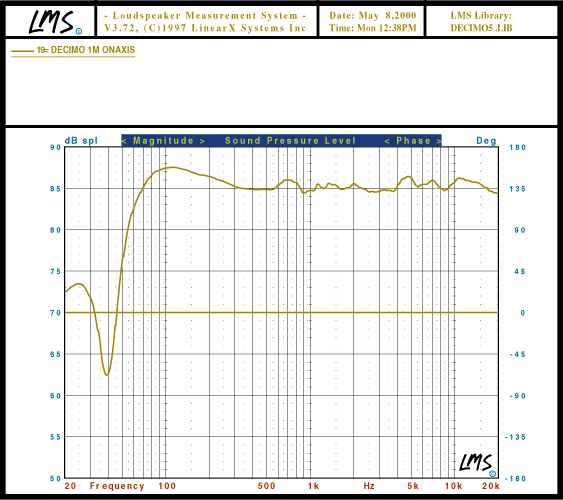
A Speaker should have uniform phase response within the audible spectrum. Preserving phase of a speaker is an important factor as you don't want to shift between inductive reactive or capacitive within the audible band as it may become obtrusive to the ear. Below is a phase vs frequency plot of the Decimo's for illustrative purposes. Good phase response also ensures uniform impedance presenting an easy load for the amplifier to drive efficiently.
 |
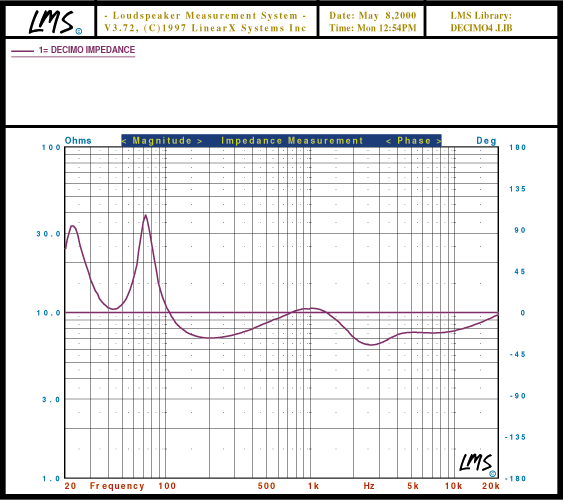 |
| On axis (1 meter) spliced with nearfield response of woofer < 500Hz without port contribution. | Magnitude of Impedance vs Frequency. |
These Aren't Speakers. They are Delicate Instruments of Sound!
The Decimo's literally disappear when you
listen to them with your eyes closed. I can't think of a better example of a speaker system that conveys
the realism of music with such intimacy. I popped in a familiar jazz CD from Pat Metheny and John
Scofield titled "I can see your house from here" and sat back in my chair with much anticipation. I
choose this CD not only because of my own personal familiarity, but because of the extensive frequency
range it reproduces. I was blown away by how lifelike the high hats sounded when the drummer (Bill
Stewart) gently stroked them with a metal brush. I actually had to convince myself that he wasn't in my
room and that I was just listening to a speaker. Not any ordinary speaker of course, a Status Speaker! I
must have heard this CD a thousand times and never noticed how compressed the treble was on other
speakers until I listened with the Decimo's. Listening to CD's from female vocalists (Celine Dion and
Natalie Merchant) it was obvious to me that the Decimo's reproduced their voices flawlessly. This really
surprised me, as many speakers tend to color female vocals in one way or the other due to cabinet
resonance or poor quality drivers utilized. CD after CD, my first impression never diminished:
these
are the best sounding two way booksheld speakers I have ever heard!
In fact, my listening experience with these speakers has been so uplifting that it has convinced me to sell my entire reference system to upgrade to all Status Acoustics speakers. I have auditioned many speakers in the past year courtesy of several respectable companies covering all price ranges. None of the others, regardless of size or price, have bestowed upon me such an emotional response as these cute little Decimo's have managed to so cleverly do.
Bottom Line: If an incredible sounding, attractive, cost no object, loudspeaker in a small package is what you are seeking, then I can, without reservation, recommend the Status Acoustics Decimo's. These speakers truly receive the Audioholics Spotlight for Product of the Year. My hat goes off to the very talented and courteous engineering staff at Status Acoustics!
The Score Card
The scoring below is based on each piece of equipment doing the duty it is designed for. The numbers are weighed heavily with respect to the individual cost of each unit, thus giving a rating roughly equal to:
Performance × Price Factor/Value = Rating
Audioholics.com note: The ratings indicated below are based on subjective listening and objective testing of the product in question. The rating scale is based on performance/value ratio. If you notice better performing products in future reviews that have lower numbers in certain areas, be aware that the value factor is most likely the culprit. Other Audioholics reviewers may rate products solely based on performance, and each reviewer has his/her own system for ratings.
Audioholics Rating Scale
 — Excellent
- — Very Good
- — Good
- — Fair
- — Poor
| Metric | Rating |
|---|---|
| Appearance | |
| Treble Extension | |
| Treble Smoothness | |
| Midrange Accuracy | |
| Bass Extension | |
| Bass Accuracy | |
| Imaging | |
| Soundstage | |
| Dynamic Range | |
| Performance | |
| Value | |
Gene manages this organization, establishes relations with manufacturers and keeps Audioholics a well oiled machine. His goal is to educate about home theater and develop more standards in the industry to eliminate consumer confusion clouded by industry snake oil.
View full profile Subscribe to our newsletter