


RBH Signature Series 41-SE Speaker Review
- Product Name: RBH Signature Series 41-SE
- Manufacturer: RBH
- Performance Rating:


- Value Rating:
- Review Date: July 31, 2003 20:00
- MSRP: $ 599/pr black
Frequency Response: 60Hz to 20kHz (+/- 3dB)
Sensitivity: 86 dB (1 Watt / 1 Meter)
Recommended Power: 20 - 100 Watts
Drive Units: One 1" Fabric Dome Tweeter;
One 4" Aluminum Cone Woofer
Crossover Frequency: 3000 Hz
System Impedance: 8 Ohm
Cabinet: Medium Density Fiberboard (MDF)
Cabinet Finish: Black Oak Woodgrain with
Nevamar tops and bases, or 30 different
genuine hardwood finishes
Dimensions: 11 ½" H x 6 ¾" W x 10" D
Weight: 12 lbs
Signature Series 41-SE Company History and Build Quality
Since 1976, RBH Sound has been designing, engineering and crafting high-performance loudspeaker systems that provide the tools for superior acoustic reproduction at sensible prices. From their inception, RBH's distinguishing quality was the implementation of aluminum and other exotic driver materials in their packages, coupled with soft dome or metal dome tweeters depending on application and budget..
In celebration of their 25-year anniversary and following recomendations from Audioholics, RBH introduced a limited edition signature series line of speakers created with the same technology found in their high-end, critically acclaimed Status Acoustic line. This limited edition series offered the ultimate in audiophile performance for the more budgetary consumer. Other speaker products from RBH include their Compact Theater CT-5.1 and CT-7.1 packages. The RBH Compact Theater 7.1 meets the demand of many new surround sound formats currently emerging in the market place. Both packages include sonically matched speakers along with a compact, but powerful subwoofer. These packages are ideal for those who want accurate sound on a budget, with limited available space. If you have the real estate for a larger speaker bundle, RBH offers a range of affordable solutions in their line of MC series. While not as small as the CT series, the MC packages offer compact speakers ranging from 4" drivers up to 6" drivers, coupled with deep bass produced from a 10" driver subwoofer. They even offer this series as an in-wall speaker for those who want a non-obtrusive speaker bundle.
If you are looking for a more refined sound, RBH offers the Signature Series line of speakers. Their flagship line of speakers range from the 41-SE's, which includes a 4" aluminum cone driver and 1" silk dome tweeter, all the way up to the 1266-SE's which include two 6" aluminum cone drivers in D'Appolito driver configuration (originally developed by Dr. Joseph D'Appolito) with a 1" silk dome tweeter sandwiched between them, and a 12" side firing aluminum driver. All the speakers in this series include the same high-end, Denmark produced 1" fabric dome tweeter for a seamless soundstage when combined into 5.1 or 7.1 applications.
The Build Quality of the 41-SE
The RBH 41-SE uses a proprietary 4" aluminum cone driver. RBH chose aluminum cone drivers for their stiffness, low mass and self dampening properties all of which allow the driver to provide a linear and more piston like response within the utilized bandwidth. The enclosures are constructed of MDF, with baffled bracing, to minimize unwanted resonance and prevent excess sonic radiation. This method of construction allows the speaker to handle high stress and power levels without excessive distortions. RBH finishes off the speaker with quality a variety of hardwood veneer finishes for the MC Series. The veneers are stained and coated with multiple coats of lacquer to ensure a furniture quality finish.
Signature Series 41-SE Comparisons and Performance
The uniqueness of RBH's Signature Series 41-SE's are not only noted by their aluminum cone drivers, but also their cabinet size and performance. The 41SE's are 11 ½" H x 6 ¾" W x 10" D with a frequency response ranging form 60Hz to 20kHz +/- 3dB. One would not necessarily expect a speaker with a 4" driver to be 10" deep and have such a low frequency extension. There are many speakers from more popular manufacturers which offer 6" drivers and have smaller cabinets in combination with frequency responses that do not play down to 60 Hz with such authority.
There are many factors that affect a speaker's bass performance. While cabinet size isn't an ultimate basis for speaker comparison, it does offer some insight into how the manufacturer designed and tuned the cabinet to match the performance of the drivers. The dimensions of the RBH 41-SE is only part of the formula for creating their 60Hz to 20kHz +/- 3dB frequency response.
Performance of the RBH Signature Series 41SE
Listening tests are typically subjective and are an expression of the listener's personal taste in sound quality. Even the best listening tests are usually conducted with some form of comparison to a variety of speakers in an isolated room with various audio tracks. For our review, we used familiar music from CD's, DVD-A, DTS CD's and DVD Movies. The RBH 41SE's were installed in Reference System 2 in multiple usages. Because of my many years of playing guitar and performing, I have also established a keen ear for how certain instruments sound, especially during live performances. This helps me appreciate the tonal character of instruments and vocals during music playback.
We began our listening test by using them as the main front channel speakers. We then switched them over to surround channel speakers and lastly, we installed them as the 7.1 channel rear surrounds.
As Mains
When considering a home theater speaker package, many of us fall victim to the wife acceptance factor (WAF) . Now, please don 't think I'm bashing wives with this broad statement, but I'm sure most of us will be willing to admit that our significant others typically prefer smaller speakers as they are less obtrusive in the room. When considering a small speaker package for either two channel stereo, or 5 / 7 channel surround, we believe the 41SE's are well suited. On their own as main speakers, they produced an accurate, broad range frequency response that one would expect from a larger speaker. While these speakers do not produce bass frequencies lower then 60Hz with much authority, they do produce a tight, very accurate mid and semi-low bass capable of enriching any listening experience, especially when mated with a musical subwoofer. This is especially noticeable when focusing on the sound of musical instruments such as bass and drums. The 41SE's were able to recreate a life-like soundstage with adequate presence for a speaker of such a small footprint. In addition to their impressive bass performance, the RBH 41-SE did an outstanding job of recreating neutral and accurate midrange and the higher frequencies of instruments and vocals with equal favor. When attention is turned toward their representation of guitars, horned instruments, and vocals, it's easy to notice how well rounded and accurate these speakers really were.
With some speakers in this price range and above, certain vocalists can sound somewhat lisp with emphasis on "s." This can be the result of an inaccurate implementation or overly bright tweeter. When hearing vocals from Patricia Barber, Norah Jones, Jewel, Donald Fagan and Cowboy Junkies on the RBH 41SE's, there are no lisp "s" to be noticed. The soft dome tweeter of the signature series is able to reproduce the detail of the vocals, without being overly bright.
As for their performance with mid bass, it is best noticed when paying attention to guitars and snare drums. My favorite listening test for this is don e by using Steely Dan's, "Two Against Nature" CD and Larry Carlton and Lee Rittenour's CD simply titled, "Larry and Lee." Both of these CD's offer superior fidelity when compared to many other CD's. On the Steely Dan CD, Walter Becker uses a custom built guitar from Roger Sadowski. The pickups in this CD offer a unique sound that is signature to Sadowski's guitar. The sound difference to some may be minor, but to the musician, it's easily identifiable on a quality pair of speakers. With the refined sound produced by the 41SE's, the sonic signature pickups in Sadowski's guitar were clearly identifiable.
The Larry and Lee CD is well suited to test the frequency extension of a speaker due to its broad range of instruments and quality fidelity. The 41SE's did an outstanding job of recreating the tightness of the drums, along with a sufficient amount of tight bass all in perfect balance. The horn section came across as being dynamic, without being overly bright.
There is no doubt that the 41SE's are well suited for main speakers for those looking for refined sound in a small package. When coupled with an RBH sub to handle the deeper bass, the 41SE's become the ultimate budget speaker offering superb fidelity and quality at an affordable price.
Signature Series 41-SE as Surrounds and Rear Speakers
As Surrounds
Based on size and performance, we believe the 41-SE is a speaker that is versatile and well-suited for many applications. This is especially true when considering them for surrounds. Most DVD movie soundtracks do not contain much frequency extension down to the lowest octaves of the audio bandwidth in the rear channels . In fact, due to placement constraints in most listening rooms, most users opt for smaller speakers and utilize the bass management of their pre-pros/receivers to reroute the bass content to a dedicated subwoofer. T hus, in this application, typical frequencies produced from the surrounds in movies are more in line with mid-bass and higher. Since the 41SE's frequency response fits right in this range (with the ability to produce 60Hz to 20kHz +/-3dB), they are ideal for the role of surrounds. While installed as surrounds, we conducted our listening tests using the sound tracks from Jurassic Park III, The Lord of the Rings, and Shrek, in addition to Steely Dan's, "Gaucho" in DTS.
The Signature Series 41-SE's were installed in Reference System 2 as the main surrounds, while reverting back to the 1266-LSE for the mains, the 661-LSE for the center, and the 1010-SEP for the sub. Initially, I was concerned that the modified LSE's would outperform the 41SE's. When the listening test started, I found this wasn't the case. While the modified LSE's (with upgraded drivers and crossover) presented finer detail, the 41-SE's were more than able to hold their own as they did a fantastic job of creating the surround ambience of a true movie theater. With these speakers in place, the rears were life-like and believable with sufficient detail.
This was also the case even with music sound tracks. DTS, SACD's and DVD-A sound tracks typically offer full frequency music. Again, although the 41-SE's do not have much frequency extension down to the lowest octaves of human hearing, when crossed over and coupled with a sub, there was sufficient bass response for a seamless blend. What was great about using the 41-SE's for surrounds when listening to full frequency music, was their ability to produce even, uniform, uncolored sound with sufficient detail.
As Rear Surrounds
The final resting place for this pair of 41-SE's was in Reference System 2 as rear surround speakers. With most of the new processors and receivers offering 7.1 surround, Audioholics wanted to do our best to stay current. When considering the 41-SE's for the role of rear surrounds, it seemed almost wasteful when considering how musical they were. But for the serious home theater enthusiast who is seeking speakers that produce audiophile quality, the 41-SE's fit this role exquisitely, especially when coupled with a full RBH Signature Series speaker package.
We believe the need for 7.1 surround is debatable, especially when considering many people's Home Theaters are subjected to tight room constraints. With an updated Reference System 2, Audioholics will be writing articles that include this format. There are an increasing number of DVD soundtracks that offer a matrix sound track, but not always offered in DTS discrete. Fewer DVD soundtracks actually offer a discrete rear surround as 6.1; but there are none that offer two discrete rear surrounds as in a true 7.1 configuration. While the 7.1 effect is not as dramatic as a center channel is to the front speakers, it does warrant consideration for use in Home Theaters installed in larger rooms.
For the role of rear 7.1 surrounds, the 41-SE's fit the bill quite nicely. In the room hosting Reference System 2, the install was challenging given there was no true rear wall to install them. We wanted to minimize drilling into the speakers, especially from the front or sides, but we needed them to point downward due to the location. Adding to the difficulty was their size and 12-lb weight and the fact that they are located directly above the heads of anyone sitting on the main couch. The last thing we want is for them to fall on someone's head, especially mine.
A challenging Installation
To accomplish this installation, I used to two heavy L-Brackets, and one smaller L-Bracket per speaker along with a series of screws in addition to some intuition. The smaller L-Bracket located on the face of the speaker, as seen in the picture, is used to partially support the weight. This bracket was installed on the wall first. I predrilled the back of the speakers to install the two large L-Brackets. I then took the speaker and bracket assembly up on a ladder and used the previously installed smaller L-Bracket to balance the weight of the speaker. While supported by the smaller L-Bracket, I then used a pencil to mark the mounting holes on the wall where the larger L-Brackets would attach. I installed metal screw mollies where these wholes didn't line up to a beam. Once the mounting holes on the wall were ready, I once again, lifted the speaker and supported it on the smaller L-bracket. I then screwed the rear of the larger L-Brackets to the wall in four places. Although the larger L-Brackets alone would probably support the weight, I didn't want to chance them falling. By using the preloading smaller L-Brackets for the weight of the speaker, the larger L-Brackets are now specifically preventing torque, while offering redundancy weight support.

Signature Series 41-SE Measurements and Analysis
Here are some real world measurements for the 41-SE's using MLS software.
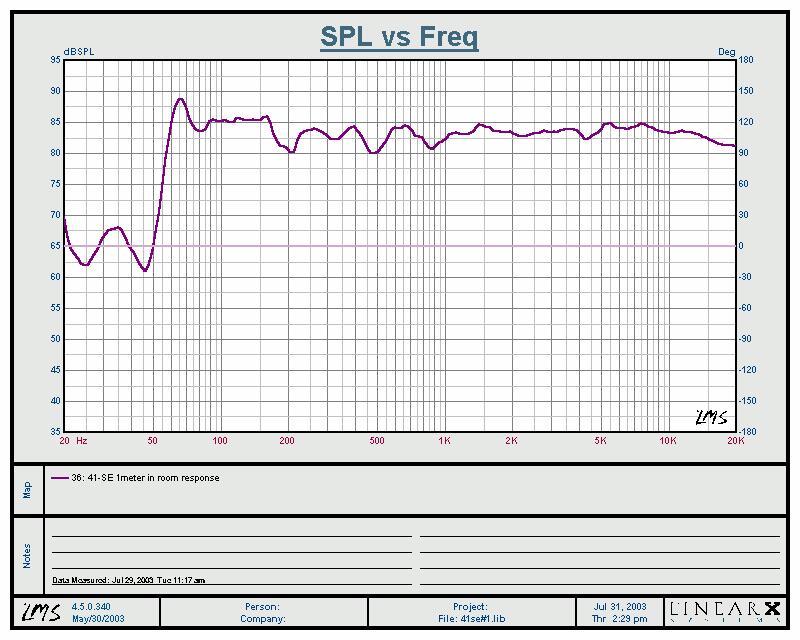
Note: The above plot is a 1/3 ocatve smoothed in room response at 1-meter. Notice the uniform frequency response and excellent extension. Their is a slight bump between 50-60 Hz which can be attributed to port contribution. This bump helped to give the little 41-SE's such authoritive bass without boominess or muddiness typically found on lesser designed systems. The average efficiency of the 41-SE's is somewhere between 85-86dB (1watt/meter). Thus we recommend mating these speakers with a quality power amp of at least 100-Watts/Channel if loud listening levels are desired.
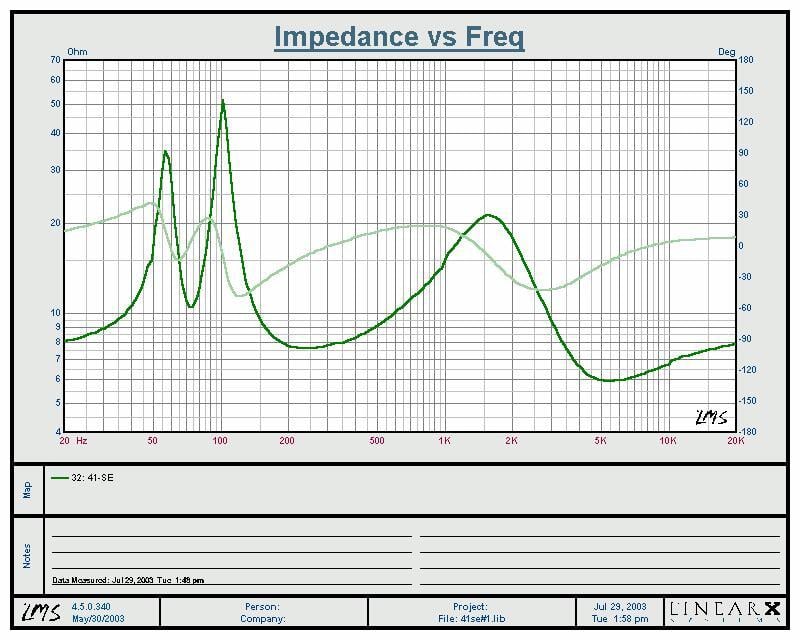
Note: The impedance of these speakers is nominally 8 ohms with a somewhat dramatic rise in the midrange area indicating that a good quality power amp should be utilized to bring out the optimal performance of these speakers. Electrical phase changes of less than 60 degrees within the power band of these speakers indicates a less reactive load to an amplifier which is always a good thing.
Signature Series 41-SE Conclusion
Given the size, price and performance of the 41-SEs, our experience taught us they were well suited for a host of applications in any Home Theater system. Coupled with a subwoofer as main speakers, they present a small package alternative for accurate, dynamic audiophile sound. When used for surrounds, they present clear, detailed sound required for producing a movie theater environment. As installed and used for rear 7.1 surrounds with DD-EX and DTS-ES, they provided a tremendous job of opening the soundstage in the rears while presenting fine details which results in improved performance of our Reference System 2 home theater.
The Score Card
The scoring below is based on each piece of equipment doing the duty it is designed for. The numbers are weighed heavily with respect to the individual cost of each unit, thus giving a rating roughly equal to:
Performance × Price Factor/Value = Rating
Audioholics.com note: The ratings indicated below are based on subjective listening and objective testing of the product in question. The rating scale is based on performance/value ratio. If you notice better performing products in future reviews that have lower numbers in certain areas, be aware that the value factor is most likely the culprit. Other Audioholics reviewers may rate products solely based on performance, and each reviewer has his/her own system for ratings.
Audioholics Rating Scale
 — Excellent
- — Very Good
- — Good
- — Fair
- — Poor
| Metric | Rating |
|---|---|
| Build Quality | |
| Appearance | |
| Treble Extension | |
| Treble Smoothness | |
| Midrange Accuracy | |
| Bass Extension | |
| Bass Accuracy | |
| Imaging | |
| Soundstage | |
| Dynamic Range | |
| Performance |  |
| Value | |
 Subscribe to our newsletter